© 2018, IRJET | Impact Factor value: 7.211 | ISO 9001:2008 Certified Journal | Page 2537
Soil-Structure Effect of Multideck R.C.C. Structures
Alesh Matale
1, Amey Khedikar
21
M-Tech Student, Tulsiramji Gaikwad Patil College of Engineering & Technology, Maharashtra, Nagpur
2Professor,Dept. of Civil Engineering, TGPCET college of Engineering, Maharashtra, Nagpur
---***---Abstract –
Different aspects of the response have beeninvestigated and inherent weaknesses have been pointed out. This usually has been done assuming a fixed-base structure while ignoring the flexibility of soil and foundation. In this thesis, the interaction between the super-structure and sub-structure (SSE) is investigated by modelling the soil as simple as possible to capture the overall response of the system. Comprehensive experimental and analytical studies have been carried out to understand the behavior of existing structure buildings constructed before the introduction of seismic design codes in 1970’s. As new analytical hysteresis rules and more advanced tools of analysis have been developed in recent years, the Straight response of a structure which can be representative of a broad range of existing or newly designed structures, is investigated while allowing for flexibility of the soil-foundation system and SSE. The use of flexible base in the analysis can lead to reduction in the structural response and damage consequences in joints and infills.
The results of this study suggest that the compliance of simply modelled soil for typical building structures have in average beneficial effects in terms of structural demand especially for stiff structures.
Key Words: Soil Structure Effect, Straight Analysis, Shear
wall, soft soil
.
1. INTRODUCTION
In the last three decades, the SSE on earthquake response of structures has attracted an intensive interest among researchers and engineers. Most of these researches focus on theoretical analysis, while less has been done on the experimental study. The interaction among the structure, foundation and soil medium below the foundation alter the actual behaviour of the structure considerably as obtained by the consideration of the structure alone. Flexibility of soil medium below foundation decreases the overall stiffness of the building structure resulting in an increase in the natural period of the system.
This effect of soil flexibility is to be accounted through consideration of springs of specified stiffness. Thus the change in natural period due to effect of soil structure interaction may be an important issue from the viewpoint of design considerations. Also it is usual practice to treat the brick infill as a non-structural element and therefore all the lateral loads are assumed to be resisted by the structure, but performance of buildings in the recent earthquakes (e g:
1985 Mexico City earthquake, 2001 Bhuj earthquake) clearly illustrates that the presence of infill wall has significant structural implication. Therefore, the structural contribution of infill wall cannot simply be neglected particularly in regions of moderate and high seismicity where the structure infill interaction may cause substantial increase in both stiffness and strength. A review of analysis and design provisions related to masonry infill RC structure in seismic design codes of different countries show that only a few codes have considered the effect of infill in analysis and design of masonry in filled RC structure. On the other hand, the stiffness and strength of in filled structure with openings are not taken care of by most of the codes. Hence the behavior of in filled structure with opening needs to be studied extensively in order to develop a rational approach or guidelines for design.
A common design practice for dynamic loading assumes the building to be fixed at their bases. In reality the supporting soil medium allows movement to some extent due to its property to deform. This may decrease the overall stiffness of the structural system and hence may increase the natural periods of the system, such influence of partial fixity of structures at foundation level due to soil flexibility intern alters the response. On the other hand, the extent of fixity offered by soil at the base of the structure depends on the load transferred from the structure to the soil as the same decides the type and size of foundation to be provided. Such an interdependent behavior of soil and structure regulating the overall response is referred to as soil structure interaction.
1.1 Objective of Study
The objectives of the study are,
1. To study of soil structure effects on infill structure and bare structure.
2. To study of soil structure effects on structure considering different types of soil.
3. To study of soil structure effect on structure with shears walls.
1.2 Scope of Study
The present study is limited to the following considerations,
© 2018, IRJET | Impact Factor value: 7.211 | ISO 9001:2008 Certified Journal | Page 2538 2. Shear walls in the structure.
3. A brick masonry infill panel. 4. Analysis by using SAP2000.
2.
MATHEMATICAL MODELLING
2.1 Idealization of Structure
A 3 bay x 3 bay building structure with 10 storey’s on isolated footing have been considered. The height of each storey is taken as 3.6 m and the longitudinal and transverse dimensions of 3 bays x 3 bay building is taken as 6 m for central bay and 6 m for the two side bays. For all the buildings the dimensions of reinforced concrete column are taken as 600 x 600 mm and for beam it is 200 x 600 mm. Similarly thickness for roof and floor is taken as 150 mm and their corresponding dead load is directly applied on the beam. The brick infill with thickness 150 mm. All the above dimensions were arrived on the basis of the design following the respective Indian code for design of reinforced concrete structure .However, these design data are believed to be practicable and hence, do not affect the generality of the conclusion.
The idealized form of a typical 3 bay x 3 bay 10 storey building structure with infill wall modeled as represented schematically in figure the present study also considers bare structure to see how correctly the influence of soil structure interaction on dynamic behavior can be predicted. This may give an idea about the error, which one should liable to commit if this popular but grossly inaccurate approach is invoked.
To study the dynamic behavior of building structure while considering the effect of soil structure interaction, building structure is modeled as 3D space structure using standard two nodded structure element with two longitudinal degrees of freedom and one rotational degree of freedom at each node. At the interface of infill and structure, the infill element and the structure element are given same nodes.
Fig -1: Plan and Elevation of building
2.2 Idealization of Soil
Flexibility of soil medium below foundation may appreciably alter the natural periods of any building. It usually causes to elongate time period of structure. It is observed (from the fig ) that soft soil amplifies ground motion more than that of hard soil.
Chart -1: Response spectra for rock and soil sites for 5% damping (IS1893)
2.3 Soil stiffness for six direction springs
In this project is where the effect of soil flexibility is not considered for isolated footing it is named as case (a). To simulate the effect of soil flexibility, three translation springs along two horizontal and one vertical axis, together with
6 m
© 2018, IRJET | Impact Factor value: 7.211 | ISO 9001:2008 Certified Journal | Page 2539 three rotational springs about those mutually perpendicular
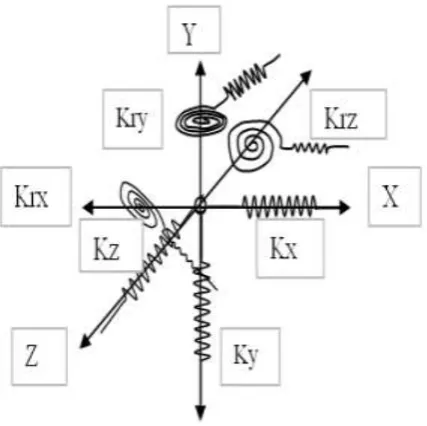
axes, have been attached as shown in Fig is case (b). The spring stiffness are presented in table.
The flexibility of soil is usually modelled by inserting springs between the foundation member and soil medium. While modelling, the number of degree of freedom should be selected carefully considering the objective of the analysis. During earthquake a rigid base may be subjected to a displacement in six degrees of freedom, and therefore resistance of soil can be expressed by the six corresponding resultant force components. Hence to make the analysis most general, translations of foundation in two mutually perpendicular principle horizontal directions and vertical direction as well as rotation of the same about these three directions are considered in this study.
Fig -2: Equivalent soil spring junction
Idealization arrangement at a typical column square foundation strip and equivalent soil spring junction [Case (b)]
Spring stiffness for square footing along various degrees of freedom
Degrees of freedom Stiffness of equivalent soil spring
Vertical Ky 4.54Gb/(1-μ )
Horizontal (lateral
direction) Kx 9Gb/(2-μ )
Horizontal (longitudinal
direction) Kz 9Gb/(2-μ )
Rocking (about the
longitudinal) Krx 0.45Gb3/(1-μ) Rocking (about the
lateral) Krz 0.45Gb3/(1-μ)
Torsion Kry 8.3Gb3
Note: “b” is half width of a square foundation
To obtain the values of spring stiffness’s of the springs for hard, medium and soft soil, value of shear modulus (G) of soil have been estimated using the following empirical relationship
G=120 N 0.8 t/ft2 ……….1 G=13333.33 N 0.8 KN/m2……….2
Where, N= Number of blows to be applied in Standard Penetration Test (SPT) of the soil; and the poisons ratio (μ) of the soil has been taken to be equal to 0.3 for all types of clay. N is taken as 3, 6, and 30 for soft, medium and hard soil respectively. The details of different soil parameters are tabulated in table. Safe Bearing Pressure is assumed for footing placed at depth 1.4 m below ground level. Since the stiffness’s of spring used to represent the soil flexibility are highly sensitive to the size of footing below which they are attached to, dimensions of various footing have been very rigorously computed separately based on Safe bearing capacity to have an exhaustive idea. The load carried by each column is obtained from the response spectrum analysis using SAP2000. All isolated footings are assumed to be square in shape. Table gives the values for spring stiffness determined using the above formulas for a ten storey building designed with isolated square footing.
[image:3.595.54.268.283.496.2]
Table -1: Types of soils and their parameters
Sr.No. Type of soil value N
Shear Modulus in
KN/m2 1.
Soft 3 32109.66
2.
Medium 6 55906.1
3.
Hard 30 202598.2
Infill without opening
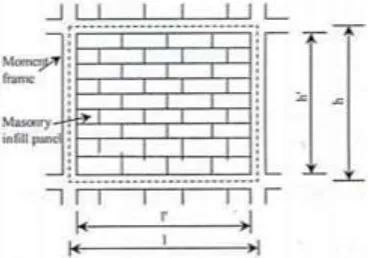
Existence infilling is noted to increase the ultimate lateral resistance of the system while resulting in less ultimate lateral deflection for lower infilling. The study of interaction of infill with the structure has been attempted by using sophisticated analysis like finite element analysis or theory of elasticity. But due to uncertainty in defining the inter face condition between the in filled with structure, an approximate analysis method may be better acceptable. One of the most common approximations of in filled wall is on the basis of equivalent diagonal strut, i.e. the system is modeled as a brace structure and infill walls as web element for the strut member. We required width and thickness of equivalent diagonal strut that will found out by using
1) Infill wall without opening 2) Infill wall with opening
© 2018, IRJET | Impact Factor value: 7.211 | ISO 9001:2008 Certified Journal | Page 2540 material of masonry construction are brick, stone, Marble,
[image:4.595.86.273.131.260.2]Granite, Limestone, Cast iron, Concrete block, Glass block and tile masonry is generally highly durable form of construction .
[image:4.595.47.280.310.465.2]Fig -3: Masonry infill panel in structure Infill wall without opening
Fig -4: Equivalent diagonal strut
The following equation to determine the equivalent or effective strut width w, where the strut is assumed to be subjected to uniform compreSSEve stress.
Structure properties
Width of Beam and column=0.23m Depth of Beam and column=0.40m
By using value of column and beam, we calculate width of infill
1) Infill-applying infill in terms of strut having width=0.7m and Thickness= 0.23 m
2) With having following property and with pined joint Elastic modulus=700 Mpa
3) Unit weight=18.85kN/m3 4) Poisons ratio= 0.3
Width and thickness of strut depend upon length of contact between wall and column (αh, and αL.) The value αh, and αL
on the basis of beam elastic boundary following equation proposed to determine αh, and αL.
Where,
h = height of masonry infill panel, m. L = length of infill panel, m.
t = thickness of infill panel and equivalent strut, m. Ef= modulus of elasticity of structure material, MPa Em= modulus of elasticity of infill material, MPa Ic= moment of inertia of column, m4.
Ib= moment of inertia of beam, m4.
θ = angle whose tangent is the infill height-to-length aspect Ratio, radians.
3. Result and Analysis
3.1 Straight Static Analysis
The plan layout and elevation of G+10 storey building is shown in fig. The building is deliberately kept symmetric in plan along both orthogonal directions. The building considered is assumed to be located in Seismic Zone II.
Data
1) Live Load = 3.5 kN/m2 at typical floor, 1.5 kN/m2 at terrace
2) Floor finish = 1 kN/m2
3) Terrace finish = 1 kN/m2
4) Location = Nagpur city
5) Earthquake load = As per IS-1893(Part-1)-2002
6) Storey height = 3.6 m
7) Walls = 0.15 m thick
8) Column size = 0.6 X 0.6 m
9) Beams = 0.2 X 0.6 m
10) Slab thickness = 0.15 m
11) Density of concrete = 25 kN/m3 12) Density of brick = 20 kN/m3
© 2018, IRJET | Impact Factor value: 7.211 | ISO 9001:2008 Certified Journal | Page 2541
3.2
Bare structure (Soft soil)
3.3 Structure with Shear wall considering its stiffness (Soft soil)
[image:5.595.216.389.295.417.2]Table -2: Analysis results of Structure type A for soft soil
Model Store
y Reaction Max. in KN
Max Displacement of
top storey in mm Frequency in cyc/ sec Period in sec Base Shear in KN
SAa(Without
SSE) G+10 5239 69 0.46 2.1
353
0.46 2.1
0.53 1.8
Sab with SSE G+10 4932 73 0.518 2.1
343
0.518 2.1
0.608 1.8
Sab’ with
SSE G+10 4319 97 0.443 2.5
305
0.443 2.5
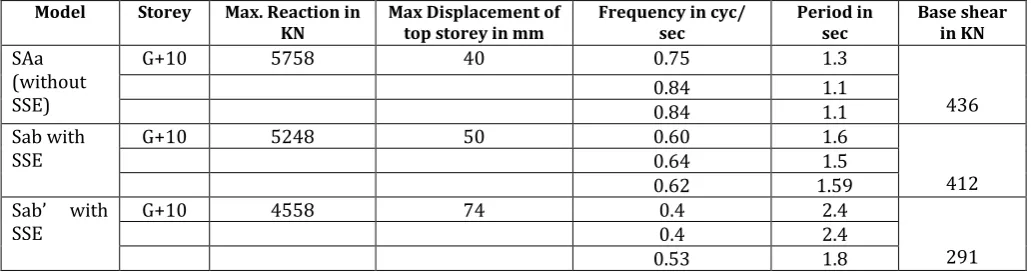
© 2018, IRJET | Impact Factor value: 7.211 | ISO 9001:2008 Certified Journal | Page 2542 Table -2: Analysis results of Structure type B, case 2’ for soft soil.
Model Storey Max. Reaction in
KN Max Displacement of top storey in mm Frequency in cyc/ sec Period in sec Base shear in KN
SAa (without SSE)
G+10 5758 40 0.75 1.3
436
0.84 1.1
0.84 1.1
Sab with
SSE G+10 5248 50 0.60 1.6
412
0.64 1.5
0.62 1.59
Sab’ with
SSE G+10 4558 74 0.4 2.4
291
0.4 2.4
0.53 1.8
3. CONCLUSIONS
In the present study, the effect of soil structure interaction on the dynamic characteristics of structure has been studied. Some of the conclusions that can be drawn from the observations made above are,
1.
Shear walls located in the central part of the multideck building gives lesser displacement and more base shear compared to other locations.2.
Nonlinear performance of both the structure are different. It is necessary to design structure considering the soil – structure interaction which gives actual effect on structure.3.
The study shows that consideration of different parameter such as soil structure interaction, and location of walls influences time period, displacement and base shear of building structure considerably. Hence it is important to consider to all these parameters in the analysis of structures.4. SCOPE OF FUTURE WORK
1. The performance of structure with SSE can be study in nonlinear dynamic analysis (Time History Analysis).
2. The effect of infill on SSE can be study.
REFERENCES
[1] Esteban S., Fernando L. C., Arezou M. F. R. (2013).
“Inelastic dynamic soil–structure interaction effects on moment-resisting structure buildings”, Engineering Structures, 51, 166–177.
[2] García J. A. (2008). “Soil Structure Interaction in the
Analysis and Seismic Design of Reinforced Concrete Structure Buildings”, The 14th World Conference on
Earthquake Engineering, Beijing, China
[3] Luco J. E. (2014). “Effects of soil–structure interaction on
seismic base isolation”, Soil Dynamics and Earthquake Engineering, 66, 167–177.
[4] Minasidis G., Hatzigeorgiou G.D. and Beskos D.E. (2014).
“SSE in steel frames subjected to near-fault earthquakes”, Soil Dynamics and Earthquake Engineering, 66, 56–68.
[5] Mitropoulou C. C., Kostopanagiotis C., Kopanos M.,
Ioakima D. and Lagaros N. D. (2016). “Influence of soil– structure interaction on fragility assessment of building structures”, Structures, 6, 85–98.
[6] Rajeev P. and Tesfamariam S. (2012). “Seismic fragilities
of non-ductile reinforced concrete frames with consideration of soil structure interaction”, Soil Dynamics and Earthquake Engineering, 40, 78–86.
[7] Rao P. V. K., Jithu P., Sruthi S. and Krishna P. H. (2014).
© 2018, IRJET | Impact Factor value: 7.211 | ISO 9001:2008 Certified Journal | Page 2543
[8] Raychowdhury P. (2011). “Seismic response of low-rise
steel moment-resisting frame (SMRF) buildings incorporating nonlinear soil–structure interaction (SSE)”, Engineering Structures, 33, 958–967.
[9] Renzi S., Madiai C. and Vannucchi G. (2013). “A
simplified empirical method for asseSSEng seismic soil-structure interaction effects on ordinary shear-type buildings”, Soil Dynamics and Earthquake Engineering, 55, 100–107.
[10] Shanmugam J., Dode P. A. and Chore H. S. (2015).
Analysis of Soil Structure Interaction in Framed Structure”, International Journal of Computer Applications, 11 – 14.
BIOGRAPHIES
Alesh A. Matale, currently pursuing M-Tech Structural Engg. From tulsiramji gaikwad patil college of engg. & technology, Nagpur, Maharashtra, Nagpur