Performance Evaluation of Priority based
Contention-MAC in Mobile Ad-Hoc Networks
Soni Sweta
SOIT, Rajiv Gandhi Proudyogiki Vishwavidyalaya,
Bhopal
Arun Nahar
SOIT, Rajiv Gandhi Proudyogiki Vishwavidyalaya,
Bhopal
Sanjeev Sharma
SOIT, Rajiv Gandhi Proudyogiki Vishwavidyalaya,
Bhopal
ABSTRACT
The communication through wireless media is in very much demand because of high mobility of the users and establishing ad hoc network in emergency situations, which requires the designing of an efficient and priority based MAC (Medium Access Protocol) to support quality of service in MANET (Mobile Ad hoc Networks) adequately. MAC is the base layer, which is required to catch up the system performance especially in mobile ad hoc wireless network. There are various MAC standards used in MANET. The IEEE 802.11 is one of them and most frequently applied to such networks presently. We found that the IEEE 802.11 MAC standard is not very much suitable into wireless network scenario because its poor performance and not satisfactorily addressing the critical issues of networking like priority based transmission across the nodes results in lower throughput, higher delay and poor fair access of cannels. In this paper, we propose a dynamic PBC-MAC protocol for wireless ad hoc networks - named as Priority Based Contention-MAC protocol- in which after the collision, contention window size increases or decreases dynamically and non-uniformly depending upon the priority levels of nodes in the network. It decides its lower Backoff time as per higher priority level of the nodes to access channel adequately. The simulation result show that PBC-MAC scheme is outperform than the Binary Exponential Backoff (BEB) scheme in the IEEE 802.11 MAC.
Keywords
MANET, PBC-MAC, Contention Window, Throughput, Fairness.
1.
INTRODUCTION
A MANET is an ever-changing dynamic wireless network established by a group of mobile users needs not necessarily taking any pre-existing infrastructure or using any centralized administration. These networks are very useful in disaster recovery situations or where there is not enough time or resources to configure a wired network [1] [12]. Of late, a significant number of researchers have moved towards studying MANETs and its various characteristics out of its increasing importance in terms of user mobility and establishing ad hoc network in emergency situations. Each node may be equipped with one or more radio interfaces that have varying transmission/receiving capabilities and operate across different frequency bands. This heterogeneity in node radio capabilities and different software/hardware configuration, can result in possibly asymmetric links and variability in processing capabilities [13].Designing network protocols and algorithms for this heterogeneous network can be complex, requiring dynamic
adaptation to the changing conditions (power and channel conditions, traffic load/distribution variations, congestion, etc.) [13].All these parameters may be used as for deciding node priority. On the other hand, if fairness and efficiency are required, QoS guarantees may be expected. IEEE 802 standards recommend an international standard 802.11 [2] for WLANs.
The IEEE 802.11 standard has two functions i.e. Distributed coordination Function and Point Coordination Function. In 802.11 DCF is based on Carrier Sense Multiple Access with Collision Avoidance (CSMA/CA). In MANET CSMA/CD is not used because a station is unable to listen to the channel while transmitting. The Distributed Coordination Function (DCF) is used for synchronous, contention-based, distributed access to the channel [3]. The performance of IEEE 802.11 MAC mechanism is determined by contention window control scheme, RTS/CTS mechanism, transmission range, etc. In addition, whether or not the IEEE 802.11 MAC protocol is efficient will affect the performance of ad hoc networks. The metrics for the performance of 802.11 ad hoc networks may have throughput, delay, jitter, energy dissipation, etc. [14].
Binary slotted exponential backoff with CSMA/CA is used in DCF of IEEE 802.11. The CSMA/CA that is used by the DCF uses a random backoff timer to avoid collision between nodes [4]. The random backoff time is obtained by multiplying this value by the slot time. The back-off timer counter is decreased as long as the channel is sensed idle, frozen when the channel is sensed busy, and resumed when the channel is sensed idle again for more than a DIFS. A station can initiate a transmission when the backoff timer reaches zero. The back-off time is uniformly chosen in the range (0, w-1). Also (w-1) is known as Contention Window (CW), which is an integer with the range determined
by the PHY characteristics CWmin and CWmax. After each unsuccessful transmission, w is doubled, up to value 2mW where W equals to (CWmin+1) and 2mW equals to (CWmax+1) [4].
Upon received a packet correctly, the destination station waits for a SIFS interval immediately following the reception of the data frame and transmits a MAC ACK back to the source station, indicating that the data frame has been received correctly. In case the source station does not receive an ACK, the data frame is assumed to be lost and the source station schedules retransmission with the CW doubled [4].
Finally, section 5 having conclusion, section 6 acknowledgments and section 7 References.
2.
REVIEW OF RELATED WORK
In the IEEE 802.11 DCF scheme [3] [4], the CW is dynamically controlled by the backoff algorithm named Binary Exponential Backoff (BEB). Here, the contention window is doubled every time when a node experiences a packet collision that results in failure of transmission. On the other hand when a node is successful in its packet transmission, the contention window resets itself to the minimum value irrespective of the number of active nodes within the range of the node or number of previous consecutive collisions encountered by the node. The BEB algorithm essentially favors the last transmitter to aggressively contend for the channel again since it has a low backoff the next time around and thus leads to unfairness, particularly when the offered load is high and low throughput when network size is large [5]. Besides this, it sharply falls to the minimum. For removing such type of fairness problem in BEB scheme, the Multiplicative Increase and Linear Decrease (MILD) algorithm was introduced in the MACAW scheme [6]. In this scheme, a collided node increases its CW by multiplying it by 1.5.
As a refined version of MILD later Multiplicative Increase and Multiplicative Decrease (MIMD) scheme is proposed [6]. In MIMD whenever a packet transmitted from a node is involved in a collision, the contention window size for the node is increased by backoff factor 2 and the contention window for the node is decreased by factor 2 if the node transmits a packet successfully. But here we can see increment and decrement are predetermined and uniformly. Basically MIMD is a special case of Exponential Increase and Exponential Decrease Backoff Algorithm (EIED)[7]. In EIED the contention window size for the node is increased by backoff factor rI and the contention window for the node is decreased by factor rD in case of collision and success respectively [7][8]. The main drawback of both MIMD and EIED are- CW becomes too large after some failures in the packet transmission, because of its exponential increase irrespective of the window size. Similarly, it will come down too fast to the minimum level with some successful transmission, because of its exponential decrease. That’s why throughput loss occurs especially in heavy loaded network as number of collisions is high. Several other proposals are appeared in recent years in this regard [8].
3.
PRIORITY
BASED
CONTENTION
PROTOCOL
In our proposed Priority Based Contention Protocol unlike in the case of BEF and other above mentioned schemes in literature review, contention window size of the sender node increases or decreases dynamically in a non-uniform rates depending upon the current situation of the shared medium and priority of the nodes. If we do not maintain the priority of the protocol, we cannot get desired optimum outcome in any transmissions. This aspect is most sought after in emergency situations like in battlefield or military operations etc. where flow of sensitive data has to take place.
Generally contention window size is incremented on a collision
factors) and another set of values say D1, D2, D3 etc (decrementing factors) by which we increment and decrement CW size dynamically depending on the priority of the nodes. We divide the priorities to the various levels as 1,2,3, etc. Number of priority levels may vary depending on the types of networks. As the type of network increases, number of priority levels also increases.
When there is collision or failure in case of the higher priority level, we increment the CW by incrementing factor of Ai where Ai is the least incremental factor and i=1 denotes the highest level of priority. Similarly on success in transmission in case of the higher level of priority, we considerably decrement the CW to the minimum level by decrementing factor Di where Di is the highest decremental factor and i=1 denotes the highest level of priority.
This can be written mathematically as follows:
When a failure occurred under priority level i:
CWnew = CWcurrent increment by Ai
CWcurrent = CWnew
(Where i = 1, 2, 3…. And A1<A2<A3……)
When a success occurred under priority level i:
CWnew = CWcurrent decrement by Di
CWcurrent = CWnew
(Where i = 1,2,3, …. And D1>D2>D3……)
To increase the throughput we have to reduce idle period. This can be done through reducing the backoff time. But reduction in backoff time causes for the increase in collision because nodes would get a premature access to the shared channel and result in collision with packets from other nodes [8][9]. This increase in the collision will reduce the throughput! Because, to get higher throughput either we have to decrease the CW size (to reduce the backoff time) or we have to minimize the collisions [8]. Our proposed works is based on to increase or decrease the CW size as per priority concept such that overall throughput of the system will be increased. We effectively achieve this goal in PBC (Priority Based Contention)-MAC scheme. Unlike BEB scheme, in PBC-MAC if two or more nodes of different priorities are collide with each other than the contention window size are incremented according to their priority level. For example at if node at highest priority stage (level 1) we increment contention window by a least factor (A1). In this way, we always get an optimum sized window to prevent large CW size, which causes reduction in backoff time to high priority node. Here we fairly assign channel to high priority node first than low priority node after collision.
transmission due to large sized contention window as occurs in BEF scheme. In the PBC-MAC scheme CW size changes in between maximum and minimum value, which depends upon priority levels. So, successful node and other node will have different priorities for seizing the channel. This will result in a not too large and not too small CW after a minimum number of success and failure in transmission respectively. In this case most of the time CW size will be more than enough or less than enough. In most of the cases this algorithm will not justify the behavior of actual computer networks. Since PBC-MAC scheme changes the CW size depending upon the priority levels and network types.
3.1
Proposed algorithm For PBC
Because of the peculiarity of our scheme having high increment on least priority level, we can initially set a very small value for CWmin. Since ad hoc networks are usually applied in the rescue operations and other emergency situations as mentioned in the first section, nodes in Ad hoc networks become active in large volume simultaneously i.e. at a time rather than consecutively [8] i.e, one by one. Therefore, we have made a assumption that if there is a higher priority initially in the network, there is a high probability for lower contention window size which causes success in transmission of higher priority node than lower priority nodes. Taking this assumption, we have made relatively least value for initial increment in case of collision so that it later increases by a factor for increment. Similar logic is applied for decrementing CW when a success in transmission comes. Selection of Ai and Di has been made depending upon total number of priority levels.
4.
SIMULATION
PARAMETER
AND
RESULT
4.1
Simulation Environment
[image:3.612.340.545.87.229.2]Qualnet-4.0 is a discrete-event simulator [10]. We have used this network simulator, for evaluating the performance of our proposed PBC algorithm. Because of its efficient kernel, QualNet models large scale networks with heavy traffic and mobility in reasonable simulation times [10]. This simulator is widely used by research scholars. It supports simulation of TCP, routing, multicast protocols over wired and wireless (local and satellite) networks etc. adequately [10][11]. We have used window Operating System to run our simulation code. We have taken the different networking scenario for the evaluations with different number of nodes. Each pair of node comprises a transmitter and a receiver. We have taken SIFS = 10μs, DIFS = 50μs and slot time = 20μs. Packet interval is five milliseconds. We have evaluated the performance by adding new nodes in the network as the time varies or expedites at arrival of several nodes priority wise simultaneously. Simulation time is taken for the simulation in order to enable chances for every node to participate in the network activity.
Table 1. Simulation Parameter
Parameter Phy Packet size Antenna type Number of nodes DIFS
SIFS ProType CWmin CWmax Simulation time Queue length
Value wireless 1500
Omni directional 50 or 100 50μs 10μs Free Space 15 or 31 1023 30 s 500
4.2
Throughput
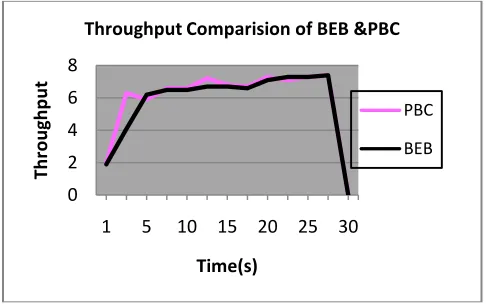
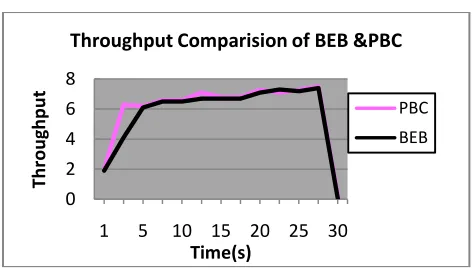
We have calculated overall throughput in the network by counting the total number of received packet at every node in each second that were sent priority wise one by one. We can get the total number of bits received by multiplying the derived number with the packet size at each defined priority level. We have also made a comparison of throughputs getting from both the algorithms in two different network situations i.e. the heavily loaded network with 100 nodes and lightly loaded network with 50 nodes. The calculation and testing performance are based on two different values for CWmin (say 15 and 31) in PBC-MAC. From graphs, it is confirmed that PBC performs better in each of the case than that of the BEB. For getting the overall throughput, we may use following equation:
Where Nrp = the total number of packets received in each second, T = the total time in second at which we have sent the packets and S = the packet size
Figure 1 Comparison of Throughput of BEB and PBC-MAC With 50 nodes and CWmin=15
0 2 4 6 8
1 5 10 15 20 25 30
Th
ro
u
gh
p
u
t
Time(s)
Throughput Comparision of BEB &PBC
PBC
BEB
[image:3.612.324.567.499.652.2]Figure 2 Comparison of Throughput of BEB and PBC-MAC with 50 nodes and CWmin=31
Figure 3 Comparison of Throughput of BEB and PBC-MAC
[image:4.612.324.561.103.255.2]with 100 nodes and CWmin=15
Figure 4 Comparison of Throughput of BEB and PBC-MAC with 100 nodes and CWmin=31
4.3 Collision
We have calculated and compared the collision in the network through simulation. We have to regulate the CW size adequately for transmission depending upon the priority levels and limiting collisions as low as possible. If a node is within the lower priority level, the reduction factor will be less and collision will be more and if the node is within high priority levels, the reduction factor will be more and collision will be low. It provides the better fairness and hence transmission among the
on priority levels. Following graph is the comparison of collision in between PBC-MAC and BEB scheme.
Figure 5 Comparison of Collision in BEB and PBC-MAC
5.
CONCLUSION
We have proposed a new PBC-MAC scheme for mobile ad hoc network in this paper. To get PBC-MAC, we have analyzed the BEB algorithm and made some correction to support our propositions. We found that the different alternatives in comparison to PBC are costlier, non-portable and unsuitable for Ad hoc networks in case of any emergency situation. We have also evaluated its performance separately by using the qualnet-4.0 network simulator. The simulation results showed that PBC-MAC performs better than the BEB in the given domain. We have applied an approach based on the matrix of the priority levels of the nodes where contending nodes dynamically decides its lower Backoff value avoiding long waiting before access to the shared medium itself. PBC-MAC scheme prevents suitably CW from growing maximum on failure and shrinking minimum on a successful transmission and hence prevents unnecessary delay for the transmission and throughput degradation thereafter. So the successful node and the other nodes in queue will have certain priority for seizing and accessing the channel. Therefore, this algorithm enhances the fairness among the nodes on the priority basis in selection of channel and transmission.
6.
ACKNOWLEDGMENTS
I deeply acknowledge and express my sincere thanks to my guide Dr.Sanjeev Sharma who always encouraged me to find out new ideas and that is in the culmination of this research.
7.
REFERENCES
[1] P Mohapatra, S Krishnamurthy. “Ad-Hoc Networks - Technologies and Protocols”, Springer Publishers, 2004 (ISBN: 0-387-22689-3).
[2] IEEE standard for wireless LAN medium Access Control (MAC) and Physical Layer (PHY) specifications, ISO/IEC 8802-11:1999(E), Aug.1999.
[3] L. Bononi, et al., “A differentiated distributed coordination function MAC protocol for cluster-based wireless ad hoc networks”, Proceedings of the 1st ACM international 0
2 4 6 8
1 5 10 15 20 25 30
Th
ro
u
gh
p
u
t
Time(s)
Throughput Comparision of BEB &PBC
PBC BEB
0 2 4 6 8
1 4 7 10 13 16 19 22 25 28
N
u
m
b
e
r
o
f Co
lli
si
o
n
s
Time(s)
Comparision of Collision in BEB &
PBC-MAC
BEB PBC
0 2 4 6 8
T
h
ro
u
g
h
p
u
t
Time(s)
Throughput Comparision of BEF & PBC
BEF PBC
0 1 2 3 4 5 6 7 8
0 2 4 6 8 10 12 14 16 18 20 22 20 26 28 30
T
h
ro
u
g
h
p
u
t
Time(s)
Throughput Comparision of BEB & PBC
BEB
[image:4.612.49.292.246.376.2][4] Haitao Wu, Shiduan Cheng,et al, “IEEE 802.11 Distributed Coordination Function(DCF)” 0-7803-7400-2/02/$17.00 (C) 2002 IEEE
[5] Jae H K, Ajith W, Injong R. “Experimental Evaluation of MAC Protocols for Fairness and QOS Support in Wireless Networks”. In the proc. of International Conference on Networking Protocols, pages 298—307, 2008.
[6] C. Siva Ram Murthy and B. S. Manoj. “Ad Hoc Wireless Networks: Architectures and Protocols”, Pearson Education, ISBN13: 9780131470231 ISBN10: 0-13-147023-X, 2008.
[7] Bianchi G, “Performance analysis of the IEEE802.11 Distributed Coordination Function”. IEEE,2000
[8] Abdul Gafur, Niraj Upadhayaya and S A Sattar, “Achieving Enhanced Throughput in Mobile Ad hoc Network using Collision Aware MAC Protocol,” International Journal of Ad hoc, Sensor & Ubiquitous Computing (IJASUC) Vol.2, No.1, March 2011
[9] Hastad J, Leighton T, and Regoff B, (1996). “Analysis of backoff protocol for multiple access channels”. SIAM Journal on Computing, pages 740—774.
[10]QualNet 4.5 Programmer’s Guide, Scalable Network Technologies, Inc., 6701 Center Drive West, Suite 520, Los Angeles, CA 90045.
[11]Scalable Network Technologies, “QualNet simulator 4.0 Version”, tutorial on http://www.cs.binghamton.edu /~vinkolar/QualNet/qualnet-tut1.pdf.
[12]C.K. Toh. “Ad Hoc Mobile Wireless Networks: Protocols and Systems”, Springer Prentice Hall Publishers, ISBN 013 007 8174, 2001.
[13] Imrich Chlamtac and et al., “Mobile ad hoc networking: imperatives and challenges”, Ad Hoc Networks 1,pp.13-64,2003