© 2018, IRJET | Impact Factor value: 6.171 | ISO 9001:2008 Certified Journal | Page 1259
ECO-FRIENDLY CONCRETE BY PARTIAL REPLACEMENT OF SAND BY
SHREDDED PIECES OF PET PLASTIC BOTTLES
B.K.KOLHAPURE
1, AMIT.CHAVAN
2, ADIL IRSHAD
3, AMAR.B
4, HASAN PATEL
51
Associate Professor, Civil Engineering Department, P.D.A. College of Engineering, Kalaburagi Karnataka.
2, 3, 4,5. Students, Civil Engineering Department, P.D.A.Collegeof Engineering, Kalaburgi, Karnataka.
---***---Abstract - Concrete is one of the versatile constructionmaterials. Seeking aggregates for concrete and sustainability of the construction industry is very essential. Hence alternative replacements of the conventional aggregates are essential. One of the environmental issues in most regions is the large number of bottles made from Poly-Ethylene Terephthalate (PET) deposited in domestic wastes and landfills, which are not bio-degradable. The purpose of this experimental study was to investigate the possibility of using shredded PET bottles waste as replacement to fine aggregates in concrete of M25 grade to make eco-friendly concrete. Concrete with a replacement of sand by shredded pieces of PET plastic bottles waste at 0%, 1%, 1.5%, 2%, 2.5%, 3%, 4%, 5% and 6% to fine aggregates (sand) were casted in form of cube specimen, cylinder specimen and prism specimen of 27 each were casted and cured for 28 days for Compressive Strength, Split Tensile Strength and Flexural Strength tests respectively. Test results are in form of tables and graphs. It is observed that replacement of sand by shredded pieces of PET plastic bottles waste improved the compressive strength unto 5% replacement by about 25% along with improvement in split tensile and flexural strengths.
Key Words: Shredded PET, Concrete, fine aggregates,
workability, Compressive strength, Split tensile, Flexural strength.
1. INTRODUCTION
Plastic is one of the materials showing immense potential in our daily lives as it possess low density, high strength, user friendly designs, fabrication capabilities, long life, light weight and low cost characteristics are the factors behind such extraordinary growth. Although, plastics have been used in very large and useful applications, it bestows to an ever increasing amount in the solid waste stream. Polyethylene forms the largest fraction, which is followed by Polyethylene Terephthalate (PET) that represents one of the most common plastics in solid urban waste. Concrete is the most widely used construction material in the world due to its high compressive strength, long service life, and low cost.[1][3]
In field of concrete technology, India as well as other nation now is seeking for an alternative for conventional aggregate that may be recognized as use plastic waste, for it might be realized as PET phase capacities. As per the estimates, India produces 500,000 tons of pet waste every year. Plastics constitute12.3% of total waste produced most of which is
from discarded water bottles. The PET bottles cannot be disposed of by dumping or burning, as they produce uncontrolled fire or contaminate the soil and vegetation. At present, the total recycling capacity in India is around 145,000 TPA its use in concrete mix will prove a better option for land fill that, being non-degradable, remain for long years and cause problem before us. Nowadays, unfortunately, the recycling rate of PET bottles is much less than the sales of virgin PET production for common uses, a possible application is to utilize waste PET pieces as replacement of fine aggregates in concrete. Plastics Packaging totals 42% of total consumption and every year little of this is recycled.[2].Hence an attempt on the utilization of waste Poly-Ethylene Terephthalate (PET) bottle granules [1] as fine aggregate is done and its mechanical behavior is investigated.
2. LITRETURE REVIEW
Arivalagan.S (2016)(1) Worked on Experimental
investigations on partial replacement of waste plastic in concrete. His papers describes the modified concrete mix, with addition of plastic aggregate replacing conventional aggregate up to 10% gives strength within permissible limit and the density of concrete decreased, increases workability because the plastic which used as aggregate is smooth.
Purnanad Savoikar (2011)(2) worked on Pulverized PET
bottles as partial replacement of sand. His papers describes that various plastic waste can be used as replacement for Natural sand to the extent of 10% without much appreciable reduction in 28 days compressive strength where as in the case of polythene bags the reduction in strength is only 3% which indicates that there may not be proper bounding and mixing of pulverized blow and injection molded plastic and PET bottles in concrete where as in case of pulverized polythene bags pieces nature of waste is helpful in bounding.
SahilVerma et al (2015)[3],Conducted the experiment on
Replacement of Natural sand in concrete by polyethylene bottle and they observed the effects of PET over the compressive strength of concrete. The environmental effects can be substantially reduced by proper encapsulation of these waste plastic bottles.
PramodSambhajiPatil (2015)[4], worked on Behavior of
© 2018, IRJET | Impact Factor value: 6.171 | ISO 9001:2008 Certified Journal | Page 1260 P Ganesh parbhu et al,(2014)[5]“ Studied on utilization of
waste pet bottle fiber in concrete and the possibilities of using the waste pet bottles as the different aspect ratio of 17,33 and 50 sizes of fiber added into the concrete with 0.5%,1%,and 1.5% pet bottle pieces for fine aggregate and found that as the maximum percentage increase in compressive strength ,split tensile at 1% of fiber content were 0.5% ,1% and 1.5% for aspect ratio 17,33 and 50 aspect ratio 50 respectively over controlled concrete.
Ms .K.Ramadevi et al.(2012)[6],conducted Experimental
investigation on properties of concrete with plastic PET (Bottle) pieces as fine aggregate. It was observed that the flexural strength increased up to 2% replacement of the fine aggregate with PET bottle pieces and it gradually decreased for 4% and remains the same for 6% replacements. The flexural strength for 28days is 5.9MPa.
ZainabZ Ismail (2008)(7)Worked on use of waste plastic in
concrete mixture as aggregate replacement and they reduced the weight of concrete with increasing the waste plastic ratio at all curing ages and this may decrease the adhesive strength between the surface of the waste plastic and cement paste.
Suyog U Dhote (2016)(8)Investigated the use of PET bottles
as a sustainable material in construction, his paper describes good alternative to improve the construction techniques. gives more compressive strength than the traditional bricks
KasibR.Malak (2015)(9) studied use of waste plastic in
concrete mixture as aggregate replacement modified concrete, casted by using plastic aggregate as a partial replacement to coarse aggregate shows 10% it could be satisfy as per IScode.
SawsanD.A.shubbar et al (2016)(10)Worked on utilization
of waste plastic bottles as fine aggregate in concrete in this research, effect of using waste PET that was converted to granules in concrete has been studied experimentally.
3. OBJECTIVES
Here an attempt on the utilization of Shredded waste Poly-ethylene Terephthalate (PET) bottle pieces as replacement to fine aggregate is done and its mechanical behavior is investigated.
The main objective is to study the replacement of sand by shredded pieces of PET plastic bottles waste in concrete by 0%, 1.0%, 1.5%, 2.0%, 2.5%, 3.0%, 4.0%, 5.0%, 6.0%
To investigate the Mechanical properties like Compressive Strength, Split Tensile Strength and Flexural Strength of such replacement of sand by shredded pieces of PET plastic bottles waste concrete with conventional concrete.
To determine the optimum percentage of shredded waste plastic pet bottles at which it gives more strength when compared to conventional concrete.
To study the workability of conventional concrete and replacement of sand by
Shredded pieces of PET plastic bottles waste concrete.
To Study the Cost benefit of conventional concrete and replacement of sand by
Shredded pieces of PET plastic bottles waste Concrete.
4. MATERIALS
[image:2.595.313.507.201.384.2]4.1. Cement: The cement used for this experiment is OPC (53Grade). The properties of cement are shown in table 4.1
Table 4.1: Properties of cement used:
1) Type and grade 2) OPC G-53 3) Specific gravity 4) 3.15 5) Normal consistency 6) 35% 7) Initial Setting time 8) 30 min 9) Final Setting time 10)600 min
4.2Coarse Aggregates: The size of coarse aggregates used are 20mm and down with specific gravity 2.85
4.3. Fine Aggregates: belongs to ZONE-II with specific gravity 2.51
4.4. Shredded pieces of PET plastic bottles waste, recommended for blow molding and extrusion process which is used in manufacturing clear bottles, containers, sheet stationery items as shown in tamp let No.1 with specific gravity 1.40. The Percentage replacement of waste shredded (PET) bottle granules as partial replacement for sand were 0%, 1%, 1.5%, 2%, 2.5%, 3.0%, 4%, 5.0% and 6.0%.
SAMPLE NO
%
replacement of shredded plastic pet bottles
COMP. STRENGTH (N/mm2 )
A1 0 31.56
A2 1 32.7
A3 1.5 36.18
A4 2 37.78
A5 2.5 38.9
A6 3 40.1
A7 4 42.4
A8 5 35
© 2018, IRJET | Impact Factor value: 6.171 | ISO 9001:2008 Certified Journal | Page 1261 Fig -1:Shredded pieces of PET Bottles
5. EXPERIMENT RESULTS
The various tests conducted and their test results which are obtained by for conventional concrete of M25 grade with mix proportion 1:1.71:3.16 with w/c ratio 0.50 and with replacement of sand by shredded pieces of PET plastic bottles with different percentage of 0%, 1%, 1.5%, 2%, 2.5%, 3.0%, 4%, 5.0% and 6.0% with sand are:
5.1Compressive strength
[image:3.595.85.243.72.223.2]
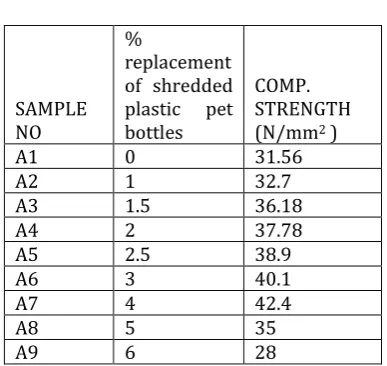
Table No. 5.1 and Chart No. 1 gives the compressive strength test at 28 days results for addition of different % replacement of shredded plastic PET bottles.
Table 5.1 Compression strength
Chart -1: Compressive strength
5.2Split tensile strength
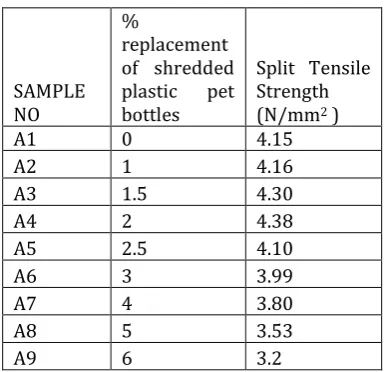
[image:3.595.345.517.104.270.2]Table number 5.2 and Chart No. 2 gives the Split tensile strength test results for addition of different percentage of PET pieces to the Concrete.
Table 5.2 Split tensile strength
Chart -2: Split tensile strength
5.3Flexural strength
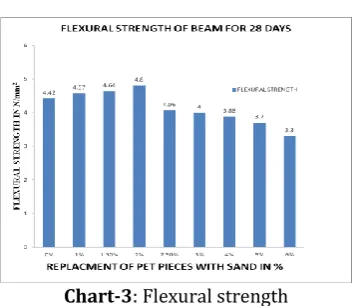
Table No.5.3 and Chart. No. 3 gives the Flexural strength test results for addition of different percentage of PET pieces to the Concrete.
SAMPLE NO
%
replacement of shredded plastic pet bottles
Split Tensile Strength (N/mm2 )
A1 0 4.15
A2 1 4.16
A3 1.5 4.30
A4 2 4.38
A5 2.5 4.10
A6 3 3.99
A7 4 3.80
A8 5 3.53
[image:3.595.54.247.387.573.2] [image:3.595.330.535.393.548.2]© 2018, IRJET | Impact Factor value: 6.171 | ISO 9001:2008 Certified Journal | Page 1262 Table 5.3 Flexural strength
Chart-3: Flexural strength
6. OBSERVATIONS AND DISCUSSIONS
It is observed that the compressive strength of concrete produced with 4% replacement of PET shredded pieces gives optimum result compared to addition of 0%,1%,1%.5%,2%,2%.5%,3%,4%,5% and 6% cured for 28 days. The percentage increase in compressive strength is found to be 25.56% with respect to 0% of PET pieces and the slump for the conventional concrete mix was 60mm and further the slump gradually increased for 1%, 1.5%,2%,2.5%,3%,4%for plastic replacements and attained maximum for 4%(i.e100mm slump) and further slump was reduced for 5% which was (<4% but >0%) So Compressive strength was adequate up to 5% replacement (i.e9.82% > 0%). This can be due to the fact that the different percentage of PET pieces behaves differently in compressive load. The bonding strength between the PET pieces matrix and concrete layer will vary for different percentage of PET pieces. Thus it can be concluded that the 4% addition of PET pieces to the concrete gives higher compressive strength compare to 0%, 1%,1.5%,2%,2.5%,3%,5% and 6% addition of PET pieces.
It is observed that the Split tensile strength of concrete produced with 2% addition of PET pieces gives optimum result compared to reference mix The increase in flexural strength was found to be 5.25% with respect to 0% of PET pieces. This can be due to the fact that the different percentage of PET pieces behaves differently in split tensile load. The bonding strength between the PET pieces matrix and concrete layer will varies for different percentage of PET pieces.
It is observed that the flexural strength of concrete produced with 2% addition of PET pieces gives optimum result compared to reference mix. The increase in flexural strength is found to be 7.92% with respect to 0% of PET pieces. This can be due to the fact that the different percentage of PET pieces behaves differently in flexural load. The bonding strength between the PET pieces matrix and
concrete layer will vary for different percentage of PET pieces.
7. CONCLUSIONS
Replacement of shredded plastic pet bottles by 4% of sand in concrete gives the higher compressive strength by 25.56% than conventional concrete for 28 days curing.
Replacement of shredded plastic pet bottles by 2% of sand in concrete gives the higher Split tensile strength, increased by 5.25% than conventional concrete for 28 days curing.
Replacement of shredded plastic pet bottles 2% of sand in concrete gives the higher flexural strength, increased by 7.92% than conventional concrete for 28 days curing.
The workability also increases by increasing of PET pieces up to 4% replacement.
Now a day’s sand availability is less and cost is more hence partial replacing sand by PET bottle pieces will be more economical and eco-friendly concrete.
REFERENCES
[1] Arivalagan.S et al 5(11): “Experimental investigation on partial replacement of waste plastic in concrete” volume:3 ISSN:2277-9655 ,
CODEN:IJESS7 , International journal of engineering sciences and research technology.
[2] PurnandSavoikar October 2011 “Pulverized PET bottles as partial replacement for sand”, International journal of earths sciences and engineering ,vole 4.No 06 SPL, October 2011 ,pp.1009-1012.
SAMPLE NO
%
replacement of shredded plastic pet
bottles Flexural Strength (N/mm2 )
A1 0 4.42
A2 1 4.57
A3 1.5 4.64
A4 2 4.8
A5 2.5 4.06
A6 3 4
A7 4 3.88
A8 5 3.70
© 2018, IRJET | Impact Factor value: 6.171 | ISO 9001:2008 Certified Journal | Page 1263 [3] SahilVerma, SahilArora, “Replacement of Natural Sand in
Concrete by Polyethylene Bottles” Volume 2 Issue: 01, April-2015.
[4] Pramodsambhajipatil, International Journal of Innovative Technology and Exploring Engineering (IJITEE) ISSN: 2278-3075, Volume4 Issue-11, April 2015.
[5] P. Ganesh Prabhu, C. Arun Kumar, R. Pandiyaraj, P. Rajesh and L. Sasi Kumar.“Study on utilization of waste PET bottle fiber in concrete”, International Journal of Research in Engineering &Technology , Volume 2, Issue 5, May 2014, Pages 233-240.
[6] Ms. K.Ramadevi, Ms. R. Manju “Experimental Investigation on the Properties of Concrete With Plastic PET (Bottle) Fibres as Fine Aggregates”. International Journal of Emerging Technology and Advanced Engineering Website: www.ijetae.com (ISSN 2250-2459, Volume 2, Issue 6, June 2012).
[7] Zainab Z. Enas A. AL-Hashmi, “Use of waste plastic in concrete mixture as aggregate replacement”, Waste Management journal, Volume 28, Issue 11, November 2008, Pages 2041–2047.
[8] Suyog u .dhote, “Investigating the use of PET bottles as a sustainable material in constructions”, International Journal of Research in Advent Technology , Special Issue 2nd International online conference on Advent Trenda and Engineering Science and Technology “ICATEST 2016”, 03 April 2016.
[9] KasibR.Malak, “use of waste plastic in concrete mixture as aggregate replacement”, International Journal of Engineering, Education and Technology (ARDIJEET), Volume 3, Issue 2, 01/04/2015.