Munich Personal RePEc Archive
Minimum Distance Requirements and
Liability: Implications for Co-Existence
Soregaroli, Claudio and Wesseler, Justus
Wageningen University, Università Cattolica del Sacro Cuore
2005
Minimum Distance Requirements and Liability: Implications
for Co-Existence
Claudio Soregaroli
Istituto di Economia Agro-alimentare, Università Cattolica del Sacro Cuore,
Italy
Justus Wesseler
Environmental Economics and Natural Resources Group, Wageningen
University, The Netherlands
Abstract
The co-existence of conventional and transgenic products in the food chain introduces new elements in the evaluation of the profitability of transgenic crops and, consequently, on the farmer’s adoption decision. In particular, one emerging problem farmers are facing in Europe is related to the legal liability of transgenic crop cultivation. In Europe, a mixture of ex-ante regulations and ex-post liability rules governing transgenic crops emerges.
One of the predominant ex-ante regulations discussed at the EU-level is a minimum distance requirement to neighbouring fields in order to avoid cross-pollination. The ex-post liability rules differ. They depend on the legal frameworks of individual members of the EU. The current interpretation of, for example, Italian and German law does not exclude ex-post liability for farmers planting transgenic crops in the case of cross-pollination.
In this paper, we analyze the value of planting transgenic crops when farmers face ex-ante regulatory and ex-post liability costs under irreversibility and uncertainty. The regulatory instrument analyzed is the minimum distance to neighbouring fields. First results indicate that under irreversibility and uncertainty the value of cultivating transgenic crops presents a trade-off between ex-ante regulatory and ex-post liability costs with respect to farm size. From this, it is not possible to conclude a priori the net effect on the size of the adopting farms, if, ceteris paribus, a minimum distance regulation is adopted within the EU and farmers can be held liable ex-post.
1. Introduction
The cultivation of biotech crops is continuously expanding worldwide. According to the International Service for the Acquisition of Agri-biotech Applications (James, 2002), 58.7 million hectares were planted with Genetically Modified (GM) organisms in 2002, an increase of 12% over the previous year. This involved nearly 6 million farmers. The United States (66.4%), Argentina (23.0%), Canada (6.0%) and China (2.1%) have the largest world share of transgenic crops. However, new countries are emerging: for example in 2002 India, Colombia and Honduras introduced biotech crops in their fields.
Considering the different commodities, soybean production has the largest world share with 36.5 million hectares in 2002. Cultivation of this crop has expanded so much in the last years that today transgenic soybean represents more than half of the total world production of these seeds. This crop is followed in importance by maize with 12.4 million hectares, cotton with 6.8 million hectares, and canola with 3 million hectares.
Considering that in 1996 the total area of GM crops was less than 3 million hectares, the adoption has undoubtedly been rapid and massive. The economic reasons are mainly considered in farmers’ expectations on the profitability of transgenic crops, in particular as regards yield and/or cost savings. However, as reviewed by Demont and Tollens (2001) studies often do not show a significant difference in profitability between conventional and GM crops when yields and costs are considered. One important factor in determining the choice of transgenic crops is the convenience given to the farmer (Marra, 2001). These crops allow for a greater flexibility in growing practices that reduces the time specificity of labour and capital. This can translate into increased labour productivity and impact on farm restructuring. Moreover, as the report of the Directorate-General for Agriculture of the European Union underlines, “…the effective profitability of a GM crop can only be properly assessed on the basis of several years of cultivation and commercialization. Several years have to be considered for two main reasons. First, many other factors have an impact on profitability. In particular, there are important yearly fluctuations in yields and prices. Second, effective profitability depends on developments on the supply and on the demand side” (EC, 2000, chapter 3).
Initial development and adoption of transgenic crops were supply driven. The target of biotech firms was the farmer and the crops produced had agronomic traits that favoured farm practices and output volumes. However, upstream effects from the demand side started to be important as the consumer’s awareness and knowledge of GM organisms increased. Consumer concern about the possible negative effects of biotech on health and the environment induced part of the population, even in countries where GM cultivation is largely allowed, to demand GM-free products (Winston, 2002). As a consequence, a double channel may develop, one including GM products and the other GM-free. This implies the segregation of agricultural products along the vertical food chain and the eventual development of an Identity Preservation (IP) and a traceability system together with opportune labelling requirements (Gaisford et al., 2002). The co-existence of conventional and transgenic products in the food chain introduces new elements in the evaluation of the profitability of GM crops and, consequently, on the farmer’s adoption decision. In particular, one emerging problem farmers are facing is related to the legal liability of GM cultivation. As will be discussed in the next section, farmers face the risk of litigation with neighbouring farmers, biotech companies and public institutions. This introduces a new element in the farm adoption process. The value of the new technology will not only depend on the incremental changes in revenues and variable production costs but also on costs from ante regulations and ex-post liability.
effects can help to evaluate the consequences of policy actions and, eventually to identify the impact of those policy instruments on adoption of the new technology.
The paper is structured as follows. First, legal issues related to co-existence are discussed, followed by a model that values transgenic crops including ex-ante regulations and ex-post liability rules at farm level. Third, the effects of changes in regulations and liability rules on adoption are discussed before we conclude.
2. Legal issues of co-existence
There are different sources of litigation that can hold a GM farmer liable for his cultivation practices. Actions are likely to be taken by non-GM farmers that consider their business damaged when GM contamination occurs. This is summarized in the following paragraphs:
Product depreciation
A farmer growing GM crops can be sued by neighbouring non-GM farmers who find their crops contaminated by GM material. The mixing of GM and non-GM material can result from cross-pollination or volunteers (self-sown plants) carried by different agents (wind, animals…) from the GM field to the neighbouring soils (Kershen 2002, Schmidt 2002). Contamination causes harm to non-GM farmers since they risk not being able to sell their products as GM-free, with negative consequences on the value of the product1. This is especially true in the case of organic production, where the utilization of GM products is excluded. Financial losses to organic farmers can also be higher if the adventitious GM contamination implies the loss of their organic status: in this case the access to important markets could be precluded for several years.
Litigation is not limited to neighbouring farmers but can also occur between landlords and tenants. A landlord can claim that the loss of organic status due to GM cultivation has a negative impact on the land value and that the tenant did not comply with the rules of “good husbandry” included in many tenancy agreements (NCF 2003). As the network of concerned farmers (NCF) underlines, depreciation of land can also cause concerns to banks, when secured loans are linked to the land value. Hence, if GM cultivation is proved to have effects on land values, landlords and banks could play a role in engaging legal disputes with the responsible GM farmer.
Legal actions by biotech companies
Companies producing GM seed invest a great deal of effort in protecting their property rights on the use of transgenic crops. Especially for those crops, such as oil-seed rape, where it is possible for the farmer to use seeds kept from the harvest of the previous year, contracts between farmers and agbiotech companies explicitly state that the farmer cannot use as seed their own harvested GM crops (and, of course, they cannot give or sell seeds to other farmers). Moreover, companies reserve the right to control and take samples from harvested crops of the farms in the following years.
The behaviour of agbiotech companies has consequences both on GM and non-GM farms as recent court cases demonstrate. Well known is the case of a Canadian farmer (Schmeiser) sued by Monsanto and held liable by the Federal Court of Canada (FCC 2001). The farmer was found guilty of knowingly growing canola containing a gene patented by Monsanto (gene Roundup® tolerant). One of the motivations of the judge that held the farmer liable was that
Roundup resistant. He planted his crop for 1998 with seed that he knew or ought to have known was Roundup tolerant” (FCC 2001, p. 125).
The above case highlights the importance of the effects of contamination. Legal actions by biotech companies put pressure on farmers to identify GM contamination and to take action to eliminate such plants from the field. However, this influences the farming practices and there is no unanimous opinion on the effect on costs and the effectiveness of the control2.
Damages to the downstream vertical chain
Labelling of food products is an important issue related to biotechnology. Bodies such as the European Union (EU) require labelling of food products as GM if they contain more than 1% of transgenic material. Also, firms can voluntarily certify their products as GM-free or organic with a guarantee of a certifying institution. One key element in this system is the maintenance of a separate channel of GM-free products and the possibility to trace back the food components up to the producing farmer. This implies that, if GM contamination is found in the food product, liability can be transferred to the responsible non-GM farmer (if any). Hence, the cost of contamination would not only be the depreciation of the product, but also the payment for damages caused to the downstream food chain. According to NCF (2003), this would expose farmers to high liability levels with difficulties also in obtaining an insurance coverage. These facts would be a further incentive for the non-GM farmer to sue neighbouring GM producers, with an overall increase of legal disputes.
In conclusion, farmers adopting transgenic crops face the risk of being held liable if they plant transgenic crops. Also, the introduction of transgenic crops often includes regulations, such as the refuge areas for Bt-corn in the United States. In the EU, minimum distance requirements to avoid cross-pollination are discussed. The distance requirements discussed range from a few meters up to several thousand meters (agnet 2002, Bock 2002). However, the risk of being held liable depends on the specific liability systems of the different countries. This will be discussed in the next section.
3. Legislation and specificities of different countries
GM farmer’s liability is likely to be included in the category of “damage to property” (so-called traditional damage). More specifically, this can be distinguished in two main categories: negligence and strict liability. Negligence, in the biotech case, occurs when the farmer fails to take adequate action in order to avoid GM contamination. If it can be proved that the GM farmer did not provide sufficient care (did not meet the standards established by law) in order to avoid contamination and that this caused prejudice to the non-GM farmer, the former could be held liable by the court. On the other hand, strict liability does not require fault or negligence by the person who caused harm. Hence, a farmer can be held liable simply because his activity is causing damages.
In order to evaluate the relationship between ex-ante regulation and ex-post liability on the farmer’s GM adoption decision, the relevant question is whether strict liability is indeed applicable to the GM farmer3. The answer is different depending on the countries considered: as will be discussed below, in the US strict liability is not likely to occur, whereas there are more possibilities in the European Union.
US legislation
In the US the regime of legal liability, biotechnology is regulated by laws that are generally applicable to agricultural products. Biotechnology in agriculture is considered by the US legislation as equivalent to other agricultural breeding practices (OSTP, 1986, General Recommendation 2).
However, it is a process based standard. USDA does not set specific tolerance levels for the presence of GM material. It is sufficient to respect the production standards to obtain the certification. Therefore, “…organic producers may face significant difficulties in proving that the farmer growing transgenic crops caused damage” (Kershen, 2002, p.7). Even if the organic farmer complies with stricter private standards (from a non-governmental institution) the court under the US legislation could consider it an “abnormally sensitive character” of the plaintiff’s activity (Kershen, 2002).
Moreover, as underlined by (Kershen, 2002, p.12-13), in the US “…courts are unlikely to endorse [claims] that insist on zero tolerance of pollen flow or volunteer plants. Courts expect neighbors to have reasonable tolerances toward one another as the court engages in balancing of gravity of the harm against the social utility of each neighbor’s use and enjoyment of their own land”. The basis of the court’s view is the substantial equivalence, in the US case, of the biotech cultivation to the traditional farming practices.
From the above discussion it appears that the possibility of legal actions against a GM farmer are limited according to the US legislation over biotech practices. Excluding negligence, the non-GM farmer will have a hard task demonstrating that transgenic cultivation caused significant damage.
EU legislation
In the EU, damage to property is not covered by EU legislation (or proposals) and is left to the civil liability systems of the Member States (EC, 2002b). Moreover, from the policy debate on co-existence, it seems that much will be left to the specific legislations of Member States. In this regard, the following paragraphs will discuss the examples of Italian and German legislation.
Italian and German legislation
In this context, the starting point of the Italian legislation is article 844 of the Civil Code stating: “a farmer cannot impede the emission of smoke, heat, odours, noise, vibrations, and similar propagations originating from a neighbouring field, if they to not exceed the normal tolerability while taking into account the conditions of the area”. The emission can be forbidden if it is “intolerable”, that is it has to be over any reasonable tolerance of its external effects (Germanò, 2002). A similar position can be found in Germany. §903 of the German Civil Code is similar to the article 844 of the Italian Civil Code. In combination with §906 of the German Civil Code organic farmers have to tolerate cross-pollination as long as this does not impose important constraints on their freedom to farm and if cross-pollination can be avoided by methods that are tolerable from an economic point of view. However, there is no precise definition of reasonable cost and considerable economic losses. Hence, the point is to define the nature and the level at which an emission can be considered “intolerable”.
Different EU legislations pose constraints to non-GM farmers. For example, under regulation 2092/91 as amended by regulation 1804/99, organic farmers can receive certification for their products only if they avoid GM products in their farming practices. In Italy, farmers receiving subsidies within the framework of the regional Rural Development Plan (RDP) are often required to produce GM-free products. Also, the Protected Designation of Origin (PDO) certification requires practices that do not allow the use of GM products. However, although PDO and organic certification are process based, the eventual contamination of GM material would preclude their labelling status if the GM content were over a threshold level. This has been defined at 1% for food (EC 49/2000) and 0.1% for organic products are discussed.4 In the first case food would loose its organic status, while in the second case the product has to be labelled as GM. Hence, the key difference with respect to the US legislation is the mandatory labelling system: the definition of intolerable emission is likely to depend on its size and could be determined by the court on a case by case basis.
adoption of transgenic crops in the US, they may pose important additional adoption costs to farmers in the EU.
In the next step we model the value of transgenic crops at farm level including ex-ante regulatory and ex-post liability costs. The regulation we use is the minimum distance a farmer planting transgenic crops has to keep between his field and neighbouring fields to reduce cross-pollination. We show that indeed, ex-post liability adds additional costs that reduce the likelihood of adoption and, what is also important, that they will not be scale neutral.
4. Theoretical framework for the GM farmer
As underlined in the previous section, the farmer’s decision on whether to adopt a GM crop is not a simple one. The value of adopting a transgenic crop depends not only on the incremental profit from growing the transgenic crops, but also on ante regulatory and ex-post liability costs.
4.1Ex-ante regulation and ex-post liability
The starting point of the conceptual framework is the definition of the GM farmer’s value function. The value of the option to adopt the GM crop can be defined as the expected value of the difference between the extra profit obtainable from the GM cultivation (as compared to the conventional one) considering the sole cultivation practices () and the costs related to liability and its control (L):
)
(
L
E
V
. (1)
If, for the moment, we assume that the farmer does not face any reduction in costs related to the adoption of a transgenic crop, he/she is assumed to adopt the transgenic crop when V is equal or grater than zero. The expected costs related to liability are the sum of the costs of respecting ex-ante regulations (C) and the value of tort liability (TL):
)
(
C
TL
E
L
. (2)Following Kolstad et al. (1990) the above relation can be reformulated as
R
D
C
L
(3)where, is the probability of causing an accident (for example, contamination of the neighbouring non-GM fields), D is the monetary value of the accident, and R is the probability that the injurer will pay the damages. In our case, R can be interpreted as a function of the court view and the probability of being sued by the neighbour who has suffered damage. From the previous equations the value function for the GM farmer can be formulated as follows:
p
,
y
,
c
,
s
C
s
,
reg
(
s
,
reg
)
D
s
,
reg
R
(
law
)
E
V
(4)where p is a vector of output prices, y is the vector of the per-hectare yields, c is the vector of the cost of inputs, s is the size of the field, reg is the enforced GM legal standard for the country, law is the tort liability system of the country and E the expectation operator.
Assuming the farm is a single field and interpreting the variable reg as the minimum distance (d) between the GM crop and the farm’s external limits, it is possible to evaluate the relationship between the minimum adoption size (s) and the severity of regulation. Assuming all of the other variables are constant, s can be solved form the following equation:
,
(
,
)
,
0
s
C
s
d
s
d
D
s
d
R
V
(5)where,
0
s
s
and
2
s
s
2
or
0
;
,
0
C
s
d
s
and
2C
s
,
d
s
2
0
;
,
0
C
s
d
d
and
2C
s
,
d
d
2
0
;
,
0
s
d
s
and
2
s
,
d
s
2
0
;
,
0
s
d
d
and
2
s
,
d
d
2
0
;
,
0
D
s
d
s
and
2D
s
,
d
s
2
0
;
,
0
D
s
d
d
and
2D
s
,
d
d
2
0
.From the implicit function theorem it is possible to write
s
V
d
V
d
s
,
hence applying the above relation to equation (5) the resulting expression is
s
s
C
s
R
s
d
D
s
d
s
D
s
d
s
d
s
d
d
s
d
s
D
d
d
s
D
d
s
R
d
C
d
s
)
,
(
)
,
(
)
,
(
)
,
(
)
,
(
)
,
(
)
,
(
)
,
(
(6)
Given that at the break even point s an increase in size determines a higher increase in the extra profit than in the implementation and liability costs, the denominator of the above equation can be assumed to be positive around s. Hence, the discussion can be focused on the numerator of the equation. For simplicity, ignore the denominator and rewrite equation (6) as
s
d
sign
C
d
R
(
s
,
d
)
D
(
s
,
d
)
d
D
(
s
,
d
)
(
s
,
d
)
d
sign
. (7)The first term on the right hand side of the above equation is positive, while the second term is negative. With an increase in distance there is a trade-off between an increase in implementation costs and a decrease in the expected value of liability. This implies that the effect on the minimum adoption size of a policy that poses higher standards on distances between GM and non-GM fields is uncertain. Hence, it is not possible to conclude that an increase in distance will exclude smaller farms. Indeed, if the decrease in expected liability is superior to the increase in implementation costs it is possible to have smaller farms adopting the technology. Or rather, the more severe legislation would not have any impact, given that those smaller farms were already adopting the technology imposing on themselves higher crop distances.
4.2 The case of irreversibility and uncertainty
multi-period time frame also adds uncertainty to the farmers’ adoption decision as future yields, prices and costs are not known with certainty.’
In the presence of net-irreversible costs, uncertainty and flexibility, the value of a GM crop is not simply the difference between the present value of future benefits and costs, as from equation (1), but the sum of this difference plus the value of the option to plant transgenic crops (Wesseler, 2003). More formally, when some costs are irreversible, costs and benefits are uncertain and the decision to invest can be postponed, the farmer maximizes the option value of the investment. Hence, equation (1) can be reformulated as follows
T
e
I
)
TL
,
C
,
(
V
E
max
)
V
(
F
(8)where F(V) is the value of the investment opportunity, V(, C, TL) is the value of the reversible net-benefits, and I are the net-irreversible costs of the investment.
As the time frame gets longer than a sowing season, the benefit of using a GM crop becomes uncertain. Profit from farm practices can change over time and there is always the risk of liability. It is possible to represent this uncertainty by the following stochastic process
C
C
dt
C
dz
C
dq
d
(9)where (-C) evolves under a combined geometric Brownian motion and Poisson process. The first two terms are common for modelling incremental benefits of transgenic crops (e.g. Demont et al., 2003; Morel et al. 2003; Wesseler, 2003). is the drift of the Brownian motion,
dz is the increment of a Wiener process, dt is the marginal increment in time and dq is the increment of a Poisson process. The third term represents tort liability modelled as the risk of a jump in the profit when the farmer is held liable. More precisely,
dt
dz
t, and
dt
y
probabilit
with
-dt
-1
y
probabilit
with
0
dq
where t is normally distributed with zero mean and unit standard deviation, is the
mean arrival rate of a Poisson process, and the percentage of the ex-post liability costs of (-C).
From the above equation and the opportune boundary conditions, as shown in Appendix 1, it is possible to obtain the following relation defining the rule for the investment decision, assuming = 1:
I
)
(
1
)
C
(
1 1
*
(10)where
1
2
2
1
2
1
2 2
2 2
1
.
(11)
s
I
1
s
)
C
(
I
d
1
d
1
d
)
C
(
d
s
1 1 1 1 1 1
(12)Given that we are observing a break even point, as in the case under certainty it is possible to assume that the denominator or the above equation is positive. Hence, equation (12) can be rewritten as
1 1 1 11
1
( ) ( ) ( )(
)
sign
s
d
sign
C
I
d
d
d
.
(13)5. Results
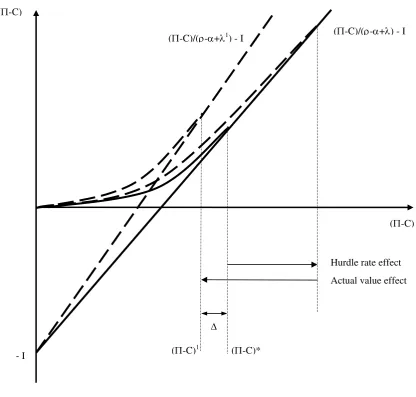
The result in equation 13 is similar to the case without irreversibility and uncertainty. The first term in the square brackets indicates the effect on the hurdle rate, which is positive. This is the positive effect of an increase in the future value of transgenic crops due to an increase in distance requirements, which can be explained by the decrease in ex-post liability costs (the option to wait worth more). The second term in the square brackets is the effect on the annualized hurdle rate. This captures the effect on the reversible value of the transgenic crop. This effect is negative as an increase in the distance reduces directly the probability of ex-post liability, which increases the actual value of adopting transgenic crops. The overall sign of the terms in the square brackets cannot be determined and will depend on the specific parameter values (see the solution in Appendix 2). However, numerical examples show a very robust negative sign of the square bracket. This means that with an increase in distance requirement the greater value of the investment opportunity is outweighed by the increase in the actual value of the project. This is shown in figure 1.
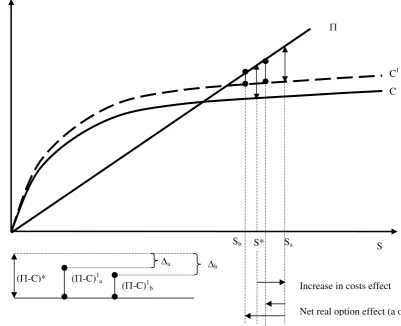
If what described above was the only force in action the effect of the policy would be a lower minimum adoption size. However, the increase in the minimum distance determines a raise in costs reducing the value of (-C). Hence, for the most common values of the parameters it is not possible, a priori, to conclude what is the effect on the minimum adoption size of the ex-ante regulation. This is shown in figure 2.
Only the case of very high drift rates and low mean arrival rates , that is, low probability of ex-post liability, turns the sign of the square brackets positive. In this case is the option value is prevailing and ex-ante regulations would be biased towards larger farms.
6. Conclusions
Appendix 1
From the definition of the value of the farmer’s investment opportunity in GM crops
t
e
I
C
V
E
C
F
max
(
)
(A1)the investment problem can be solved by dynamic programming. The first step is to define the Bellman equation as
C
dt
E
dF
C
F
(A2)
This equation equates the return over dt computed from a capital whose value is F using a discount rate to the expected change in the value of the investment opportunity F. This means that the optimality condition for the farmer is when the value of the investment opportunity in GM crops changes over time in the same way as a normal capital investment. Total liability is still considered the maximization problem and defined as a percentage of (-C) that follows a jump process with a mean arrival rate of . Hence, the following combined stochastic processes for (-C) and TL is assumed:
C
C
dt
C
dz
C
dq
d
.
(A3)where dz is a Wiener process with the property
dz
tdt
, where t has zero mean andunit standard deviation and the relative expected values are E(dz)=0 and E(dz2)=dt, dq is the increment of the jump process and
dt
y
probabilit
with
-dt
-1
y
probabilit
with
0
dq
.
Using Ito’s lemma for the combined Brownian motion and Poisson process, the expected value of dF can be defined as
F
C
C
F
C
dt
dt
C
C
C
F
dt
C
C
C
F
dF
E
2
1
2 22 2
(A4)
Substituting (A4) into (A2) and simplifying for dt gives the following second order differential equation
C
C
F
C
F
C
F
C
C
F
C
C
C
F
1
2
1
2 22 2
that can be rearranged as
1
0
)
(
2
1
2 22 2
C
F
C
F
C
C
C
F
C
C
C
F
(A5)conditions
( C) 0
0
F
(A6.1)I
C
C
F
)
(
)
(
(A6.2))
(
1
)
(
C
F
(A6.3)a solution must take the form
0
and
1
with
)
(
)
(
)
(
C
A
1
C
1
A
2
C
2
1
2
F
(A7)To ensure condition (A6.1) the coefficient A2 must be assumed equal to zero. Hence, from
equation (A7), (A5) simplifies to
0
)
1
(
)
(
)
1
(
2
1
11 2 1
1
.
(A8)Assuming = 1 this leads to the solution
1
)
(
2
2
1
2
1
2 2
2 2
1
.
(A9)Boundary conditions (A6.2 – A6.3) can be used to get the value of the unknown variable A1
and the optimal value of (-C) for the investment decision. This results in the following relation
I
C
(
)
1
)
(
1
1
Appendix 2
Given
( )
0 and
d
d
the sign of1
0
d
while 11
0
1
d
. This can be easily seen form the following derivative:d
d
d
1 1
1 1 1 1 1 1
)
1
(
)
1
(
1
d
d
2 1 2 2 2 2 2 1 1 1 1 2 1 2 2 2 2)
(
2
2
1
1
)
1
(
)
1
(
)
(
2
2
1
1
setting 2 1 2 2 2 2
)
(
2
2
1
1
K
we can write
1
1
1
1
1 1 1 1 1
d
K
d
given that both of the factors of the right hand side are negative, the sign of the derivative is positive. Now, what is the prevailing sign of the following derivative?
) ( 1 1 ) ( 1 1)
(
1
)
(
1
d
d
substitute for the above result
)
(
1
1
1
)
(
1
1 1 1 11
d
K
d
and collect terms
)
(
1
1
1
1
1 1 1 1 1
K
d
Figure 1 – Effect of an increase in distance requirements on the threshold level of
(
-C) for the adopting farm
(-C)/(-+1) - I
(-C)
- I
(-C)/(-+) - I
(-C)1 (-C)* F(-C)
Hurdle rate effect Actual value effect
Legend:
= per hectare extra profit of the transgenic crop. C = per hectare costs of minimum distance. F (-C) = value of the investment opportunity. I = irreversible costs when adopting the technology.
= discount rate.
= drift of the Brownian motion.
= mean arrival rate of the Poisson process.
1
= mean arrival rate after the increase in distance requirements.
(-C)* = minimum net extra profit in order to adopt the technology at the initial state.
(-C)1= minimum net extra profit in order to adopt the technology after the increase in distance.
Figure 2 – Effect of an increase in distance requirements on the minimum
adoption size of the farm (S)
Sa
Sb
b
(-C)1b
(-C)1a
, C
S
a
(-C)*
S*
Increase in costs effect
Net real option effect (a or
C C1
Legend:
= per hectare extra profit of the transgenic crop. C = per hectare costs of minimum distance.
(-C)* = minimum net extra profit in order to adopt the technology at the initial state (see figure 1). (-C)1a,b = minimum net extra profit in order to adopt the technology after the increase in distance.
a,b = net effect on the minimum net extra profit given by the increase in distance (see figure 1).
S* = minimum adoption size at the initial state.
References
agnet, 2002. GM free and the six mile exclusion zone. September 19. <http://131.104.232.9/agnet-archives.htm>.
Bock, A.K., Lheureux K., Libeau-Dulos M., Nilsagård H., Rodriguez-Cerezo E., 2002. Scenarios for co-existence of genetically modified, conventional and organic crops in European agriculture. Institute for Prospective Technological Studies and Joint Research Centre of the European Commission (IPTS – JRC).
Bruno, F., 2003. I profili giuridici dell’agricoltura transgenica. Working Paper for the research project Governare la rivoluzione biotech in agricoltura: politiche ed istituzioni, INEA-MIPAF, Rome.
Alberta Canola Producers Commission (ACPC), 1999. The canola’s producers perspective on biotechnology. <http://www.canola.ab.ca/tec/>.
Clark, E. A., 2001. On the implication of the Schmeiser decision. Bulletin of the Genetics Society of Canada, June 2001.
Demont, M., Wesseler, J., Tollens, E., 2002. Transgenic sugar beets versus biodiversity: the one Euro question. Working Paper 2001/58, Department of Agricultural and Environmental Economics, K.U.Leuven.
Demont M., Tollens E., 2001. Uncertainties estimating the welfare effects of agricultural biotechnology in the European Union, Working Paper 2001/58, Department of Agricultural and Environmental Economics, K.U.Leuven.
European Commission, 2003a. GMOs: Commission addresses GM crop co-existence, IP/03/314, Brussels, March 5, 2003.
European Commission, 2003b. Co-existence of genetically modified and conventional crops: roundtable on latest research results. IP/03/495, Brussels, April 4, 2003.
European Commission, 2002a. Proposal for a directive of the European Parliament and the Council on Environmental liability with regard to the prevention and restoration of environmental damage. COM (2002) 17 final, Brussels, January 23, 2002.
European Commision, 2002b. Frequently asked questions on the Commission's proposal on Environmental Liability, Brussels, January 23, 2002.
European Commision, 2000. Economic Impacts of Genetically Modified Crops on the Agri-Food Sector: a first review. Brussels, April, 2000, available at http://europa.eu.int/comm/agriculture/res/index_en.htm
European Commision, 1999. Council Regulation (EC) 1804/1999 of July 19. Official Journal of the European Commission, 24.8.1999, L222/1-28.
Federal Court of Canada, 2001. Monsanto Canada Inc. vs. Schmeiser, decision by Judge MacKay 2001 FCT 256, March 29, 2001.
Gaisford, J. D., Hobbs, J. E., Kerr, W. A., Perdikis, N., Plunkett, M. D., 2002. The Economics of Biotechnology. Cheltenham, UK: Edward Elgar.
Germanò, 2002. Voce Biotecnologie in agricoltura, IV Digesto discipline privatistiche, Torino: Utet.
James, C., 2002. Global Status of Commercialized Transgenic Crops: 2002. ISAAA Briefs
No.27. ISAAA: Ithaca, NY.
Kershen, D.L., 2002. Legal liability issues in agricultural biotechnology, National AgLaw Center Pubblications, University of Arkansas School of Law, November 2002.
Kolstad, C.D., Ulen, T.S., Johnson, G.V., 1990. Ex post liability for harm vs. ex ante safety regulation: substitutes or complements? The American Economic Review, 80 (4), 888-901.
Marra, M.C., 2001. Agricultural Biotechnology: A Critical Review of the Impact Evidence to Date, paper presented at IFPRI & AARES Preconference Workshop "Agricultural Biotechnology: Markets and Policies in an International Setting", Adelaide, January 22 2001.
Morel, B., S. Farrow, F. Wu, and E. Casman. 2003. Pesticide Resistance, the Precautionary Principle, and the Regulation of Bt Corn: Real Option and Rational Option Approaches to Decision-Making. In R. Laxminarayan (ed.) Battling Resistance to Antibiotics and Pesticides, 184-213. Washington, D.C.: Resources for the Future.
Network of Concerned Farmers (NCF), 2003. <http://www.non-gm-farmers.com/issues_legal_ litigation.asp>.
of biotechnology, 51 Fed. Reg. 23302, June 26, 1986.
Schmidt, H., 2002. Die heutigen rechtlichen Rahmenbedingungen für die Koexistenz der biologischen Landwirtschaft mit benachbarten transgenen Kulturen in Deutschland. Diskurs Grüne Gentechnik. Bundesministerium für Verbraucherschutz, Ernährung und Landwirtschaft, Berlin.
United States, 1965. Second Restatement of the Law Torts 9.
Winston, M. L., 2002. Travels in the Genetically Modified Zone. Cambridge: Harvard University Press.
Wesseler, J., 2003. Resistance Economics of Transgenic Crops. A Real Option Approach. In R. Laxminarayan (ed.) Battling Resistance to Antibiotics. An Economic Approach, 214-237.Washington, D.C.: Resources for the Future.
1
For examples on short and long term impacts of GM contamination on conventional and organic farmers see Bock
et al. (2002). 2
For some authors the control of volunteers can be easily implemented by using other herbicides, such as 2,4-D or MCPA, in association with Roundup (ACPC, 1999). Other scientists see this issue as much more problematic with important implications for farm practices (Clark, 2001). Moreover, in the case of canola, the GM farmer willing to switch back to the conventional crop will face severe problems due to the control of volunteers with the risk of not being able to save seed for the following sowing season and the threat of being sued by the seed developer. 3
If this is true, as will be clear in the model specification, ex-ante regulations are not the sole forces influencing the profitability of the GM crop and, consequently, the adoption decision.
4