R E S E A R C H
Open Access
On solving split mixed equilibrium
problems and fixed point problems of
hybrid-type multivalued mappings in Hilbert
spaces
Nawitcha Onjai-uea
1and Withun Phuengrattana
1,2**Correspondence:
1Department of Mathematics,
Faculty of Science and Technology, Nakhon Pathom Rajabhat University, Nakhon Pathom, 73000, Thailand
2Research Center for Pure and
Applied Mathematics, Research and Development Institute, Nakhon Pathom Rajabhat University, Nakhon Pathom, 73000, Thailand
Abstract
In this paper, we introduce and study iterative algorithms for solving split mixed equilibrium problems and fixed point problems of
λ-hybrid multivalued mappings in
real Hilbert spaces and prove that the proposed iterative algorithm converges weakly to a common solution of the considered problems. We also provide an example to illustrate the convergence behavior of the proposed iteration process.MSC: 47N10; 47J20; 47J22; 46N10
Keywords: split mixed equilibrium problems; hybrid multivalued mappings; weak convergence; Hilbert spaces
1 Introduction
LetHbe a real Hilbert space with inner product·,·and induced norm · . LetCbe a nonempty closed convex subset ofH,ϕ:C→Rbe a function, andF:C×C→Rbe a bifunction. Themixed equilibrium problemis to findx∈Csuch that
F(x,y) +ϕ(y) –ϕ(x)≥, ∀y∈C. (.)
The solution set of mixed equilibrium problem is denoted byMEP(F,ϕ). In particular, if
ϕ= , this problem reduces to the equilibrium problem, which is to findx∈Csuch that F(x,y)≥,∀y∈C. The solution set of equilibrium problem is denoted byEP(F).
The mixed equilibrium problem is very general in the sense that it includes, as special cases, optimization problems, variational inequality problems, minimization problems, fixed point problems, Nash equilibrium problems in noncooperative games, and others; see,e.g., [–].
In , Censor and Elfving [] firstly introduced the following split feasibility prob-lem in finite-dimensional Hilbert spaces: LetH,Hbe two Hilbert spaces andC,Qbe
nonempty closed convex subsets ofH andH, respectively, and letA:H→H be a
bounded linear operator. The split feasibility problem is formulated as finding a pointx∗
with the property
x∗∈C and Ax∗∈Q.
The split feasibility problem can extensively be applied in fields such as intensity-modulated radiation therapy, signal processing and image reconstruction, then the split feasibility problem has received so much attention by so many scholars; see [–].
In , Kazmi and Rizvi [] introduced and studied the following split equilibrium problem: letC⊆HandQ⊆H. LetF:C×C→RandF:Q×Q→Rbe nonlinear
bi-functions and letA:H→Hbe a bounded linear operator. Thesplit equilibrium problem
is to findx∗∈Csuch that
F
x∗,x≥, ∀x∈Cand such thaty∗=Ax∗∈QsolvesF
y∗,y≥,∀y∈Q. (.)
The solution set of the split equilibrium problem is denoted by
SEP(F,F) :=
x∗∈C:x∗∈EP(F) andAx∗∈EP(F)
.
The authors gave an iterative algorithm to find the common element of sets of solution of the split equilibrium problem and hierarchical fixed point problem; for more details refer to [, ].
In , Suantaiet al.[] proposed the iterative algorithm to solve the problems for finding a common elements the set of solution of the split equilibrium problem and the fixed point of a nonspreading multivalued mapping in Hilbert space, given sequence{xn} by
⎧ ⎪ ⎪ ⎨ ⎪ ⎪ ⎩
x∈C arbitrarily,
un=TrFn(I–γA∗(I–T F
rn)A)xn, xn+∈αnxn+ ( –αn)Sun, ∀n∈N,
(.)
where{αn} ⊂(, ),rn⊂(,∞) andγ ∈(,L) such thatLis the spectral radius ofA∗Aand A∗ is the adjoint ofA,C⊂H,Q⊂H,S:C→K(C) is a -nonspreading multivalued
mapping,F:C×C→RandF:Q×Q→Rare two bifunctions. The authors showed
that under certain conditions, the sequence{xn}converges weakly to an element ofF(S)∩ SEP(F,F).
Several iterative algorithms have been developed for solving split feasibility problems and related split equilibrium problems; see,e.g., [–].
2 Preliminaries
LetCbe a nonempty closed convex subset of a real Hilbert spaceH. We denote the strong convergence and the weak convergence of the sequence{xn}to a pointx∈Hbyxn−→x andxnx, respectively. It is also well known [] that a Hilbert spaceHsatisfiesOpial’s condition, that is, for any sequence{xn}withxnx, the inequality
lim sup
n−→∞ xn–x<lim supn−→∞ xn–y
holds for everyy∈Hwithy=x.
The following two lemmas are useful for our main results.
Lemma . In a real Hilbert space H,the following inequalities hold: () x–y≤ x–y– x–y,y,∀x,y∈H;
() x+y≤ x+ y,x+y,∀x,y∈H;
() tx+ ( –t)y=tx+ ( –t)y–t( –t)x–y,∀t∈[, ],∀x,y∈H;
() If{xn}is a sequence inHwhich converges weakly toz∈H,then
lim sup
n→∞ xn–y
=lim sup
n→∞ xn–z
+z–y, ∀y∈H.
Lemma .([]) Let H be a Hilbert space and{xn}be a sequence in H.Let u,v∈H be such thatlimn→∞xn–uandlimn→∞xn–vexist.If{xnk}and{xmk}are subsequences of{xn}which converge weakly to u and v,respectively,then u=v.
A single-valued mappingT:C−→His calledδ-inverse strongly monotone[] if there exists a positive real numberδsuch that
x–y,Tx–Ty ≥δTx–Ty, ∀x,y∈C.
For eachγ ∈(, δ], we see thatI–γT is a nonexpansive single-valued mapping, that is,
(I–γT)x– (I–γT)y≤ x–y, ∀x,y∈C.
We denote byCB(C) andK(C) the collection of all nonempty closed bounded subsets and nonempty compact subsets ofC, respectively. TheHausdorff metricHonCB(C) is defined by
H(A,B) :=max
sup x∈A
dist(x,B),sup y∈B
dist(y,A)
, ∀A,B∈CB(C),
wheredist(x,B) =inf{d(x,y) :y∈B}is the distance from a pointxto a subsetB. LetS:C→ CB(C) be a multivalued mapping. An elementx∈Cis called afixed pointofSifx∈Sx. The set of all fixed points ofSis denoted byF(S), that is,F(S) ={x∈C:x∈Sx}. Recall that a multivalued mappingS:C→CB(C) is called
(i) nonexpansiveif
(ii) quasi-nonexpansiveifF(S)=∅and
H(Sx,Sp)≤ x–p, ∀x∈C,∀p∈F(S);
(iii) nonspreading[] if
H(Sx,Sy)≤dist(y,Sx)+dist(x,Sy), ∀x,y∈C;
(iv) λ-hybrid[] if there existsλ∈Rsuch that
( +λ)H(Sx,Sp)≤( –λ)x–y+λdist(y,Sx)+λdist(x,Sy), ∀x,y∈C.
We note that -hybrid is nonexpansive, -hybrid is nonspreading, and ifSisλ-hybrid with F(S)=∅, thenSis quasi-nonexpansive. It is well known [] that ifSisλ-hybrid, thenF(S) is closed. In addition, ifSsatisfies the condition:Sp={p}for allp∈F(S), thenF(S) is also convex.
The following result is a demiclosedness principle forλ-hybrid multivalued mapping in a real Hilbert space.
Lemma .([]) Let C be a nonempty closed convex subset of a real Hilbert space H and S:C→K(C)be aλ-hybrid multivalued mapping.If{xn}is a sequence in C such that xnx and yn∈Sxnwith xn–yn→,then x∈Sx.
For solving the mixed equilibrium problem, we assume that the bifunctionF:C×C→
Rsatisfies the following assumption:
Assumption . LetCbe a nonempty closed and convex subset of a Hilbert spaceH. Let
F:C×C→Rbe the bifunction,ϕ:C→R∪ {+∞}is convex and lower semicontinuous
satisfies the following conditions: (A) F(x,x) = for allx∈C;
(A) Fis monotone,i.e.,F(x,y) +F(y,x)≤,∀x,y∈C;
(A) for eachx,y,z∈C,limt↓F(tz+ ( –t)x,y)≤F(x,y);
(A) for eachx∈C,y→F(x,y)is convex and lower semicontinuous;
(B) for eachx∈Hand fixedr> , there exist a bounded subsetDx⊆Candyx∈C such that, for anyz∈C\Dx,
F(z,yx) +ϕ(yx) –ϕ(z) +
ryx–z,z–x< ;
(B) C is a bounded set.
Lemma .([]) Let C be a nonempty closed and convex subset of a Hilbert space H.Let
F:C×C→Rbe a bifunction satisfies Assumption.and letϕ:C→R∪ {+∞}be a
proper lower semicontinuous and convex function such that C∩domϕ=∅.For r> and x∈H.Define a mapping TrF:H→C as follows:
TF
r (x) =
z∈C:F(z,y) +ϕ(y) –ϕ(z) +
ry–z,z–x ≥,∀y∈C
for all x∈H.Assume that either(B)or(B)holds.Then the following conclusions hold:
() for eachx∈H,TrF=∅; () TF
r is single-valued; () TF
r is firmly nonexpansive,i.e.,for anyx,y∈H,
TF
r x–TrFy
≤TF
r x–TrFy,x–y
;
() F(TF
r ) =MEP(F,ϕ);
() MEP(F,ϕ)is closed and convex.
Further,assume that F:Q×Q→Rsatisfying Assumption.andφ:Q→R∪ {+∞}is
a proper lower semicontinuous and convex function such that Q∩domφ=∅,where Q is a nonempty closed and convex subset of a Hilbert space H.For each s> and w∈H,define
a mapping TF
s :H→Q as follows:
TF
s (v) =
w∈Q:F(w,d) +φ(d) –φ(w) +
rd–w,w–v ≥,∀d∈Q
.
Then we have the following: () for eachv∈H,TsF=∅; () TF
s is single-valued; () TF
s is firmly nonexpansive; () F(TF
s ) =MEP(F,φ);
() MEP(F,φ)is closed and convex.
3 Main results
In this section, we prove the weak convergence theorems for finding a common element of the set of solutions of split mixed equilibrium problems and the set of fixed points of
λ-hybrid multivalued mappings in real Hilbert spaces and give a numerical example to support our main result.
We introduce the definition of split mixed equilibrium problems in real Hilbert spaces as follows.
Definition . LetCbe a nonempty closed convex subset of a real Hilbert spaceHand
Qbe a nonempty closed convex subset of a real Hilbert spaceH. LetF:C×C→Rand
F:Q×Q→Rbe nonlinear bifunctions, letϕ:C→R∪ {+∞}andφ:Q→R∪ {+∞}
be proper lower semicontinuous and convex functions such thatC∩domϕ=∅andQ∩ domφ=∅, and letA:H→Hbe a bounded linear operator. Thesplit mixed equilibrium
problemis to findx∗∈Csuch that
F
x∗,x+ϕ(x) –ϕx∗≥, ∀x∈C, (.)
and such that
y∗=Ax∗∈Q solves F
y∗,y+φ(y) –φy∗≥, ∀y∈Q. (.)
The solution set of the split mixed equilibrium problem (.) and (.) is denoted by
SMEP(F,ϕ,F,φ) :=
x∗∈C:x∗∈MEP(F,ϕ) andAx∗∈MEP(F,φ)
We now get our main result.
Theorem . Let C be a nonempty closed convex subset of a real Hilbert space H and
Q be a nonempty closed convex subset of a real Hilbert space H.Let A:H→H be a
bounded linear operator and S:C→K(C)aλ-hybrid multivalued mapping.Let F:C×
C→R,F:Q×Q→Rbe bifunctions satisfying Assumption.,letϕ:C→R∪ {+∞}
andφ:Q→R∪ {+∞}be a proper lower semicontinuous and convex functions such that C∩domϕ=∅and Q∩domφ=∅,respectively,and Fis upper semicontinuous in the first
argument.Assume that =F(S)∩SMEP(F,ϕ,F,φ)=∅and Sp={p}for all p∈F(S).Let {xn}be a sequence generated by x∈C and
⎧ ⎪ ⎪ ⎨ ⎪ ⎪ ⎩
un=TrFn(I–γA∗(I–T F
rn)A)xn, yn=αnxn+ ( –αn)wn, wn∈Sun,
xn+=βnwn+ ( –βn)zn, zn∈Syn,∀n∈N,
(.)
where{αn} ⊂(, ),{βn} ⊂(, ),{rn} ⊂(,∞),andγ ∈(,L)such that L is the spectral radius of A∗A and A∗is the adjoint of A.Assume that the following conditions hold:
(C) <lim infn→∞βn≤lim supn→∞βn< ; (C) <lim infn→∞αn≤lim supn→∞αn< ; (C) <lim infn→∞rn.
Then the sequence{xn}generated by(.)converges weakly to p∈ .
Proof First, we show thatA∗(I–TF
rn)Ais a
L-inverse strongly monotone mapping. Since TF
rn is firmly nonexpansive andI–T F
rn is -inverse strongly monotone, we see that A∗I–TF
rn
Ax–A∗I–TF
rn
Ay=A∗I–TF
rn
(Ax–Ay),A∗I–TF
rn
(Ax–Ay)
=I–TF
rn
(Ax–Ay),AA∗I–TF
rn
(Ax–Ay)
≤LI–TF
rn
(Ax–Ay),I–TF
rn
(Ax–Ay)
=LI–TF
rn
(Ax–Ay)
≤LAx–Ay,I–TF
rn
(Ax–Ay)
=Lx–y,A∗I–TF
rn
Ax–A∗I–TF
rn
Ay
for allx,y∈H. This implies thatA∗(I–TrFn)Ais aL-inverse strongly monotone mapping. Sinceγ∈(,L), it follows thatI–γA∗(I–TF
rn)Ais a nonexpansive mapping. Now, we divide the proof into five steps as follows:
Step. Show that{xn}is bounded. Letq∈ . Then we haveq=TF
rnqandq= (I–γA∗(I–T F
rn)A)q. By nonexpansiveness of I–γA∗(I–TF
rn)A, it implies that
un–q=TrFn
I–γA∗I–TF
rn
Axn–TrFn
I–γA∗I–TF
rn
Aq
≤I–γA∗I–TF
rn
Axn–
I–γA∗I–TF
rn
Aq
This implies that
wn–q=dist(wn,Sq)≤H(Sun,Sq)≤ un–q ≤ xn–q, (.)
and so
yn–q=αnxn+ ( –αn)wn–q
≤αnxn–q+ ( –αn)wn–q
=xn–q. (.)
It follows that
zn–q=dist(zn,Sq)≤H(Syn,Sq)≤ yn–q ≤ xn–q. (.)
By (.) and (.), we have
xn+–q=βnwn+ ( –βn)zn–q
≤βnwn–q+ ( –βn)zn–q
=xn–q. (.)
This implies that{xn–q}is decreasing and bounded below, thuslimn−→∞xn–qexists for allq∈ .
Step. Show thatlimn→∞wn–zn= .
From Lemma .(), (.), (.), andSq={q}, we have
xn+–q=βnwn+ ( –βn)zn–q
≤βnwn–q+ ( –βn)zn–q–βn( –βn)wn–zn
≤ xn–q–βn( –βn)wn–zn. (.)
This implies that
βn( –βn)wn–zn≤ xn–q–xn+–q.
From Condition (C) andlimn→∞xn–qexists, we have
lim
n→∞wn–zn= . (.)
Step. Show thatlimn→∞un–xn= andlimn→∞wn–un= . Forq∈ , we see that
un–q=TrFn
I–γA∗I–TF
rn
Axn–TrFnq
≤I–γA∗I–TF
rn
Axn–q
≤ xn–q+γA∗
I–TF
rn
Axn
+ γq–xn,A∗
I–TF
rn
≤ xn–q+γ
Axn–TrFnAxn,AA
∗I–TF
rn
Axn
+ γA(q–xn),Axn–TrFnAxn
≤ xn–q+Lγ
Axn–TrFnAxn,Axn–T F
rnAxn
+ γA(q–xn) +
Axn–TrFnAxn
–Axn–TrFnAxn
,Axn–TrFnAxn
≤ xn–q+LγAxn–TrFnAxn
+ γAp–TF
rnAxn,Axn–T F
rnAxn
–Axn–TrFnAxn
≤ xn–q+LγAxn–TrFnAxn
+ γ
Axn–T F
rnAxn
–Axn–TrFnAxn
=xn–q+γ(Lγ – )Axn–TrFnAxn
.
Thus, by (.) and (.), we have
xn+–q≤βnwn–q+ ( –βn)zn–q
≤βnun–q+ ( –βn)xn–q
≤βn
xn–q+γ(Lγ – )Axn–TrFnAxn
+ ( –βn)xn–q
≤ xn–q+γ(Lγ– )βnAxn–TrFnAxn
. (.)
Therefore, we have
–γ(Lγ– )βnAxn–TrFnAxn
≤ xn–q–xn+–q.
Sinceγ(Lγ– ) < , it follows by Condition (C) and the existence oflimn→∞xn–qthat
lim
n→∞Axn–T F
rnAxn= . (.)
SinceTF
rn is firmly nonexpansive andI–γA∗(I–T F
rn)Ais nonexpansive, we have
un–q=TrFn
I–γA∗I–TF
rn
Axn–TrFnq
≤TF
rn
I–γA∗I–TF
rn
Axn–TrFnq,
I–γA∗I–TF
rn
Axn–q
=un–q,
I–γA∗I–TF
rn
Axn–q
=
un–q+I–γA∗
I–TF
rn
Axn–q
–un–xn–γA∗
I–TF
rn
Axn
≤
un–q+xn–q–
un–xn+γA∗
I–TF
rn
Axn
– γun–xn,A∗
I–TF
rn
Axn
which implies that
un–q≤ xn–q–un–xn+ γ
un–xn,A∗
I–TF
rn
Axn
≤ xn–q–un–xn+ γun–xnA∗
I–TF
rn
Axn. (.)
This implies by (.) and (.) that
xn+–q≤βnwn–q+ ( –βn)zn–q
≤βnun–q+ ( –βn)xn–q
≤βn
xn–q–un–xn+ γun–xnA∗
I–TF
rn
Axn
+ ( –βn)xn–q.
Therefore, we have
βnun–xn≤ xn–q–xn+–q+ γ βnun–xnA∗
I–TF
rn
Axn
≤ xn–q–xn+–q+ γ βnMA∗
I–TF
rn
Axn,
whereM=sup{un–xn:n∈N}. This implies by Condition (C), (.), and the existence oflimn→∞xn–qthat
lim
n→∞un–xn= . (.)
From (.), (.), and the definition of{yn}, we obtain
xn+–q≤βnwn–q+ ( –βn)zn–q
≤βnxn–q+ ( –βn)yn–q
=βnxn–q+ ( –βn)
αnxn–q+ ( –αn)wn–q
–αn( –αn)xn–wn
≤βnxn–q+ ( –βn)
xn–q–αn( –αn)xn–wn
=xn–q–αn( –αn)( –βn)xn–wn.
This implies that
αn( –αn)( –βn)xn–wn≤ xn–q–xn+–q.
From Conditions (C), (C), and the existence oflimn→∞xn–q, we have
lim
n→∞wn–xn= . (.)
By (.) and (.), we get
Step. Show thatωw(xn)⊂ , whereωw(xn) ={x∈H:xnix,{xni} ⊂ {xn}}. Since{xn} is bounded andHis reflexive,ωw(xn) is nonempty. Letp∈ωw(xn) be an arbitrary element. Then there exists a subsequence{xni} ⊂ {xn}converging weakly top. From (.), it implies thatunipasi→ ∞. By (.) and Lemma ., we havep∈F(S).
Next, we show thatp∈MEP(F,ϕ). Sinceun=TrFn(I–γA∗(I–T F
rn)A)xn, we have
F(un,y) +ϕ(y) –ϕ(un) + rn
y–un,un–xn–γA∗
I–TF
rn
Axn
≥, ∀y∈C,
which implies that
F(un,y) +ϕ(y) –ϕ(un) + rn
y–un,un–xn– rn
y–un,γA∗
I–TF
rn
Axn
≥, ∀y∈C.
From Assumption .(A), we have
ϕ(y) –ϕ(un) + rn
y–un,un–xn– rn
y–un,γA∗
I–TF
rn
Axn
≥–F(un,y)≥F(y,un), ∀y∈C,
and hence
ϕ(y) –ϕ(uni) + rni
y–uni,uni–xni– rni
y–uni,γA
∗I–TF
rni
Axni
≥F(y,uni),
∀y∈C.
This implies by uni p, Condition (C), (.), (.), Assumption .(A), and the proper lower semicontinuity ofϕthat
F(y,p) +ϕ(p) –ϕ(y)≤, ∀y∈C.
Putyt=ty+ ( –t)pfor all t∈(, ] andy∈C. Consequently, we getyt∈C and hence F(yt,p) +ϕ(p) –ϕ(yt)≤. So, by Assumption .(A)-(A), we have
=F(yt,yt) –ϕ(yt) +ϕ(yt)
≤tF(yt,y) + ( –t)F(yt,p) +tϕ(y) + ( –t)ϕ(p) –ϕ(yt)
≤tF(yt,y) +ϕ(y) –ϕ(yt)
.
Hence, we have
F(yt,y) +ϕ(y) –ϕ(yt)≥, ∀y∈C.
Lettingt→, by Assumption .(A) and the proper lower semicontinuity ofϕ, we have
F(p,y) +ϕ(y) –ϕ(p)≥, ∀y∈C.
SinceAis a bounded linear operator, we haveAxniAp. Then it follows from (.) that
TF
rniAxniAp asi→ ∞. (.)
By the definition ofTF
rniAxni, we have
F
TF
rniAxni,y
+φ(y) –φTF
rniAxni
+ rni
y–TF
rniAxni,T F
rniAxni–Axni
≥, ∀y∈Q.
SinceFis upper semicontinuous in the first argument, it implies by (.) that
F(Ap,y) +φ(y) –φ(Ap)≥, ∀y∈Q.
This shows thatAp∈MEP(F,φ). Therefore,p∈SMEP(F,ϕ,F,φ) and hencep∈ .
Step. Show that{xn}converges weakly to an element of . It is sufficient to show that
ωw(xn) is a singleton set. Letp,q∈ωw(xn) and{xnk},{xnm}be two subsequences of{xn}such thatxnkpandxnmq. From (.), we also haveunkpandunmq. By (.) and Lemma ., we see thatp,q∈F(S). Applying Lemma ., we obtainp=q. This completes
the proof.
Ifϕ=φ= in (.) and (.), then the split mixed equilibrium problem reduces to split equilibrium problem. So, the following result can be obtained from Theorem . imme-diately.
Theorem . Let C be a nonempty closed convex subset of a real Hilbert space Hand Q be
a nonempty closed convex subset of a real Hilbert space H.Let A:H→Hbe a bounded
linear operator and S:C→K(C)aλ-hybrid multivalued mapping.Let F:C×C→R,
F:Q×Q→Rbe bifunctions satisfying Assumption.,and Fis upper semicontinuous
in the first argument.Assume that =F(S)∩SEP(F,F)=∅and Sp={p}for all p∈F(S).
Let{xn}be a sequence generated by x∈C and
⎧ ⎪ ⎪ ⎨ ⎪ ⎪ ⎩
un=TrFn(I–γA∗(I–T F
rn)A)xn, yn=αnxn+ ( –αn)wn, wn∈Sun,
xn+=βnwn+ ( –βn)zn, zn∈Syn,∀n∈N,
(.)
where{αn} ⊂(, ),{βn} ⊂(, ),{rn} ⊂(,∞),andγ ∈(,L)such that L is the spectral radius of A∗A and A∗is the adjoint of A.Assume that the following conditions hold:
(C) <lim infn→∞βn≤lim supn→∞βn< ; (C) <lim infn→∞αn≤lim supn→∞αn< ; (C) <lim infn→∞rn.
Then the sequence{xn}generated by(.)converges weakly to p∈ .
Remark .
problem. In fact, we present a new iterative algorithm for finding a common element of the set of solutions of split mixed equilibrium problems and the set of fixed points ofλ-hybrid multivalued mappings in a real Hilbert space.
(ii) It is well known that the class ofλ-hybrid multivalued mappings contains the classes of nonexpansive multivalued mappings, nonspreading multivalued mappings. Thus, Theorems . and . can be applied to these classes of mappings.
We give an example to illustrate Theorem . as follows.
Example . LetH=R,H=R,C= [–, ], andQ= (–∞, ]. LetA:H−→Hdefined
byAx=xfor eachx∈H. ThenA∗y=yfor eachy∈H. So,L= is the spectral radius of
A∗A. Define a multivalued mappingS:C−→K(C) by
Sx= ⎧ ⎨ ⎩
[–|x|x|+| , ], x∈[–, –);
{}, x∈[–, ].
It easy to see thatSis -hybrid multivalued mapping withF(S) ={}andS() ={}. For eachx,y∈C, define the bifunctionF:C×C−→RbyF(x,y) =xy+y–x–xand
de-fineϕ(x) = for eachx∈C. For eachu,v∈Q, define the bifunctionF:Q×Q−→Rby
F(u,v) =uv+ v– u–uand defineφ(u) = for eachu∈Q.
Chooseαn=nn+,βn=nn+,rn=n+n , andγ =. It is easy to check thatF,F,{αn},{βn},
{rn}satisfy all conditions in Theorem .. For eachx∈C, we computeTF
r Ax. Findzsuch that
≤F(z,y) +ϕ(y) –ϕ(z) +
ry–z,z–Ax
=zy+ y– z–z+ r
y–z,z–x
= (z+ )(y–z) + r(y–z)
z–x
= (y–z)
(z+ ) + r
z–x
for ally∈Q. Thus, by Lemma .(), it follows thatz=x(+–rr). That is,TF
r Ax=x(+–rr) for eachx∈C. Furthermore, we get
I–γA∗I–TF
r
Ax=x– A
∗Ax–TF
r Ax
=x– A
∗x –
x– r ( +r)
=x–
x –
x– r ( +r)
=x
– γ
Table 1 Numerical results of Example 3.5 for the algorithm (3.19)
n xn xn– xn–1
1 –3.0000000e+00
-2 –6.8786127e–02 2.9312139e+00 3 0.0000000e+00 6.8786127e–02 4 0.0000000e+00 0.0000000e+00
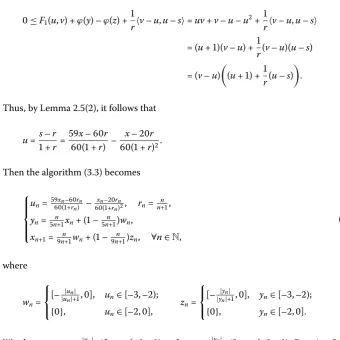
Next, we findu∈Csuch thatF(u,v) +ϕ(y) –ϕ(z) +rv–u,u–s ≥ for allv∈C, where
s= (I–γA∗(I–TF
r )A)x. Note that
≤F(u,v) +ϕ(y) –ϕ(z) +
rv–u,u–s=uv+v–u–u
+
rv–u,u–s
= (u+ )(v–u) +
r(v–u)(u–s)
= (v–u)
(u+ ) + r(u–s)
.
Thus, by Lemma .(), it follows that
u=s–r +r=
x– r ( +r) –
x– r ( +r).
Then the algorithm (.) becomes
⎧ ⎪ ⎪ ⎨ ⎪ ⎪ ⎩
un=(+xn–rnr)n –(+xn–rrn n), rn=
n n+,
yn=nn+xn+ ( –nn+)wn,
xn+=nn+wn+ ( –nn+)zn, ∀n∈N,
(.)
where
wn= ⎧ ⎨ ⎩
[–|u|un|n|+, ], un∈[–, –);
{}, un∈[–, ],
zn= ⎧ ⎨ ⎩
[–|y|yn|n|+, ], yn∈[–, –);
{}, yn∈[–, ].
We choosewn= –|u|un|n|+ ifun∈[–, –) andzn= –|y|n|yn|+ ifyn∈[–, –). By using SciLab, we compute the iterates of (.) for the initial pointx= –. The numerical experiment’s
results of our iteration for approximating the point are given in Table .
4 Conclusions
Acknowledgements
The authors are thankful to the referees for careful reading and the useful comments and suggestions.
Funding
This work was supported by the Research Center for Pure and Applied Mathematics, Research and Development Institute, Nakhon Pathom Rajabhat University, Nakhon Pathom, Thailand. The second author was also supported by the Thailand Research Fund under the project RTA5780007.
Competing interests
The authors declare that they have no competing interests.
Authors’ contributions
All authors contributed equally and significantly in writing this paper. All authors read and approved the final manuscript.
Publisher’s Note
Springer Nature remains neutral with regard to jurisdictional claims in published maps and institutional affiliations.
Received: 25 March 2017 Accepted: 5 June 2017
References
1. Ceng, LC, Yao, JC: A hybrid iterative scheme for mixed equilibrium problems and fixed point problems. J. Comput. Appl. Math.214, 186-201 (2008)
2. Blum, E, Oettli, W: From optimization and variational inequalities to equilibrium problems. Math. Stud.63, 123-145 (1994)
3. Combettes, PI, Hirstoaga, SA: Equilibrium programming in Hilbert spaces. J. Nonlinear Convex Anal.6, 117-136 (2005) 4. Flam, SD, Antipin, AS: Equilibrium programming using proximal-like algorithm. Math. Program.78, 29-41 (1997) 5. Censor, Y, Elfving, T: A multiprojection algorithm using Bregman projections in a product space. Numer. Algorithms8,
221-239 (1994)
6. Censor, Y, Bortfeld, T, Martin, B, Trofimov, A: A unified approach for inversion problems in intensity-modulated radiation therapy. Phys. Med. Biol.51, 2353-2365 (2006)
7. Censor, Y, Elfving, T, Kopf, N, Bortfeld, T: The multiple-sets split feasibility problem and its applications for inverse problems. Inverse Probl.21, 2071-2084 (2005)
8. Censor, Y, Motova, A, Segal, A: Perturbed projections and subgradient projections for the multiple-sets split feasibility problem. J. Math. Anal. Appl.327, 1244-1256 (2007)
9. Chan, T, Shen, J: Image Processing and Analysis: Variational, PDE, Wavelet, and Stochastic Methods. SIAM, Philadelphia (2005)
10. Kazmi, KR, Rizvi, SH: Iterative approximation of a common solution of a split equilibrium problem, a variational inequality problem and a fixed point problem. J. Egypt. Math. Soc.21, 44-51 (2013)
11. Bnouhachem, A: Algorithms of common solutions for a variational inequality, a split equilibrium problem and a hierarchical fixed point problem. Fixed Point Theory Appl.2013, 278 (2013)
12. Bnouhachem, A: Strong convergence algorithm for split equilibrium problems and hierarchical fixed point problems. Sci. World J.2014, 390956 (2014)
13. Suantai, S, Cholamjiak, P, Cho, YJ, Cholamjiak, W: On solving split equilibrium problems and fixed point problems of nonspreading multi-valued mappings in Hilbert spaces. Fixed Point Theory Appl.2016, 35 (2016)
14. Deepho, J, Kumam, W, Kumam, P: A new hybrid projection algorithm for solving the split generalized equilibrium problems and the system of variational inequality problems. J. Math. Model. Algorithms Oper. Res.13(4), 405-423 (2014)
15. Kumam, W, Deepho, J, Kumam, P: Hybrid extragradient method for finding a common solution of the split feasibility and system of equilibrium problems. Dyn. Contin. Discrete Impuls. Syst., Ser. B, Appl. Algorithms21(6), 367-388 (2014) 16. Deepho, J, Martinez-Moreno, J, Kumam, P: A viscosity of Cesaro mean approximation method for split generalized
equilibrium, variational inequality and fixed point problems. J. Nonlinear Sci. Appl.9, 1475-1496 (2016) 17. Opial, Z: Weak convergence of the sequence of successive approximation for nonexpansive mappings. Bull. Am.
Math. Soc.73, 591-597 (1967)
18. Suantai, S: Weak and strong convergence criteria of Noor iterations for asymptotically nonexpansive mappings. J. Math. Anal. Appl.311, 506-517 (2005)
19. Iiduka, H, Takahashi, W: Weak convergence theorem by Cesaro means for nonexpansive mappings and inverse-strongly monotone mappings. J. Nonlinear Convex Anal.7, 105-113 (2006)
20. Suantai, S, Phuengrattana, W: Existence and convergence theorems forλ-hybrid mappings in Hilbert spaces. Dyn. Contin. Discrete Impuls. Syst. Ser. A, Math. Anal.22, 177-188 (2015)