Volume 2010, Article ID 608374,21pages doi:10.1155/2010/608374
Research Article
New Dilated LMI Characterization for
the Multiobjective Full-Order Dynamic Output
Feedback Synthesis Problem
Jalel Zrida
1, 2and Kamel Dabboussi
1, 21Ecole Sup´erieure des Sciences et Techniques de Tunis, 5 Taha Hussein Boulevard,
BP 56, Tunis 1008, Tunisia
2Unit´e de Recherche SICISI, Ecole Sup´erieure des Sciences et Techniques de Tunis,
5 Taha Hussein Boulevard, BP 56, Tunis 1008, Tunisia
Correspondence should be addressed to Kamel Dabboussi,dabboussi [email protected]
Received 23 April 2010; Revised 17 August 2010; Accepted 17 September 2010
Academic Editor: Kok Teo
Copyrightq2010 J. Zrida and K. Dabboussi. This is an open access article distributed under the Creative Commons Attribution License, which permits unrestricted use, distribution, and reproduction in any medium, provided the original work is properly cited.
This paper introduces new dilated LMI conditions for continuous-time linear systems which not only characterize stability and H2 performance specifications, but also, H∞ performance
specifications. These new conditions offer, in addition to new analysis tools, synthesis procedures that have the advantages of keeping the controller parameters independent of the Lyapunov matrix and offering supplementary degrees of freedom. The impact of such advantages is great on the multiobjective full-order dynamic output feedback control problem as the obtained dilated LMI conditions always encompass the standard ones. It follows that much less conservatism is possible in comparison to the currently used standard LMI based synthesis procedures. A numerical simulation, based on an empirically abridged search procedure, is presented and shows the advantage of the proposed synthesis methods.
1. Introduction
in 13, wherein some robust dilated LMI conditions were proposed for some class of matrices. Since then, a flurry of results has been proposed in both the continuous-time 6,7,10,14–17and the discrete-time systems5,14,18–20. These conditions offer, though, no particular advantages for monoobjective and precisely known systems, but were found to greatly reduce conservatism in the multi-objective 6–8, 19 and the robust control problems 9, 10,14–16,18, 19. In this respect, an interesting extension for the utilization of these dilated LMI conditions as in, e.g., 21–23 provided solutions to the problem of robust root-clustering analysis in some nonconnected regions with respect to polytopic and norm-bounded uncertainties. Generally, the main feature of these LMI conditions, in their dilated versions, consists in the introduction of an instrumental variable giving a suitable structure, from the synthesis viewpoint, in which the controller parameterization is completely independent from the Lyapunov matrix. A particular difficulty though with these proposed dilated versions in the continuous-time case is the absence of dilatedH∞conditions
as it is visible in6,15.
This paper introduces new dilated LMIs conditions for the design of full-order dynamic output feedback controllers in continuous-time linear systems, which not only characterize stability and H2 performance specifications, but also, H∞ performance
specifications as well. Similarly to the existing dilated versions, these new dilated LMI conditions carry the same properties wherein an instrumental variable is introduced giving a suitable structure in which the controller parameterization is completely independent from the Lyapunov matrix. In addition, scalar parameters are also introduced, within these dilated LMI, to provide a supplementary degree of freedom whose impact is to further reduce, in a significant way, the conservatism in sufficient standard LMI conditions. It is also shown, in this paper, that the obtained dilated LMI conditions always encompass the standard ones. As a result, the conservatism which results whenever the standard LMI conditions are used is expected to considerably reduce in many cases. This paper focuses on the multi-objective full-order dynamic output feedback controller design in continuous-time linear systems for which the constraining necessity of using a single Lyapunov matrix to test all the objectives and all the channels, which constitutes a major source of conservatism, is no longer a necessity as a different Lyapunov matrix is separately searched for every objective and for every channel. It is shown, in this paper, that despite constraining the instrumental variable, the new dilated LMI conditions are, at worst, as good as the standard ones, and, generally, much less conservative than the standard LMI conditions. The proposed solution is quite interesting, despite an inevitable increase in the number of decision variables in the involved LMIs and a multivariable search procedure that could be abridged through empirical observations. A numerical simulation is presented and shows the advantage of the proposed synthesis method.
2. Background
Consider the linear time-invariant continuous-time and input-free system
˙
xt Axt Bwt,
zt Cxt Dwt,
where the state vectorxt ∈ Rn, the perturbation vector wt ∈ Rm, and the performance vectorzt∈Rp. All the matricesA,B,C,andDhave appropriate dimensions. LetHwzs
A B C D
CsI−A−1B Dbe the system transfer matrix from inputwto outputz. The
following two lemmas are well knownsee, e.g.,1,3and provide necessary and sufficient conditions for System2.1to be asymptotically stable under anH2performance constraint
and a H∞ performance constraint, respectively. These standard results will be extensively used in this paper.
Lemma 2.1. System2.1withD 0is asymptotically stable andHwzs22 < γH2if and only if
there exist symmetric matricesXH2∈Rn×nandW∈Rm×msuch that
TraceW< γH2,
XH2 B
∗ W
>0,
Sym{AXH2} XH2CT
∗ −I
<0.
2.2
Lemma 2.2. System2.1is asymptotically stable andHwzs2∞< γH∞if and only if there exists a symmetric matrixXH∞>0inRn×nsuch that
⎡ ⎢ ⎢ ⎣
Sym{AXH∞} XH∞CT B
∗ −I D
∗ ∗ −γH∞I
⎤ ⎥ ⎥
⎦<0. 2.3
3. Multiobjective Control Synthesis
Consider the continuous-time time-invariant linear system with input
˙
xAx Bww Buu,
zCzx Dzww Dzuu,
yCyx Dyww,
3.1
where the state vectorxt∈Rn, the perturbation vectort∈Rm, the input command vector ut∈Rq, the performance vectorzt∈Rp, and the controlled output vectoryt∈Rr, and all the matricesA,Bw,Bu,Cz,Dzw,Dzu,Cy, andDywhave the appropriate dimensions. In the dynamic output feedback case, the control law is given by the state equations
˙
η Λη Γy,
As this controller is supposed to be of a full order n,Λ∈Rn×n,Γ ∈Rn×r, andΦ∈Rq×n. The closed-loop system is then described by the augmented state equations
˙ x ˙ η
ACl
x η
BClw,
zCCl
x η
DClw,
3.3
where
ACl
A BuΦ
ΓCy Λ
∈R2n×2n
, BCl
Bw ΓDyw
∈R2n×m,
CCl
Cz DzuΦ∈Rp×2n, DClDzw∈Rp×m.
3.4
The closed loop system transfer matrix from inputwto outputzthen becomes
Hwzs
ACl BCl CCl DCl
⎡ ⎢ ⎢ ⎣
A BuΦ Bw
ΓCy Λ ΓDyw
Cz DzuΦ Dzw ⎤ ⎥ ⎥
⎦. 3.5
It is supposed that this system is of a multichannel type meaning that the perturbation vector wis partitioned into a given numbersayIof block components,
wt wT
1t| · · · |wTit| · · · |wTIt T
∈Rm; wit∈Rmi;
I
i1
mim, 3.6
and the performance vectorzis partitioned into a given numbersayJof block components,
zt zT
1t| · · · |zTjt| · · · |zTJt T
∈Rp; zjt∈Rpj;
J
j1
pjp. 3.7
It is supposed that some performance specifications are defined with respect to a particular channelija path relating input componentwi to output componentzjor a combination of channels. It is also supposed that, for a given control law strategy, these performance specifications can always be expressed in terms of anH2and/or aH∞transfer matrix norm
of the corresponding channel, namely, Hwizjs EjHwzsFi, where the matrices Ej and
Fi are set to select the desired input/output channel from the system closed-loop transfer matrixHwzs. In fact,Ejis aJ-block row matrix of dimensionpj×psuch that only thejth block is nonzero and is the identity matrix inRpj. Similarly,Fiis anI-block column vector of
problem of the multi-objective controller synthesis is to construct a controller that stabilizes the closed loop system and, simultaneously, achieves all the prescribed specifications. It is easy to see that, for each channelij, the closed loop transfer matrix is given by
Hwizjs Ej
⎡ ⎢ ⎢ ⎣
A BuΦ Bw
ΓCy Λ ΓDyw
Cz DzuΦ Dzw ⎤ ⎥ ⎥ ⎦Fi
⎡ ⎢ ⎢ ⎣
A BuΦ BwFi ΓCy Λ ΓDywFi
EjCz EjDzuΦ EjDzwFi ⎤ ⎥ ⎥
⎦. 3.8
On the channel basis, the closed-loop system is then described by
˙ x ˙ η
ACl,ij
x η
BCl,ijwi,
zjCCl,ij
x η
DCl,ijwi,
3.9
where
ACl,ij ACl
A BuΦ
ΓCy Λ
∈R2n×2n, B
Cl,ij BClFi
BwFi ΓDywFi
∈R2n×m,
CCl,ij EjCCl
EjCz EjDzuΦ∈Rp×2n, DCl,ij EjDClFiEjDzwFi∈Rp×m.
3.10
The dynamic output feedback synthesis multi-objective problem consists of looking for a dynamic controller that stabilizes the closed loop system and, in the same time, achieves the desired H2 and/or H∞ performance specifications for every single system channel. More
specifically, the dynamic output feedback synthesis multi-objective problem aims at making System3.1possess the following propriety.
Propriety P
System 3.1 is stabilizable by a dynamic output feedback law 3.2 such that, for every channelij, either or both of the following two conditions hold:
iHwizj22< γH2,ijwithEjDzwFi0;
iiHwizj2∞< γH∞,ij.
Theorem 3.1the standard sufficient conditions. If there exist symmetric matricesX1 ∈ Rn×n
andX−1 ∈ Rn×n, general matricesΛ1 ∈Rn×n,Γ1 ∈Rn×r, andΦ1 ∈Rq×n and, for every channel ij,
are satisfied:
i StdH2
TraceWij< γH2,ij, ⎡
⎢ ⎢ ⎣
X−1 I X−1BwFi Γ1DywFi
∗ X1 BwFi
∗ ∗ Wij
⎤ ⎥ ⎥ ⎦>0,
⎡ ⎢ ⎢ ⎣
SymX−1A Γ1Cy AT Λ1 CzTETj
∗ Sym{AX1 BuΦ1} X1CzTETj ΦT1DTzuEjT
∗ ∗ −I
⎤ ⎥ ⎥ ⎦<0;
3.11
ii StdH∞
X−1 I
I X1
>0,
⎡ ⎢ ⎢ ⎢ ⎢ ⎢ ⎣
SymX−1A Γ1Cy AT Λ1 CzTEjT X−1BwFi Γ1DywFi
∗ Sym{AX1 BuΦ1} X1CTzEjT ΦT1DTzuETj BwFi
∗ ∗ −I EjDzwFi
∗ ∗ ∗ −γH∞,ij I
⎤ ⎥ ⎥ ⎥ ⎥ ⎥ ⎦<0,
3.12
then, ProprietyPholds, and furthermore, a set of the controller parameters defined in 3.2is given by
Λ −X−1
−2X−1AX1X−2T−ΓCyX1X2−T−X−−21X−1BuΦ X−−21Λ1X−2T,
Γ X−1 −2Γ1,
Φ Φ1X2−T,
3.13
where the nonsingular matricesX2andX−2are obtainedviathe equation
X1X−1 X2XT−2I. 3.14
Proof. If either or both of conditionsStdH2andStdH∞are satisfied, letX X
1 X2 XT
2 −XT2X−1X−−T2
and letT X
−1I XT
−20
3.14 among infinitely many possibilitiesvia the singular value decomposition ofI−X1X−1.
In view of3.13and3.14, the following useful identities are easily derived:
TTXT
X−1 I I X1
,
TTA
ClXT
X−1A Γ1Cy Λ1
A AX1 BuΦ1
,
TTB
Cl,ij TTBClFi
X−1BwFi Γ1DywFi
BwFi
,
CCl,ijXTEjCClXT
EjCz EjCzX1 EjDzuΦ1
.
3.15
As either or both of conditionsStdH2andStdH∞are satisfied, by the congruence lemma applied to each LMI and in view of the identities listed just above, either or both of the following conditions are also satisfied, respectively,
i
T−T 0
0 I
⎡ ⎢ ⎢ ⎣
X−1 I X−1BwFi Γ1DywFi
I X1 BwFi
∗ Wij
⎤ ⎥ ⎥ ⎦
T−1 0
0 I
T−T 0
0 I
TTXT TTB
Cl,ij
∗ Wij
T−1 0
0 I
X BCl,ij
∗ Wij
>0,
T−T 0
0 I
⎡ ⎢ ⎢ ⎣
SymX−1A Γ1Cy AT Λ1 CTzETj
∗ Sym{AX1 BuΦ1} X1CzTETj ΦT1DzuT ETj
∗ −I
⎤ ⎥ ⎥ ⎦
T−1 0
0 I
T−T 0
0 I
SymTTAClXT
TTXCT
Cl,ij
∗ −I
T−1 0
0 I
Sym{AClX} XCTCl,ij
∗ −I
<0;
ii
T−T
X−1 I I X1
T−1 X >0; 3.17
⎡ ⎢ ⎣
T−T 0 0
0 I 0
0 0 I
⎤ ⎥ ⎦
×
⎡ ⎢ ⎢ ⎢ ⎢ ⎢ ⎣
SymX−1A Γ1Cy AT Λ1 CzTETj X−1BwFi Γ1DywFi
∗ Sym{AX1 BuΦ1} X1CTzETj ΦT1DzuT ETj BwFi
∗ −I EjDzwFi
∗ ∗ −γH∞,ijI
⎤ ⎥ ⎥ ⎥ ⎥ ⎥ ⎦
×
⎡ ⎢ ⎢ ⎣
T−1 0 0
0 I 0
0 0 I
⎤ ⎥ ⎥ ⎦
⎡ ⎢ ⎢ ⎣
T−T 0 0
0 I 0
0 0 I
⎤ ⎥ ⎥ ⎦ ⎡ ⎢ ⎢ ⎣
SymTTAClXT
TTXCT
Cl,ij TTBCl,ij
∗ −I DCl,ij
∗ ∗ −γH∞,ijI
⎤ ⎥ ⎥ ⎦ ⎡ ⎢ ⎢ ⎣
T−1 0 0
0 I 0
0 0 I
⎤ ⎥ ⎥ ⎦
⎡ ⎢ ⎣
Sym{AClX} XCTCl,ij BCl,ij
∗ −I DCl,ij
∗ ∗ −γH∞,ijI ⎤ ⎥ ⎦<0.
3.18
According to Lemmas2.1and2.2, these are precisely the sufficient standard LMI conditions, expressed on a channel basis, for ProprietyPto hold.
Theorem 3.1provides sufficient conditions for the existence of a single multi-objective
dynamic output controller in terms of LMI conditions in which common Lyapunov matrices are enforced for convexity. This is known to produce, in general, overly conservative results. The following theorem attempts at reducing the effect of this limitation.
Theorem 3.2the dilated sufficient conditions. If there exist general matricesM∈Rn×n,G1 ∈ Rn×n,G−1∈Rn×n,Λ2,Γ2, andΦ2and for every channel ij, for some scalarsαH2,ij >0andαH∞,ij >0, there exist symmetric matricesVij ∈ Rmi×mi,N1,H2,ij ∈ Rn×n,Y1,H2,ij ∈ Rn×n,N1,H∞,ij ∈ Rn×n,
Y1,H∞,ij ∈Rn×n, general matricesN2,H2,ij ∈Rn×nandN2,H∞,ij ∈Rn×nsuch that either or both of the following two conditions are satisfied:
i DilH2
TraceVij< γH2,ij, ⎡
⎢ ⎣
N1,H2,ij N2,H2,ij G−T1BwFi Γ2DywFi ∗ Y1,H2,ij BwFi
∗ ∗ Vij
⎡ ⎢ ⎢ ⎢ ⎢ ⎢ ⎢ ⎢ ⎢ ⎢ ⎢ ⎢ ⎣
αH2,ijSymGT−1A Γ2Cy
αH2,ijΛ2 AT
αH2,ijCTzETj
∗ αH2,ijSym{AG1 BuΦ2} αH2,ij
GT
1CTzEjT ΦT2DTzuETj
∗ ∗ −I
∗ ∗ ∗
∗ ∗ ∗
N1,H2,ij GT−1A Γ2Cy−αH2,ijG−1 N2,H2,ij Λ2−αH2,ijI
NT
2,H2,ij A−αH2,ij MT Y1,H2,ij AG1 BuΦ2−αH2,ijGT1
EjCz EjCzG1 EjDzuΦ2
−Sym{G−1} −I−M
∗ −Sym{G1}
⎤ ⎥ ⎥ ⎥ ⎥ ⎥ ⎥ ⎥ ⎥ ⎥ ⎥ ⎥ ⎦
<0;
3.19
ii DilH∞
⎡ ⎢ ⎢ ⎢ ⎢ ⎢ ⎢ ⎢ ⎢ ⎢ ⎢ ⎢ ⎢ ⎣
αH∞,ijSymGT−1A Γ2Cy
αH∞,ijΛ2 AT
αH∞,ijCzTETj
∗ αH∞,ijSym{AG1 BuΦ2} αH∞,ij
GT
1CTzETj ΦT2DTzuETj
∗ ∗ −I
∗ ∗ ∗
∗ ∗ ∗
∗ ∗ ∗
GT
−1BwFi Γ2DywFi N1,H∞,ij GT−1A N2,H∞,ij Λ2−αH∞,ijI
Γ2Cy−αH∞,ijG−1 Y1,H∞,ij AG1
BwFi N2T,H∞,ij A−αH∞,ijMT BuΦ2−αH∞,ijGT1
EjDzwFi EjCz EjCzG1 EjDzuΦ2
−γH∞,ijI 0 0
∗ −Sym{G−1} −I−M
∗ ∗ −Sym{G1}
⎤ ⎥ ⎥ ⎥ ⎥ ⎥ ⎥ ⎥ ⎥ ⎥ ⎥ ⎥ ⎥ ⎥ ⎥ ⎥ ⎥ ⎥ ⎥ ⎥ ⎦
<0.
Then, Propriety P holds, and furthermore, a set of the controller parameters defined in3.2
is given by
Λ −G−T
−3GT−1AG1G3−1−G−−T3GT−1BuΦ−ΓCyG1G−31 G−−T3Λ2G−31,
Γ G−T
−3Γ2,
Φ Φ2G−31,
3.21
where the nonsingular matricesG3andG−3are obtained via the equation
MGT
−1G1 GT−3G3. 3.22
Proof. If either or both of conditions DilH2 and DilH∞ are satisfied, let G G
1I−G1G−1G−−13 G3 −G3G−1G−−13
and let T G−1I G−30
be a nonsingular transformation matrix with G3
and G−3 selected from 3.22 among infinitely many possibilities via the singular value
decomposition ofM−GT−1G1. In view of3.21 and 3.22, the following useful identities
are easily derived:
TTGT
GT
−1 M
I G1
,
TTA
ClGT
GT
−1A Γ2Cy Λ2
A AG1 BuΦ2
,
TTB
Cl,ij TTBClFi
GT
−1A Γ2Cy Λ2
A AG1 BuΦ2
,
CCl,ijGTEjCClGT
EjCz EjCzX1 EjDzuΦ2
.
3.23
On the other hand, let us introduce
YH2,ij T−T
N1,H2,ij N2,H2,ij
∗ Y1,H2,ij
T−1, Y
H∞,ij T−T
N1,H∞,ij N2,H∞,ij
∗ Y1,H∞,ij
T−1. 3.24
i
T−T 0
0 I
⎡ ⎢ ⎢ ⎣
N1,H2,ij N2,H2,ij G−T1BwFi Γ2DywFi ∗ Y1,H2,ij BwFi
∗ Vij
⎤ ⎥ ⎥ ⎦
T−1 0
0 I
T−T 0
0 I
TTY
H2,ijT TTBCl,ij
∗ Vij
T−1 0
0 I
YH2,ij BCl,ij
∗ Vij
>0,
⎡ ⎢ ⎢ ⎣
T−T 0 0
0 I 0
0 0 T−T ⎤ ⎥ ⎥ ⎦ × ⎡ ⎢ ⎢ ⎢ ⎢ ⎢ ⎢ ⎢ ⎢ ⎢ ⎣
αH2,ijSymGT−1A Γ2Cy
αH2,ijΛ2 AT
αH2,ijCzTETj
∗ αH2,ijSym{AG1 BuΦ2} αH2,ij
GT
1CTzETj ΦT2DTzuETj
∗ ∗ −I
∗ ∗ ∗
∗ ∗ ∗
N1,H2,ij GT−1A Γ2Cy−αH2,ijG−1 N2,H2,ij Λ2−αH2,ijI NT
2,H2,ij A−αH2,ijMT Y1,H2,ij AG1 BuΦ2−αH2,ijGT1
EjCz EjCzG1 EjDzuΦ2
−Sym{G−1} −I−M
∗ −Sym{G1}
⎤ ⎥ ⎥ ⎥ ⎥ ⎥ ⎥ ⎥ ⎥ ⎦ × ⎡ ⎢ ⎢ ⎣
T−1 0 0
0 I 0
0 0 T−1
⎤ ⎥ ⎥ ⎦ ⎡ ⎢ ⎢ ⎣
T−T 0 0
0 I 0
0 0 T−T ⎤ ⎥ ⎥ ⎦ ⎡ ⎢ ⎢ ⎣
αH2,ijSym
TTA
ClGT
αH2,ijTTGTCTCl,ij TT
YH2,ij AClG−αH2,ijGT
T
0 −I CCl,ijGT
0 0 −TTSym{G}T
⎤ ⎥ ⎥ ⎦ × ⎡ ⎢ ⎢ ⎣
T−1 0 0
0 I 0
0 0 T−1
⎤ ⎥ ⎥ ⎦ ⎡ ⎢ ⎢ ⎣
αH2,ijSym{AClG} αH2,ijGTCTCl,ij
YH2,ij AClG−αH2,ijGT
0 −I CCl,ijG
0 0 −Sym{G}
⎤ ⎥ ⎥ ⎦<0;
ii
⎡ ⎢ ⎢ ⎢ ⎢ ⎣
T−T 0 0 0
0 I 0 0
0 0 I 0
0 0 0 T−T ⎤ ⎥ ⎥ ⎥ ⎥ ⎦
×
⎡ ⎢ ⎢ ⎢ ⎢ ⎢ ⎢ ⎢ ⎢ ⎢ ⎢ ⎢ ⎢ ⎣
αH∞,ijSymGT−1A Γ2Cy
αH∞,ijΛ2 AT
αH∞,ijCzTETj
∗ αH∞,ijSym{AG1 BuΦ2} αH∞,ij
GT
1CTzETj ΦT2DTzuETj
∗ ∗ −I
∗ ∗ ∗
∗ ∗ ∗
∗ ∗
GT
−1BwFi Γ2DywFi N1,H∞,ij GT−1A Γ2Cy−αH∞,ijG−1 N2,H∞,ij Λ2−αH∞,ijI
BwFi
NT
2,H∞,ij A−αH∞,ij MT Y1,H∞,ij AG1 BuΦ2−αH∞,ijGT1
EjDzwFi EjCz EjCzG1 EjDzuΦ2
−γH∞,ijI 0 0
∗ −Sym{G−1} −I−M
∗ ∗ −Sym{G1}
⎤ ⎥ ⎥ ⎥ ⎥ ⎥ ⎥ ⎥ ⎥ ⎥ ⎥ ⎥ ⎥ ⎥ ⎦
×
⎡ ⎢ ⎢ ⎢ ⎢ ⎣
T−1 0 0 0
0 I 0 0
0 0 I 0
0 0 0 T−1
⎤ ⎥ ⎥ ⎥ ⎥ ⎦
⎡ ⎢ ⎢ ⎢ ⎢ ⎣
T−T 0 0 0
0 I 0 0
0 0 I 0
0 0 0 T−T ⎤ ⎥ ⎥ ⎥ ⎥ ⎦
×
⎡ ⎢ ⎢ ⎢ ⎢ ⎢ ⎣
αH∞,ijTTSym{AClG}T αH∞,ijTTGTCTCl,ij TTBCl,ij TTYH∞,ij AClG−αH∞,ijGTT
∗ −I DCl,ij CCl,ijGT
∗ ∗ −γH∞,ijI 0
∗ ∗ ∗ −TTSym{G}T
⎤ ⎥ ⎥ ⎥ ⎥ ⎥ ⎦
×
⎡ ⎢ ⎢ ⎢ ⎢ ⎣
T−1 0 0 0
0 I 0 0
0 0 I 0
0 0 0 T−1
⎡ ⎢ ⎢ ⎢ ⎢ ⎢ ⎣
αH∞,ijSym{AClG} αH∞,ijGTCClT,ij BCl,ij YH∞,ij AClG−αH∞,ijGT
ef22∗ −I DCl,ij CCl,ijG
∗ ∗ −γH∞,ijI 0
∗ ∗ ∗ −Sym{G}
⎤ ⎥ ⎥ ⎥ ⎥ ⎥ ⎦<0.
3.26
To summarize, we have proven that if either or both conditionsDilH2andDilH∞ are satisfied, then either or both of the following conditions are also satisfied:
i
TraceVij< γH2,ij,
YH2,ij BCl,ij
∗ Vij
>0,
⎡ ⎢ ⎢ ⎣
αH2,ijSym{AClG} αH2,ijGTCTCl,ij
YH2,ij AClG−αH2,ijGT
0 −I CCl,ijG
0 0 −Sym{G}
⎤ ⎥ ⎥ ⎦<0;
3.27
ii
⎡ ⎢ ⎢ ⎢ ⎢ ⎢ ⎣
αH∞,ijSym{AClG} αH∞,ijGTCClT,ij BCl,ij YH∞,ij AClG−αH∞,ijGT
∗ −I DCl,ij CCl,ijG
∗ ∗ −γH∞,ijI 0
∗ ∗ ∗ −Sym{G}
⎤ ⎥ ⎥ ⎥ ⎥ ⎥
⎦<0. 3.28
The third LMI of the first item condition is equivalent to
⎡ ⎢ ⎢ ⎣
0 0 YH2,ij
∗ −I 0
∗ ∗ 0
⎤ ⎥ ⎥
⎦ Sym
⎧ ⎪ ⎪ ⎨ ⎪ ⎪ ⎩ ⎡ ⎢ ⎢ ⎣
ACl CCl,ij
−I ⎤ ⎥ ⎥
⎦GαH2,ijI 0 I ⎫ ⎪ ⎪ ⎬ ⎪ ⎪
which, according to the elimination lemma3, leads to
I 0 ACl
0 I CCl,ij ⎡
⎢ ⎢ ⎣
0 0 YH2,ij
∗ −I 0
∗ ∗ 0
⎤ ⎥ ⎥ ⎦ ⎡ ⎢ ⎢ ⎣ I 0 0 I AT
Cl CTCl,ij ⎤ ⎥ ⎥ ⎦<0,
I 0 −αH2,ijI
0 I 0
⎡ ⎢ ⎢ ⎣
0 0 YH2,ij
∗ −I 0
∗ ∗ 0
⎤ ⎥ ⎥ ⎦ ⎡ ⎢ ⎢ ⎣ I 0 0 I
−αH2,ij I 0 ⎤ ⎥ ⎥ ⎦<0.
3.30
The two previous LMIs are equivalent to
Sym{AClYH2,ij}YH2,ijCTCl,ij
∗ −I
< 0 and −2αH
2,ijYH2,ij 0
∗ −I
<0, that is, for anyαH2,ij >0,YH2,ij >0.
Similarly, the LMI of the second item condition is equivalent to
⎡ ⎢ ⎢ ⎢ ⎢ ⎢ ⎣
0 0 BCl,ij YH∞,ij
∗ −I DCl,ij 0
∗ ∗ −γH∞,ijI 0
∗ ∗ ∗ 0
⎤ ⎥ ⎥ ⎥ ⎥ ⎥ ⎦ Sym ⎧ ⎪ ⎪ ⎪ ⎪ ⎪ ⎨ ⎪ ⎪ ⎪ ⎪ ⎪ ⎩ ⎡ ⎢ ⎢ ⎢ ⎢ ⎢ ⎣ ACl CCl,ij
0 −I ⎤ ⎥ ⎥ ⎥ ⎥ ⎥ ⎦G
αH∞,ijI 0 0 I ⎫ ⎪ ⎪ ⎪ ⎪ ⎪ ⎬ ⎪ ⎪ ⎪ ⎪ ⎪ ⎭
<0. 3.31
According to the Elimination lemma, this leads to
⎡ ⎢ ⎢ ⎣
I 0 0 ACl
0 I 0 CCl,ij
0 0 I 0
⎤ ⎥ ⎥ ⎦ ⎡ ⎢ ⎢ ⎢ ⎢ ⎢ ⎣
0 0 BCl,ij YH∞,ij
∗ −I DCl,ij 0
∗ ∗ −γH∞,ijI 0
∗ ∗ ∗ 0
⎤ ⎥ ⎥ ⎥ ⎥ ⎥ ⎦ ⎡ ⎢ ⎢ ⎢ ⎢ ⎢ ⎣
I 0 0
0 I 0
0 0 I
AT
Cl CTCl,ij 0 ⎤ ⎥ ⎥ ⎥ ⎥ ⎥ ⎦<0,
⎡ ⎢ ⎢ ⎣
I 0 0 −αH∞,ijI
0 I 0 0
0 0 I 0
⎤ ⎥ ⎥ ⎦ ⎡ ⎢ ⎢ ⎢ ⎢ ⎢ ⎣
0 0 BCl,ij YH∞,ij
∗ −I DCl,ij 0
∗ ∗ −γH∞,ijI 0
∗ ∗ ∗ 0
⎤ ⎥ ⎥ ⎥ ⎥ ⎥ ⎦ ⎡ ⎢ ⎢ ⎢ ⎢ ⎢ ⎣
I 0 0
0 I 0
0 0 I
−αH∞,ijI 0 0 ⎤ ⎥ ⎥ ⎥ ⎥ ⎥ ⎦<0.
3.32
The previous two matrix inequalities are equivalent to
⎡ ⎢ ⎢ ⎣
SymAClYH∞,ij YH∞,ijCTCl,ij BCl,ij
∗ −I DCl,ij
∗ ∗ −γH∞,ijI
⎤ ⎥ ⎥ ⎦<0,
⎡ ⎢ ⎢ ⎣
−2αH∞,ij YH∞,ij 0 BCl,ij
∗ −I DCl,ij
∗ ∗ −γH∞,ijI ⎤ ⎥ ⎥ ⎦<0.
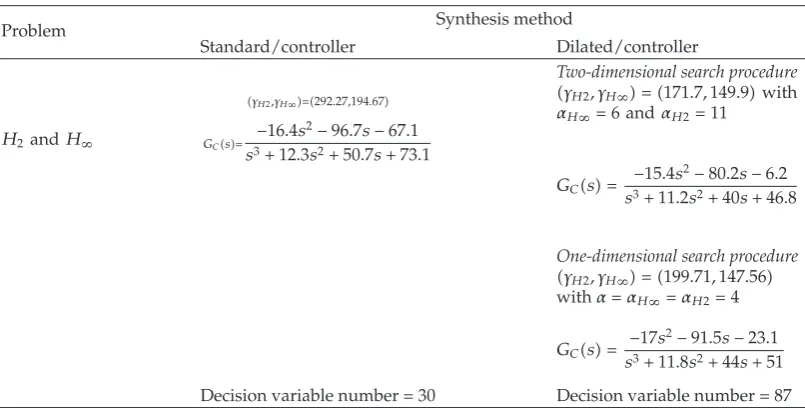
Table 1:Simulation results, withGCsrepresenting the LMI produced full-order dynamic output feedback
controller.
Problem Synthesis method
Standard/controller Dilated/controller
H2andH∞
γH2,γH∞292.27,194.67
GCs −16.4s
2−96.7s−67.1
s3 12.3s2 50.7s 73.1
Two-dimensional search procedure
γH2, γH∞ 171.7,149.9with αH∞6 andαH211
GCs −15.4s
2−80.2s−6.2
s3 11.2s2 40s 46.8
One-dimensional search procedure
γH2, γH∞ 199.71,147.56
withααH∞αH24
GCs −17s
2−91.5s−23.1
s3 11.8s2 44s 51
Decision variable number30 Decision variable number87
Via the Schur lemma, the latter inequality is equivalent toYH∞,ij >0 and
−I DCl,ij
∗ −γH∞,ijI α−1
H∞,ij
2 ×
⎡ ⎣ 0
BT
Cl,ij ⎤ ⎦Y−1
H∞,ij
0 BCl,ij<0. 3.34
Clearly, as −I D
Cl,ij ∗ −γH∞,ijI
< 0, there always exists a sufficiently large αH∞,ij > 0 which satisfies this LMI. According to Lemmas2.1and2.2, these are precisely the sufficient standard LMI conditions, expressed on a channel basis, for ProprietyPto hold.
Theorem 3.2 also provides sufficient conditions for the existence of a single
multi-objective dynamic output controller in terms of LMI conditions in which the constraint of a common Lyapunov matrix is no longer needed. Convexity is rather insured by constraining the instrumental variables G to be common. This is known to produce, in general, less conservative results than those obtained with the standard conditions of Theorem 3.1. Reducing further this conservatism is also possible through the positive scalar parameters αH2,ij and αH∞,ij. A simple multidimensional search procedure can be carried out in the
space of these parameters in order to obtain the values of these parameters for which LMI 3.19 and/or LMI 3.20 are feasible and produce the best multi-objective dynamic output controller with optimal performance levels. This multidimensional search procedure can, however, be overly expensive if the number of channel gets larger. A solution to this rather annoying limitation will be proposed in the next section. Yet, the important results of
Theorem 3.2constitute a significant contribution to the multi-objective control problem.
4. Recovery Condition
In the following theorem, it will be shown that our proposed dilated LMI conditions for the design of multiobjective full-order dynamic output feedback controllers do indeed encompass the standard conditions. This situation will be of great importance, as it will guarantee that conservatism will be almost always reduced. Similar results do exist in the literature in both the discrete-time19and the continuous-time case6,7. The continuous-time results were, however, strictly concerned with the multi-channelH2synthesis problem
and only in7that the recovery of the standard approach is proven. In view of this, the following theorem extends the discrete-time results to the continuous-time case. This point constitutes the major contribution of this paper.
Theorem 4.1. For, the multi-objective dynamic output feedback synthesis problem, if the standard LMI conditions of Theorem 3.1are satisfied and achieve, with a given controller, the upper bounds γS
H2,ijandγHS∞,ij, then the dilated inequality conditions ofTheorem 3.2are also satisfied with the same controller and with the upper boundsγHD2,ij ≤γHS2,ij andγHD∞,ij ≤γHS∞,ij.
Proof. If the standard LMI conditions ofTheorem 3.1are satisfied for a given controller and achieve, for every channel, the upper bounds γHS2,ij and γHS∞,ij, then there exist symmetric matricesXandWijsuch that
TraceWij< γHS2,ij,
X BCl,ij
∗ Wij
>0,
Sym{AClX} XCClT,ij
∗ −I
<0
4.1
and/or
X >0,
⎡ ⎢ ⎢ ⎣
Sym{AClX} XCTCl,ij BCl,ij
∗ −I DCl,ij
∗ ∗ −γS
H∞,ijI ⎤ ⎥ ⎥ ⎦<0.
4.2
Let us prove that these standard LMI conditions imply that the dilated inequality conditions
the system closed-loop parameters, the right-hand sides of the dilated LMI conditions of
Theorem 3.2take the following form:
TraceVij,
YH2,ij BCl,ij
∗ Vij
,
⎡ ⎢ ⎢ ⎣
αH2,ijSym{AClG} αH2,ijGTCTCl,ij YH2,ij AClG−αH2,ijGT
∗ −I CCl,ijG
∗ ∗ −Sym{G}
⎤ ⎥ ⎥ ⎦
4.3
and/or
⎡ ⎢ ⎢ ⎢ ⎢ ⎢ ⎣
αH∞,ijSym{AClG} αH∞,ijGTCClT,ij BCl,ij YH∞,ij AClG−αH∞,ijGT
∗ −I DCl,ij CCl,ijG
∗ ∗ −γH∞,ijI 0
∗ ∗ ∗ −Sym{G}
⎤ ⎥ ⎥ ⎥ ⎥ ⎥
⎦. 4.4
Let, in these matrices,YH2,ij YH∞,ij X, Vij Wij,αH2,ij αH∞,ij α, γHD2,ij γHS2,ij,
γD
H∞,ij γHS∞,ij andGα−1X, these right-hand sides become
TraceWij,
X BCl,ij
∗ Wij
,
⎡ ⎢ ⎢ ⎣
Sym{AClX} XCTCl,ij α−1AClX
∗ −I α−1C
Cl,ijX
∗ ∗ −2α−1X
⎤ ⎥ ⎥ ⎦.
4.5
and/or
⎡ ⎢ ⎢ ⎢ ⎢ ⎢ ⎣
Sym{AClX} XCClT,ij BCl,ij α−1AClX ∗ −I DCl,ij α−1CCl,ijX
∗ ∗ −γS
H∞,ijI 0
∗ ∗ ∗ −2α−1X
⎤ ⎥ ⎥ ⎥ ⎥ ⎥
Let us prove, for these four matrices above, that the second matrix is positive definite while the third and/or the fourth matrices are both negative definite. Clearly, the standard conditions imply that
TraceWij< γHS2,ij,
X BClFi
∗ Wij
>0. 4.7
By virtue of the Schur complement lemma, the third matrix and/or the fourth matrix will be negative definite if and only ifX >0,
Sym{AClX} XCTClETj
∗ −I
α−1
2 ×
ACl EjCCl
X
ACl EjCCl
T
<0, 4.8
and/or
⎡ ⎢ ⎢ ⎣
Sym{AClX} XCTClETj BClFi
∗ −I EjDClFi
∗ ∗ −γS
H∞,ijI ⎤ ⎥ ⎥
⎦ α
−1
2 ×
⎡ ⎢ ⎢ ⎣
ACl EjCCl
0 ⎤ ⎥ ⎥ ⎦X
⎡ ⎢ ⎢ ⎣
ACl EjCCl
0 ⎤ ⎥ ⎥ ⎦ T
<0. 4.9
As, from the standardH2andH∞conditions,
Sym{AClX} XCTClETj
∗ − I
<0,
⎡ ⎢ ⎢ ⎣
Sym{AClX} XCTClETj BClFi ∗ −I EjDClFi
∗ ∗ −γS
H∞,ijI ⎤ ⎥ ⎥
⎦<0, 4.10
there always exists anα >0 which achieves, simultaneously, these two conditions. As a result, the dilated inequality conditions ofTheorem 3.2are also satisfied. This proves that the dilated LMI multi-objective conditions always encompass the standard ones. Clearly, this means that the dilated-based approach yields upper bounds that are alwaysγHD2,ij ≤ γHS2,ij andγHD∞,ij ≤ γS
H∞,ij.
Theorem 4.1has proven that the dilated LMI conditions of Theorem 3.2 do indeed
encompass the standard ones ofTheorem 3.1. The multidimensional search procedure carried out in the space of the scalarsαH2,ij, αH∞,ijbeing exhaustive, up to a given discretization step that could be made as small as needed, does indeed cover every region, and in particular, the region where the standard conditions are recovered and which is defined byααH2,ij
αH∞,ij, whereαis greater than a minimum value αmin defined by the two LMIs just in the
proof above. In practice, the value of αmin can be easily computed through a simple one
dimensional line search procedure over these two LMIs.
rule, observed with many examples we have tried, fits nicely to where the recovery of the standard conditions can be proved. In order to achieve optimality, it is then reasonable to abridge the costly multi-dimensional search procedure to a much cheaper one-dimensional search in the line αH2,ij αH∞,ij α for all channels. In this way, this proposed simple line search procedure not only provides a near optimal solution, but achieves the recovery condition which guarantees that this solution is, at least, as good as the one provided by the standard conditions.
5. An Example
Consider the LTI unstable third-order plant
⎡ ⎢ ⎢ ⎣ ˙ x1 ˙ x2 ˙ x3 ⎤ ⎥ ⎥ ⎦ ⎡ ⎢ ⎢ ⎣
0 10 2
−1 1 0
0 2 −5
⎤ ⎥ ⎥ ⎦ ⎡ ⎢ ⎢ ⎣ x1 x2 x3 ⎤ ⎥ ⎥ ⎦ ⎡ ⎢ ⎢ ⎣ 1 0 1 ⎤ ⎥ ⎥ ⎦w ⎡ ⎢ ⎢ ⎣ 0 1 0 ⎤ ⎥ ⎥ ⎦u, z1 z2 ⎡ ⎢ ⎢ ⎢ ⎢ ⎢ ⎢ ⎢ ⎢ ⎣ x1 u x2 x3 u ⎤ ⎥ ⎥ ⎥ ⎥ ⎥ ⎥ ⎥ ⎥ ⎦ ⎡ ⎢ ⎢ ⎢ ⎢ ⎢ ⎢ ⎢ ⎢ ⎣
1 0 0
0 0 0
0 1 0
0 0 1
0 0 0 ⎤ ⎥ ⎥ ⎥ ⎥ ⎥ ⎥ ⎥ ⎥ ⎦ ⎡ ⎢ ⎢ ⎣ x1 x2 x3 ⎤ ⎥ ⎥ ⎦ ⎡ ⎢ ⎢ ⎢ ⎢ ⎢ ⎢ ⎢ ⎢ ⎣ 0 1 0 0 1 ⎤ ⎥ ⎥ ⎥ ⎥ ⎥ ⎥ ⎥ ⎥ ⎦ u,
y0 1 0 ⎡ ⎢ ⎢ ⎣ x1 x2 x3 ⎤ ⎥ ⎥ ⎦ 2w.
5.1
The system is supposed to be consisting of two channels. Channel 1 connects the perturbation vectorwto the performance componentz1, while Channel 2 connects the perturbation vector w to the performance component z2. The objective here is to find a stabilizing full-order
i.e., a third orderdynamic output feedback controller which achieves simultaneously and optimally the performance specificationsHwz2
2
2 < γH2 and Hwz1
2
∞ < γH∞, relatively to
Channel 2 and Channel 1, respectively. Optimality is here defined as the minimization of γH2 γH∞, giving equal importance to the two channels. The use of the dilated LMI conditions
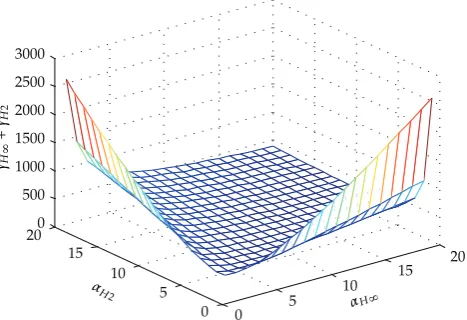
can be carried out through a search procedure in the planeαH2, αH∞.Figure 1is a
three-dimensional plot which depicts the waveform ofγH2 γH∞in that plane. This figure clearly
shows that optimality is achieved close to the direction where αH2 αH∞ α. In this
example, it is found that the minimum value ofαwhich guarantees recovery isαmin 680.
The abridged search procedure along the lineαH2αH∞αproduced a near optimal global
performance ofγH2 199.71 and γH∞ 147.56 whenα αH2 αH∞ 4. Clearly, in this
example, improvement is being made in the region belowαmin 680 where recovery is not
necessarily there.Table 1lists the simulation results obtained with the sufficient standard LMI conditions ofTheorem 3.1and with the sufficient dilated LMI conditions ofTheorem 3.2.
0 5
10 15 20
0 5 10 15 200 500 1000 1500 2000 2500 3000
αH2
γH∞
+
γH2
[image:20.600.185.419.99.259.2]αH∞
Figure 1:3D-plot of the waveformγH2 γH∞in the planeαH2, αH∞.
onH∞performance levels were possible. However, this improvement comes at the expense
of almost tripling the number of decision variables involved in the proposed dilated LMI conditionsseeTable 1.
6. Conclusion
This paper has presented new dilated LMI conditions for the design of multiobjective full-order dynamic output controllers in continuous-time systems that are able to cope not only with stability analysis andH2 performance specifications, but also, with H∞ performance
specifications as well. The paper developed new controller synthesis procedures which offer no particular advantage for precisely known monoobjective systems, but significantly reduce conservatism in the multi-objective control problem, as the main property of these new dilated LMI conditions, besides the fact thatthey allow a complete independence between the standard Lyapunov matrix and the controller parametersis that they always encompass the standard ones. A numerical simulation is presented which supports these claims. The extension of these results to other control issues such as the robust controller, model predictive controller, and filter design problems is rather straightforward and yet very useful.
References
1 S. Boyd, L. El Ghaoui, E. Feron, and V. Balakrishnan,Linear Matrix Inequalities in System and Control Theory, vol. 15 ofSIAM Studies in Applied Mathematics, SIAM, Philadelphia, Pa, USA, 1994.
2 Y. Nesterov and A. Nemirovskii,Interior-Point Polynomial Algorithms in Convex Programming, vol. 13 ofSIAM Studies in Applied Mathematics, SIAM, Philadelphia, Pa, USA, 1994.
3 R. E. Skelton, T. Iwazaki, and G. Grigoriadis,A Unified Approach to Linear Control Design, Taylor and Francis Series in Systems and Control, Taylor and Francis, London, UK, 1997.
4 C. A. R. Crusius and A. Trofino, “Sufficient LMI conditions for output feedback control problems,”
IEEE Transactions on Automatic Control, vol. 44, no. 5, pp. 1053–1057, 1999.
5 K. H. Lee, J. H. Lee, and W. H. Kwon, “Sufficient LMI conditions for H∞output feedback stabilization
6 P. Apkarian, H. D. Tuan, and J. Bernussou, “Continuous-time analysis, eigenstructure assignment, and H2synthesis with enhanced linear matrix inequalitiesLMIcharacterizations,”IEEE Transactions
on Automatic Control, vol. 46, no. 12, pp. 1941–1946, 2001.
7 Y. Ebihara and T. Hagiwara, “New dilated LMI characterizations for continuous-time multiobjective controller synthesis,”Automatica, vol. 40, no. 11, pp. 2003–2009, 2004.
8 C. Scherer, P. Gahinet, and M. Chilali, “Multiobjective output-feedback control via LMI optimization,”
IEEE Transactions on Automatic Control, vol. 42, no. 7, pp. 896–911, 1997.
9 M. Dettori and C. W. Scherer, “New robust stability and performance conditions based on parameter dependent multipliers,” inProceedings of the 36th IEEE Conference on Decision and Control (CDC ’00), vol. 5, pp. 4187–4192, 2000.
10 Y. Ebihara and T. Hagiwara, “A dilated LMI approach to robust performance analysis of linear time-invariant uncertain systems,”Automatica, vol. 41, no. 11, pp. 1933–1941, 2005.
11 E. Feron, P. Apkarian, and P. Gahinet, “Analysis and synthesis of robust control systems via parameter-dependent Lyapunov functions,”IEEE Transactions on Automatic Control, vol. 41, no. 7, pp. 1041–1046, 1996.
12 P. Gahinet, P. Apkarian, and M. Chilali, “Affine parameter-dependent Lyapunov functions and real parametric uncertainty,”IEEE Transactions on Automatic Control, vol. 41, no. 3, pp. 436–442, 1996.
13 J. C. Geromel, M. C. de Oliveira, and L. Hsu, “LMI characterization of structural and robust stability,”
Linear Algebra and Its Applications, vol. 285, no. 1–3, pp. 69–80, 1998.
14 Z. Duan, J. Zhang, C. Zhang, and E. Mosca, “Robust H2and H∞filtering for uncertain linear systems,” Automatica, vol. 42, no. 11, pp. 1919–1926, 2006.
15 D. Peaucelle, D. Arzelier, O. Bachelier, and J. Bernussou, “A new robust D-stability condition for real convex polytopic uncertainty,”Systems & Control Letters, vol. 40, no. 1, pp. 21–30, 2000.
16 U. Shaked, “Improved LMI representations for the analysis and the design of continuous-time systems with polytopic type uncertainty,”IEEE Transactions on Automatic Control, vol. 46, no. 4, pp. 652–656, 2001.
17 W. Xie, “An equivalent LMI representation of bounded real lemma for continuous-time systems,”
Journal of Inequalities and Applications, vol. 2008, Article ID 672905, 8 pages, 2008.
18 M. C. de Oliveira, J. Bernussou, and J. C. Geromel, “A new discrete-time robust stability condition,”
Systems & Control Letters, vol. 37, no. 4, pp. 261–265, 1999.
19 M. C. de Oliveira, J. C. Geromel, and J. Bernussou, “Extended H2and H∞norm characterizations and
controller parametrizations for discrete-time systems,”International Journal of Control, vol. 75, no. 9, pp. 666–679, 2002.
20 C. Farges, D. Peaucelle, D. Arzelier, and J. Daafouz, “Robust H2performance analysis and synthesis
of linear polytopic discrete-time periodic systems via LMIs,”Systems & Control Letters, vol. 56, no. 2, pp. 159–166, 2007.
21 D. Arzelier, D. Henrion, and D. Peaucelle, “Robust D-stabilization of a polytope of matrices,”
International Journal of Control, vol. 75, no. 10, pp. 744–752, 2002.
22 O. Bachelier, D. Peaucelle, D. Arzelier, and J. Bernussou, “A precise robust matrix root-clustering analysis with respect to polytopic uncertainty,” inProceedings of the American Control Conference, vol. 5, pp. 3331–3335, Chicago, Ill, USA, July 2000.