R E S E A R C H
Open Access
Stability for iterative roots of piecewise
monotonic functions
Lin Li
1, Wei Song
2*and Yingying Zeng
3*Correspondence:
2Department of Mathematics,
Harbin Institute of Technology, Harbin, Heilongjiang 150080, P.R. China
Full list of author information is available at the end of the article
Abstract
GlobalC0and localC1stability of iterative roots for monotonic functions defined on a compact interval, as well as globalC1instability under some assumptions, are well-known facts. In this paper, we investigate the stability of iterative roots for piecewise monotonic functions with nonmonotonicity height equal to 1. We prove the roots areC1locally stable andC0global stable with the same extension.
MSC: 39B22; 37E05
Keywords: iterative root; stability; nonmonotonicity height; extension
1 Introduction
Given a Banach spaceXandr≥,Cr(X) is defined as the set of allCrself-mappings onX. An iterative root of orderk∈NofF∈Cr(X) is a functionf ∈Cr(X) that satisfies
fk(x) =F(x), ∀x∈X, (.)
wherefkdenotes thekth iterate off. Being an important problem, iterative roots is con-nected to the research of embedding flow and topological conjugacy in dynamical systems [, ], which is also involved in the study of functional equations [, ]. To find solutions of equation (.) has a long history since years ago [–]. In addition to monotonic map-pings [, ], plenty results were obtained for the iterative roots of piecewise monotonic functions [–].
LetI:= [a,b] be an interval. A pointx∈(a,b) is referred as afortof continuous mapping F:I→I whenF is strictly monotonic in no neighborhood ofx. LetS(F) be the set of all forts ofF. ThenF is called apiecewise monotonic function ifN(F) :=#S(f) is finite. The set of all such piecewise monotonic self-mappings onIis denoted byPM(I,I). It is well known thatN(F) is nondecreasing under iteration, we define thenonmonotonicity height H(F) ofFas the smallest integermsuch thatN(Fm) =N(Fm+). WhenH(F) = , the problem of iterative roots is reduced to be discussed on thecharacteristic interval(see [–]), denoted byK(F). Furthermore, for every continuous iterative rootf ofFof order k≥ there exists a corresponding natural number(f), which mapsIintoK(F). Suchf is called a root of-extension(see []). The following result gives the iterative roots of those functions with -extension.
Lemma .(Theorem in []) Suppose F∈PM(I,I)and H(F) = .Let K(F)be the charac-teristic interval of F, [m,M]be the range of F and[m,M]be those of F restricted to K(F).If equation(.)has a continuous solution f:K(F)→K(F)maps[m,M]into[m,M],then there exists a continuous function
f(x) :=
f(x), x∈K(F),
F|–K(F)◦f◦F(x), x∈I\K(F), (.)
satisfies fk(x) =F(x)for all x∈I.
Clearly,f defined in (.) is a root of -extension andK(f) =K(F). Conversely, it is easy to prove that all continuous iterative roots ofFof orderkwith -extension are in the form of (.).
In addition to the study of the existence of iterative roots, more and more attention was paid to their stability. A local result as regardsCstability for a class of strictly monotonic mappings with one fixed point was considered in [], as well as the globalCstability with more than one fixed point in []. Recently, the authors of [] investigated theCstability of iterative roots for increasing functions defined on a compact interval. They proved that those iterative roots areClocally stable butCglobally unstable.
In this paper, we consider the stability of iterative roots for piecewise monotonic func-tions with nonmonotonicity height equal to . We prove that those roots with the same extension are locallyCstable and globallyCstable.
2 C1stability
LetF∈PM(I,I) withH(F) = andK(F) := [a,b]⊂Ibe its characteristic interval. For eachλ∈(, ), let
H –(λ) :=
h∈C(I) :ha=a,ha=λ,h(x) > andh(x) <x,∀x∈a,b,
H +(λ) :=
h∈C(I) :hb=b,hb=λ,h(x) > andh(x) >x,∀x∈a,b.
For a given integerk≥, as discussed in [], each functionFin class λ∈(,)H–(λ) has a kth orderCiterative rootf onK(F),i.e.,fk(x) =F(x) for allx∈K(F), which is unique and strictly increasing.
Let the norm · rbe defined by
F r:=sup x∈I
F(x)+· · ·+sup x∈I
Fr(x)
for allr∈N∪ {}andF∈Cr(I). Based on the determined formula off,Clocal stability andC global instability forf were investigated in []. The following result shows the stability for those roots.
Lemma .(Theorem . in []) Let F∈H
–(λ) (orH+(λ))with a givenλ∈(, )and let (Fm)be a sequence of functions inH–(λ) (orH+(λ)).If
lim
then
lim
m→∞ ˜fm–f˜ = , (.)
wheref and˜ f˜mare unique kth order Citerative roots of F and Fm,respectively,defined on K(F).
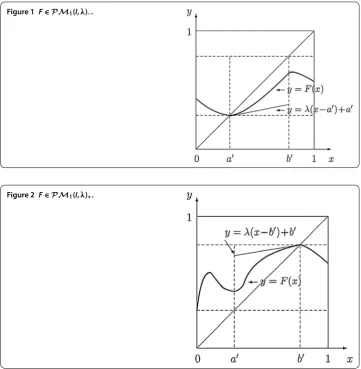
Note that a similar result also holds forF∈ λ∈(,)H +(λ). Let
PM(I,λ)–:=PM(I)∩H–(λ), PM(I,λ)+:=PM(I)∩H+(λ)
(see Figures and ), where
PM(I) =
F∈PM(I,I) :H(F) = andK(F) =a,b.
We first recall some known results. LetS(F) :={d,d, . . . ,dN(F)}, satisfyinga=d<d<
· · ·<dN(F) <dN(F)+=b. Furthermore, letIi:= [di,di+] denotes the closure of ith sub-interval andFi:=F|Ii. ThenI=
N(F)
[image:3.595.117.479.364.734.2]i= IiandFis strictly monotone onIi.
Figure 1 F∈PM1(I,λ)–.
As shown in [], for eachIithere exists a sequence (i,i, . . . ,iτ–) in
, , . . . ,N(F)τ–:=, , . . . ,N(F)× · · · ×, , . . . ,N(F)
τ–
,
whereτ≤min{k,N(F)}such that
Ii f
→Ii f
→ · · ·→f Iiτ– f
→K(F), (.)
whereI→f J denotesf(I)⊂J. Then (.) gives a correspondenceτf :{, , . . . ,N(F)} →
{, . . . ,min{k,N(F)}}asi→τ, which is the number that mapsIi into the characteristic intervalK(F). In [], the natural number
(f) := max i∈{,,...,N(F)}τf(i)
is referred to as thepaceof the iterative rootf.
The following theorem is our main result in this section.
Theorem . Let F∈PM(I,λ)–(orPM(I,λ)+)with someλ∈(, )and let(Fm)be a sequence of functions inPM(I,λ)–(orPM(I,λ)+).If
lim
m→∞ Fm–F = , (.)
then
lim
m→∞ fm–f = ,
where f and fmare kth order Citerative roots of F and Fmwith-extension,respectively.
Proof LetF˜:=F|K(F)andF˜m:=Fm|K(F), for convenience. It suffices to discuss the case that F∈PM(I,λ)–since the proof for the caseF∈PM(I,λ)+is similar. We first prove the existence of those iterative roots ofF,Fm∈PM(I,λ)– with -extension onI. As men-tioned before, each function F andFm has a kth orderC iterative root f˜ and f˜m on their characteristic interval, respectively. Then ˜f(a) =f˜m(a) =asincea is a common fixed point ofFandFm. Furthermore, by the definition ofH–(λ), we havef˜(F([a,b]))⊂ [F(a),F(b)], which implies thatf˜satisfies the conditions in Lemma .. Hence,f˜can be extended as aC iterative rootf ofF on the whole intervalI. Similarly, for eachm∈N there exists a continuous iterative rootfmofFm, which can be presented by
fm(x) :=
˜
fm(x), x∈K(F),
˜
F–
m ◦ ˜fm◦Fm(x), x∈I\K(F),
(.)
wheref˜k
m(x) =F˜m(x) for allx∈K(F). Then it follows from Lemma . that lim
Next, we turn to prove the convergence of (fm) inI\K(F), by (.) and (.) we have fm(x) –f(x)= f˜
m(Fm(x))Fm(x)
˜
Fm(F˜–
m(f˜m◦Fm(x))) – f˜
(F(x))F(x)
˜
F(F˜–(f˜◦F(x)))
≤ f˜m(Fm(x))Fm(x)
˜
Fm(F˜–
m(f˜m◦Fm(x))) – f˜
m(Fm(x))Fm(x)
˜
F(F˜–(f˜◦F(x)))
+ ˜f
m(Fm(x))Fm(x)
˜
F(F˜–(f˜◦F(x)))–
˜
f(F(x))F(x)
˜
F(F˜–(f˜◦F(x)))
≤ f˜m(Fm(x))Fm(x)
˜
Fm(F˜–
m(f˜m◦Fm(x)))F˜(F˜–(f˜◦F(x))) A(x)
+
˜
F(F˜–(f˜◦F(x)))
B(x) (.)
for everyx∈I\K(F), where A(x) =F˜mF˜m–f˜m◦Fm(x)
–F˜F˜–f˜◦F(x) and
B(x) =f˜mFm(x)
Fm(x) –f˜F(x)F(x).
In the following, we will estimate the limit ofA(x) andB(x). Since
A(x)≤F˜mF˜m–f˜m◦Fm(x)
–F˜F˜m–f˜m◦Fm(x) +F˜F˜m–˜fm◦Fm(x)
–F˜F˜–f˜◦F(x)
≤ Fm–F +F˜ ˜
Fm–˜fm◦Fm(x)
–F˜F˜m–f˜◦Fm(x) +F˜F˜m–˜f◦Fm(x)
–F˜F˜–f˜◦Fm(x) +F˜F˜–˜f◦Fm(x)
–F˜F˜–f˜◦F(x)
≤ Fm–F +F˜ ˜
Fm–˜fm◦Fm(x)
–F˜F˜m–f˜◦Fm(x) +F˜◦ ˜F–◦ ˜F◦ ˜Fm–f˜◦Fm(x)
–F˜◦ ˜F–◦ ˜Fm◦ ˜Fm– ˜
f ◦Fm(x) +F˜F˜–˜f◦Fm(x)
–F˜F˜–f˜◦F(x) by (.) and the facts thatF˜◦ ˜F–
m andF˜◦ ˜F–are uniformly continuous, we haveA(x)→ uniformly inIasm→ ∞.
Moreover, by the definition ofB(x), we obtain
B(x)≤f˜mFm(x)
Fm(x) –f˜mFm(x)
F(x)+f˜mFm(x)
F(x) –f˜F(x)F(x)
≤f˜mFm(x)Fm(x) –F(x)+F(x)f˜m
Fm(x)
–f˜F(x)
≤f˜mFm(x) Fm–F +F(x)˜fmFm(x)
–˜fFm(x)+f˜
Fm(x)
–f˜F(x)
≤f˜mFm(x) Fm–F +F(x) ˜fm–f˜ +f˜
Fm(x)
Noticef˜andf˜mareCdifferentiable. Then it follows from (.)-(.) thatB(x)→ uni-formly inIwhenm→ ∞.
On the other side, note thatF˜(x),F˜m(x) > for allx∈K(F), which implies
<sup x∈I
F˜(F˜–(˜f(F(x)))) <∞
and
≤sup x∈I
f˜m(Fm(x))Fm(x)
˜
Fm(F˜–
m(f˜m(Fm(x))))F˜(F˜–(f˜(F(x)))) <∞.
Therefore, in view of (.), it gives
lim m→∞f
m–f= .
We concludelimm→∞ fm–f = . The proof of Theorem . is completed.
Theorem . shows theCstability of iterative roots with -extension since the form of roots is determined uniquely by (.). Conversely, we conclude theCinstability for those roots with different extensions. Moreover, according to the construction of iterative roots with large extensions (see []), we find that the mode of the roots is not unique, which leads to theCinstability for those iterative roots in different modes. Similar to the proof for the -extension in Theorem ., we have the following result for larger extensions.
Theorem . Let F∈PM(I,λ)–(orPM(I,λ)+)with someλ∈(, )and let(Fm)be a sequence of functions inPM(I,λ)–(orPM(I,λ)+).If
lim
m→∞ Fm–F = ,
and F,Fmhas a kth order Citerative root f and fmwith the same mode of extension,then
lim
m→∞ fm–f = .
3 Hyers-Ulam stability
In this section we prove the Hyers-Ulam stability of equation (.).
SupposeF∈PM(I,I) andIiis an open interval between two consecutive forts (or end-points) ofF. RecallI= Ni=(F)cl(Ii) and we letI(F) :={Ii:i= , , . . . ,N(F)}.
Theorem . Let F∈PM(I,I)with H(F) = be given.If the function fs∈PM(I,I)is Lips-chitzian with constants m> ,M> such that
m|x–y| ≤fs(x) –fs(y)≤M|x–y| (.) for every x,y∈K(F),and satisfies:
(A) H(fs) = andK(fs) =K(F);
(A) fsk(x) =F(x)for allx∈K(F),andfsmapsK(F)onto itself homeomorphically;
(A) fk
then equation(.)has a solution f∈PM(I,I)such that
fs–f ≤ +M
mk δ. (.)
Proof This proof is based on the construction of iterative roots of F ∈PM(I,I) with H(F) = . Let
Fs(x) :=fsk(x), ∀x∈I. (.)
It follows from (A) thatH(Fs) = andK(F) is also the characteristic interval ofFsby the iterating mode offs. Thus, from the proof of Theorem . in [] and (.), eachkth order continuous iterative rootfsofFsis extended from that onK(F) by the following formula:
fs(x) =Fs|–K(F)◦fs|K(F)◦Fs|Ii(x), ∀x∈Ii∈I(F)\
K(F). (.)
Hence, the desired functionf ∈PM(I,I) can be defined by
f(x) :=
fs(x), x∈K(F), F|–
K(F)◦fs|K(F)◦F|Ii(x), x∈Ii∈I(F)\{K(F)}.
(.)
SinceFsmapsK(F) onto itself homeomorphically by (A), it means thatFs|–K(F)◦fs|K(F)◦F|Ii is well defined. Sincefk
s(x) =F(x) for allx∈K(F), one can check thatfdefined in (.) is a solution of equation (.).
In order to prove (.), it suffices to prove
fs–f ≤ +M
mk δ, ∀x∈Ii∈I(F). (.)
Obviously, (.) holds for everyx∈K(F). We next claim that, for everyx∈Ii,
(K) Fs|–K(F)◦fs|K(F)◦F|Ii(x) –Fs| –
K(F)◦fs|K(F)◦Fs|Ii(x)≤ M mkδ,
(K) F|–K(F)◦fs|K(F)◦F|Ii(x) –Fs| –
K(F)◦fs|K(F)◦F|Ii(x)≤ mkδ.
Actually, it follows from (.), (A), and (.) that, for everyx∈Ii, fs|K(F)◦F|Ii(x) –fs|K(F)◦Fs|Ii(x)≤MF|Ii(x) –Fs|Ii(x)≤Mδ
and
fs|K(F)◦F|Ii(x) –fs|K(F)◦Fs|Ii(x)
=Fs◦Fs|–K(F)◦fs|K(F)◦F|Ii(x) –Fs◦Fs| –
K(F)◦fs|K(F)◦Fs|Ii(x)
≥mkFs|–K(F)◦fs|K(F)◦F|Ii(x) –Fs| –
On the other hand, in view of (.) and (A) we have
δ≥Fs◦F|–K(F)◦fs|K(F)◦F|Ii(x) –F◦F| –
K(F)◦fs|K(F)◦F|Ii(x) =Fs◦F|–K(F)◦fs|K(F)◦F|Ii(x) –Fs◦Fs|
–
K(F)◦fs|K(F)◦F|Ii(x)
≥mkF|–K(F)◦fs|K(F)◦F|Ii(x) –Fs| –
K(F)◦fs|K(F)◦F|Ii(x) for everyx∈Iand thus (K) is proved.
Therefore, consider everyx∈Ii, it follows from (K) and (K) that fs(x) –f(x)=F|–K(F)◦fs|K(F)◦F|Ii(x) –Fs|
–
K(F)◦fs|K(F)◦Fs|Ii(x)
≤F|–K(F)◦fs|K(F)◦F|Ii(x) –Fs| –
K(F)◦fs|K(F)◦F|Ii(x) +Fs|–K(F)◦fs|K(F)◦F|Ii(x) –Fs|
–
K(F)◦fs|K(F)◦Fs|Ii(x)
≤ +M
mk δ.
Thus (.) is proved. The proof of Theorem . is completed.
Theorem . Let F∈PM(I,I)with H(F) = be given.If the function fs∈PM(I,I)is Lips-chitzian with constants m> ,M> such that
m|x–y| ≤fs(x) –fs(y)≤M|x–y| for every x,y∈K(F),and satisfies:
(A) for eachIi∈I(F)there exists a positive integerτ ≤min{k,N(F)}such that fτ
s(Ii)⊂K(F)andS(fsk) =S(F);
(A) fk
s(x) =F(x)for allx∈K(F),andfsmapsK(F)onto itself homeomorphically;
(A) fk
s –F ≤δfor a constantδ> ,
then equation(.)has a solution f∈PM(I,I)such that
fs–f ≤ +M
mk δ.
The proof is similar to that of Theorem ..
4 Examples
Example . Consider the mappingF: [–, ]→[–, ], defined by
F(x) =
–x+x+x, ∀x∈[–, ),
x+
x, ∀x∈[, ].
Clearly,F∈C([–, ))∪C([, ]) andF maps [–, ] into [, ]. Thus,K(F) = [, ]. Moreover,λ=
and all conditions inPM(I,λ)– are satisfied onK(F). Therefore, by Theorem . theCiterative root ofFwith -extension isCstable.
Example . Define the mappingF: [, ]→[, ] by
F(x) =
x, ∀x∈[,], x– x+
Obviously,H(F) = andK(F) = [,]. In order to demonstrate the validity of conditions in Theorem ., consider the functionfs: [, ]→[, ]:
fs(x) =
x, ∀x∈[, ], –x+ , ∀x∈(, ],
which is Lipschitzian with the constantsm=,M= onK(F), such that
|x–y| ≤fs(x) –fs(y)≤ |x–y|.
Moreover, one can check that conditions (A) and (A) in Theorem . are true forfs. We further calculate that
fs(x) =
x, ∀x∈[,], –x+ , ∀x∈(, ]. Hence, it follows that
fs(x) –F(x)=x–x– ≤
, ∀x∈[, ].
Therefore, by Theorem ., equation (.) has a solutionf ∈PM([, ], [, ]) such that fs–f ≤,, for allx∈[, ].
Competing interests
The authors declare that they have no competing interests.
Authors’ contributions
The authors contributed equally to the writing of this paper. All authors read and approved the final manuscript.
Author details
1Department of Mathematics, Physics and Information Engineering, Jiaxing University, Jiaxing, Zhejiang 314001,
P.R. China.2Department of Mathematics, Harbin Institute of Technology, Harbin, Heilongjiang 150080, P.R. China. 3College of Mathematics and Software Science, Sichuan Normal University, Chengdu, Sichuan 610068, P.R. China.
Acknowledgements
The authors are grateful to the editor and the referees for their valuable comments. This work is supported by the National Science Foundation of China (Nos. 11301226, 11101105), Zhejiang Provincial Natural Science Foundation of China under Grant No. LQ13A010017 and Scientific Research Fund of Sichuan Provincial Education Department (No. 15ZB0041).
Received: 30 August 2015 Accepted: 1 December 2015
References
1. Fort, MK Jr.: The embedding of homeomorphisms in flows. Proc. Am. Math. Soc.6, 960-967 (1955)
2. Shi, Y-G, Li, L, Le´sniak, Z: On conjugacy ofr-modal interval maps with nonmonotonicity height equal to 1. J. Differ. Equ. Appl.19, 573-584 (2013)
3. Baron, K, Jarczyk, W: Recent results on functional equations in a single variable. Aequ. Math.61, 1-48 (2001) 4. Targonski, G: Topics in Iteration Theory. Vandenhoeck & Ruprecht, Göttingen (1981)
5. Babbage, C: An essay towards the calculus of functions. Philos. Trans. R. Soc. Lond.105, 389-423 (1815) 6. Kuczma, M: Functional Equations in a Single Variable. Polish Sci., Warsaw (1968)
7. Kuczma, M, Choczewski, B, Ger, R: Iterative Functional Equations. Encycl. Math. Appl., vol. 32. Cambridge University Press, Cambridge (1990)
8. Zhang, J, Yang, L: Discussion on iterative roots of piecewise monotone functions. Acta Math. Sin.26, 398-412 (1983) (in Chinese)
9. Zhang, W: PM functions, their characteristic intervals and iterative roots. Ann. Pol. Math.65, 119-128 (1997) 10. Li, L, Yang, D, Zhang, W: A note on iterative roots of PM functions. J. Math. Anal. Appl.341, 1482-1486 (2008) 11. Liu, L, Zhang, W: Non-monotonic iterative roots extended from characteristic intervals. J. Math. Anal. Appl.378,
12. Liu, L, Jarczyk, W, Li, L, Zhang, W: Iterative roots of piecewise monotonic functions of nonmonotonicity height not less than 2. Nonlinear Anal.75, 286-303 (2012)
13. Xu, B, Zhang, W: Construction of continuous solutions and stability for the polynomial-like iterative equation. J. Math. Anal. Appl.325, 1160-1170 (2007)
14. Zhang, W, Zhang, W: Continuity of iteration and stability of iterative roots. J. Comput. Appl. Math.235, 1232-1244 (2011)
15. Zhang, W, Zeng, Y, Jarczyk, W, Zhang, W: LocalC1stabilityversusglobalC1unstability for iterative roots. J. Math. Anal.