2019 International Conference on Information Technology, Electrical and Electronic Engineering (ITEEE 2019) ISBN: 978-1-60595-606-0
Balanced Risk Assessment System for the Elderly
Based on Factor Analysis and EWM
Xin-lin YING
1, Can-can SU
1, Ying-ying LU
2, Qiang LIU
3and Yan-ling XU
4,*1
College of engineering, Huazhong agricultural university, Wuhan, China 2
College of Economics & Management, Huazhong agricultural university, Wuhan, China 3
Hubei Tourism School, Wuhan, China
4 Department of mathematics and statistics, College of science, Huazhong Agricultural University, Wuhan, China
*Corresponding author
Keywords: Evaluation system, Factor analysis, EWM, Senile gait.
Abstract. This paper discusses how to evaluate the balance ability of the elderly and puts forward specific suggestions to prevent falls. Through literature review, we have established the first level of indicators including age, posture, walking posture, medical history [1][2]. Then different diseases and different characteristics of the body during walking were taken as secondary indicators. Factor analysis and stepwise regression were used to screen index and extract information. Finally, entropy weight method is used to quantify the index. It was found that the three secondary indicators of walking posture in the system of men and women all had an impact of 1/3. In men, lead leg and disease have basically the same effect on the elderly's falls, while in women, age and disease have basically the same effect.
Introduction
Falls are common in the elderly population. Falls may cause many complications in elderly people, because they generally have poor rehabilitation ability, so the side effects can be so debilitating as to accelerate body failure. In addition, the fear from falls may impair the ability to move and constrict the scope of mobility, therefore worsening the quality of life significantly. Consequently, it is of great realistic importance to make a balance ability assessment for elderly people with a view to assisting them in mobility status, correcting postures and preventing accidental falls.
Research Object
According to the spatial 3d coordinate points of 42 points in the whole body of 80 elderly people with a gait cycle given by 2018APMCM, their age, BMI, lead leg and medical history data were also included.
Research Methods
Disease Factors Based on Stepwise Regression
First, we identify disease types that are important for balance.
Through stepwise regression, diseases that have a great impact on male and female falls are obtained, and the corresponding values of disease indicators are obtained according to linear regression.
prevalence t
coefficien n
correlatio
Disease * (1)
Classification of Indicators Based on Factor Analysis
Factor analysis was used to combine the first order indexes with a lot of the same information. Factor analysis is to decompose the original variable into a linear combination of several common factors, so as to better understand the internal relationship of the original variable.
Set X ii( 1, 2,... )p be p variables, it can be denoted as:
(2)
(3)
(4)
1, 2, , m
F F F are called common factors, which are unobservable variables. L(Lij)p m is
called a factor loading matrix. i is a special factor, which cannot be included by the first m common factors. And it satisfies cov( , )F 0, meanwhile, F, are irrelevant.
Steps of the factor analysis:
1. Find the potential common factors F1,F2,...,Fm; 2. Calculate factor loading;
3. Explain the relationship between variables.
Age, BMI, disease and lead leg were used for factor analysis, so as to classify The four indicators and establish a risk assessment system.
Risk Assessment System Based on Entropy Weight Method (EWM )
Information entropy borrows the concept of dryness in thermodynamics to describe, on average, the amount of information about an event. According to the definition of information flag, entropy value can be used to judge the high dispersion degree of an index. The smaller the entropy value is, the higher the high dispersion degree of the index is. The greater the influence of the index on the comprehensive evaluation that is, the weight is.
The procedure of objective weight determination by entropy weight method:
Step 1 Data Standardization
Firstly, the data is preprocessed to remove the data dimension. The specific method is as follows:
(5)
ij
x is the jth index of the ith elderly, the normalized version is xij'
; max(xj) is the maximum
value of the jth index; min( )xj is the smallest value of the jth index.
Step 2Calculate the entropy of each index
(6)
j
E is the information entropy of the ith index; yij is the proportion of the jth index of the ith
elderly.
Step 3 Calculate the weight of each index
j
w is the weight of the jth index.
1 11 1 12 2 13 3 1 1
2 21 1 22 2 23 3 2 2
1 1 2 2 3 3
= ... = ... ... = ... m m m m
p p p p pm m p
X L F L F L F L F
X L F L F L F L F
X L F L F L F L F
1 1 2 2 3 3
= ...
i i i i im m i
X L FL F L F L F
+
XLF
min(x ) '
max( ) min(x )
(7)
Solution of the Model
Regression Results and Analysis
Through stepwise regression analysis, we found that for men, only bone fractures had a significant effect on balance, so they were considered as disease indicators. For women all 10 diseases except drug/alcohol abuse had significant effects on balance. Taking 10 diseases as independent variables and fall times as dependent variables, linear regression was conducted to obtain the correlation coefficients of 10 diseases, and the value of this index for women was obtained according to the disease formula.
Factor Analysis Results and Analysis
Factor analysis was carried out for the four indicators according to the given data of disease, age, BMI and lead leg. The results of factor analysis for male and female patients were shown in equations 8 and 9.
F1=0.84813*age-0.08803*BMI+0.77765*disease+0.12375*lead
F2=0.06460*age+0.98234*BMI-0.22085*disease-0.00645*lead (8) F3=0.09420*age-0.00497*BMI+0.08317*disease+0.9929*lead
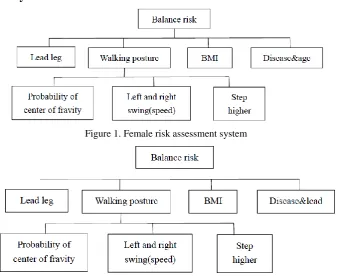
For men, four indicators are divided into three factors, one of which mainly includes lead and disease, and the other two factors are BMI and age.
F1=-0.03363*age+0.07714*BMI-0.7968*disease+0.80137*lead
F2=0.99804*age+0.01718*BMI+0.06453*disease+0.01908*head (9) F3=0.01709*age+0.99682*BMI-0.04226*disease+0.06087*lead
For women, four indicators are divided into three factors, namely, age, disease, BMI and lead leg.
[image:3.595.131.469.486.766.2]Risk Assessment System
Figure 1. Female risk assessment system
Figure 2. Male risk assessment system.
The results obtained by entropy weight method are as follows.
1
1 j
j m
j j
E w
m E
Table 1. The weight of female assessment index for female.
index Disease & age BMI lead walking posture weight 0.150583 0.346014 0.249489 0.253913
Table 2. The weight of female gait index for female
index Probability of center of gravity
Left and right swing (speed)
Step higher
[image:4.595.79.516.87.291.2]weight 0.339904 0.333274 0.326822
Table 3. The weight of male assessment index for male.
index Disease & lead age BMI walking posture
[image:4.595.81.512.200.290.2]weight 0.350502 0.147629 0.2482 0.253699
Table 4. The weight of male gait index for male
index Probability of center of gravity
Left and right swing (speed)
Step higher
weight 0.32486 0.339499 0.335641
For men, age accounts for the smallest proportion, so it is believed that the balance ability of men has little to do with age. However, there was a strong relationship between balance and fracture risk. Generally, men who engage in sports activity are also more likely to break bones when they are younger than women. Side effects start to show up in old age. It can be found from the data of the research objects that men generally take significantly longer to complete a gait cycle than women. This suggests that fear of falls and fractures makes them more likely to fall. In the aspect of walking posture, the three functions are basically the same.
Summary
For both men and women, it can be found that BMI is an important indicator of balance ability. Older people with a lower BMI have healthier systems. Biology also found that the elderly with short and fat body types have lower balance ability than those with medium body types and those with tall and thin body types. People who are tall and thin tend to have a lower BMI. Then it can be found that age and disease form an unobservable special factor for women. Lead leg is used as an indicator alone. This indicates that the internal regulation function of the body has a great impact on women's balance ability, and this effect is constantly strengthened with the increase of age. The exertion leg, on the other hand, can show the effect of a single type of joint flexibility on falls.[3]
For men: Age is a separate category. Studies have shown that finger joint flexibility deteriorates faster in men than in women as they age. And balance ability basically is concerned with knee, ankle, hip. Rheumatism is less common in men than in women. So men are less likely to fall. Disease and lead have reciprocal effects on falls. Play a role in male diseases, mainly ipads fracture. This indicates that the disease is easy to lead to falls, but the better use of a leg force can overcome the problem.[3]
Acknowledgement
This research was financially supported by the postgraduate curriculum construction of Huazhong Agricultural University “Longitudinal data analysis with SAS application” (Grants No. 2016KC14).
References
[2] Duan Zengwu. Capturing and Application of Human Motion Information Based on Kinect, Hebei University, Wuhan, 2016.