2018 3rd International Conference on Information Technology and Industrial Automation (ICITIA 2018) ISBN: 978-1-60595-607-7
A Routing Protocol Based on Path Signal
Strength in Wireless Sensor Networks
Min Jiang, Bencan Gong, Dong Ren and Peng Chen
ABSTRACT
In order to improve the packet delivery rate of wireless sensor networks, this paper proposes a routing protocol based on path signal strength (PSSR) in wireless sensor networks. In the process of routing discovery, the node can get the link quality information through the radio signal strength received by the physical layer and calculate the path signal strength from sink to the current node to select a path with higher path signal strength and fewer hops. Omnet network simulation software and castalia simulation framework are used to simulate PSSR. The simulation results show that PSSR can effectively improve the packet delivery rate.1
INTRODUCTION
Wireless Sensor Networks (WSN) is widely used in many fields, such as environmental monitoring, military reconnaissance, medical monitoring, space exploration, rescue and disaster relief, and has important scientific research value and broad application prospects. At present, the research of WSN mainly focuses on the MAC layer, the network layer and the transport layer, as well as the cross-layer interaction between the layers. The network layer is responsible for forwarding the data collected by sensor nodes to sink hop by hop. Its performance is very important, and it is a research hotspot of WSN. The limitation of resources brings great challenges to the design of WSN routing protocols. Compared with traditional routing protocols, WSN routing protocols pay more attention to energy efficiency
1
Min Jiang, Bencan Gong, Peng Chen, College of Computer and Information Technology, China Three Gorges University, Yichang Hubei, China
and reliability of data transmission [1]. Because the routing protocol based on minimum hops is simple to implement, uses the maximum distance for data transmission each time from the current node to sink, and has the less network delay, so it has been widely used [2]. This paper proposes a novel routing protocol based on path signal strength, which increases the data packet delivery rate and reduces the energy consumption of network.
RELATED WORK
At present, many hop-based routing protocols and their improved algorithms have been proposed. In multipath Rings Routing protocol [3],sink broadcast topology set up packet with the ring number 0 during topology formation. Each node that receives this topology set up packet will increase the ring number by 1 and rebroadcast it. This process continues until all nodes get ring number, which denotes the hop distance from source to sink. A queue-based routing protocol (LRP) with link quality awareness is proposed [4]. In sparse and densely deployed underwater acoustic sensor networks, LRP can avoid path loops and packet loss and improve data transmission rate. A link quality and energy-aware routing protocol (LQEAR) is proposed [5]. LQEAR selects the next hop node according to the link quality, the residual energy of the node and the distance between the forwarding node and sink. LQEAR can provide higher transmission reliability and effectively balance the energy consumption of the node. A reliable routing protocol based on pressure sensor (PSBR) is proposed [6], which relies on various metrics provided by link quality estimator to select data forwarding nodes, and achieves high data transmission efficiency. A reliable and energy-saving routing protocol (RRP) for underwater sensor networks is proposed [7], which combines the characteristics of direction-based flooding routing and vector-based obstacle avoidance protocols. It can controls the number of nodes forwarding data packets by hop-by-hop measuring the link quality between nodes to improve reliability. In the process of routing, these protocols introduce link quality information between the current node and its neighbors, which reduces the packet loss rate. However, they only consider the link quality information directly connected to the current node, and do not consider the quality information of other links in the path, so network packet loss rate is still high.
PSSR SCHEME
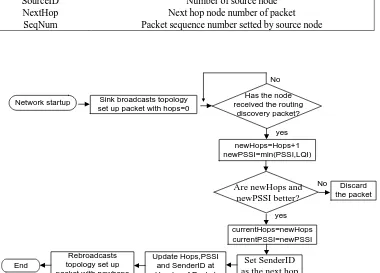
current Hops and current PSSI of the node. If their values are better, they are updated. Finally, the next hop information is recorded and the routing discovery packet is rebroadcasted. The path signal strength is the quality information of all links from sink to current node, and PSSR uses it as the basis for routing selection. The rules for judging whether newHops and newPSSI are better are as follows:
Rule 1:(currentHops>newHops && (newPSSI>=currentPSSI || newPSSI>=LQIThreshold))
Rule 2: (currentHops==newHops && newPSSI>currentPSSI)
Rule 3: (currentHops<newHops && currentPSSI<LQIThreshold && (newPSSI-currentPSSI) /(newHops-currentHops)>LQIDifference)
[image:3.612.99.482.297.406.2]Where LQIThreshold and LQIDifference are two experimental parameters. The former is the threshold of good link quality, and the latter is the difference of link quality per unit hop.When any of the rules is satisfied, the new path will be selected.
TABLE I. FORMAT OF NETWORK PACKET.
Field Name Meaning
PacketKind Packet types, including routing setup packets and data packets SinkID Number of sink
Hops Number of hops from sender to sink SenderID Sender's number
PSSI Path signal strength from sink to current node SourceID Number of source node
NextHop Next hop node number of packet SeqNum Packet sequence number setted by source node
yes No
Network startup Sink broadcasts topology set up packet with hops=0
Discard the packet
Set SenderID as the next hop
Update Hops,PSSI and SenderID at Header of Packet Rebroadcasts
topology set up packet with newhops
newHops=Hops+1 newPSSI=min(PSSI,LQI)
currentHops=newHops currentPSSI=newPSSI
Has the node received the routing
discovery packet?
Are newHops and newPSSI better?
End
No
yes
[image:3.612.108.488.375.648.2]Figure 2. Packet delivery rate for small networks.
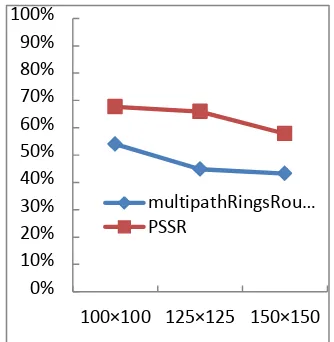
Figure 3. Packet delivery rate for large networks.
SIMULATION AND RESULT ANALYSIS
This paper simulates and compares Multipath Routing and PSSR protocol. The performance of the two protocols is measured by packet delivery rate. The emulation environment used in this paper is OMNET++ version 4.6 [8] and Castalia-3.2 [9]. The simulation time is 6000s.The wireless transmitter module is CC2430, the initial energy of node is 18730J.The packet size is 20bytes.
The coordinates of the base station are (0,0). For small-scale networks, nine nodes are evenly distributed in 30m*30m, 40m*40m, 50m*50m and 60m*60m network areas. For large-scale networks, 100 nodes are evenly distributed in 100m*100m, 150m*150m and 200m*200m network areas. The packet delivery rate of the network are shown in Figure 2 and Figure 3. For networks of different sizes,
0% 10% 20% 30% 40% 50% 60% 70% 80% 90% 100%
30×30 40×40 50×50 60×60 multipathRingsRouting PSSR
0% 10% 20% 30% 40% 50% 60% 70% 80% 90% 100%
[image:4.612.209.376.296.467.2]the packet delivery rate of PSSR is higher than that of multipath Rings Routing. With the increase of network area, the number of transmission hops increases accordingly. Therefore, the packet delivery rate of PSSR protocol decreases. For small-scale and large-scale networks, the average packet delivery rates of PSSR are 26.4% and 31.7% higher than those of Multipath Routing, respectively.
CONCLUSIONS
In this paper, the PSSR routing protocol based on path signal strength is proposed. In the process of routing discovery, the node can select a path with higher path signal strength and fewer hops according to the established optimization rules. The simulation results show that PSSR can effectively improve the packet delivery rate.
ACKNOWLEDGMENTS
This work is supported by the National Natural Science Foundation of China (No. 60672137), the National Key Research and Development Projects of China (No. 2016YFD0800902) and the Major Technological Innovation Project in Hubei Province of China (No.2017ABA157).
REFERENCES
1. Zhihong Qian, Yijun Wang. “Internet of Things-Oriented Wireless Sensor Networks Review”. Journal of Electronics & Information Technology, 2013, 35(1):215-227.
2. Olayinka O O, Attahiru S A. “A Survey on an Energy-Efficient and Energy-Balanced Routing Protocol for Wireless Sensor Networks”. Sensors, 2017, 17(5):1-51.
3. Dhwani J B, Ishan R. “Performance of Multipath Ring Routing Protocol with Static Implementation in Wireless Sensor Network”. International Journal of Engineering Technology, Management and Applied Sciences, 2015, 3(1):35-37.
4. Faheem M, Tuna G, Gungor V C. “LRP: Link Quality-Aware Queue-Based Spectral Clustering Routing Protocol for Underwater Acoustic Sensor Networks”. International Journal of Communication Systems.2017, 30(12):1-17.
5. Aswale S, Ghorpade V R. “LQEAR: Link Quality and Energy-Aware Routing for Wireless Multimedia Sensor Networks”. Wireless Personal Communications. 2017, 97(1):1291-1304. 6. Tariq M, Abd L M S, Ayaz M, et al. “Pressure Sensor Based Reliable (PSBR) Routing Protocol
for Underwater Acoustic Sensor Networks”. Ad Hoc & Sensor Wireless Networks. 2016, 32(3):175-196.
7. Al-Shihri F, Arafah M. “Reliable and Energy Efficient Routing Protocol for Under Water Sensor Networks.International Journal on Semantic Web and Information Systems”.2017, 13(2):14-26. 8. A Varga, OpenSim Ltd. “OMNeT++ User Manual, Version 4.6”.https://omnetpp.org.