S T U D Y P R O T O C O L
Open Access
A randomized clinical trial of a peri-operative
behavioral intervention to improve physical
activity adherence and functional outcomes
following total knee replacement
Milagros C Rosal
1*, David Ayers
2, Wenjun Li
1, Carol Oatis
3, Amy Borg
1, Hua Zheng
2and Patricia Franklin
2Abstract
Background:Total knee replacement (TKR) is a common and effective surgical procedure to relieve advanced knee arthritis that persists despite comprehensive medical treatment. Although TKR has excellent technical outcomes, significant variation in patient-reported functional improvement post-TKR exists. Evidence suggests that consistent post-TKR exercise and physical activity is associated with functional gain, and that this relationship is influenced by emotional health. The increasing use of TKR in the aging US population makes it critical to find strategies that maximize functional outcomes.
Methods/Design:This randomized clinical trial (RCT) will test the efficacy of a theory-based telephone-delivered Patient Self-Management Support intervention that seeks to enhance adherence to independent exercise and activity among post- TKR patients. The intervention consists of 12 sessions, which begin prior to surgery and continue for approximately 9 weeks post-TKR. The intervention condition will be compared to a usual care control condition using a randomized design and a probabilistic sample of men and women. Assessments are conducted at baseline, eight weeks, and six- and twelve- months. The project is being conducted at a large healthcare system in Massachusetts. The study was designed to provide greater than 80% power for detecting a difference of 4 points in physical function (SF36/Physical Component Score) between conditions (standard deviation of 10) at six months with secondary outcomes collected at one year, assuming a loss to follow up rate of no more than 15%. Discussion:As TKR use expands, it is important to develop methods to identify patients at risk for sub-optimal functional outcome and to effectively intervene with the goal of optimizing functional outcomes. If shown efficacious, this peri-TKR intervention has the potential to change the paradigm for successful post-TKR care. We hypothesize that Patient Self-Management Support to enhance adherence to independent activity and exercise will enhance uniform, optimal improvement in post-TKR function and patient autonomy, the ultimate goals of TKR. Trial Registration:ClinicalTrials.gov: NCT00566826
Background
The number of primary total knee replacement (TKR) procedures has grown by 73% in the past 10 years [1] and is projected to expand by more than 600% to 3.48 million procedures by 2030 [2]. Several facts are respon-sible for this increase in use, including (1) the
prevalence of knee arthritis parallels the growing num-bers of older adults, (2) increasing numnum-bers of working aged adults are choosing TKR [1], and (3) TKR is a cost-effective intervention that reduces and eliminates pain. Despite these encouraging facts, significant varia-tion remains in patient-reported funcvaria-tional improve-ment after TKR. An estimated 15-38% of patients report minimal functional improvement at 12 months, while another 10% report functional gains up to 3 times the national average [3,4]. Furthermore, our data suggests
* Correspondence: [email protected]
1Department of Medicine, Division of Preventive and Behavioral Medicine,
University of Massachusetts Medical School, 55 Lake Avenue North, Worcester, MA 01655, USA
Full list of author information is available at the end of the article
that the distribution of physical function at 12 months after TKR is bimodal [5]. The mechanism that underlies this varied functional improvement is not understood. While TKR researchers have identified some consistent predictors of poor gains in post-TKR function, no one patient attribute or surgical factor offers a satisfactory explanation for this outcome variation [6]. Importantly, poor emotional health as measured by the Mental Com-posite Score (MCS) of the SF36 is consistently asso-ciated with poor functional gain following TKR [3,4]. The NIH TKR Consensus Panel called for further research to address the role of patient attributes and rehabilitation regimens in functional outcome after TKR.
Exercise and activity improve global and knee-specific function in knee arthritis patients [7] and patient’s con-fidence in their ability to manage their arthritis pain and function has been consistently associated with improved function, exercise, pain control, and self-care [8]. We have examined these associations in our pilot research and our data support a direct relationship between quantity of post-TKR exercise and activity and func-tional gain after TKR. This relationship was mediated by the patient’s emotional health (SF36, MCS) and MCS was directly correlated with self-efficacy for arthritis self-care [9].
Based on the existing evidence, we hypothesize that a Patient Self-Management Support intervention that tar-gets self-efficacy for physical activity and independent activity and exercise during the peri-operative TKR per-iod will improve actual adherence to independent exer-cise and activity and, thus, maximize 6 and 12 month functional outcomes among post- TKR patients. This paper describes an ongoing study that is testing this hypothesis.
Methods/Design
Study Design
This prospective randomized clinical trial (RCT), funded by the National Institute for Arthritis and Musculoskele-tal and Skin Diseases; NIAMS), is testing the efficacy of a theory-based telephone-delivered patient self-manage-ment support intervention to optimize post-TKR patient functional outcomes. The study participants are rando-mized to the Patient Self-Management Support inter-vention or to a usual care (control) condition, defined as care as prescribed by the patient’s orthopedic surgeon or health care provider. The study seeks to assess the effect of the intervention on post TKR functional improvement, and understand the mechanisms of inter-vention effect by evaluating the roles of home exercise, physical activity, exercise self-efficacy, and participant attributes on functional improvement after TKR. It is hypothesized that, as compared to the control condition,
patients receiving the Patient Self-Management Support intervention will have significantly greater increase in 6 and 12 month global (SF36/PCS) and knee-specific (WOMAC-Western Ontario and McMaster Universities Osteoarthritis Index) function. We also hypothesize that the intervention will enhance self-efficacy for exercise and that, in turn, increased self-efficacy will be asso-ciated with higher levels of home exercise and physical activity at 8 weeks and 6 and 12 month post-TKR. The study has approval from the Institutional Review Board of the Office of Human Subjects at the University of Massachusetts Medical School.
Setting and population
The study is being implemented in collaboration with the Arthritis and Joint Replacement Center at UMass Memorial Medical Center (UMMHC), Worcester, MA, the sole dedicated arthroplasty center for the UMMHC 7-hospital system. Men and women 21 years of age or older and scheduled for primary, single-side TKR sur-gery undergoing sursur-gery at the Arthritis and Joint Repla-cement Center are eligible for participation. Exclusions include: inflammatory arthritis, TKR due to fracture, malignancy, infection, or failure of a previous arthro-plasty; inability to provide informed consent due to dementia or cognitive impairment; co-existing condi-tions that would negate functional improvement with surgery and exercise (i.e., severe Parkinson disease, or hemi paresis); emergently scheduled surgery; simulta-neous bi-lateral TKR; terminal illness with life expec-tancy of less than one year; expected to be community dwelling after surgery; unavailable to complete the study procedures (i.e., will be out-of-region during rehabilita-tion period); and planning another TKR or total hip replacement surgery within 6 months.
Recruitment, baseline assessment and randomization The study coordinator recruits patients by reviewing a list of patients each week who are scheduled for upcom-ing TKR surgery, assessupcom-ing patient’s eligibility, calling patients to introduce the study and then mailing the consent form. The coordinator then follows up via tele-phone call. Patients complete and mail back a baseline assessment that includes the SF-36, the Pre-Surgery WOMAC, and a modified arthritis and exercise Self-Efficacy Scale. In addition, participants wear an ankle accelerometer (Step Activity Monitor) for four continu-ous days (at least one weekend day), and complete an exercise log.
represent subgroups of patients who may respond differ-ently to the intervention. Patients are stratified by gen-der (two categories), BMI (three categories, < 30, 30-35, and > 35), and emotional health (SF36/Mental Compo-site Score; MCS) (three categories, < 45, 46-60, and > 60). This sampling scheme ensures that the sample includes wide variation in pre-operative BMI and MCS and gender balance. The categories are based on the dis-tribution of pre-operative measures in a national sample. There are 2 × 3 × 3 = 18 strata in total. Within each stratum, 5 patients are randomized to intervention group and 5 to control group. The order of the two blocks is randomly permuted. Total target enrollment for the trial is 180 patients.
Study conditions
Patient Self-Management Support intervention condition
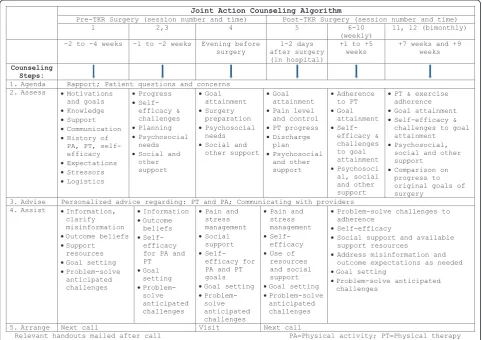
Intervention theoretical frameworkThe intervention is based on social cognitive theory (SCT) [10]. Consistent with SCT, the intervention targets knowledge, attitudes (self-efficacy), and behavioral capabilities for self-man-agement through a variety of literacy- and age-sensitive print materials and activities. The intervention sessions are delivered in accordance with the Patient-Centered Model [11-16], also known as the 5As model. This model guides the interventionist to deliver health beha-vior change counseling in a brief and structured man-ner. Accordingly, the counselor Asks about the patient’s
“agenda“for the encounter;Assessesthe patient’s experi-ences with specific behaviors (often milestone beha-viors);Advises changes needed for improvement;Assists in setting goals for increasing activities and exercise and problem-solves with the individual potential challenges to goal attainment; andArrangesfollow up. The counse-lor facilitates and reinforces self-efficacy for specific behaviors by progressively building on the patient’s prior successes with the same or similar behaviors, assisting the patient in finding solutions for challenges encountered along the way, encouraging the patient to go a step further, and assisting the patient in eliciting the appropriate support from his or her social environ-ment. Principles of motivational interviewing are used to facilitate the communication between the counselor and the patient [17]. This includes an emphasis on suppor-tive (as opposed to confrontasuppor-tive) exchanges, exploring patient ambivalence and“rolling with resistance.” Intervention development The intervention develop-ment was theory-based and its content was informed by thorough literature review of interventions for osteoar-thritis arosteoar-thritis, Internet-based health information, and interviews with TKR surgeons, hospital nurses, hospital-and community-based physical hospital-and occupational thera-pists, and interviews with patients. Challenges to suc-cessful post-TKR functional achievement were identified
and strategies to address them were developed and inte-grated to form the intervention. Telephone counseling was selected as the primary basis for the intervention because it is a low-cost, broad reach mechanism for the delivery of post-TKR support interventions to patients with movement limitations and transportation difficul-ties. Although this counseling format has not been stu-died among TKR patients, it has been well stustu-died for medical patients with other conditions and has been used alone or in combination with in-person sessions and print materials [18-20]. The initial intervention was further refined following a pre-test with 6 pilot patients. Intervention Structure and ContentThe final interven-tion protocol includes a total of 12 sessions: three prior to surgery, one call the evening before surgery, a hospi-tal visit at 2-3 days after surgery, and seven additional sessions post-discharge between weeks two and nine post-surgery. All sessions, except for the hospital visit are telephone-based. The first call is approximately 45 minutes on average, with follow up contacts ranging from 5 to 20 minutes.
physical activity, activities that may be limited after the surgery, using exercise and activity logs, joining local groups for physical activity, eating for recovery, and how to tell if making progress. Topics related to emotional health include: tips to help with anxiety, depression, fati-gue, and stress. The intervention is delivered in English and Spanish by a trained bilingual health educator. Fig-ure 1 depicts components of the intervention protocol over time.
Intervention fidelitySeveral procedures are implemen-ted to maximize intervention fidelity. The intervention coach was trained in the delivery of the intervention protocol by the investigators. A customized Microsoft Access database guides the delivery of specific interven-tion components (5A’s, as described above). Calls are audiotaped for random review by the behavioral researcher who provides timely feedback to the coach concerning errors of omission or commission, and addi-tional training as needed.
Participant safety A Safety Monitoring Plan is fol-lowed. All adverse events are first reported to the PI, the lead surgeon, and the lead behavioral scientist for
appropriate action. All serious adverse events (such as hospitalizations), and other adverse events (depression) are reported to the Safety Officer and to the sponsor, NIAMS. Patients who express significant depressive symptoms either to the study Coach or study coordina-tor, or have a CES-D score≥16, are encouraged to dis-cuss their feelings with their health care provider and to seek professional help. The study team (physical thera-pist, psychologist and PI) provides consultation and supervision on medical, rehabilitative and psychosocial issues to the coach throughout the program.
Control Condition
The control condition consists of usual care as pre-scribed by the participant’s health care providers, includ-ing surgical management and physical therapy. Patients in the control condition also receive the copy of stan-dard post-TKR exercises and one goal planning sheet. The surgeon and treating physical therapist are blinded to the study condition and do not participate in data collection of study end-points. However, it is possible for patients to mention the study coach calls to the sur-geon at a follow-up visit.
Joint Action Counseling Algorithm
Pre-TKR Surgery (session number and time) Post-TKR Surgery (session number and time)
1 2,3 4 5 6-10
(weekly) 11, 12 (bimonthly) -2 to -4 weeks -1 to -2 weeks Evening before
surgery after surgery 1-2 days (in hospital)
+1 to +5
weeks +7 weeks and +9 weeks
Counseling Steps:
1. Agenda Rapport; Patient questions and concerns 2. Assess xMotivations
and goals
xKnowledge
xSupport
xCommunication
xHistory of PA, PT, self-efficacy xExpectations xStressors xLogistics xProgress x Self-efficacy & challenges xPlanning xPsychosocial needs
xSocial and other support xGoal attainment xSurgery preparation xPsychosocial needs
xSocial and other support
xGoal attainment
xPain level and control
xPT progress
xDischarge plan xPsychosocial and other support xAdherence to PT xGoal attainment x Self-efficacy & challenges to goal attainment xPsychosoci al, social and other support
xPT & exercise adherence
xGoal attainment
xSelf-efficacy & challenges to goal attainment
xPsychosocial, social and other support
xComparison on progress to original goals of surgery
3. Advise Personalized advice regarding: PT and PA; Communicating with providers 4. Assist xInformation,
clarify misinformation
xOutcome beliefs
xSupport resources
xGoal setting
xProblem-solve anticipated challenges xInformation xOutcome beliefs x Self-efficacy for PA and PT xGoal setting x Problem-solve anticipated challenges
xPain and stress management xSocial support x Self-efficacy for PA and PT goals
xGoal setting
x Problem-solve anticipated challenges
xPain and stress management
x Self-efficacy
xUse of resources and social support
xGoal setting
xProblem-solve anticipated challenges
xProblem-solve challenges to adherence
xSelf-efficacy
xSocial support and available support resources
xAddress misinformation and outcome expectations as needed
xGoal setting
xProblem-solve anticipated challenges
5. Arrange Next call Visit Next call
[image:4.595.57.540.373.713.2]Relevant handouts mailed after call PA=Physical activity; PT=Physical therapy
Study assessments
Data are collected at baseline prior to surgery and at 8 weeks, 6 months, and 12 months post-TKR. Sources of data include: (1) patients, (2) surgical records, (3) physi-cal therapy records, and (4) data recorded by the inter-vention coach in the interinter-vention database. The following section describes individual measures used to assess outcomes of interest.
Main outcomes
Physical Function The SF-36 Version 2, a generic 36 item assessment of health status is used to assess physi-cal (PCS) and mental (MCS) function [21-24].
Knee Function WOMAC, a 17 item survey, is used to assess knee-specific measures of the degree of difficulty in performing daily activities (e.g., descending stairs) plus joint-specific pain and stiffness [25].
Secondary outcomes
Knee performance measures include timed up and go (TUG), timed stairs, and 6 minute walk [26,27]. Knee impairment measures include knee range of motion (ROM) and measurements of knee flexion and extension ROM [28,29]. These measures are collected by trained physical therapists with demonstrated clinically accepta-ble reliability.
Mediators
Self-Efficacy The Stanford Patient Education Research Center Arthritis Self-Efficacy tool was modified slightly to address the post-surgical experience [30]. Scale items assess an individual’s perceived ability to manage pain/ discomfort and frustration, and keep knee pain from interfering with roles and activities.
Exercise and Activity AStep Activity Monitor (acceler-ometer) assesses mean steps per day and activity inten-sity (steps per minute). The monitor provides a summary of total number of steps/cycle per 24 hour period and percent time/day that the individual is active at high/moderate/low activity, % of day inactive, and maximum sustained intensity for 5 and 30 minutes [31]. In addition, participants complete anexercise (paper) log to record the number of daily exercise sessions, repeti-tions and sets for each of the core home-based physical therapy exercises. The log is completed at 8 weeks and 6 months.
Potential moderators
In addition to the above measures, the study assesses participants’demographic and psychosocial characteris-tics (i.e., age, gender, residence/zip code, race/ethnicity, educational level, employment, insurance status, depres-sive symptoms [32], trait anxiety [33], physical co-mor-bid conditions [34], social support [35,36], and body mass index (BMI).
Sample size considerations and statistical analyses
Sample size estimation Sample sizes were calculated using the method developed by Frison and Pocock [37]
with the SF-36 PCS as the primary outcome. Because patients are randomized within surgeon, we assume complete randomization of the study subjects to each treatment arm. We used the mean changes of repeated measures to estimate the required sample sizes based on Analysis of Covariance (ANCOVA) method. The mean change is defined as the difference between each sub-ject’s mean post-treatment PCS (the mean of 6 and 12 month PCS) and the baseline measurement.
Effect SizeThis trial was designed to determine whether the intervention will outperform the control by 4 or more points in the SF36 PCS. This effect size is approxi-mately one-half of the PCS standard deviation and 40% of the mean pre-post PCS TKR change of 10.5 points reported in the PORT study. Based on our pilot data and the national registry of TKR patients, mean post-PCS scores are assumed to be 39.5 and 43.5 for the con-trol and intervention arms, respectively; the standard deviation of post-TKR PCS is estimated as 10.9 for pre-and post-intervention periods pre-and the autocorrelation coefficient between the post treatment measurements across time for PCS is 0.65, and between pre-and post treatment measures is 0.50 [4]. One pre-intervention and two post-intervention measurements were com-pleted (6 and 12 months). Assuming 75 completers per condition after attrition or exclusion due to missing data, the trial is capable of detecting an intervention effect of a change of 4 or more points on the SF36 PCS with statistical power in excess of 0.83 at two-sided sig-nificance level of 0.05, or 0.90 at one-sided sigsig-nificance level of 0.05. Secondarily, a 10 point difference in change in WOMAC physical functional scores between the arms can be detected with > 85% power at 5% sig-nificance level.
interaction terms with the intervention indicator. The intervention effects on changes in knee pain, function using WOMAC sub-scores, number of daily repetitions and mean steps/hour on step activity monitor, and self-efficacy scores) will be analyzed using similar approaches. If the proposed intervention is effective, the post-TKR increases in home exercise and activity levels, and self-efficacy score in the intervention condition should be significantly greater than in the control condi-tion. Next, we will examine whether the improvement in Stanford Arthritis Self-Efficacy scores predicts increases in home exercise and activity levels. Using a similar approach, we will test whether higher levels of home exercise (number of daily repetitions) and physical activ-ity (mean steps/day on accelerometer) at 8 weeks post-TKR are associated with greater improvement in 6 and 12 month post-TKR global physical function and knee function.
In the analysis, we will assess possible selection bias by evaluating the equivalence in subjects’ socio-demo-graphic characteristics and baseline clinical and beha-vioral measures between “completers” (i.e., patients participating in 6 and/or 12 month follow-up) and drop-outs. If systematic and significant differences are observed, we will apply proper statistical procedures to account for such informative attrition or missingness. (See below) Differences between completers and drop-outs will be acknowledged as limitations to the generali-zation of study results.
Self-care Program Cost Analysis An estimate of the annual cost of developing and refining the self-care pro-gram will be calculated from the perspective of the sur-geon’s office at one point in time. Intervention program logs will be used to estimate the recurring labor and operational costs of delivering the program. Because the research team will have delivered the program to 90 patients, we will calculate the telephone counselor time, phone costs, and print material costs per patient required to prepare and deliver telephone and in-hospi-tal sessions. In addition, we will estimate the cost of behavioral expert supervision. Sensitivity analyses will test the range of assumptions for telephone counselor time and salary, print material costs, and clerical sche-duling time. This secondary analysis will serve future dissemination discussions.
Conclusion
This paper presented the theoretical rationale and design of an ongoing randomized controlled trial that will test the efficacy of a Patient Self-Management Sup-port intervention on TKR functional outcomes. TKR is a common and well accepted intervention for advanced knee arthritis and, thus, maximizing functional out-comes is of utmost priority. If efficacious, this
intervention has considerable potential for dissemina-tion. In addition to the potential for patient support programs to enhance self-management, lessons learned in this trial may inform tailored post-TKR rehabilitation strategies, including home activity and exercise regimens.
Acknowledgements and Funding
This study was supported by grant # R01 AR054479 from the National Institute of Arthritis and Musculoskeletal and Skin Diseases.
Author details
1Department of Medicine, Division of Preventive and Behavioral Medicine,
University of Massachusetts Medical School, 55 Lake Avenue North, Worcester, MA 01655, USA.2Department of Orthopedics and Physical Rehabilitation, University of Massachusetts Medical School, 55 Lake Avenue North, Worcester, MA 01655, USA.3Department of Physical Therapy, Arcadia University, 450 S. Easton Road, Glenside, PA 19038, USA.
Authors’contributions
MCR, DA, WL and PF contributed to the study design. MCR, CO, DA and PF designed the intervention and oversee the study implementation. HZ, AB and PF designed the data collection system to support the intervention and integrate patient assessments. All authors read and approved the final manuscript.
Competing interests
The authors declare that they have no competing interests.
Received: 8 August 2011 Accepted: 7 October 2011 Published: 7 October 2011
References
1. Kurtz S, Mowat F, Ong K, Chan N, Lau E, Halpern M:Prevalence of primary and revision total hip and knee arthroplasty in the United States from 1990 through 2002.J Bone Joint Surg Am2005,87:1487-1497. 2. Kurtz S, Ong K, Lau E, Mowat F, Halpern M:Projections of primary and
revision hip and knee arthroplasty in the United States from 2005 to 2030.J Bone Joint Surg Am2007,89:780-785.
3. Heck DA, Robinson RL, Partridge CM, Lubitz RM, Freund DA:Patient outcomes after knee replacement.Clini Orthop Relat Res1998,356:93-110. 4. Ayers DC, Franklin PD, Trief PM, Ploutz-Snyder R, Freund D:Psychological
attributes of preoperative total joint replacement patients: Implications for optimal physical outcome.J Arthroplasty2004,19(7 Suppl 2):125-130. 5. Franklin PD, Li W, Ayers DC:The Chitranjan Ranawat Award: Functional
outcome after total knee replacement varies with patient attributes.Clin Orthop Relat Res2008,466:2597-2604.
6. Jones CA, Beaupre LA, Johnston DW, Suarez-Almazor ME:Total joint arthroplasties: Current concepts of patient outcomes after surgery.Clin Geriatr Med2005,21:527-541.
7. Messier SP, Loeser RF, Miller GD, Morgan TM, Rejeski WJ, Sevick MA, Ettinger WH, Pahor M, Williamson JD:Exercise and dietary weight loss in overweight and obese older adults with knee osteoarthritis: The Arthritis, Diet, and Activity Promotion Trial.Arthritis Rheum2004, 50:1501-1510.
8. Lorig KR, Sobel DS, Stewart AL, Brown BW, Bandura A, Ritter P,
Gonzalez VM, Laurent DD, Holman HR:Evidence suggesting that a chronic disease self-management program can improve health status while reducing hospitalization: A randomized trial.Med Care1999,37:5-14. 9. Franklin PD, McLaughlin J, Boisvert CB, Li W, Ayers DC:Pilot study of
methods to document quantity and variation of independent patient exercise and activity after total knee arthroplasty.J Arthroplasty2006, 21(6 Suppl 2):157-163.
10. Bandura A:Self-efficacy: The exercise of controlNew York: WH Freeman and Company; 1997.
12. Ockene JK, Wheeler EV, Adams A, Hurley TG, Hebert J:Provider training for patient-centered alcohol counseling in a primary care setting.Arch Intern Med1997,157:2334-2341.
13. Ockene JK, Adams A, Hurley TG, Wheeler EV, Hebert JR:Brief physician-and nurse practitioner-delivered counseling for high-risk drinkers: Does it work?Arch Intern Med1999,159:2198-2205.
14. Hebert JR, Ebbeling CB, Ockene IS, Ma Y, Rider L, Merriam PA, Ockene JK, Saperia GM:A dietitian-delivered group nutrition program leads to reductions in dietary fat, serum, cholesterol, and body weight: The Worcester Area Trial for Counseling in Hyperlipidemia (WATCH).J Am Diet Assoc1999,99:544-552.
15. Kristeller JL, Merriam PA, Ockene JK, Ockene IS, Goldberg RJ:Smoking intervention for cardiac patients: In search of more effective strategies.
Cardiology1993,82:317-324.
16. Rosal MC, Ebbeling CB, Lofgren I, Ockene JK, Ockene IS, Hebert JR: Facilitating dietary change: The patient-centered counseling model.J Am Diet Assoc2001,101:332-341.
17. Miller WR, Rollnick S:Motivational interviewing: Preparing people for change.
2 edition. New York, NY: Guilford Press; 2002.
18. Maisiak R, Austin J, Heck L:Health outcomes of two telephone interventions for patients with rheumatoid arthritis or osteoarthritis.
Arthritis Rheum1996,39:1391-1399.
19. Fries JF, Carey C, McShane DJ:Patient education in arthritis: Randomized controlled trial of a mail-delivered program.J Rheumatol1997, 24:1378-1383.
20. Marcus AC, Garrett KM, Cella D, Wenzel LB, Brady MJ, Crane LA, McClatchey MW, Kluhsman BC, Pate-Willig M:Telephone counseling of breast cancer patients after treatment: A description of a randomized clinical trial.Psychooncology1998,7:470-482.
21. Ware J, Kosinski M, Keller SD:SF-36 Physical and Mental Component Summary Scales: A user’s manualBoston, MA: The Health Institute, New England Medical Center; 1994.
22. Kosinski M, Zhao SZ, Dedhiya S, Osterhaus JT, Ware JE Jr:Determining minimally important changes in generic and disease-specific health-related quality of life questionnaires in clinical trials of rheumatoid arthritis.Arthritis Rheum2000,43:1478-1487.
23. McDowell I, Newell C:Measuring health.InA guide to rating scales and questionnaires..2 edition. Edited by: McDowell I, Newell C. New York: Oxford University Press; 1996:269-276.
24. A community for measuring health outcomes using SF tools.[http:// www.sf-36.org].
25. Bellamy N, Buchanan WW, Goldsmith CH, Campbell J, Stitt LW:Validation study of WOMAC: A health status instrument for measuring clinically important patient relevant outcomes to antirheumatic drug therapy in patients with osteoarthritis of the hip or knee.J Rheumatol1988, 15:1833-1840.
26. Yoshida Y, Mizner RL, Ramsey DK, Snyder-Mackler L:Examining outcomes from total knee arthroplasty and the relationship between quadriceps strength and knee function over time.Clin Biomech (Bristol, Avon)2008, 23:320-328.
27. Kennedy DM, Stratford PW, Wessel J, Gollish JD, Penney D:Assessing stability and change of four performance measures: A longitudinal study evaluating outcome following total hip and knee arthroplasty.BMC Musculoskelet Disord2005,6:3.
28. Mockford BJ, Thompson NW, Humphreys P, Beverland DE:Does a standard outpatient physiotherapy regime improve the range of knee motion after primary total knee arthroplasty?J Arthroplasty2008,23:1110-1114. 29. Ritter MA, Harty LD, Davis KE, Meding JB, Berend ME:Predicting range of
motion after total knee arthroplasty. Clustering, log-linear regression, and regression tree analysis.J Bone Joint Surg Am2003,85-A:1278-1285. 30. Lorig K, Seleznick M, Lubeck D, Ung E, Chastain R, Holman H:The
beneficial outcomes of the arthritis self-management course are not adequately explained by behavior change.Arthritis Rheum1989,32:91-95. 31. Coleman KL, Smith DG, Boone DA, Joseph AW, del Aguila MA:Step activity
monitor: long-term, continuous recording of ambulatory function.J Rehabil Res Dev1999,36:8-18.
32. Devins GM, Orme CM:Center for epidemiologic studies depression scale. InTest Critiques. Volume II.Edited by: Sweetland RC. Kansas City: Test Corp of America, a subsidiary of Westport Publishers, Inc.; 1985:144-160. 33. Spielberger CD:Manual for the state-trait anxiety inventoryPalo Alto, CA:
Consulting Psychologists Press; 1983.
34. Charlson ME, Pompei P, Ales KL, MacKenzie CR:A new method of classifying prognostic comorbidity in longitudinal studies: development and validation.J Chronic Dis1987,40:373-383.
35. Sherbourne CD, Stewart AL:The MOS social support survey.Soc Sci Med
1991,32:705-714.
36. Sherbourne CD, Meredith LS, Rogers W, Ware JE:Social support and stressful life events.Qual Life Res1992,1:235-246.
37. Frison L, Pocock SJ:Repeated measures in clinical trials: Analysis using mean summary statistics and its implications for design.Stat Med1992, 11:1685-1704.
Pre-publication history
The pre-publication history for this paper can be accessed here: http://www.biomedcentral.com/1471-2474/12/226/prepub
doi:10.1186/1471-2474-12-226
Cite this article as:Rosalet al.:A randomized clinical trial of a peri-operative behavioral intervention to improve physical activity adherence and functional outcomes following total knee replacement. BMC Musculoskeletal Disorders201112:226.
Submit your next manuscript to BioMed Central and take full advantage of:
• Convenient online submission
• Thorough peer review
• No space constraints or color figure charges
• Immediate publication on acceptance
• Inclusion in PubMed, CAS, Scopus and Google Scholar
• Research which is freely available for redistribution