J . Phys. A: Math. Gen. 22 (1989) 1101-1109. Printed in the UK
Self-avoiding random walks on multifractal lattices
Bruce S Elenbogen? and Jeffrey J Prentid
I Department of Mathematics, The University of Michigan-Dearborn, Dearborn, Michigan 48128, USA
$ Department of Natural Sciences, The University of Michigan-Dearborn, Dearborn, Michigan 48128, USA
Received 19 July 1988
Abstract. A renormalisation theory is developed to study the critical behaviour of self- avoiding random walks on multifractals. Critical exponents and connectivity constants are calculated for walks on a class of square multifractal lattices using a finite lattice renormali- sation. The effect of the multifractal disorder is considered for both annealed and quenched disorder
.
1. Introduction
A self-avoiding random walk (SARW) is a random walk that contains no self-intersec- tions. The properties of SARW have been intensively investigated in the last two decades among the disciplines of mathematics, physics, chemistry and biology. A fundamental statistical property of the SARW is the root-mean-square distance between its endpoints, denoted R. It is well known (de Gennes 1979) that this distance scales with the number of steps N in the walk for N >> 1 according to the power law behaviour
R - N u . (1)
The critical exponent U is a universal exponent that characterises the scaling behaviour of the SARW. A large amount of research has focused on the theoretical, numerical and experimental determination of U for SARW in ordered media or on regular (Euclidean) lattices. In two dimensions, it is conjectured that the exact value of U is
a
(Nienhuis 1982). This value agrees with numerical simulations (Guttman 1987). In three dimensions, the most accurate estimate of v is 0.588 (Le Guillou and Zinn Justin 1980, Majid et a1 1983).The study of disorder and its effect on the critical behaviour of the SARW has attracted considerable attention in recent years. The phenomena studied include SARW on percolation clusters (Sahimi 1984, Roy and Chakrabarti 1987, Kim 1987, Meir and Aharony 1988), deterministic fractals (Ben-Avraham and Havlin 1984, Bradley 1987), crumpled fractals (Chen and Guy 1986) and random networks (Kardar and Zhang 1987, Thirumalai 1988). The effect of disorder on the critical exponent U , whether relevant or irrelevant, is not conclusive and there exist contradictions (Thirumalai 1988). Recently, there has been much interest in multifractal phenomena. Multifractals are objects that can be partitioned into fractal subsets, each with a different fractal dimension (Mandelbrot 1982). Multifractality was discovered in the context of fluid turbulence (Mandelbrot 1974, Benzi et a1 1984). A formalism for characterising multifractals in terms of a spectrum of scaling exponents or fractal dimensions has recently been developed (Halsey et a1 1986). In the last three years, multifractals have
received much attention and have been applied to a diverse set of phenomena, including fluid turbulence, percolation, non-linear dynamical systems, growth processes and localisation (Meir and Aharony 1988 and references therein).
Random (not self-avoiding) walks on a two-dimensional multifractal lattice have been investigated using computer simulation (Meakin 1987a). The critical exponent U assumes values that are less than its non-disordered value of
1.
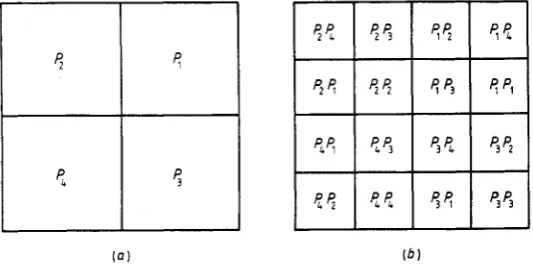
This indicates that this class of multifractal disorder is relevant for random walk phenomena. Another study (Meir and Aharony 1988) focuses on the averaging process itself over the multifractal disorder in percolation phenomena. This study indicates that such averag- ing is a non-trivial process in which the multifractal correlations can induce anomalous behaviour.In this paper, we study the effect of multifractal disorder on SARW in two dimensions. The multifractal disorder is characterised by the multifractal lattices illustrated in figure 1 and defined below. Multifractals of this type were introduced to model scaling phenomena in fluid turbulence (Mandelbrot 1974, Benzi et a1 1984). They were recently used as substrates for random walks (Meakin 1987a) and Eden clusters (Meakin 1987b). These multifractal lattices are generated from an iterative construction process. The first stage of the construction consists of the random assignment of four numbers (weights) pl, p 2 , p 3 and p4 to the four quadrants of a square lattice (figure l ( a ) ) . These four numbers (0 < p i G 1) can be considered as (proportional to) probability weights representing a probability disorder or as Boltzmann weights representing an energy disorder. In the second stage of the construction, each quadrant is subdivided into four subquadrants. The weight associated with each subquadrant is determined by multiplying the quadrant weight by pl, p 2 , p 3 and p4 in random order (figure l(b)). This process is continued until the smallest length scale (one lattice unit) is reached. The asymptotic limit of this process defines a fractal measure on a two-dimensional space. The multifractality of the lattice can be described by a spectrum of scaling exponents, each characterising a fractal subset embedded in the lattice (Meakin 1987a).
[image:2.498.122.389.417.549.2]( 0 ) (6)
Figure 1. Generation of the multifractal lattice; ( a ) first stage, ( b ) second stage.
2. Renormalisation
Self-avoiding random walks on multifractal lattices 1103
of the multifractal lattice and that of the SARW. This application of the renormalisation group theory to geometrical critical phenomena on multifractals is new. Thus far, renormalisation group ideas have only been applied to pure multifractal spaces without any geometrical critical structure embedded in them. A scaling theory has been developed in the context of multifractal growth processes (Coniglio 1986). A real-space renormalisation scheme has been applied to diffusion-limited aggregation (Nagatani 1987). Our goal will be to calculate the critical exponent U describing the average size of the SARW on the multifractal substrate. The renormalisation theory will also allow
us to calculate the connectivity constant of the SARW. Our study of v for self-avoiding random walks represents a natural extension of Meakin’s numerical study (Meakin 1987a) of the same exponent for purely random walks on the same multifractal lattices. A comparision of the two results will provide insights into the multifractal effects on geometrical critical phenomena.
We first define the renormalisation of the multifractal lattice. Consider a change in length scale by a scale factor b. Focus on a quadrant of the lattice that was generated from the weight pi. A quadrant containing b 2 sites is renormalised (projected) into a single site whose weight is determined by the simple average over the b 2 site weights. This projection rule can be phrased in the formal mathematical language of multifrac- tals. It corresponds to the partition function of the multifractal lattice (Halsey et a1 1986). If w, denotes the weight associated with site s, then a quadrant containing b 2 sites that was generated from the weight p i renormalises into a single site whose weight is
where
n =In blln 2.
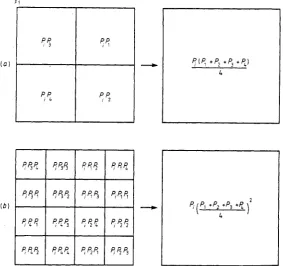
The term p i ( p I + p 2 + p P 3 + p 4 ) ” is the partition function (or first moment function) of the multifractal quadrant generated from the weight p i after n iterations. This projection preserves the multifractality of the lattice. The projection has built into it the multiplica- tive trademark (Coniglio 1986) that characterises this class of multifractals. The renormalisation of the multifractal lattice for b = 2 and b = 4 is illustrated in figure 2. The renormalisation of the SARW is defined by the well known ‘connectivity rule’ for geometrical critical phenomena (Stanley er a1 1982). According to this rule, all the
SARW configurations that span a quadrant starting from the bottom left site and exiting
at any top site map onto a single vertical renormalised step. The renormalisation of
a SARW configuration for b = 4 is illustrated in figure 3. A fugacity weight K is associated with each step of the walk. The renormalised fugacity weight is denoted K’. Each vertex of the walk is assigned the corresponding site weight
w,.
The renormalisation transformation is a mapping between K and K’ that preserves the physics (partition function) of the SARW on the multifractal lattice. A particular multifractal lattice is defined by a particular set of values for the weights pl, p z , p 3 and p 4 . A condensed notation representing this set of values will be denoted by the parameter p . The renormalisation transformation for a multifractal lattice (labelled p ) will be denoted by the mapping KL ( K ) . This transformation is defined by the invariance of the (grand) partition function under the renormalisation:
)1
F ( Pi +P2 rP,+e
[image:4.498.125.409.66.332.2]4
Figure 2. Renormalisation of the multifractal lattice. The renormalisation of the quadrant generated from the weight p , is shown for the scale factors ( a ) b = 2 and ( b ) b = 4. The renormalised site weight is defined by the partition function of the multifractal quadrant.
Figure 3. Renormalisation of a self-avoiding random walk configuration on a multifractal quadrant for the scale factor b = 4.
The partition function is defined by the weighted sum over all SARW configurations
and over all the multifractal disorder configurations. The disorder configurations are the set of all geometric realisations of the site weights resulting from the random assignment of the basic weights ( p , , p 2 , p 3 , p4) according to the definition of the multifractal lattice. This sum over both the SARW and the disorder configurations is equivalent to treating the multifractal disorder degrees of freedom as being in equili- brium with the SARW degrees of freedom. Alternatively, this partition function rep-
[image:4.498.125.378.383.514.2]Self-avoiding random walks on multijiiactal lattices 1105
of averaging corresponds to treating the multifractal disorder as annealed disorder. Later, we will discuss treating the disorder as quenched.
To illustrate the structure of the renormalisation transformation, we exhibit the transformation explicitly for b = 2. Implementing the program defined above on the multifractal quadrant in figure 2( a ) , the b = 2 renormalisation transformation assumes the following form:
+
p2ip3
+p4
) 2 Kb=
&
(P:
+P:
+
P: +P:)
(pip2 +pip3 + ~ 1 ~ 4 + ~ 2 p 3 +p2p4+p3p4)K2+
%(P:
+P:
+Pi
+P:)
( P l P 2 P 3 +Plp2P4+ PIP3P4 +P2P3P4)K3+~(P:+P:+P::+P~)P1P2P3P4K4. (4)
For p1 = p2 = p 3 = p4 = 1, this transformation reduces to the b = 2 transformation charac- terising the SARW problem on a regular (Euclidean) square lattice (Stanley et a1 1982). The critical exponent up and the connectivity constant p p for a SARW on a multifrac- tal lattice labelled p are calculated from the renormalisation transformation Kb( K ) . If Kp” is the non-trivial fixed point of KL(K), and A, is the eigenvalue of the linearised
K b ( K ) , then
Pp = 1IKp” where Kp” = Kb(K:)
dKb(KF) d K *
up =In blln A, where A, =
(5)
[image:5.498.119.433.299.609.2]0
I
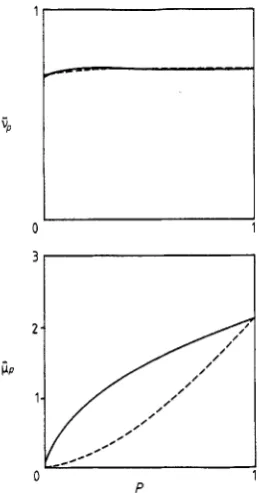
P 1Figure 4. The critical exponent vp and the connectivity constant F~ for SARW on multifractal lattices labelled p . The results were obtained from a renormalisation theory which treats the multifractal disorder as annealed. Results are shown for disorder of type I ( p , = p 2 = 1,
‘ I
[image:6.498.124.254.67.314.2]0
I
Figure 5. The critical exponent Gp and the connectivity constant &, for SARW on multifrac- tal lattices labelled p . The results were obtained from a renormalisation theory which treats the multifractal disorder as quenched. Results are shown for disorder of type I (pl = p 2 = 1, p , = p 4 = p ) (full curve) and type I1 ( p l = 1, p 2 = p , p 3 = p 2 , p4=p3) (broken curve). We calculate the critical exponent vp and the connectivity constant p p using a b = 2 renormalisation for two classes of disorder, denoted type I and type I1 (Meakin 1987a). For type I, p1 = p 2 = 1 and p 3 = p4 = p . For type 11, p , = 1, p 2 = p , p 3 = p 2 , p4 = p 3 . The parameter p is a real number between 0 and 1. The results for the b = 2 renormalisation are displayed in figure 4.
We next consider treating the multifractal disorder as quenched disorder. Instead of averaging the SARW partition function over the multifractal disorder, we calculate the partition function for a fixed disorder configuration. For each disorder configur- ation, the corresponding renormalisation transformation is used to calculate a critical exponent and a connectivity constant. These properties are then averaged over the disorder configurations, treating each configuration as equally probable. The quenched critical descriptors will be denoted Pp and
pP’
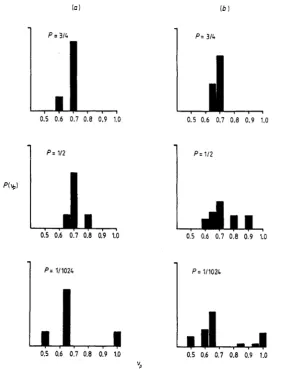
The results obtained from a b = 2 renormalisation are displayed in figure 5. More detail characterising this quenched behaviour is contained in the probability distributionP(
vp) for the critical exponentv p These distributions are displayed in figure 6 .
3. Discussion
Selfavoiding random walks on multifractal lattices 1107
P = 314 P = 314
0.5 0.6 0.7 0.8 0.9 1.0
P = 112
I
0.5 0.6
P = 111024
I
0.8 0.9 1.00.5 0.6 0.7 0.8 0:9 1:O
vP
0.5 0.6 0.7 0.8 0.9 1.0
P : 1/2
0.5 0.6 0.7 0.8 0.9 1.0
P : 111024
[image:7.498.121.418.64.434.2]L
0.5 0.6 0.1 0.8 0.9 1.0 Figure 6. The probability distribution P( v,) for the critical exponent vp of SARW on lattices with quenched multifractal disorder of ( a ) type I ( p , = p z = 1, p 3 = p4 = p ) and ( b ) type I1(P, = 1 , p 2 = P. P3 = P2, p4=p3).
this small-p critical behaviour should be approached more rapidly for the type-I1 disorder. The small-p results in figure 4 corroborate this qualitative interpretation. It should be noted that this small-p behaviour can be derived analytically from the renormalisation transformation for all scale factors and thus represents an exact result. This small-p behaviour does not occur for the quenched exponent (figure 5 ) because of the nature of the averaging process. In the quenched average over the exponents, all walk sizes contribute more equally for small p (figure 6 ) . The extended walks, although more probable for small p , do not dominate the quenched average. A primary objective for performing the quenched calculation was to provide more detailed information regarding the effect of the multifractal disorder (both quenched and annealed) on the critical behaviour. Such information is contained in the exponent probability distributions displayed in figure 6 . In particular, note the emergence of the extended walks ( vp = 1) as p decreases.
It is interesting to contrast this small-p behaviour of the self-avoiding random walk with that of an ordinary (not self-avoiding) random walk on the same multifractal lattice. A random walk on such an ultra-dilute lattice will not be extended. On the contrary, it will be compact as it remains localised in a small region around one of the large-weight sites. The most probable random walk configuration is the one which maximises the number of visits to such a site. Such a compact walk is characterised by a critical exponent that approaches a value of zero. This small-p behaviour of random walks has been observed in a recent numerical simulation (Meakin 1987a).
This limiting (small-p) behaviour of the SARW with annealed disorder provides a concrete example of what appears to be a general trademark of geometrical critical phenomena on multifractals. This trademark is due to the nature of the averaging process over the multifractal disorder. Indeed, a recent study (Meir and Aharony 1988) of percolation phenomena with multifractal disorder indicates that the averaging over the multifractal structures may be dominated by a rare subset of the structures. In summary, we have developed a real-space renormalisation scheme to understand the critical behaviour of self-avoiding random walks on multifractals. Such a scheme could also be applied to other geometrical critical phenomena with multifractal disorder. For future work, it would be useful to study the connection between the fractal dimension (or spectrum of dimensions) of the SARW and the spectrum of dimensions that characterise the substrate multifractality. In particular, for small p , there should exist a connection between the fractal dimension of the SARW and the fractal dimension of the subset of maximum-weight lattice sites. Such a study may provide insight into the spatial correlations within the multifractal substrate itself. Multifractal correlations, although not well understood, are crucial for characterising the geometrical structure of multifractals (Cates and Deutsch 1987). The SARW could provide a useful probe with which to understand the correlations within any multifractal space.
References
Ben-Avraham D and Havlin S 1984 Phys. Rev. A 29 2309
Benzi R, Paladin G, Parisi G and Vulpiani A 1984 J. Phys. A: Math. Gen. 17 3521
Bradley R M 1987 J. Phys. A: Math. Gen. 20 L821
Cates M E and Deutsch J M 1987 Phys. Rev. A 35 4907
Selj-avoiding random walks on multijiractal lattices 1109
de Gennes P G 1979 Scaling Concepts in Polymer Physics (Ithaca, NY: Cornell University Press) Guttman A J 1987 J. Pbys. A: Math. Gen. 20 1839
Halsey T C, Jensen M H, Kadanoff L P, Procaccia I and Shraiman B 1986 Pbys. Reu. A 33 1141 Kardar M and Zhang Y C 1987 Pbys. Rev. Lett. 58 2087
Kim Y 1987 J. Phys. A: Math. Gen. 20 6047
Le Guillou J C and Zinn-Justin J 1980 Pbys. Reo. B 21 3979
Majid I, Djordjevic 2 V and Stanley H E 1983 Pbys. Rev. Lett. 51 1282 Mandelbrot B B 1974 J. Fluid Mecb. 62 3321
-
1982 The Fractal Geometry of Nature (San Fransico: Freeman) Meakin P 1987a J. Pbys. A: Math. Gen. 20 L771-
1987b J. Pbys. A: Math. Gen. 20 L779 Meir Y and Aharony A 1988 Pbys. Rev. A 37 596 Nagatani T 1987 J. Pbys. A: Math. Gen. 20 L381 Nienhuis B 1982 Pbys. Rev. Lett. 49 1062Roy A K and Chakrabarti B K 1987 J. Pbys. A: Math. Gen. 20 215
Sahimi M 1984 J. Pbys. A: Math. Gen. 17 L379
Stanley H E, Reynolds P J, Redner S and Family F 1982 Real Space Renormalization ed T W Burkardt and J M J van Leeuwen (Berlin: Springer)