Two thromboxane A2 receptor isoforms in
human platelets. Opposite coupling to adenylyl
cyclase with different sensitivity to Arg60 to
Leu mutation.
T Hirata, … , M Okuma, S Narumiya
J Clin Invest.
1996;
97(4)
:949-956.
https://doi.org/10.1172/JCI118518
.
Thromboxane A2 (TXA2) receptor is a key molecule in hemostasis as its abnormality leads
to bleeding disorders. Two isoforms of the human TXA2 receptor have been cloned; one
from placenta and the other from endothelium, here referred to as TXR alpha and TXR beta,
respectively. These isoforms differ only in their carboxyl-terminal tails. We report that both
isoforms are present in human platelets. The two isoforms expressed in cultured cells show
similar ligand binding characteristics and phospholipase C (PLC) activation but oppositely
regulate adenylyl cyclase activity; TXR alpha activates adenylyl cyclase, while TXR beta
inhibits it. The Arg60 to Leu mutant of TXR alpha, which has been shown to impair PLC
activation (Hirata, T., A. Kakizuka, F. Ushikubi, I. Fuse, M. Okuma, and S. Narumiya. 1994.
J. Clin. Invest. 94: 1662-1667), also impairs adenylyl cyclase stimulation, whereas that of
TXR beta retains its activity to inhibit adenylyl cyclase. These findings suggest that the
pathway linked to adenylyl cyclase inhibition might be involved in some of the
TXA2-induced platelet responses such as shape change and phospholipase A2 activation which
remain unaffected in the patients with this mutation.
Research Article
Find the latest version:
J. Clin. Invest.
© The American Society for Clinical Investigation, Inc. 0021-9738/96/02/0949/08 $2.00
Volume 97, Number 4, February 1996, 949–956
Two Thromboxane A
2Receptor Isoforms in Human Platelets
Opposite Coupling to Adenylyl Cyclase with Different Sensitivity to Arg
60to Leu Mutation
Takako Hirata,*‡ Fumitaka Ushikubi,‡ Akira Kakizuka,‡ Minoru Okuma,* and Shuh Narumiya‡
*The 1st Division, Department of Internal Medicine and ‡Department of Pharmacology, Kyoto University Faculty of Medicine, Kyoto 606-01, Japan
Abstract
Thromboxane A2 (TXA2) receptor is a key molecule in he-mostasis as its abnormality leads to bleeding disorders. Two isoforms of the human TXA2 receptor have been cloned; one from placenta and the other from endothelium, here re-ferred to as TXRa and TXRb, respectively. These isoforms differ only in their carboxyl-terminal tails. We report that both isoforms are present in human platelets. The two iso-forms expressed in cultured cells show similar ligand bind-ing characteristics and phospholipase C (PLC) activation but oppositely regulate adenylyl cyclase activity; TXRa ac-tivates adenylyl cyclase, while TXRb inhibits it. The Arg60 to Leu mutant of TXRa, which has been shown to impair PLC activation (Hirata, T., A. Kakizuka, F. Ushikubi, I. Fuse, M. Okuma, and S. Narumiya. 1994. J. Clin. Invest. 94:
1662–1667), also impairs adenylyl cyclase stimulation, whereas that of TXRb retains its activity to inhibit adenylyl cyclase. These findings suggest that the pathway linked to adenylyl cyclase inhibition might be involved in some of the TXA2-induced platelet responses such as shape change and phospholipase A2 activation which remain unaffected in the patients with this mutation. (J. Clin. Invest. 1996. 97:949–
956.) Key words: G-proteins • phospholipase C • phospholi-pases A • platelet activation • alternative splicing
Introduction
Platelet activation is a complex network of interdependent biochemical processes through which platelets undergo a se-quence of responses: shape change, aggregation, and secretion. All of these responses can be induced by a number of physio-logical agonists such as thrombin, ADP, platelet-activating fac-tor and thromboxane A2 (TXA2)1 (1). TXA2 is a major arachi-donic acid metabolite in platelets that binds to the specific membrane receptor to initiate these processes (2). The TXA2 receptor is linked via a guanine nucleotide-binding protein (G protein) of the Gq class to phospholipase C (PLC), which hy-drolyses phosphoinositides to the two potent stimulatory sec-ond messengers inositol 1,4,5-triphosphate (IP3) and diacyl-glycerol (3, 4). These molecules affect divergent pathways of
platelet activation; IP3 causes increases in cytoplasmic free cal-cium and diacylglycerol causes activation of protein kinase C. However, whether this pathway contributes to all of the TXA2-induced platelet responses remains undefined. Some studies using the radiolabeled TXA2 analogs as ligands dem-onstrated two classes of binding sites in platelets, and indicated that they might represent the receptor subtypes (5–8). They further suggested that the two putative subtypes of the recep-tor may independently mediate shape change and aggregation (8, 9). This suggestion has been supported by the reports that platelet shape change and aggregation can be differentiated by several TXA2 analogs. For example, in some species, the TXA2 agonist U46619 induces platelet shape change and an in-crease in calcium without aggregation (10). In addition, the TXA2 analog S-145 prevents aggregation and secretion by U46619 but itself induces shape change (11). One model con-sistent with these observations is that the TXA2 receptor-mediated signaling consists of two separate receptor-effector systems mediating distinct functional responses; one linked to PLC activation resulting in platelet aggregation and secretion, and the other mediating an increase in cytosolic calcium and platelet shape change (12).
We have recently identified Arg60 to Leu mutation in the first cytoplasmic loop of the TXA2 receptor in a bleeding dis-order characterized by defective platelet aggregation re-sponses to TXA2 and its analogs (13). The platelets of the pa-tients with this mutation were impaired in PLC activation. Consistently, the Arg60 to Leu mutant of TXRa expressed in cultured cells exhibited impaired agonist-induced PLC activa-tion. Their platelets, however, exhibited shape change and phospholipase A2 (PLA2) activation when stimulated by a TXA2 agonist (14, 15). These findings favor the hypothesis that shape change and PLA2 activation are not mediated by PLC activation but by other pathways independent of PLC activa-tion and not affected by this mutaactiva-tion. A cDNA encoding a TXA2 receptor has initially been cloned from human placenta and the deduced 343–amino acid sequence indicates that it be-longs to the superfamily of G protein-coupled receptors (16). Recently, a cDNA encoding a receptor isoform of 407 amino acids has been isolated from human endothelium (17). These
Address correspondence to Shuh Narumiya, M.D., Ph.D., Depart-ment of Pharmacology, Kyoto University Faculty of Medicine, Yo-shida, Sakyo-ku, Kyoto 606-01, Japan. Phone: 81-75-753-4392; FAX: 81-75-753-4693; E-mail: [email protected]
Received for publication 11 August 1995 and accepted in revised form 30 November 1995.
1. Abbreviations used in this paper: CHO, Chinese hamster ovary; G protein, guanine nucleotide-binding protein; GR32191, [1R-[1a(Z), 2b, 3b,5a]]-(1)-7-[5-[[(1,19 biphenyl)-4-yl]methoxy]-3-hydroxy-2-(1-pip-eridinyl)cyclopentyl]-4-heptenoic acid; HBS, Hepes-buffered saline; I-BOP, [1S-[1a,2a(Z), 3b(1E,3S*),4a ]]-7-[3-[3-hydroxy-4-[4-iodophen-oxy]-1-butenyl]-7-oxabicyclo[2.2.1]hept-2-yl]-5-heptenoic acid; IP3,
inositol 1,4,5-triphosphate; PI, phosphatidylinositol; PLA2,
phospho-lipase A2; PLC, phospholipase C; RT, reverse transcription; S-145,
5Z-7-(3-endo-phenylsulphonylaminobicyclo[2.2.1]hept-2-exo -yl)hep-tenoic acid; STA2, 9,11-epithio-11,12-methano-TXA2; TXA2,
throm-boxane A2; U46619, 15S-hydroxy-11a,9a
two isoforms, here referred to as TXRa and TXRb, are gener-ated by alternative splicing from a single gene and differ only in their carboxyl-terminal domains; the 15 amino acid se-quence in the carboxyl end of TXRa is replaced by a 79–amino acid sequence in TXRb. The existence of multiple isoforms could account for the separate effector systems linked to the TXA2 receptor, provided both isoforms are present in platelets and divergent in their signaling pathways.
Here we report the identification of two isoforms of the hu-man TXA2 receptor in platelets. The two isoforms expressed in cultured cells showed the same ligand binding characteris-tics and agonist-induced activation of PLC but distinct effects on adenylyl cyclase activity; TXRa activated adenylyl cyclase, while TXRb inhibited it. Since the patients with the Arg60 to Leu mutation of the TXA2 receptor showed some of the TXA2-induced platelet responses, we have examined the ef-fects of this mutation on these pathways to explore their possi-ble involvement in those responses. We show that the Arg60 to Leu mutation selectively impairs the pathways linked to PLC activation and to adenylyl cyclase stimulation but not that linked to adenylyl cyclase inhibition. It is, therefore, possible that the pathway linked to adenylyl cyclase inhibition is in-volved in the platelet responses remaining unaffected in these patients.
Methods
Materials.9,11-epithio-11,12-methano-TXA2 (STA2) was a generous
gift from Ono Pharmaceuticals Co. Ltd. (Osaka, Japan). 5Z-7-(3-endo-phenylsulphonylaminobicyclo[2.2.1]hept-2-exo-yl) heptenoic acid (S-145) and its tritium derivative [3H]S-145 were generous gifts
from Shionogi Research Laboratories (Osaka, Japan). [1S-[1a, 2a(Z), 3b(1E, 3S*), 4a ]]-7-[3-[3-hydroxy-4-[4-iodophenoxy]-1-bute-nyl]-7-oxabicyclo[2.2.1]hept-2-yl]-5-heptenoic acid (I-BOP) was ob-tained from Cayman Chemical Co. (Ann Arbor, MI). [1R-[1a(Z), 2b, 3b, 5a]]-(1)-7-[5-[[(1, 19 -biphenyl)-4-yl]methoxy]-3-hydroxy-2-(1-pi-peridinyl)cyclopentyl]-4-heptenoic acid (GR32191) was kindly sup-plied by Dr. R. A. Coleman (Glaxo Research Ltd., Ware, England).
Myo-[2-3H]inositol (19.1 Ci/mmol) and cAMP [125I] assay system
were obtained from Amersham Corp. (Arlington Heights, IL), per-tussis toxin from Funakoshi Co. Ltd. (Tokyo, Japan), forskolin from Sigma Chemical Co. (St. Louis, MO) and RO-20-1724 from Paesel (Frankfurt/M, Germany). All other materials were obtained from the sources as described previously (13).
Amplification of platelet mRNA. Total RNA was extracted from platelets by the acid guanidium-phenol-chloroform method (18). 1 mg of total RNA was reverse-transcribed (RT) in a volume of 20 ml as described previously (19). For a control, reactions were carried out under the same conditions without reverse transcriptase. 2 ml of the reaction mixture was used for amplification by polymerase chain re-action (PCR) in a final volume of 20 ml, containing 50 mM KCl, 10 mM Tris-HCl (pH 8.8), 1.5 mM MgCl2, 0.1% Triton X-100, 10%
di-methylsulfoxide, 0.25 mM dNTPs, 1 U Taq Polymerase (Wako Pure Chemical Industries Ltd., Osaka, Japan), and 20 pmol of each primer. After denaturation at 948C for 2 min, 35 cycles (948C for 1 min, 628C for 1 min, 728C for 1.5 min) were followed by a final elongation step for 3.5 min at 728C. Primers used are based on the sequences of the TXA2 receptor isolated from placenta (16). One pair of primers
in-clude TX30 (59-CCGCCATGGCCTCAGAGCGCTAC-39)
corre-sponding to nucleotides (nt) 371-393, as numbered in the published sequence (16), and 3T4 (59-GGGGTGCCCGCGTTTCACAT-39; nt 1884–1903). Other pairs include 7S1 (59 -CTGCTCATCTACTTG-CGCGT-39; nt 868–887) and 3T4, or 7S1 and 3T2 (59 -CAGGGTCAA-AGAGCATGCAA-39; nt 1787–1806). PCR products were electro-phoresed, excised, purified using Geneclean II (Bio 101 Inc., Vista,
CA), and blunt-end-ligated to pBluescript II SK1 (Stratagene, La Jolla, CA). Plasmid subclones were sequenced by the dideoxy chain termination method.
Genomic PCR. Genomic DNA was prepared from white blood cells of the patient T.T. (13) as described (20). A 1146 bp fragment that includes the portion encoding peptide-b was amplified by PCR,
using primers I2 (59-GTCCAGGCTGACAGCTCTCC-39)
corre-sponding to intronic nt -29 to -10 upstream from the second coding exon (21) and 3T4. PCR was done as described in RT-PCR except that 0.1 mg genomic DNA was used instead of RT reaction mixture as a template. PCR products were subcloned and sequenced.
Expression of wild-type and mutant TXA2 receptor isoforms. For tran-sient expression, cDNAs encoding the two isoforms were inserted into the pCMX expression vector under the control of the cytomega-lovirus promoter (22) and COS-m6 were transfected in 15-cm dishes with 25 mg of plasmid DNA by calcium phosphate precipitation (23). The cells were grown in DME with 10% fetal calf serum and har-vested at 72 h after transfection for ligand binding assays or at 24 h to be trypsinized and plated in 6-well plates for phosphatidylinositol (PI) assay. For stable expression, cDNAs encoding the wild-type and mutant isoforms were inserted into the mammalian expression vector pEF-BOS (24) with a blasticidin S-resistance marker (Funakoshi Co. Ltd.) and introduced into Chinese hamster ovary (CHO) cells by the calcium phosphate method. Stable transformants were cloned by se-lection in the a-modified minimal essential medium containing 10% fetal calf serum and 15 ng/ml blasticidin S (Funakoshi Co. Ltd.).
Ligand binding studies. Tansfected COS-m6 cells or CHO cells were cultured in 15 cm dishes to confluency and harvested as de-scribed previously (25). Cells were washed once and suspended at 1 3 107 cells/ml in a buffer containing 20 mM Hepes (pH 7.4), 140 mM
NaCl, 5 mM KCl, 5 mM MgCl2. Binding assays were performed
es-sentially as described (26). Briefly, cells (100 ml) were incubated in a total volume of 200 ml at 308C for 1 h. In the [3H]S-145 saturation
ex-periments, nine different concentrations of the radioligand (0.125–32 nM) were used. In the displacement experiments, 1 nM of [3H]S-145
and different concentrations of the unlabeled competitors were em-ployed. The reaction was terminated by the addition of 4 ml of ice-cold 10 mM Tris (pH 7.4) and immediate vacuum filtration through GF/C filters (Whatman International Ltd., Maidstone, England) fol-lowed by four additional 4-ml washes with the same buffer. The ra-dioactivity on the filter was measured by scintillation counting. Non-specific binding was determined in the presence of a 1,000-fold excess of unlabeled S-145.
Measurement of PI hydrolysis. Transfected COS-m6 cells or CHO cells were cultured in 6-well plates to 90% confluency in the medium described above and then incubated for 20 h in inositol-free DME with 10% dialyzed fetal calf serum containing 1 mCi/ml myo
-[2-3H]inositol. The cells were washed with Hepes-buffered saline (HBS)
and preincubated with 10 mM LiCl in HBS at 378C for 10 min. Then various concentrations of STA2 were added to each medium. After 5
or 30 min incubation, the medium was removed and the reaction was terminated by 1 ml of 5% trichloroacetic acid. The generation of IP3
or total inositol phosphate was measured as described (27).
cAMP assays. CHO cells stably expressing wild-type or mutant isoforms were cultured in 24-well plates and treated with or without 100 ng/ml pertussis toxin for 12 h. They were then washed once with HBS and preincubated for 10 min in HBS containing 0.1 mM RO-20-1724 at 378C. Cells were then stimulated for 10 min with I-BOP at the indicated concentrations with or without 1 mM forskolin. The reac-tion was terminated by the addireac-tion of an equal volume (0.5 ml) of 10% trichloroacetic acid. Quantification of cAMP was performed by a radioimmunoassay using an Amersham cAMP assay kit.
Results
Identification of two isoforms of the human TXA2 receptor in
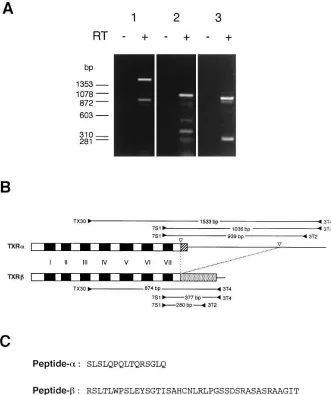
receptor have already been cloned (16, 17). These are sche-matically represented in Fig. 1 B. Comparison of two cDNAs revealed that TXRb has a deletion of a 659-bp sequence that comprises the distal portion of the cytoplasmic carboxyl tail and the following 39 untranslated region of TXRa. Deletion of this sequence results in another reading frame downstream in TXRb. Consequently, a 15 amino acid carboxyl-terminal se-quence of TXRa (peptide-a) is replaced witha new 79 amino acid sequence (peptide-b) in the carboxyl end of TXRb (Fig. 1
C). Peptide-a contains four serine and threonine residues as potential phosphorylation sites, whereas peptide-b contains 14 residues. To determine whether the two receptor isoforms ex-ist in human platelets, RT-PCR was carried out. Two frag-ments were amplified using a sense primer TX30 located in the third transmembrane domain and an antisense primer 3T4 in the 39 untranslated domain shared by the two isoforms (Fig. 1
A, lane 1). The amplification of these fragments depended strictly on cDNA synthesis, indicating that the fragments were derived from RNA and not from contaminated genomic DNA. Sequence analyses confirmed that the larger band cor-responds to TXRa and the smaller band TXRb. Additional PCR reactions using different pairs of primers (7S113T4 and
7S113T2) each yielded two bands of the expected size (Fig. 1
A, lanes 2 and 3), further confirming the presence of the two isoforms in platelets.
Ligand binding characteristics of the two TXA2 receptor
iso-forms. To investigate functional differences between the two
[image:4.612.59.390.60.455.2]isoforms, TXRa and TXRb were transiently expressed in COS-m6 cells or stably expressed in CHO cells. The two iso-forms expressed in CHO cells displayed indistinguishable, high-affinity binding of the TXA2 receptor antagonist [3 H]S-145 with a Kd value of 2.1 nM for both TXRa and TXRb (Fig. 2 A). Scatchard analyses using [3H]S-145 revealed a single class of binding sites on both receptor isoforms. Similar results were obtained on transfected COS-m6 cells (data not shown). Be-cause previous studies using I-BOP, a TXA2 agonist, and GR32191, a TXA2 antagonist, detected two classes of binding sites in platelets (8, 12), binding of these ligands to the two iso-forms were studied by testing their abilities to displace specific [3H]S-145 binding. I-BOP displaced specific [3H]S-145 binding to the two isoforms similarly (Fig. 2 B). GR32191 also showed similar displacement for the two isoforms (Fig. 2 C). Further-more, GR32191, which identified reversible and irreversible binding sites in platelets (12), bound only irreversibly to both
Figure 1. PCR detection of the two iso-forms of the human TXA2 receptor in
platelets. (A) Ethidium bromide staining of PCR products. Platelet RNA was used as a template after the incubation in the pres-ence (1) or absence (2) of reverse tran-scriptase (RT). PCR products were ana-lyzed on 2% agarose gels. Two bands are identified in each PCR reaction using prim-ers TX30 and 3T4 (reaction 1), 7S1 and 3T4 (reaction 2), and 7S1 and 3T2 (reaction 3). The larger and the smaller bands in each reaction correspond to TXRa and TXRb mRNAs, respectively. (B) Schematic rep-resentation of the two isoforms of the TXA2 receptor showing the primers used in
isoforms (data not shown). Thus, the two isoforms at least un-der the present experimental conditions do not correspond to the subtypes shown previously in platelets.
PLC activation by the two TXA2 receptor isoforms. We next
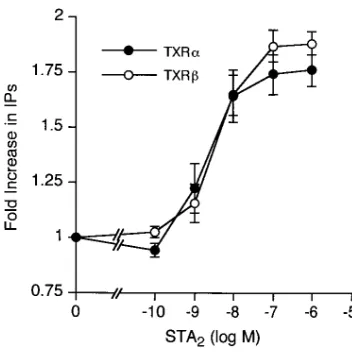
investigated whether the different carboxyl-terminal tails af-fect the PLC activation. Untransaf-fected COS-m6 cells did not show any significant increase in inositol phosphate production to the TXA2 agonist STA2 (data not shown). Stimulation of cells expressing TXRa or TXRb by STA2 induced an increase in inositol phosphate production with almost the same concen-tration-response curves (Fig. 3). Since we had previously shown that the Arg60 to Leu mutation of TXRa impairs its ag-onist-induced activation of PLC, we asked whether this muta-tion also affects PLC activamuta-tion mediated by TXRb. Stable transformants expressing a similar number of wild-type or mu-tant TXRb were chosen for this experiment. Mutant TXRb
exhibited an unaltered binding affinity for [3H]S-145, com-pared to that of wild-type TXRb (Fig. 4 A). When the two cell lines were examined for the activation of PLC, mutant TXRb
was found to be impaired in its ability to produce agonist-induced PI hydrolysis (Fig. 4 B). These results indicate that the mutation impairs PLC activation both in TXRa and TXRb. Thus, the Arg60 in the first cytoplasmic loop appears to be es-sential for PLC activation.
Activation and inhibition of adenylyl cyclase by the two TXA2
receptor isoforms. Previous studies have shown possible
[image:5.612.56.250.56.547.2]in-volvement of the adenylyl cyclase pathway in TXA2-mediated platelet responses, although the results are conflicting (28). Therefore, we examined effects of the difference of the car-boxyl-terminal tail on adenylyl cyclase activation in cells ex-pressing the two isoforms. As shown in Fig. 5, I-BOP increased the level of cAMP in cells expressing TXRa in a concentra-tion-dependent fashion above 10 nM, while no increase was
Figure 2. Ligand binding characteristics of the two TXA2 receptor
isoforms. (A) Scatchard analyses of TXRa (d) or TXRb (s). Spe-cific [3H]S-145 binding to CHO cells stably expressing TXRa or
TXRb was determined. TXRa exhibited an affinity for [3H]S-145
(Kd 5 2.1 nM) which was comparable to that of TXRb (Kd 5 2.1 nM).
Both cell lines expressed a similar number of receptors (Bmax 5 246.8
and 216.3 fmol / 1 3 106 cells for TXRa and TXRb, respectively).
Data shown are representative of three independent experiments, each performed in duplicate. (B and C) Displacement of specific [3H]S-145 binding to TXRa (d) or TXRb (s) by I-BOP (B) and GR32191 (C). Both ligands displaced specific [3H]S-145 binding to
[image:5.612.314.490.437.613.2]CHO cells stably expressing TXRa or TXRb similarly. Each curve is representative of three independent experiments, each performed in duplicate.
Figure 3. STA2-induced PLC activation in COS-m6 cells expressing
the two TXA2 receptor isoforms. COS-m6 cells transiently expressing
TXRa (d) or TXRb (s) were incubated with STA2 for 30 min and
total inositol phosphate production was measured. Both isoforms are expressed in a similar number (190.1 pmol and 145.7 pmol / 1 3 106
cells for TXRa and TXRb, respectively). The data are presented as fold increases, where the values from the cells in the absence of STA2
were chosen as the reference values. Data points are mean6SE from 3 replicate wells from a single experiment. Where not shown, an SE bar is smaller than the symbol. The results were independently con-firmed in two additional experiments. The EC50 values for activation
found in those expressing TXRb. We next examined whether the two isoforms can inhibit adenylyl cyclase. I-BOP inhibited the forskolin-induced cAMP generation in cells expressing TXRb but not in cells expressing TXRa (Fig. 6 A). This inhibi-tion was sensitive to pertussis toxin treatment (Fig. 6 C), sug-gesting that it was mediated by the interaction of the receptor with Gi/Go. Since pertussis toxin did not affect adenylyl cyclase stimulation by TXRa (data not shown), it seems that each iso-form couples to a separate G protein in addition to a common G protein of the Gq class.
Effects of the Arg60 to Leu mutation on adenylyl cyclase
ac-tivity. The finding that the TXA2 receptor mediates pathways
other than that linked to PLC led us to examine the effect of the Arg60 to Leu mutation on these pathways, since the pa-tients with this mutation show some platelet responses such as shape change and PLA2 activation despite the defective activa-tion of PLC when stimulated by a TXA2 agonist. Before
ad-dressing this question, we examined the genomic sequence corresponding to peptide-b, that had not been analyzed in our previous study (13), by genomic PCR in one of the patients, and confirmed that it bears no mutation. The Arg60 to Leu mu-tation, which had been shown to impair PLC activation by TXRa, also impaired adenylyl cyclase activation by this iso-form (Fig. 5). In contrast, as shown in Fig. 6 B, the mutant TXRb was capable of inhibiting adenylyl cyclase above the I-BOP concentration of 1 pM. This inhibitory effect was also sensitive to pertussis toxin treatment (Fig. 6 C). Taken to-gether, the Arg60 to Leu mutation affects the pathways linked to PLC activation and to adenylyl cyclase stimulation but not that linked to adenylyl cyclase inhibition. The existence of a pathway which is not affected by the mutation may be related to the partial response to TXA2 in these patients.
Discussion
[image:6.612.317.494.56.240.2]We have shown here that the two isoforms of the human TXA2 receptor exist in platelets and that these isoforms medi-ate distinctive spectra of transduction pathways. Although the two isoforms similarly activated PLC, they differently regu-lated adenylyl cyclase activity; TXRa activated adenylyl cy-clase, while TXRb inhibited it. Previous studies using some TXA2 analogs identified two classes of binding sites in plate-lets and suggested the possibility that the receptor subtypes corresponding to these two classes are present and mediate separate functional responses of platelets. The presence of the two TXA2 receptor isoforms in platelets first led us to compare their binding properties in relation to these studies. However, the expression studies in CHO cells and COS cells revealed no difference between the two; both I-BOP and GR32191 dis-placed specific [3H]S-145 binding to the isoforms similarly, and GR32191 irreversibly bound to both isoforms. These results suggest that the two isoforms do not correspond to the two
Figure 4. Functional properties of wild-type and mutant TXRb stably expressed in CHO cells. (A) Scatchard analyses of wild-type (s) and mutant (m) TXRb. Wild-type and mutant TXRb exhibited similar af-finities for [3H]S-145 (K
d 5 1.8 nM for both wild-type and mutant
TXRb). Both cell lines expressed a similar number of receptors (Bmax 5 204.9 and 212.2 fmol / 1 3 106 cells for wild-type and mutant
TXRb, respectively). (B) STA2-induced IP3 accumulation in CHO
cells expressing wild-type (s) and mutant (m) TXRb. CHO cells were incubated with STA2 for 5 min and IP3 production was
mea-sured. Data points are mean6SE from three replicate wells from a single experiment. The results were independently confirmed in two additional experiments. The data are presented as fold increases, where the values from the cells in the absence of STA2 were chosen
as the reference values.
Figure 5. Adenylyl cyclase stimulation by wild-type and mutant TXRa. CHO cells expressing TXRa (d), TXRb (s) or the Arg60 to
Leu mutant of TXRa (m) were incubated with various concentra-tions of I-BOP and the cAMP contents in the cells were measured as described in Methods. Data points are mean6SE from 3 replicate wells from a single experiment. The results were independently con-firmed in 2 additional experiments. The EC50 value for activation
[image:6.612.61.247.58.381.2]classes of binding sites for some ligands found in intact plate-lets, unless they behave differently in platelets.
The identification of the pathway linked to adenylyl cyclase inhibition made us to wonder how this pathway is involved in TXA2-induced platelet responses. Both PLC activation and in-hibition of adenylyl cyclase can lead to platelet activation. Given the lower concentrations required for adenylyl cyclase inhibition than for PLC activation, the two pathways might act independently rather than synergistically. We have found that they are distinguished by the effects of the Arg60 to Leu muta-tion; PLC activation is attenuated by this mutation, whereas adenylyl cyclase inhibition is not. This mutation has been iden-tified in a bleeding disorder characterized by defective platelet aggregation responses to TXA2 and its agonists (13). Previous study demonstrated that despite the impaired activation of PLC, the patients’ platelets showed shape change (14) and PLA2 activation (15), implying the existence of the pathways leading to these responses that are not affected by the muta-tion. As our studies showed that the inhibition of adenylyl cy-clase is unaffected by the mutation, the pathway represented by this parameter might be implicated in shape change and PLA2 activation. This pathway appears to be mediated by Gi/Go because it is sensitive to pertussis toxin treatment. This is in accordance with our previous finding that the purified TXA2 receptor is functionally reconstituted with both Gi2 and Gq in phospholipid vesicles (29). Consistent with the idea that this Gi/Go-linked pathway is involved in PLA2 activation, TXA2 stimulates mitogen-activated protein kinase via Gi in some types of cells and activates PLA2 (30, 31). Thus, the present study suggests an intriguing possibility that the TXA2 receptor isoforms separately mediate different kinds of activa-tion responses in human platelets, although we cannot com-pletely exclude the possibilities that other effector systems linked to the mutated receptor or those mediated by other re-ceptor(s) than the mutated receptor evoke these responses.
Our experiments have also shown stimulation of adenylyl cyclase by one isoform of the TXA2 receptor. Ishikawa and Ogawa (32) previously found that STA2 elevated cAMP level in platelets at high concentrations to cause the inhibitory effect on aggregation. Based on this finding, they speculated that this pathway could negatively regulate platelet activation to atten-uate or terminate responses. However, the stimulation they observed was not suppressed by a TXA2 antagonist, ONO-3708. Because ONO-3708 completely displaced the radioli-gand binding to the cloned TXA2 receptor (16), it is doubtful that the stimulation observed by these authors is mediated by the TXA2 receptor we discuss here. Given the fact that stimu-lation of adenylyl cyclase is observed at relatively high agonist concentrations, the physiological significance of this pathway remains unclear.
Production of multiple isoforms by alternative splicing has been reported in G protein–coupled receptor family (33–38). Two regions of divergence that result from alternative splicing have been identified: the third cytoplasmic loop and the boxyl-terminal tail. Those that have alternatively-spliced car-boxyl tails include several members: the neurokinin-1 receptor (36), the prostaglandin E receptor EP3 subtype (37), the mono-cyte chemoattractant protein-1 receptor (38), and the TXA2 receptor. Alternative splicing of the EP3 receptor creates iso-forms which exhibit distinct functional properties, including different efficiency in activation of a G protein (37), different specificity in coupling to G proteins (39) and different
sensitiv-Figure 6. Adenylyl cyclase inhibition by wild-type and mutant TXRb. (A and B) I-BOP-induced inhibition of forskolin-induced cAMP accumulation in CHO cells expressing TXRa (d), TXRb (s) or the Arg60 to Leu mutant of TXRb (m). Cells were incubated with 1 mM forskolin and various concentrations of I-BOP and the cAMP contents were measured. The data are presented as percentages of the control values obtained from the forskolin-stimulated cells in the absence of I-BOP. Data points are mean6SE from three replicate wells from a single experiment. The results were independently con-firmed in 2 additional experiments. The EC50 values for activation
through wild type and Arg60 to Leu mutant of TXRb were 0.93 and
[image:7.612.56.251.59.549.2]ity to desensitization (40). The present study suggests that the carboxyl-terminal tails of the two TXA2 receptor isoforms, like those of the bovine EP3 receptor (39), determine the specific-ity of G protein coupling. Furthermore, the distinctive effects of the Arg60 to Leu mutation suggested that the interaction of the receptor with different G proteins is distinctly regulated by different domains of the receptor; this residue appears to be important for the interaction of the receptor with Gq and pos-sibly with Gs, but not with Gi/Go.
Taken together, the data presented here support the exist-ence of multiple signaling pathways via the two TXA2 receptor isoforms in platelets, which could interact each other to coor-dinate platelet activation processes. Comparison of the effects of the Arg60 to Leu mutation on these pathways with the responses observed in the platelets of the patients with this mutation implicates the possible relationship between the TXRb-Gi pathway and the platelet shape change and PLA2 ac-tivation. This hypothesis should be rigorously tested in future studies.
Acknowledgments
We thank Ono Pharmaceuticals and Shionogi Company for their kind supply of STA2 and [3H]S-145, respectively. We also thank R.A.
Coleman for kindly providing GR32191.
This work was supported in part by grants-in-aid from the Minis-try of Education, Science and Culture and the MinisMinis-try of Health and Welfare of Japan, the Japan Society for the Promotion of Science for Young Scientists, the Takeda Science Foundation, the Uehara Me-morial Foundation and Funds for Comprehensive Research on Aging and Health.
References
1. Kroll, M.H., and A.I. Schafer. 1989. Biochemical mechanisms of platelet activation. Blood. 74:1181–1195.
2. Samuelsson, B., M. Goldyne, E. Granström, M. Hamberg, S. Hammar-ström, and C. Malmsten. 1978. Prostaglandins and thromboxanes. Ann. Rev. Biochem. 47:997–1029.
3. Brass, L.F., C.C. Shaller, and E.J. Belmonte. 1987. Inositol 1,4,5-triphos-phate-induced granule secretion in platelets: evidence that the activation of phospholipase C mediated by platelet thromboxane receptors involves a gua-nine nucleotide binding protein-dependent mechanism distinct from that of thrombin. J. Clin. Invest. 79:1269–1275.
4. Shenker, A., P. Goldsmith, C.G. Unson, and A.M. Spiegel. 1991. The G protein coupled to the thromboxane A2 receptor in human platelets is a
mem-ber of the novel Gq family. J. Biol. Chem. 266:9309–9313.
5. Johnson, G.J., P.C. Dunlop, L.A. Leis, and H.L. From. 1988. Dihydropy-ridine agonist Bay K 8644 inhibits platelet activation by competitive antago-nism of thromboxane A2-prostaglandin H2 receptor. Circ. Res. 62:494–505.
6. Morinelli, T.A., S. Niewiarowski, J.L. Daniel, and J.B. Smith. 1987. Re-ceptor-mediated effects of a PGH2 analogue (U46619) on human platelets. Am.
J. Physiol. 253:H135–H143.
7. Hedberg, A., S.E. Hall, M.L. Ogletree, D.N. Harris, and E.C. Liu. 1988. Characterization of [5, 6-3H]SQ 29,548 as a high affinity radioligand, binding to
thromboxane A2/prostaglandin H2-receptors in human platelets. J. Pharmacol.
Exp. Ther. 245:786–792.
8. Dorn II, G.W. 1989. Distinct platelet thromboxane A2/prostaglandin H2
receptor subtypes. A radioligand binding study of human platelets. J. Clin. In-vest. 84:1883–1891.
9. Dorn II, G.W., and A. DeJesus. 1991. Human platelet aggregation and shape change are coupled to separate thromboxane A2-prostaglandin H2
recep-tors. Am. J. Physiol. 260:H327–H334.
10. Nakano, T., A. Terawaki, and H. Arita. 1987. Signal transduction in col-lagen-stimulated rat platelets is composed of three stages. J. Biochem. (Tokyo)
101:1169–1180.
11. Hanasaki, K., and H. Arita. 1988. Characterization of a new compound, S-145, as a specific TXA2 receptor antagonist in platelets. Thromb. Res. 50:365–
376.
12. Takahara, K., R. Murray, G.A. FitzGerald, and D.J. Fitzgerald. 1990. The response to thromboxane A2 analogues in human platelets. Discrimination
of two binding sites linked to distinct systems. J. Biol. Chem. 265:6836–6844.
13. Hirata, T., A. Kakizuka, F. Ushikubi, I. Fuse, M. Okuma, and S. Naru-miya. 1994. Arg60 to Leu mutation of the human thromboxane A
2 receptor in a
dominantly inherited bleeding disorder. J. Clin. Invest. 94:1662–1667. 14. Ushikubi, F., M. Okuma, K. Kanaji, T. Sugiyama, T. Ogorochi, S. Naru-miya, and H. Uchino. 1987. Hemorrhagic thrombocytopathy with platelet thromboxane A2 abnormality: defective signal transduction with normal
bind-ing activity. Thromb. Haemost. 57:158–164.
15. Fuse, I., M. Mito, A. Hattori, W. Higuchi, A. Shibata, F. Ushikubi, M. Okuma, and K. Yahata. 1993. Defective signal transduction induced by throm-boxane A2 in a patient with a mild bleeding disorder: impaired phospholipase C
activation despite normal phospholipase A2 activation. Blood. 81:994–1000.
16. Hirata, M., Y. Hayashi, F. Ushikubi, Y. Yokota, R. Kageyama, S. Na-kanishi, and S. Narumiya. 1991. Cloning and expression of cDNA for a human thromboxane A2 receptor. Nature (Lond.) 349:617–620.
17. Raychowdhury, M.K., M. Yukawa, L.J. Collins, S.H. McGrail, K.C. Kent, and J.A. Ware. 1994. Alternative splicing produces a divergent cytoplas-mic tail in the human endothelial thromboxane A2 receptor. J. Biol. Chem. 269:
19256–19261 [published erratum appears in J. Biol. Chem. 270:7011 (1995)]. 18. Chomczynski, P., and N. Sacchi. 1987. Single-step method of RNA isola-tion by acid guanidium thiocyanate-phenol-chloroform extracisola-tion. Anal. Bio-chem. 162:156–159.
19. Kakizuka, A., W.H. Miller, Jr., K. Umesono, R.P. Warrell, Jr., S.R. Frankel, V.V.V.S. Murty, E. Dmitrovsky, and R.M. Evans. 1991. Chromosomal translocation t(15;17) in human acute promyelocytic leukemia fuses RARa
with a novel putative transcription factor, PML. Cell. 66:663–674.
20. Vandenplas, S., I. Wiid, A. Grobler-Rabie, K. Brebner, M. Ricketts, G. Wallis, A. Bester, C. Boyd, and C. Mathew. 1984. Blot hybridization analysis of genomic DNA. J. Med. Genet. 21:164–172.
21. Nüsing, R.M., M. Hirata, A. Kakizuka, T. Eki, K. Ozawa, and S. Naru-miya. 1993. Characterization and chromosomal mapping of the human throm-boxane A2 receptor gene. J. Biol. Chem. 268:25253–25259.
22. Umesono, K., K.K. Murakami, C.C. Thompson, and R.M. Evans. 1991. Direct repeats as selective response elements for the thyroid hormone, retinoic acid, and vitamin D3 receptors. Cell. 65:1255–1266.
23. Graham, F.L., and A.J. van der Eb. 1973. A new technique for the assay of infectivity of human adenovirus 5 DNA. Virology. 52:456–467.
24. Mizushima, S., and S. Nagata. 1990. pEF-BOS, a powerful mammalian vector. Nucleic Acids Res. 18:5322.
25. Yokota, Y., Y. Sasai, K. Tanaka, T. Fujiwara, K. Tsuchida, R. Shige-moto, A. Kakizuka, H. Ohkubo, and S. Nakanish. 1989. Molecular characteriza-tion of funccharacteriza-tional cDNA for rat substance P receptor. J. Biol. Chem. 264:17649– 17652.
26 Ushikubi, F., M. Nakajima, M. Hirata, M. Okuma, F. Fujiwara, and S. Narumiya. 1989. Purification of the thromboxane A2/prostaglandin H2 receptor
from human blood platelets. J. Biol. Chem. 264:16496–16501.
27. Berridge, M.J., R.M.C. Dawson, C.P. Downes, J.P. Heslop, and R.F. Ir-vine. 1983. Changes in the levels of inositol phosphates after agonist-dependent hydrolysis of membrane phosphoinositides. Biochem. J. 212:473–482.
28. Halushka, P.V., D.E. Mais, P.R. Mayeux, and T.A. Morinelli. 1989. Thromboxane, prostaglandin and leukotriene receptors. Annu. Rev. Pharma-col. ToxiPharma-col. 10:213–239.
29. Ushikubi, F., K. Nakamura, and S. Narumiya. 1994. Functional reconsti-tution of platelet thromboxane A2 receptors with Gq and Gi2 in phospholipid
vesicles. Mol. Pharmacol. 46:808–816.
30. Morinelli, T.A., L. Zhang, W.H. Newman, and K.E. Meier. 1994. Thromboxane A2/prostaglandin H2-stimulated mitogenesis of coronary artery
smooth muscle cells involves activation of mitogen-activated protein kinase and S6 kinase. J. Biol. Chem. 269:5693–5698.
31. Lin, L.L., M. Wartmann, A.Y. Lin, J.L. Knopf, A. Seth, and R.J. Davis. 1993. cPLA2 is phosphorylated and activated by MAP kinase. Cell. 72:269–278.
32. Ishikawa, Y., and A. Ogawa. 1991. Elevation of platelet cyclic AMP level by thromboxane A2/prostaglandin H2 receptor agonists. Thromb. Res. 64:
667–676.
33. Giros, B., P. Sokoloff, M.-P. Martres, J.-F. Riou, L.J. Emorine, and J.-C. Schwarz. 1989. Alternative splicing directs the expression of two D2 receptor
isoforms. Nature (Lond.). 342:923–926.
34. Monsma, F.J., Jr., L.D. McVittie, C.R. Gerfan, L.C. Mahan, and D.R. Sibley. 1989. Multiple D2 dopamine receptors produced by alternative RNA
splicing. Nature (Lond.). 342:926–929.
35. Toso, R.D., B. Sommer, M. Ewert, A. Herb, D.B. Pritchett, A. Bach, B.D. Shivers, and P.H. Seeburg. 1989. The dopamine D2 receptor: two
molecu-lar forms generated by alternative splicing. EMBO J. 8:4025–4034.
36. Fong, T.M., S.A. Anderson, H. Yu, R.-R.C. Huang., and C.D. Strader. 1991. Differential activation of intracellular effector by two isoforms of human neurokinin-1 receptor. Mol. Pharmacol. 41:24–30.
37. Sugimoto, Y., M. Negishi, Y. Hayashi, T. Namba, A. Honda, A. Watabe, M. Hirata, S. Narumiya, and A. Ichikawa. 1993. Two isoforms of the EP3
recep-tor with different carboxyl-terminal domains. Identical ligand binding proper-ties and different coupling properproper-ties with Gi proteins. J. Biol. Chem. 268:2712–
2718.
chemoattractant protein-1 receptors reveals alternative splicing of the carboxy-terminal tails. Proc. Natl. Acad. Sci. USA. 91:2752–2756.
39. Namba, T., Y. Sugimoto, M. Negishi, A. Irie, F. Ushikubi, A. Kakizuka, S. Ito, A. Ichikawa, and S. Narumiya. 1993. Alternative splicing of C-terminal tail of prostaglandin E receptor subtype EP3 determines G-protein specificity.
Nature (Lond.). 365:166–170.
40. Negishi, M., Y. Sugimoto, A. Irie, S. Narumiya, and A. Ichikawa. 1993. Two isoforms of prostaglandin E receptor EP3 subtype; different