© 2016, IRJET | Impact Factor value: 4.45 | ISO 9001:2008 Certified Journal
| Page 249
EFFECT AND BEHAVIOUR OF LIGHT WEIGHT CONCRETE USING FLY ASH
AGGREGATE
S.Azzaruddin
1, K.Tanuja
2, N.Vasu Deva Naidu
31
M.Tech Structural Engineering & KMM Institute of Technology and Science,Tirupati,AP
2
K.Tanuja, Dept
. of CivilEngineering ,Assistant Professor& KMM Institute of Technology and Science,Tirupati,AP
3N.VasuDevaNaidu, Dept. of Civil Engineering, Assistant Professor, Mjr College of Engineering, AP
---***---Abstract -
Solid waste management is one of the most important techniques in today’s global manufacturing scenario. This project is done in view of utilizing the waste in an efficient manner for constructive purpose under eco friendly environmental conditions. In this study, the fine and coarse aggregates were completely replaced by fly ash aggregates in fly ash concrete .a mix design was done for M20 grade of concrete by IS method. Ordinary Portland cement of 53 grade was selected and fly ash aggregates were prepared by mixing fly ash with cement and water. The properties of fly ash fine aggregates and fly ash coarse aggregates were studied. The aggregate crushing value and aggregate impact value of fly ash coarse aggregates were also studied. The cement and fly ash proportions of 15:85, 20:80 and 25:75 were tried with a suitable water content of 20% by total weight to get the fly ash aggregates. The concrete cubes, cylinders and beams were cast with the fly ash aggregates obtained from the above three cement fly ash proportions. Then the compressive strength, split tensile strength and flexural strength were tested and compared with control concrete. This paper briefly presents the compressive strength development of fly ash aggregate concrete at different ages. The split tensile strength and flexural strength of all the concrete mixes were also investigated at different days of curing.Key Words: Fly ash; coarse aggregates ,compressive strength, split tensile strength , flexural strength
1.INTRODUCTION
Aggregates are used in a variety of building and construction applications. in the context of concrete formulations, aggregates are fine or coarse particles consisting of sands, crushed stones and gravels that are mixed with the cement paste to form a concrete Mixture. Most conventional concrete structures are produced using “normal weight” sand and gravel aggregate. However, there are a number of applications where the relatively high specific gravity of the normal weight aggregate is an undesirable characteristic. In applications where a lighter weight concrete is required, the normal weight aggregates partially or totally replaced with lower specific gravity or “lightweight” aggregates. Lightweight concrete is commonly used in applications such as concrete masonry units (i.e. concrete blocks) or bridge decks. Lightweight aggregates can be naturally occurring but
they are relatively scarce. Most of the lightweight aggregate material that is used for lightweight concrete is manufactured” by some means. For example, thermal treatment or preprocessing of certain naturally occurring minerals can produce an aggregate having a cellular or foam-like structure, hence a lower bulk specific gravity. Expanded clay is an example of a lightweight aggregate. Compared to normal weight aggregate, that usually has a bulk specific gravity greater than 2.6; a lightweight aggregate has a specific gravity less than 2.2. For example, the expanded clay aggregate used as the “control” aggregate in this study has a bulk specific gravity of about 1.6. Concrete that is produced using light weight aggregate will have a lower specific gravity than that produced with normal weight aggregate, but can still have mechanical properties suitable for structural applications. The concept of using plastic powders or granules as a concrete additive or aggregate is not new.Lightweight aggregate concrete is the Concrete made by replacing the usual material aggregate by lightweight aggregates .Though lightweight concrete can’t always substitute normal concrete for its strength Potential, it has its own advantages like reduced dead load, and thus economic structures and enhanced seismic resistance, high sound absorption and good fire resistance.
2. LITERATURE REVIEW
Lightweight concrete can be defined as a type of concrete which includes an expanding agent in that it increases the volume of the mixture while giving additional qualities such as nailibility and lessened the dead weight. It is lighter than the conventional concrete with a dry density of 300 kg/m3 up
to 1840 kg/m3 87 to 23% lighter. It was first introduced by
© 2016, IRJET | Impact Factor value: 4.45 | ISO 9001:2008 Certified Journal
| Page 250
concrete construction and has an economical advantage. During the last forty years, a number of lightweight fly ash aggregate production facilities were constructed at power plant locations in the United States and Canada. Other facilities were in various stages of planning before being terminated for various reasons. Development of lightweight fly ash aggregate production plants also occurred in various locations overseas, including England, the Federal Republic of Germany and the Netherlands most of which are still in operation today. In North America the overall rate of success for operating lightweight aggregate plants using fly ash has not been good for a variety of reasons. The major reasons for failures of operating plants and the abandonment of proposed plants are both technical in nature as well as economic. However, a new rotary kiln lightweight aggregate has been introduced into the North American market in 1994 by Minergy Corporation. This unique patented process utilizes Coal ash and wastewater solids to produce a high quality structural grade lightweight aggregate material.
3. MATERIAL PROPERTIES
[image:2.595.328.539.336.463.2]Following materials are used for preparing test specimens Ordinary Portland cement 53 grade confirming to IS: 8112-1989Fly ash (FA) obtained from Thermal power plant, V T P S class-F conforming to IS: 13812-1981. Local River sand confirming to Grading Zone-II of IS: 383-1970 Fly ash Fine aggregate (FAFA) obtained from cement fly ash proportions 20:80 and 25:75.Hard Broken Granite stone (HBG) confirming to graded aggregate of size 20mm as per IS: 383-19790Fly ash coarse aggregate concrete (FACA) obtained from cement fly ash proportions 20:80 and 25:75.Bore well water of VRSEC Engineering college campus for mixing and curing.
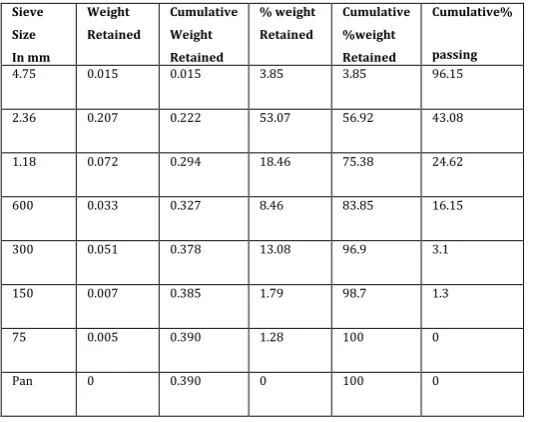
Table -1: Required Properties of Flyash Fine Aggregate for 1Kg Weight
Sieve Size In mm
Weight Retained
Cumulative Weight Retained
% weight Retained
Cumulative %weight Retained
Cumulative%
passing
4.75 0.015 0.015 3.85 3.85 96.15
2.36 0.207 0.222 53.07 56.92 43.08
1.18 0.072 0.294 18.46 75.38 24.62
600 0.033 0.327 8.46 83.85 16.15
300 0.051 0.378 13.08 96.9 3.1
150 0.007 0.385 1.79 98.7 1.3
75 0.005 0.390 1.28 100 0
Pan 0 0.390 0 100 0
4. MANUFACTURING PROCESSES
4.1. Formation of fly ash aggregate
The constituents like cement, fly ash and water produce the fly ash aggregates. Water is the binding material that paves the way for the function of the aggregate with good bond property. Cement and fly ash are constituents for preparation of the aggregates. Also water is the Binder when it is added to increase the workability. Three different proportions of cement and fly ash such as 15:85, 20:80 and 25:75 were tried.
4.2.
Preparation of Fly Ash Aggregates
Cement and fly ash were mixed in above two proportions in a concrete mixer. The dry constituents of cement of fly ash contents were thoroughly mixed in the drum for about 10 minutes then the water is added approximately 20% by weight the applied by changing the angle of the rotating drum until the complete formation of fly ash aggregates. This method of formation of fly ash aggregates is called pelletisation.
Fig -1: Preparation of Fly Ash Aggregates
4.3.
Drying and Curing of Fly Ash Aggregates
The fly ash aggregates were taken out from the mixer and allowed to dry for one day. Then the
aggregates were cured in a water tank for about 7 days.
[image:2.595.30.303.521.732.2] [image:2.595.327.539.549.684.2]
© 2016, IRJET | Impact Factor value: 4.45 | ISO 9001:2008 Certified Journal
| Page 251
4.4.
Fly Ash Coarse Aggregate (FACA):
The aggregate size more than 4.75mm was sieved as
a coarse aggregate. From them 20mm size and 16 mm size coarse aggregate were sieved separately to use them as coarse aggregate.
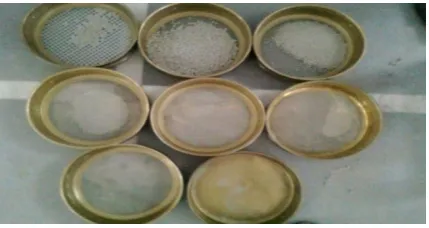
Fig -3: Fly Ash Coarse Aggregates
The aggregate having size less than 4.75mm were sieved and then it is used as fine aggregate.
Fig -4: Fly Ash Fine Aggregates
5. MIX DESIGN
Mix design is carried out for the M20 grade concrete by using IS 10262 – 2009
Target mean strength
=fck+1.65S=20+1.65x4=26.6N/mm2 Selection of water cement Ratio
Assume mild exposure condition Min W/C Ratio = 0.55 Min cement content = 300 kg/m3 Adopt W/C= 0.5 Selection of water content From Table 5 IS 10262-2009 for 20 mm size of aggregate
Max water content = 186 lit
Maximum size of aggregate is 20 mm
Slump value of 25 to 50 mm Calculation of cement content: Water –cement ratio – 0.5
Cement content = 186/0.5 = 372 kg/m3
Proportion of volume of coarse aggregate & fine aggregate:
From Table 3 coarse aggregate corresponding to 20mm size and fine aggregate conforming to Zone-II
Volume of Coarse aggregate per unit volume for W/C -0.5 = 0.62 Volume of fine aggregate = 1-0.62 = 0.38
Mix calculations:Volume of concrete = 1 m3
Volume of cement = mass of cement /specific gravity of cement x 1/1000= 372/3.15x1/1000 = 0.118m3 Volume of water = 0.186 m3
Volume of all in aggregates=1- (0.186+0.118) = 0.696 m3
Mass of coarse aggregates
= e x volume of coarse aggregate x s g of coarse aggregate x 1000= 0.696x0.62x2.8x1000
= 1208.26m3
Mass of fine aggregate=0.696x0.38x2.69x1000 = 711.45m3
Mix proportions: Cement - 372 kg/m3
Water - 186 lit Fine aggregate - 711.45 kg/m3 Coarse aggregate - 1208.256 kg/m3 W/C - 0.55
6. EXPERIMENTAL RESULTS
6.1. Compression Test
[image:3.595.52.276.133.320.2]15x15x15cm Concrete cubes were tested as per IS 516-1959. The test was conducted in 120t compression testing machine. The load was applied at the rate approximately 140kg/cm2/min until the failure of the specimen. The maximum load to the specimen until failure was recordedCompressive strength of fly ash aggregate concrete and conventional concrete for 7 days curing are given below For cement fly ash proportion 15:85
Table -2: PROPERTIES OF SPLIT COMPRESSION TEST
Age of testing
Proportion Cement: fly ash
Compressive Strength in N/mm2
7 days 15:85 14.96
Conventional concrete 17.78 50% fly ash aggregate
Replacement
15.85
40% fly ash aggregate Replacement
16.15
14 days 15:85 19.1
Conventional Concrete
25.30
[image:3.595.73.288.381.495.2]© 2016, IRJET | Impact Factor value: 4.45 | ISO 9001:2008 Certified Journal
| Page 252
Replacement 40% fly ash aggregate Replacement
20.25
28 days 15:85 21.35
Conventional concrete
30.15
50% fly ash aggregate Replacement
26.15
40% fly ash aggregate Replacement
26.75
6.2. Split Tension Test
Concrete cylinders of 15cm diameter and 30cm height were tested for split tensile strength as per IS 5816-1976. The specimen was placed horizontally between the loading surface of the compression testing machine and the load was applied without shocks until the failure of the Specimen. The maximum load at failure was recorded
Table -3: PROPERTIES OF SPLIT TENSION TEST
Age of Testing Proportion of Cement: Fly ash
Splitting Tensile strength In N/mm2
7 days 15:85 1.98
Controlled concrete 2.56
28 days 15:85 3.45
Conventional concrete 4.12
6.3. Flexural strength Test
The concrete beams of size 10cm x 10cm x 50cm were tested as per IS 516-1959. The load was applied through two similar rollers mounted at one third points of the supporting span. The load was applied without shock until the failure occurs. The maximum load at failure.
Table -4: PROPERTIES OF SPLIT FLEXURAL STRENGTH
Age of Testing Proportion of
Cement: Fly ash Flexural strength In N/mm2
7 days 15:85 2.0
Conventional concrete 3.8
28 days 15:85 3.50
Conventional concrete 4.25
6.4. Compression Test
15x15x15cm Concrete cubes were tested as per IS 516-1959. The test was conducted in 120t compression testing machine. The load was applied at the rate approximately 140kg/cm2/min until the failure of the specimen. The maximum load to the specimen until failure was recorded Compressive strength of fly ash aggregate concrete and conventional concrete with different age of testing.
Table -5: PROPERTIES OF COMPRESSION TEST
Age of testing
Proportion Cement
Compressive Strength in N/mm2
7 days 20:80 16.67
Conventional concrete 14.96
50% fly ash aggregate Replacement
17.87
40% fly ash aggregate Replacement
17.15
14 days 20:80 21.23
Conventional Concrete
22.24
50% fly ash aggregate Replacement
23.15
40% fly ash aggregate Replacement
22.24
28 days 20:80 24.44
Conventional concrete
30.15
50% fly ash aggregate Replacement
27.56
40% fly ash aggregate Replacement
27.00
6.5. Split Tension Test
Concrete cylinders of 15cm diameter and 30cm height were tested for split tensile strength as per IS 5816-1976. The specimen was placed horizontally between the loading surface of the compression testing machine and the load was applied without shocks until the failure of the Specimen. The maximum load at failure was recorded.
Table -6: PROPERTIES OF SPLIT TENSION TEST
Age of Testing Proportion of Cement: Fly ash
Flexural strength In N/mm2
7 days 20:80 2.15
Conventional concrete 2.56
28 days 20:80 3.85
Conventional concrete 4.12
6.6. Compression Test
© 2016, IRJET | Impact Factor value: 4.45 | ISO 9001:2008 Certified Journal
| Page 253
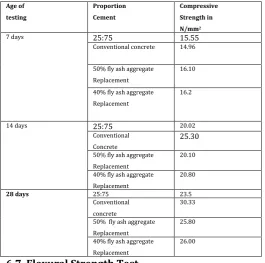
Table -7: PROPERTIES OF COMPRESSION TESTAge of testing
Proportion Cement
Compressive Strength in N/mm2
7 days 25:75 15.55
Conventional concrete 14.96
50% fly ash aggregate Replacement
16.10
40% fly ash aggregate Replacement
16.2
14 days 25:75 20.02
Conventional Concrete
25.30
50% fly ash aggregate Replacement
20.10
40% fly ash aggregate Replacement
20.80
28 days 25:75 23.5
Conventional concrete
30.33
50% fly ash aggregate Replacement
25.80
40% fly ash aggregate Replacement
26.00
6.7. Flexural Strength Test
The concrete beams of size 10cm x 10cm x 50cm were tested as per IS 516-1959. The load was applied through two similar rollers mounted at one third points of the supporting span. The load was applied without shock until the failure occurs. The maximum load at failure.
Age of Testing Proportion of Cement: Fly ash
Flexural strength In N/mm2
7 days 25:75 2.10
Conventional concrete 3.8
28 days 25:75 3.20
Conventional concrete 4.25
7. CONCLUSION
The weight of the concrete cubes compared to the
conventional concrete is reduced to about 27.5% by
weight.
The aggregates are vital elements in concrete. The usage of enormous quantities of aggregates results in destruction of hills causing geological and environmental imbalance.
The environmental impacts of extracting river sand and crushed stone aggregates become a source of increasing concern in most parts of the Country. Pollution hazards, noise, dust, blasting vibrations, loss of forests and spoiling of natural
environment are the bad impacts caused due to extraction of aggregates. Landslides of weak and steep hill slopes are induced due to unplanned exploitation of rocks.
REFERENCES
[1] Abdullah Anwar, Sabih Ahmad, Syed Aqeel Ahmad, Juned Ahmad and Syed Mohd. Ashraf Husain (2014), “Study of Compressive Strength of Concrete by Partial Replacement of Cement with High Volume Fly Ash”, International Journal of Current Engineering and Technology, E-ISSN 2277 – 4106, P-ISSN 2347 – 5161, Vol.4, No.6, December 2014, pp. 4162-4166.
[2] Aman Jatale, Kartikey Tiwari and Sahil Khandelwal (2013), “ Effects On Compressive Strength When Cement Is Partially Replaced By Fly-Ash”, IOSR Journal of Mechanical and Civil Engineering (IOSR-JMCE) e-ISSN: 2278-1684 Volume 5, Issue 4, January - February 2013, pp. 34-43.
[3] International Journal of Engineering and Technology Innovation, vol. 4, no. 1, page no 30-37 , 2014.