© 2016, IRJET | Impact Factor value: 4.45 | ISO 9001:2008 Certified Journal
| Page 775
Non Uniform Blur and Illumination Variance Face Recognition Using
Local Binary Pattern
Sravya konakala
1, Dr.Suman maloji
2Department of Electronics and communication Engineering, LBRCE, Andhra Pradesh,
India,[email protected]
Department of Electronics and communication Engineering, LBRCE, Andhra Pradesh,
India,[email protected]
---***---
Abstract-
Face recognition has made significant advances in the last decade, but robust commercial applications are still lacking. Current authentication/identification applications are limited to controlled settings, e.g., limited pose and illumination changes, with the user usually aware of being screened and collaborating in the process. Among others, pose and illumination changes are limited. To address challenges from looser restrictions, this paper proposes a novel framework for real-world face recognition in un-controlled settings named Face Analysis for Commercial Entities (FACE). Its robustness comes from normalization correction strategies to address pose and illumination variations. Existing methods for performing face recognition in the presence of blur are based on the convolution model and cannot handle non-uniform blurring situations that frequently arise from tilts and rotations in hand-held cameras. In this paper, we propose a methodology for face recognition in the presence of space-varying motion blur comprising of arbitrarily-shaped kernels. We model the blurred face as a convex combination of geometrically transformed instances of the focused gallery face, and show that the set of all images obtained by non-uniformly blurring a given image forms a convex set.1. INTRODUCTION
Real word face recognition in unconstrained scenarios is still a major challenge for biometrics. The reasons are manifold. Among them is the fact that gallery (stored) enrolled face images are usually captured in controlled settings, using a predefined arrangement of subjects and capture devices, whereas the probes (test images) are captured in quite different settings. The latter usually present looser restrictions, which significantly increase intra class variability, so that pose and illumination, as well as expression and occlusions, may become disturbing factors. The goal for Face Analysis for Commercial Entities (FACE), the novel framework for automatic
authentication of biometric face images that we present in this paper, is to address the existing challenges and to advance biometric identity management for real-world commercial applications. Illumination and pose variations are among the crucial factors that may and actually do hinder correct recognition within such operational scenarios. Becker and Ortiz evaluated some of the most popular and well-established algorithms for face recognition (principal component analysis (PCA), LDA, ICA, and SVMs) to assess the feasibility of real-world face recognition in uncontrolled setting using data drawn from Facebook. The cited work reports that none of the algorithms evaluated is robust enough to cope with the variations occurring during the data capture stage and that face recognition performance for real application is significantly lacking.
© 2016, IRJET | Impact Factor value: 4.45 | ISO 9001:2008 Certified Journal
| Page 776
points on the input face image, which are used to correct the pose through affine transformations of their corresponding regions two quality indices, are defined for this purpose, which are inversely related to the “effort” that would be needed to correct the original biometric image. The Sample Pose (SP) index accounts for pose quality (which is inversely proportional to measured distortion), and the Sample Illumination (SI) index accounts for illumination quality (which is inversely proportional to measured variations). In both cases, a high index value indicates high quality; owing to these quantitative indices, some biometric samples can be discarded.
2. LITERATURE
Traditionally, blurring due to camera shake has been modelled as a convolution with a single blur kernel, and the blur is assumed to be uniform across the image [2], [3]. However, it is space-variant blur that is encountered frequently in hand-held cameras [4]. While techniques have been proposed that address the restoration of non-uniform blur by local space-invariance approximation [5]–[7], recent methods for image restoration have modelled the motion-blurred image as an average of protectively transformed images [8]–[12].
Face recognition systems that work with focused images have difficulty when presented with blurred data. Approaches to face recognition from blurred images can be broadly classified into four categories. (i) De-blurring-based [13], [14] in which the probe image is first blurred and then used for recognition. However, de-blurring art-facts are a major source of error especially for moderate to heavy blurs. (ii) Joint de-blurring and recognition [15], the flip-side of which is computational complexity. (iii) Deriving blur-invariant features for recognition [16], [17]. But these are effective only for mild blurs. (iv).The direct recognition approach of [18] and [19] in which re-blurred versions from the gallery are compared with the blurred probe image. It is important to note that all of the above approaches assume a simplistic space-invariant blur model. For handling illumination, there have mainly been two directions of pursuit based on (i) the 9D subspace model for face [20] and (ii) extracting and matching illumination insensitive facial features [21], [22]. Tan et al. [23] combine the strengths of the above two methods and propose an integrated framework that includes an initial illumination normalization step for face recognition under difficult lighting conditions. A subspace learning approach using image gradient orientations for illumination and occlusion-robust face recognition has been proposed in [24]. Practical face recognition algorithms must also
possess the ability to recognize faces across reasonable variations in pose. Methods for face recognition across pose can broadly be classified into 2D and 3D techniques. A good survey article on this issue can be found in [25].
3. POSE AND ILLUMINATION DISTORTIONS
A way to measure the quality of a FACE probe is to consider the amount of effort that would be needed to correct for pose and illumination distortions in the image, with larger corrections yielding lower quality distortion indices. The normalization procedure aims at recovering a frontal pose of the face presented in the input image, starting from the points located using the STASM approach in, as sketched previously. The distribution of such points on the face is a good starting point to evaluate the degree of distortion that needs to be corrected by the pose normalization process.
3.1 The illumination problem
Images of the same face appear differently due to the change in lighting. If the change induced by illumination is larger than the difference between individuals, systems would not be able to recognize the input image. To handle the illumination problem, researchers have proposed various methods. It has been suggested that one can reduce variation by discarding the most important Eigen face. And it is verified in [18] that discarding the first few Eigen faces seems to work reasonably well. However, it causes the system performance degradation for input images taken under frontal illumination.
In [19], different image representations and distance measures are evaluated. One important conclusion that this paper draws is that none of these method is sufficient by itself to overcome the illumination variations. More recently, a new image comparison method was proposed by Jacobs et al. [20]. However this measure is not strictly illumination-invariant because the measure changes for a pair of images of the same object when the illumination changes.
© 2016, IRJET | Impact Factor value: 4.45 | ISO 9001:2008 Certified Journal
| Page 777
I will explain their approach in detail later. Actually, there are a lot of issues in how to reconstruct 3D surface from single image.
3.2 The pose problem
The system performance drops significantly when pose variations are present in input images. Basically, the existing solution can be divided into three types: 1) multiple images per person are required in both training stage and recognition stage, 2) multiple images per person are used in training stage but only one database image per person is available in recognition stage, 3) single image based methods. The second type is the most popular one.
3.3 Motion Blur Model for Faces
Motion blur is the apparent streaking of rapidly moving objects in a still image or a sequence of images such as a movie or animation. It results when the image being recorded changes during the recording of a single exposure, either due to rapid movement or long exposure.The apparent motion of scene points in the image will vary at different locations when the camera motion is not restricted to in-plane translations. In such a scenario, the space-varying blur across the image cannot be explained using the convolution model and with a single blur kernel. In this section, we present the space-variant motion blur model [8]–[10], [29] and illustrate how this model can explain geometric degradations of faces resulting from general camera motion.
To implement the motion filter, once convolved with an image, the linear motion of a camera by len pixels, with an angle of theta degrees in a counterclockwise direction. The filter becomes a vector for horizontal and vertical motions. The default len is 9 and the default theta is 0, which corresponds to a horizontal motion of nine pixels.
To compute the filter coefficients, h, for 'motion':
Construct an ideal line segment with the desired length and angle, centered at the center coefficient of h.
For each coefficient location (i,j), compute the nearest distance between that location and the ideal line segment.
h = max(1 - nearest_distance, 0);
Normalize h:h = h/(sum(h(:)))
3.4 Local Binary pattern
Local binary patterns (LBP) is a type of visual descriptor used for classification in computer vision. LBP is the particular case of the Texture Spectrum model
proposed in 1990. LBP was first described in 1994. It has since been found to be a powerful feature for texture classification; it has further been determined that when LBP is combined with the Histogram of oriented gradients (HOG) descriptor, it improves the detection performance considerably on some datasets.
The LBP feature vector, in its simplest form, is created in the following manner:
Divide the examined window into cells (e.g. 16x16 pixels for each cell).
For each pixel in a cell, compare the pixel to each of its 8 neighbors (on its top, middle, left-bottom, right-top, etc.). Follow the pixels along a circle, i.e. clockwise or counter-clockwise.
Where the center pixel's value is greater than the neighbor's value, write "0". Otherwise, write "1". This gives an 8-digit binary number (which is usually converted to decimal for convenience).
Compute the histogram, over the cell, of the frequency of each "number" occurring (i.e., each combination of which pixels are smaller and which are greater than the center). This histogram can be seen as a 256-dimensional feature vector.
Optionally normalize the histogram.
Concatenate (normalized) histograms of all cells. This gives a feature vector for the entire window.
The feature vector can now be processed using the Support vector machine or some other machine-learning algorithm to classify images. Such classifiers can be used for face recognition or texture analysis.
4.
EXPERIMENTAL RESULTS
© 2016, IRJET | Impact Factor value: 4.45 | ISO 9001:2008 Certified Journal
| Page 778
Fig -1: input face images
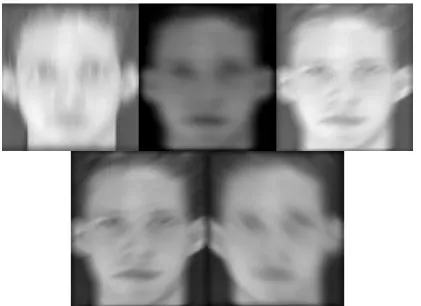
Each image is varied with different illumination changes, pose variations and motion blur both uniform and non uniform.
Fig -2: a combination of input images with illumination variations
Fig -3: Combination of input images with motion blurs variations uniform and non uniform
Fig -4: Input images with pose variations
Once LBP features are extracted from the images, they are saved in the database. When the test image, is given the feature of the test image is matched with the database features and the recognized feature is matched.
Fig -5: face recognition result
5. CONCLUSION
[image:4.595.322.541.93.269.2] [image:4.595.57.271.95.282.2] [image:4.595.55.264.341.509.2] [image:4.595.311.527.352.544.2] [image:4.595.56.267.551.704.2]© 2016, IRJET | Impact Factor value: 4.45 | ISO 9001:2008 Certified Journal
| Page 779
6. REFERENCES
[1] W. Zhao, R. Chellappa, P. J. Phillips, and A. Rosenfeld, “Face recognition: A literature survey,” ACM Comput. Surv., vol. 35, no. 4 , pp. 399–458, Dec. 2003.
[2] R. Fergus, B. Singh, A. Hertzmann, S. T. Roweis, and W. T. Freeman, “Removing camera shake from a single photograph,” ACM Trans. Graph., vol. 25, no. 3, pp. 787–794, Jul. 2006.
[3] Q. Shan, J. Jia, and A. Agarwala, “High-quality motion deblurring from a single image,” ACM Trans. Graph., vol. 27, no. 3, pp. 73:1–73:10 , Aug. 2008.
[4] A. Levin, Y. Weiss, F. Durand, and W. T. Freeman, “Understanding blind deconvolution algorithms,” IEEE Trans. Pattern Anal. Mach. Intell., vol. 33, no. 12, pp. 2354–2367, Dec. 2011.
[5] M. Šorel and F. Šroubek, “Space-variant deblurring using one blurred and one underexposed image,” in Proc. 16th IEEE Int. Conf. Image Process., Nov. 2009, pp. 157–160.
[6] H. Ji and K. Wang, “A two-stage approach to blind spatially-varying motion deblurring,” in Proc. IEEE Conf. Comput. Vis. Pattern Recognit., Jun. 2012, pp. 73–80.
[7] S. Cho, Y. Matsushita, and S. Lee, “Removing non-uniform motion blur from images,” in Proc. Int. Conf. Comput. Vis., Oct. 2007, pp. 1 – 8.
[8] Y.-W. Tai, P. Tan, and M. S. Brown, “Richardson-Lucy deblurring for scenes under a projective motion path,” IEEE Trans. Pattern Anal. Mach. Intell., vol. 33, no. 8, pp. 1603–1618, Aug. 2011.
[9] O. Whyte, J. Sivic, A. Zisserman, and J. Ponce, “Non-uniform deblurring for shaken images,” Int. J. Comput. Vis., vol. 98, no. 2, pp. 168–186 , 2012.
[10] A. Gupta, N. Joshi, L. Zitnick, M. Cohen, and B. Curless, “Single image deblurring using motion density functions,” in Proc. Eur. Conf. Comput. Vis., 2010, pp. 171– 184.
[11] Z. Hu and M.-H. Yang, “Fast non-uniform deblurring using constrained camera pose subspace,” in Proc. Brit. Mach. Vis. Conf., 2012, pp. 1–11.
[12] C. Paramanand and A. N. Rajagopalan, “Non-uniform motion deblurring for bilayer scenes,” in Proc. IEEE Conf. Comput. Vis. Pattern Recognit., Jun. 2013, pp. 1115–1122.
[13] H. Hu and G. de Haan, “Adaptive image restoration based on local robust blur estimation,” in
Proc. 9th Int. Conf. Adv. Concepts Intell. Vis. Syst., 2007, pp. 461–472.
[14] M. Nishiyama, A. Hadid, H. Takeshima, J. Shotton, T. Kozakaya, and O. Yamaguchi, “Facial deblur inference using subspace analysis for recognition of blurred faces,” IEEE Trans. Pattern Anal. Mach. Intell., vol. 33, no. 4, pp. 838–845, Apr. 2011.
[15] H. Zhang, J. Yang, Y. Zhang, N. M. Nasrabadi, and T. S. Huang, “Close the loop: Joint blind image restoration and recognition with sparse representation prior,” in Proc. Int. Conf. Comput. Vis., Nov. 2011, pp. 770–777.
[16] T. Ahonen, E. Rahtu, V. Ojansivu, and J. Heikkila, “Recognition of blurred faces using local phase quantization,” in Proc. 19th Int. Conf. Pattern Recognit., Dec. 2008, pp. 1–4.
[17] R. Gopalan, S. Taheri, P. Turaga, and R. Chellappa, “A blur-robust descriptor with applications to face recognition,” IEEE Trans. Pattern Anal. Mach. Intell., vol. 34, no. 6, pp. 1220–1226, Jun. 2012.
[18] I. Stainvas and N. Intrator, “Blurred face recognition via a hybrid network architecture,” in Proc. 15th Int. Conf. Pattern Recognit., vol. 2. Sep. 2000, pp. 805–808.
[19] P. Vageeswaran, K. Mitra, and R. Chellappa, “Blur and illumination robust face recognition via set-theoretic characterization,” IEEE Trans. Image Process., vol. 22, no. 4, pp. 1362–1372, Apr. 2013.
[20] K.-C. Lee, J. Ho, and D. Kriegman, “Acquiring linear subspaces for face recognition under variable lighting,” IEEE Trans. Pattern Anal. Mach. Intell., vol. 27, no. 5, pp. 684–698, May 2005.
[21] S. Biswas, G. Aggarwal, and R. Chellappa, “Robust estimation of albedo for illumination-invariant matching and shape recovery,” IEEE Trans. Pattern Anal. Mach. Intell., vol. 31, no. 5, pp. 884–899, May 2009.
[22] T. Zhang, Y. Y. Tang, B. Fang, Z. Shang, and X. Liu, “Face recognition under varying illumination using gradientfaces,” IEEE Trans. Image Process., vol. 18, no. 11, pp. 2599–2606, Nov. 2009.
[23] X. Tan and B. Triggs, “Enhanced local texture feature sets for face recognition under difficult lighting conditions,” in Analysis and Modeling of Faces and Gestures (Lecture Notes in Computer Science), vol. 4778. Berlin, Germany: Springer-Verlag, 2007, pp. 168–182.
© 2016, IRJET | Impact Factor value: 4.45 | ISO 9001:2008 Certified Journal