© 2015, IRJET ISO 9001:2008 Certified Journal Page 703
Analysis of Solar Steam Generating Device and Effect of Glass Cover on Efficiency
of System
Shashikant G. Mane 1P.R. Sawant2,N.N. Shinde3
1Reaserch student Energy Technology, Department of Technology, Shivaji University, Kolhapur, Maharashtra, India 2 Rajarambapu Institute of Technology, Sakharale, Islampur, Maharashtra, India
3 Energy Technology, Department of Technology, Shivaji University, Kolhapur, Maharashtra, India
---***---Abstract -
This paper presents the design, development and performance analysis of device which can be used for the generation of high temperature water or low temperature steam. When water is heated at high temperature steam generation can be achieved. One has to use a closed pressure vessel for steam generation. Today flat plate collectors are used for water generation which cannot heat water at high temperature and high pressure. For this cause a concentrated solar system is used with a pressure vessel as a receiver. In a parabolic dish collector convective losses play a important role in the performance of the system. Convective losses are dependent on the wind speed and ambient air conditions. With the use of glass cover heat losses due convective losses can be minimised. Glass cover also produces green house effect. Green house effect causes to receive more light waves and stops reflection of heat waves. Thus glass cover plays important role to reduce convective heat losses also. Paper presents the actual development of device, testing and analysis of the test results. Paper also explains the experimental results which show the effect of black coating for receiver on the efficiency and energy collected by the system.Key Words: Solar Water Heating, Concentrated Solar Power (CSP), Steam generation, Convective heat losses, Glass Cover, Performance Improvement
1.
INTRODUCTION
The basic principle of solar thermal collection is that when solar radiation is incident on a surface (such as that of a black-body), part of this radiation is absorbed, thus increasing the temperature of the surface. As the temperature of the body increases, the surface loses heat at an increasing rate to the surroundings. Steady-state is reached when the rate of the solar heat gain is balanced by the rate of heat loss to the ambient surroundings. Two types of systems are used to utilize this solar thermal conversion. First is Passive systems and Active systems. Passive system is considered, in which an external solar collector with a heat transfer fluid is used to convey the collected heat. Active system doesn’t need any additional working fluid or the system required to circulate it. By concentrating the incoming radiation, the operating temperature of the system is increased significantly, and subsequently increases the efficiency of the conversion
from sunlight to thermal energy. Concentrated solar is type of solar system which allows the effective collecting and concentrating of the incoming solar irradiation. The concentrator receives approximately 1.064 kW/m2 of solar insolation (dependent upon time of year), which is concentrated and reflected to the receiver with less area. At present, there are four main CSP technology families, which can be categorized by the way they focus the sun‟s rays and the technology used to receive the sun’s energy:
1. Parabolic Troughs (Line Focus, Mobile Receiver) 2. Linear Fresnel Reflectors (Line Focus, Fixed
Receiver)
3. Solar Towers (Point Focus, Fixed Receiver) 4. Parabolic Dishes (Point Focus, Mobile Receiver)
2.
Importance and scope of Solar Device for
Steam Generation
Water heating and steam generation are the most important heat applications in the industrial, commercial or domestic sector. In industrial and commercial sectors most of the time temperature requirements are higher than the temperature that can be achieved with solar flat collector. So the application of solar energy in heating application reduces from possible use of energy. But with the help of CSP one can generate higher temperature which can be useful to generate low pressure steam which has following applications.
Table 1 Industrial applications of Low pressure Steam
Industry Pressure
(bar) Flow Rate (kg/hr)
Bakeries 1 10
Restaurants 1 100
Hospitals 3 150
Paper Production 1 7
Creameries and
Dairies 0.3 – 3 200
It covercomes the drowback of flat plate solar water heater. It can directly supply low pressure steam for end application. However the efficncy of convertion for economical industrial application is needed. Concentrated solar power systems works at high temperature so the efficiency of the system are better than that of the flat plate collector. One can develop a device producing steam and working at higher efficiency than traditonal solar water heater.
© 2015, IRJET ISO 9001:2008 Certified Journal Page 704 1. Material selection consideration for various system
components
2. Material selection based on the availability and working conditions
3. Detailed theoretical design for of the each components 4. Specification finalization for the system with
modification from practical constraints 5. Proposed system details
6. System after manufacturing
Material Selection
Materials for all components are selected as per the standard guidelines for the material selection for solar concentrating and stem generation devices. Important selection is for Glass cover to improve the efficiency of the system.
Glass cover is used for the receiver to reduce the convective and radiation heat losses from receiver. Due to greenhouse effect glass cover reduces radiation heat loss from the receiver. Two different experiments are carried out for the receiver with glass coating and receiver without glass coating.
a. Physical properties as thermal expansion for glass b. Optical properties of glass cover
Design details and proposed system:
Load on the system to be designed is finalized based on the system output requirement and depending steam quality required.
Final Specification of the System parameters
Amount of water to be converted into steam = 1.5 kg/hr Minimum pressure at which steam is extracted from the absorber = 1.5 bar
Maximum pressure at which steam is allowed to heat = 3.0bar
1. Finalize the Specification for the Concentrator dish
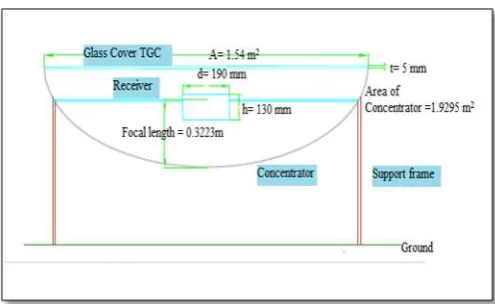
Surface area of the Concentrator dish = 1.54 m2 Focal length of the concentrator dish = 0.3223 m
2. Finalize the specifications for the absorber cylinder
Minimum internal diameter of the absorber cylinder = 190mm
Minimum Height of the absorber cylinder = 130mm Minimum thickness of the absorber cylinder = 2.235mm
[image:2.595.310.556.100.223.2]Figure 1: Design details and proposed system setup for experiment of system without Glass Cover
Figure 2: System Details for Steam generation device with glass cover
4.
Use of Glass Cover
Heat losses from receiver
Convective Heat losses
The experimental convective loss from a solar cavity receiver can be estimated under the on-flux. In the on-flux mode, the receiver is tested in actual solar conditions by placing it at the focus of a parabolic dish concentrator. To calculate convective heat transfer to surrounding from receiver, let us consider that convective heat loss from receiver is due to natural convection and Forced convection. From calculation it can be decided that forced convection losses are considered as negligible.
Radiative Heat Losses
Any body kept in space radiates radiations at all the time. Also it simultaneously receives radiation from other bodies. Receiver receives light radiations (High Wavelength radiations) and radiates short wavelength heat radiations. The wavelength of radiation depends upon temperature of receiver.
Effect of Glass Cover
Green house effect:
Glass cover taps the solar radiation by greenhouse effect. Glass cover allows long wavelength light radiations from sunlight to fall on the collector. The short wavelength heat radiations from the receiver surface are trapped. Thus greenhouse effect allows energy to enter the system and doesn’t leave the system.
Effect on Convective Losses
Convective heat losses are due to flow of wind. As wind flow increases convective losses also increases. When glass cover is used it traps air inside the glass cover and reduces the amount of heat loss due convective losses. In case use of glass cover in CSP its main effect is to reduce the radiation losses from the receiver. In case of environment where wind speed is significant to have effect of heat gai from receiver glass cover helps to reduce.
5.
Testing and Performance Evaluation
[image:2.595.41.271.643.745.2]© 2015, IRJET ISO 9001:2008 Certified Journal Page 705 without top glass cover (TGC) designated as
CSC-A-Without TGC-Regular
2. Concentrating solar collector -with Aluminum absorber CSC-A with 1.5 liter water capacity with top glass cover (TGC) designated as CSC-A-With TGC-Regular
Testing Methodology
The system specifications are finalized for 1.5 liter of water heating with aluminum absorber, vertical cylinder type. A cooker made of Aluminum with the given dimensions is fitted at the focal point of reflector which will fall below the top horizontal surface, so as to enable to fix the top glass cover during the experimentation. The schematic is shown in figure 2 and figure 4.
1. Concentrating solar collector -with Aluminimium-without coating absorber CSC-A with 1.5 liter water capacity
[image:3.595.37.285.344.496.2]2. Concentrating solar collector -with Aluminimium-with absorber Coating CSC-A with 1.5 liter water capacity
Figure 4: Test setup for System with top Glass cover
Performance Evaluation of the Proposed System
Theoretical performance analysis of the system can done one basis of the theory developed as follows. One has to calculate total available energy and total losses in the system to calculate the performance of the system. Methodology for the performance evaluation can explained as follows
1. Calculate the Total solar radiations available at the plane of the system.
2. Find out the total energy collected by the concentrator 3. Calculate total amount of heat loss at receiver
4. Calculate total amount of heat loss in steam piping 5. Evaluate the performance of the system in the form of
collector efficiency and system efficiency.
6. Proposed parameters that have to be recorded for performance evaluation in experimental method.
Formulas for performance evaluation
1. QOPTAINED = Γ ×(ρAL ×αAL)× EINC
Γ =capture fraction for receiver
AL× α AL = 0.7 = reflectance absorptance product for
receiver material.
2. Qloss = Ar ×Ul ×(Tr – Ta) Ar = Area of receiver
Ul = Overall Heat loss coefficient
Tr = Receiver temperature
Ta = Temperature of air surrounding a receiver 3. Ul = hconv + hrad
hconv = Convective heat loss coefficient
hrad = Radiative heat loss coeffiecient
4. Collector efficiency collector =
5.Collector efficiency
collector =
Data is collected for both of the test setups and above specified calculations are carried out. From this calculations and detailed data analysis following reading is found.
Table 2 results for Experiments on system efficiency
Cas e Average Solar Radiatio n
Temperature Steam Pressure Time
to achiev e 1.5 bar (min) System efficienc y (%) Receive r surface Steam inside receive r pot Maximu m Achieved Averag e Cas e 1A
950 160 135 3.1 3.0 20 72.00
Cas
e 1B 900 150 110 2.0 1.8 15 72.00
Cas e 2A
1050 150 125 2.3 2.3 10 76.00
Cas
e 2B 1000 155 130 2.6 2.3 10 74.00
6.
Effect of Glass Cover
This effect can studied on the three basic criteria 1. Effect on temperature
2. Effect on Useful Heat Gain 3. Effect on System efficiency
[image:3.595.301.565.346.515.2]© 2015, IRJET ISO 9001:2008 Certified Journal Page 706 Graph 1: Temperature Vs Solar radiation for receiver
without glass cover.
Graph 2: Temperature Vs Solar radiation for receiver with black coating.
From the figure it can be seen that as one use the glass cover for the receiver the surface temperature for the receiver increases.
1. If one considers at 1000 watt/m2 solar radiation
surface temperature will be nearly about 155°C and 165 °C
2. Maximum and average surface temperature will be increased by 10°C.
3. Nearly 10% rise in surface temperature is observed.
Effect on Useful Heat Gain
Graph 3: Useful Heat Gain Vs Solar radiation for receiver without black coating.
Graph 4: Useful Heat Gain Vs Solar radiation for receiver with black coating.
From the graph it is seen that as the radiation increases total heat gain also increases. The effect of glass cover total useful heat gain increases for same amount of solar radiation. Without glass cover total heat gain for 1000watt solar radiation is nearly 550 watt. With glass cover same value will be nearly about 700 watt. Thus one can conclude that total heat gain will increase by 25-27% at the 1000 watt solar radiation.
© 2015, IRJET ISO 9001:2008 Certified Journal Page 707 Graph 5: Useful Heat Gain Vs Solar radiation for receiver
with black coating.
Graph 6: Useful Heat Gain Vs Solar radiation for receiver with black coating.
Effect of glass cover on the system efficiency for receiver without black coating is shown in the graphs. Glass cover doesn’t show any effect on the system efficiency. Glass cover and black coating applied simultaneously efficiency increase by 5%.
7.
Results and Conclusion
Use of Glass cover improved efficiency by 2-4 % in both case for receiver with black coating. Use of glass cover and black coating improves the steam pressure by 0.5 bar and 0.2 bar respectively. When applied both simultaneously improve pressure by nearly 1.0 bar. Time taken to produce steam is also reduced with use of glass cover. Glass cover with black coated receiver help to reduce time up to 10 min. When glass cover is used along with the receiver having black coating nearly 15% rise in surface temperature is observed. From discussion one can conclude that total heat gain will increase by 25-27% at the 1000 watt solar radiation. Glass cover and black coating applied simultaneously efficiency increase by 4%.
Recommendations
System proposed here can be used to supply steam for instantaneous steam generation requirement. System described above can be optimized for following reasons System can be converted into continuous steam generation system with use of water pumping system and valves. Performance improvement is possible with the experimental evaluation. Automatic tracking system either mechanical or hydraulic can be used. By variation of coating materials, performance of system can be evaluated. Heat losses in the steam pipe and steam generator can reduced with proper coating material. Commercial models can be designed. System is best suitable for various industrial and commercial applications along with domestic application.
8.
References:
1. Atul A. Sagade (2012),”Experimental Investigation of Variation of Mass Flow Rate on the Performance of Parabolic Dish Collector with Nickel Chrome Coated Receiver”.
2. Sethuraman Ramasamy and Pakkirisamy
Balashanmugam,(2015), IJISET - International Journal of Innovative Science, Engineering & Technology, Vol. 2, Issue 1, January 2015, ISSN 2348 – 7968.
3. Lacour Ayompe ET.AL. Thermal Performance Analysis of a Solar Water Heating System With Heat Pipe Evacuated TubeCollector Using Data From a Field Trial, 2013-04-01, School of Civil and Building Services Engineering.
4. P.Balashanmugam, G.Balasubramanian,
K.Balasubramaniyan, Fabrication And Testing Of An Integral Compact Solar Water Heater, International Journal of Advanced Scientific and Technical Research Issue 3 volume 5, Sep.-Oct. 2013.
5. Mathew Job, The future water heating technologies, The Mechanist apr-jun 2013.
6. Shahidul Islam Khan, Asif Islam, Performance Analysis of Solar Water Heater, Smart Grid and Renewable Energy, 2011, 2, 396-398.
7. Sara Al-Beaini, Merwan Benhabib, Samantha Engelage, Adam Langton, Domestic Solar Water Heater for Developing Countries, Final Report,May 16, 2007. 8. Wolfgang Scheffler, Solare Bruecke, Graf Von
Werdenbergst, Introduction To The Revolutionary Design Of Scheffler Reflectors, Www.Solare-Bruecke.Org.
9. Matthew Damon Mercer, Design, fabrication and analysis of thermal storage solar cooker prototype for use in Rajasthan, India, Theses and Dissertations, University of Iowa Iowa Research Online.
© 2015, IRJET ISO 9001:2008 Certified Journal Page 708 Journal of Recent Research and Review, Vol. III,
September 2012, ISSN 2277 – 8322.
11. Gang Xiao, Manual making of a parabolic solar collector, 2011.
12. Charles Christopher Newton, Electronic Theses, Treatises and Dissertations, The Florida State University, DigiNole Commons.