Int J Clin Exp Pathol 2017;10(8):8495-8502 www.ijcep.com /ISSN:1936-2625/IJCEP0058673
Original Article
Expression of circular RNA circASXL1 correlates
with TNM classification and predicts
overall survival in bladder cancer
Gang Tang1,2, Wanqin Xie3, Chuan Qin1,2, Yunpeng Zhen1,2, Yinlei Wang1,2, Feiran Chen1,2, Zhiyong Du1,2, Zhouliang Wu1,2, Bo Zhang1,2, Zhonghua Shen1,2, Dawei Tian1,2, Hailong Hu1,2
1Department of Urology, The Second Hospital of Tianjin Medical University, Tianjin, China; 2Tianjin Key Laboratory
of Urology, Tianjin Institute of Urology, The Second Hospital of Tianjin Medical University, Tianjin, China; 3Key
Labo-ratory of Genetics and Birth Health of Hunan Province, The Family Planning Research Institute of Hunan Province, Changsha, Hunan, China
Received June 2, 2017; Accepted June 21, 2017; Epub August 1, 2017; Published August 15, 2017
Abstract: Circular RNAs (circRNAs) as a family of non-coding RNAs are increasingly recognized regarding their bio-genesis, regulatory roles in gene expression and clinic significance in developmental diseases and cancers. In this study, we aim to identify circRNAs that may be associated with clinicopathological characteristics of patients with bladder cancer. The circRNAs databases CircBase and circ2 Traits were used to seek circRNAs reported to bladder cancer. The expression levels of the circRNA of interest in paired samples of tumor tissue and adjacent normal mucosa from 61 patients with bladder cancer were detected by real-time quantitative reverse transcription-polymerase chain reaction (qRT-PCR) and statistically analyzed. Database search shows that circASXL1 (circBase ID: hsa_circ_0001136) transcribed from the ASXL1 gene locus is among the circRNAs with altered expressions in bladder cancer. Results showed that the expression level of circASXL1 was significantly higher in bladder cancer tissues compared to that in adjacent noncancerous tissues (P<0.001). To be noticed, chi-square tests support that the expression of circASXL1 significantly correlates with tumor grade (P=0.025), tumor stage (P=0.019), lymph node invasion (P=0.011) and distant metastasis (P=0.032). The area under ROC curve (AUC) is 0.770 for circASXL1 in predicting tumor invasion (T2-T4 tumors). Kaplan-Meier survival analysis indicates that tumors of high circASXL1 expression are associated with shorter overall survival compared to tumors of low circASXL1 expression. Further, multivariate analysis reveals that circASXL1 is an independent prognostic factor for overall survival for patients with bladder cancer. Expression of circASXL1 in bladder tumor correlates with TNM classification and may independently predict overall survival for patients with bladder cancer.
Keywords: Circular RNA, circASXL1, bladder cancer, biomarker
Introduction
Bladder cancer is the most common tumor malignancy of the urinary system, with estimat-ed 5-year prevalence of 1, 110, 265 patients worldwide, ranking the 9th in cancer incidence
[1]. In China, bladder cancer also has the high-est incidence rate across all urinary system tumors and the bladder cancer-related mortali-ty has been increasing overthe past decades. For patients diagnosed with muscle non-inva-sive bladder cancer which accounts for roughly 75% of bladder cancer, tumor recurrence and
progression are significant risk factors linked to
patient survival outcomes [2, 3]. Therefore, molecular biomarkers predictive of tumorigen-esis and development of bladder cancer are greatly needed in clinical course.
Circular RNAs (CircRNAs) are recognized as a naturally occurring family of non-coding RNAs characterized by covalently closed loop struc-tures with neither 5’ to 3’ polarity nor a polyad-enylated tail [4-6]. Since the discovery of cir-cRNAs over 20 years ago [7, 8], such molecules
were typically considered as molecular flukes or
advancesin RNA deep sequencing technology and bioinfor matics, recent work has revealed that large numbers of circRNAs are endoge-nous, abundant, conserved and stable in mam-malian cells [9-12]. Studies show that circRNAs can function as microRNA (miRNA) sponges, regulate alternative splicing, and modulate the expression of parental genes [12-16]. Accu- mulating evidence suggests that circRNAs may be involved in many disorders and cancers [17-19]. Certain circRNAs have been found aber-rantly expressed in Hirschsprung’s disease
[20] and heart failure [21]. In a series of more recent studies, circRNAs have been proposed as potential biomarkers for gastric cancer [22],
colorectal cancer [23-25] and hepato cellular carcinoma [26].
In the latest study, 469 circRNAs were detected to be differentially expressed between bladder carcinoma and matched para-carcinoma tissue
[image:2.612.97.517.70.516.2]Expression of circRNAs in bladder cancer
analyzed the expression of circASXL1 in tumor tissues and paired normal mucosa from 61 patients with bladder cancer, as well as its cor-relations with clinical characteristics of the patients.
Materials and methods
Clinical sample collection
This study was conducted upon approval of the
cancer were divided into the non-muscle-inva-sive group (Ta, T1 stage) or the muscle-invanon-muscle-inva-sive group (T2, T3, T4 stage) [32]. All patients were followed up retrospectively through hospital records and telephone interviews with either the patients or their close relatives.
Total RNA extraction and cDNA synthesis
[image:3.612.94.366.98.571.2]Total RNA was isolated from frozen tissues in -80°C using TRIzol reagent (Invitrogen, Carls-
Table 1. Correlations between circASXL1 expression and clinical parameters in bladder cancer
Characteristics patientsNo. of CircASXL1 expression P value
High Low
N (%) 61 (100.0) 27 (44.3) 34 (55.7)
Gender 0.763
Female 17 (27.9) 7 (25.9) 10 (29.4) Male 44 (62.1) 20 (74.1) 24 (70.6)
Age 0.842
≤65 37 (60.7) 16 (59.3) 21 (61.8) >65 24 (39.3) 11 (40.7) 13 (38.2)
Tumor size 0.355
≥3 cm 21 (34.4) 11 (40.7) 10 (29.4) <3 cm 40 (65.6) 16 (59.3) 24 (70.6)
Tumor number 0.251
≤2 43 (70.5) 17 (63.0) 26 (76.5) >2 18 (29.5) 10 (37.0) 8 (23.5)
Vascular tumor embolus 0.158
Negative 46 (75.4) 18 (66.7) 28 (82.4) Positive 15 (24.6) 9 (33.3) 6 (17.6) Grade
G1 18 (29.5) 4 (14.8) 14 (41.2) 0.025 G2-G3 43 (70.5) 23 (85.2) 20 (58.8)
T classification 0.019
Ta-T1 26 (42.6) 7 (25.9) 19 (55.9) T2-T4 35 (57.4) 20 (74.1) 15 (44.1)
LN invasion 0.011
Negative 42 (68.9) 14 (51.9) 28 (82.4) Positive 19 (31.1) 13 (48.1) 6 (17.6)
Distant metastasis 0.032
Negative 51 (83.6) 19 (70.4) 32 (94.1) Positive 10 (16.4) 8 (29.6) 2 (5.9)
Ki67 0.192
≤40% 35 (57.4) 11 (40.7) 24 (70.6) >40% 26 (42.6) 16 (59.3) 10 (29.4)
P53 0.754
0 28 (45.9) 13 (48.1) 15 (44.1) +-+++ 33 (54.1) 14 (51.9) 19 (55.9)
Number with percentage is given in brackets. LN = invasion lymph node invasion.
Medical University. Written in- formed consent was received for all patients. A total of 61 pairs of tumor tissue and adja-cent normal mucosa were ob- tained from bladder cancer patients who underwent radi-cal cystectomy at the Second Hospital of Tianjin Medical University between 2010 and 2011. The patients did not receive any treatment prior to surgery. The clinical specimens were snap-frozen in liquid nitro-gen immediately after resection and stored at -80°C until use. All the bladder carcinomas were
pathologically confirmed.
Clinical information
The clinical characteristics of patients including gender, age, tumor size, tumor number and vascular tumor embolus were retrieved from patient’s medi-cal reports. Tumor staging was performed according to the World Health Organization
clas-sification and the sixth edition of TNM classification of the
Union for International Cancer Control (UICC, 2002). Immu- nohistochemical staining and scoring protocols for Ki67 and p53 were previously described
truction. Concentration and quality of the iso-lated RNA were analyzed by Nano Drop ND- 1000 spectrophotometer (Nano Drop Thermo, Wilmington, DE). After RNA extraction, cDNA was synthesized according to the following method (Transcriptor First Strand cDNA Syn- thesis Kit, Roche, Germany). First, 2 µg RNA were dilutedinto 10 µl RNase-free water in a 0.2 ml PCR tube, and then 1 µl random primers was added and mixed well. Second, the tubes were put into a PCR thermocycler and incubat-ed at 65°C a for 10 minutes. Third, place the tubes on ice immediately and prepare the reac-tion mix as following: 4 µL 5× Buffer, 2 µL dNTP (10 mM), 0.5 µL Transcriptor Reverse Transcripta- se, 0.5 µL RNase-free water. The reaction mix was incubated at 55°C for 30 minutes, 85°C for 5 minutes and 4°C forever.
Real-timequantitative PCR
qRT-PCR was conducted with 2× lightcycler 480 SYBR Green I Master (Roche). The thermo-cycler program was set as 95°C for 10 min, fol-lowed by 40 cycles of 95°C for 15 sec, 60°C for
60 sec, and 72°C for 30 sec. Specific divergent primers for circASXL amplification were
desig-ned as below: forward, 5’-TAAACTGCCTGGCC- GAATC-3’ and reverse 5’-TCCTTCTGCCTCTAT- GACCTG-3’, and synthesized by GenePharma Company (Shanghai, China). As internal control,
human U6 was amplified using forward primer
5’-CTCGCTTCGGCAGCACA-3’ and reverse prim-er 5’-AACGCTTCACGAATTTGCGT-3’. The
prod-uct of qRT-PCR was further confirmed by Sanger
sequencing. The relative expression level of cir-cASXL1 wascalculated using 2-ΔΔCt method. Statistical analysis
[image:4.612.94.518.73.374.2]Expression of circRNAs in bladder cancer
Receiver operating characteristic (ROC) curve was constructed to evaluate the diagnostic accuracy of circASXL1 for tumor invasion. The postoperative survivalrate was analyzed using Kaplan-Meier method, and the log-ranktest
was used to assess the level of significance
for difference between the survival curves. Multivariate Cox proportional regression
analy-sis was performed to determine the indepen-dent contribution of clinicopathological factors for overall survival. P<0.05 was considered
sta-tistically significant.
Results
Expression of circASXL1 in bladder cancer
Specific divergent primers were designed for amplification using cDNA as template.
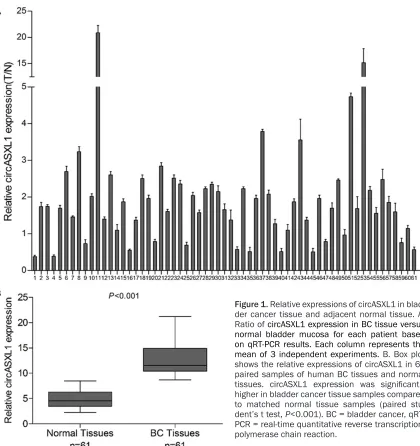
Sequ-encing results show that the RT-PCR product matches circASXL1 in circBase (http://www.cir-cbase.org, ID: has_circ_0001136), indicatinga success forthe detection of circASXL1 in total RNA. Next, we examined the relative expres-sion levels of circASXL1 in paired samples of bladder cancer tissue and adjacent normal mucosa from 61 patients by qRT-PCR. Results show that the relative level of circASXL varies considerably between patients (Figure 1A). And the expression level of lncRNA-n336928 was
significantly higher in bladder cancer tissues
compared to that in paired normal tissues (Figure 1B, P<0.001).
Correlations between circASXL1 expression and clinicopathological factors in bladder cancer
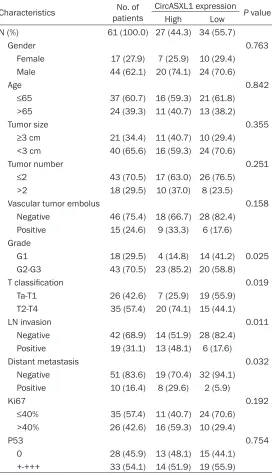
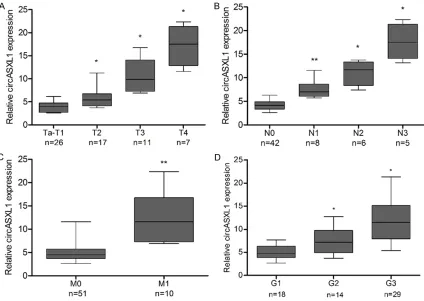
The circASXL1 expression was categorized as low or high according to the median level of cir-cASXL1 in bladder cancer tissues (n=61) for the convenience for correlation analysis. Chi square test indicates that the level of circASXL1 expressionis not obviously associated with pat-ent’s gender, age, tumor size, tumor number, vasculartumor embolus, Ki67 level and P53 level. However, the level of circASXL1 expres-sion is associated with tumor grade, tumor stage, lymph node invasion and distant metas-tasis (Table 1). Further, stratification analysis
indicates that circASXL1 expression does differ
in subgroups based on T classification (Figure 2A), lymph node invasion, (Figure 2B), distant metastasis (Figure 2C) or grade (Figure 2D), showing a tendency that advanced bladder tumors may have higher levels of circASXL1. To evaluate the diagnostic value of circASXL1 on tumor invasion (T2-T4 bladder cancer), ROC curve was plotted. The area under the ROC curve (AUC) is 0.770, and the sensitivity and
specificity are 0.686 and 0.769, respectively
(Figure 3), suggesting a modest accuracy forcir-cASXL1 in diagnosis of tumor invasion.
Figure 3. ROC curves for CircASXL1 in TNM (Ta-T1, T2-T4) diagnosis in bladder cancer. The area under curves (AUC) is 0.770; the sensitivity and specificity are 0.686 and 0.769, respectively. ROC = receiver operating characteristic, AUC = area under the curve.
Correlation of circASXL1 expression and pa-tient survival
We explored the correlation of circASXL1 expression level (high vs. low) with patient over-all survival in bladder cancer. Kaplan-Meier curves show that tumors of high circASXL1 expression are associated with shorter overall survival compared to tumors of low circASXL1 expression. In this study, the median follow-up was 34 months (range, 1 to 60 months). The median overall survival time was 44.6 months in the high expression group versus 54.3 months in the low expression group (Figure 4,
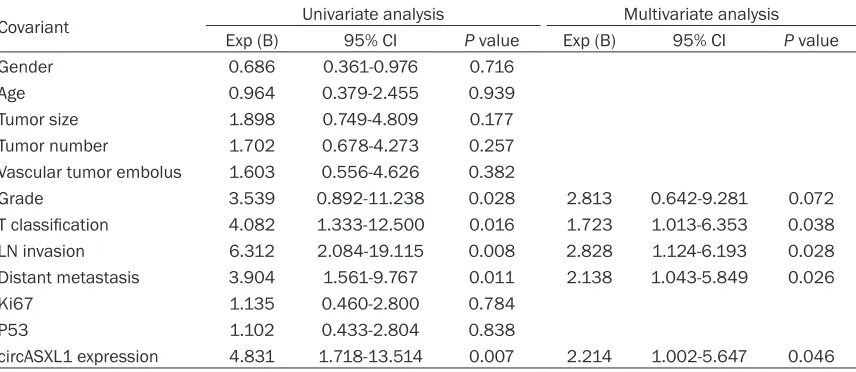
P=0.003). To determine the prognostic signifi -cance of circASXL1 expression, univariate
anal-ysis was conducted first and led to the finding that tumor grade, TNM classification and cir -cASXL1 expression are factors linked with over-all survival. Multivariate Cox proportional haz-ards regression analyses with adjustment for tumor grade, stage, lymph node invasion and metastasis indicate that circASXL1 expression level is an independent prognostic factor for 5-year overall survival of patients with bladder cancer in the cohort (Table 2).
Discussion
The emerging circRNAs are increasingly ac knowledged as a kind of non-coding RNAs that play roles in gene regulation and disease patho-genesis. The diagnostic and prognostic values of circRNAs in cancers are gaining more
inter-est as exemplified in studies of gastric cancer
[22], colorectal cancer [23-25] and hepatocel-lular carcinoma [26].
More recently, a number of circRNAs werere-portedto be differentially expressed in bladder cancer tissue compared with adjacent non-cancerous tissuein terms of microarray data
[27]. Among the differentially regulated cir-cRNAs, circASXL1, a circular RNA transcribed from the ASXL1 gene locus draw our attention. In the present study, we detected the expres-sion of circASXL1 in paired samples of tumor tissue and normal mucosa from 61 patients with bladder cancer by using qRT-PCR. Based on our data, the expression level of circASXL1 varies considerably between individuals, and we observed that circASXL1 expression was
significantly higher in bladder tumor tissues
compared to that in matched adjacent normal mucosa.
Importantly, our study shows that the
expres-sion of circASXL1 is significantly associated with tumor grade and TNM classification, and
that more aggressive tumors tend to have high-er expression of circASXL1, implicating a diag-nostic role of circASXL1 in bladder cancer. Thus, we employed ROC curves to evaluate the performance of circASXL1 in tumor invasion
[image:6.612.94.522.97.283.2]prediction. Although specificity and sensitivity results simply support a modest efficacy of cir -cASXL1 for tumor invasion diagnosis, it is expected to improve diagnostic accuracy by
Table 2. Univariate and multivariate analysis of prognostic factors with respect to 5-year overall sur-vival of patients with bladder cancer
Covariant Univariate analysis Multivariate analysis
Exp (B) 95% CI P value Exp (B) 95% CI P value
Gender 0.686 0.361-0.976 0.716
Age 0.964 0.379-2.455 0.939
Tumor size 1.898 0.749-4.809 0.177
Tumor number 1.702 0.678-4.273 0.257
Vascular tumor embolus 1.603 0.556-4.626 0.382
Grade 3.539 0.892-11.238 0.028 2.813 0.642-9.281 0.072
T classification 4.082 1.333-12.500 0.016 1.723 1.013-6.353 0.038 LN invasion 6.312 2.084-19.115 0.008 2.828 1.124-6.193 0.028 Distant metastasis 3.904 1.561-9.767 0.011 2.138 1.043-5.849 0.026
Ki67 1.135 0.460-2.800 0.784
P53 1.102 0.433-2.804 0.838
circASXL1 expression 4.831 1.718-13.514 0.007 2.214 1.002-5.647 0.046
Expression of circRNAs in bladder cancer
using circASXL1 combined with other circRNAs in future studies. Here, our study also high-lights a prognostic role of circASXL1 in bladder cancer. Multivariate analysis suggests that cir-cASXL1 can independently predict the patient overall survival. However, considering the potential bias that may result from relatively small patient number and high ratio of patient with high-grade T1 tumors in our study, the
prognostic significance should be validated by
multiple independent studies with larger cohorts before it is taken generally.
Although circRNAs have been associated with clinic characteristics of patients with bladder cancer, the mechanisms by which circRNAs play pathological roles in bladder cancer are just begun to be revealed. In a recent study by Zhong et al, circTCF25 was shown to down-regulate miR-103a-3p and miR-107, increase CDK6 expression, and promote proliferation and migration in vitro and vivo in bladder carci-noma [27]. Additionally, quite a few studies have demonstrated the regulatory role of cir-cRNAs in gene expression by functioning as microRNA sponges [17]. Therefore, it will be interesting to explore microRNAs that are tar-geted by circASXL1 in bladder cancer using cell line models in future studies.
In summary, our study for the first time shows
circASXL1 is associated with tumor TNM
clas-sification and may predict overall survival in
bladder cancer. Further studies are expected to reveal the mechanisms underlying the path-ological roles of circASXL1 in bladder cancer.
Acknowledgements
This study was supported in part by grants from the Natural Science Foundation of Tianjin (No. 15JCYBJC24600).
Disclosure of conflict of interest
None.
Address correspondence to: Drs. Hailong Hu and Dawei Tian, Department of Urology, The Second Hospital of Tianjin Medical University, 23 Pingjiang Road, Tianjin 300211, China; Tianjin Key Labora- tory of Urology, Tianjin Institute of Urology, The Second Hospital of Tianjin Medical University, 23 Pingjiang Road, Tianjin 300211, China. Tel: +86 13662096232; E-mail: [email protected]
(HLH); Tel: +86 18698087129; E-mail: jianshi- [email protected] (DWT)
References
[1] Ploeg M, Aben KK, Kiemeney LA. The present and future burden of urinary bladder cancer in the world. World J Urol 2009; 27: 289-293. [2] Zhao F, Lin T, He W, Han J, Zhu D, Hu K, Li W,
Zheng Z, Huang J, Xie W. Knockdown of a novel lincRNA AATBC suppresses proliferation and induces apoptosis in bladder cancer. Oncotar-get 2015; 6: 1064-1078.
[3] Zhuang J, Lu Q, Shen B, Huang X, Shen L, Zheng X, Huang R, Yan J, Guo H. TGFbeta1 se-creted by cancer-associated fibroblasts induc-es epithelial-minduc-esenchymal transition of blad-der cancer cells through lncRNA-ZEB2NAT. Sci Rep 2015; 5: 11924.
[4] Lasda E, Parker R. Circular RNAs: diversity of form and function. RNA 2014; 20: 1829-1842. [5] Jeck WR, Sharpless NE. Detecting and charac-terizing circular RNAs. Nat Biotechnol 2014; 32: 453-461.
[6] Chen LL, Yang L. Regulation of circRNA biogen-esis. RNA Biol 2015; 12: 381-388.
[7] Cocquerelle C, Mascrez B, Hetuin D, Bailleul B. Mis-splicing yields circular RNA molecules. FASEB J 1993; 7: 155-160.
[8] Nigro JM, Cho KR, Fearon ER, Kern SE, Rup-pert JM, Oliner JD, Kinzler KW, Vogelstein B. Scrambled exons. Cell 1991; 64: 607-613. [9] Salzman J, Gawad C, Wang PL, Lacayo N,
Brown PO. Circular RNAs are the predominant transcript isoform from hundreds of human genes in diverse cell types. PLoS One 2012; 7: e30733.
[10] Salzman J, Chen RE, Olsen MN, Wang PL, Brown PO. Cell-type specific features of circular RNA expression. PLoS Genet 2013; 9: e1003777.
[11] Jeck WR, Sorrentino JA, Wang K, Slevin MK, Burd CE, Liu J, Marzluff WF, Sharpless NE. Cir-cular RNAs are abundant, conserved, and as-sociated with ALU repeats. RNA 2013; 19: 141-157.
[12] Memczak S, Jens M, Elefsinioti A, Torti F, Krueger J, Rybak A, Maier L, Mackowiak SD, Gregersen LH, Munschauer M, Loewer A, Ziebold U, Landthaler M, Kocks C, le Noble F, Rajewsky N. Circular RNAs are a large class of animal RNAs with regulatory potency. Nature 2013; 495: 333-338.
[13] Zhang Y, Zhang XO, Chen T, Xiang JF, Yin QF, Xing YH, Zhu S, Yang L, Chen LL. Circular in-tronic long noncoding RNAs. Mol Cell 2013; 51: 792-806.
Q, Zhao Y, Jia Y, Xu P, Liu H, Shan G. Exon-intron circular RNAs regulate transcription in the nu-cleus. Nat Struct Mol Biol 2015; 22: 256-264. [15] Ashwal-Fluss R, Meyer M, Pamudurti NR, Iva-nov A, Bartok O, Hanan M, Evantal N, Memc-zak S, Rajewsky N, Kadener S. circRNA biogen-esis competes with pre-mRNA splicing. Mol Cell 2014; 56: 55-66.
[16] Hansen TB, Jensen TI, Clausen BH, Bramsen JB, Finsen B, Damgaard CK, Kjems J. Natural RNA circles function as efficient microRNA sponges. Nature 2013; 495: 384-388. [17] Hansen TB, Kjems J, Damgaard CK. Circular
RNA and miR-7 in cancer. Cancer Res 2013; 73: 5609-5612.
[18] Li F, Zhang L, Li W, Deng J, Zheng J, An M, Lu J, Zhou Y. Circular RNA ITCH has inhibitory effect on ESCC by suppressing the Wnt/beta-catenin pathway. Oncotarget 2015; 6: 6001-6013. [19] Zheng Q, Bao C, Guo W, Li S, Chen J, Chen B,
Luo Y, Lyu D, Li Y, Shi G, Liang L, Gu J, He X, Huang S. Circular RNA profiling reveals an abundant circHIPK3 that regulates cell growth by sponging multiple miRNAs. Nat Commun 2016; 7: 11215.
[20] Peng L, Chen G, Zhu Z, Shen Z, Du C, Zang R, Su Y, Xie H, Li H, Xu X, Xia Y, Tang W. Circular RNA ZNF609 functions as a competitive en-dogenous RNA to regulate AKT3 expression by sponging miR-150-5p in Hirschsprung’s dis-ease. Oncotarget 2017; 8: 808-818.
[21] Wang K, Long B, Liu F, Wang JX, Liu CY, Zhao B, Zhou LY, Sun T, Wang M, Yu T, Gong Y, Liu J, Dong YH, Li N, Li PF. A circular RNA protects the heart from pathological hypertrophy and heart failure by targeting miR-223. Eur Heart J 2016; 37: 2602-2611.
[22] Li P, Chen S, Chen H, Mo X, Li T, Shao Y, Xiao B, Guo J. Using circular RNA as a novel type of biomarker in the screening of gastric cancer. Clin Chim Acta 2015; 444: 132-136.
[23] Bachmayr-Heyda A, Reiner AT, Auer K, Sukh-baatar N, Aust S, Bachleitner-Hofmann T, Mes-teri I, Grunt TW, Zeillinger R, Pils D. Correlation of circular RNA abundance with proliferation--exemplified with colorectal and ovarian can-cer, idiopathic lung fibrosis, and normal human tissues. Sci Rep 2015; 5: 8057.
[24] Dou Y, Cha DJ, Franklin JL, Higginbotham JN, Jeppesen DK, Weaver AM, Prasad N, Levy S, Coffey RJ, Patton JG, Zhang B. Circular RNAs are down-regulated in KRAS mutant colon can-cer cells and can be transferred to exosomes. Sci Rep 2016; 6: 37982.
[25] Xie H, Ren X, Xin S, Lan X, Lu G, Lin Y, Yang S, Zeng Z, Liao W, Ding YQ, Liang L. Emerging roles of circRNA_001569 targeting miR-145 in the proliferation and invasion of colorectal cancer. Oncotarget 2016; 7: 26680-26691. [26] Shang X, Li G, Liu H, Li T, Liu J, Zhao Q, Wang C.
Comprehensive circular RNA profiling reveals that hsa_circ_0005075, a new circular rna biomarker, is involved in hepatocellular crcino-ma development. Medicine (Baltimore) 2016; 95: e3811.
[27] Zhong Z, Lv M, Chen J. Screening differential circular RNA expression profiles reveals the regulatory role of circTCF25-miR-103a-3p/ miR-107-CDK6 pathway in bladder carcinoma. Sci Rep 2016; 6: 30919.
[28] Ghosal S, Das S, Sen R, Basak P, Chakrabarti J. Circ2Traits: a comprehensive database for circular RNA potentially associated with dis-ease and traits. Front Genet 2013; 4: 283. [29] Feng C, Wang L, Ding G, Ding Q, Zhou Z, Jiang
H, Wu Z. Predictive value of clinicopathological markers for the metachronous bladder cancer and prognosis of upper tract urothelial carci-noma. Sci Rep 2014; 4: 4015.
[30] Wang L, Feng C, Ding G, Ding Q, Zhou Z, Jiang H, Wu Z. Ki67 and TP53 expressions predict recurrence of non-muscle-invasive bladder cancer. Tumour Biol 2014; 35: 2989-2995. [31] Wang L, Feng C, Ding G, Zhou Z, Jiang H, Wu Z.
Relationship of TP53 and Ki67 expression in bladder cancer under WHO 2004 classifica-tion. J BUON 2013; 18: 420-424.