Plant pathology, pest management, weed science and plant protection are scientific disciplines with a long history (e.g. D��� 2000; K���� 1998; K����� 1989; http://flnem.ifas.ufl.deu/HISTORY/nemati-cide_his.htm). As people are subjected to gradual and sometimes to sudden changes in the trends of thought – so is the science of the plant protec-tion. Now and again, it is instructive to look over the trends in research, teaching, and management of diseases, pests, and weeds worldwide and na-tion wide. In the Czech Republic, an attempt has been made to identify the past and recent trends in phytosanitary legislation, institutionalisation of the plant health care, and in plant pathology research (K����� 1997, 2000, 2002).
The aim of this study was to characterise trends in the plant health research in the Czech Republic based on the analysis of the scientific papers pub-lished in the scientific periodical Plant Protection Science during the past 50 years.
MATERIALS AND METHODS
Journal. The pest control trends were estimated based on the analysis of papers published by a multidisciplinary scientific journal “Plant Pro-tection Science”, former “Ochrana Rostlin” (in English Plant Protection). This journal has been published quarterly since 1921. Since 1998, the journal has borne the English title Plant
Protec-tion Science (PPS). PPS is a major internaProtec-tional scientific journal covering the problematic of the plant disease, pest and weed control research in the Czech Republic (CZ); it is published by the Czech Academy of Agricultural Sciences (hptt:// www.cazv.cz) in the Institute of Agricultural and Food Information (Slezská 7, 120 56 Prague 2, Czech Republic, hptt://www.uzpi.cz) and is financed by the Ministry of Agriculture of the Czech Republic. The journal is published quarterly. The abstracts from this journal are comprised in AGRIS/FAO database, Phytomed database, BIOSIS Previews database, CAB abstracts database and in Czech Agricultural and Food Bibliography. The journal publishes original scientific papers, short commu-nications and reviews together with book reviews, proceedings and other items. From 1998 on, plant health care glossary is issued as a supplement of the journal step by step. Terms of the major fields of plant health and their definitions are given in both English and Czech in this glossary.
Analysis. Included in this study were all sci-entific papers occurring in PPS in 1950–2003. It is to note that the information from 1951–1964 is completely absent from this 50-year period since PPS was not published in these years. During the period mentioned, the scientific papers on the plant protection written by Czech and Slovak authors were published in the journal “Rostlinná Výroba” (in English Plant Production) (K����� 1991).
Re-Supported by the Ministry of Education, Youth and Sports of the Czech Republic, Grant No. M01-01-03.
F����
Scientometrical Analysis of the Journal Plant Protection
Science in 1950–2002
V����� STEJSKAL and R���� AULICKÝ
gression analysis of the data was used to indicate trends – the missing years (i.e. 1951–1964) were excluded from the analysis.
RESULTS
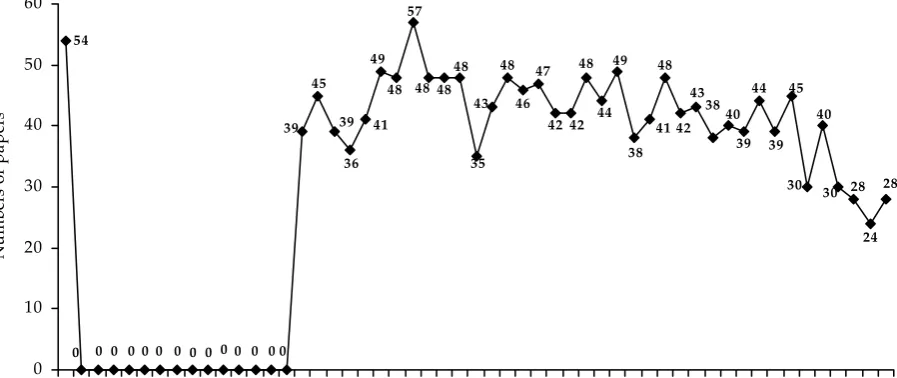
During the period studied 1633 articles appeared in PPS. Figure 1 shows that the publication peak was in 1970s and 1980s while there was a decline in 1990s. In Figure 2isshowed the relative proportions of publications in various disciplines dealing with plant health in PPS: mycology (34.3%), entomology (20.9%), virology (20.9%), weed science (13.7%), bacteriology (4.9%), agroecology (3.2%), stored-product protection (1.7 %), rodent control, (0.2%) air-pollution derived injuries (0.1%). The relative
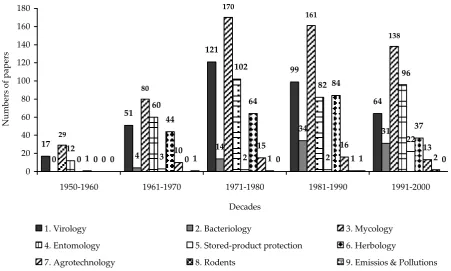
contributions of the disciplines were fairly steady over the period studied except for the increase of the publications on stored product protection in the last decade (Figure 3). Figure 4shows decreasing numbers of publications on synthetic pesticides published in PPS.
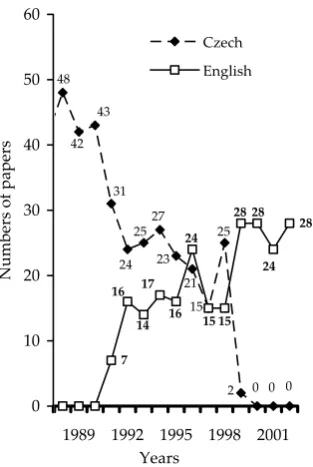
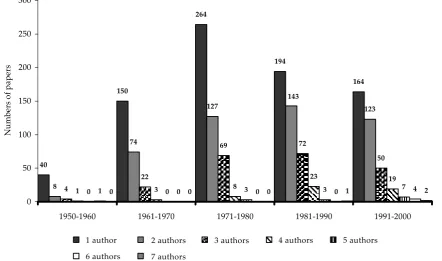
In the last 50 years, 2425 authors appeared in PPS. Steadily was increasing number of authors in PPS (Figure 5) and was increasing proportion of foreign (non-Czech) authors in PPS (Figure 6). The proportion of papers in English was increas-ing after 1989 (Figure 7), reachincreas-ing 100% in the last 3 years. Figure 8shows a decreasing trend to publish papers by sole authors. The papers with the largest collectives of authors appeared in the last decade, and include 2 articles by 7 authors.
38
43 44
40 39 39
45 40
30 30 28 28
24 57
48
42 41
48 47 49
38 44 48
42 42
43 46
48 49 45
39 39 41
36
0 0 0 0 0 0 0 0 0 0 0 00 0
35 48 48
48 54
0 10 20 30 40 50 60
1950 1953 1956 1959 1962 1965 1968 1971 1974 1977 1980 1983 1986 1989 1992 1995 1998 2001
Years
N
um
be
rs
o
f p
ap
er
s
20.9%
4.9%
34.3% 20.9%
1.7% 13.7%
3.2% 0.2%
0.1%
Virology
Bacteriology
Mycology
Entomology
Stored-product protection
Herbology
Agrotechnology
Rodents
Emissions & Pollutions
[image:2.595.68.517.302.491.2]Figure 1. Number of papers published by PPS showing decreasing trend in the last decade
17
51
121
99
64
0 4
14
34 31
29
80
170
161
138
12
0 3 2 2
22 1
44
64
84
37
0 10
15 16 13
0 0 01 10 11 2 0
60
96 82
102
0 20 40 60 80 100 120 140 160 180
1950-1960 1961-1970 1971-1980 1981-1990 1991-2000
Decades
N
um
be
rs
of
pa
pe
rs
1. Virology 2. Bacteriology 3. Mycology
4. Entomology 5. Stored-product protection 6. Herbology
[image:3.595.75.527.85.356.2]7. Agrotechnology 8. Rodents 9. Emissios & Pollutions
Figure 3. Number of papers published by PPS on various plant protection disciplines over the five past decades
DISCUSSION
The general trends in Czech plant protection sci-ence during the last five decades were estimated on the analysis of the papers published by the multidisciplinary scientific journal “Plant Protec-tion Science”, former “Ochrana Rostlin”. We are convinced that the results are representative enough
to make generalisation about the Czech plant pro-tection science since PPS is the only international scientific journal specialised in the problematic of the plant protection in the Czech Republic.
The peak of annual publishing quantity in PPS was in 1970s and 1980s. The number of papers per year decline in 1990s thus probably reflecting (i) the restriction of the scientific institutes and
Figure 4. Decreasing trend in publishing papers dealing with pesticides in PPS
y = –0.4751x + 34.557
0 10 20 30 40 50 60
1965 1967 1969 1971 1973 1975 1977 1979 1981 1983 1985 1987 1989 1991 1993 1995 1997 1999 Years
N
um
be
rs
of
pa
pe
[image:3.595.88.494.408.577.2]y = –2.2855x+ 72.293 0 20 40 60 80 100
1989 1990 1991 1992 1993 1994 1995 1996 1997 1998 1999 2000 2001 2002
[image:4.595.76.536.86.265.2]Years (%)
[image:4.595.79.271.336.720.2]Figure 6. Decreasing propor-tion of the Czech (i.e. “nati-onal”) authors appearing in PPS in the last decade
Figure 7. Increasing proportion of the English papers in PPS in 1986–2001
62 6662
0
55 62 56
67 67
48
49 4852 51
55 53 56 56 44 52 57 61 64 72 65 67 71 70 69 76 64 65 66 73 72 0 0 0 0 0 0 0 0 0 0 0 0 0 68 82 38 91 73 0 20 40 60 80 100
1950 1953 1956 1959 1962 1965 1968 1971 1974 1977 1980 1983 1986 1989 1992 1995 1998 2001 Years N umb er s of pa per s
Figure 5. Increasing number of authors appearing in PPS in the five past decades
54
0 0 0 0 0 0 0 0 0 0 0 0 0 0 39 45 39 36 41 49 48 57
48 48 48
35 43 48 46 47 42 42 48 49
0 0 0 44 41 38 15 21 25 2 23 27 25 24 31 48 42 43 28 24 28 28 15 15 24 16 17 14 16 7 0 10 20 30 40 50 60
1950 1953 1956 1959 1962 1965 1968 1971 1974 1977 1980 1983 1986 1989 1992 1995 1998 2001 Years Numbers of papers Czech English
the agricultural research in CZ in early and mid 1990s, and (ii) the increasing demands on quality of PPS coupled in this period. Out of 1633 articles that appeared in PPC in the last 50 years, 34.3% was on mycology, and 20.9% on entomology and virology, respectively. These three disciplines rep-resent the largest plant protection disciplines in CZ, followed by weed science, bacteriology, agr-oecology, and stored product protection, rodent management and air-pollution derived injuries. The relative contributions of the disciplines were fairly steady over the period studied except for the increased publication share of the stored product protection. The latter may reflect global trends of agricultural policy to increase the quality and safety of agro-products in developed countries (S������� 2001; T����� 2002). Another similar-ity with the general international trend was the decreasing number of publications on synthetic pesticides (Figure 4). For example, the worldwide
54
0 0 0 0 0 0 0 0 0 0 0 0 0 0 39 45 39 36 41 49 48 57
48 48 48
35 43 48 46 47 42 42 48 49
0 0 0
44 41 38 15 21 25 2 23 27 25 24 31 48 42 43 28 24 28 28 15 15 24 16 17 14 16 7 0 10 20 30 40 50 60
[image:4.595.86.243.488.722.2]40
150
264
194
164
8
74
127 123
4
22
69 72
50
1 3 8
23 19
0 1 0 0 0 0 3 0 0 3 0 1 7 4 2
143
0 50 100 150 200 250 300
1950-1960 1961-1970 1971-1980 1981-1990 1991-2000
Decades
N
um
be
rs
of
pa
pe
rs
1 - Author 2 - Authors 3 - Authors 4 - Authors 5 - Authors 6 - Authors 7 - Authors
review of the scientific publications by H����� (2000) reveals that “in 1960s there have been very few published studies on biological control (e.g. natural enemies) or on biorational methods, such as
pherom-ones, hermetic systems and inert dusts”. The reading
of the contents of the articles published in PPS also reveals that the journal has moved from the one of national relevance to that of international significance. It has lost some of the seclusion it had with recording and solving the immediate problems facing the Czech and Slovak agricultural and horticultural industries. The change from the practical, field-based work toward more labora-tory-based work can be traced through papers such as those describing serological and molecular techniques for the detection and determination of plant pathogens. A quantitative analysis of the latter publishing trends will be available in the subsequent work.
The global process of integration and interna-tionalisation of applied sciences was reflected by PPS via (i) replacement of the original national title (i.e. “Ochrana Rostlin”) by the new English title (i.e. “Plant Protection Science”), (ii) increasing number of foreign authors (Figure 6) and foreign members of the editorial board, (iii) increasing proportion of papers in English (Figure 7) reaching 100% in 1999. Non-English speaking and publishing
researchers risk being overlooked and not cited by English mainstream international research (G��-����� & W(G��-�������-D���� 1990). Similar trends of “journal internationalisation” can also be observed in other European and non-European countries; e.g. the resent transformation of the “Zeitschrift für Angewandte Entomologie” into the “Journal of Applied Entomology” in Germany.
[image:5.595.78.521.91.352.2]We think that the most general result of this study was the finding of the trend to publish papers on plant protection by more than one author. What is the reason for and increasing multiple author-ship? The current science is increasingly becoming international, interdisciplinary, and complex. It steadily heightens the demands for teamwork. In contrast to the recent past, nowadays it is beyond the ability of any individual to acquire detailed knowledge and skill required even within one scientific discipline; i.e. plant protection in this case. Thus the research team that is preparing a publication usually gathers various specialists, such as taxonomists, physiologists, molecular biologists, epidemiologists, bio-mathematicians and statisticians. S���� (2001), a famous devel-opmental biologist, reported that currently the number of co-authors per one paper range from 6 to 20 in the top ranked journals. Recently, A��� and M��� (2000) found that, given to tendency
Figure 8. Decreasing trend to publish single author papers in the last decade 1 author
6 authors
2 authors 7 authors
of authors to refer to their own work, there is a strong and significant positive correlation be-tween the average number of authors per paper and the average impact factor for a subject area. Thus, the increasing trend of multiple authorship is also connected with the spiralling a pressure on the increase of personal citation index and of the impact factor for journals dealing with a particular subject area.
The Czech Republic was partially internation-ally isolated by the restrictive communist policy in 1948–1989. This scientometrical analysis re-vealed that most of the changes leading to the internationalisation of the journal PPS occurred after 1989, with the termination of the “cold war” and breaking down the isolative “iron curtain” in Europe. We hope that sociologists of science will appreciate this documentation since it is an example of how national policy can influence the publishing policy and the policy of science. In the future, it will be interesting to explore the influ-ence of the forthcoming (i.e. 2004) membership of the Czech Republic in the European Union on the scientometric profile of the PPS.
Acknowlegment: Gratitude is expressed to Prof. Václav Kůdela for his helpful comments.
References
A��� M., M��� M. (2000): Impact factors: Use and abuse. Perspectives Publ., 1: 1–6.
G������� E., W�������-D���� A. (1990): Language use in international research: A citation analysis.
Curr. Contents, 52 (October): 5–17.
D��� D. (2000): A brief history of pest management. In: D��� D.: Insect Pest Management. CABI Publ., Wallingford: 1–6.
H����� C.P. (2000): IPM for food storage in develo-ping countries: 20th century aspirations for the 21st
century. Crop Prot., 19: 825–830.
K���� M. (1998): Integrated pest management: Histo-rical perspectives and contemporary developments. Ann. Rev. Entomol., 43: 243–270.
K����� V. (ed.). (1989): Obecná fytopatologie. Aca-demia, Praha.
K����� V. (1991): Sedmdesát let časopisu Ochrana rostlin. Ochr. Rostl., 27: 177–181.
K����� V. (1997): Rostlinolékařské právní normy v českých zemích a jejich historický vývoj. Stud. Inform., Ř. Rostl. Výr., No. 3, ÚZPI, Praha.
K����� V. (2000): Nástin dějin institucionalizace rostlinolékařství v českých zemích 1899–1999. ÚZPI, Praha.
K����� V. (2002): Plant pathology in the Czech Re-public. In: Proc. 6th Conf. EFPP, Prague. Plant Protec.
Sci., 38 (Special Issue 1): 1–8.
S���� J. (2001): O vědcích a vejcích. Paseka, Praha. S������� V. (2001): A new concept of economic injury
level that includes penalisation of damage to quality and safety of agricultural products. Plant Protect. Sci., 37: 151–156.
T����� B. (2002): Current trends in stored product pest research. Int. Pest Control, 44: 110–113.
Received for publication February 13, 2003 Accepted a�er corrections July 31, 2003
Abstract
S������� V., A������ R. (2003): Scientometrical analysis of journal Plant Protection Science in 1950–2002. Plant Protect. Sci., 39: 109–115.
publish-ing of pesticide papers, and an increaspublish-ing trend to publish papers by more than one author. The global process of integration and internationalisation of applied sciences was reflected by PPS via (i) replacement of the national (OR) title with the English title (PPS) of the journal, (ii) increasing number of foreign authors, and (iii) increasing proportion of scientific papers in English, reaching 100% in 1999. Most of the changes leading to internationalisa-tion of the journal PPS were traceable after 1989s with the terminainternationalisa-tion of a “cold war” in Europe.
Keywords: scientometry; publication policy; plant protection; pesticide; Czech science
Souhrn
S������� V., A������ R. (2003): Scientometrická analýza časopisu Plant Protection Science v letech 1950-2002. Plant Protect. Sci. 39: 109–115.
Analyzovali jsme vědecké články publikované v časopise „Plant Protection Science“ (PPS) (dřívější „Ochrana Rostlin“). Cílem studie bylo najít obecné trendy ve výzkumu ochrany rostlin za posledních pět dekád (tj. za období 1950–2002). V analyzovaném období bylo publikováno 1633 prací 2425 autory. Sedmdesátá a osmdesátá léta představovala vrchol v množství publikací v PPS. V 90. letech došlo k publikačnímu poklesu z následujících důvodů: 1. snižování počtu výzkumných ústavů v ČR a 2. zvyšování požadavků na kvalitu publikací. Publikační proporce jednotlivých disciplin v PPS byla: mykologie 34,3 %, entomologie 20,9 %, virologie 20,9 %, herbologie 13,7 %, bakteriologie 4,9 %, protektivní agroekologie 3,2 %, ochrana před skladištními škůdci 1,7 %, ochrana před hlodavci 0,2 % a výzkum vlivu emisí 0,1 %. Relativní přínos jednotlivých disciplín byl ve sledovaném období relativně stálý s výjimkou prací týkajících se skladištních škůdců. To odráží současné globální trendy zemědělské politiky, která klade důraz na kvalitu a bezpečnost potravin. Snižující se počet článků s tematikou tradičních pesticidů rovněž odráží světové trendy. PPS odráží i proces internacionalizace a integrace světové vědy: 1. změnou národního názvu (Ochrana Rostlin) na mezinárodní (Plant Protection Science), 2. zvyšujícím se zastoupením zahraničních autorů a 3. zvyšujícím se zastoupením anglicky psaných článků (v posledních třech letech je to 100%). Dalším zjištěním byla zvyšující se proporce článků v PPS psaných více než jedním autorem. To indikuje, že zvyšující se interdisciplinarita a složitost současné vědy zvyšuje požadavky na týmovou práci. Většina změn vedoucí k internacionalizaci PPS byla po roce 1989, kdy v Evropě skončila studená válka, což demonstruje význam národní politiky na politiku vědy. Navrhujeme, aby byla provedena analýza vlivu vstupu ČR do EU na scientometrické parametry časopisu PPS.
Klíčová slova: scientometrie; publikace; ochrana rostlin; pesticidy; česká věda
Corresponding author:
Ing. V����� S�������, PhD., Výzkumný ústav rostlinné výroby, oddělení ochrany zásob, 161 06 Praha 6-Ruzyně, Česká republika