Parallel Iterative Solution of the Hermite
Collocation Equations on GPUs
E. Mathioudakis, N. Vilanakis, E. Papadopoulou and Y. Saridakis
Abstract—We consider the computationally intense problem of solving the large, sparse and non-symmetric system of equa-tions arising from the discretization of elliptic Boundary Value Problems (BVPs) by the Collocation finite element method using Hermite bi-cubic elements. As the size of the problem directly suggests the usage of parallel iterative methods, we consider the implementation on multiprocessor shared memory parallel architectures with Graphics Processing Units of the non-stationary preconditioned Bi-Conjugate Gradient Stabi-lized (BiCGSTAB) iterative method. To induce scalability to our computation, we structure the Collocation matrix to a particular line red-black ordered form, leading to the devel-opment of a well-structured parallel algorithm for the iterative method. The realization of the said algorithm took place on a HP SL390 multiprocessor machine with Tesla M2070 GPUs. Execution time measurements are used to reveal the efficiency of our parallel implementation.
Index Terms—Collocation, BiCGSTAB, Shared Memory, OpenMP, OpenACC, GPUs.
I. INTRODUCTION
C
OLLOCATION method is a high order accurate dis-cretizer for BVPs modelling applications in several fields of science and engineering (e.g. [1]). The method approximates the solution of the problem avoiding nume-rical integration and making readily available the values of the solution function and its first derivatives at all grid nodes. Thus the resulting linear system is large and sparse, suggesting the usage of efficient iterative solvers [2], [3], [4]. For realistic applications, where fine discretizations are necessary, the realization of the method requires high perfor-mance computing architectures. The resources for these com-puting environments can include multi-core machines with Graphic Processing Units (GPUs), which can accelerate the performance. To take advantage of the increased computing power capabilities GPUs induce to computers, an efficient realization of a parallel algorithm for shared memory and massively parallel architectures is needed.These scientific issues have attracted the interest of sev-eral researchers in the past and an important progress has been made in the area of parallel iterative solution of the collocation finite element method (e.g. [5], [6], [7], [8], [9], [10]).
The aim of this work is the development of appropriate parallel algorithms for the numerical treatment of the collo-cation equations on GPU computational environments. The paper is organized as follows: In Section II, the iterative
Manuscript received March 23, 2013; revised April 16, 2013.
This work was supported by EU (European Social Fund ESF) and Greek funds through the operational programEducation and Lifelong Learningof the National Strategic Reference Framework (NSRF) - Research Funding Program: THALIS.
All authors are with the Department of Sciences, Technical University of Crete, University Campus, 73132 Chania, Crete, Greece – Corresponding author’s e-mail: [email protected].
solution for collocation linear system of algebraic equations arising from the application of finite element method based on a Hermite bi-cubic elements is briefly described. Section III presents the basic features for developing a parallel algorithm for multiprocessor with GPUs machines for the BiCGSTAB iterative solving procedure. Finally, in Section IV, we present the numerical results from the performance evaluation of the parallel algorithm.
II. REDBLACKCOLLOCATION LINEAR SYSTEMS Let us consider the modified Helmholtz problem
∇2u(x, y)−λu(x, y) = f(x, y) , (x, y)∈Ω u(x, y) = g(x, y) , (x, y)∈∂Ω
(1) withλ ≥0 on the rectangular domainΩ ≡(0,1)×(0,1) as our model problem. Assuming a uniform partition of the intervals Ix = Iy = [0,1] into n
s subintervals Imx =
Iy
m , m = 1 , . . . , ns which generates a uniform grid with spacingh= n1
s and nodal coordinates(xi, yj), where
xi = (i−1)handyj = (j−1)h,i, j= 1, . . . ,(ns+ 1). The Hermite Bi-Cubic finite element approximation seeks an approximate solutionu˜(x, y) in the form
u(x, y) ∼ ˜u(x, y) =
˜
n X
i=1 ˜
n X
j=1
αi,jφi(x)φj(y) , (2)
where n˜ = 2(ns + 1). The basis functions φi(x) and
φj(y) are the known one dimensional piecewise Hermite cubic polynomials [11]. Based, now, on the basic properties of Hermite basis functions, one can easily verify that the following four unknowns
a2i−1,2j−1 = u˜(xi, yj)
a2i−1,2j = h∂y∂ u˜(xi, yj)
a2i,2j−1 = h∂x∂ u˜(xi, yj)
a2i,2j = h2 ∂ 2
∂x∂yu˜(xi, yj)
(3)
are associated with the mesh point (xi, yi). With the im-position of boundary conditions 8ns+ 4 unknowns, asso-ciated with nodes on the boundary ∂Ω, can be determined beforehand. Therefore collocation equations needed for the determination of the remainingn= 4n2s unknowns are then constructed by forcing the approximate solution u˜(x, y) to satisfy the BVP in n interior collocation points. These are the four Gaussian points in each of the n2
s elements Iij. Since there is an one-to-one correspondence between collo-cation points and equations, a numbering of the equations is produced when we number the collocation points while a numbering of the unknowns is readily available when we number the unknowns associated with each node. This procedure results to a linear system
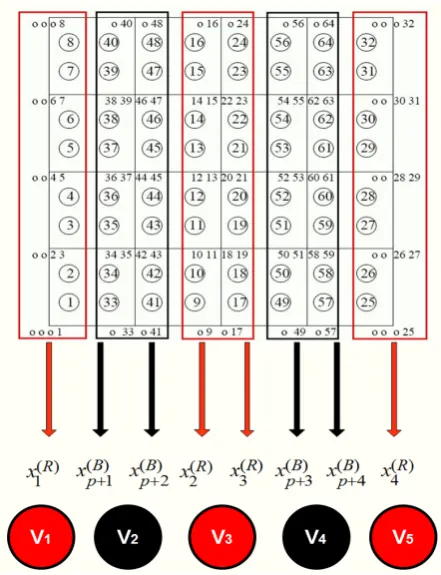
Fig. 1. Numbering of unknowns and equations forns= 4.
whereAis the n×n Collocation coefficient matrixand x = [x1 x2 · · · xn]T ≡ [α1,1 · · · α˜n,n˜]T
is the unknown vector, with n = 4n2
s.
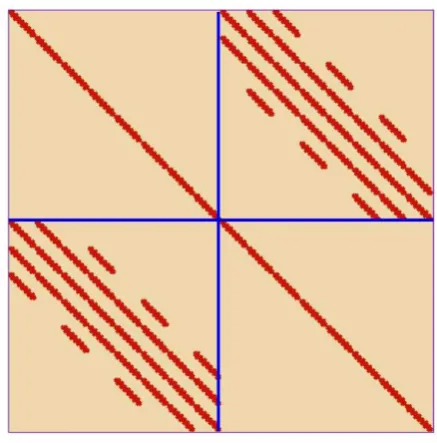
To increase parallelism, we number unknowns and equa-tions in red-black ordered fashion (cf. [7]) depicted in Fig. 1 for ns = 4. Small numbers represent the numbering of unknowns per node while circled numbers represent the numbering of the equations per element. Small circles on the boundary indicate unknowns that have been evaluated from the boundary conditions. In Fig. 2 the structure of the resulted collocation matrix after the application of a similar-ity transformation as in [7], [8] is shown schematically. One can easily verify that the collocation matrix takes its 2-cyclic normal form
A =
DR HB
HR DB
, (5)
whereDRandDBare non-singular block diagonal matrices. For the case ofns= 2pthey have the form
DR = diag[A2 2A1 2A2 · · · 2A1 2A2 −A2
| {z }
2p−blocks
], (6)
DB = 2diag[A1 A2 · · · A1 A2
| {z }
2p−blocks
] (7)
HR =
R1 R2
R3 R1 R2
. .. . .. . .. . .. . .. . ..
R3 R1 R2
R3 Rˆ1
(8)
HB =
B1 B2
B3 B1 B2
. .. . .. . .. . .. . .. . ..
B3 B1 B2
B3 B1
(9)
Fig. 2. Structure of the Collocation Matrix forns= 4.
where
R1 =
A4 A3
−A4 A3
, R1ˆ =
A4 −A4
−A4 −A4
,
R2 = −
A4 0
A4 0
, R3 =
0 A3
0 −A3
,
and
B1 =
A3 −A4
A3 A4
,
B2 =
0 0
A3 −A4
, B3 = −
A3 A4
0 0
.
The block form of the above matrices involve four2ns×2ns pentadiagonal basic real matricesAi fori= 1, . . . ,4 [10].
In our earlier work [8], [9], [12], [10] we have successfully solved the red-black collocation linear system using the SOR and preconditioned Krylov subspace iterative methods based in the following splitting of the matrix
A = DA − LA − UA , (10)
where
DA =
DR O O DB
, LA =
O O
−HR O
,
UA =
O −HB
O O
, (11)
and for the other members of the collocation linear system we have assumed the conformal partitioning of the vectors xandbinto
x =
xR xB
and b =
bR bB
. (12)
[image:2.595.315.534.54.276.2]converge faster than SOR and any other Krylov subspace method.
To increase the scalability, as well as to reduce the execution time, of the preconditioned BiCGSTAB method, we introduce the following two sided preconditioning
M1−1A M2−1M2x = M1−1b , (13)
whereM1is the Gauss Seidel’s iteration matrix based on the
matrix splitting in (10)
M1 = DA−LA = DA(I−DA−1LA) (14)
and
M2 = I−D−A1UA . (15)
The collocation linear system takes the following form
I O
O S
xR+DR−1HRxB xB
=
ˆ bR ˆ bB
, (16)
where
S=DB−HRDR−1HB (17)
is the Schur complement of the collocation matrix with respect ofDB and
ˆ
bR = D−R1bR and ˆbB = bB−HRˆbR . (18)
The detailed computation involved in the equations above can be described by means of the following algorithm :
Algorithm for Schur complement collocation equations
S1: Solve DRˆbR=bR
S2: Evaluate ˆbB = bB−HRˆbR S3: Solve with BiCGSTAB SxB = ˆbB S4: Evaluate xˆB = HBxB
S5: Solve DRxˆR=xˆB S6: Evaluate xR = ˆbR−xˆR
Obviously, the dominant operations of the algorithm are the matrix vector multiplication with the block diagonal matrices DR, DB, HB and HR, followed by the direct solution of linear systems involving matrices DR andDB. Said operations, in theseredandblack computation cycles, require the design of efficient algorithms for shared memory architectures.
[image:3.595.316.537.52.340.2]III. PARALLEL ALGORITHM FORCOLLOCATION The architecture of the parallel system available, along with the number of processors, are the most important factors affecting the ordering and the partition of the whole computation of a parallel algorithm. Our model is a shared memory system, consisting of a few powerful processor cores for the host computer and a few hundreds for the graphics processing unit. GPU cores can perform only basic arithmetic operations and they have their own memory. As such, data and computation partitioning must take into consideration the particular architecture at hand and, at the same time, keep all cores busy during the whole computation. This no idle core model requires well balanced computational and memory communication loads. An efficient way to carry
Fig. 3. Assigning collocation unknowns into threads forns= 4.
out the demanding task of assigning threads to cores is by considering at first a virtual architecture with unlimited number of cores. If now one takes also into consideration the requirement that these threads must be data independent with minimized memory communication, and that the number of subintervals ns = 2p of the discretization in both x andy directions is even, it can be easily observed that the appropriate allocation scheme requires the assignment of one core thread for each one of the2p+1vertical grid lines. This is shown schematically in Fig.3 forns= 4.
Moreover,odd core threads representred grid lines while
even threads represent black grid lines and due to the 2p -block partitioning of all vectors participating in the compu-tation, it becomes clear that each one of the odd threads
V2i−1, i= 1, . . . , p+ 1, has being assigned with the task
of determining the solution subvectorst2i−2andt2i−1while
each one of the even threads V2i , i= 1, . . . , p , has being assigned with the task of determining the solution subvectors t2p+2i−1andt2p+2i. The irregularity appeared in threadsV1
andV2p+1 is due to the boundary conditions.
In the parallel algorithm all basic linear algebra vector operations such as inner products, vector additions and multiplications with scalars, can be executed in parallel based on the above 2p-block partitioning of all vectors. These operations are performed in parallel since there is no data dependence from one thread to the other.
Red Computation Cycle
C$ OMP PARALLEL DO DEFAULT(SHARED)
do i= 0 to p V2i+1 computes t2i, t2i+1
enddo
C$ OMP END PARALLEL DO
Black Computation Cycle
C$ OMP PARALLEL DO DEFAULT(SHARED)
do i= 1 to p
V2i computes t2p+2i,t2p+2i−1
enddo
C$ OMP END PARALLEL DO
In the above algorithms, the CPU thread implementation can be realized by using efficient procedures from existing numerical libraries [13]. For example, in the case of the forward and backward substitutions, during the block direct solution of the linear systems with matricesDRandDB, the appropriate procedure from Lapack library is chosen, while for the matrix vector multiplication, involving the matrices
HB andHR, the procedure from BLAS library can be used. However, if one wants to exploit the special structure of the matrices involved in the computations to optimize the GPU thread implementation, it is necessary to design efficient algorithms for the massively parallel model.
The serial nature of the computations involved during the forward and backward substitutions of linear system solu-tions, combined with the fact of GPU memory limitasolu-tions, directly imply that the solution of the linear systems during the red and black cycles, with coefficient matrices DR and
DB respectively, have to be performed from the computer host threads.
On the other hand, the independence of the data involved during the matrix-vector basic linear algebra operations, combined with the fact that the hundreds of GPU cores are organized in computational groups and are able to perform simultaneously - via the SIMD programming model - basic arithmetic operations extremely faster than the computer host processors, directly imply that the matrix-vector multiplica-tion subroutines during the red and black cycles involving the
HRandHB block matrices are suitable for GPU implemen-tations. Further improvement is achieved by taking advantage of HR’s and HB’s block structure, from relations (8) and (9) respectively, which is based on two only pentadiagonal matricesA3 andA4 of order 2ns.
The above are implemented in the parallel algorithm that follows and describes in detail the black cycle fort=HBz GPU matrix vector multiplication.
Black GPU Computation Cycle
!$ACC DATA COPYIN(z) CREATE(temp) COPYOUT(t) !$ACC KERNELS
!$ACC LOOP INDEPENDENT
do k= 1 to ns−3 with step 2
k1= (k−1)2ns , k2=k2ns
k3= (k+ 1)2ns , k4= (k+ 2)2ns
!$ACC LOOP INDEPENDENT
do i= 1 to 2ns
t(k2+i) =A3(3, i)z(k1+i) +A4(3, i)z(k2+i) enddo
!$ACC LOOP INDEPENDENT
do i= 2 to 2ns
t(k2+i−1) =t(k2+i−1)+
A3(2, i)z(k1+i−1) +A4(2, i)z(k2+i)
enddo
!$ACC LOOP INDEPENDENT
do i= 1 to 2ns−1
t(k2+i+ 1) =t(k2+i+ 1)+
A3(4, i)z(k1+i) +A4(4, i)z(k2+i)
enddo
!$ACC LOOP INDEPENDENT
do i= 1 to 2ns−2
t(k2+i) =t(k2+i)+
A3(1, i+ 2)z(k1+i+ 2)+ A4(1, i+ 2)z(k2+i+ 2)
enddo
!$ACC LOOP INDEPENDENT
do i= 1 to 2ns−2
t(k2+i+ 2) =t(k2+i+ 2)+
A3(5, i)z(k1+i) +A4(5, i)z(k2+i)
enddo
!$ACC LOOP INDEPENDENT
do i= 1 to 2ns
t(k3+i) =A3(3, i)z(k3+i)−A4(3, i)z(k4+i)
enddo
!$ACC LOOP INDEPENDENT
do i= 2 to 2ns
t(k3+i−1) =t(k3+i−1)+
A3(2, i)z(k3+i−1)−A4(2, i)z(k4+i)
enddo
!$ACC LOOP INDEPENDENT
do i= 1 to 2ns−1
t(k3+i+ 1) =t(k3+i+ 1)+
A3(4, i)z(k3+i)−A4(4, i)z(k4+i)
enddo
!$ACC LOOP INDEPENDENT
do i= 1 to 2ns−2
t(k3+i) =t(k3+i)+
A3(1, i+ 2)z(k3+i+ 2)− A4(1, i+ 2)z(k4+i+ 2)
enddo
!$ACC LOOP INDEPENDENT
do i= 1 to 2ns−2
t(k3+i+ 2) =t(k3+i+ 2)+
A3(5, i)z(k3+i)−A4(5, i)z(k4+i)
enddo
!$ACC LOOP INDEPENDENT
do i= 1 to 2ns
temp(i) =t(k3+i) enddo
!$ACC LOOP INDEPENDENT
do i= 1 to 2ns
t(k3+i) =t(k3+i)−t(k2+i) enddo
!$ACC LOOP INDEPENDENT
do i= 1 to 2ns
t(k2+i) =t(k2+i) +temp(i) enddo
enddo
We point out that, due to limited space, the part of the algorithm corresponding to the first and last block rows of the HB matrix is not included. The GPU realization of the red computational cycle can be described by an analogous algorithm.
MAPPING ONTO AFIXEDSIZEARCHITECTURE
When implementing the algorithm on a fixed core parallel system, consisting of P cores, groups of threads have to be mapped onto the GPU and host processor cores. In this section we describe the mapping process in the case ofns=
kP, since simple adjustments can be made to cover all other cases. In this particular case, however, the computational cost is uniform for all cores. The mapping mechanism we shall follow is that of associating k consecutive threads to each one of the Pj , (j = 1, . . . , P) cores of the fixed size architecture and is shown schematically bellow.
y y • • • y
~
V(j−1)k+1 V(j−1)k+2 Vjk
Pj
?
It becomes obvious, following the above mapping, that with each Pj core we associate the k core threads
V(j−1)k+1, . . . , Vjk. Observe that :
• Whenever k is even the indices (j−1)k+ 1 and jk
satisfy (j−1)k+ 1 isodd while jk iseven. Hence the core threadsV(j−1)k+1andVjkare respectivelyred
(odd) andblack (even)threads and therefore schemati-cally we have:
y y • • • y y
~
Red Black Red Black
Pj
?
Thus, with core Pj we associate the k red vectors tl , l = (j−1)k, . . . , jk−1 and thek black vectors t2p+l, l= (j−1)k+ 1, . . . , jk .
• Whenever k is odd the indices (j−1)k+ 1 and jk satisfy(j−1)k+ 1 and jk are odd when j isodd
while(j−1)k+ 1 and jk areeven when j iseven. Hence the threadsV(j−1)k+1andVjkare bothred (odd) whenj isodd while they are bothblack (even)whenj
iseven and therefore schematically we have:
x x • • • x x x
~
Red Black Red Black Red
Pj, j isodd
?
x x • • • x x x
~
Black Red Black Red Black
Pj, j iseven
?
Thus, when j is odd, with core Pj we associate the
k+ 1redvectorstl, l= (j−1)k, . . . , jkand thek−1
black vectors t2p+l , l = (j−1)k+ 1, . . . , jk−1 , while, when j is even, with core Pj we associate the
k−1 red vectorstl, l= (j−1)k+ 1, . . . , jk−1 and thek−1black vectorst2p+l, l= (j−1)k, . . . , jk . All the above are used to carry out each step of the following Schur complement algorithm:
Parallel Algorithm for Schur comp. collocation equations
S1: Solve in parallel on host DRˆbR=bR S2: Send matricesA3 and A4 to GPU
S3: Evaluate in parallel on GPU ˆbB = bB−HRˆbR S4: Solve in parallel with BiCGSTAB SxB = ˆbB S5: Evaluate in parallel on GPU xˆB = HBxB S6: Solve in parallel on host DRxˆR=xˆB S7: Evaluate in parallel on host xR = ˆbR−xˆR The parallel algorithm’s computations in step S4 for the BiCGSTAB method are performed on the host except for the two matrix vector multiplications at each iteration step involving the Schur complement matrixS. More specifically, the computation in step S4, involving the matricesHR and
HB as multipliers, is executed on the GPU as follows:
Evaluation oft = Sp
S1: Sendpfrom host to GPU
S2: Evaluate in parallel on GPUt = HBp
S3: Sendtfrom GPU to host
S4: Solve in parallel on hostDRs = t
S5: Sendsfrom host to GPU
S6: Evaluate in parallel on GPUq = HRs
S7: Sendq from GPU to host
S8: Evaluate in parallel on hostt = DBp − q
The communication cost for data movement between host and GPU memory is the cost for transferring two vectors of size2n2
sin each direction. Thus, the communication cost for every BiCGSTAB iteration step, is the cost of transferring eight vector of size2n2
sin each direction, since matricesA3
andA4 are moved and stored in the GPU memory once at
the beginning of the solution process.
IV. REALIZATION ON AGPU SHARED-MEMORY PARALLEL COMPUTER
GPU [14] connected via a PCI-e gen2 slot. The GPU has 6GB of memory and 448 cores on 14 multiprocessors. The application is developed in double precision Fortran code using OpenMP [15], [16] and OpenACC [17] standards with PGI’s compilers version 12.9 [18]. For the basic linear algebra operations subroutines from scientific libraries BLAS and LAPACK [19] are considered, as they are utilized for this specific platform.
For the implementation of the above parallel algorithm the test Dirichlet Helmholtz problem, which accepts the following exact solution
u(x, y) = 10φ(x)φ(y), φ(x) =e−100(x−0.1)2(x2−x),
[image:6.595.311.540.57.141.2] [image:6.595.93.246.275.348.2] [image:6.595.76.264.445.726.2]with λ = 1 was solved. The following Table I presents the behaviour of the method regarding convergence iteration steps and linear system error L2-norm for discretization sizes up to 2048 finite elements in each direction.
Table I: Iterations and error L2-norm ns Iterations ||b−Ax(m)||2
256 294 6.06e-11
512 589 2.85e-11
1024 1161 1.39e-11
2048 3726 9.59e-12
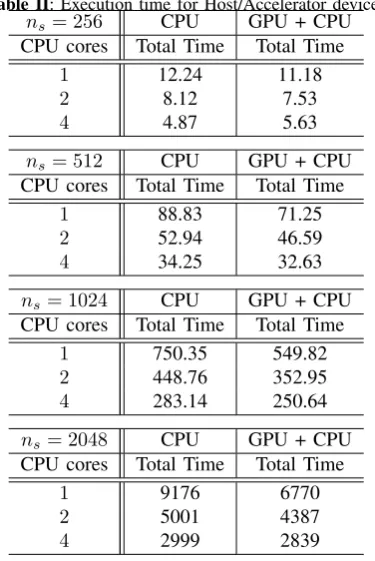
Focusing now, on the performance of our parallel algorithm and its implementation on the given parallel environment, we have collected time measurements using several execution parameters, such as the number of host cores and GPU enabling. Table II below summarize these execution time measurements in seconds each of one for different problem size starting fromns= 256up tons= 2048discretizations.
Table II: Execution time for Host/Accelerator devices ns= 256 CPU GPU + CPU CPU cores Total Time Total Time
1 12.24 11.18
2 8.12 7.53
4 4.87 5.63
ns= 512 CPU GPU + CPU CPU cores Total Time Total Time
1 88.83 71.25
2 52.94 46.59
4 34.25 32.63
ns= 1024 CPU GPU + CPU CPU cores Total Time Total Time
1 750.35 549.82
2 448.76 352.95
4 283.14 250.64
ns= 2048 CPU GPU + CPU CPU cores Total Time Total Time
1 9176 6770
2 5001 4387
4 2999 2839
In the following last Table III the execution time in more detail for the cases involving the GPU can be found. The time for data transferring from CPU to GPU and vice versa for all discretizations is presented. The computation time for every available CPU core number is also measured.
Table III: Multi-core execution time ns GPU - CPU Computation Time
Comm. Time 1 Core 2 Cores 4 Cores 256 1.52 9.66 6.01 4.11
512 6.81 64.44 39.78 25.82
1024 44.3 505.5 308.6 206.3
2048 541 6229 3846 2298
We have to mention that the communication time between CPU and GPU is independent of the number of the CPU cores, because in our algorithm the transferring phase is per-formed by one thread due to the computation load balancing. This avoids the data bottleneck movements between multiple CPU threads over the PCI slot of the machine.
V. CONCLUSIONS
A new parallel algorithm for implementing the BiCGSTAB iterative method for solving the Hermite Collocation equations, arising from elliptic PDEs, has been developed and realized on multi-core machines with GPUs. The performance of the algorithm is affected by the size of the problem and the number of CPU cores. A performance acceleration of up to almost30% is observed.
ACKNOWLEDGMENT
The present research work has been co-financed by the European Union (European Social Fund ESF) and Greek national funds through the Operational ProgramEducation and Lifelong Learning
of the National Strategic Reference Framework (NSRF) - Research Funding Program: THALIS. Investing in knowledge society through the European Social Fund.
REFERENCES
[1] C. E. Houstis, E. N. Houstis, and J. Rice, “Pde computations: Methods and performance evaluation,”Par. Comp., vol. 5, pp. 141–163, 1997. [2] R. Varga,Matrix Iterative Analysis. New York: Springer Verlag, 2000. [3] H. der Vorst, “Bi-cgstab : A fast and smoothly converging variant of bi-cg for the solution of nonsymmetric linear systems,”SIAM J. Sci.Stat.Comp., vol. 13, pp. 631–644, 1992.
[4] Y. Saad,Iterative methods for sparse linear systems. SIAM, 2003. [5] C.C.Christara, “Parallel solvers for spline collocation equations,”
Ad-vances in Engineering Software, vol. 27, pp. 71–89, 1996.
[6] S.H.Brill and G.F.Pinder, “Parallel implementation of the bi-cgstab method with block red-black gauss-seidel preconditioner applied to the hermite collocation discretization of partial differetial equations,”
Parallel Computing, vol. 28, pp. 399–414, 2002.
[7] E. Mathioudakis, E. Papadopoulou, and Y. Saridakis, “Iterative solu-tion of elliptic collocasolu-tion systems on a cognitive parallel computer,”
Computers and Maths with Appl., vol. 48, pp. 951–970, 2004. [8] ——, “Mapping parallel iterative algorithms for pde computations on a
distributed memory computers,”Parallel Algorithms and Applications, vol. 8, pp. 141–154, 1996.
[9] ——, “Bi-cgstab for collocation equations on distributed memory par-allel computers,”Numerical Mathematics and advanced applications - ENUMATH 2001, Springer, pp. 957–966, 2003.
[10] E. Mathioudakis and E. Papadopoulou, “Grid computing for the bi-cgstab applied to the solution of the modified helmholtz equation,”Int. J. App. Maths and comp. sciences, vol. (4),3, pp. 179–184, 2007. [11] T. Papatheodorou, “Block aor iteration for nonsymmetric matrices,”
Math. Comp., vol. (41),164, pp. 511–525, 1983.
[12] E. Mathioudakis, E. Papadopoulou, and Y. Saridakis, “Preconditioning for solving hermite collocation by the bi-cgstab,”WSEAS Trans. on Mathematics, vol. (5),7, pp. 811–816, 2006.
[13] J. Dongarra, I. Duff, D. Sorensen, and H. van der Vorst,Numerical Linear Algebra for high-performance computers. Phil.: SIAM, 1998. [14] Nvidia,http://www.nvidia.com/object/tesla-servers.html.
[15] C. Rohit,Parallel programming with OpenMP. M. K., 2001. [16] OpenMP,http://www.openmp.org.