In the Czech Republic, there are 4 national parks (area of 111.6 ha, i.e. 1.4% of the Czech Republic’s territory) and 24 protected landscape areas (area of 1,041.6 thousand ha, i.e. 13.2% of the Czech Republic’s territory) within large-area specially protected areas (as established by Act No. 114/1992); within small-area specially protected areas there are 1997 units (different statute of protection and size) representing 86.3 thousand ha, i.e. 1.0% of the CR territory. The areas are under special protection con-cerning the restriction of the wood-producing function of forests. The limitation of the wood-producing function of forests is also applied in a substantial part of the CR forests (logically in areas intended for fulfi lling the func-tion of forests in terms of Act No. 289/1996) representing 22.3% of the area of forests in the category of protection forests and special-purpose forests. Although it is evident that both examples mentioned above frequently overlap, in the category of specially protected areas there is a part of the territory (about 30%) out of the land intended for fulfi lling the functions of forests and it would be possible to mention also other aspects, it is obvious that the areas where the wood-producing function is legally limited are extensive, very differentiated and distributed throughout the territory of the country. Moreover, it is evident that in accordance with the fulfi lment of the principles of the
NATURA 2000 programme, a certain part of forests not negligible from the viewpoint of area fulfi lling the wood-producing function of forests will be distinguished without other than legal restrictions (CHYTRÝ et al. 2001). If the above-mentioned facts are a prerequisite for our accession to the EU in the near future, it is necessary to take into account the fulfi lment of the wood-producing function of forests and to deal with related questions. The matters are put into the foreground if we take into consideration that we unambiguously belong to countries with the smallest average area of private property in Europe and that the realized cuts do not reach harvesting potentials according to domestic and European experts.
WOOD-PRODUCING FUNCTION OF FORESTS IN SPECIALLY PROTECTED AREAS Fulfi lment of the wood-producing function of forests can be understood as a removal of wood mass (through logging operations) from the forest environment, usually for the purpose of its commercial use. The activity can be realized in all stages of forest development and positive economic effects are usually expected.
The intensity of wood-producing function can range in extreme positions from an individual selection with the JOURNAL OF FOREST SCIENCE, 48, 2002 (5): 230–236
Risks of the wood-producing function of forests in areas with
the special statute of protection
J. S
IMONMendel University of Agriculture and Forestry, Faculty of Forestry and Wood Technology,
Brno, Czech Republic
ABSTRACT:Fulfi lling the wood-producing function of forests can be understood as a removal of wood mass by logging operations from the forest environment usually for the purpose of its commercial use. The activity can be implemented in all stages of forest development. Positive economic effects are usually expected. Management in specially protected areas requires to concentrate on the preferential fulfi lment of protection objectives in affecting the forest ecosystem. In this context, the use of the wood-producing function of forests is often comprehended as controversial. But it has been proved that the maintenance of the forest condition corresponding to the ideas of fulfi lment of protection objectives requires differentiated management, application of silvicultural as well as logging measures, viz. even in ‘measure-free’ zones. Many strategies of management for specially protected regions have been formulated, however, evaluation or quantifi cation of risks of the activity from the aspect of danger and fulfi lling the objective of protection is missing. The paper deals with this problem, plans the methodology of evaluation and quantifi cation of risks of using the wood-producing function of forests in specially protected areas with a special statute of protection – areas falling under the NATURA 2000 directive. The quantifi cation of risks and specifi cation of the limiting values for evaluation of various technologies were studied by an expert method in 2000–2001 in eleven small-scale and large-scale protected areas in the Czech Republic.
minimum volume of harvested timber per unit area to the ap-plication of clear felling. To let the forest to its development without any felling measures represents rather an extreme position. In this case, however, it is not possible to speak about the use of the wood-producing function of forests.
In specially protected areas (defi ned by Act No. 114/ 1992) where the forest and the forest environment are in-fl uenced and thus the wood-producing function of forests is fulfi lled, it is necessary to prefer the objectives that will ensure and stabilize the ecological function of forest eco-systems in accordance with differentially determined sub-jects of protection and management of their use. Fulfi lling these objectives, the use of the wood-producing function is often understood as an antagonistic negative factor.
This attitude is not however correct because it is neces-sary to admit that special management in specially pro-tected areas has to take into account (in order to ensure the objectives of protection) also silvicultural and regeneration measures where the wood-producing function is applied. It is evident from a number of publications (e.g. MÍCHAL et al. 1992; POLENO 1997; MÍCHAL, PETŘÍČEK 1999; PRŮŠA 2001, etc.), methodology of preparing the plans of care of specially protected areas takes it into account (KOLEKTIV 1999), it is also refl ected in legislation. The use of par-ticular technologies and risks of their application from the viewpoint of achieving the objectives of protection have not been discussed or rough empiricism is used. For these reasons, the VaV/610/2/00 project Determination of limits and assessment of risks of the wood-producing function of forests in specially protected areas according to the cat-egory of protection was solved within the CR Ministry of Environment assignment in 2000–2001. The project objec-tive was to prepare basic methodologies for the potential quantifi cation of risks of the wood-producing function of forests in specially protected areas, generally in a prospect for areas with the special statute of protection. The resulting methodology is presented in this paper.
SYSTEM ANALYSIS OF RISKS OF THE WOOD-PRODUCING FUNCTION OF FORESTS
IN SPECIALLY PROTECTED AREAS The quantifi cation of the wood-producing function of forests from the viewpoint of achieving the objective of protection is dealt with in the following scheme:
Degree of risk (DR) – basic value 1–100
The conception of a comprehensive risk of irrevers-ible changes in the forest ecosystem destruction is also introduced.
Risk materialization (RM) – weight 1–10
0 no risk factor has no effect on achievement of the objective of protection 1 1 small by materializing the effect of a risk factor the objective of protection is not endangered 10
or its achievement is not worsened
2 medium by materializing the effect of a risk factor the objective of protection is not endangered, 20 however, its achievement is more diffi cult
3 large by materializing the effect of a risk factor the objective of protection is endangered, 50 its achievement is challenging but realistic
4 extraordinarily large by materializing the effect of a risk factor the objective of protection is endangered, 80 its achievement is often unrealistic
5 extreme the materialization of the effect of a risk factor cannot be prevented, achievement 100 of the objective of protection is not realistic
Effects of the risk materialization (ERM) – weight 1–10
Time aspects of the effect of risk materialization from the viewpoint of maintenance (restoration) of the objective of protection
1 minimum, zero weight 1
2 realistic, unexpectable weight 3
3 realistic, signifi cant weight 7
4 sure weight 10
Quantifi cation of risks (QR) Quantifi cation of a particular risk
QRi = (DR . RM . ERM) + CUR,
CUR – coeffi cient of unpredictable risk – (0–100) Quantifi cation of the total risk of technology use
n QTR = a . b . c .∑ QRi
i=1
where: a – coeffi cient of a potential failure to observe optimum logging and hauling technology (1–10),
b – coeffi cient of the degree of protection regime as re-lated to the zones of differentiated protection (1–4), c – coeffi cient of the degree of natural character of
forest stands (2–10).
The use of technologies with respect to fulfi lling the objective of protection
– acceptable (exploitable), – problematic,
– unacceptable (unrecommendable).
(Quantifi cation on the basis of research results). Economic evaluation
Management result: – positive + – balanced ± – negative –
1 short-term weight 1
2 temporary weight 5
3 permanent weight 10
The scheme shows the basic methodology for the quantifi cation of risks and classifi cation and evaluation of actual technologies proposed for particular areas. The solution, i.e. evaluation of the technology aimed at the use of the wood-producing function of forests in accordance with the given objective of protection, is implemented in the following successive steps:
– area classifi cation, area categorization for basic man-agement strategies
– specifi cation of the protection objectives for parts of the area with particular management strategies,
– defi nition of the optimized silvicultural or regeneration procedures,
– simulation of the development of stands using a growth simulator according to PRETZSCHand SEIFERT (1999) and ĎURSKÝ (1999) for selected silvicultural or regen-eration procedures aimed at the verifi cation of fulfi lling the objective of protection,
– the proposal of technology variants including eco-nomic evaluation,
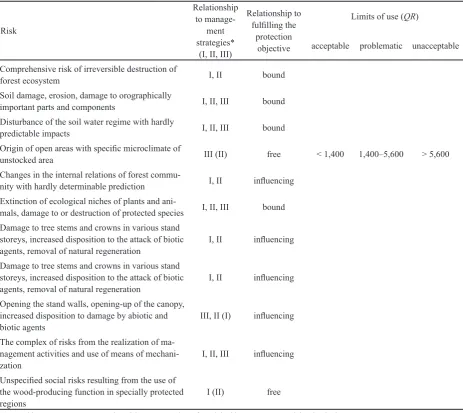
– risk quantifi cation in a scheme given in Table 1 for assessment of particular risks and with the following limits for assessment of total risk of the use of logging technology:
– technology is utilizable without problems if QTR / 100 < 300 and the case if QR > 1,400 does not incur any risk;
[image:3.595.74.538.335.748.2]– technology is utilizable if QR > 5,600 does not incur any risk (at the same value of QTR / 1,000). In this case, it is necessary to assess risks from the potential failure of logging technology;
Table 1. General scheme of the quantifi cation of risks of the wood-producing function in specially protected areas in relation to fulfi lling the objective of protection
Risk
Relationship to
manage-ment strategies*
(I, II, III)
Relationship to fulfi lling the
protection objective
Limits of use (QR)
acceptable problematic unacceptable
Comprehensive risk of irreversible destruction of
forest ecosystem I, II bound
Soil damage, erosion, damage to orographically
important parts and components I, II, III bound
Disturbance of the soil water regime with hardly
predictable impacts I, II, III bound
Origin of open areas with specifi c microclimate of
unstocked area III (II) free < 1,400 1,400–5,600 > 5,600
Changes in the internal relations of forest
commu-nity with hardly determinable prediction I, II infl uencing Extinction of ecological niches of plants and
ani-mals, damage to or destruction of protected species I, II, III bound Damage to tree stems and crowns in various stand
storeys, increased disposition to the attack of biotic
agents, removal of natural regeneration I, II infl uencing Damage to tree stems and crowns in various stand
storeys, increased disposition to the attack of biotic
agents, removal of natural regeneration I, II infl uencing Opening the stand walls, opening-up of the canopy,
increased disposition to damage by abiotic and
biotic agents III, II (I) infl uencing
The complex of risks from the realization of ma-nagement activities and use of means of
mechani-zation I, II, III infl uencing
Unspecifi ed social risks resulting from the use of the wood-producing function in specially protected
regions I (II) free
*Areas with management strategy when risk assessment is preferential with respect to potential technologies I required condition, ‘measure-free’ regime, individual
special-purpose selection only
II possibility of gradual achievement of the target condition in a long-time horizon based on the use of silvicultural and logging measures, utilizable III unrealistic achievement of the required condition,
– technology where 300 < QTR / 1,000 < 1,300 is evalu-ated as problematic, however utilizable in justifi ed cases and at the same time QR < 5,600 for all values of a defi ned risk;
– technology where QTR / 1,000 > 1,300 cannot be as-sessed as recommendable.
Quantification of risks is carried out by an expert method in the following steps:
– empirical assessment of values and coeffi cients for the basic computational scheme,
– calculation of values of particular risks and of total risk for a broader spectrum of areas within the CR (SIMON et al. 2001),
– evaluation of the use of technologies by a group of experts and classifi cation into categories: acceptable, problematic, unacceptable,
– specifying the limit assessments of risks.
VERIFICATION OF THE METHODOLOGY OF RISK QUANTIFICATION IN USING THE WOOD-PRODUCING FUNCTION OF FORESTS
IN SPECIALLY PROTECTED AREAS
The methodology was studied and tested in 11 small-scale and large-small-scale areas in the CR within the VAV/ 610/2/00 Project Determination of limits and assess-ment of risks of the wood-producing function of forests in specially protected areas according to the category of protection (SIMON et al. 2001). The project was included in research plans of the Faculty of Forestry and Wood Technology, University of Agriculture and Forestry, Brno
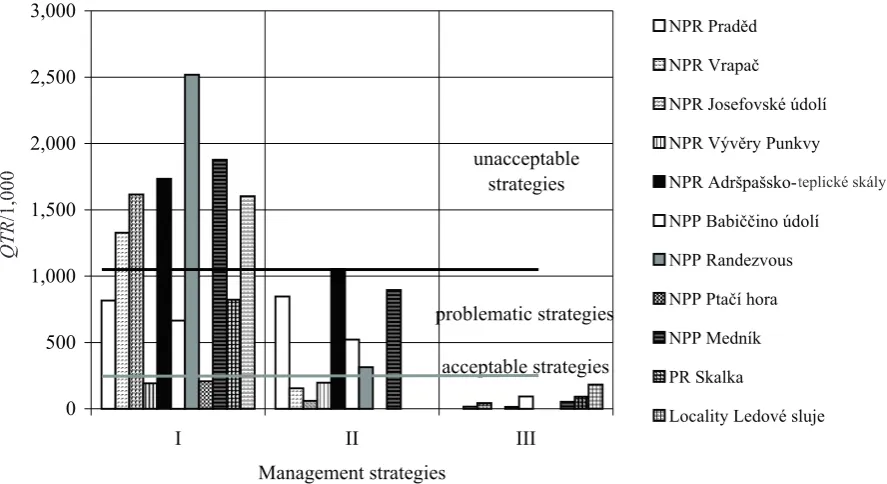
(MSM 434100005). Quantifi cation of total risk for regions with different management strategies in particular areas is given in Fig. 1, an example of determination for the Praděd National Nature Reserve (the Jeseníky Protected Landscape Area) is presented in the following Fig. 1.
THE JESENÍKY PROTECTED LANDSCAPE AREA (NATIONAL NATURE RESERVE PRADĚD)
Areas with management strategy I – Logging and hauling technologies
Individual selection of trees for the purpose of releas-ing the natural regeneration. Directional fellreleas-ing usreleas-ing a power saw, leaving wood in the locality.
– Risks of the wood-producing function
Comprehensive risk of irreversible destruction of an ecosystem
QR = (80 . 10 . 5) + 80 = 4,080 quantifi cation of total risk n
∑ QRi= 4,080 i=1
QTR = 5 . 4 . 10 . 4,080 = 816,000 Areas with management strategy I/II – Logging and hauling technologies
Individual and group selection, cutting with power saw, directional felling. Horse skidding. Leaving dry wood in the locality.
– Risks of the wood-producing function damage to crowns, rubbing off the tree stems
������������� ����������
����������������������
���������������������
� ��� ����� ����� ����� ����� �����
� �� ���
���������������������
����������
����������
��������������������
�����������������
�����������������������������
�������������������
��������������
��������������
����������
���������
[image:4.595.58.502.467.709.2]���������������������
Fig. 1. General scheme of quantifi cation of the total risk of using the wood-producing function in particularly protected areas as related to the management strategy
teplické skály teplické skály
QTRQTR
QR = (20 . 3 . 5) = 300
thinning the stands, increased disposition to damage by abiotic agents
QR = (50 . 7 . 5) + 30 =1,780
increased danger of damage by biotic agents (bark beetle) as a result of damage and physiological stress
QR = (20 . 7 . 5) + 10 = 710
removal of individual trees of the autochthonous eco-type of spruce
QR = (50 . 7 . 10) = 3,500
decreased capability to predict the development of stand components
QR = (10 . 3 . 1) + 50 = 80
general social risks resulting from the implementation of felling measures in specially protected areas
QR = (1 . 10 . 5) = 50 quantifi cation of total risk
n
∑QRi = 6,420
i=1
QTR = 1 . 4 . 6 . 6,420 = 154,080 Areas with management strategy II – Logging and hauling technologies
Clear felling with limits according to Act No. 289/ 1995, felling with power saw. Skidding – fi rst a horse, then a cableway to a roadside landing.
– Risks of the wood-producing function
damage to the soil surface, introskeletal erosion
QR = (80 . 10 . 10) + 80 = 8,080
opening the stand walls, danger of destruction of neighbouring stands by combined effects
QR = (50 . 10 . 5) + 100 = 2,600
creation of clearings with the microclimatic phenomenon of an open area markedly complicating reforestation
QR = (50 . 10 . 5) + 50 = 2,550
changes in the original water regime with hardly pre-dictable impacts
QR = (50 . 7 . 5) + 80 = 1,830
creation of the environment for game concentration after the origin of young plantations
QR = (50 . 10 . 5) + 10 = 2,510
general social risks resulting from logging carried out in specially protected areas
QR = (1 . 10 . 5) = 50 quantifi cation of total risk
n
∑QRi = 17,620 i=1
QTR = 2 . 4 . 6 . 17,620 = 845,760
CONCLUSION
In deciding on the use of the wood-producing function of forests in specially protected areas it is necessary to take into consideration the following aspects:
Areas or regions included in management strategy I (‘measure-free’ regime), i.e. areas that are most suitable
to fulfi l the target idea, will frequently change during their self-development, frequently to communities consider-ably different from the target community. The use of the wood-producing function appears to be useful even there, however, it has to be supported by the long-term simula-tion of development in various strategies. Risks are high, economic effects usually considerably low, however, it is possible to keep permanently a target idea (condition).
Using the wood-producing function is justifi ed and logic in areas or regions with management strategy II (possible conversion to the target idea of a community in a long-time horizon by suitable silvicultural practices). The long-term simulation of development based on various silvicultural strategies is necessary even there. The risk is generally adequate, economics of the measures is usually balanced and it concerns partly profi ts. With respect to the fact that the time horizon is long-term, attainment of the target vision of a community can however be complicated by natural and social effects. Changes in the view on the objective of protection rank among the effects.
In areas with management strategy III (not correspond-ing to the target idea), the use of the wood-produccorrespond-ing function is logic and necessary. It is possible to apply even a more intensive approach there (clear felling, pre-mature felling), decision-making is relevant in the fi eld of technology in relation to the strategy of regeneration (reforestation). With respect to the facts it is possible to defi ne risks that are usually adequate, risks concerning the breach of the protection objectives are minimal. Eco-nomic effects are usually favourable or balanced if we do not take into account potential production losses that are, however, balanced by the effort to achieve the objective of protection as quickly as possible.
In areas with management strategy I (e.g. protection of a species) it is generally very diffi cult to generalize the rate of risk, however, it is possible to state that it is consider-able being extraordinarily related to the suitconsider-able choice of technological aspects and precise implementation. Economic effects are not usually positive as they largely depend on the structure of existing stands (management strategies I, II, III) because there is always an endeavour to create stands approaching the target idea of stands on a site. With respect to this aspect the use of the strategy can be considered as complicated.
Generally, it is possible to state that the structure of potential risks is very similar in the majority of the areas considerable differences being in their quantifi ca-tion which indicates the possibility to use proposed tech-nologies.
Risk quantification and classification of using the wood-producing function are possible on the basis of the proposed scheme and method, however, we have to take into consideration that it is based on an expert method and, therefore, it is necessary to use comparative standards (e.g. actual risks of management outside specially protected areas under comparative conditions).
Social risks of using the wood-producing function in specially protected areas appear to be a quite specifi c risk. The risk does not show an immediate effect on the objec-tive of protection, however, in a social context it can often play an important role.
In principle, the only possibility of limiting the risks under condition of the choice of an optimum technology is its quite precise application.
Acknowledgement
The author is indebted to 29 collaborators for an ex-traordinary effort in studying the problems, particularly to Dr. ANTONÍN BUČEKfrom the Faculty of Forestry and Wood Technology, Mendel University of Agriculture and Forestry, Brno and to RNDr. STANISLAV VACEK, DrSc., Research Institute of Forestry and Game Management, Jíloviště-Strnady, Research Station Opočno for an assist-ance in studying the methodology of risk assessment.
References
CHYTRÝ M., KUČERA T., KOČÍ M., 2001. Katalog biotopů ČR. Praha, AOPAK ČR: 304.
ĎURSKÝ J., 1999. Zur Verwendung von Rasterstichproben für die Fortschreibung, Nutzungsplanung und Behandlungsverbes-serung in einem Forstbetrieb. Forstw. Cbl., 118: 314–325. KOLEKTIV, 1999. Metodika přípravy plánů péče pro zvláště
chráněná území. Praha, AOPAK ČR: 41.
MÍCHAL I., PETŘÍČEK V., 1999. Péče o chráněná území. II. Lesní společenstva. Praha, AOPAK ČR: 713.
MÍCHAL I. et al., 1992. Obnova ekologické stability lesů. Praha, Academia: 169.
POLENO Z., 1997. Trvale udržitelné obhospodařování lesů. Praha, MZe: 105.
PRETZSCH H., SEIFERT S., 1999. Wissenschaftliche Visuali-sierung des Waldwachstums. Allg. Forstz., 18: 960–962. PRŮŠA E., 2001. Pěstování lesů na typologických základech.
Lesnická práce, s.r.o.: 593.
SIMON J. et al., 2001. Stanovení limitů a posouzení rizik vyu-žívání produkční funkce lesů ve zvláště chráněných územích podle kategorií ochrany. [Závěrečná zpráva pro MŽP ČR.] Brno, MZLU, LDF: 130.
Zákon č. 289/1995 Sb. o lesích a o změně a doplnění některých zákonů.
Zákon č. 114/1992 Sb. o ochraně přírody a krajiny.
Received 25 March 2002
Rizika uplatnění produkční funkce lesů na územích se zvláštním statutem ochrany
J. SIMON
Mendelova zemědělská a lesnická univerzita, Lesnická a dřevařská fakulta, Brno, Česká republika
ABSTRAKT:Naplňování produkční funkce lesů lze chápat jako odebírání dřevní hmoty těžbou z lesního prostředí, obvykle za účelem jejího komerčního využití. Uvedenou činnost lze realizovat ve všech stadiích vývoje lesa; zpravidla se předpokládá pozitivní ekonomický efekt. Při hospodaření ve zvláště chráněných územích je nutné se obecně zaměřit při managementu ovliv-ňování lesního ekosystému na přednostní plnění cíle ochrany. V tomto kontextu bývá často uplatovliv-ňování produkční funkce lesů chápáno jako kontroverzní. Lze však považovat za prokázané, že velmi často udržení stavu lesa, který odpovídá představám naplnění cíle ochrany, vyžaduje diferencovaný management, uplatnění pěstebních i těžebních zásahů, a to i v tzv. bezzásahových zónách. Strategií hospodaření pro zvláště chráněná území je formulováno mnoho, co ale chybí, je hodnocení, resp. kvantifi kace rizik uvedené činnosti právě z pozice ohrožení, tj. plnění cíle ochrany. Příspěvek řeší právě uvedenou oblast, navrhuje metodiku hodnocení a kvantifi kace rizik uplatňování produkční funkce lesů ve zvláště chráněných územích se zvláštním statutem ochra-ny; jde o území spadající do oblasti směrnice NATURA 2000. Kvantifi kace rizik a vymezení mezních hodnot pro posouzení různých technologií bylo řešeno expertní metodou v letech 2000–2001 na jedenácti maloplošných a velkoplošných chráněných územích v ČR.
Klíčová slova:zvláště chráněná území; produkční funkce lesa; riziko uplatnění
Článek navrhuje metodiku hodnocení a kvantifi kace rizik uplatňování produkční funkce lesů ve zvláště chráněných územích řešenou na jedenácti chráněných územích v České republice.
Kvantifi kace celkového rizika uplatnění technologie (KCR ) je kalkulována podle vztahu:
n
KCR = a . b . c .∑KNi
kde: a – koefi cient možného nedodržení technologie, b – koefi cient stupně režimu ochrany porostů, c – koefi cient stupně přirozenosti lesních porostů, KN – kvantifi kace jednotlivých určených rizik.
Kvantifi kace jednotlivého rizika závisí na stupni rizika (SR), naplnění rizika (NR) a účinku naplnění rizika (UNR), který zahrnuje časový aspekt – dlouhodobost rizika. Zaveden je i koeficient neprognózovatelného rizika (KNR). Kvantifi kace jednotlivého rizika je pak kalkulována na základě vztahu:
KNi = (SR . NR . UNR) + KNR
Hodnotíme-li využitelnost technologií na základě kvan-tifi kace rizik ve třech základních stupních – přijatelné, problematické, nepřijatelné, můžeme konstatovat, že přijatelné technologie, tedy využití produkční funkce lesa při zachování cílů ochrany, je možné uplatnit i v části tzv. bezzásahových zón. Je však jisté, že v zásadě jedinou možností omezení rizik je za předpokladu volby optimální technologie její zcela precizní aplikace. Dále je jisté, že při využití produkční funkce lesů ve zvláště chráněných územích nelze odstranit tzv. oblast společenských rizik, která sice cíl ochrany neohrožuje, ale lokálně může sehrát významnou roli.
Corresponding author:
Prof. Ing. JAROSLAV SIMON, CSc., Mendelova zemědělská a lesnická univerzita, Lesnická a dřevařská fakulta, Ústav hospodářské úpravy lesů, Lesnická 37, 613 00 Brno, Česká republika