JOURNAL OF FOREST SCIENCE, 63, 2017 (7): 331–338 doi: 10.17221/31/2017-JFS
The effect of slow-release fertilizers on the soil
environment of spread windrows in the Krušné Hory Mts.
Jan PECHÁČEK*, Dušan VAVŘÍČEK, Aleš KUČERA, Peter DUNDEK
Department of Geology and Pedology, Faculty of Forestry and Wood Technology, Mendel University in Brno, Brno, Czech Republic
*Corresponding author: [email protected]
Abstract
Pecháček J., Vavříček D., Kučera A., Dundek P. (2017): The effect of slow-release fertilizers on the soil environment of spread windrows in the Krušné Hory Mts. J. For. Sci., 63: 331–338.
The current revitalization of forest ecosystems in the Krušné Hory Mts. is carried out through: (i) spreading line wind-rows, (ii) chemical amelioration. The aim of this research consisted in: (i) assessing basic pedochemical characteristics of spread windrows, (ii) testing the effect of slow-release fertilizers from the Silvamix® series and dolomitic limestone on the root ball zone soil five years after application. The results of this study suggest that spread windrows are a suit-able environment for forest species: with the only risk being extremely low P concentrations. Our results further show an increase in the amount of soil macrobioelements in the case of Silvamix® R and Silvamix® Forte, namely P over 125 and 85%; Mg2+ over 84 and 108%; base saturation (BS) over 44 and 40.7%, respectively, compared with a control. Having applied dolomitic limestone, an increase of BS (by 88%), Mg2+ (by 250%) and Ca2+ (by 37%) was observed; there was a reduction in the level of mobile Al3+ (by 25%) compared with the control. Stromfolixyl® application did not affect the chemistry of the soil environment.
Keywords: fertilization; chemical properties of soil; liming; Norway spruce; revitalization; spot amelioration
Supported by the Ministry of Agriculture of the Czech Republic, Project No. QJ1320040. The Krušné Hory Mts. are among the areas the
most significantly affected by air pollution ecologi-cal stresses in Europe. In the 1960s–90s, the air pol-lution situation, in synergy with climatic extremes in the eastern part of the mountains, resulted in the total disintegration of forest ecosystems (Va-cek et al. 2003). The overall large-scale clear-felling of these stands allowed forest sites to be prepared using heavy machinery. The top soil horizons were considered heavily acidified and toxic, therefore, in the 1970s–80s they were raked in line windrows using dozer technologies (Podrázský et al. 2010; Pecháček et al. 2017). These measures were to facilitate and accelerate the regeneration of forest ecosystems. Altogether, approximately 10,000 ha of forests were affected; however, the exact extent is unavailable (Remeš et al. 2005).
Based on the findings of forestry research, revi-talization of the soil environment through spread-ing the line windrows started at the beginnspread-ing of the new millennium. Consequently, the soil envi-ronment was enriched with C-substances and an increase in cation exchange capacity occurred as well (Vavříček et al. 2011).
Within the Krušné Hory Mts. area of interest, chemical amelioration was applied using individu-al fertilization or large-scindividu-ale liming. Individuindividu-al fer-tilization (individually for each transplant) is the most frequently applied treatment using slow-re-lease mineral fertilizers. Their effect on the nutri-tion and growth of forest tree species was studied by Remeš et al. (2005) and Vavříček et al. (2011) in the region concerned, and by Ingerslev (1997) or Podrázský and Remeš (2008) elsewhere. The fertilizer effect on the soil environment was studied only sporadically and in short intervals (Vavříček et al. 2010). Large-scale liming was applied espe-cially in the 1980s, and in some regions also in the following decades (the extent is not clearly re-corded). The short-term, but also long-term effects on the soil environment were described (Frank, Stuanes 2003; Podrázský, Ulbrichová 2003; Šrámek et al. 2003; Borůvka et al. 2005).
In light of the foregoing facts, an experiment was arranged on the Špičák research plot; a completely scarified area where the organomineral material was later spread in a period of 20–30 years. Slow-release fertilizers and dolomitic limestone were in-dividually applied to Norway spruce transplants. The soil there was sampled after five years and ba-sic pedochemical characteristics were analysed.
The aim of this study is to answer the following questions:
(1) What are the basic pedochemical characteristics of spread windrows?
(2) Can individual fertilization using slow-release fertilizers and dolomitic limestone affect the soil environment five years after application?
MATERIAL AND METHODS
The research investigation was carried out on the Špičák research plot (885 m a.s.l.) situated in the beech-spruce altitudinal vegetation zone of the Krušné Hory Mts., in the borderland between the Czech Republic and Germany (50°49'67"N, 13°23'67"E). The average annual precipitation in the area fluctuates within 900–1,200 mm and the mean annual temperatures fluctuate between 2.7 and 5°C. The plot is located on a slight north-facing slope, the soil type, Haplic Podzol (FAO 2015), is developed on muscovite mica.
The plot’s revitalizing phase was carried out in 2003 and the existing substitute stands of six working sectors were chipped; the organomineral material from current windrows was spread in a 15–20 cm thick layer. A new pseudo-topsoil
hori-zon was created in this way, consisting of 20–30% of the humus of the fine-grained soil (Vavříček et al. 2008). In 2004, single working sectors were refor-ested with Norway spruce (Picea abies (Linnaeus) H. Karsten); those were four-year-old (2 + 2) bare-root transplants. After that, each of the six work-ing sectors was divided into five regular rectangular plots with 50–60 transplants on each. Each working sector was treated with:
(1) tablet fertilizer Silvamix® Forte – SF (ECOLAB Znojmo, spol. s.r.o., Czech Republic);
(2) tablet fertilizer Silvamix® R – SR (ECOLAB Znojmo, spol. s.r.o., Czech Republic);
(3) Stromfolixyl® – STR (ECOLAB Znojmo, spol. s.r.o., Czech Republic);
(4) dolomitic limestone – DL (Krkonošské vápenky Kunčice, a.s., Czech Republic);
(5) untreated plot – control (C).
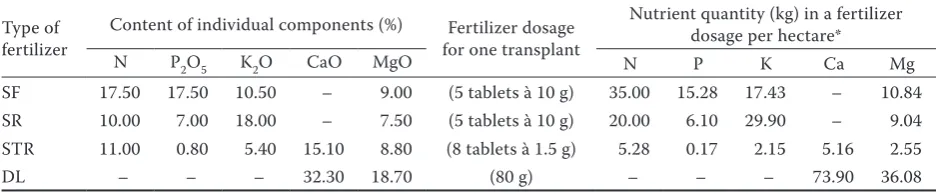
Therefore, each treatment is found in six replica-tions. Fertilizers were applied at the beginning of the vegetation period which followed the spread-ing of line windrows. Tableted fertilizers were spot-applied to each individual transplant. Using a planter, fertilizers were incorporated 3–5 cm deep so that no fertilizing substance could be lost, par-ticularly N, because of biochemical reactions and its volatilization. DL was separately applied as a spot powder sprinkling to each transplant as well. Fertilizers and DL were evenly layered within the area under the transplants’ crowns; the elemental composition and applied doses are presented in Table 1.
Soil samples were collected the 5th year after the
fertilizer application. The organomineral matrix was sampled from each plot: two composite sam-ples were always taken from the root ball zone. One composite sample was created by blending material taken from the root zone of three transplants. Alto-gether twelve composite samples were taken from each treatment (including C).
Laboratory work covered the analyses of pHH2O
and pHKCl using a pH-meter (INOLAB, spol. s.r.o., Czech Republic) with combined glass electrode (soil/H2O or 1M KCl = 1:2.5), H+ concentration
applying the principle of dual pH measurements (Adams, Evans 1989), and available mineral nu-trients (Ca2+, Mg2+, K+) from the Mehlich II
leach-ate by an atomic adsorption spectrophotometry method (Mehlich 1978) in mg·kg–1. P content
was determined spectrophotometrically in a solu-tion of ascorbic acid, H2SO4 and Sb3+. Oxidizable
the unreacted rest was determined by “dead stop” Mohr’s salt titration. Determination of total nitro-gen (Nt) was performed using the Kjeldahl method (Zbíral et al. 1997). Mobile Al3+ content was
de-terminedby Sokolov’s method. Cation exchange capacity (CEC) was determined by the summation method (Eq. 1), the content of a particular cation was calculated by Eq. 2, base saturation (BS) in % was calculated by Eq. 3:
2 2 3 –1
CEC K Ca Mg HAl mmol·kg (1)
mmol mg
C C / M / Oxn (2)
where:
Cmmol – nutrient concentration (mmol·kg–1),
Cmg – nutrient concentration (mg·kg–1),
M – element molar mass, Oxn – nutrient oxidation number.
2 2
BS Ca Mg K / CEC (3)
Statistical processing was done using the STA-TISTICA CZ program (Version 9.0, 2009). Non-parametric analysis of variance (Kruskal-Wallis test) was used; in case of a significant result, Tukey’s post-hoc comparison test was applied to identify significant differences between treat-ments. Hypothesis validity was evaluated accord-ing to P-value at α = 0.05. Correlation analysis was used to evaluate relationships between indi-vidual pedochemical properties. When evaluating pedochemical characteristics of fertilized treat-ments and C, the abbreviation “CWC” is used, i.e. compared with control. The score C is always considered as a basis (100%). Soil environment pedochemical characteristics were evaluated by Vavříček (2011); the threshold of 1,000 mg·kg–1
was considered toxic for Al3+.
RESULTS
Soil environment of spread windrows
The results of treatment analyses C (Table 2) show that pedochemical properties of spread wind-rows are favourable with one exception. This soil layer is characterized by strongly to extremely acid soil reaction, high humus content with balanced Cox and Nt as well as C/N ratio. Basic cation content can be characterized as high (Mg2+, Ca2+) or
me-dium high (K+) (Vavříček 2011). Considerable
ab-solute content of basic cations corresponds to high CEC; however, BS is generally low and soil sorption complex is occupied mainly by acid cations, both H+ and Al3+. The content of the latter element is
al-ready approaching the toxic limit of 1,000 mg·kg–1.
The element in minimum is likely to be P, the con-centrations of which oscillate within extremely low values (Vavříček 2011).
The effect of applied fertilizers
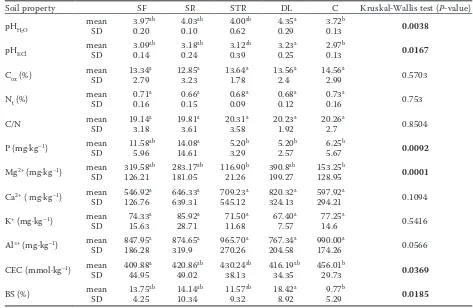
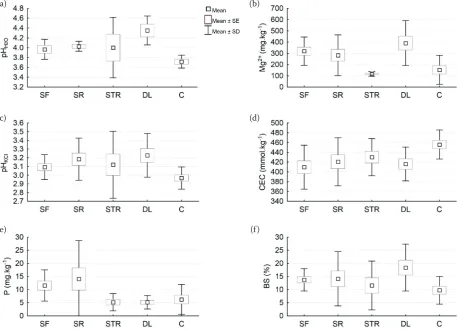
The fertilizer effect on the soil environment in the root ball zone is presented in Table 2. In terms of ANOVA, pHH2O, pHKCl, P and Mg
2+ content, CEC
and BS (Fig. 1) were classified as significant param-eters, despite the considerably frequent variabili-ty. As for Al3+ content, H
0 was narrowly rejected
(P-value = 0.0566). Differences in Cox and Nt con-tent, C/N ratio, Ca2+, K+ and Al3 content were
clas-sified as insignificant.
When comparing data sets in terms of pHH2O, it
[image:3.595.63.536.75.172.2]becomes evident that values in DL are significantly higher CWC. Lower amounts of mobile hydrogen ions can be observed in other treatments, however, without any statistical significance. A similar situ-ation is shown for results of laboratory analyses in the case of pHKCl.
Table 1. Composition of applied fertilizers and their dosage
Type of fertilizer
Content of individual components (%) Fertilizer dosage for one transplant
Nutrient quantity (kg) in a fertilizer dosage per hectare*
N P2O5 K2O CaO MgO N P K Ca Mg
SF 17.50 17.50 10.50 – 9.00 (5 tablets à 10 g) 35.00 15.28 17.43 – 10.84 SR 10.00 7.00 18.00 – 7.50 (5 tablets à 10 g) 20.00 6.10 29.90 – 9.04 STR 11.00 0.80 5.40 15.10 8.80 (8 tablets à 1.5 g) 5.28 0.17 2.15 5.16 2.55
DL – – – 32.30 18.70 (80 g) – – – 73.90 36.08
When observing Cox content, there are slightly lower values within all fertilized plots CWC. Cox closely correlates with Nt, the content of which in individual treatments shows an identical trend; the only exception is SF where slightly higher CWC values can be observed even after five years.
Compared with C, the content of available P in SR and SF was distinctly higher. Application of these fertilizers caused the higher P amount on av-erage by 125% (SR) and 85% (SF). The fertilizer ef-fect was not so pronounced in case of K+. Samples
taken from SR, however, showed values higher by 12%; nevertheless, test statistics did not show this difference as significant.
The amount of Ca2+ and Mg2+ correlates very
closely with pHH2O, pHKCl (Fig. 2a); unsurprisingly,
samples taken in DL show the highest content. Ca2+ content was higher by 37% (CWC). The
ef-fect of other fertilizers on Ca2+ content was not
noticeable. Mg2+ amount is still strongly
influ-enced by the addition of fertilizer substances. Compared with C, DL showed values higher by
150%, in the case of SF the values were higher by 108%. A very strong effect was also observed in SR (by 84% more CWC).
The amount of base cations is closely interlinked with dynamics of mobile Al3+, these two variables
show a significant negative correlation (Fig. 2b). Al3+ is in significant negative correlation with
re-gard to other related parameters, such as pHH2O, pHKCl or BS. A positive effect (lower value CWC) on Al3+amount was observed in most fertilized
treatments. In this case, STR is the only tested product which shows no effect.
BS, besides the already mentioned bond for Al3+,
[image:4.595.59.532.73.381.2]shows a positive correlation relationship with pH; a negative relationship was also demonstrated with respect to CEC, which is closely related to organic substance content. These statistical relationships can be very generally interpreted as the following fertilization consequences: (i) decrease of organic substances, (ii) analogous reduction of exchange positions on the organomineral sorption complex (CEC decrease), (iii) increase of the total amount
Table 2. Fertilizer effect on selected pedochemical properties in the root ball zone five years after application
Soil property SF SR STR DL C Kruskal-Wallis test (P-value)
pHH2O
mean 3.97ab 4.03ab 4.00ab 4.35a 3.72b
0.0038
SD 0.20 0.10 0.62 0.29 0.13
pHKCl meanSD 0.143.09ab 3.180.24ab 3.120.39ab 3.230.25a 2.970.13b 0.0167 Cox (%) meanSD 13.342.79a 12.853.23a 13.641.78a 13.562.4 a 14.562.99a 0.5703 Nt (%) meanSD 0.710.16a 0.660.15a 0.680.09a 0.120.68a 0.730.16a 0.753 C/N meanSD 19.143.18a 19.813.61a 20.313.58a 20.231.92a 20.262.7 a 0.8504 P (mg·kg–1) mean 11.58ab 14.08a 5.20b 5.20b 6.25b 0.0092
SD 5.96 14.61 3.29 2.57 5.67
Mg2+ (mg·kg–1) mean 319.58ab 283.17ab 116.90b 390.8ab 153.25b 0.0001 SD 126.21 181.05 21.26 199.27 128.95
Ca2+ ( mg·kg–1) mean 546.92a 646.33a 709.23a 820.32a 597.92a 0.1094 SD 126.76 639.31 545.12 324.13 294.21
K+ (mg·kg–1) mean 74.33a 85.92a 71.50a 67.40a 77.25a 0.5416
SD 15.63 28.71 11.68 7.57 14.6
Al3+ (mg·kg–1) mean 847.95a 874.65a 965.70a 767.34a 990.00a 0.0566 SD 186.28 319.9 270.26 204.58 174.26
CEC (mmol·kg–1) mean 409.88a 420.86ab 430.24ab 416.19ab 456.01b 0.0369
SD 44.95 49.02 38.13 34.35 29.73
BS (%) meanSD 13.754.25ab 14.1410.34ab 11.579.32ab 18.428.92a 9.775.29b 0.0185
of base cations, (iv) BS increase. Samples from DL show higher average values by 88% (CWC); this fact was confirmed by test statistics. Distinctly higher BS values, however, not significantly, were also found in SF (by 41%) and SR (by 44%).
[image:5.595.67.526.57.387.2]As already stated, most fertilizers cause a de-crease of CEC levels; nevertheless, it has to be pointed out that the effect is not very pronounced. Only SF fertilizer was significant as values lower by 10% CWC were recorded there.
Fig. 2. Representation of correlation relationships: pHKCl vs. amount of available Mg2+ and Ca2+ (a), amount of mobile
Al3+ vs. base saturation (BS) and pH
KCl (b) in the root ball zone Mg2+= 0.0006×pHKCl+ 2.9585
Ca2+= 0.0005×pH KCl+ 2.8183
2.5 2.7 2.9 3.1 3.3 3.5 3.7 3.9
pH
K
C
l
pH
K
C
l
Mg2+, Ca2+(mg·kg–1)
Mg Ca
pHKCl= –0.2759×Al3++ 40.724
BS = –0.0067×Al3++ 3.7814
0.00 0.50 1.00 1.50 2.00 2.50 3.00 3.50 4.00 4.50
0.0 5.0 10.0 15.0 20.0 25.0 30.0 35.0 40.0 45.0 50.0
0 20 40 60 80 100 120 140 160 0 200 400 600 800 1000 1200 1400 1600
BS
(%
)
Al3+(mmol·kg–1)
BS pH/KCl
[image:5.595.65.533.559.724.2]2+ 2+
Fig. 1. The effect of fertilizers on selected pedochemical properties of soil environment in the root ball zone 5 years after application
SF – Silvamix® Forte (ECOLAB Znojmo, spol. s.r.o., Czech Republic), SR – Silvamix® R (ECOLAB Znojmo, spol. s.r.o., Czech Republic), STR – Stromfolixyl® (ECOLAB Znojmo, spol. s.r.o., Czech Republic), DL – dolomitic limestone (Krkonošské vápenky Kunčice, a.s., Czech Republic), C – control (untreated plot), CEC – cation exchange capacity, BS – base saturation
(a) (b)
(c) (d)
(e) (f)
DISCUSSION
Soil environment of spread windrows High concentrations of Ca2+ and Mg2+ are likely
related to the persisting effect of formerly per-formed large-scale liming. Still noticeable effects of these measures in similar climatic and soil en-vironments were also described by Vavříček et al. (2010) or Kuneš et al. (2011).
Despite the high Ca2+ and Mg2+ content, a very
to extremely low pH value was observed, which was not too surprising for the authors with respect to the above-mentioned conditions. In addition to these conditions, acidity can be induced by the high humus content and related high content of low molecular organic compounds, which cause natu-ral acidification of the soil environment. The cor-relation analysis showed that decreasing pH value at Špičák increases the amount of mobile Al3+, the
concentration of which exceeds the toxic threshold of 1,000 mg·kg–1 in some samples; the toxic form
(Al3+) can destroy the fine roots and thus
contrib-ute to a decrease in forestry vitality (Bakker 1999); furthermore, it can decrease the uptake of divalent bases. This problem is known in specialized litera-ture as a lack of Mg2+ and Ca2+ ions induced by Al3+
(Geburek, Scholz 1989).
Phosphorus is likely the element in minimum and its concentration fluctuates within extremely low values. The deficiency of this nutrient was also demonstrated by further studies conducted in the Krušné Hory Mts. (Fiala 2013) as well as in some other border mountains within the Czech Republic, e.g. in the Krkonoše Mts. (Vavříček et al. 2008) or Hrubý Jeseník Mts. (Pecháček 2013). From this, it can be stated that P, besides K and Mg, can further limit nutrient vitality and development of spruce stands in mountain areas in the Czech Republic (Jandl et al. 2001). Regarding the possible plan-ning of remedial fertilization measures, the results of assimilatory organ analysis should not be forgot-ten either; it is a reliable indicator with regard to soil nutrient amounts in acceptable forms.
The effect of applied fertilizers
Dolomitic limestone. Excessive mineralization of organic material and related Nt losses are con-sidered as one of the critical negatives of liming. Nt loss due to this measure was confirmed for example by studies of Podrázský and Ulbrichová (2000) or Moravčík and Ciencala (2001). Air polluted
clear-cuts and open areas (Podrázský 2006) are generally classified as the most susceptible to this phenomenon. However, with respect to this study, Nt content was not affected and it is consistent with results presented for example by Lhotský and Vinšová (1981).
One of the major effects expected from liming, i.e. a massive increase of Mg2+ and Ca2+
concentra-tions, was confirmed in this experiment. Despite a longer period since the limestone application and a comparatively small supplied quantity (at a par-ticular number of transplants, 80 g to each trans-plant would correspond to a dose of 320 kg·ha–1),
liming was efficient. Consistent results were also confirmed by other authors (Podrázský 1992, 1993a, b; Jönsson 2000; Frank, Stuanes 2003). When conducting this research, Al3+ was reduced
by 25%; this fact corresponds to the results of other authors (Juncker 1995).
Silvamix® Forte, Silvamix® R. Sets of samples taken from fertilized treatments showed an indistinct (SR) or very slight (SF) effect on Nt content. Five years after application, these results follow the expectation because N content in fertilizers is not too high. Simi-lar conclusions were also described by Pecháček (2013), who tested the same types of fertilizers in up-land zones of the Hrubý Jeseník Mts.
Having evaluated the time dynamics of the fertil-izer effect on P content, the Vavříček et al. (2010) study can be used because the fertilizer effect is evaluated three years after application. It becomes evident from the comparison that the effect of fertil-izer weakens as the time from application increases, however, it is still very pronounced. Depending on P content in the fertilizer composition, higher concen-trations of this element were found CWC; SR was higher by 125%, SF was higher by 85%. Pecháček (2013) reported similar results as well.
The effect of fertilizers on soil K+ corresponds to
their composition. Five years after application, SR showed only a slight effect (by 10% more CWC), while SF effect was no longer evident. When com-pared with the Vavříček et al. (2010) study, it becomes evident that the SR fertilizer effect is re-duced with the time that has elapsed since applica-tion (40% more K+ amount CWC was found three
years after application).
Even five years after application, fertilizers initi-ated higher amounts of exchangeable Mg2+ despite
in the Šumava Mts. and observed a higher concen-tration of exchangeable Mg2+ even seven years after
application. The content of extractable Ca2+ was
not affected, as had been expected.
CONCLUSIONS
Top soils of spread windrows form a favourable environment which corresponds to site condi-tions. However, Al3+ and P can be considered risky
elements. Al3+ concentrations reach the critical
threshold of 1,000 mg·kg–1, and P amount
fluctu-ates within extremely low values.
The lack of phosphorus can be compensated ef-fectively and in the long term by applying the tested Silvamix® series fertilizers. After five-year applica-tion, a higher content of this element was found in SR (by 125%) and SF (by 85%) CWC. Both fertiliz-ers initiate a pronounced increase of soil Mg2+ (SR
by 184%, SF by 108%), BS (SR by 44%, SF by 40.7%); a decreasing effect on the soil K+ amount (by 12%)
CWC in SR was also found.
Five years from DL application changes in the soil environment were observed which are common for the liming effect mechanism. This treatment showed higher values of pHH2O (by 16%), pHKCl (by 9%) and BS (by 88%) CWC. Higher values were also observed in base cations: Mg2+ (by 250%) and Ca2+
(by 37%). The individual spot liming did not affect the amount of humic substances (by Cox); the level of mobile Al3+ was lower by 25% in this treatment.
In accordance with expectations, no effect on the soil environment was observed after the applica-tion of STR fertilizer.
References
Aarnio T., Martikainen P.J. (1995): Mineralization of C and N and nitrification in scots pine forest soil treated with nitrogen fertilizers containing different proportions of urea and its slow-releasing derivative, ureaformaldehyde. Soil Biology and Biochemistry, 27: 1325–1331.
Aarnio T., Räty M., Martikainen P.J. (2003): Long-term avail-ability of nutrients in forest soil derived from fast- and slow-release fertilizers. Plant and Soil, 252: 227–239. Adams W.A., Evans G.M. (1989): Effect of lime application
to parts of an upland catchment on soil properties and the chemistry of drainage waters. European Journal of Soil Science, 40: 585–597.
Bakker M.R. (1999): Fine root parameters as indicator of sustainability of forest ecosystems. Forest Ecology and Management, 122: 7–16.
Borůvka L., Podrázský V., Mládková L., Kuneš I., Drábek O. (2005): Some approaches to the research of forest soils af-fected by acidification in the Czech Republic. Soil Science and Plant Nutrition, 51: 745–749.
FAO (2015): World Reference Base for Soil Resources 2014. International Soil Classification System for Naming Soils and Creating Legends for Soil Maps. Rome, FAO: 192. Fiala P. (2013): Průzkum výživy lesa na území České republiky
1996–2011. 1st Ed. Brno, Ústřední kontrolní a zkušební ústav zemědělský: 148.
Frank J., Stuanes A.O. (2003): Short-term effects of liming and vitality fertilization on forest soil and nutrient leach-ing in Scots pine ecosystem in Norway. Forest Ecology and Management, 176: 371–386.
Geburek T., Scholz F. (1989): Response of Picea abies (L.) Karst. provenances to aluminium in hydroponics. In: Scholz F., Gregorius H.R., Rudin D. (eds): Genetic of Air Pollutants in Forest Tree Populations. Berlin, Heidelberg, Springer-Verlag: 55–65.
Ingerslev M. (1997): Effects of liming and fertilization on growth, soil chemistry and soil water chemistry in a Nor-way spruce plantation on a nutrient-poor soil in Denmark. Forest Ecology and Management, 92: 55–66.
Jandl R., Glatzel G., Katzensteiner K., Eckmullner O. (2001): Amelioration of magnesium deficiency in a Norway spruce stand (Picea abies) with calcined magnesite. Water, Air and Soil Pollution, 125: 1–17.
Jönsson A.M. (2000): Soil properties affecting the frost sen-sitivity of beech bark in southern Sweden. Scandinavian Journal of Forest Research, 15: 523–529.
Juncker F. (1995): About acidification in forests. Dansk sko-vbrugs tidsskrift, 80: 137–144. (in Danish)
Kuneš I., Baláš M., Špulák O. (2011): Stav výživy smrku ztepilého jako podklad pro zvážení potřeby přihnojení listnáčů a jedle vnášených do jehličnatých porostů. Zprávy lesnického výzkumu, 56 (Special Issue): 36–43.
Lhotský J., Vinšová M. (1981): Mikrobiologický a chemický test účinků melioračních opatření na regradaci látkové přeměny v půdě degradačního stadia lesního ekosystému. Lesnictví, 27: 339–360.
Mehlich A. (1978): New extractant for soil test evaluation of phosphorus, potassium, magnesium, calcium, sodium, manganese and zinc. Communications in Soil Science and Plant Analysis, 9: 477–492.
Moravčík P., Ciencala E. (2001): Přehled poznatků k omezení vlivu imisí a acidifikace půd na lesy. In: Hruška J., Ciencala E. (eds): Dlouhodobá acidifikace a nutriční degradace le-sních půd – limitující faktor současného lesnictví. Prague, Česká geologická služba: 33–53.
Pecháček J., Janoušek J., Dundek P., Vavříček D. (2017): Ini-tial fertilization impact on Norway spruce nutrition and growth in the Krušné hory Mts. Acta Universitatis Agricul-turae et SilviculAgricul-turae Mendelianae Brunensis, 65: 907–917. Podrázský V. (1992): Změny chemismu skarifikovaného a
neskarifikovaného horského humusového podzolu po vápnění. Zprávy lesnického výzkumu, 37: 22–25.
Podrázský V. (1993a): Vliv provozního vápnění na půdní chemismus v Jizerských horách. Zprávy lesnického výz-kumu, 4: 17–19.
Podrázský V. (1993b): Krátkodobé účinky vápnění v extrém-ních imisně ekologických podmínkách Orlických hor. Lesnictví, 39: 97–105.
Podrázský V. (2006): Effects of controlled liming on the soil chemistry on the immission clear-cut. Journal of Forest Science, 52: 28–34.
Podrázský V., Remeš J. (2008): Vliv přihnojení na výškový růst kultury jedle obrovské. Zprávy lesnického výzkumu, 53: 207–209.
Podrázský V., Ulbrichová I. (2000): Vývoj lesních půd a experi-mentálních výsadeb po povrchovém vápnění na imisních holinách. In: Pulkrab K., Kobliha J., Podrázský V. (eds): Krajina, les a lesní hospodářství – výzkumné záměry LF ČZU v Praze 2000. Sborník z celostátní konference, Kost-elec nad Černými lesy, Jan 22–23, 2001: 111–122. Podrázský V., Ulbrichová I. (2003): Surface liming of
immis-sion clear-cuts: Benefits and risks. Ecology, 22: 277–283. Podrázský V., Kapička A., Kouba M. (2010): Restoration
of forest soils after bulldozer site preparation in the Ore Mountains over 20 years development. Ekológia (Brati-slava), 29: 281–289.
Remeš J., Podrázský V., Ulbrichová I., Meduna V. (2005): Fer-tilization of Norway spruce plantations on the bulldozer-spread windrows in the Ore Mts. Journal of Forest Science, 51 (Special Issue): 49–53.
Røsberg I., Frank J., Stuanes A.O. (2006): Effects of liming and fertilization on tree growth and nutrient cycling in
a Scots pine ecosystem in Norway. Forest Ecology and Management, 237: 191–207.
Šrámek V., Lomský B., Fadrhonsová V. (2003): Vápnění le-sních porostů v Krušných horách – výsledky opakovaných analýz na LS Horní Blatná a OL Boží Dar. In: Slodičák M., Novák J. (eds): Výsledky lesnického výzkumu v Krušných horách v roce 2002. Sborník z celostátní konference, Tep-lice, Mar 27, 2003: 33–40.
Vacek S., Hejcman M., Semelová V., Remeš J., Podrázský V. (2009): Effect of soil chemical properties on growth, foliation and nutrition of Norway spruce stand affected by yellowing in the Bohemian Forest Mts., Czech Republic. European Journal of Soil Science, 128: 367–375.
Vacek S.,Vančura K., Zingari P.C., Jeník J., Simon J., Smejkal J. (2003): Mountain Forests of the Czech Republic. Prague, Ministry of Agriculture of the Czech Republic: 311. Vavříček D. (2011): Péče o úrodnost půd v lesních školkách.
In: Foltánek V. (ed.): Péče o půdu v lesních školkách. Sborník referátů přednesených na instruktážním kurzu, Křtiny, Sept 8, 2011: 46–77.
Vavříček D., Pecháček J., Baláž G. (2011): Vliv hnojení na výživu a růst smrku ztepilého (Picea abies /L./ Karsten) na lokalitě Špičák v oblasti Krušných hor. Zprávy lesnického výzkumu, 56: 130–136.
Vavříček D., Pancová-Šimková P., Samec P., Baláž G. (2008): Půdní chemické vlastnosti rozpracovaných valů a holoseč-ných ploch imisní oblasti Krušholoseč-ných hor. Zprávy lesnického výzkumu, 53: 249–257.
Vavříček D., Pecháček J., Jonák P., Samec P. (2010): The effect of point application of fertilizers on the soil environment of spread line windrows in the Krušné hory Mts. Journal of Forest Science, 56: 195–208.
Zbíral J., Honsa I., Malý S. (1997): Analýza půd III. Jednotné pracovní postupy. Brno, ÚKZÚZ: 150.