
The Probability of Multiple Correct
Packet Reception in Coded Synchronous
Frequency-Hopped Spread-Spectrum Networks
Dongmin Lim,
Member, IEEE,and Lajos Hanzo,
Senior Member, IEEEAbstract— In this paper we present a computationally
effi-cient method of evaluating the probability of multiple correct packet reception in coded synchronous frequency-hopped spread-spectrum (FHSS) networks. We show that the approximation using the independent receiver operation assumption (IROA), which has been frequently employed in the literature without rigorous validation, produces reasonable results in most network load conditions when compared to the exact computations derived from our proposed method. Specifically, the expected value of the absolute error was in the range of 0.0055%–18.21% in the investigated scenarios.
I. INTRODUCTION
S
PREAD-SPECTRUM networks employing slotted trans-missions can be characterized by the probability of multi-ple correct packet reception, which is defined as the probability that exactly out of arbitrarily selected packets are received correctly, given that packets are transmitted simultaneously in the network. This probability is denoted by . In the generic performance study of slotted multiple access spread-spectrum networks, this quantity has been evaluated approximately for various cases, for example, in the analysis by Polydoros and Silvester [1]. Later, exact and approximate methods of obtaining this quantity have been presented for frequency-hopped spread-spectrum (FHSS) networks in [2] and for direct-sequence spreading in [3]. Recently, Murali and Hughes [4] have investigated the tradeoffs in terms of coding, throughput, delay, and stability of FHSS networks, estimating the associated quantities by simulation due to the computa-tionally intensive nature of the methods suggested in [2].In this paper we present a computationally efficient method of evaluating the probability of multiple correct packet
recep-Paper approved by J. Wang, the Editor for Wireless Spread Spectrum of the IEEE Communications Society. Manuscript received July 27, 1998; revised December 14, 1998. This work was supported by the Korea Science and Engineering Foundation (KOSEF); Motorola ECID, Swindon, U.K.; European Community, Brussels, Belgium; Engineering and Physical Sciences Research Council, Swindon, U.K.; Mobile Virtual Centre of Excellence, U.K.; and The Royal Society, U.K.
D. Lim was with the Department of Electronics and Computer Science, University of Southampton, Highfield, Southampton SO17 1BJ U.K., on leave from the Department of Electronic Engineering, Gyeongsang National University, Chinju, China (e-mail: [email protected]).
L. Hanzo is with the Department of Electronics and Computer Science, University of Southampton, Highfield, Southampton SO17 1BJ U.K. (e-mail: [email protected]).
Publisher Item Identifier S 0090-6778(99)06301-1.
tion in coded FHSS networks. In Section II we describe and model the FHSS network under consideration. In Section III we detail the procedure of evaluating the probability of mul-tiple correct packet reception, and in Section IV we present our numerical results. Finally, our conclusions are offered in Section V.
II. NETWORK DESCRIPTION
We consider a network in which transmitters (or users) communicate with distinct receivers. Each user is assumed to transmit packets according to a slotted channel access scheme. The packets are constructed and transmitted using Reed–Solomon (RS) error correction coding and frequency-hopped signaling, employing the singly extended RS code, where each symbol in the codeword can assume a value from the alphabet of size . Specifically, each transmitted packet consists of one RS-coded codeword and each RS-coded symbol in the codeword is transmitted on a frequency deter-mined by the random frequency-hopping algorithm employed. We consider synchronous frequency hopping among users of the network, which is the case, when the propagation delay of the network is low compared to the hop interval. We assume that the frequency hopping pattern of each user is memoryless and uniformly distributed over frequency slots and that those of different users are statistically identical and independent of each other. The specific modulation type is not considered. We take into account, however, the effect of the additive white Gaussian noise (AWGN) on the modulation and demodulation process by means of the symbol error rate .
When more than two users occupy the same frequency slot in a hop interval, there is a high probability of symbol errors in this hop interval, a condition which is referred to as a frequency hit in [5]. Several methods have been devised to provide more accurate information concerning the occurrences of the hit [5], [6]. We consider two special cases, namely
no side information (NSI) and perfect side information (PSI).
No side information refers to the case when no information is available concerning the occurrence of hits, while perfect side information refers to the case when the occurrence of a hit is known exactly, i.e., with a probability of one. At the receiver, the decoding method applied can vary according to the availability of the hit-related side information. In case of no side information, we assume that every hit causes symbol
errors in the corresponding hop interval with a probability of one and that the packet is decoded by a standard decoding method, such as the Berlekamp–Massey algorithm [7]. For the case of perfect side information, the symbols involved in the hit hop interval are marked as erasures and error-and-erasure decoding can be invoked where, due to the knowledge of the symbol error positions, the maximum number of correctable errors is doubled, since all the syndrome equations can be solved for a doubled number of error magnitudes, instead of having to compute both the error magnitudes and positions [7]. More specifically, the so-called bounded-distance decoding is assumed and the received packet is guaranteed to be correct if twice the number of errors plus the number of erasures remain within the minimum distance of the RS code, i.e., if [7]
(1) III. ANALYSIS
In order to determine whether a packet is correct or not, we have to count the number of errors and erasures which occur during the packet’s reception at the corresponding receiver. Thus, it is necessary to keep track of every packet which is being received in a slot in order to evaluate the desired probability of multiple correct packet reception
. We let be the actual number of errors encountered and the number of erasures counted at the receiver for the packet transmitted by the th user during the period spanning the first to the th hopping interval. Furthermore, we define the random variables , , as
for NSI for PSI
(2)
where
for NSI
for PSI. (3) We introduced the limit into the definition of since there is no need to count the number of errors beyond corresponding to the maximum error correction ability of the RS code plus one, beyond which the packet cannot be decoded correctly, regardless of the presence or absence of further hits. Now we briefly state a theorem which will be used in our forthcoming analysis. This is referred to as the inclusion and
exclusion formula in combinatorics, and the proof can be found
in [8] and [9].
Theorem 1—The Realization of Among Events: For
any integer with , the probability that exactly among the events occur simultaneously is given by
(4)
where
.. .
(5)
By applying the above theorem, we can determine as
(6)
where
(7) Equation (7) accrues from the assumption that the packets transmitted in the same hop interval are, statistically speaking, exposed to identical conditions.
We now introduce vector notations where the vectors are -dimensional, if not specified otherwise. We let
and define the initial state as . At the end of th hop interval, must be in the ranges given below in order for the event to occur
for NSI for PSI
(8) We let denote the set of necessary for the event to be encountered, where . Then the number of elements in is given as
(9) where
for NSI for PSI. (10) Below we define a specific operation which the vector is exposed to. We let denote the operation that sorts the elements of in nonincreasing order. If we apply this operation to every element in and discard the resulting duplicates, we can obtain a new set . The number of the elements in is equal to the number of selections with repetition of objects chosen from the types of objects. Thus, according to [9] we have
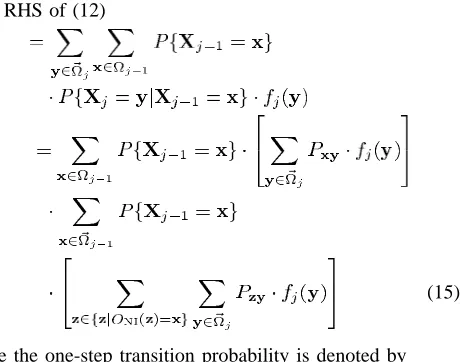
Noting that is a Markov chain, we can express the probability in (7) as
(12)
where the above functions are defined as number of elements in the set
(13) (14) Upon taking into account the one-step transition probability of the Markov chain, we have
RHS of (12)
(15)
where the one-step transition probability is denoted by (16) The one-step transition probabilities for the NSI and PSI cases are derived in the Appendix. Comparing (12) and (15), we arrive at a recursive equation for
(17) (18)
Finally, we obtain the desired probability of multiple correct packet reception by solving the above equation recursively, since
[image:3.612.64.294.293.474.2](19) In Fig. 1, we provided the pseudocode of the algorithm, , proposed for solving the recursive equation. This algorithm sequentially produces , , , . Noting that the set involved in the algorithm is now shifted from to and comparing the size of the two sets, we can see that the computational complexity of the algorithm is substantially reduced. In order to quantify the reduction in computational complexity achieved by our proposed method
Fig. 1. AlgorithmREQN for solving the recursive equation.
in comparison to the technique advocated in [2], we compare the number of nested iterations involved in both methods of evaluating the probability of multiple correct packet reception. From (6) and (7) and Fig. 1, the number of iterations involved in our method, , can be shown to be
(20) where is defined in (10) and and for the NSI and the PSI scenarios, respectively. On the other hand, from [2, eqs. (3) and (17)], we can see that the number of iterations involved in the previous proposed method, namely , is given by
(21) In Fig. 2, we compare the number of iterations involved in both methods with increasing number of users for both the NSI and PSI scenarios using (32,16) RS coding. Note that the parameters , , and are irrelevant to the computational complexity. From the curves, we can see that the reduction of computational complexity, when using our proposed method, becomes very substantial as the number of users increases.
IV. NUMERICAL RESULTS
Fig. 2. Comparison of the computational complexity between our proposed method and the previous method [2] in terms of the number of nested iterations with increasing number of usersk for both NSI and PSI cases with (32,16) RS coding.
Fig. 2. In this context, we note that the numerical evaluations in [2] were limited to users for the NSI case and to for the PSI case for reasons which become explicit in Fig. 2, and that the numerical results according to [2], as expected, coincided with our results.
In Figs. 3 and 4 we present numerical results of our analysis for the NSI and the PSI scenarios, respectively. Upon varying the available number of frequency slots , the curves in Figs. 3 and 4 represent situations where the network load is light ( for the NSI case and for the PSI case), medium ( for the NSI case and for the PSI case), and heavy ( for the NSI case and for the PSI case). Due to numerical precision limitations and due to the resultant buildup of round-off errors, numerical results below 1 10 became less reliable and thus they were dropped from the figures. The dotted curves in the figures show the results obtained according to the independent receiver operation assumption (IROA) [2], [3]. We can see that the relative error expressed in percent tends to increase as the probability reduces.
As a measure of estimating the accuracy of the IROA approximation, we introduced the expected absolute error (EAE), defined as
[image:4.612.307.559.355.597.2](22) The EAE values expressed in terms of percent for the results shown in Fig. 3 were 0.70, 18.21, and 0.12 for the cases of , and , respectively, and those for Fig. 4 were 0.011, 4.1, and 0.0055 for the cases of , and , respectively. Judging from the EAE values, we can see that
Fig. 3. The probabilityP (m; k 0 m j L) of correctly receiving m out of k arbitrarily selected packets when transmittingL simultaneous packets for the NSI case withL = 10, k = 10, for q = 80; 29, and 14 frequency slots and for a modem symbol error rate ofPN= 1 2 1003, and(32; 16)RS coding.
Fig. 4. The probabilityP (m; k 0 mjL) of correctly receiving m out of k arbitrarily selected packets, when transmittingL simultaneous packets for the PSI case withL = 10, k = 6, for q = 30; 13, and 7 frequency slots and for a modem symbol error rate ofPN= 1 2 1003, and(32; 16)RS coding.
the IROA approximation gives reasonable results under most network load conditions, although it becomes less accurate under the medium load condition.
V. CONCLUSIONS
inclusion and exclusion formula of combinatorics in order to determine the probability systematically, and we could greatly reduce the computational complexity involved in solving the resultant recursive equation upon exploiting that the packets transmitted in the same hop interval are, statistically speaking, exposed to identical conditions. Nevertheless, the presented method becomes computationally too intensive as the number of users in the network increases beyond single figures. The approximation method with IROA, which has been frequently used in the literature, was shown to produce reasonable results under various network load conditions compared to the exact results derived from our proposed method. The expected value of the absolute error was in the range of 0.0055%–18.21% in the investigated scenarios. A future challenge which remains to be solved is applying our proposed technique also to the asynchronous hopping scenario.
APPENDIX
In this appendix we derive the one-step transition probabili-ties for the NSI and PSI cases. We first find the probability distribution of the number of symbol errors, erasures, and correct symbols among the symbols in a hop interval, given that packets are transmitted simultaneously in the network. Based on this probability distribution, we derive the one-step transition probabilities. As before, all vectors are
-dimensional, unless specified otherwise.
A. NSI Case
We denote the number of symbol errors and correct symbols among the symbols in a hop interval by and , respectively. We let be the event that the symbol contained in the packet transmitted by th user in a hop interval is received correctly. By applying the inclusion and exclusion formula, we have
(23) where
(24) Now we consider the one-step transition probability. Noting the definition of for NSI, we can see that can increase at most by one. Letting and , the one-step transition probability is given by
(25)
TABLE I
EVENTDESCRIPTION FOR THENSI CASE
TABLE II
EVENTDESCRIPTION FOR THEPSI CASE
where , , and ) represent the number of events , , and , respectively, defined in Table I.
B. PSI Case
When we consider the PSI case, we have to include the occurrences of symbol erasures. We denote the number of symbol errors, erasures, and correct symbols among the symbols in a hop interval by , , and , respectively, and in addition by and the number of symbols, which are hit and hit-free, respectively. We let be the event that the symbol contained in the packet transmitted by the th user in a hop interval is not hit. By applying the inclusion and exclusion formula [8], [9], we have
(26) where
and , the one-step transition probability is given by
(28) where , , , , and ) represent the number of events , , , , and , respectively, defined in Table II.
REFERENCES
[1] A. Polydoros and J. Silvester, “Slotted random access spread-spectrum networks: An analytical framework,” IEEE J. Select. Areas Commun., vol. SAC-5, pp. 989–1002, July 1987.
[2] T. J. Ketseoglou and E. Geraniotis, “Multireception probabilities for FH/SSMA communications,” IEEE Trans. Commun., vol. 40, pp. 223–233, Jan. 1992.
[3] E. Geraniotis and J. Wu, “The probability of multiple correct packet re-ceptions in direct-sequence spread-spectrum networks,” IEEE J. Select.
Areas Commun., vol. 12, pp. 871–884, June 1994.
[4] R. Murali and B. L. Hughes, “Coding and stability in frequency-hop packet radio networks,” IEEE Trans. Commun., vol. 46, pp. 191–199, Feb. 1998.
[5] M. B. Pursley, “Frequency-hop transmission for satellite packet switch-ing and terrestrial packet radio networks,” IEEE Trans. Inform. Theory, vol. IT-32, pp. 652–667, Sept. 1986.
[6] C. W. Baum and M. B. Pursley, “A decision-theoretic approach to the generation of side information in frequency-hop multiple-access communications,” IEEE Trans. Commun., vol. 43, pp. 1768–1777, Feb./Mar./Apr. 1995.
[7] E. R. Berlekamp, “The technology of error-correcting codes,” Proc.
IEEE, vol. 68, pp. 564–593, May 1980.
[8] W. Feller, An Introduction to Probability Theory and Its Applications, 3rd ed. New York: Wiley, 1968, vol. I.
[9] A. Tucker, Applied Combinatorics. New York: Wiley, 1980.
Dongmin Lim (S’87–M’93) was born in Seoul, Korea, in 1962. He received the B.S. degree from Seoul National University in 1986, and the M.S. and Ph.D. degrees from Korea Advanced Institute of Science and Technology (KAIST), Seoul, in 1988 and 1992, respectively, all in electrical engineering. Since September 1992, he has been with the Department of Electronic Engineering, Gyeongsang National University, Chinju, where he is currently an Assistant Professor. During 1998, he was on leave as a Visiting Research Fellow at the De-partment of Electronics and Computer Science, University of Southampton, Southampton, U.K. His current research interests include signal processing for communications, digital data transmission, spread spectrum communications, and performance evaluation of communication networks.
Lajos Hanzo (M’91–SM’92) has held various re-search and academic posts in Hungary, Germany, and the U.K. during his 23-year career in telecom-munications. Since 1986, he has been a member of the academic staff of the Department of Electronics and Computer Science, University of Southampton, U.K., and has been a Consultant to Multiple Access Communications Ltd., U.K. Currently he holds a chair in telecommunications. As a member of two multinational consortia and funded by the European Community as well as the Engineering and Physical Sciences Research Council (EPSRC) U.K., he is currently conducting research toward the next generation of wireless multimedia systems. He has published widely in wireless multimedia communications, including two monographs and in excess of 200 research papers, organized and chaired conference ses-sions, presented overview lectures, and was awarded a number of distinctions. He manages a team of researchers.
![Fig. 2. In this context, we note that the numerical evaluationsin [2] were limited toin Fig](https://thumb-us.123doks.com/thumbv2/123dok_us/1048500.620706/4.612.45.301.59.305/fig-context-note-numerical-evaluationsin-limited-toin-fig.webp)