Abstract
Boolean Satisfiability is a ubiquitous modeling tool in Electronic Design Automation, It finds application in test pattern generation, delay-fault testing, combinational equivalence checking and circuit delay computation, among many other problems. Moreover, Boolean Satisfi-ability is in the core of algorithms for solving Binate Cov-ering Problems. This paper describes how Boolean Satisfiability algorithms can take circuit structure into account when solving instances derived from combina-tional circuits. Potential advantages include smaller run times, the utilization of circuit-specific search pruning techniques, avoiding the overspecification problem that characterizes Boolean Satisfiability testers, and reducing the time for iteratively generating instances of SAT from circuits. The experimental results obtained on several benchmark examples in two different problem domains display dramatic reductions in the run times of the algo-rithms, and provide clear evidence that computed solu-tions can have significantly less specified variable assignments than those obtained with common SAT algo-rithms.
1. Introduction
Boolean Satisfiability (SAT) is intrinsic to many prob-lems in Electronic Design Automation (EDA). Originally motivated by the work of T. Larrabee in test pattern generation [15], SAT models and techniques have since been applied to delay-fault testing, equivalence checking, circuit delay computation, logic synthesis and functional vector generation [8], among other applications. (See [5, 7, 15, 17, 18, 20] for an overview of applications of SAT to EDA.) Moreover, SAT can also play a central role in solving instances of binate covering problems (BCP) [6, 9, 10, 11, 13], in particular for those in which the constraints are hard to satisfy, e.g. in computing minimum size test patterns [10]. SAT also plays a key role in other domains, including for example Artificial Intelligence [3, 21] and Operations Research [2]. Recent years have seen dramatic improvements in SAT algorithms, which have been thor-oughly validated in different application areas [3, 16, 21].
With respect to applications of SAT in EDA, in most cases the original problem formulation starts from a circuit description, for which a given (circuit) property needs to be validated for at least one primary input vector. The resulting circuit formulation, which may only be implicitly specified, is then mapped into an instance of SAT, in most cases using Conjunctive Normal Form (CNF) formulas.
The utilization of CNF models and SAT algorithms has important advantages:
1. Existing, and extensively validated SAT algorithms, can be used instead of dedicated algorithms.
2. New improvements and new SAT algorithms can be easily applied to each target application.
In contrast, the utilization of CNF formulas and associ-ated SAT algorithms is also characterized by several draw-backs:
1. As observed in [20], the structural information of the circuit, often of crucial importance, is lost.
2. In many EDA problems, a large number of instances of SAT has to be solved for each circuit. Hence, mapping a given problem description into SAT can represent a sig-nificant percentage of the overall running time [15]. 3. Computed input patterns are in general overspecified.
Overspecification can be a serious drawback in different applications, including circuit testing and binate con-straint solving.
With the purpose of addressing these problems, in [20] a new dynamic data structure, i.e. an extended implication graph, is proposed for solving instances of SAT in combi-national circuits. Despite the promising results of [20], uti-lizing a new data structure requires dedicated algorithms. Hence new search pruning techniques, developed for example in the context of SAT algorithms, will have to be adapted to the circuit graph data structure.
In this paper we show how to utilize structural informa-tion in SAT algorithms. To a generic SAT algorithm we add a layer that maintains circuit-related information, e.g. fanin/fanout information as well as value justification rela-tions. The proposed approach allows using any SAT algo-rithm to which this layer can be added. The main advantages of the proposed approach is that some of the previously mentioned drawbacks, i.e. inaccessibility to structural information and overspecification of input pat-terns, are eliminated. The main contribution over the work of [20] is that data structures used for SAT need not be modified, and so existing algorithmic solutions for SAT can naturally be augmented with the proposed layer for handling structural information. Moreover, the approach proposed in this paper is significantly simpler than the one in [20], since only minor modifications to SAT algorithms are required.
The paper is organized as follows. Section 2 introduces basic definitions associated with SAT and combinational circuits. Next we briefly survey SAT algorithms, giving particular emphasis to those that have been shown to be effective in solving EDA problems. Afterwards, in Section
Algorithms for Solving Boolean Satisfiability in Combinational Circuits
Luís Guerra e Silva, L. Miguel Silveira and João Marques-Silva
Instituto Superior Técnico Cadence European Labs/INESC
4, we detail the proposed approach for taking into consid-eration structural information while solving SAT. Section 5 analyzes preliminary results on two EDA applications. The paper concludes in Section 6 by reviewing the contri-butions and providing some perspective on future research work.
2. Definitions
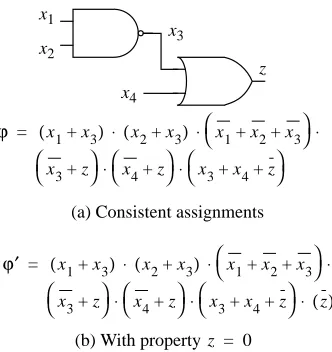
The CNF formula of a combinational circuit is the con-junction of the CNF formulas for each gate output, where the CNF formula of each gate denotes the valid input-out-put assignments to the gate. An example of a circuit, asso-ciated CNF formula and the specification of an objective is shown in Figure 1. (The derivation of the CNF formulas for simple gates can be found for example in [15, 17].)If we view a CNF formula for a gate as a set of clauses, the CNF formulaϕ for the circuit is defined by the set union (or conjunction) of the CNF formulas of each gate. Hence, given a combinational circuit it is straightforward to create the CNF formula for the circuit as well as the CNF for proving a given property of the circuit.
SAT algorithms operate on CNF formulas, and conse-quently can readily be applied to solving instances of SAT associated with combinational circuits. Examples include the CNF formulas for test pattern generation [15] and cir-cuit delay computation expressions [18].
3. Boolean Satisfiability Algorithms
The overall organization of a generic SAT algorithm is shown in Figure 2. This generic SAT algorithm captures the organization of several of the most competitive algorithms [3, 16, 21].
[image:2.595.78.244.95.271.2]The algorithm conducts a search through the space of the possible assignments to the problem instance vari-ables. At each stage of the search, a variable assignment is selected with theDecide() function. A decision level d is associated with each selection of an assignment. Implied necessary assignments are identified with the Deduce() function, which in most cases corresponds to straightfor-ward derivation of implications [3, 16]. Whenever a clause
Figure 1: Example circuit and CNF formula
x1 x2
z x4
x3
ϕ = (x1+x3) ⋅ (x2+x3) ⋅x1+x2+x3⋅ x3+z
x
4+z
x
3+x4+z
⋅ ⋅
ϕ′ = (x1+x3) ⋅ (x2+x3) ⋅x1+x2+x3⋅ x3+z
x
4+z
x
3+x4+z
( )z
⋅ ⋅ ⋅
(a) Consistent assignments
(b) With property z = 0
becomes unsatisfied theDeduce() function returns a con-flict indication which is then analyzed using the Diag-nose() function. The diagnosis of a given conflict returns a backtracking decision level , which denotes the deci-sion level to which the search process is required to back-track to. The Erase() function clears implied assignments that result from each assignment selection. Different organizations of SAT algorithms can be modeled by this generic algorithm. Currently, all of the most effi-cient SAT algorithms [3, 16, 21] are characterized by sev-eral of the following key properties:
1. The analysis of conflicts can be used for implementing Non-chronological Backtracking search strategies. Hence, assignment selections deemed irrelevant can be skipped over during the search [3, 16, 21].
2. The analysis of conflicts can also be used for identifying and recording new implicates of the Boolean function associated with the CNF formula. Clause Recording plays a key role in recent SAT algorithms, but in most cases large recorded clauses are eventually deleted [3, 16].
3. Other techniques have been developed. Relevance-Based Learning [3] extends the life-span of large recorded clauses that will eventually be deleted. Con-flict-Induced Necessary Assignments [16] denote assignments to variables which are necessary for pre-venting a given conflict from occurring again during the search.
Before running the SAT algorithm, different forms of preprocessing can be applied [16]. This in general is denoted by aPreprocess() function.
4. Satisfiability in Combinational Circuits
4.1. Additional Data Structures
Let denote a property of a combinational circuit C which is to be satisfied to an objective value o and which can be described by a given set of clauses. This satisfiabil-ity problem is denoted by and can be mapped into an instance of SAT, . The following information is asso-ciated with each variable x ofϕ, that also represents a cir-cuit node x of :
// Input arg: Current decision level d
// Output arg: Backtrack decision level
// Return value: SATISFIABLE or UNSATISFIABLE
//
SAT (d, & ) {
if (Decide (d) != DECISION)
return SATISFIABLE;
while (TRUE) {
if (Deduce (d) != CONFLICT) {
if (SAT (d + 1, ) == SATISFIABLE)
return SATISFIABLE;
else if ( != d || d == 0) {
Erase (d); return UNSATISFIABLE; }
}
if (Diagnose (d, ) == CONFLICT) {
return UNSATISFIABLE;
} } }
β
β
β β
β
Figure 2: Generic backtrack search SAT algorithm
β
Cp
Cp,o
〈 〉
ϕ
[image:2.595.313.533.96.273.2]1. denotes the fanin nodes of x.
2. denotes the set of fanout nodes of x.
3. denotes the threshold value on the number of suit-able assigned inputs (of x) that are necessary for justifying value v on node x.
4. denotes the actual counter of assigned inputs (of x) that are involved in justifying the value v on node x. Note that the value assigned to each variable x is denoted by . Moreover, observe that each circuit node x, with assigned value v, becomes justified whenever
.
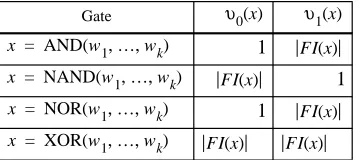
Table 1 contains a few examples of threshold values on the number of assigned inputs required for justifying a given node. For example, for an AND gate at least one input assigned value 0 justifies the assignment of value 0 to x, whereas for value 1 all inputs must be assigned value
1. Hence, and . As another
example, observe that for an XOR gate justification of any assigned value requires assignments to all gate inputs;
hence . For other simple gates
this information can also be easily derived, and in all cases
we have .
For any simple gate with output x, we can associate with each fanin node w the counters that must be updated as the result of assigning a value v to w. For example, for an AND gate an assignment of 0 to a fanin node w incre-ments by 1, and an assignment of 1 to fanin node w increments by 1. These relations are illustrated in Table 2 for a few example gates. Note that for the XOR gates, both counters are updated when an input node becomes assigned.
As with standard search algorithms in combinational circuits [1], a justification frontier is maintained, which denotes the sets of variables/nodes that require justifica-tion. Observe that the condition that indicates the need for
node justification is , where
.
4.2. Modifications to the SAT Algorithm
Given the previous definitions, a SAT algorithm can be FI x( )
FO x( ) υv( )x
ιv( )x
ν( )x ιv( )x ≥υv( )x
Gate
1
[image:3.595.79.259.98.178.2]1 1
Table 1: Threshold values on assigned inputs
υ0( )x υ1( )x x = AND w( 1, ,… wk) FI x( )
x = NAND w( 1, ,… wk) FI x( )
x = NOR w( 1, ,… wk) FI x( )
x = XOR w( 1, ,… wk) FI x( ) FI x( )
υ0( )x = 1 υ1( )x = FI x( )
υ0( )x = υ1( )x = FI x( ) υ0( )x,υ1( )x ∈ {1 FI x, ( )}
ι0( )x ι1( )x Gate
and and
Table 2: Justification counters associated with gate inputs
wi = 0 wi = 1
x = AND w( 1, ,… wk) ι0( )x ι1( )x x = NAND w( 1, ,… wk) ι1( )x ι0( )x x = NOR w( 1, ,… wk) ι1( )x ι0( )x x = XOR w( 1, ,… wk) ι0( )x ι1( )x ι0( )x ι1( )x
ν( )x = v
( ) ∧ (ιv( )x <υv( )x) v∈ {0 1, }
adapted so that the information regarding justification can be properly maintained. Moreover, the fanin information can be used for implementing structure-based heuristic decision making procedures, e.g. simple or multiple back-tracing [1]. With respect to the algorithm of Figure 2, functions Deduce() and Diagnose() have to invoke dedicated procedures for updating node justification infor-mation. Additionally, theDecide() function now tests for satisfiability by checking for an empty justification fron-tier instead of checking whether all clauses are satisfied. These are the only required modifications to the general SAT algorithm. In addition, the Decide() function can optionally be modified to perform backtracing given the fanin information associated with each variable.
We should note that the data structures described above operate in much the same way as justification works in combinational circuits [1]. The main difference is that in our approach justification and value consistency are for-mally dissociated; value consistency, and hence conflicts, are handled by the SAT algorithm, and justification by the new added layer.
4.3. Handling Special Implications
Besides taking structural information into account, fur-ther improvements are possible when the SAT algorithm is intended to prove or disprove a given circuit property, and when several constraints are formulated as logical impli-cations. This technique can be viewed as a generalization of syntactic satisfiability [17]. It is plain that for a combi-national circuit we can find consistent assignments. Syn-tactic satisfiability hinges on this fact to allow the search algorithm to stop the search when clauses not yet satisfied are guaranteed to have a satisfying assignment, e.g. when no clause of the original circuit CNF formula has literals assigned value 0.
Let us suppose that when proving a given circuit prop-erty we have several implications of the form , where variable y is not associated with one of the circuit variables, being used instead for describing the target cir-cuit property. This implication is satisfied if . Hence, only when is a necessary assignment, do we need to require that the equivalent clausal form be satisfied. We refer to this conditional con-sideration of clauses as implicational syntactic satisfiabil-ity.
4.4. Additional Advantages
For some EDA problems it is necessary to repeatedly solve instances of SAT. Pervasive clauses were introduced in [17] for denoting a clause that is recorded while solving an instance of SAT, and which can be used subsequently for solving other instances of SAT that are associated with the same circuit. For example, pervasive clauses may be used in test pattern generation (TPG) for denoting value relations between circuit nodes.
With the structural information described in this sec-tion, we can also characterize which variables can yield pervasive clauses and which cannot. Hence, while solving a given EDA problem, the SAT algorithm can identify per-vasive clauses, which it can subsequently re-utilize while y→
∑
wiy = 0 y = 1
y+
∑
wi
solving instances that are associated with the same circuit.
5. Experimental Results
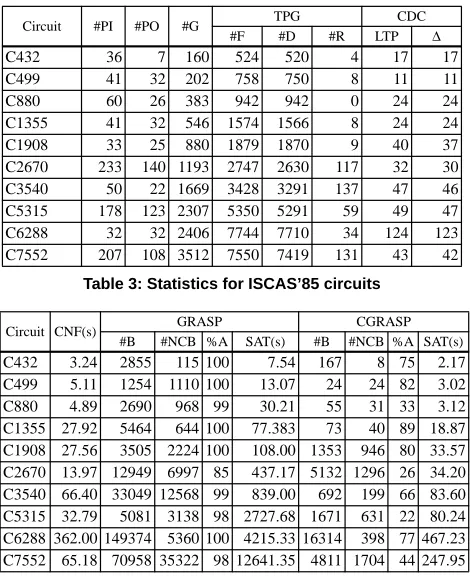
In this section we evaluate the practical usefulness of the circuit structure-aware SAT algorithm described in Section 4. For this purpose, we used a state of the art pub-lic-domain SAT algorithm, GRASP [16], and built on top of this algorithm a new SAT algorithm that takes structural information into account, CGRASP. Two EDA applica-tions are considered for comparing GRASP and CGRASP, namely test pattern generation [15, 17] and circuit delay computation (CDC) [7, 18]. Statistics for the ISCAS’85 benchmark circuits [4], regarding TPG and circuit delay computation, are shown in Table 3. #PI, #PO, #G, #F, #D, #R, LPT and ∆ denote, respectively, the number of pri-mary inputs, the number of pripri-mary outputs, the number of gates, the number of stuck-at faults, the number of detect-able faults, the number of redundant faults, the longest topological delay and the critical circuit delay under float-ing-mode operation [7]. All the experimental results shown below were obtained on a P-II 266 MHz Linux workstation with 128 MByte of physical memory.
5.1. Test Pattern Generation
The first experiment consists in evaluating CGRASP for TPG, using a simplified version of the model in [17]. For this purpose, both GRASP and CGRASP were run on the ISCAS’85 benchmark circuits. The results are shown in Table 4. For each algorithm, CNF(s), #B, #NCB, %A and SAT(s) denote, respectively the total CNF formula build time, the total number of backtracks, the total
num-Circuit #PI #PO #G TPG CDC #F #D #R LTP ∆
C432 36 7 160 524 520 4 17 17
C499 41 32 202 758 750 8 11 11
C880 60 26 383 942 942 0 24 24
C1355 41 32 546 1574 1566 8 24 24
C1908 33 25 880 1879 1870 9 40 37
C2670 233 140 1193 2747 2630 117 32 30
C3540 50 22 1669 3428 3291 137 47 46
C5315 178 123 2307 5350 5291 59 49 47
C6288 32 32 2406 7744 7710 34 124 123
[image:4.595.50.285.95.383.2]C7552 207 108 3512 7550 7419 131 43 42
Table 3: Statistics for ISCAS’85 circuits
Circuit CNF(s) GRASP CGRASP #B #NCB %A SAT(s) #B #NCB %A SAT(s)
C432 3.24 2855 115 100 7.54 167 8 75 2.17
C499 5.11 1254 1110 100 13.07 24 24 82 3.02
C880 4.89 2690 968 99 30.21 55 31 33 3.12
C1355 27.92 5464 644 100 77.383 73 40 89 18.87
C1908 27.56 3505 2224 100 108.00 1353 946 80 33.57
C2670 13.97 12949 6997 85 437.17 5132 1296 26 34.20
C3540 66.40 33049 12568 99 839.00 692 199 66 83.60
C5315 32.79 5081 3138 98 2727.68 1671 631 22 80.24
C6288 362.00 149374 5360 100 4215.33 16314 398 77 467.23 C7552 65.18 70958 35322 98 12641.35 4811 1704 44 247.95
Table 4: Results for test pattern generation
ber of non-chronological backtracks, the average percent-age of assigned variables over all solved instances and the SAT search time. In this experiment, each fault was indi-vidually targeted, i.e. fault simulation and hence fault dropping were not applied. Moreover, neither GRASP nor CGRASP abort any fault. As can be readily concluded, the search times become drastically reduced when structural information is taken into account, and a justification fron-tier is used for SAT purposes. Indeed, for some of the benchmark circuits the search times can be reduced by almost two orders of magnitude.
Besides the reduction in CPU times from GRASP to CGRASP, we can also observe similar reductions in the total number of backtracks. Nevertheless, the pruning techniques of GRASP are still used in CGRASP, as the number of non-chronological backtracks clearly illus-trates. Moreover, CGRASP computes test patterns that are significantly less specified than the test patterns computed by GRASP (see Table 4). Hence, by taking structural information into account we can effectively handle the overspecification problem, and compute test patterns that can be as specified as those obtained with purely structural methods [1]. Given the experimental analysis of [19], where SAT-based ATPG algorithms are shown to be com-petitive with structural ATPG methods, and the above experimental results, we hypothesize that further improve-ments to SAT-based ATPG algorithms are possible.
5.2. Circuit Delay Computation
Another potential application is SAT-based circuit delay computation [18, 12]. Experimental results compar-ing GRASP and CGRASP for circuit delay computation are shown in Table 6. For these experiments, the model of [18, 12] is used, and unit gate delays are assumed. In addi-tion to the ISCAS’85 circuits, we generated several carry-skip adders1, to evaluate how each algorithm performs with increasing circuit size and complexity. As can be con-cluded once more, utilizing to the structural information of the circuit proves crucial in reducing the CPU times spent searching. Similarly to TPG, the reduction in run times can be dramatic, in some cases two orders of magnitude reductions are observed. Once more, despite the very sig-nificant reductions in the run times, we can still observe the pruning techniques of GRASP being used. As shown, the number of non-chronological backtracks still repre-sents a significant percentage of the overall number of
1. See Table 5 for statistics regarding these circuits.
Circuit #PI #PO #G LTP ∆
csa.32.16 65 33 170 69 66
csa.32.8 65 33 180 73 38
csa.32.4 65 33 200 81 30
csa.64.16 129 65 340 137 70
csa.64.8 129 65 360 145 46
csa.64.4 129 65 400 161 46
csa.128.16 257 129 680 273 78
csa.128.8 257 129 720 289 62
[image:4.595.313.545.97.221.2]csa.128.4 257 129 800 321 78
backtracks. Moreover, as was noted for TPG, the advan-tages of CGRASP become patent with increasing circuit sizes, especially for the carry-skip adders [18, 12]. We should observe that one of the conclusions of [12] is that GRASP is one of the most competitive SAT algorithms for computing circuit delays. Hence, the above results clearly indicate that by taking the structural information into account, SAT solvers can be significantly improved upon.
6. Conclusions
This paper proposes a new algorithm for solving Bool-ean Satisfiability problems in combinational circuits. For manipulating structural information, the proposed approach requires minor modifications in existing SAT algorithms. The experimental evaluation of the new algo-rithm on different applications shows dramatic improve-ments over other Boolean Satisfiability solvers that have been shown to be highly effective [16]. As shown in the previous sections, the proposed algorithm also effectively addresses the overspecification problem, leading to signif-icant reductions in the number of assigned variables for the satisfiable instances of SAT.
Besides the computational improvements observed, the proposed approach only requires minor modifications to existing SAT algorithms, allowing new algorithmic improvements to be readily applied to solving SAT in combinational circuits. This approach is in clear contrast to the one in [20], which requires dedicated data structures and associated algorithms.
One potential drawback of the proposed algorithm, that is also common to all SAT-based approaches, is that the CNF formula of the circuit property to prove needs to be generated each time, thus impacting overall efficiency. In the examples we ran, the time to generate the CNF formu-las can range from a small percentage, for the larger benchmarks in TPG, to a large percentage, for the larger examples in CDC and the smaller examples in TPG.
Circuit CNF(s) GRASP CGRASP #B #NCB SAT(s) #B #NCB SAT(s)
C432 0.01 66 3 0.09 0 0 0.01
C499 0.01 0 0 0.51 0 0 0.01
C880 0.01 20 12 0.30 0 0 0.02
C1355 0.05 1540 397 9.03 1 1 0.13
C1908 0.12 93 67 9.30 56 42 1.31
C2670 0.11 558 231 21.88 422 177 2.17
C3540 0.06 41 30 3.92 3 3 0.49
C5315 0.06 35 28 8.99 17 2 0.23
C6288 0.14 1216 223 37.34 1725 208 33.96
C7552 0.06 8 8 23.79 1 1 0.47
csa.32.16 0.02 0 0 0.17 0 0 0.01
csa.32.8 0.23 44 19 1.39 0 0 0.22
csa.32.4 1.32 431 240 7.38 210 33 0.83
csa.64.16 1.21 104 47 10.72 0 0 1.04
csa.64.8 6.01 1745 425 80.01 694 57 4.66
csa.64.4 17.81 7994 3058 414.84 3510 1713 19.52
csa.128.16 36.24 15110 2500 1446.63 2526 105 31.42
csa.128.8 89.48 56570 15122 5853.47 11053 3665 93.17 csa.128.4 199.15 108098 44309 24725.92 33190 23238 399.57
Table 6: Results for circuit delay computation
Future research work will necessary address this issue. Other future improvements involve incorporating addi-tional structural pruning techniques, specific to combina-tional circuits, with the objective of further simplifying solving SAT in circuits. Examples include application-spe-cific pruning techniques, e.g. unique sensitization points [15], that can reduce the amount of search for each application.
References
[1] M. Abramovici, M. A. Breuer and A. D. Friedman, Digital Systems Testing and Testable Design, Computer Science Press, 1990. [2] P. Barth, “A Davis-Putnam Enumeration Algorithm for Linear
pseudo-Boolean Optimization,” Technical Report MPI-I-95-2-003, Max Planck Institute for Computer Science, 1995.
[3] R. Bayardo Jr. and R. Schrag, “Using CSP Look-Back Techniques to Solve Real-World SAT Instances,” in Proc. of the Nat’l Conf. on Artificial Intelligence, pp. 203-208, July 1997.
[4] F. Brglez and H. Fujiwara, “A Neutral List of 10 Combinational Benchmark Circuits and a Target Translator in FORTRAN,” in Proc. of the Int’l Symp. on Circuits and Systems, 1985.
[5] C.-A. Chen and S. K. Gupta, “A Satisfiability-Based Test Generator for Path Delay Faults in Combinational Circuits,” in Proc. of the Design Automation Conf., pp. 209-214, June 1996.
[6] O. Coudert, “On Solving Covering Problems,” in Proc. of the Design Automation Conf., June 1996.
[7] S. Devadas, K. Keutzer and S. Malik, “Computation of Floating Mode Delay in Combinational Circuits: Practice and Implementa-tion,” IEEE Trans. on Computer Aided Design of Integrated Cir-cuits and Systems, vol. 12 no. 12, pp. 1923-1936, December 1993. [8] F. Fallah, S. Devadas and K. Keutzer, “Functional Vector
Genera-tion For HDL Models Using Linear Programming and 3-Satisfiabil-ity”, in Proc. of the Design Automation Conf., pp. 528-533, June 1998.
[9] F. Ferrandi et al., “Symbolic Algorithms for Layout-Oriented Syn-thesis of Pass Transistor Logic Circuits,” in Proc. of the Int’l Conf.e on Computer-Aided Design, November 1998.
[10] P. Flores, H. Neto and J. Marques-Silva, “An Exact Solution to the Minimum-Size Test Pattern Problem” in Proc. of the Int’l Confer-ence on Computer Design, October 1998.
[11] R. Fuhrer and S. Nowick, “Exact Optimal State Minimization for 2-Level Output Logic,” in Int’l Workshop on Logic Synthesis, June 1998.
[12] L. Guerra e Silva, J. Marques-Silva, L. M. Silveira and K. A. Sakal-lah, “Satisfiability Models and Algorithms for Circuit Delay Com-putation,” in Workshop on Timing Issues in the Specification and Synthesis of Digital Systems (TAU), December 1997.
[13] G. D. Hachtel and F. Somenzi, Logic Synthesis and Verification Algorithms, Kluwer Academic Publishers, 1996.
[14] W. Kunz and D. Stoffel, Reasoning in Boolean Networks, Kluwer Academic Publishers, 1997.
[15] T. Larrabee, “Test Pattern Generation Using Boolean Satisfiability,” IEEE Trans. on Computer-Aided Design, vol. 11, no. 1, pp. 4-15, January 1992.
[16] J. Marques-Silva and K. A. Sakallah, “GRASP—A New Search Algorithm for Satisfiability,” in Proc. of the Int’l Conf. on Com-puter-Aided Design, pp. 220-227, November 1996. (URL: http:// algos.inesc.pt/grasp/grasp.tar.gz.)
[17] J. Marques-Silva and K. A. Sakallah, “Robust Search Algorithms for Test Pattern Generation,” in Proc. of the Int’l Symp. on Fault-Tolerant Computing, pp. 152-161, June 1997.
[18] P. McGeer, A. Saldanha, P. R. Stephan, R. K. Brayton and A. L. Sangiovanni-Vincentelli, “Timing Analysis and Delay-Test Genera-tion Using Path Recursive FuncGenera-tions,” in Proc. of the Int’l Conf. on Computer-Aided Design, pp. 180-183, November 1991.
[19] P. Stephan, R.K. Brayton and A.L. Sangiovanni-Vincentelli, “Com-binatorial Test Generation Using Satisfiability”, IEEE Trans. on Computer-Aided Design of Integrated Circuits and Systems, vol. 15, no. 9, September 1996.
[20] P. Tafertshofer, A. Ganz and M. Henftling, “A SAT-Based Implica-tion Engine for Efficient ATPG, Equivalence Checking, and Opti-mization of Netlists,” in Proc. of the Int’l Conf. on Computer-Aided Design, pp. 648-657, November 1997.