Abstract—Lean has been known to be very influential to improving performance in the manufacturing industry. However, studies on the impact of lean on the medical laboratory industry are limited, particularly in a developing economy. The purpose of this research was to evaluate the impact of the adoption of lean tools in the medical laboratory services in Namibia. First, a suitable set of performance criteria are identified for evaluating the impact of lean in a medical laboratory industry setting. Second, the impact of lean adoption is evaluated. Third, managerial implications are derived from the findings. The study evaluated the impact of lean adoption based on a set of identified measures, quality improvement, operational performance, turnaround time, customer satisfaction, market share, employee motivation, cost reduction, and reduced waste. Quality improvement was found to be the most realized impact of lean implementation in more than 85 % of the laboratories. Finally, this research study presents strategies that can be considered for effective lean transformation in the medical laboratory industry.
Index Terms— Lean, lean healthcare, lean tools, medical laboratory industry, Namibia
I. INTRODUCTION
HE adoption of lean tools in the healthcare service sector has been a subject of much concern in the academic and industry community [1]. Similarly, the medical laboratory industry service providers are under strong pressure to improve their turnaround time. Since its inception in the manufacturing sector in the 90s, lean tools have diffused into the healthcare sector, howbeit at a slower pace than expected [2] [3]. To encourage continued adoption of lean healthcare, the healthcare service provider need to be aware of what lean can do in the healthcare industry. In this respect, an assessment or evaluation of the impact of lean
Manuscript received May 10, 2017; revised July 29, 2017. This work was supported in part by the Namibia University of Science and Technology, Namibia.
M. Mutingi a Senior Lecturer with the Faculty of Engineering, Namibia University of Science and Technology, Namibia. He is also a Visiting Senior Research Fellow with the Department of Quality and Operations Management, University of Johannesburg, South Africa. (phone: 264-61 207 2569; fax: 264-264-61 207 9569; e-mail: [email protected]).
H.D. Isack was a student in the Master of Industrial Engineering in the Department of Mechanical and Marine Engineering, Namibia University of Science and Technology, Windhoek, Namibia. She is a medical technologist at the Namibia Institute of Pathology, Namibia (e-mail:
H. Muaiyarira is an Associate Professor with the Faculty of Engineering, Namibia University of Science and Technology, Namibia (email: [email protected]).
C. Mbohwa is an established Researcher and Professor with the Department of Quality and Operations Management, University of Johannesburg, South Africa (email: [email protected])
adoption is essential. This inquiry will help to reveal the realized operational excellence improvement and competitive advantages that the healthcare service may expect to obtain, should lean healthcare be adopted.
A few studies on impact of lean in other industries are found in the literature. In [4], the authors investigated the impact of lean practices on the operational performance of manufacturing organizations. Similarly, studies were conducted to investigate the impact of lean strategies on the operational performance, with a focus on manufacturing companies in Thailand [5]. The researchers considered four operational performance measures, namely, quick delivery relative to competitors, unit cost of products relative to competitors, overall productivity, and customer satisfaction. In the same vein, the impact of the application of lean manufacturing strategies was assessed based on profitability [6]. Other studies evaluated the impact on performance based on financial performance [7], innovation performance [8], social performance, and environmental performance.
The healthcare sector could significantly benefit from lean adoption, in terms of cost saving, time saving, service delivery timeliness, productivity, and quality improvement [2][3]. As reported in [9], lean can improve productivity, cost efficiency, quality, and service delivery in hospitals. Successful lean improvement were reported in [2], in terms of patients care, reduced errors, decreased cost, reduced waiting time, improved interdepartmental interaction, and increased employee satisfaction. In [10], lean implementation improved patient care and financial performance of health care services. In [11], the researchers examined the impact of lean on hospital performance in term of perceived quality and efficiency measures. An assessment of the impact of lean techniques was carried out on a rural district hospital in KwaZulu-Natal, South Africa, in terms of patient cycle and waiting times [12]. In light of this review, the impact of lean implementation can be measured in terms of delivery time, cost efficiency, productivity, quality, and patient satisfaction.
To our knowledge, there are no prior studies on the impact of lean adoption on healthcare service performance of the medical laboratory industry in a developing economy. Thus, the purpose of this study is to assess the impact of lean in the Namibian medical laboratory industry. The specific objectives of the research are as follows:
1) To determine the suitable criteria for evaluation of the impact of lean in a medical industry setting; 2) To evaluate the impact of lean adoption in the
medical industry in Namibia; and,
The Impact of Lean in Medical Laboratory
Industry: Empirical Studies in Namibia
Michael Mutingi,
Member, IAENG
, Hilma D. Isack, Harmony Musiyarira, and Charles Mbohwa
3) To derive managerial implications from the findings. The next section provides a brief overview of the Namibian medical laboratory industry.
II. NAMIBIAN MEDICAL LABORATORY INDUSTRY:AN
OVERVIEW
The medical laboratory industry in Namibia is under pressure to improve their turnaround time.According to the report by The National Public Health Laboratory of Namibia 13], the demand for laboratory services continues to rise every year, as customers increasingly expect evidence-based healthcare interventions. Medical laboratory services are required to address clinical diagnosis and interventions in a timely manner. The Namibia Ministry of Health and Social Services postulated that an efficient laboratory system is very critical for efficient and correct diagnosis [13]. The report also indicated that, due to logistic challenges, long turnaround times have been a common experience in the laboratory industry.
The application of lean tools in the Namibian medical laboratory industry is still in its infancy and growth stage. Though a good number of tools are already in use, the usage is limited. Preliminary observations have shown most of the laboratories are not aware of lean terminology. Instead, most of these laboratories use different terms and tools that are related to lean. For instance, policy deployment/ standardization is called standard operating procedures (SOPs) in the medical laboratory sector. However, other popular tools such as PDCA (Plan-Do-Check), inventory control cards, visual management, root cause analysis, the 5 whys, Pareto or ABC analysis, and cause and effect analysis, are widely used in the Namibian medical laboratory industry.
The next section describes the research approach followed in this study.
III. RESEARCH METHODOLOGY
In this research, a descriptive, cross-sectional, mixed methodology was used. This is partly attributed to the fact that the purpose of the research was to assess a sample of the population at a specific point in time. As such, a combination of qualitative and quantitative research techniques was used for the research. While qualitative techniques were useful for gathering expert opinions and insights into the problem situation, quantitative techniques were useful in quantifying the information from respondents by way of generating numerical data which could then be transformed into statistics that are easy to interpret.
The research was carried out over a period of one month, based on a sample of 72 medical laboratories across Namibia. The respondents consisted of medical laboratory employees from both private and public laboratories. A combination of both probability and non-probability (purposive) sampling techniques were used for sampling participants. On the one hand, probability sampling was used for selecting participants in management positions, and on the other, purposive sampling was used for selecting participants in managerial positions. Selection of participants in management was used to obtain valuable
expert opinion, specifically for semi-structured questions. In addition, selecting participants in non-managerial positions was essential to ensure sufficient data so that the results can be generalized over the entire organizations.
The research questionnaire contained questions designed to capture information for on a rated scale. Therefore, a five-point Likert type scale was used to ask respondents for scoring, ranging from 1 = strongly disagree to 5 = strongly agree, which is convenient for analyzing data. The questionnaire contained close-ended questions, with an extra space for respondent opinions. The questionnaire was sent out online to the participants. The data was recorded anonymously and archived to ensure confidentiality. The next section presents results and discussions in line with the research aim and objectives.
IV. RESULTS AND DISCUSSIONS
A. Respondent Information
A total of 72 medical laboratories, consisting of private and public employees, were assessed in this research. A total of 40 out of 72 (56 %) respondents were obtained from public medical laboratories. On the other hand, the rest, 32 out of 72 (44 %) respondents, were from private medical laboratories. This was expected because there are more public medical laboratories than private ones in the country. The level of adoption of each tool and its associated impact on laboratory performance were investigated.
B. Adopted f Lean Tools
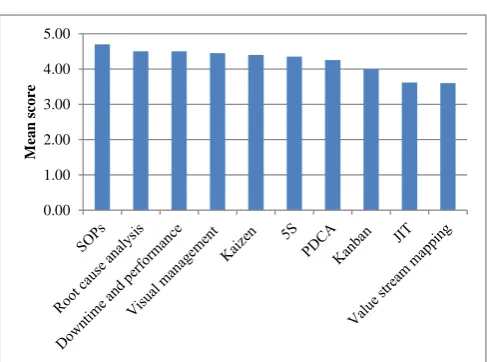
This research identified the lean tools that were adopted in the medical laboratory industry. The identified lean tools were as follows:
Standardized operating procedures (SOPs), Root causes analysis,
Downtime and performance, Key performance indicator (KPI),
Visual management (warning and regulatory signs), Kaizen (continuous improvement),
5S (sort, straighten, shine, standardize, sustain), PDCA (Plan Do Check Act) or Deming cycle, Kanban (Inventory regulator), and
Value stream mapping.
0.00 1.00 2.00 3.00 4.00 5.00
M
ea
n
sc
o
[image:2.595.303.547.586.767.2]re
These are presented and ranked in Fig. 1. Findings from the study showed that the level of adoption of lean tools was moderate in most of the medical laboratories. Unlike most research findings in the literature [14][15], value stream mapping and 5S methodology were not considered as the most important lean tools, but were surprisingly moderately practiced.
SOPs emerged as the most utilized lean tool in the Namibian medical laboratory industry. This is because each laboratory is required to have standard operating procedures, which are sets of documents that define practices which need to be strictly followed by all employees, strictly and without deviations (ISO 15189, 2012).
C. Measures of Impact or Effect of Lean Tools
Findings from this study showed that the impact or effects of lean adoption can be evaluated in terms of the following measures:
Quality improvement Operational performance Turnaround time Customer satisfaction Market share
Employee motivation or job satisfaction Cost reduction
Reduced waste
Based on these performance measures, the impact of lean adoption was evaluated.
D. Perceived Impact of Lean Tools
The objective of this research was to find out the effect or impact of the adoption of lean tools. This was essential to evaluate how much the original intended reason for lean adoption was achieved. The assumption is that when the lean tools were implemented, there were specific intended performance objectives to be achieved.
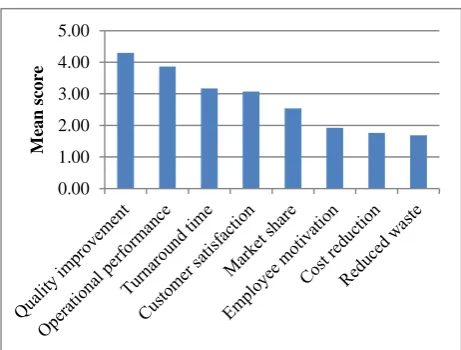
Results in Fig. 2 show that 80% of the realized impact in the medical laboratory industry was from the following:
Quality improvement
Improved operational performance Shorter turnaround time
Improved customer retention/satisfaction
Gain in market share through improved in service.
Quality improvement was found to be the most realized impact of lean implementation in more than 85 % of the laboratories.
The study revealed that the application of lean tools in the Namibian medical laboratory industry had a positive impact. Lean tools improved quality operational performance, shortened turnaround time, improve employee motivation and reduce cost. These impacts are similar to the outcome of the study in [15] in which it was argued that better outcomes for patients implies more on shortened treatment time and reduced waiting time. The same study also stated that, the outcomes of lean initiatives relates to performance and employees development.
In regards to the overall impact of the implementation lean tools and principles, the study revealed that, most laboratories partially achieved the overall expectation of lean principles, with few showing very little achievement. In [15], researchers stressed that health organizations only implement the first three lean principles, and the fact that the lean principles steps “Establish pull” and “Seek perfection” are not well represented in the lean healthcare articles may indicate that the implementation of lean principles in healthcare have not achieved to this level of maturity. Appropriate and effective lean transformation strategies are essential for the Namibian medical laboratory industry, if lean tools and principles are to be effective.
Different studies provide different strategies of how to implement lean principles in different industries. This study suggests that the following approaches should be considered when lean principles are applied in the Namibian medical laboratory industry:
1) Identify the KPIs that are not meeting the target and the existing wastes
2) Once the lean wastes are identified, initiate improvements on affected KPIs and communicate to appropriate personnel.
3) All personnel involved should be inducted, trained and assigned the required responsibilities.
4) Appropriate lean tools should be identified and applied to eliminate wastes.
5) If there is little or no improvement, restart the process over and over until the wastes are removed.
6) If wastes are eliminated, keep monitoring the process often to see if the wastes are re-appearing.
7) Sustain the process and strive for perfection by continually removing the wastes as they appear.
The suggested strategies are slightly in agreement with [15] who stated that there is no single correct way of implementing lean in healthcare and that the usual implementation steps include conducting lean training, initiating pilot projects and implementing improvement using interdisciplinary teams. In addition, the suggested strategies are slightly similar to [16] who reported the following strategy: define and assess the current strategic system in the company; form the lean implementation team; define the area which need improvement (Identify the KPIs); sketch the existing process status and map (using value stream mapping and visual management; measure the current state of the process and identify the wastes (7 types of wastes); implement lean tools based on the identified wastes; 0.00
1.00 2.00 3.00 4.00 5.00
M
ea
n
sc
o
[image:3.595.52.283.590.765.2]re
evaluate the effectiveness and efficiency of the proposed approach; continuous improvement techniques and culture must be developed in process improvement (Kaizen, 5S).
V. CONCLUSIONS AND RECOMMENDATIONS
A. Conclusions
This study examined the usage and impact of lean principles, lean tools, as well as the enablers and barriers of lean principles applications in the Namibian medical laboratory industry; it also developed lean principles implementation strategy.
This study showed that lean is implemented and mostly used in Namibian medical laboratory industry as a quality improvement approach rather than as a turnaround time improvement approach. Standard operating procedure (SOP) is the most adopted tool in Namibian laboratories, opposing many studies which show that value stream mapping is the most frequently tool used in healthcare. Management support plays a huge role in the success of lean principles implementation while lack of support from management is a huge hindrance to the success of lean principles implementation.
Lean is a useful tool in identifying and eliminating the wastes, which are transportation, defect, over-production, over-processing, inventory, motion and waiting, and this can only be achieved by applying the right tools at the right time. Lean plays a role in increasing efficiency, reducing wastes while improving quality of patient care and processes, balance costs, increase employees job satisfactions.
B. Recommendations
Furthermore, management ability to teach and pass on the knowledge to others was used very little in the Namibian medical laboratory industry. This is an indication that the managers are doing less when it comes to sharing the knowledge with the people on the ground. Therefore, this finding is in disagreement with [17] who stressed that supportive managers and a work environment that encourage knowledge transfer are essential to success.
Another finding was that internal motivation, external motivation, new technology procured, 5S methodology, Kanban and continuous improvement are moderately or somewhat practiced in the medical laboratory industry. This is a good indication that medical laboratory services are trying the most advanced improvement tools to improve quality of service provided, as supported by the study presented in [18]. This research makes the following recommendations:
1) The Ministry of Health and Social Services should come up with policies and guidelines which laboratories have to follow when operating, for them to provide fast and quality laboratory services.
2) The medical laboratory industry should be on the lookout for the modern quality improvement tools, they should research how and when these tools can be applied in the laboratory services and they should communicate the tools to all laboratory personnel to encourage lean culture in the industry.
3) Medical laboratory personnel should be able to accept
change, as this is the only way they will be able to implement lean successfully. They should be well inducted and trained on lean tools for best practice. 4) It is essential that the knowledge about how lean
principles can be applied in the Namibian medical laboratory industry is shared so that the laboratories can effectively apply lean principles for success and for good customer satisfaction.
C. Further Research
Further research is required on the impact of lean implementation. Similar research is required to evaluate why lean tools are not fully utilized and incorporated into the laboratory day-to-day activities to influence the success and the sustainability of lean transformation in the Namibian medical laboratory industry.
Studies on how to improve the thoroughness and frequency of use of the lean tools are essential in order to find ways to enhance the impact of lean tools. Furthermore, the importance of value stream mapping needs further research since this is widely known to be instrumental in improving the healthcare industry in general, and so is expected to be the most effective tool for identifying loop holes with the process flow by identifying value adding and non-value adding activities, allowing corrective actions to be taken.
ACKNOWLEDGMENT
The authors appreciate the respondents who provided relevant data without which this research could not have been successful.
REFERENCES
[1] M. Mutingi, R. Monageng, C. Mbohwa, Lean healthcare implementation in Southern Africa: A SWOT analysis. Proceeding of the World Congress on Engineering, 2, pp. 1-4, 1 – 3 July 2015, London, UK.
[2] Graban, M. Lean Hospitals: CRC Press: Taylor & Francis Group, 2009
[3] P. Mazzocato, C. Savage, M. Brommels, H. Aronsson, J. Thor, "Lean Thinking in healthcare: A realist review of the literature," Quality Safety Health Care, 19 (5), pp. 376-382, 2010
[4] L. Belekoukias, J.A. Garza-Reyes, V. Kumar, “The impact of lean methods and tools on the operational performance of manufacturing organizations”, International Journal of Production Research 52 (18), 2014.
[5] S. Rahman, T. Laosirihongthong, A. S. Sohal, “Impact of lean strategy on operational performance: A study of Thai manufacturing companies” Journal of Manufacturing Technology Management 21 (7), pp. 839-852, 2010
[6] D. J. Meade, S. Kumar, B. White. “Analyzing the impact of the implementation of lean manufacturing strategies on profitability”, Journal of the Operational Research Society, 61 (5), pp 858–871, May 2010
[7] K. Demeter, Z. Matyusz, “The impact of lean practices on inventory turnover”, International Journal of Production Economics, 133 (1), pp. 154–163, September 2011
[8] S. Iamratanakul. “The impact of lean practices on NPD performance”, The 2016 IEEE International Conference on Management of Innovation and Technology (ICMIT), Bangkok, Thailand, 19-22 September 2016
[9] , J. P. Womack, D. T. Jones. Lean thinking: Banish waste and create wealth in your corporation. New York: Free Pres, 2003
[11] Y. T. Min, “The impact of lean implementation on Quality and Efficiency in US hospitals," PhD Dissertation, Boston University, 2014
[12] L. Naidoo, O. H. Mahomed, “Impact of Lean on patient cycle and waiting times at a rural district hospital in KwaZulu-Natal”, African Journal of Primary Health Care & Family Medicine, pp. 1-9 [13] NPHL: The National Public Health Laboratory. Strategic Plan
(Establishing a strong Public Health Laboratory System). Windhoek: Ministry of Health and Social Services, 2012.
[14] T. Joosten, I. Bongers, R. Janssen, (2009). Applications of lean thinking in Health care: Issues and observations. International Journal For Quality in Health Care, 21(5), pp. 341-347.
[15] B. Poksinska, The current state of lean impementation in health care: Literature review. Quality Management in Health Care, 20(2), pp. 319-329, 2010.
[16] G. Venugopal, “Lean strategy implementation methodology”, 2013 Retrieved from www.slideshare.net
[17] E. A. Smith, “The role of tacit and explicit knowledge in the workplace”, Journal of Knowledge Management, 5(4), pp. 311-321, 2001.