Abstract— This paper proposes a new reinforcement learning
method to solve a train marshaling problem for assembling an outgoing train. In the problem, the arrangement of incoming freight cars is assumed to be random. Then, the cars are rearranged to the desired layout in order to assemble an outgoing train. In the proposed method, each set of freight cars that have the same destination make a group, and the desirable group layout constitutes the best outgoing train. Then, a rearrange operation is conducted by using several sub-tracks and an outgoing train is assembled in the main track. When a rearrangement operation is conducted in the proposed method, several cars located on different sub-tracks are collected by a locomotive so that the transfer distance of locomotive is reduced. In order to rearrange cars by the desirable order, cars are removed from a sub-track to one of other sub-tracks. Each marshaling plan that consists of series of removal and rearrangement operations are generated by a reinforcement learning system based on the transfer distance of a locomotive. The total transfer distance of the locomotive required to assemble an outgoing train can be minimized by the proposed method.
Index Terms— Collective action, Freight train, Marshaling,
Q-Learning, Scheduling, Container transfer problem
I. INTRODUCTION
ailway freight transportation has smaller environmental load as compared to the transportation by tracks. However, modal shifts are required for area that has no railway in order to link different modes of transportation including rail. A freight train consists of several freight cars, and each car has its own destination. The train driven by a locomotive travels several destinations decoupling corresponding freight cars at each freight station. In intermodal transports including rail, containers carried into the station are loaded on freight cars and located at the freight yard in the arriving order. The initial layout of freight cars in the yard is determined by considering both arrangement of incoming train and the arriving order of the containers carried by non-rail methods. Containers carried into the station are loaded on freight cars and the initial layout of freight cars is thus random. For efficient shift in assembling outgoing train, freight cars must be rearranged before coupling to the freight train. In general, the rearrangement process is conducted in a
Manuscript received January 7, 2017.
Y. Hirashima is with Osaka Institute of Technology, 1-79-1 Kitayama, Hirakata, Osaka, 573-0196 Japan (phone, fax: +81-72-866-5187; e-mail: [email protected]).
freight yard that consists of a main-track and several sub-tracks. Freight cars initially placed on sub-tracks are rearranged, and lined into the main track. This series of operation is called marshaling, and several methods to solve the marshaling problem have been proposed [1]-[4]. However, in these methods, the marshaling is based on the layout generated by the classification process that assigns each car into a certain sub-track. This causes restrictions on the number of sub-tracks and the number of cars in a sub-track. On the other hands, in our research group, several methods that can generate marshaling plans from the random arrangement of cars in sub-tracks have been proposed [5],[6]. Since, in these methods, each rearrange operation is conducted for cars in the same sub-track, the marshaling plan can be improved by using method proposed in [7] considering collective movements in a rearrange operation. A rearrange operation in the method in [7] is conducted after collecting cars in the same group from several sub-tracks by the desirable order. The method is effective for reducing the total transfer distance of locomotive.
In this paper, the collective movements is augmented and a new learning algorithm for improving marshaling plan of freight cars in a train is proposed. In the proposed method, the initial arrangement of freight cars in sub-tracks are assumed to be random, and thus any arrangements as the result of classification of incoming freight cars can be managed. Then, marshaling plans based on the transfer distance of locomotive are obtained by a reinforcement learning method [8]. Freight cars to be rearranged are collected from several sub-tracks, coupled to each other and moved into the main track by a locomotive. Simultaneously, the optimal sequence of car-movements as well as the number of freight cars that can achieve the desired layout of outgoing train is obtained by autonomous learning. In order to show the effectiveness of the proposed method, computer simulations are conducted for several methods.
II.PROBLEM DESCRIPTION A.Freight Yard
A freight yard is assumed to have 1 main track and m
sub-A Reinforcement Learning for Freight Train
with Augmented Collective Motions in a
Marshaling
Yoichi Hirashima
tracks. Define k as the number of freight cars carried in and assigned to sub-tracks in a classification stage. Then, they are moved to the main track by the desirable order based on their destination in a marshaling stage. In the yard, a locomotive moves freight cars, and the movement of freight cars from sub-track to sub-track is called removal, and the car-movement from sub-track to main track is called rearrangement. For simplicity, the maximum number of freight cars that each sub-track can have is assumed to be n, the ith car is recognized by an unique symbol ci, (i=1,
, k). Fig. 1 shows the outline of freight yard in the case k=30, m=n=6. In the figure, track Tm denotes the main track, and other tracks [1]-[6] are sub-tracks. The main track is linked with sub-tracks by a joint track, which is used for moving cars between sub-tracks, or for moving them from a sub-track to the main track.Fig. 1: Freight yard
[image:2.595.56.271.244.454.2]When the locomotive L moves a certain car, other cars locating between the locomotive and the car to be moved must be removed to other sub-tracks. This operation is called removal. Then, if k
nm-(n-1) is satisfied for keeping adequate space to conduct removal process, every car can be rearranged to the main track. In each sub-track, positions of cars are defined by n rows. Every position has unique position number represented by mn integers, and the position number for cars at the main track is 0.Fig. 2 shows an example of position index for k=30, m=n=6 and the layout of cars for Fig. 1-(b). In Fig. 2, the position ``[a][1]'' that is located at row ``[a]'' in the sub-track ``[1]'' has the position number 1. For unified representation of layout of cars in sub-tracks, the first car is placed at the row ``[a]'' in
every track, and a newly placed car is coupled with the adjacent freight car.
B.Desired layout in the main track
In the main track, freight cars that have the same destination are placed at the neighboring positions. In this case, removal operations of these cars are not required at the destination regardless of arrangements of these cars. In order to consider this feature in the desired layout in the main track, a group is organized by cars that have the same destination, and these cars can be placed at any positions in the group. Then, making a group corresponding to each destination, the order of groups lined in the main track is predetermined by destinations. This feature yields several desirable layouts in the main track.
Fig. 3 depicts examples of desirable layouts of cars and the desired layout of groups in the main track. In the figure, freight cars c1,
, c6 to the destination1 make group1, c7,
, c18 to the destination2 make group2, c19,
, c25 to thedestination3 make group3. Groups1,2,3 are lined by ascending order in the main track, which make a desirable layout. Also, in the figure, examples of layout in group1 are in the dashed square.
[image:2.595.313.544.537.791.2]The layout of groups lined by the reverse order does not yield additional removal actions at the destination of each group. Thus, in the proposed method, the layout lined groups by the reverse order and the layout lined by ascending order
Fig. 2 Example of position index and yard arrangement [a]
[b]
[c]
[d] [e] [f]
Position index Marshaling yard c26 c29 c28
c19 c27 c30
c17 c18 c15 c16
c13 c14 c24 c20
c22 c23
c25 c21 c11 c12
c9 c10
c7 c8 c5 c6
c3 c4
c1 c2
[1] [2][3] [4] [5] [6] [1] [2] [3] [4] [5] [6]
Fig 3: Groups and arrangements of freight cars c25
…
c19 c18
…
c7 c6
…
c1
group3
group2
group1 (destination3)
(destination2)
(destination1) c6 c5 c4 c3 c2 c1
c1 c2 c3 c4 c6 c5
c3 c2 c1 c6 c5 c4
c2 c1 c6 c5 c4 c3
… Desirable layouts for group1
Fig 4: Group layouts in a out going train
g1
L
g2
g3
g4
g1
L
g 2
g3
g4
g 1
L
g 2
g3
g4
g 1
L
g2
g3
g 4
g3
g2
g1
g4
g 3
g1
g2
L
g4
g3
g1
g 4
L
g3
g 2
g1
g2
L
g3
g 4
g1
step1 step2
step3
step1 step2
step3
step1 step2
[image:2.595.64.280.575.707.2]from both ends of the train are regarded as desired layouts. By defining r as the number of groups, the total number of layouts of group is 2r-1.
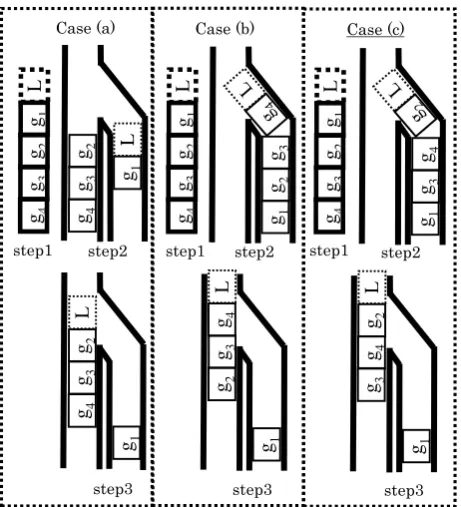
[image:3.595.319.544.35.723.2]Fig. 4 depicts examples of material handling operation for extended layout of groups at the destination of group1. In the figure, step 1 shows the layout of the incoming train. In case (a), cars in group1 are separated at the main track, and moved to a sub-track by the locomotive L at step 2. In cases (b),(c), cars in group1 are carried in a sub-track, and group1 is separated at the sub-track. In the cases, group1 can be located without any removal actions for cars in each group. Thus, these layouts of groups are regarded as candidate for desired one in the learning process of the proposed method.
When there exists a rearranging car that has no car to be removed on it, its rearrangement precedes any removals. In the case that several cars can be rearranged without a removal, rearrangements are repeated until all the candidates for rearrangement requires at least one removal. If several candidates for rearrangement require no removal, the order of selection is random, because any orders satisfy the desirable layout of groups in the main track. In this case, the arrangement of cars in sub-tracks obtained after rearrangements is unique, so that the movement count of cars has no correlation with rearrangement order of cars that require no removal. This operation is called direct rearrangement. When a car in a certain sub-track can be rearrange directly to the main track and when several cars located adjacent positions in the same sub-track satisfy the layout of group in the main track, they are coupled and applied direct rearrangement.
Fig. 5 shows 2 cases of marshaling including a removal and rearrangements, existing candidates for rearranging cars that require no removal. At the top of figure, from the left side, a desired layout of cars and groups, and the initial layout of cars in sub-tracks followed by 2 cases in 2 columns are depicted for m=4, n=5, k=9. In both cases, c1, c2, c3, c4 are in group1,
c5, c6, c7, c8 are in group2, and group1 must be rearranged first
to the main track. In each group, any layouts of cars can be acceptable. In case1, c2 in step 1, c3 in step 3 and step 4 are
applied the direct rearrangement. Also, in case2, steps 2 through 4 are direct rearrangements. Step2 in case1 and step1 in case2 are removals. Step 4 in case1, 3 cars c1, c4, c5 located
adjacent positions are coupled with each other and moved to the main track by a direct rearrangement operation. In addition, at steps 2 and 3 in case 2, cars in group1 and group2 are collected in sub-tracks to rearrange directly, since the arrangement of c3, c2, c1, c4, c5 can satisfy the desired layout
of groups in the main track. Whereas, at steps 1,3,4 in case 1, 3 direct rearrangements are conducted separately.
In addition, Fig.6 shows an example of augmented collective movements. In case3 in the figure, the transfer distance of locomotive is reduced in steps 1 and 4 because the freight cars are collected from c9 through c3 without a
decoupling operation, and because a removal is included in the collective movements. Whereas a decoupling operation is conducted in each step in case1 and two decoupling in steps 1, 4 in case2.
C.Marshaling process
A marshaling process consists of following 6 operations: (I) selections: group-layout in the main track,
(II) rearrangement of freight cars to the main track, when they can be moved directly,
(III) selection: a freight car to be rearranged into the main track,
(IV) selection: removal destinations of the cars in front of the car selected in (IV),
(V) selection: the number of cars to be moved in (V), (VI) removal of the cars determined in (VI) to the
selected sub-track in (V).
group3(c9)
m=4
group2
(c5,c6,c7,c8)
c5 c6 n=5
c4 c8 c9
group1 c1 c2 c7 c3
(c1,c2,c3,c4) Initial arrangement
Desirable layout (Sub-tracks)
(Main track)
Case1 Case2
c9
c5 c6 c5 c6
c4 c8 c9 c4 c8
c2 c1 c7 c3 c1 c2 c7 c3
Step1
c5 c9
c5 c6 c4 c6
c4 c8 c1 c8
c2 c1 c9 c7 c3 c2 c7 c3
Step2
c5 c9 c4
c5 c6 c6 c1
c3 c4 c8 c8 c2
c2 c1 c9 c7 c7 c3
Step3
c5 c5
c4 c4 c9
c1 c6 c1 c6
c3 c8 c2 c8
c2 c9 c7 c3 c7
After operations (I),(II) are finished, (III)-(VII) are repeated until one of desirable layouts is achieved in the main track, and a series of operations from the initial one in (I) to the final one in (III) achieving the desirable layout is defined as a trial.
Now, define Go as the desired layout and h1 as the number
of candidates of Go. Each candidate in operation (I) is represented by uj1 (1
j1
h1, h1=2r-1)In the operation (IV), each group has the predetermined position in the main track. Then, the car to be rearranged is defined as cT, and candidates of cT is determined by the number of freight cars that have already rearranged to the main track and the group layout in Go. h2 is defined as the
number of freight cars in group to be rearranged, and uj3 (h1+1
j3
h1+h2) as candidates of cT.In the operation (V), the removal destination of cars located on the car to be rearranged is defined as TR. Then,
defining uj4 (h1+h2+1
j4
h1+h2+m-1) as candidates of TR,excluding the sub-track that has the car to be removed, and the number of candidates is m-1.
In the operation (VI), defining np as the number of removal
cars required to rearrange cT, and defining nq as the number
of removal cars that can be located the sub-track selected in the operation (V), the candidate numbers of cars to be moved are determined by uj5 (1
uj5
min{np,nq}, h1+h2+m
j5
h1+h2+m +min{np, nq}). (III)-(VI) are repeated until all the
cars are rearranged into the main track.
In the operation (II), collective movements are generated by the following operations (IIa-IId):
(IIa) Determine the cars that can be rearranged directly to the main-track, and the sub-tracks including those cars. Also, determine if such sub-tracks can be yielded by a single removal operation, and define h4 the number of candidates of
removal-destination for the removal cars.
(IIb) Define TC as the sub-track including cars to be
rearranged directly, and h3 as the number of
candidates of TC.
(IIc) If h3>1, select a TC as the tail of the collected cars,
if h3=1, rearrange TC without collective movements,
if (h3=0, h4<2), operation (II) is finished,
and if (h3=0, h4>1), select a removal operation,
(IId) Conduct rearrange or removal and go to (IIa). Then, defining uj2 (h1+h2+m+min{np, nq}
j2
h1+h2+h3+h4+m+min{np, nq}) as candidates
D.Transfer distance of Locomotive
When a locomotive transfers freight cars, the process of the unit transition is as follows: (E1) starts without freight cars, and reaches to the joint track, (E2) restarts in reverse direction to the target car to be moved, (E3) joints them, (E4) pulls out them to the joint track, (E5) restarts in reverse direction, and transfers them to the indicated location, and (E6) disjoints them from the locomotive. Then, the transfer distance of locomotive in (E1), (E2), (E4) and (E5) is defined as D1, D2, D3 and D4, respectively, and the distance of the unit
transition D is calculated by D= D1+ D2+ D3 +D4. Also, define
the unit distance of a movement for cars in each sub-track as Dminv, the length of joint track between adjacent sub-tracks, or,
sub-track and main track as Dminh. The location of the
locomotive at the end of above process is the start location of the next movement process of the selected car. The initial
position of the locomotive is located on the joint track nearest to the main track.
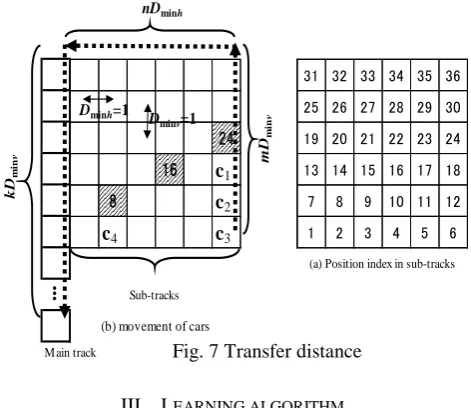
Fig. 7 shows an example of transfer distance. In the figure, m=n=6, Dminv=Dminh=1,k=18, (a) is position index, and (b) depicts movements of locomotive and freight car. Also, the locomotive starts from position 8, the target is located on the position 18, the destination of the target is 4, and the number of cars to be moved is 2. Since the locomotive moves without freight cars from 8 to 24, the transfer distance is D1+D2=12, D1=5,D2=7, whereas it moves from 24 to 16 with 2 freight cars, and the transfer distance is D3+D4=13 (D3=7,D4=6).
III. LEARNING ALGORITHM
Defining Q1 as an evaluation value for Go, Q1(Go) is updated
by the following rule when one of desired layout is achieved in the main track:
𝑄1(𝐺O) ← max {𝑄1(𝐺O), (1 − 𝛼)𝑄1(𝐺O) + 𝛼𝑅 ∏ 𝛾𝑖 𝑙
𝑖=1
}
[image:4.595.309.532.56.311.2](1) Fig. 6 Augmented collective movements
Case3
c
9c
6c
8c
9c
7c
5c
6c
5c
4c
8c
4c
1c
2c
7c
3c
1Step1
c
2
c
3 Step3c
9c
6c
9c
8c
5c
6c
7c
4c
8c
5c
1c
7c
4c
2c
1c
2c
3c
3Step2 Step4
31 32 33 34 35 36
25 26 27 28 29 30
19 20 21 22 23 24
13 14 15 16 17 18
7 8 9 10 11 12
1 2 3 4 5 6
(a) Position index in sub-tracks
24
16 c1
8 c2
c4 c3
M ain track
Sub-tracks
(b) movement of cars
…
kD
m
in
v
Dminh=1 D
minv=1
mD
m
in
v
nDminh
[image:4.595.310.546.466.670.2]where l denotes the total movement counts required to achieve the desired layout,
is learning rate,
i is discount factor calculated for each movement, R is reward that is given only when one of desired layout is achieved in the main track.Define s(t) as the state at time t, Tc as the sub-track selected as the destination for the removed car, pC as the number of
classified groups, qM as the movement counts of freight cars
by direct rearrangement, and s’ as the state that follows s. In the direct rearrangement, Q2a is defined as evaluation values
for (s1,uj2a), where s1=[s, Go], s2=[s1, TC], and Q2b is defined
as evaluation values for (s1,uj2b). Then, Q2a(s1,TC) is updated
by the following rule:
continued) is movement e (collectiv ) , ( max finished) is movement e (collectiv ) , ( max ) main track the into moved cars (all R ) , ( ) 1 ( ) , ( 2 2 3 3 1 2 3 3 1 1 C 1 2 C 1 2 a a j j j a u j u a a u Q u Q V V T Q T Q s s s s
(2) In removal operations, define pM as the number of cars moved.Q3,Q4 and Q5 are defined as evaluation values for
(s1,uj3),(s3,uj4),(s4,uj5) respectively, where s3=s1, s4=[s3, cT], s5=[s4, TR]. Q2b(s4,TR) ,Q3(s3,cT) Q4(s4, TR) , and Q5(s5,pM) are
updated by following rules:
) , ( max ) , ( ) 1 ( ) , ( 2 2 1 2 2 2 R 4 2 R 4 2 a a j j a u b b u Q V V T Q T Q s s s
)
,
(
max
)
c
,
(
3 4 4 43
4
j u
T
Q
u
Q
j
s
s
(3))
,
(
max
)
,
(
4 R 5 5 54
5
j
u
Q
u
T
Q
j
s
s
(4)
removal)
a
is
(
)
,
(
max
,
R
)
,
(
)
-(1
ent)
rearrangem
a
is
(
)
,
(
max
=
,
)
,
(
)
1
(
)
,
(
4 4 4 4 4 M 5 5 2 1 2a 3 3 M 5 5 M 5 5 4 j2au
u
'
Q
V
V
p
Q
u
u
'
Q
V
V
p
Q
p
Q
j u a j u js
s
s
s
s
(5)where
is the learning rate, R is the reward that is given when one of desirable layout is achieved, and
is the discount factor that is used to reflect the transfer distance of locomotive and calculated by the following equation:)
1
0
,
1
0
(
,
maxmax
D
D
D
, (6) where Dmax is the maximum value of D.
Propagating Q-values by using eqs.(1)-(6), Q-values are discounted according to the transfer distance of locomotive. In other words, by selecting the removal destination that has the largest Q-value, the transfer distance of locomotive can be reduced.
In the learning stages, each uj, (1
j
h1+h2+h3+h4+m+min{np, nq}) is selected by the soft-max action selection
method [8] In the addressed problem, Q2, Q3, Q4, Q5 become
smaller when the number of discounts becomes larger. Then, for complex problems, the difference between probabilities in candidate selection remain small at the initial state and large at final state before achieving desired layout, even after repetitive learning. In this case, obtained evaluation does not contribute to selections in initial stage of marshaling process, and search movements to reduce the transfer distance of locomotive is spoiled in final stage. To conquer this drawback, Q2a, Q2b, Q3, Q4, Q5, Q6 are normalized, and probability P for
selection of each candidate is calculated by
(7)
,
)
,
(
min
)
,
(
max
)
,
(
min
)
,
(
)
,
(
~
i i j i i j i i j i i j i i u j i i u j i i u j i i j i iu
Q
u
Q
u
Q
u
Q
u
Q
s
s
s
s
s
2,3,4,5)
(i
(8)
,
)
/
)
,
(
~
exp(
)
/
)
,
(
~
exp(
)
,
(
ji
i i u u i i j i i j i
u
Q
u
Q
u
P
s
s
s
,
)
/
)
(
~
exp(
)
/
)
(
~
exp(
)
(
1 1 1 1 1
j u u j ju
Q
u
Q
u
P
wherer
is a thermo constant.IV. COMPUTER SIMULATIONS
Computer simulations are conducted for m=12,n=6,k=36 and learning performances of following 2 methods are compared: (A) Proposed method considering with augmented collective movements in the direct rearrangement, (B) Proposed method with conventional collective
movements [7]
(C) Proposed method without collective movements in the direct rearrangement [6].
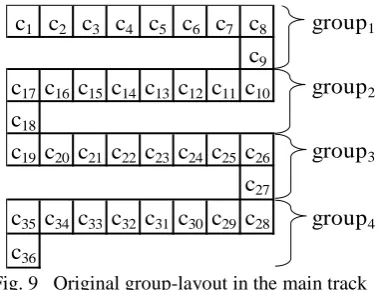
The initial arrangement of freight cars in sub-tracks train is described in Fig.8. The original group-layout is group1,
group2, group3, group4, the order that is depicted in Fig.9.
Also, cars c1,
,c9 are in group1, c10,
,c18 are in group2,c19,
,c27 are in group3,c28,
,c36 are in group4. Otherparameters are set as
=0.9,
=0.2,
=0.9, R=1.0,
=0.1. Both methods consider extended layout of groups and derive desirable layouts autonomously in order to reduce the total transfer distance of the locomotive. The locomotive and freight cars assumed to have the same length, and Dminv=Dminh=20m.c
6c
4c
26c
10c
27c
14c
24c
15c
5c
30c
13c
19c
7c
1c
16c
2c
29c
8c
25c
3c
21c
35c
33c
20c
11c
31c
28c
9c
23c
36c
17c
34c
22c
12c
18c
32The results are shown in Fig.10. In the figure, horizontal axis expresses the number of trials and the vertical axis expresses the minimum processing time found in the past trials. A trail starts with an initial arrangement in sub-tracks, and finished when all the freight cars are rearranged into the main track. Each result is averaged over 20 independent simulations. In Fig.10, although the learning performance of method (A) is under preparing, (A) includes all the collective movements in (B) so that the marshaling plan can be improved as compared to that in (B). Also, the learning performance of method (B) is better than that of (C), because (B) collects freight cars in sub-tracks for each direct rearrangement. Simulation results obtained by (A) will be shown at the presentation.
Table 1 Total transfer distance
Transfer distance [m]
best average worst
Method(B) 15280 15480 15800
Method(C) 24980 25600 26720
V.CONCLUSIONS
A new scheduling method has been proposed in order to rearrange and line cars in the desirable order onto the main track considering augmented collective movements of the locomotive in the direct rearrangement of freight cars. The learning algorithm of the proposed method is derived
based on the reinforcement learning that evaluates the total transfer distance of locomotive in a marshaling. In order to reduce the total transfer distance of locomotive in a marshaling, the proposed method obtain group-layout of desirable arrangement of outgoing train and collecting order of freight cars in sub-tracks, so that the total transfer distance in a marshaling plan derived by the proposed method has been reduced by about 40% as compared to the conventional method in computer simulations. In addition, the arrangement of freight cars in the main track, the rearrange order of cars, the position of each removal car, the number of cars to be removed, and the group layout in the outgoing train has been obtained simultaneously so that the learning performance of the proposed method has been improved.
REFERENCES
[1] C. F. Daganzo, R. G. Dowling, R. W. Hall: Railroad classification yard throughput: The case of multistage triangular sorting, Transportation Research, Part A, No.17, Vol. 2 (1983), pp. 95-106.
[2] U. Blasum, M. R. Bussieck, W. Hochstättler, C. Moll, H.-H. Scheel and T. Winter: Scheduling Trams in the Morning, Mathematical Methods of Operations Research Vol. 49, No. 1 (2000) , pp. 137-148. [3] R. Jacob, P. Marton, J. Maue and M. Nunkesser: Multistage Methods
for Freight Train Classification, Proceedings of 7th Workshop on Algorithmic Approaches for Transportation Modeling, Optimization, and Systems (2007) , pp. 158-174.
[4] T. Nonner and A. Souza: Optimal Algorithms for Train Shunting and Relaxed List Update Problems, 12th Workshop on Algorithmic Approaches for Transportation Modelling, Optimization, and Systems (2012), pp. 97-107.
[5] Y. Hirashima: An Intelligent Train Marshaling Based on the Processing Time Considering Group Layout of Freight Cars in IAENG Transactions on Electrical Engineering Volume 1, World Scientific (2013), pp.229-243.
[6] Y. Hirashima: A Reinforcement Learning System for Generating Train Marshaling Plan of Freight Cars Based on the Processing Time Considering Group Layout, Proceedings of The International MultiConference of Engineers and Computer Scientists 2013, (2013) , pp.30-35.
[7] Y. Hirashima: A Reinforcement Learning for Marshaling of Freight Train Considering Collective Motions, Proceedings of The International MultiConference of Engineers and Computer Scientists 2016, (2016) , pp. pp19-24.
[8] R. Sutton and A. Barto: Reinforcement Learning, MIT Press (1999). Fig. 9 Original group-layout in the main track
c
1c
2c
3c
4c
5c
6c
7c
8c
9c
17c
16c
15c
14c
13c
12c
11c
10c
18c
19c
20c
21c
22c
23c
24c
25c
26c
27c
35c
34c
33c
32c
31c
30c
29c
28c
36group
1group
2group
3group
4T
ra
n
sf
er
d
ist
an
ce
o
f
lo
co
mo
ti
v
e
Trials
0 2000 4000 6000 8000
16 20 24 28 32 [km]
Fig. 10 Performance comparison (B)
[image:6.595.49.288.410.683.2]