Abstract—This study aimed at investigating the effect of
activating Co/Al2O3 catalyst by syngas on its behavior during Fisher
Tropsch Synthesis (FTS). The catalyst was prepared by incipient wetness impregnation (IWP) method and characterized by X-ray diffraction (XRD) and temperature programmed reduction (TPR) analyses. The catalytic evaluation was performed at 215 oC and 20 bar in a fixed-bed reactor. The data have revealed that syngas-reduced catalyst has a different structure compared to H2-reduced
catalyst. Although TPR data suggest that the presence of CO causes the catalyst to be reduced at lower temperatures, CoO species were detected in the syngas-reduced catalyst. This was due to the reoxidation of cobalt species by water vapor as CO methanation took place during the reduction process in presence of the synthesis gas. These cobalt oxides catalyze the water-gas-shift reaction that favored methane formation and led to low C5+ selectivity.
Keywords—Activation, Cobalt catalyst, Fischer-Tropsch, Synthesis gas.
I. INTRODUCTION
ICHER-TROPSCH (FT) process converts synthesis gas (a mixture of CO and H2) into liquid fuels. The synthesis gas is obtained from carbon-containing feedstock such as biomass, coal and natural gas through gasification or reforming processes. Hence, biomass-, coal- and gas-to-liquid (B/C/GTL) technologies are alternative routes for liquid fuels production which have received significant research interest as global energy demand increases while environmental regulations are becoming more stringent.
For industrial applications, the FT process usually requires a cobalt- or iron-based catalyst which must be activated before the reaction. For cobalt-based catalysts, the activation usually consists of reducing the catalyst using hydrogen at temperatures ranging from 250 to 400 oC [1]. However, some studies [2, 3] have reported that the presence of CO in the activation gas improves the performance of cobalt catalysts. Our previous results [3] have shown that activating a Co/TiO2
This work was supported in part by the National Research Foundation (NRF) (90737) and the University of Johannesburg (05-15-265590).
D. Seanokeng is with the Department of Chemical Engineering, University of Johannesburg (e-mail: [email protected]).
A. Iloy is with the Department of Chemical Engineering, University of Johannesburg (e-mail: [email protected]).
K. Jalama is with the Department of Chemical Engineering, University of Johannesburg (corresponding author: +27(0)11-559-6157; e-mail: kjalama@ uj.ac.za).
catalyst using synthesis gas (with H2/CO ratio of 2/1) produces a better catalyst with more stability, activity and better product selectivity. Therefore, this study aims at extending these findings to an alumina-supported catalyst by evaluating the effect of reducing Co/ɣ-Al2O3 catalyst with synthesis gas compared to H2.
II. EXPERIMENTALDETAILS A. Catalyst Preparation
The catalyst support was prepared by mixing 20g of gamma alumina with 15g of distilled water and drying in air at 120 oC for 17 hours followed by calcination at 400 oC for 6 hours. The catalyst was prepared by incipient wetness impregnation of the calcined support with cobalt nitrate (Co(NO3)2.6H2O) solution to achieve a metal loading for 25% (reduced cobalt weight-basis). The sample was subsequently dried and 120 oC for 17 hours and then calcined in air at 400 oC for 12 hours to transform and decompose cobalt nitrate into cobalt oxide.
B. Catalyst Characterization
The structure of the catalyst was analyzed by x-ray diffraction (XRD) technique using a Rigaku Ultima diffractometer using the following settings: 40 kV, 30 mA and a scan speed of 2o/min.
Temperature programmed reduction (TPR) was used to attempt and study the catalyst behaviour during activation in presence of 5%CO in He and 5%H2 in Ar respectively. Firstly, ca. 100 mg of calcined catalyst sample were placed in a tube reactor and degassed at 150 oC in Ar for 30 min. After cooling to 60 oC, Ar was replaced with either 5% H2 in Ar or 5% CO in He and the analysis was started after the signal of the thermal conductivity detector (TCD), downstream the tube reactor, had stabilized. A heating rate of 10 oC was used to reach a temperature of 700 oC that was maintained constant for a ca. 30 - 40 min before stopping the analysis.
C. Catalyst evaluation
The evaluation of hydrogen- and syngas-activated catalysts was carried out in a fixed-bed reactor. Before the reaction, 1g of catalyst was loaded in the reactor and activated at 390 oC and atmospheric pressure using either pure hydrogen or synthesis gas (ca. 10% N2, 30% CO, balance H2) at a fixed
Fischer-Tropsch Synthesis over Co/ɣ-Al
2
O
3
Catalyst: Activation by Synthesis Gas
Ditlhobolo Seanokeng, Achtar Iloy, Kalala Jalama
flowrate of 73 ml/min for 14 hours. After the activation process, the reactor was cooled to a temperature below 100 oC under the flow of syngas before building the reactor pressure up to 20 bar and increasing the temperature to 215 oC to start the FT reaction. The gas flow rate was readjusted to ca. 40 ml/min. The analysis of the outlet gas product was done using a DANI Master gas chromatograph (GC) using a stainless steel general 60/80 Carboxen column connected to a TCD and a Supel-Q Plot fused silica capillary column 30m x 0.32mm connected to a flame ionization detector (FID). The TCD detected H2, N2, CO and CH4 while the FID detected hydrocarbons (olefins and paraffins).
III. RESULTSANDDISCUSSION A. Catalyst Characterization
Fig. 1 shows XRD analysis data for unreduced (pattern a), syngas- and hydrogen-activated catalyst samples (patterns b and c). Diffraction peaks for cobalt oxide (Co3O4) were observed for the unreduced catalyst sample. All of these peaks are not visible for both the catalyst reduced by hydrogen and that reduced by syngas suggesting that these species were converted into metallic cobalt and/or CoO. While the diffraction peaks for metallic cobalt were detected on both reduced catalysts, CoO was only detected on the syngas-reduced catalyst due to two possible reasons: i) as the reduction of Co3O4 to metallic cobalt occurs in two steps, i.e. Co3O4 → CoO → Co0, it is possible that the second step was limited in presence of syngas; ii) since methane and water formed during catalyst reduction by syngas, it is possible that a portion of Co0 in the syngas-reduced catalyst was reoxidized to CoO by the water vapour.
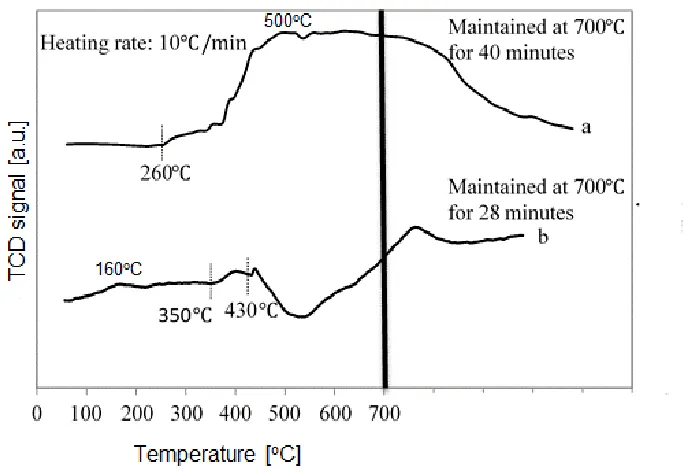
Fig. 2 shows TPR data for both H2 - and CO-reduced catalyst samples. CO was used instead of syngas to avoid technical complications that are caused by the formation of FT products in the catalyst during the reduction process as explained in our earlier study [3]. When the catalyst was reduced with 5% H2 in Ar (Fig. 2a), one peak was observed to start at ca. 260 oC and was followed by a large peak that extended up to 700 oC through its maximum value at ca. 500 o
C . These peaks are attributed to the two-step reduction of Co3O4 species with various interaction levels with the alumina support to Co0. When the catalyst was reduced with CO (Fig. 2b), the first peak was observed at ca. 140 oC followed by a number of unresolved peaks below 500 oC. These peaks were also attributed to the two-step reduction of Co3O4 species in various interaction with the alumina support. The large peak that started above 500 oC was due to rapid carbon deposition on the catalyst surface. When compared to the hydrogen-reduced catalyst, it can be seen that the reduction by CO occurred at lower reduction temperatures.
B. Catalyst evaluation
reduced catalyst stabilized within 20 hours on stream and maintained a CO conversion of ca. 26% without showing any deactivation up to 90 hours on stream. The syngas-reduced catalyst showed a lower conversion and a deactivation feature that started after ca. 29 hours on stream where a CO conversion of ca. 24% was measured. This value decreased with the TOS and reached ca. 18% after 90 hours.
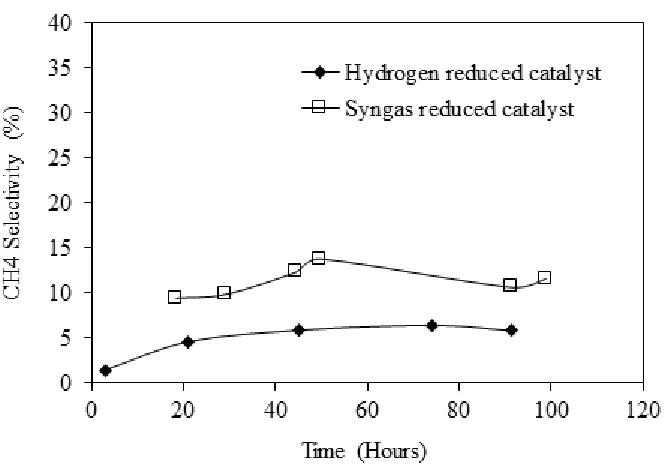
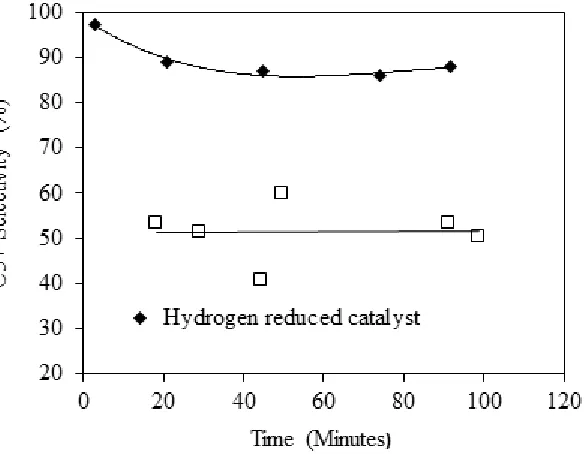
Methane, C2-C4 and C5+ hydrocarbons selectivities for H2- and syngas-reduced catalysts as function of TOS are respectively reported in figures 4 to 6. Reducing the catalyst with syngas led to higher methane (fig. 4) and lower C5+ hydrocarbons (fig. 6) selectivities compared to the H2-reduced catalyst. The selectivities for C2-C4 hydrocarbons were comparable for both catalysts (fig. 5). Similar findings were reported by Dai and Yu [4] who explained the high methane formation on syngas-reduced catalyst by the presence of cobalt carbide formed during the catalyst reduction process. Our XRD data in fig. 1 did not show any diffraction peak for cobalt carbide but rather a peak for CoO in syngas-reduced catalyst that can explain the low activity and higher methane formation measured on this catalyst. Previous studies have also related higher methane formation to the presence of cobalt oxides [5 – 7]. These species catalyse the water-gas-shift reaction [5, 7] and increase the local H2/CO ratio on active sites resulting in more hydrogenation of the adsorbed species.
Fig. 7 shows the CO2 selectivity for the syngas-reduced catalyst as function of TOS and confirms that this catalyst was also active for the water-gas-shift reaction. No CO2 formation was detected on the H2-reduced catalyst.
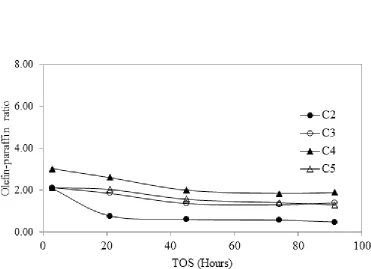
Fig. 8 shows the light olefin-to-paraffin ratios as function of TOS. No light olefin was detected over the syngas-reduced catalyst confirming that the hydrogenation of adsorbed species was favoured on this catalyst. For the H2-reduced catalyst, C3-C5 olefin-to-paraffin ratios were between 1.3 and 2 after 45 hours on stream. As expected for cobalt-based catalysts activated by H2, the ethylene to ethane ratio was below 1.
IV. CONCLUSION
[2] B. Jongsomjit, J.G. Goodwin Jr, Co-support Compound Formation in Co/Al2O3 Catalysts: Effect of Reduction Gas Containing CO, Catalysis
Today 77 (2002) 191-204.
[3] K. Jalama, J. Kabuba, H. Xiong, L. L. Jewell, Co/TiO2 Fischer-Tropsch
Catalysts Activation by Synthesis Gas, Catalysis Communications 17 (2012) 154-159.
[4] X. Dai, C. Yu, Effects of Pretreatment and Reduction on the Co/Al2O3
Catalyst for CO Hydrogenation, Journal of Natural Gas Chemistry 17 (2008) 288 - 292.
[5] R.C. Reuel, C.H. Bartholomew, The Stoichiometries of H2 and CO
Adsorptions on Cobalt: Effects of Support and Preparation, Journal of Catalysis 85 (1984) 63 - 77.
[6] A.Y. Khodakov, A. Griboval-Constant, R. Bechara, V.L. Zholobenko,
Pore Size Effects in Fischer Tropsch Synthesis over Cobalt-Supported Mesoporous Silicas, Journal of Catalysis 206 (2002) 230-241.
[7] A. Martı́nez, C. López, F. Márquez, I. Dı́az, Fischer–Tropsch Synthesis of Hydrocarbons over Mesoporous Co/SBA-15 Catalysts: The influence of Metal loading, Cobalt Precursor, and Promoters, Journal of Catalysis 220 (2003) 486-499.
Fig. 1. XRD analysis for a) unreduced 25% Co/Al2O3 catalyst, b) 25% Co/Al2O3 catalyst reduced by syngas c) 25% Co/Al2O3 catalyst
[image:3.612.175.473.165.366.2]reduced by h 3O4 0.
[image:3.612.140.484.437.675.2]Fig. 3. CO conversion for 25% Co/Al2O3 catalyst reduced by H2 and syngas versus TOS.
[image:4.612.109.444.400.633.2]Fig. 5. C2-C4 selectivity for 25% Co/Al2O3 catalyst reduced by H2 and syngas versus TOS.
[image:5.612.125.417.382.609.2]Fig. 7. CO2 Selectivity for catalyst reduced with syngas.
[image:6.612.122.493.330.599.2]