Expression of
Plxdc2/TEM7R
in the developing nervous system
of the mouse
Suzanne F.C. Miller
a, Kristen Summerhurst
d, Annette E. Rünker
a, Géraldine Kerjan
b,
Roland H. Friedel
c, Alain Chédotal
b, Paula Murphy
d, Kevin J. Mitchell
a,¤a SmurWt Institute of Genetics, Trinity College Dublin, Dublin 2, Ireland
b Centre National de la Recherche ScientiWque UMR7102, Université de Paris 6, Case 12, 9 Quai Saint-Bernard, 75005 Paris, France c Department of Biological Sciences, Howard Hughes Medical Institute, Stanford University, Stanford, CA 94305, USA
d Department of Zoology, Trinity College Dublin, Dublin 2, Ireland
Received 21 September 2006; received in revised form 14 November 2006; accepted 10 December 2006
Abstract
Plexin-domain containing 2 (Plxdc2) is a relatively uncharacterised transmembrane protein with an area of nidogen homology and a plexin repeat (PSI domain) in its extracellular region. Here, we describe Plxdc2 expression in the embryonic mouse, with particular empha-sis on the developing central nervous system. Using light microscopy and optical projection tomography (OPT), we analyse RNA in situ
hybridization patterns and expression of two reporter genes, -geo (a fusion of -galactosidase to neomycin phosphotransferase) and pla-cental alkaline phosphatase (PLAP) in a Plxdc2 gene trap mouse line (KST37; [Leighton, P.A., Mitchell, K.J., Goodrich, L.V., Lu, X., Pin-son, K., Scherz, P., Skarnes, W.C., Tessier-Lavigne, M., 2001. DeWning brain wiring patterns and mechanisms through gene trapping in mice. Nature 410, 174–179]). At mid-embryonic stages (E9.5–E11.5) Plxdc2-geo expression is prominent in a number of patterning centres of the brain, including the cortical hem, midbrain–hindbrain boundary and the midbrain Xoorplate. Plxdc2 is expressed in other tissues, most notably the limbs, lung buds and developing heart, as well as the spinal cord and dorsal root ganglia. At E15.5, expression is apparent in a large number of discrete nuclei and structures throughout the brain, including the glial wedge and derivatives of the cortical hem. geo expression is particularly strong in the developing Purkinje cell layer, especially in the posterior half of the cerebellum. The PLAP marker is expressed in a number of axonal tracts, including the posterior commissure, mammillotegmental tract and cerebellar peduncle. We compare Plxdc2-geo expression in the embryonic brain with the much more restricted expression of the related gene Plxdc1 and with members of the Wnt family (Wnt3a, Wnt5a and Wnt8b) that show a striking overlap with Plxdc2 expression in certain areas.
© 2007 Elsevier B.V. All rights reserved.
Keywords: Plxdc2; Plxdc1; TEM7R; TEM7; KST37; Wnt1; Wnt3a; Wnt5a; Wnt8b; PLAP secretory trap; OPT, optical projection tomography; Cortical hem; Cajal–Retzius cells; Midbrain–hindbrain boundary; Glial wedge; Purkinje cell layer; AER, apical ectodermal ridge; Mammillotegmental tract; Pos-terior commissure; Cerebellar peduncle
1. Results and discussion
During neurodevelopment, patterning of the neuropei-thelium and establishment of cell fates is followed by (or sometimes linked with) migration of cells to appropriate positions and guidance of growing axons along stereotyped pathways to appropriate targets. A number of conserved
families of molecules involved in axon guidance have been identiWed in several species. These include families of guid-ance cues such as the netrins, semaphorins, slits, and eph-rins (Dickson, 2002; Yu and Bargmann, 2001). In addition, a number of classically deWned morphogens, including Wnts, BMPs, and Shh have also recently been found to act in axon guidance (reviewed in Charron and
Tessier-Lav-igne, 2005). These molecules and their receptors are
charac-terised by a variety of extracellular motifs involved in cell–cell interactions, dimerisation or autoregulation. In *Corresponding author. Tel.: +353 1 896 3067; fax: +353 1 679 8558.
addition to these well-characterised proteins, a large num-ber of novel transmembrane protein-encoding genes con-taining such motifs are predicted in mammalian genomes, many of which are expressed in the developing brain (unpublished data) and are good candidates to be involved in axon guidance or other aspects of nervous system devel-opment.
The PLAP secretory trap method was designed and developed to screen for novel axon guidance receptors in the mouse (Leighton et al., 2001). Previous studies utilising this method isolated a gene trap insertion in a novel gene (mouse line KST37; Leighton et al., 2001), since named
plexin domain-containing 2 (oYcial MGI gene symbol
Plxdc2). This gene encodes a type I transmembrane protein of 530 amino acids, characterised by an extracellular region of weak nidogen homology and a plexin repeat or PSI domain, a domain found in known axon guidance mole-cules such as semaphorins and plexins as well as integrins and a small number of other molecules (Bork et al., 1999). The PSI domain has been shown to be involved in autoreg-ulatory intramolecular contacts in a number of cases
(Bunch et al., 2006; Mould et al., 2005; Zang and Springer,
2001). A related gene (now called Plxdc1) was isolated in a screen for genes upregulated in human tumour endothe-lium and named tumour endothelial marker 7 (TEM7) ( Car-son-Walter et al., 2001; St Croix et al., 2000). Plxdc2 is thus also referred to as TEM7-related (TEM7R). The parallels between angiogenesis and nerve growth have been noted before and several molecules originally identiWed in axon guidance have been directly implicated in angiogenesis (Basile et al., 2006; Carmeliet and Tessier-Lavigne, 2005).
In this study, we investigate Plxdc2 expression in the mouse at a number of stages of embryonic development, paying particular attention to its expression in the develop-ing nervous system. We compare this with the much more restricted expression of Plxdc1 in the embryonic brain and with a number of Wnt genes that show a striking overlap with Plxdc2 expression in certain areas.
1.1. Characterisation of a PLAP secretory trap insertion in Plxdc2
The PLAP secretory trap method was designed to iden-tify axon guidance genes in the mouse by simultaneous mutation of the trapped gene and transgenic labelling of neurons that normally express it and their axons. The endogenous promoter of the trapped gene drives produc-tion of a bicistronic transcript that encodes two proteins, a fusion of the endogenous protein to -geo (a fusion of -gal to neomycin phosphotransferase) and placental alkaline phosphatase (PLAP), which is translated independently using an internal ribosome entry site. It is important to note that both markers report gene expression and not necessar-ily endogenous protein localisation; PLAP labels axons of neurons expressing the trapped gene, whereas the -geo fusion protein remains membrane bound inside cell bodies. Comparisons of corresponding X-gal and PLAP stainings
conWrm that PLAP reliably labels the axons of neurons stained with X-gal (Leighton et al., 2001). Studies of previ-ously trapped genes have shown that both the PLAP and -gal markers faithfully reXect reported expression patterns
(Leighton et al., 2001), although perdurance of the -geo
fusion protein may be an issue in comparing the dynamics of expression to results from in situ hybridisation tech-niques.
Using a candidate primer approach, we characterised the exact site of the PLAP secretory trap insertion in the KST37 mouse line to intron 3–4 of the Plxdc2 gene (Ensembl:ENSMUST00000028081; Supplemental Wgure 1).
1.2. Plxdc-geo expression in the embryo
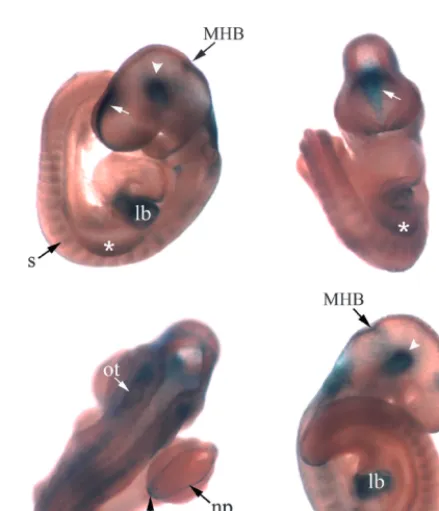
[image:2.595.294.514.331.587.2]Expression of Plxdc2-geo in the embryo was investi-gated by whole mount X-gal staining of heterozygous gene trap mice at embryonic day (E)9.5, E11.5 and in the brain of E15.5 embryos. At E9.5, Plxdc2-geo expression was observed in the Xoor of the midbrain and in an anterior and medial area of the telencephalon that includes the choroid plexus epithelium and presumptive cortical hem (Fig. 1). Expression of Plxdc2-geo was also evident in the mid-brain–hindbrain boundary (MHB), a major organising
centre of the developing brain (Raible and Brand, 2004). Within the trunk region, Plxdc2-geo expression occurred in a segmented pattern within the somites. At later stages of development, Plxdc2-geo expression is found in the dorsal root ganglia (DRG, see below) and expression at E9.5 is thus most likely to include the neural crest-derived spinal primordia which give rise to the sensory cells of the DRG. Plxdc2-geo expression was also evident in the limb buds, the lung buds and in the otic vesicle (Fig. 1). In the most caudal region of the embryo, expression is seen in the lat-eral edges of the neuroepithelium in the region of the still open posterior neuropore (future dorsal midline) and in the extreme distal tip of the tail bud (Fig. 1).
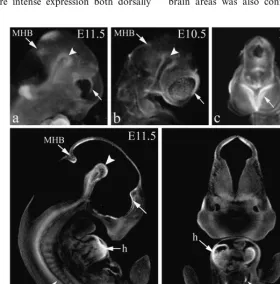
By E11.5, Plxdc2-geo expression was more complex and widespread, and its intricate expression pattern became increasingly diYcult to document using classical micros-copy and photography techniques. We therefore utilised Optical Projection Tomography (OPT), a method for 3D optical microscopy, to visualise Plxdc2-geo expression in the E11.5 mouse (Fig. 2). Rather than scanning through diVerent depths of focus in the specimen to reconstruct the 3D object (as in confocal microscopy), OPT maximises the depth of focus, capturing projected optical density images of the whole specimen (Sharpe et al., 2002). Computer soft-ware then reconstructs the original 3D information from 400 images taken through one complete 360 degree revolu-tion. The 3D computer object can then be viewed as a series
of virtual sections in any orientation or can be viewed from “external” view-points (when volume rendered). Fig. 2
shows both external views (b–e and g) and virtual sections (f, h, i, and j).
OPT highlighted Plxdc2-geo expression in restricted domains in a number of areas of the E11.5 embryo (Fig. 2;
Supplementary data, video 1) including the brain, limb bud,
sensory ganglia, branchial arches, heart, lung buds (Figs. 2
and 3) and urogenital tract (data not shown). In the eye,
cel-lular Plxdc2-geo expression was restricted to a region of localised expression in the centre of the lens (Fig. 2a and b). In both hind and fore limb buds, Plxdc2-geo was expressed in broad domains of distal mesenchyme, extend-ing more proximally on the posterior side (Fig. 2a and d) with a reduced level at the extreme distal tip (Fig. 2f and h). Expression is also seen in the apical ectodermal ridge, a major signalling centre involved in the proximal-distal pat-terning of the developing vertebrate limb (Fig. 2f and inset in h). Continued Plxdc2-geo expression was also evident in regions of the developing otic vesicle (Fig. 2b). Plxdc2-geo expression within the trunk at E11.5 had resolved to a clear restriction within the developing DRG (Fig. 2f). This pat-tern of expression agrees with previously published data at E12.5, which showed Plxdc2-geo expression in the DRG and PLAP expression in the corresponding axons (
Leigh-ton et al., 2001). These data also showed reporter gene
expression in motor and sympathetic preganglionic axons
and the Xoorplate of the spinal cord (Leighton et al., 2001). In the present study, expression is seen in the ventral spinal cord, including the Xoorplate from an anterior limit at the midbrain, and the motor column of the neural tube from an anterior limit at the level of prevertebrae C2/C3 (Fig. 2f and h). A broadband of expression is also seen in the lateral plate mesoderm.
In the E11.5 brain, Plxdc2-geo expression was observed in a number of discrete areas, including important pattern-ing centres. The broad expression seen in the medial telen-cephalon at E9.5 has evolved to a clearly deWned domain (Fig. 2i and j). By this stage the telencephalic vesicles have expanded and are separated by a medial invagination of the dorsal midline due to low levels of proliferation combined with high levels of apoptosis (Furuta et al., 1997).
geo expression was observed throughout the medial invagination encompassing the cortical hem and choroid plexus epithelium (CPe) and extending slightly caudal in the medial diencephalon (Fig. 2i and j, arrow). The cortical hem is crucial for normal cortical development and disrup-tion of the area can lead to severe hippocampal abnormali-ties (Shimogori et al., 2004). At E11.5, a complete ring of Plxdc2-geo expression was evident at the MHB (Fig. 2i) with signiWcantly more intense expression both dorsally
and ventrally. Elsewhere in the brain, Plxdc2-gal continues to be expressed in the Xoor of the midbrain although this expression now extends into the hindbrain. Two clusters of cellular Plxdc2-geo expression were also evident in the ventral midbrain, lateral to and distinct from the Xoor plate expression (Fig. 2b, c, d, and h).
The speciWcity of the reporter gene expression was
con-Wrmed by whole-mount in situ hybridisation with a Plxdc2
[image:4.595.135.416.311.595.2]antisense riboprobe (Fig. 3). At E11.5, in situ hybridisation showed the same overall pattern of expression as the Plxdc2-geo reporter gene, although there was a reduction in the relative intensity in certain areas, particularly in the cortical hem and the limbs (Fig. 3a, d, and e). These areas gave a stronger in situ hybridisation signal at E10.5 (Fig. 3b and c). This modest disparity could be due to technical diVerences in the protocols used for in situ hybridisation on E10.5 and E11.5 embryos (the former being freshly pre-pared and the latter having been frozen), or possibly to per-durance of the Plxdc2-geo fusion protein. Despite this diVerence, in situ hybridisation conWrmed Plxdc2 expres-sion in the cortical hem, the MHB, the Xoor of the midbrain and in all of the areas highlighted by X-gal staining of het-erozygous gene trap embryos. Later expression in speciWc brain areas was also conWrmed by in situ hybridisation
(data not shown). A control sense probe for Plxdc2 showed a low level non-speciWc background staining (data not shown).
1.3. Comparative deWnition of Plxdc-geo expression within the cortical hem and MHB
We noted remarkable similarities between the expression of Plxdc2-geo and that of a number of members of the Wnt family, several of which are expressed in the cortical hem and MHB, for example. Wnt1 is essential for the devel-opment of the posterior midbrain and anterior hindbrain
and is expressed in a thin ring at the MHB as early as E9.5
(Panhuysen et al., 2004). Wnt3a expression can be used to
distinguish the structure of the cortical hem as early as E10.5 (Grove et al., 1998). By E11.5, Wnt5a and Wnt8b are also expressed in the cortical hem (Grove et al., 1998; Shimogori et al., 2004; Tole et al., 2000).
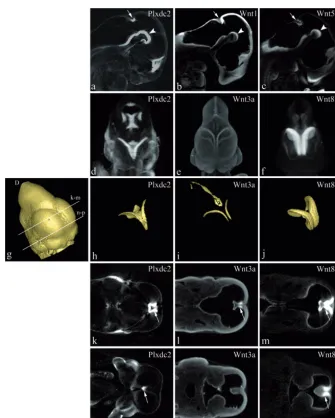
In order to more closely deWne the domains of
geo expression within brain structures, we compared its expression at E11.5 to that of Wnt1, Wnt3a, Wnt5a, and
[image:5.595.121.457.180.598.2]Wnt8b, examined and viewed with the same OPT method-ology (Fig. 4). Comparison with Wnt1 and Wnt5a conWrms co-expression with Plxdc2-geo at the MHB and in the
Xoor of the midbrain (Fig. 4a, b, and c), but unlike Wnt1, Plxdc2-geo is not detected in the dorsal midline of the midbrain. In the Xoorplate, Plxdc2-geo expression is more extensive rostrocaudally than either of the Wnt genes and is not restricted to the ventricular aspect. Wnt5a expression also shows striking similarities with that of Plxdc2 in the limb (Yamaguchi et al., 1999) and in the glial wedge (see below and Keeble et al., 2006).
The extent of the expression domain in the medial cere-bral cortex was more closely deWned by comparison with domains of Wnt3a, Wnt8b (Fig. 4d–p) and Wnt5a expres-sion (data not shown). Fig. 4d–f show dorsal external views of the midbrain–forebrain regions of 3D reconstructed (volume rendered) specimens. Fig. 4h–j represents the over-all shape and size of the domains by showing them in isola-tion at a constant viewing angle, whereas Fig. 4k–p shows comparable virtual sections. As previously described (e.g.,
Grove et al., 1998), Wnt3a is expressed precisely within the
cortical hem (Fig. 4i and l) as well as the dorsal midline of the more caudal brain. Wnt8b is expressed in a broader domain encompassing the cortical hem but extending also into the choroid plexus medially, and more laterally along the walls of the telencephalic vesicles including the region of the prospective hippocampus (Fig. 4j and m). The domain of Plxdc2-geo expression is less broad than Wnt8b
but also includes the choroid plexus and the prospective hippocampus (Fig. 4h and k). Rostrocaudally, the midline expression of Plxdc2-geo is more extensive than either Wnt gene; as mentioned earlier, it extends caudally into the dorsal midline of the diencephalon and Fig. 4n–p shows that rostrally, Plxdc2-geo is expressed at a level where
Wnt3a is no longer expressed and Wnt8b is localised more laterally.
1.4. Plxdc2-geo expression in the E15.5 brain
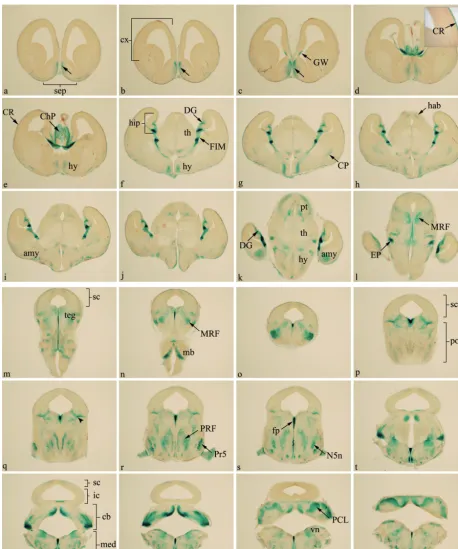
Expression of Plxdc2-geo in the E15.5 brain was inves-tigated by X-gal staining of 100m sections from heterozy-gous Plxdc2 gene trap mice (Fig. 5). An intricate pattern of Plxdc2-geo expression was observed in a number of nuclei throughout the brain as well as in the neuroepithelium. In the forebrain, regions of cellular Plxdc2-geo expression include the glial wedge and the developing medial septum
(Fig. 5a–c). Expression is evident in the choroid plexus
(derived from the CPe) and derivatives of the cortical hem, namely the Wmbria and the dentate gyrus of the developing hippocampus as well as Cajal–Retzius cells in the marginal zone of the developing cortex (Fig. 5d–f). Plxdc2-geo expression is also observed in discrete nuclei within the hypothalamus, habenula, pretectum and amygdala
(Fig. 5f–k). In more caudal regions, Plxdc2-geo is also
expressed within the tegmentum and pons in the midbrain reticular formation and pontine reticular formation
(Fig. 5n–s). Plxdc2-geo expression was notable at the
bor-der region of the superior colliculus and the pons (Fig. 5q) and within the principal sensory trigeminal nucleus and tri-geminal motor nucleus (Fig. 5r and s). In the hindbrain,
extensive Plxdc2-geo expression was evident in the X oor-plate and in distinct compartments of the developing Pur-kinje cell layer of the cerebellum as well as many nuclei of the medulla oblongata, including the vestibular nuclei (Fig. 5t–x). (Expression in the developing Purkinje cell layer has also been described at P0 (Leighton et al., 2001)).
Staining in several areas including the glial wedge and
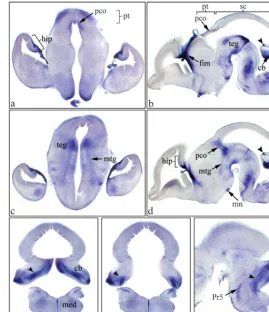
Wmbria, for example, indicates that Plxdc2-geo expression is, at least in part, glial in nature. Neuronal Plxdc2 expres-sion was also conWrmed by PLAP staining of several axon tracts in the E15.5 brain (Fig. 6). PLAP staining was evident in axons of the posterior commissure which crosses the midline at the dorsal midbrain, connecting right and left pretectal areas (Fig. 6a–d). PLAP expression also occurred in axons of the mammillotegmental tract which project from the mammillary nuclei to the tegmentum (Fig. 6c–d). In the hindbrain, strong PLAP staining was evident in the cerebellar peduncle connecting the cerebellum and the medulla oblongata (Fig. 6e–g). The sagittal view also high-lights the uneven expression in the developing cerebellum with much greater expression in the caudal half at this mid-sagittal level (Fig. 6b and d). Very discrete expression at the border between the inferior colliculus and developing cere-bellum is also evident in this view (Fig. 6b and d). Wide-spread vascular Plxdc2 expression in the brain is also apparent by PLAP staining (Fig. 6).
1.5. Plxdc2-PLAP expression in the eye and ear at E15.5
PLAP staining of 100m sections through the head illus-trated continued Plxdc2 expression in the eye and ear at E15.5 (Fig. 7). PLAP staining within the eye was restricted to the proliferating region of the inner neuroblastic layer and the cuboidal epithelium of the lens (Fig. 7a). Sagittal sections through the ear illustrated Plxdc2 expression in the cochlea. PLAP staining was evident in the ventral epithe-lium and a sharp border existed between ventral and dorsal sides (Fig. 7b and c). Neuronal Plxdc2 expression was also illustrated by axonal staining within the trigeminal gan-glion (Fig. 7c).
1.6. Plxdc1 expression
Plxdc1/TEM7 shows signiWcant homology to Plxdc2, sharing the same domain architecture and exhibiting 53% amino acid identity between the two proteins in the mouse. An investigation of Plxdc1 expression in the brain was facilitated by the creation of a Plxdc1 “targeted trap” mouse line (Friedel et al., 2005). In this case, the PLAP secretory trap vector was fused to gene-speciWc homology arms, thus utilizing homologous recombination to insert the vector into the intron between exons 11 and 12 of the
Plxdc1 gene.
[image:7.595.61.520.44.593.2]
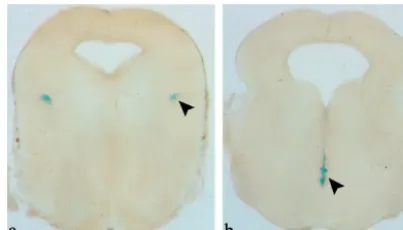
more intense staining but appear phenotypically normal). Plxdc1-geo expression in the brain diVered greatly to that of Plxdc2-geo. At E16.5, Plxdc1-geo expression was restricted to a single paired midbrain nucleus lying ventral to the tectum (Fig. 8a), in a location consistent with the pedunculopontine tegmental nucleus.
Neuroepi-thelial expression was also evident at the fourth ventricle
(Fig. 8b). More widespread expression of Plxdc1-geo was
[image:8.595.148.418.44.356.2]observed in neonatal and postnatal brain sections (data not shown), in accord with in situ hybridisation and immunohistochemistry results in the rat (Lee et al., 2005, 2006). SpeciWc expression in the Purkinje cells and para-Fig. 6. Neuronal Plxdc2 (PLAP) expression in the E15.5 brain. a and c, coronal sections through the E15.5 brain illustrating PLAP staining in axons of the posterior commissure and the mammillotegmental tract. b and d, corresponding sagittal sections illustrating the trajectory of these Wbre tracts. e and f, coronal sections showing PLAP staining in axons of the cerebellar peduncle projecting between the cerebellum and the medulla oblongata. g, corresponding sagittal section illustrating the trajectory of this tract. b and d: arrowhead, border of inferior colliculus and cerebellum. e–g: arrowhead, cerebellar peduncle. cb, cere-bellum; Wm, Wmbria; hip, hippocampus; ic, inferior colliculus; mn, mammillary nucleus; mtg, mammillotegmental tract; pco, posterior commissure; Pr5, princi-pal sensory trigeminal nucleus; pt, pretectum; sc, superior colliculus; teg, tegmentum. Scale bar: a and c 1.5 mm; b and d–f 1.75 mm; g 1.3 mm.
[image:8.595.152.414.428.546.2]
ventricular nucleus of the hypothalamus at these later stages, for example, (data not shown) matches observa-tions in the rat precisely (Lee et al., 2005), conWrming the speciWcity and sensitivity of the reporter genes. At E10.5, whole mount X-gal staining of homozygous gene trap mice illustrated no Plxdc1-geo expression.
2. Experimental procedures
2.1. Characterisation of a PLAP secretory trap insertion in Plxdc2
A candidate primer approach was employed in order to characterise the site of vector insertion. A series of forward primers was designed from the wildtype Plxdc2 genomic sequence at 1.5 kb intervals and reverse prim-ers were designed to the vector sequence. Genomic DNA from heterozy-gous Plxdc2 mice was used as template for the PCR reaction. A 2.2 kb band was ampliWed using one primer combination and sequenced in order to isolate the exact site of insertion.
2.2. Genotyping of mice
Genotyping of gene trap mice was carried out by PCR. Forward and reverse primers were designed to wildtype genomic sequence close to the site of vector insertion. An additional reverse primer was designed to the vector sequence in order to amplify mutated fragments. Genomic DNA was extracted from small tail sections by digestion in Boston BuVer (50 mM Tris pH 8.0, 50 mM KCl, 2.5 mM EDTA, 0.45% NP40, 0.45% Tween 20, Proteinase K) overnight at 56 °C and used as template for the PCR. The primer sequences were as follows: Plxdc2; forward primer to wildtype sequence 5⬘-GAGAGCTACTTAGGCTGATTCTGT-3⬘, reverse primer to wildtype sequence 5⬘-CCTCGACAGTAATTCAACCT GCTG-3⬘, reverse primer to vector sequence 5⬘-GCTACCGGCTAA AACTTGAGACCT-3⬘. Plxdc1; forward primer to wildtype sequence 5⬘ -TCTCTCTACATAGCTCTGGCTGTC-3⬘, reverse primer to wildtype sequence 5⬘-AGTCAGGTCTGAGGTCAGCTGTCT-3⬘, reverse primer to vector sequence 5⬘-ACTTCCGGAGCGGATCTCAAACTC-3⬘.
2.3. Visualisation of reporter genes
Whole embryos were Wxed in 0.2% glutaraldehyde (0.1 M phosphate buVer, 2 mM MgCl2, 5 mM EGTA) for 30 min. Following Wxation, three washes were carried out at room temperature in washing buVer (0.1 M phosphate buVer, 2 mM MgCl2, 0.02% NP40, 0.1% sodium deoxycho-late). Embryos were transferred to X-gal staining solution (1 mg ml¡1 X-gal, 5 mM K4Fe(CN)6, 5 mM K3Fe(CN)6 in embryo washing buVer) and incubated at 37 °C until colour developed. Stained embryos were post-Wxed in 4% paraformaldehyde (PFA)/phosphate buVered saline (PBS) at 4 °C overnight in order to preserve staining patterns and stored in PBS.
Brains for X-gal staining were Wxed in 1% glutaraldehyde for 5 h. Sec-tions (100m) were collected using a vibrating microtome (Leica, model VT1000S) and free Xoating sections were stained for gal activity (as pre-viously described). Following staining, sections were post-Wxed in 4% PFA/PBS, air dried onto glass slides and mounted in Aqua Polymount (Polysciences Inc.).
E15 brains and whole heads for PLAP staining were Wxed overnight in 4% PFA/PBS at 4 °C. Fixed tissues were embedded in 6% agar and 100m sections collected using a vibrating microtome. Sections were air dried onto glass slides. Following incubation in PBS for 45 min at 65 °C to inactivate endogenous phosphatases, PLAP activity was detected with AP staining buVer (0.1 mg ml¡1 5-bromo-4-chloro-3-indolyl phosphate, 1 mg ml¡1 nitroblue tetrazolium in 100 mM Tris–HCL pH 9.5, 100 mM NaCl, 5 mM MgCl2). Sections were dehydrated in increasing concentra-tions of methanol and cleared in benzyl benzoate: benzylalcohol (BB:BA, 2:1). Following rehydration, cleared sections were mounted in Aqua Polymount.
2.4. In situ hybridisation
In situ hybridisation was carried out largely according to Wilkinson (1992) with minor adjustments. Hybridisation times were extended to 2-3 days at 65 °C. Final post-hybridisation washes were in 0.2%SSC/ 0.1%CHAPS, three times for 20 min at 65 °C. Antisense probes used are represented by the following Genbank sequences: Plxdc2; nucleotides 1524–2188 on NM_026162. Wnt1; nucleotides 138-2345 on BC005449.
Wnt3a; nucleotides 2310–2676 on NM_009522. Wnt5a; nucleotides 193– 2324 on BC018425. Wnt8b; nucleotides 942–1634 on NM_011720. Sense control probes were routinely employed in each experiment. Mice strains: E10.5, C57BL/6JOlaHsd (Harlan); E11.5, CD1.
2.5. Optical projection tomography
In situ hybridised or X-gal stained embryos were rinsed brieXy in water, and embedded in 1% low melting point agarose. Once set, the block of agarose was cut in the desired orientation and aYxed to a metal mount. Specimens were then dehydrated overnight in 100% methanol and cleared in BB:BA (2:1). OPT was carried out as described (Sharpe et al., 2002) on a prototype scanner built at the MRC Human Genetics Unit Edinburgh (now commercially available from BioOptonics). Soft-ware for 3D reconstruction, volume rendering and analysis was kindly provided by James Sharpe and the Edinburgh Mouse Atlas Project (MRC Human Genetics Unit).
Acknowledgements
[image:9.595.161.363.48.163.2]
by Science Foundation Ireland grants to K.J.M (01/F.1/ B006) and to P.M (02/IN1/B267).
Appendix A. Supplementary data
Supplementary data associated with this article can be found, in the online version, at doi:10.1016/j.mod-gep.2006.12.002.
References
Basile, J.R., Castilho, R.M., Williams, V.P., Gutkind, J.S., 2006. Semaph-orin 4D provides a link between axon guidance processes and tumor-induced angiogenesis. Proc. Natl. Acad. Sci. USA 103, 9017– 9022.
Bork, P., Doerks, T., Springer, T.A., Snel, B., 1999. Domains in plexins: links to integrins and transcription factors. Trends Biochem. Sci. 24, 261–263.
Bunch, T.A., Helsten, T.L., Kendall, T.L., Shirahatti, N., Mahadevan, D., Shattil, S.J., Brower, D.L., 2006. Amino acid changes in Drosophila alphaPS2betaPS integrins that aVect ligand aYnity. J. Biol. Chem. 281, 5050–5057.
Carmeliet, P., Tessier-Lavigne, M., 2005. Common mechanisms of nerve and blood vessel wiring. Nature 436, 193–200.
Carson-Walter, E.B., Watkins, D.N., Nanda, A., Vogelstein, B., Kinzler, K.W., St Croix, B., 2001. Cell surface tumor endothelial markers are conserved in mice and humans. Cancer Res. 61, 6649–6655.
Charron, F., Tessier-Lavigne, M., 2005. Novel brain wiring functions for classical morphogens: a role as graded positional cues in axon guid-ance. Development 132, 2251–2262.
Dickson, B.J., 2002. Molecular mechanisms of axon guidance. Science 298, 1959–1964.
Friedel, R.H., Plump, A., Lu, X., Spilker, K., Jolicoeur, C., Wong, K., Venk-atesh, T.R., Yaron, A., Hynes, M., Chen, B., Okada, A., McConnell, S.K., Rayburn, H., Tessier-Lavigne, M., 2005. Gene targeting using a promoterless gene trap vector (“targeted trapping”) is an eYcient method to mutate a large fraction of genes. Proc. Natl. Acad. Sci. USA 102, 13188–13193.
Furuta, Y., Piston, D.W., Hogan, B.L., 1997. Bone morphogenetic proteins (BMPs) as regulators of dorsal forebrain development. Development 124, 2203–2212.
Grove, E.A., Tole, S., Limon, J., Yip, L., Ragsdale, C.W., 1998. The hem of the embryonic cerebral cortex is deWned by the expression of multiple Wnt genes and is compromised in Gli3-deWcient mice. Development 125, 2315–2325.
Keeble, T.R., Halford, M.M., Seaman, C., Kee, N., Macheda, M., Ander-son, R.B., Stacker, S.A., Cooper, H.M., 2006. The Wnt receptor Ryk is required for Wnt5a-mediated axon guidance on the contralateral side of the corpus callosum. J. Neurosci. 26, 5840–5848.
Lee, H.K., Bae, H.R., Park, H.K., Seo, I.A., Lee, E.Y., Suh, D.J., Park, H.T., 2005. Cloning, characterization and neuronal expression proWles of tumor endothelial marker 7 in the rat brain. Brain Res. Mol. Brain Res. 136, 189–198.
Lee, H.K., Kang, D.S., Seo, I.A., Choi, E.J., Park, H.T., Park, J.I., 2006. Expression of tumor endothelial marker 7 mRNA and protein in the dorsal root ganglion neurons of the rat. Neurosci. Lett. 402, 71–75. Leighton, P.A., Mitchell, K.J., Goodrich, L.V., Lu, X., Pinson, K., Scherz, P.,
Skarnes, W.C., Tessier-Lavigne, M., 2001. DeWning brain wiring patterns and mechanisms through gene trapping in mice. Nature 410, 174–179. Mould, A.P., Travis, M.A., Barton, S.J., Hamilton, J.A., Askari, J.A., Craig,
S.E., Macdonald, P.R., Kammerer, R.A., Buckley, P.A., Humphries, M.J., 2005. Evidence that monoclonal antibodies directed against the integrin beta subunit plexin/semaphorin/integrin domain stimulate function by inducing receptor extension. J. Biol. Chem. 280, 4238–4246. Panhuysen, M., Vogt Weisenhorn, D.M., Blanquet, V., Brodski, C., Heinz-mann, U., Beisker, W., Wurst, W., 2004. EVects of Wnt1 signaling on proliferation in the developing mid-/hindbrain region. Mol. Cell Neu-rosci. 26, 101–111.
Raible, F., Brand, M., 2004. Divide et Impera–the midbrain-hindbrain boundary and its organizer. Trends Neurosci. 27, 727–734.
Sharpe, J., Ahlgren, U., Perry, P., Hill, B., Ross, A., Hecksher-Sorensen, J., Baldock, R., Davidson, D., 2002. Optical projection tomography as a tool for 3D microscopy and gene expression studies. Science 296, 541–545. Shimogori, T., Banuchi, V., Ng, H.Y., Strauss, J.B., Grove, E.A., 2004.
Embryonic signaling centers expressing BMP, WNT and FGF proteins interact to pattern the cerebral cortex. Development 131, 5639–5647. St Croix, B., Rago, C., Velculescu, V., Traverso, G., Romans, K.E.,
Mont-gomery, E., Lal, A., Riggins, G.J., Lengauer, C., Vogelstein, B., Kinzler, K.W., 2000. Genes expressed in human tumor endothelium. Science 289, 1197–1202.
Tole, S., Ragsdale, C.W., Grove, E.A., 2000. Dorsoventral patterning of the telencephalon is disrupted in the mouse mutant extra-toes(J). Dev. Biol. 217, 254–265.
Wilkinson, D.G., 1992. In situ hybridisation: A practical approach. IRL Press, Oxford.
Yamaguchi, T.P., Bradley, A., McMahon, A.P., Jones, S., 1999. A Wnt5a pathway underlies outgrowth of multiple structures in the vertebrate embryo. Development 126 (6), 1211–1223.
Yu, T.W., Bargmann, C.I., 2001. Dynamic regulation of axon guidance. Nat. Neurosci. 4 (Suppl), 1169–1176.