39
Journal of the Statistical and Social Inquiry Society of Ireland Vol. XLVII
The Expected and Unexpected Consequences of ESA 2010
- an Irish perspective
Michael Connolly1 Central Statistics Office
(read before the Society, 30 November 2017)
Abstract: On 14 July 2016 Ireland reported an extraordinary increase in GDP of 26.3% for 2015. This paper explores the rationale for this result in the context of the new statistical standards of SNA 2008 (ESA 2010) and BPM6 that had been recently introduced. The primary focus is on the recording of research and development activities now inside the production boundary and included for the first time in the Macro Economic accounts together with the related contract manufacturing activities. There is particular reference to the impact of economic globalisation, together with initiatives linked to application of the Base Erosion and Profit Shifting (BEPS) recommendations of OECD. The large corporate relocations in 2015 together with transactions in intangible assets and the associated depreciation are explained and their impact on the economic accounts is illustrated. Some unintended consequences of the application of the new statistical standards is discussed and an alternate approach to the recording in particular of cross border transactions in Intellectual Property products is outlined.
Keywords: Globalization, System of National Accounts, Research and Development, Depreciation, Balance of Payments, Contract Manufacturing
JELs: F62, E01, K34
1. INTRODUCTION
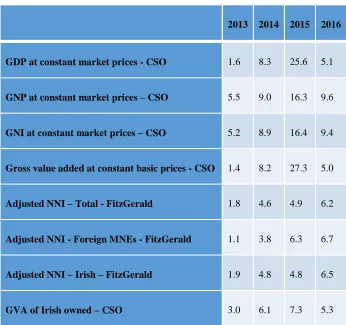
On 12 July 2016 CSO reported 2015 annual national accounts estimates for economic growth in Ireland of 26.3 percent to a startled press conference in Government Buildings, Dublin. At the press conference, CSO outlined that the principal factor was economic globalisation in the form of international corporate relocations with very large additions to Ireland’s stock of intangible assets and greatly increased contract manufacturing activities abroad associated with these relocated entities. To arrive at a more informed understanding of the events that led to this increase in economic growth for Ireland, it is necessary to step back to July 2013.
In July 2013 CSO implemented the new economic standards of the European System of Accounts (ESA 2010) and the IMF Balance of Payments Manual 6th edition (BPM6). The new standards were the outcome of extensive international discussion and debate concerning a total of forty four issues and also resulted in twenty nine clarifications covering a wide variety of topics2. These discussions took place during the update of the United Nations System of National Accounts (SNA) that resulted in SNA 2008 which preceded ESA 2010. ESA 2010 is SNA 2008 translated into a legal instrument that determines how EU member states must compile their national accounts, while the SNA is a series of international recommendations that apply to all member states of the United Nations. In addition there were issues common to both SNA and BPM6 discussed in the BPM consultative framework.
What is particularly pertinent to this paper is that these new standards introduced both conceptual and practical recommendations to address the measurement challenges to the SNA accounting framework posed by economic globalisation. Indeed, following the introduction of the new standards, a need to develop an even greater level of understanding around economic globalisation activities was identified, despite the additional guidance and recommendations already included in the new SNA (ESA) and BPM manuals.
The UNECE/OECD/Eurostat Guide to The Impact of Globalization on National Accounts (2011) and the subsequent UNECE Guide to Measuring Global Production (2015) were therefore developed to provide additional guidance on both a conceptual and practical level. The latter Guide is particularly relevant as it sets out to address the impact of the new standards on the global production and distribution chains of multinational enterprises (MNEs). The key issues addressed in these Globalisation Guides are, in turn, central to explaining the 2015 National Accounts results reported for Ireland and are outlined in Table 1 below.
40
[image:2.596.82.524.144.617.2]The key globalisation issues discussed in the development of SNA 2008 and BPM6 standards are identified below. They apply to both conceptual items and practical approaches to compilation of the National Accounts. Due to Ireland’s dependency on MNEs it is no coincidence that the most significant items for Ireland in applying the new standards were also these main recommendations covering the topic of economic globalisation.
Table 1 Economic Globalisation - Key Issues and Recommendations from SNA 2008
No. Issue / clarification Brief summary of issue References
9 Research and Development Q. Should research and development
be recognised as capital formation, leading to the creation of Intellectual Property Products? A. Yes; and so ESA 2010 recognises R&D as capital formation, which is a change from ESA 95.
ESA 2010 3.82 – 3.83; 3.127
(7)
Manua3l 1.1 – 1.14
10 Patented entities Q. Redundant due to recognition of
R&D as capital formation leading to Intellectual Property Products. A. So patented entities omitted from ESA 2010 asset categories, replaced by intellectual property products.
-
38a Change of economic
ownership (as a term)
Q. Is more description needed to clarify what is meant by economic (as opposed to legal) ownership?
A: Yes
ESA 2010 1.90
39b Predominant centre of
economic interest (as a term)
Q. Should this term be adopted to help in the determination of the residence of households, where there are several candidates to be the country of “residence”. A. Yes, but additional material needed to ensure no
unnecessary change to business units.
ESA 2010 2.07
40 Goods sent abroad for
processing
Q. Should there be a change to “no imputation of a change in ownership”, and a processing service observed in the national accounts? A. Yes, change to “no imputation”.
ESA 2010 3.166d
Manual 20.1 – 20.12
41 Merchanting (in international
trade)
In ESA 95, recorded as a service, with no trade in goods. A change in recording is observed in BPM 6 and in the national accounts. The
merchanting margin that was shown as services is now shown as the margin on goods, classed as export of goods, and recording the imports as negative exports of goods.
ESA 2010 3.164d
Manual 21.1 – 21.7
In Table 1 we see the main globalisation issues together with some accompanying observations. Nevertheless it may not be entirely clear to readers why Research and Development is included in this table. In fact the cross border nature of R&D activities in Ireland mean that this issue is particularly pertinent when considering the economic effects of globalisation on the Irish economy.
Research & Development
R&D and Patented Entities are now included under the single R&D heading in SNA 2008 (ESA 2010) although in previous versions of the standards they were addressed separately. In SNA ‘93 (ESA ‘95) R&D related only to
41
actual Research and Development activities and was recorded as intermediate consumption in the SNA i.e. treated as an input to production activities. However, in the previous edition of Balance of Payments (BPM5) and SNA ‘93 (ESA ‘95) outright purchases of R&D intellectual products i.e. patents or licences were recorded in the Capital Account under acquisition/disposal of non-financial non produced assets4. In this case, although the cross border transaction was recorded in the Balance of Payments framework and SNA capital account, the transaction was not included in capital formation.
R&D had been the subject of intensive debate and discussion in the lead in to the introduction of the previous standards, SNA ‘93 (ESA ‘95) and BPM5 in 1993 and indeed in the earlier edition SNA ‘68 in 1968, but in each of these editions a comprehensive treatment of R&D in the accounts was not resolved or agreed.
In addition, R&D related royalties and licenses were initially recorded as property income (primary income) in SNA 1968 and subsequently as a service, i.e. included in GDP, in SNA ’93 (ESA’95) and maintained in SNA 2008 (ESA 2010).
Change in Economic Ownership and Economic Residence
The remaining issues detailed in the Table 1 relate to two key conceptual matters that were central to explaining the increase in Ireland’s GDP in 2015. Firstly Issue 38a Change in economic ownership (as a term) and secondly Issue 39b covering Predominant centre of economic interest.
The clarifications associated with these concepts in the accounts gave additional guidance on how to determine whether an entity is in fact resident or not in a given economy and the basis for recording transactions entered into by a resident entity, i.e. where a change in economic ownership occurs.
Although the principle of recording transactions in the corporate or market sector5 where a change in economic ownership occurs had been established in previous editions of SNA6 and BPM, the aim was to introduce greater clarity both in SNA 2008 and BPM6. This principle is one of the key concepts underlying the compilation of the economic accounts.
Processing and Merchanting
The final two items in Table 1 relate to Goods sent abroad for processing and to transactions related to Merchanting. In these two cases the revised treatment accorded more closely with recognising the change of ownership when recording these transactions.
In the case of merchanting7 a good is bought in one country and then resold in another country without crossing the border of the merchant. The standards changed the way of reporting these transactions. In SNA ‘93 they were recorded on a net basis under the services heading; the margin on the buy/sell was recorded as a business service. In this case a “no change of economic ownership” was imputed. In SNA 2008 these buy and sell transactions were recorded on a gross basis under the goods heading; thus recognising the change in economic ownership that occurs when the merchant buys the good and again when it is sold, with implications for inventories. However, the two transactions are recorded as negative and positive exports of goods. No overall change to GDP results from this change in recording.
Goods sent abroad for processing8 covers many of the transactions associated with contract manufacturing. The entire model for recording these types of transactions where elements of the production process are outsourced has changed since SNA ‘93 and BPM5 were introduced. The standard case was where goods went abroad for further processing and then returned to the country of the sender. The treatment was to impute a “change in economic ownership” and recognise the export and import associated with the movement of the good before and after processing abroad. The net of these two transactions accords with the value of the processing service provided abroad.
In reality no change in ownership takes place because the good remains in the ownership of the principal that sent it abroad. In SNA 2008 and BPM6 it is recognised that no change in economic ownership takes place and the transaction with the processer abroad is recorded as the import of a manufacturing service by the principal.
4 See IMF Balance of Payments 5th Manual (1993) par 311
5 Leaving aside taxes and subsidies and other “something for nothing (or vice versa) type transactions”
6 SNA ’93 par 14.55 re when change in economic ownership occurs or not.. par4.24 re : centre of economic ownership 7 For a more detailed discussion see Eurostat/OECD/UNECE (2011) Chapter x
42
Many of the transactions that take place in global value chains9 (GVCs) involve outsourcing and procurement between affiliates and third parties abroad. These GVCs span continents as specialization of stages in the production and distribution cycle are clustered in particular countries or zones. Although no change is GDP results from this change in recording it is possible that the increased clarity around the nature of these transactions results in additions or reductions in activity being recorded in a country’s national accounts and balance of payments.
Updating the Standards
The last three updates of the standards took place in 1968, 1993, and 2008 (2010). These standards apply to practically all the countries in the world irrespective of their level of economic development and the application can be uneven across countries in March 2016, 62 countries had implemented SNA 2008 (partially or fully) and a further 98 had implemented SNA ‘9310.
Oversight and validation by Eurostat, ECB and IMF guarantees this level of compliance, for example through the Own Resources11 (GNI) verification process carried out by Eurostat. It requires documentation of all the processes followed in compiling a member state’s National Accounts and Gross National Income (GNI) in particular. The GNI verification process is carried out in conjunction with other EU directorates, notably DG Budget.
In summary, the previous sections have highlighted the key changes in the statistical standards, SNA 2008 (ESA 2010) and BPM6, related to the recording of items significantly impacted by globalisation. This focus on globalisation was emphasised through the related conceptual framework of economic ownership and economic residence. This represents an essential starting point to an understanding of the drivers behind the 2015 national accounts and balance of payments annual results reported by CSO in July 2016.
Section II of this paper considers the expected consequences of applying these changes to the statistical standards and their impact on the Irish National Accounts and International Accounts (BOP &IIP).
These findings are followed in Section III by what I am terming the unexpected consequences of introducing these changes to the accounts. The changed global environment for international tax compliance, a key feature of the Base Erosion and Profit Shifting (BEPS) initiative of the OECD is also discussed in detail in Section III.
Section IV discusses the recommendations of the (Irish) Economic Statistics Review Group12 (ESRG). These ESRG recommendations were designed to address both expected and unexpected consequences of implementing the new standards.
In Section V summary conclusions are presented along with some forward looking issues for consideration in the next revision of the statistical standards, probably in the mid to late 2020s. In particular, a proposal regarding the classification of certain cross border activities covering IP is outlined.
2. IMPLEMENTATION OF ESA 2010 New Standards for R&D
Some of the questions posed in the 1993 revisions of the standards were the following:
Should all expenditure on R&D, or only some, be recorded as capital formation?
Can all the practical difficulties of deriving satisfactory estimates be overcome, for example by using expenditure data collected in accordance with the Frascati Manual13, and obtaining appropriate deflators and service lives?
9 A Global Value Chain takes in the entire life cycle of a product from conception to production, distribution, sales to customers and after sale services
10 See par 22 https://unstats.un.org/unsd/nationalaccount/aeg/2016/RM2_UNSC_Report.pdf
11 The GNI Own Resources framework uses the National Accounts of EU member states to calculate their contribution to the EU budget
12 For these reports see http://www.cso.ie/en/csolatestnews/eventsconferencesseminars/resrg/ 13 The Frascati Manual sets out the OECD recommendations for Capital Formation
43
The previous version of the standards, SNA ’93, distinguished between the three elements of R&D as mentioned above;
1. Expenditure incurred in the development of R&D assets
2. R&D related services such as royalties and licenses which related to the use of assets created by R&D activities.
3. The R&D assets themselves, i.e. intellectual property products (IPPs).
In the SNA ‘93 patented entities, as these assets were classified, were treated as non-financial, non-produced assets 14. However, payments arising from the use of R&D related intellectual property products were required by convention to be recorded as payments for services (similar to rentals from an operating lease of fixed assets such as aircraft or ships). This created an anomaly in the SNA accounting rules, which prior to SNA ‘93 required payments for the use of non-produced assets to be recorded as property income. If R&D is not treated as capital formation, in this context, the question was whether the payment for the use of patented entities should be recorded as a payment for services, i.e. royalties.
Moreover, the measurement of productivity in the SNA ‘93 (ESA ‘95) framework also highlighted shortcomings in approach to R&D and the related patented entities. There were clearly some unanswered questions, specifically how could accurate estimates for capital services and multi factor productivity be made when the IP assets are excluded from the calculations. At the same time, the exports of royalties added to GDP. Thus the result was an overstatement of all measures of productivity.
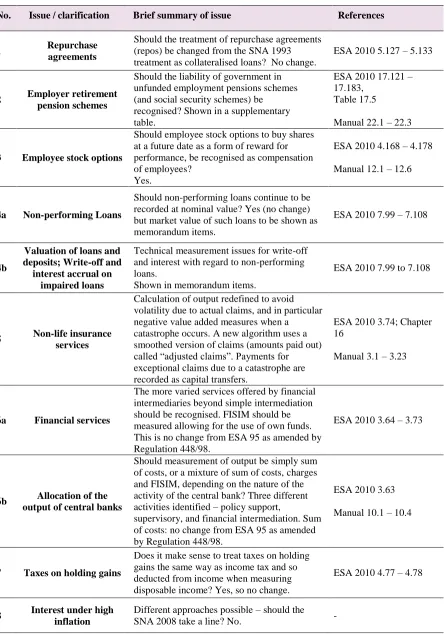
The intention of this paper is not to revisit the decisions and recommendations of SNA 2008 (ESA 2010) or BPM6. The focus is instead on the consequences, both intended and unintended, of these decisions for National Accounts and Balance of Payments compilers with a particular focus on Ireland. However there is a particular emphasis on the impact on R&D given the cross border nature of these activities in Ireland. Of all the globalisation related issues highlighted in Table 1 and indeed of all the issues detailed in Annex 1, R&D had the largest single impact on the Irish national accounts and balance of payments.
As already outlined, the treatment of R&D activities and the related patented entities created by these activities are recorded indistinguishably and capitalised in the National Accounts. Nevertheless the consequences for Ireland of the inclusion of each of these two aspects of R&D together in the latest version of SNA were very different.
Both cross border and domestic R&D activities are capitalised under Gross Fixed Capital Formation in the National Accounts. In the case of both the purchase abroad of an R&D asset (IP), and the import of R&D related services from affiliates or third parties an import of services is also recorded with the result that no overall addition to GDP occurs during the period in question15.
Regardless of whether the IP assets are developed abroad by affiliates or purchased outright, they add to GDP once they begin to be used in production activities:
in the domestic economy, or
abroad through the use of contract manufacturing arrangements, or
through the export of royalties to other non-resident affiliates.
R&D activities in Ireland mainly take the form of research programmes carried out in Universities or other public sector institutions. R&D is also carried out in the corporate sector in Ireland and through partnerships between public and private sector companies and institutions. This overall activity amounts in value to approx. €3bn16 per annum. In addition to this R&D, many multinational enterprises (MNEs) fund research and development activities carried out abroad on their behalf.
14 See SNA’93 par 10.130
15 Of course if the IP asset generates royalties for export or indeed the substitution away from imported royalties there is a resulting contribution to GDP
44
In SNA 200817 (ESA 2010) manuals R&D transactions, i.e. when a market producer purchases R&D intellectual property products or incurs expenditure on R&D activities being carried out on its behalf are explained as follows:
A market producer purchases R&D18: The purchases are reclassified from intermediate consumption (ESA ‘95) to gross fixed capital formation (ESA 2010).
The former distinction between R&D assets and expenditure on R&D in SNA ’93 (ESA’95) was replaced by a common treatment, with both being capitalised and recorded under capital formation and in the stocks of capital assets of a country. It is likely that the distinction between these two elements of R&D was no longer considered relevant to ensure a consistency of recording between in-house developed and purchased R&D. However, when the impact of cross border purchases of R&D related patents is considered these changes were very significant particularly for small, open economies engaged in activities where these intellectual property products are critical inputs to production.
Moreover, the impacts on the accounts of these changes in the standards relating to R&D were compounded by other developments in favour of greater compliance with international recommendations for corporate tax planning, specifically the OECD Base Erosion and Profit Shifting (BEPS). These initiatives were complimented by other developments in Irish tax law.
It is unlikely than those involved in framing the statistical standards could have foreseen that the introduction of the new statistical standards as they apply to Research and Development activities would coincide with these global and domestic initiatives addressing aspects of corporate tax planning by MNEs.
BEPS Recommendations
The Base Erosion and Profit Shifting (BEPS) recommendations of OECD were aimed at ensuring greater compliance with the principal that income is taxed where it is earned and received significant support, particularly from OECD member countries. Ireland 19 has strongly supported these initiatives and has introduced the necessary associated legislation. In fact, the BEPS proposals were introduced at the same time as domestic legislative changes aimed at addressing some of the same issues namely ending the so called “Double Irish”20 or Dutch Sandwich” and also eliminating stateless21 companies.
Following on from the introduction of the BEPS recommendations and the associated legal changes there has been a fairly steady stream of imports by MNEs resident in Ireland of intellectual property from foreign affiliates. The presence of IP assets on the balance sheet of an Irish entity gives more substance to the economic residence and centre of economic interest of the Irish based MNEs. This activity began in the first quarter of 2012 and is ongoing (see Figure 4 below). The deadline for the expiry of the so called “Double Irish” tax arrangement is 2019 so the recent acceleration in IP imports will continue until then unless other factors emerge to incentivise these types of transactions beyond that date.
Results for 2015
In addition to the transactions in investment and imports of IP referred to in the previous section, in 2015 there were also very significant relocations of companies, i.e. the entire balance sheets for a small number of very large entities were included in the balance sheet data for Ireland. These relocations occurred as a result of the reclassification22 of these enterprises from non-resident status to resident in Ireland status. These changes in
17 SNA 2008 par 10.103 – 10.105
18 Eurostat ( 2014) Manual on the changes between ESA ’95 and ESA 2010 Par 1.5.a.2
19 http://budget.gov.ie/Budgets/2015/Documents/Competing_Changing_World_Tax_Road_Map_final.pdf 20 The double Irish In broad terms, an Irish incorporated company will automatically be tax resident in Ireland.
The 'place of incorporation' test is subject to two exceptions: (a) the treaty exception; and, (b) the trading exception. This trading exception is central to what is now commonly referred to as the 'double Irish' structure. By utilising the trading exception, it is possible to create a company which, although Irish incorporated, is not tax resident in Ireland and therefore generally not subject to Irish corporation tax. The company may also not be regarded as tax resident in any other jurisdiction, and this has led some commentators to describe such companies as stateless.
21 The effect of the legislation is that if such a company is managed and controlled in a treaty partner country, and that country applies a 'place of incorporation' test of residence, then the company will be Irish tax resident if it is not regarded as a tax resident of any territory.
45
classification were made in accordance with the changes in domestic legislation referred to in Section 2.2 (BEPS Recommendations). In these cases the additions to the balance sheet positions in assets and liabilities were recorded under “other changes in volume” rather than as transactions in the economic accounts in Capital Formation, imports of IP etc.
The assets were dominated by intellectual property and explain most of the increase in capital assets of €300bn in 2015 (see Figure 1 below). The additions to the stock of capital assets were offset by increased financial liabilities, which were recorded in the Irish International Investment Position (IIP). Determining the economic residency was a critical first step in the incorporation of this data in the National and International Accounts for Ireland.
Determining Economic Residency
This determination was led by the work of CSO’s Large Cases Unit (LCU) whose main task is to ensure a consistent recording of large MNEs in the various statistical domains (National Accounts, Balance of Payments, Business and Trade). The LCU maintains close contacts with the senior management levels of the respondent MNE’s. The LCU also uses information from external sources, such as data from the taxation authority (Revenue) and the Companies Registration Office (CRO), to ensure data quality and completeness and also to ascertain tax residency.
The work of the LCU experts, which includes company profiling, ensures proper identification and treatment of such corporate relocation cases and, more generally, determines the economic ownership of the entities under consideration.
Company residence in Ireland is based upon management and control. In the Irish national accounts, tax-residency is an important criterion used in confirming the centre of predominant economic interest. Other criteria taken into account includes country of incorporation, location of staff, especially senior management, and whether the entities can draw up complete sets of accounts and balance sheets and have autonomy of decision in economic matters. There are instances where companies incorporated in Ireland are tax-resident elsewhere and have no employment in Ireland. There are also cases where companies registered abroad are tax-resident in Ireland and have substantial Irish employment. As outlined above, company tax-residence in Ireland is based upon management and control being exercised within the country. When a company is tax resident in Ireland, this is a significant factor in determining residence in the sense of ESA 2010. However, the overall assessment of residence by CSO also takes into account information and evidence obtained from company meetings regarding management and control by the entities in question of their activities.
In the case of the relocated entities in question, CSO obtained sufficient evidence that the management and control of global production chains including the use of R&D assets (blueprints etc.) is exercised in Ireland.
Crucially, these entities have associated companies that have very significant employment and are engaged in Global Production and Value Chain management in Ireland that entail the use of the relocated assets.
Results for 2015
The presentation in the Non-Financial and Financial Institutional Sector Accounts for 2015 also gives a comprehensive overview of the overall impact of these relocations both capital and financial on the Irish economy23.
Associated with the corporate relocations were increases in contract manufacturing activity24. In these cases Ireland was now the economic principal for substantial additional production abroad where it had engaged contract manufacturers. These arrangements are accounted for in line with the clarifications and changes in the standards as outlined in Table 1, particularly in relation to the measurement of exports and imports on a “change of economic ownership” basis and also how value added should be attributed in these scenarios25.
23 See CSO Institutional Sector Accounts 2015 (annual)
http://www.cso.ie/en/releasesandpublications/ep/p-isanff/isanff2015/commentary/ 24 See Stapel-Weber & Verrinder (2016) for details of a framework for these events
46
Figure 1 - Stock of Capital Assets 2011 - 2015
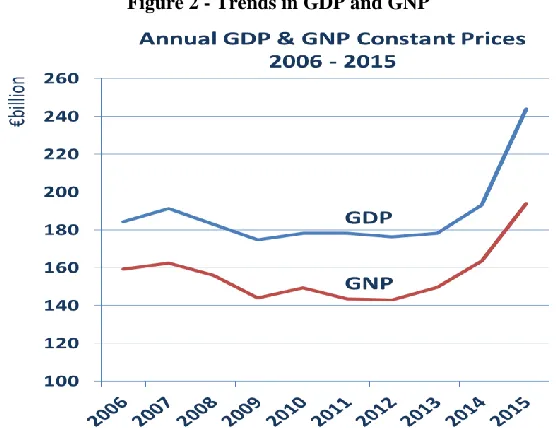
When the net effect of sales of goods produced abroad under contract was added to Ireland’s trade exports, the balance of trade in goods and services in the national accounts doubled from €35bn to €70bn between 2014 and 2015, driving a level shift in GDP (see Figure 2 below).
Figure 2 - Trends in GDP and GNP
[image:8.596.159.437.399.613.2]47
Figure 3a - Contract Manufacturing in Ireland where IP is located abroad
However, once the intellectual property was located in Ireland, these offsetting royalty charges did not occur, and consequently contract manufacturing results in a greater addition to Ireland’s GDP due to the value added generated by these activities. This is clearly seen in the Irish results for 2015. This scenario is illustrated in Figure 3b below.
[image:9.596.133.472.412.762.2]48
[image:10.596.69.536.214.295.2]In summary, the changes in the statistical standards together with the changed legislative and international oversight on how MNEs are structured and where they earn their profits, has had major implications for Ireland. We have observed a change in the statistical recording of R&D activities and assets, coupled with an international policy initiative (BEPS) aimed at bringing IP assets closer to where the R&D is carried out or alternatively closer to where the production is taking place. This is aimed at reducing the potential for income to be earned at a different location from where production is taking place. In Ireland these collective changes have resulted in a changed recording of R&D in the National and International Accounts which has been compounded by a series of very significant transactions in R&D, either through relocations or inter affiliate purchases of R&D related IP products. The balance sheet for R&D related products in Ireland has consequently increased hugely.
Table 2 Transactions in R&D Cross Border v’s Capital Investment
2012 2013 2014 2015
Capital Formation - R&D 9,853 7,942 9,579 21,342
Of which :
Current Account Net Imports R&D 7,240 4,944 6,427 17,943
Domestic R&D 2,613 2,998 3,152 3,399
[image:10.596.77.518.383.658.2]Table 2 illustrates the extent of domestic investment in R&D and how this compares with cross border R&D activity, largely involving MNEs. The balance of activity clearly lies with the MNEs. However, although the changes due to the introduction of SNA 2008 (ESA 2010) are significant and form the major explanatory factor in the rise in GDP for 2012 - 2014, it is only when we get to 2015 that really material changes in investment occur. This is before taking account of the balance sheet impact of the corporate relocations.
Figure 4. Imports of Business services: Research and development, €m
These impacts could be described as the intended or expected consequences of the changes in the standards, albeit amplified or compounded by the changes in tax legislation and BEPS international recommendations.
1,436 3,585
1,367 1,618
1,256 1,353 1,658
1,791 1,960
2,045 2,331 2,368 3,711
5,228 6,002
4,760
2,979 9,455
2,881
49
3. UNINTENDED CONSEQUENCES OF CHANGES Impact of Depreciation26 (Consumption of Fixed Capital)
[image:11.596.73.524.201.274.2]As a result of the corporate relocations discussed in the previous section, the size of the capital stock of Ireland increased dramatically (see Fig 1 above). These additional assets resulted in a significantly larger depreciation charge for 2015 compared to 2014, see Table 3 below. In fact depreciation doubled, increasing from €31bn in 2014 to €62bn in 2015. This increase is largely explained by the additions to the capital stock of Ireland due to corporate relocations and the resulting increase in the depreciation charge on these capital assets.
Table 3 Analysis of Impact of Relocations on GDP and GNI –current prices
Year GDP Depreciation Net Factor Flows GNI NNI
2014 193,160 30,891 -29,715 161,759 130,868
2015 255,815 61,558 -53,173 200,762 139,204
Change 32.4% 24.1% 6.4%
The impact (see Table 3) of increased depreciation on the economic aggregates published in 2015 can be clearly seen by looking at the increases in GDP of +32.4%27 and GNI of 24.1% whereas NNI (an aggregate that excludes depreciation) reported an increase of only 6.4% in 2015.
As previously discussed, the impact of the cross border movements of IP arising either from the 2015 corporate relocations or from transactions in IP results in a zero sum - the increases in capital formation are directly offset by the increased imports. Similarly increased capital assets due to relocations are offset by increased financial liabilities. Nevertheless the scale of the contribution of depreciation to GNP28 and GNI and its impact on the Net Factor Flows is particularly large.
It might have reasonably been considered that this would be the extent of any activity generated by the new IP assets whether relocated or purchased from affiliates abroad. Of course once the assets became active they substitute for existing royalty imports or add to royalty exports and ultimately add to GDP (see Figures 3a and 3b).
This analysis of Expenditure GDP29 is the ideal prism through which these corporate events can be viewed where changes in investment and changes in exports and imports of goods and services can be observed. However, Income GDP30 is also very informative. Looking at the impact of additional IP on the income side particularly where cross border IP is being considered means that two separate but definitely linked sets of calculations around Gross Operating Surplus and what is termed Primary income in the Balance of Payments, need to be examined. Primary income is the main contributor to Net Factor Incomes (NFI) from abroad, the key explanatory variable in the transition from GDP to GNP (GNI).
Income GDP - Operating Surplus v’s Net Factor Income
In the National Accounts Gross Operating Surplus is the portion of income derived from production activities by incorporated enterprises31 that is earned by capital, as a factor of production. It differs from profits reported in company accounts for a variety of reasons however, the main differences occur because it excludes the effects of market price changes, it also excludes interest payments and receipts but includes an estimate for financial intermediation service charges. It is termed “Gross” because it makes no allowance for depreciation, in other words in the calculation of Gross Operating Surplus, company depreciation charges are added back. Depreciation
26 Depreciation in the SNA is termed the consumption of fixed capital see SNA 2008 par 6.240 27 In current prices
28 In recent editions of both ESA and SNA, GNI has replaced GNP. GNI is GNP adjusted for EU taxes and subsidies see http://www.cso.ie/en/releasesandpublications/er/nie/niear2016/ Table 4 & 6
29 Personal and Government Consumption of goods and services, Capital formation and net exports C+I+G+(X-M) = GDP 30 Operating surplus, mixed income, compensation of employees, depreciation plus taxes less subsidies on products and production. GOS+GMI+COE+T-S =GDP
50
or consumption of fixed capital (CFC) as it is termed in National Accounts is then calculated based on the perpetual inventory method (PIM). CFC is then subtracted from the Gross Operating Surplus calculation to give Net Operating Surplus (see Fig 5 below). Depreciation is calculated in the PIM model based on the economic lives of the assets. This differs from the accounting measure used in a company’s statutory accounts. In the case of the IP assets related to R&D, the economic life tends to be longer than the accounting life, although assets lives can vary from company to company. The asset valuation at the outset is the same32 in both approaches but the consequence of the difference in asset lives is that the depreciation from the PIM model will usually be smaller than the statutory accounting depreciation charge.
[image:12.596.97.500.237.516.2]When the calculation of Primary income for Balance of Payments is made the actual company depreciation33 is normally charged rather than the PIM based economic charge. The PIM model usually produces depreciation estimates at the level of economic activity sector (Nace) rather than company by company. Therefore the depreciation charges for all the entities engaged in the same economic activity are grouped together rather than producing company specific estimates within the PIM model.
Figure 5 - Company accounting and National Accounts Operating Surplus
Consequently there are different depreciation estimates used in the Operating Surplus PIM model based calculations used in GDP and for BOP primary income calculations which generally use the depreciation as reported by the company (see Figure 5 for an illustration of the differences). GOS is an addition to GDP of income earned in the domestic economy and the NFI attributes these same profits or income (net of depreciation) to the foreign direct investor in the transition from GDP to GNI because these earnings are not ultimately the income of Ireland but instead accrue to the country of the owner of the corporation. This is particularly relevant for MNEs that are generally wholly owned by a foreign direct investor. In these cases primary income earned is incorporated into the Net Factor Income from Abroad when the transition from GDP to GNI is presented in the national accounts. If different estimates of depreciation /CFC are used at different stages in the accounting framework there will be an over/under estimate in GNI. If these differences are significant some balancing adjustments are necessary (see footnote 32). In general, a coordinated approach to ensure this does not occur requires a focus on asset lives, asset valuation and the method of calculating depreciation, i.e. geometric or straight line.
In the case of the relocated entities in 2015, particularly given the scale of the underlying capital assets and the related depreciation charge for 2015, adjustments were necessary to avoid introducing a distortion to the economic aggregates.
32 Simplification - the asset valuation may be different at the outset. In addition the annual revaluation, geometric assumptions etc. of the asset will result in different asset valuations to apply the depreciation calculations to.
33 In recognition of the difficulties associated with these types of calculations see BPM6 Box 11.5 item b consumption of fixed capital - ….assumes depreciation is an acceptable approximation to consumption of fixed capital. Aggregate adjustments may be possible if it is not
PIM CFC
€10bn
10 20 30 40 50 60 70
Total Gross Profit from Admin and Survey Sources, €65m
Net Profit and PIM CFC, €65m
€bn
Accounting
Depreciation
Accounting
Net Profit
€50bn
NNI discrepancy
Net Operating
Surplus
51
Unanticipated Changes – Implementation of ESA 2010 (SNA2008)
This scenario is what I have termed an unanticipated consequence of the implementation of the SNA (ESA) standards as they apply to IPP from R&D activities. On account of the large scale of cross border movements, in Ireland’s case at least, there are large depreciation charges and a need to actively manage the consistency and coherence of depreciation charges between National Accounts and Balance of Payments.
If we are to consider the anticipated changes and the unanticipated changes of implementing SNA 2008 (ESA 2010) and BPM6 the recording of R&D in the macroeconomic accounts is the clear front runner in terms of the impact on the economic accounts. There is in reality a two stage impact. Firstly the impact of the R&D related changes in SNA 2008 observed at the time of the introduction of ESA 2010 (in June 2013) and then the subsequent IP imports and corporate relocations that have occurred following the BEPS recommendations and the related Irish legislation. In the context of the 2015 results for Ireland we could consider the following stages:
The anticipated change was an increase in GDP of 6 per cent at the time of the implementation of ESA 2010 compared to earlier estimates of GDP in 2013. Imports of R&D had already been recorded - in line with SNA’93 - therefore the additions of these R&D imports to capital formation led to an increase in GDP over the entire time series. (See Fig 5)
In 2015 Expenditure GDP an increase of 26.3% was recorded due to the additions to net exports due to the activities of the relocated companies. These exports were produced on a contract manufacturing basis with production outsourced abroad while GVC management, IP and all other aspects of the value chain management remained in Ireland. In other words, the economic owner of this additional production abroad was resident in Ireland in line with the clarifications introduced in the new standards
The main unanticipated change resulted from the corporate relocations that added the majority of the increase of €300bn to the stock of Irish capital assets in highly mobile R&D or patent products or IPP. Consequently very large increases in depreciation occurred which, when taken together with the increases in goods and services produced abroad under contract manufacturing arrangements, resulted in the increase in GDP of 26.3% in 2015 and an increase of 18.7% in GNP.
As argued previously, these relocations were probably driven by changes in the regulatory environment.. Of course had the IP assets been excluded from capital formation, in line with SNA ‘93 (ESA ‘95), the increase in GDP in 2015 would still have been very large on account of the inclusion of contract manufacturing activity, in line with the previous standards. However, as the depreciation charge would have been excluded, the knock on impact on GNP and GNI would have been significantly reduced and higher profit outflows to the foreign direct investors in these relocated entities would have been recorded.
It is possible that, when considering the revisions to the standards, all aspects might not have been given the same attention. In particular, the accounting consequences of cross border movement of these highly mobile intangible assets, particularly into small and open economies such as Ireland might not have been perceived as a very high risk item.
0
5
10
15
20
25
30
Ireland Belgium Netherlands Austria Poland Finland Sweden
[image:13.596.70.519.146.361.2]%
Figure 6: Impact of implementation of ESA 2010 in selected EU
countries
52
What seems to have occurred is that the returns earned by MNEs from intellectual property or research and development assets that were previously sheltered from taxation through the Double Irish or Dutch Sandwich, in the light of the changed regulatory environment, are now sheltered from taxation by substantial depreciation being charged against the returns earned.
For economic statisticians, a further unanticipated consequence of these changes to the standards and recommendations was the level of suppression of data required to protect the confidentiality of MNEs that had supplied the data. This suppression resulted in less detailed data being available to explain the developments in key economic indicators in the National Accounts SNA framework such as GDP/GNP/GNI together with other important indicators in the International Accounts viz the Balance of Payments current account and the Net International Investment Position.
The Director General of CSO convened the Economic Statistics Review Group34 (ESRG) in July 2016 to address the deficit in information that could be gleaned from the existing presentations of the macro-economic accounts in 2015 following the large corporate relocations,
4. RECOMMENDATIONS OF ESRG - THE LANE REPORT Establishment of ESRG
To address the challenges of interpreting economic developments posed by the arrival of highly mobile IP products in Ireland and also the related substantial increases in contract manufacturing abroad, the ESRG began its work in August 2016. The focus (terms of reference) of the ESRG was to identify a suite of analyses or indicators that would provide a better understanding of the domestic components of the highly globalised Irish economy.
The members were selected due to their roles as key stakeholders in the macro economic data and information produced by CSO. A wide range of users including Central Bankers, economic policy makers, business representatives, economic journalists, Government Debt managers and other experts and commentators on the economy accepted the invitation to participate. In addition to these National representatives, the ESRG included observers from Eurostat and International Monetary Fund. Presentations were also given to the group by OECD, UNSD, KPMG and the Revenue Commissioners. When the group (see Appendix 2 for composition) came together to discuss how best to meet user needs, greater emphasis was already being placed on indicators already published by the CSO such as information on personal consumption in the National Accounts framework and data on employment and earnings. Nevertheless the discussions of the group identified areas where there was a need for additional indicators or extended analysis of existing presentations of the macro accounts.
The group met between September and November 2016 and produced a report which was submitted to the Director General of CSO. The ESRG report and CSO’s response35 were both published on 3 February 2017. The ESRG report identified a suite of analyses or indicators to provide better understanding of the domestic activity and components of Ireland’s highly globalised economy.
Although GDP and GNP continue to be important indicators for the Irish economy, the development of a new level indicator, called modified GNI (GNI*), was proposed to address the unique nature of the Irish economy. GNI* is designed to exclude the depreciation attributable to relocated capital assets and the impact of the so called re-domiciled quoted firms or corporate inversions36. This new level indicator will provide useful information for analytical and economic modelling purposes, but can also be used to better measure the sustainability of Debt in the economy; Government, Corporate or Household, as a ratio of GNI* in addition to existing GDP based ratios. The Lane Report proposed other measures to enable a greater understanding of cyclical trends in the economy where investment in highly mobile internationally leased aircraft and intellectual property is excluded. Structural perspectives were also recommended in order that MNE activity can be seen separately and distinctly from domestic activity.
34 The ESRG has also been titled the Lane Report; the Chair of the ESRG was the Governor of the Central Bank of Ireland Mr Philip Lane.
53
Delivery of these new indicators and measures by CSO will be incremental. Some were included in the annual National Income and Expenditure (NIE) results in mid-2017. Over the following years37, they will be extended in stages to the various quarterly series, where feasible. Progress will be kept under review and feedback will be sought from users on developments.
Ultimately the proposed new measures will be robust, repeatable, consistent and comparable. The CSO will have to balance the level of detail made available against its commitment to the confidentiality of data provided by respondents. A legally binding guarantee of confidentiality is given to all CSO respondents. This is essential to enable CSO to collect the data required to produce detailed presentations of economic and social data.
Overall, the recommendations of the ESRG represent a substantial response towards making the macroeconomic statistical aggregates more meaningful. They facilitate alternative analysis with a more realistically scaled measure of the economy. The recommendations of the ESRG cover the short to medium term with a series of deliverables already delivered in 2017. The recommendations that require a more micro based approach are scheduled for 2018 and subsequent years reflecting the scale of the challenge in building new aggregates from the basic data, i.e. from the bottom up.
5. ALTERNATIVE APPROACHES Classification of Cross Border Intellectual Products
The ESRG represented a prompt response to an enormous challenge to the relevance and clarity of the Irish National Accounts and Balance of Payments posed by increased economic globalisation that resulted in the 26.3% increase in GDP in 2015. The inclusion of the additional analytical presentations recommended by the ESRG have already begun in the Irish National Accounts beginning with the inclusion of GNI* and a measure of modified Total Domestic Demand in July 201738. This has been followed by the first stage of implementing the structural recommendations in the Annual Institutional Sector Accounts for 2016 in November 2017. In this case a separate set of accounts for the MNE sector39 have been produced including production, distribution income, saving, investment, lending/borrowing and a full suite of financial accounts. This work will continue over successive years to complete the programme of work on all the analytical and statistical presentations.
If the globalisation impact on the Irish accounts for 2015 hadn’t been so dramatic and necessitated immediate action to better communicate and assist users in understanding what had occurred, a different and considerably slower route might have been pursued. The fifteen year period between updates of the SNA framework allows for detailed consideration to be given to complex issues that can have wide ranging impacts across the statistical framework. Given the importance of indicators of economic growth to policy makers, debt managers, ratings agencies and investors in determining the progress being achieved in an economy, decisions taken in the updates of the SNA framework can have very significant impacts on this information. Accordingly, the intervening periods between revisions to the framework do offer opportunities to address the statistical measurement challenges that might arise for example as a result of economic globalisation, where a change in methodology or recording might be considered.
The lead in to the next set of standards will undoubtedly present opportunities to explore other approaches to dealing with economic globalisation in the statistical framework of SNA. The benefit of this approach is that an international solution can be agreed by all compilers. This preserves the comparability of data across countries rather than having individual countries producing separate analytical presentations. It also facilitates the sharing of experiences to make all NSIs aware of developments that could be occurring in their own economies without their being necessarily fully aware.
This approach requires active participation in the initial discussions that lead ultimately to the next set of standards for SNA and BPM. It can, nevertheless, be achieved through a variety of routes i.e. via the Advisory Expert Group (AEG) of the Inter Secretarial Working Group on National Accounts (ISWGNA)40 or indeed through any of the
37 See CSO response to Lane report for precise timetable of implementation of recommendations of ESRG
38 See Annex 1 for presentation of GNI* and Modified Domestic Demand from NIE 2016 and QNA Q1 2017 released on 14 July 2017 http://www.cso.ie/en/releasesandpublications/er/nie/niear2016/ and Annex 4A and 4B in Quarterly National Accounts Q1 2017 http://www.cso.ie/en/releasesandpublications/er/na/quarterlynationalaccountsquarter12017/
39 Initially the MNE sector is the totals for the companied covered by the LCU - will be developed further using a more intensive micro data approach in 2018 and after.
54
various working groups and task forces at Eurostat, ECB, OECD or IMF where it is possible to table issues for discussion as part of the coordinated approach to the production of the next edition of the standards. Of course the issues being raised by a given member state must be of general concern and relevance to some or all compilers as support is needed from other countries for any proposal to have the possibility of being implemented at the International level in SNA. Ultimately without sufficient support such an approach in dealing with an issue might fail if other countries are not convinced of the need to change.
In this overall context, one question surfaced informally at the time that the impact of the corporate relocations was reported in the 2015 Irish National Accounts. It related to the classification of cross border inter affiliateIP asset transactions or similar relocations of Balance Sheets dominated by IP. The question was whether IP assets in these specific circumstances should be treated as financial assets rather than capital assets (which is how they are currently recorded)?
The economic rationale for transferring IP between affiliates from one country to another can be difficult to understand. The use of IP within an MNE group can be facilitated through the payment of royalties without the necessity to change the geographic location of the patent or licence being used in production. Given the intangible nature of IP products there isn’t any particular need for these products to be located where production is occurring or even in the location where the Global Value Chain (GVC) is being managed from. However, in certain instances R&D activities are co-funded by a number of foreign affiliates in an MNE group. In such cases cross border movement of IP could result after successful research and development has been completed.
To further complicate matters, it is also possible that some IP that has been purchased is not coming from the country where the IP was developed in the first place and instead is coming from another location in line with tax optimisation strategies being followed by MNEs. Movement of IP assets can also occur following corporate restructuring as MNEs may want to demonstrate greater transparency and compliance for example in line with BEPS recommendations or other legislation changes discussed earlier. In these cases the IP may be associated with the global production arrangements abroad by MNEs in Ireland. It has been asked whether in these scenarios it is appropriate to record these particular cross- border- inter- affiliate IP assets as additions to the capital stock of Ireland?
Instead, it was suggested that these transactions in cross border IP assets could be recorded as transactions in a type of securitised asset and be recorded in the Financial Account of the Balance of Payments? A securitised asset is the bundling of an existing asset into a tradable security. Indeed, there are quite a number of examples of the securitisation of Intellectual Property Products41. The purpose of the movement of IP across an MNE group might not appear to be done to enable production to take place but rather to facilitate income being earned at one particular location as opposed to another. The R&D activities that resulted in the creation of these assets have in many cases already occurred in another country. Consequently, it is argued that viewing these highly mobile intangible assets that remain within an MNE group as being different in nature to R&D expenditure or the resulting patented asset might seem plausible. This particular type of R&D asset could be thought of as having characteristics more akin to a financial asset. In this case the flows accruing to the securitised asset would be recorded as interest flows rather than the royalty service flows normally earned by IP assets. The related depreciation (CFC) would not be charged in this scenario where the assets are reclassified.
If these IP assets were recognised and recorded as financial assets, the impact on the macroeconomic accounts would be more aligned with the domestic impact of the relocation or purchase. The financial accounts would be balanced between the securitised asset transaction and the related intragroup liability transactions in loans incurred to fund the IP purchase. Therefore the impact on the net International Investment Position (IIP) would be neutral and balanced with the purchase of the securitised asset being offset by the transaction in loan liabilities. In the recording of the Net Factor Income the income inflow from the IP securitised asset asset would be offset with a Direct Investment profit flow back to the non-resident investor. The overall impact on GNI would be similar to the NNI result for 2015.
In this proposal, however, there is clearly the risk of asymmetric recording where the originating country - the country of the Head Quarters of the MNE - records the asset sale as a reduction in capital formation while the statistical compiler in the receiving or country of the affiliate records the asset as a financial asset. This proposal therefore also entails international coordination and a case by case type of treatment by compilers in both economies.
55
Furthermore, despite the practical attractions of treating or recording these capital assets as financial ones, there is a fundamental question whether this approach can be justified within the framework of the SNA?
The answer to this question is clearly that the IP assets are undoubtedly involved in the production process as inputs. In the cases under consideration although there aren’t explicit royalty flows, the capital assets are clearly involved in the production process and by extension in the generation of GVA and GDP. A key consideration is the impact on productivity measures. In this proposal which entails the exclusion of asset additions from the capital stock of Ireland, measuring Total Factor Productivity would understate the capital services used in production and the residual TFP measure would be completely overstated.
Looking at this issue more generally, the impact on productivity measures prior to SNA 2008 i.e. under SNA ’93 with the exclusion of IP from capital formation a similar impact on capital services and TFP measures occurred, accordingly, is really appropriate to exclude these specific IP assets from capital.
As it stands this proposal therefore represents a deviation from the existing standards, SNA 2008 and BPM6 and the question is firstly can it be conceptually justified and secondly can it be made operational? To fully explore these questions is beyond the scope of this paper but further research is encouraged.
6. CONCLUSIONS
I have argued here that the introduction of the SNA 2008 (ESA 2010) and BPM6 statistical standards resulted in an increase of GDP in Ireland, these increases compared with similar results across the countries of the European Union. However once the additional legal developments in Ireland concerning the phasing out of the so called Double Irish or Dutch Sandwich and Stateless companies together with the BEPS recommendations were introduced, these changes in the statistical standards had very substantial impacts on Irish economic statistics.
The key recommendation of SNA 2008 (ESA 2010) related to the capitalising of R&D assets and it is these same IP assets that were driven onshore into the Irish economy as a consequence of the changes in legislation and BEPS. The highly mobile nature of these intangible assets means that huge inflows can occur in a small open economy.
Additionally there were unexpected consequences of these changes to the standards in the depreciation charges for the Irish economy in 2015 in particular following the very large corporate relocations. These calculations also brought to light the need to ensure a balanced impact on the calculations of Gross Operating Surplus in GDP and Net Factor Incomes in the Balance of Payments.
In July 2017 the initial phase of work associated with the implementation of the ESRG recommendations resulted in the production of a number of new indicators being compiled in the Irish National Accounts and Balance of Payments for analytical purposes including GNI*. The response by policymakers, analysts and other commentators to the introduction of these new indicators has been overwhelmingly positive. It is already clear that these new indicators are already enabling a more meaningful analysis of the Irish economy.
The paper concludes with an open question regarding the treatment of cross border inter affiliate transactions in Intellectual Property; in this particular scenario is there a case for recording these assets as Financial rather than Capital assets? This question requires further consideration but initial conclusions are not encouraging.
References
Central Statistics Office, Ireland , National Accounts, various Central Statistics Office, Ireland, Balance of Payments ,various
Central Statistics Office, Ireland, International Investment Position, various
Central Statistics Office, Ireland, Financial and Non-Financial Institutional Sector Accounts 2015 Central Statistics Office, Ireland, 2015 Estimates of the Capital Stock of Fixed Assets
Eurostat, Monitoring GNI for Own Ressource Purposes
56
Eurostat, 2014 Manual on the changes between ESA ’95 and ESA 2010
http://ec.europa.eu/eurostat/en/web/products-manuals-and-guidelines/-/KS-GQ-14-002
Stapel-Weber&Verrinder(2016) Globalisation at work in statistics — Questions arising from the ‘Irish case’ Eurona Issue 2 -2016 https://ec.europa.eu/eurostat/cros/system/files/euronaissue2-2016-art2.pdf
System of National Accounts 2008,1993, 1965
International Monetary Fund, Balance of Payments 5th &6th Manual
Intersecretariat Working Group on National Accounts, Advisory Expert Group 2016 meeting at OECD Paris
https://unstats.un.org/unsd/nationalaccount/aeg/2016/RM3_UNSC_Supplement.pdf
UNECE/Eurostat/OECD (2011) The impact of Globalization on National Accounts
57
ANNEX 1: SNA 2008 — LIST OF ISSUES AND CLARIFICATIONS
No. Issue / clarification Brief summary of issue References
1 Repurchase
agreements
Should the treatment of repurchase agreements (repos) be changed from the SNA 1993 treatment as collateralised loans? No change.
ESA 2010 5.127 – 5.133
2 Employer retirement
pension schemes
Should the liability of government in unfunded employment pensions schemes (and social security schemes) be
recognised? Shown in a supplementary table.
ESA 2010 17.121 – 17.183,
Table 17.5
Manual 22.1 – 22.3
3 Employee stock options
Should employee stock options to buy shares at a future date as a form of reward for performance, be recognised as compensation of employees?
Yes.
ESA 2010 4.168 – 4.178
Manual 12.1 – 12.6
4a Non-performing Loans
Should non-performing loans continue to be recorded at nominal value? Yes (no change) but market value of such loans to be shown as memorandum items.
ESA 2010 7.99 – 7.108
4b
Valuation of loans and deposits; Write-off and
interest accrual on impaired loans
Technical measurement issues for write-off and interest with regard to non-performing loans.
Shown in memorandum items.
ESA 2010 7.99 to 7.108
5 Non-life insurance
services
Calculation of output redefined to avoid volatility due to actual claims, and in particular negative value added measures when a
catastrophe occurs. A new algorithm uses a smoothed version of claims (amounts paid out) called “adjusted claims”. Payments for exceptional claims due to a catastrophe are recorded as capital transfers.
ESA 2010 3.74; Chapter 16
Manual 3.1 – 3.23
6a Financial services
The more varied services offered by financial intermediaries beyond simple intermediation should be recognised. FISIM should be measured allowing for the use of own funds. This is no change from ESA 95 as amended by Regulation 448/98.
ESA 2010 3.64 – 3.73
6b Allocation of the
output of central banks
Should measurement of output be simply sum of costs, or a mixture of sum of costs, charges and FISIM, depending on the nature of the activity of the central bank? Three different activities identified – policy support,
supervisory, and financial intermediation. Sum of costs: no change from ESA 95 as amended by Regulation 448/98.
ESA 2010 3.63
Manual 10.1 – 10.4
7 Taxes on holding gains
Does it make sense to treat taxes on holding gains the same way as income tax and so deducted from income when measuring disposable income? Yes, so no change.
ESA 2010 4.77 – 4.78
8 Interest under high
inflation
Different approaches possible – should the
[image:19.596.80.525.89.723.2]58
No. Issue / clarification Brief summary of issue References
9 Research and
development
Should research and development be
recognised as capital formation, leading to the creation of Intellectual Property Products? Yes; and so ESA 2010 recognises R&D as capital formation, which is a change from ESA 95.
ESA 2010 3.82 – 3.83; 3.127 (7)
Manual 1.1 – 1.14
10 Patented entities
Redundant due to recognition of R&D as capital formation leading to Intellectual Property Products. So patented entities omitted from ESA 2010 asset categories, replaced by intellectual property products.
-
11 Originals and copies
Should copies be recognised as separate assets from the originals? Yes, if satisfying the requirements to be assets in their own right. Annual licence payments for use of intellectual property products treated as rentals.
ESA 2010 3.86
12 Databases
Slight redefinition of databases, recognised separately from computer software. No material change.
ESA 2010 3.132; Table 7.1
13 Other intangible
fixed assets
Replaced by “Other intellectual property products”, a residual category for intellectual property products, not already specified in the categories of R&D: mineral exploration, computer software and databases, and entertainment, literary or artistic originals. So no change except name.
ESA 2010 3.132; Table 7.1
14 Cost of ownership
transfers
The issue discussed in AEG was how to treat decommissioning costs of large capital projects such as nuclear power stations. It was decided that decommissioning costs
(termination costs) should be included in the value of asset at acquisition, then written off as consumption of fixed capital over the life of the asset. When no information on
decommissioning costs is available when the asset is acquired, the decommissioning costs are recognised and written off in the year of decommissioning.
ESA 2010 3.129
Manual 5.1 – 5.5
15 Cost of capital
services
Should capital services be shown explicitly as a component of value added in the production account? Not in the core accounts.
-
16 Government owned
assets
Should a return on capital be imputed when measuring government output as the sum of costs? No, and so no change.
ESA 2010 3.49
17 Mineral exploration Expanded description of treatment, but no
change of concept ESA 2010 3.136
18
Rights over non-produced assets by
non-residents
Expanded description of non-produced resources apart from land: no fundamental change.
ESA 2010 3.186
19 Military expenditures
Expenditure on military weapon systems to be treated as capital formation – asset boundary expanded.
ESA 2010 3.129b; Annex 7.1 AN.114; 20.190
59
No. Issue / clarification Brief summary of issue References
20 Land
Land before improvements remains a non- produced asset. Land improvements to be recognised as produced assets. As such they are classified under AN.112 “Other buildings and structures” as AN.1123 “land improvements”
ESA 2010 3.190-3.191; 7.55; AN.1123
Manual 11.1 – 11.9
21
Contracts, leases and licences for the use of
underlying assets
Under certain conditions, contracts etc. can be recognised as non-produced non-financial assets. Expanded description but no change of concept.
ESA 2010 3.190 – 3.191; 7.55; Annex 7.1 AN.22
22 Goodwill and other
non- produced assets Expanded description, no change of concept.
ESA 2010 3.192; 7.59 -7.60
23 Obsolescence and
depreciation Expanded description, no change of concept. ESA 2010 6.13
24
Public-Private Partnerships (Build-Own- Operate-Transfer
schemes: BOOTs)
Description of these new schemes included and guidance given on how to determine economic ownership of assets created. No change of concept.
ESA 2010 15.41; 20.276-20.290
25 Units in the 1993 SNA A bundle of issues regarding definition and sector
classification of units. See below
25a Ancillary units
Inconsistencies between national and regional measures of value added by kind of activity are removed by a revised definition of ancillary units.
ESA 2010 1.31; 3.12–3.13
25b
Holding companies, special purpose entities,
trusts
Entities holding assets and liabilities, with no production. How should they be treated? More guidance given on classification of units.
ESA 2010 2.14a - 2.14b; 2.46e; 2.65e – 2.65f
Manual 15.1 – 15.5
25c Multi-territory
enterprises
How should the economic measures of multi- territory enterprises be split amongst the territories? Activity allocated according to appropriate
indicators.
ESA 2010 18.17
25d Unincorporated
enterprises in ROW