Abstract— In order to deploy IoT solutions, it is possible to employ cloud computing platforms such as Amazon Web Services or Microsoft Azure. Within cloud platforms, it is also possible to deploy solutions on Infrastructure as a Service, Platform as a Service or Software as a Service. The decision about which of this approaches to use depends on costs, geographical location or even QoS parameters. This paper shows a decision model according to relevant features for IoT deployments over cloud computing systems.
Index Terms— AWS, AMQP, Cloud Computing, cost, IoT, Microsoft Azure, MQTT
I. INTRODUCTION
NTERNET of Things is a new term, it has been mentioned in different conferences and papers for instances, Dave Evans presented in 2011 the term [1], as the technology that will change everything. Dave supported this concept in the impact that Internet has had in some knowledge areas such as education, communication, business, science, government, among others. IoT through internet in data collection, analysis and distribution [1]. The paper also presents results of the study made by Cisco IBSG, the related features are: world population Vs devices connected to internet, this describes the growth of IoT, whit the result was more devices that people to the internet, estimating that 25,000 million devices are connected to Internet and 50.000 million by 2020 [1].
The International Telecommunication Union –ITU, defined IoT as: ―A global infrastructure for the information society, enabling advanced services by interconnecting (physical and virtual) things based on existing and evolving
interoperable information and communication
technologies‖ [2]. The ITU-T found the Study Group 20 –
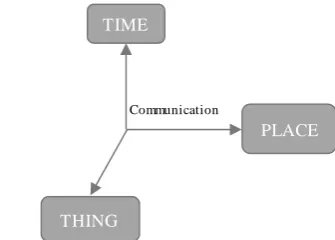
SG20 to develop standards for IoT and its applications including smart cities and communities [3]. In conclusion, IoT is the connection between the physical world and Internet, this connection is set with any object [2], in any moment and in any place, as is expressed in Fig. 1.
This work was supported in part by Military University Nueva Granada under grant INV-ING-2114. The authors would like to thank the GISSIC group for providing tools for development of testing scenarios.
E. G. is with Telecommunications Engineering Department, Military University Nueva Granada Bogotá, Colombia; (e-mail: [email protected])
D. R. is with Telecommunications Engineering Department, Military University Nueva Granada Bogotá, Colombia; (e-mail: [email protected]).
J. U. Author with Telecommunications Engineering Department, Military University Nueva Granada Bogotá, Colombia; (e-mail: [email protected]).
IoT architecture has two capabilities: management and security. They are related with four layers: Application layer are the IoT applications; Service support and application support layer contain generic support capabilities and specific support capabilities; Network layer consists in networking and transport capabilities; Device Layer has two capabilities: device capabilities and gateway [2], the architecture is as show in the Fig. 2.
In 2016 the ITU and Cisco System, presented the report that outlines IoT as world development opportunity to improve the quality of life of millions of people and progress in sustainable development [4]. This report defines IoT as: the growth of devices capable of connecting to the Internet and the devices communicate with other devices without human intervention [4]. The report has three approaches to the development of IoT [5]:
--Availability guarantees access to IoT devices in an easy and low-cost [5]
--Affordability guarantees the basic availability of IoT [5] --Adaptability ensures the adaptation of the devices to the half and the interoperability between them [5].
Decision Model to Deploy IoT Solutions on
Cloud Computing Based Platforms
Edward P. Guillén, Diana M. Ruiz and Jenny K.Ubaque
I
M
an
ag
em
e
n
t
Ca
p
ab
il
it
ie
s
Application Layer
Service support and Application support layer
Network Layer
Device Layer
S
ec
u
ri
ty
Ca
o
ab
il
it
ie
[image:1.595.327.495.184.304.2]s
Fig. 2. IoT reference model.
THING TIME
[image:1.595.317.541.439.601.2]PLACE Communication
Gartner, Inc., has realized a study a total of 6.4 billion Internet-connected devices is estimated by 2016, exceeding 30% connected devices in 2015 [6]. The services are classified as professional category using external providers to design, install and operate IoT systems with the possibility of growth in connectivity and consumption services [6]. Another study by Gartner, Inc., presented the magic quadrant of Gartner, identifying the leaders in the main technology markets, displaying the positions of the competitors from the market into four categories: leaders, visionaries, niche players and challengers [7].
The Gartner‘s Magic Quadrant for Enterprise Application Platform as a Service worldwide published in March 2016, the Gartner‘s Magic Quadrant for IaaS Service published in May 2015 and the Gartner‘s Magic Quadrant for Public Cloud Storage Services published in June of 2015; concluding that the Amazon Web Services –AWS and Microsoft Azure platforms are the leader providers of cloud services [8]. The NIST define cloud computing as ―a model for enabling ubiquitous, convenient, on-demand network access to a shared pool of configurable computing resources (e.g., networks, servers, storage, applications, and services) that can be rapidly provisioned and released with minimal management effort or service provider interaction‖ [9]
II. CLOUDCOMPUTINGPLATFORMS
Amazon Web Services –AWS and Microsoft Azure are considered the leaders in Cloud. AWS is about twice as big as Microsoft Azure, which is its closest competition, and ten times bigger than all its competitors together. However, Azure has had a fast development in the last years [10 - 12].
Cloud services providers offer different kind of solutions to their clients according to need and workflow. Some factors allow to better visualize the focus that each one have. The factors are: computing capacity, storage and network, public and private cloud services, and IoT services [13]. They decide the approach of each one of the platforms that offer cloud services [13].
AWS and Azure offer similar ranges in computing capacity, storage and networking, and IoT services for device control and data management [14] [15]. The service in both platforms are integrated with other services for a better solution.
A. AWS IoT Vs. Microsoft Azure IoT
The Table I present the features running operation of IoT on both platforms [10]. Another study by Gartner, Inc., presented in the magic quadrant of Gartner, identifies the leaders in the main technology markets, showing the positions of the competitors [7].
Both platforms integrate in their structure the IoT architecture, the IoT communication use protocols as HTTP and MQTT, with telemetry communication patterns to achieve the control and command of devices, both are based in languages of programming such as Java and C and allow the connection of the same devices [12]. The communication of each platform is encrypted through the Transport Layer Security –TLS protocol by sending X.509 certificates to maintain a safe communication. Authentication differs on each platform, AWS employs two types of authentication that depends on the used protocol: AWS IAM and Incognito or SigV4 and X.509 certificate. Micorsoft Azure uses a Token SAS to access control and credentials that give permission of access to the final points [13].
B. AWS IoT Service Architecture
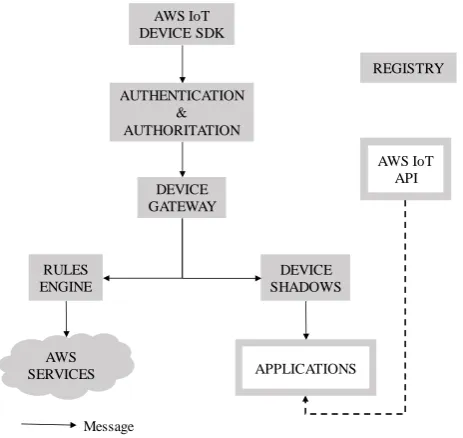
The AWS IoT architecture, is based on the MQTT protocol. With this the "things" report its status through messages that are sent to a broker with reference to a specific topic, and those which receive the messages are which are subscribed to that topic [16].
The AWS IoT structure, has an SDK for devices with AWS IoT. It is a software development kit that allows the connection, authentication and exchange of messages of hardware devices or mobile applications, performing the authentication and authorization according to the protocol. The gateway of the device is the point of communication between connected devices and cloud (engine rules, shadows of AWS services, applications and devices). Finally, as it has a rules engine that enables the processing of incoming data from devices, and one devices shadow that stores the sent states from devices and that can be modified through any application [15] [16], as is shown in Fig. 3.
TABLEI
AWSIOTVSMICROSOFTAZUREIOT
Area Amazon Web Service IoT Microsoft Azure IoT
Protocols Control: HTTPS. HTTP, AMQP, MQTT and custom protocols. Patterns of
communication
Data: HTTPS, WebSockets and MQTT
Telemetry(Control) and command
Certified device platforms
Broadcom, Marvell, Renesas, Texas Instruments, Microchip,
Intel, Mediatek, Qualcomm, Seeed, BeagleBoard, Raspberry
Pi, Intel.
Intel, Raspberry Pi, Freescale, Texas
Instruments, MinnowBoard, BeagleBoard, Seeed,
resin.io
SDK/Language
Embedded C, JavaScript, Arduino
Yún.
.Net y UWP, Java, C, Nodejs
Security TLS (Mutual
authentication)
TLS (Only authentication of server)
Authentication
AWS IAM o AWS Cognitive for applications, HTTPS
and WebSockets.
By SAS token device SigV4 and Certificate
X.509 for connections with HTTP and authentication based on
certificates for connections MQTT.
C. Microsoft Azure Service Architecture
Microsoft presents an architecture that is divided into three groups: Device Connectivity, Data Processing and Analytics and Presentation. In this structure, the devices acquired data from the gateway, the data is available for processing whit other services, this stage is called back-end, from where is input data to other applications through a control panel or a presentation device [18] [20], as shown in Fig. 04.
D. Services and costs in relation to IoT
Platforms are analyzed in terms of offered services and costs, which can, in addition, be integrated with IoT solutions [19-21] as shown in table II, table III and table IV, which is divided into three sections.
An IoT system can integrate multiple services as the related in Table II, to cover the whole of a specific needing, where instead many solutions, a single one could bring different integrated services such as: storage, databases, data analysis, notifications control, among others services [24]. In particular cases, the platforms charge according to the volume of information and the storage capacity depending on the case, paying for what is used. When it is about sending messages in AWS, it must be kept in mind that a message is a data block 512 bytes. I.e., a 1024-byte message will be billed as two messages, and messages smaller than 512 bytes, is charged as a message, while Microsoft Azure sets a size of 256 KB for messages from device to cloud and
64 KB from cloud to device [25] [26].
To understand in detail, the architecture of services of both platforms is necessary to talk about their business forms, which is divided into three models [22]:
--IaaS (infrastructure as a service): It has the hardware, but the Administration is performed by the client. I.e., the supplier provides the machine, but installation and the rest is done the customer. (Virtual machines, servers, storage).
--Paas (platform as a service): the supplier provides all the tools and the client does not have that manage them. I.e., customer does not install, does not program, the
IaaS PaaS SaaS
Applications
Data
Runtime
Middleware
Applications
Data
Applications
Data
Runtime
Middleware
Runtime
Middleware
O/S
Virtualization
Servers
Storage
Networking
O/S
Virtualization
Servers
Storage
Networking
O/S
Virtualization
Servers
Storage
Networking
Your manage Managed by
[image:3.595.58.290.50.269.2]Vendor
Fig. 5. Microsoft Azure Service Architecture
TABLEII
PARALLELBETWEENSERVICESAWSIOTANDMICROSOFTIOT
Service AWS Microsoft Azure
Compute
Virtual servers EC2 Virtual Machines
Backend process
logic Lambda Functions
Storage and content delivery
Object storage S3 Blob Storage
Networking Virtual Private Cloud Virtual Network Relational
database RDS SQL Database
NoSQL database DynamoDB
DocumentDB
Table storage DynamoDB
SimpleDB Table Storage
Networking
Analytics Kinesis Analytics Stream Analytics Machine learning Machine learning Machine learning
Internet of Things
Streaming data Kinesis Firehose Kinesis Streams
Event Hubs
Internet of
Things IoT (Preview)
IoT Hub
Mobile services
Notification Simple Notification Service
Notification Hubs
Application services
Messaging Simple Queue Service Bus
Security and identity
Directory Directory Service Azure Active Directory
Comparison of services, compute, storage and content delivery, networking, IoT, mobile services, application services, security and identity.
DEVICE CONNECTIVITY DATA PROCESSING
AND ANALYTICS PRESENTATION
Low-power devices IP-capable
devices
IoT Client
Existing IoT devices
IoT Client Gateway IoT Client
Cloud gateway
IoT solution backend
[image:3.595.55.286.405.548.2]Presentation and business connectivity
Fig. 4. Microsoft Azure Service Architecture
AWS IoT DEVICE SDK
DEVICE SHADOWS RULES
ENGINE
DEVICE GATEWAY AUTHENTICATION
& AUTHORITATION
REGISTRY
AWS SERVICES
AWS IoT API
APPLICATIONS
Message
[image:3.595.305.537.455.675.2]platform provides everything and customer uses it. --SaaS (Software as service): it is about the software that runs on the platform and the customer uses it normally. (APIs: CRM, Email, Hangouts, etc.)
AWS is mainly known as an infrastructure as a service platform, but many of their services, are also comparable with platform as a service [22]. The comparison between IaaS and PaaS is in the type of service offered and both platforms have mixes of both [20] [23] . All this is summarized in the Fig. 5.
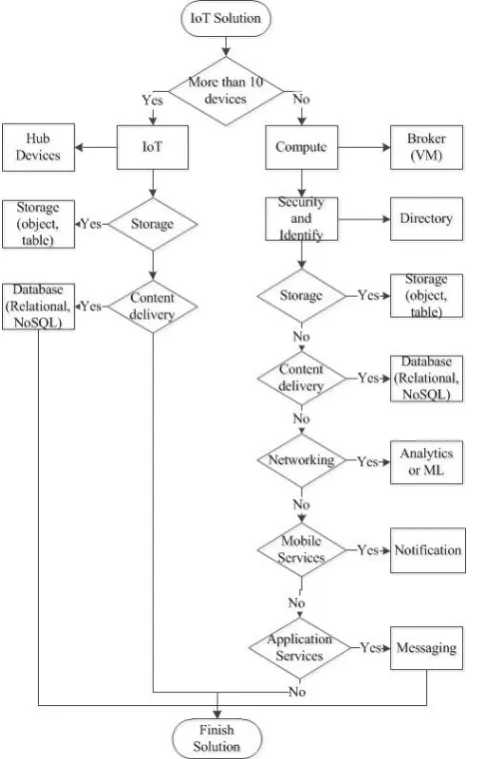
Now, knowing Table II services, the costs for service Table III and table IV, for Microsoft Azure and AWs platforms, and the business models of cloud platforms in the Fig 5, you can proceed to identify business models and services most suitable for the implementation of IoT systems, as chow in Fig 6.
The flowchart, allows to visualize the business model for IoT when tries of IaaS and PaaS. As you can see, the various business model. According to the need of the customer, according to the devices that you want to connect. For this reason, you could not define which of the two models is best. If thenumber of devices that you want to connect is less than 10, the business model more appropriate is the IaaS, where resources are managed by the client, but if the number of devices is greater than 10, the business model most suitable is the country, where the customer uses
resources that the provider offers carry it out implementations and also manage their applications [23] [24].
TABLEIII COSTSOFPLATFORMS
Service AWS Microsoft Azure
Compute
Virtual servers
Free Layer:750 hours of EC2 usage with instance t2.micro of Linux, RHEL, o SLES
Type Windows
Microsoft Windows Server Level A0 750 hours of Elastic Load
Balancing more 15 GB of data processing
HDD, 1 core, 0.75 GB RAM y 20 GB disk
30 GB of Amazon Elastic Block Store, 2 million of I/O and 1 GB storage of snapshots, 15 GB outgoing bandwidth in all AWS services
1 GB regional data transfer
$0,020/month
Backend process logic
1 million of request and 400.000 GB / second of time of computer free of charge. Additional 0,20 USD per every one million request and 0,00001667 USD for every GB – second used
$0,00/month
Storage and content delivery
Object storage
5 GB of storage standard, 20.000 requests Get y 2.000 requests Put free.
Storage capacity: LRS: $0.024/ GB, ZRS: $0.03/GB, GRS: $0.048 GB, RA-GRS: $0.061 GB
Access Price: $0,0036 for every 100.000 transactions
Networking
$ 0,05 USD per hour of VPN connection.
Gateway NAT and processed data GB: $ 0,045.
Free with subscription of up to 50 networks virtual.
Relational database
Instance: db.t2.micro MySQL:$0.017 SQL Server: $0.022
Basic: 5 DTUs, 2 GB storage $0.0067 / hour. S0: 10 DTUs, 250 GB storage $0.0202 / hour
NoSQL database
25 GB of storage, 25 units of capacity of reading and 25 units of writing ability – Manage 200 million request for free.
Storage: $0,259 GB / month.
Reserved request units: $0.008 units/hours.
Table storage
Performance of writing: $0.0065 by hour for every 10 units of ability of writing. Performance of writing: $0.0065 by hour for every 10 units of ability of writing. Performance of reading: $0.0065 per hour every 50 units of capacity of reading. First 25 GB stored free, additional $0.25 per GB / month.
Firts 2.5 millio DynamoDB Streams free, additional $0.02000 per 100,000 DynamoDB Streams.
Capacity: $0,07 / GB Storage transactions: $0,0036/unit
Networking
Analytics Not defined
Processed data: $0,001/GB
Streaming units: $0,031 Units/hour.
Relational database
Instance: db.t2.micro MySQL:$ 0.017 SQL Server: $0.022
Basic: 5 DTUs, 2 GB storage $0.0067 / hour. S0: 10 DTUs, 250 GB storage $0.0202 / hour.
AWS Vs Microsoft Azure in Compute, Storage and content delivery and networking.
[image:4.595.46.289.112.492.2]Other protocols are used in systems such as IoT: Extensible Messaging and Presence Protocol - XMPP, DataDistribution Service - DDS, Java Message Service JMS - Constrained Application Protocol - CoAP, Representational State Transfer - REST, among others [29]. In the Table V are performed a comparison of the behavior of the two protocols more used.
III. IOTPROTOCOLS
The protocol used by Microsoft Azure for IoT services is Advanced Message Queuing Protocol - AQMP, due to its adaptation to the services: Service Bus, topics/subscriptions,
Event Hub and IoT Hub. But now incorporated the support of natively to MQTT, omitting the translation of fields MQTT to AMQP in communication with the broker [28]. The Protocol base for AWS IoT is MQTT, but the platforms support the Hypertext Transfer Protocol-HTTP [13].
--Model publication subscription: Broker and node post information and others subscribe according to a theme. Generally, the broker is subscribed to all messages and then manages the workflow nodes [30]
--Disconnection of space: while the node and the broker needs to have the IP address of one other, nodes can publish information and subscribe to information posted other nodes. This reduces the overload that can accompany to them sessions TCP and ports, and allows that those nodes end that operate independently one of another [30].
--Decoupling of synchronization: A node that is in the middle of an operation not be interrupted for receive a message published to which is subscribed. The message is put in tail along the corridor until the receiver node is finished with its existing operation. Thus prevents operating current and reduces repeated operations, avoiding interruptions of operations in progress, or drowsy States [30].
--Safety of MQTT, uses TCP unencrypted, but as TCP uses TLS / SSL Internet security, this is a very safe method for traffic encryption [30].
-Quality of service (QoS) levels MQTT: this Protocol has three levels of service: levels 0, 1, and 2, where the raising of the standard guarantees the delivery of messages [30].
Level 0 (fire and forget), is a single transmission without the guarantee of the arrival of the message [30].
Level 1, ensures that a message is received at least once by the recipient. When the message is received and understood, it responds with an acknowledgment of receipt (PUBACK) addressed to the node publishing [30]. Level 2, this level tries to ensure that the message is received and decoded by the receiver. It‘s the level
TABLEV
UNITS FOR MAGNETIC PROPERTIES
MQTT AMQP
Message Queue Telemetry Transport)
Advanced Message Queuing Protocol
Abstraction Publish/Subscribe
Request/Response publish/subscribe
Architecture
Client/server-each sensor's client connected to a Broker
P2P or Broked
QoS
3 Levels. *Fire and forget *Delivered at least once *Delivered exactly once
3
Standar MQTT-v3.1.1. OASIS
STANDARD OASIS AMQP
Security and identity
Subscription control
Issues with hierarchical pairing
Exchanges, queues and the links in v0.9.1 standard, defined in the latest v1.0
Security
Authentication of clients, information with SSL/TLS encryption
SASL, TLS
authentication for data encryption.
AWS Vs Microsoft Azure in Compute y Storage and content delivery TABLEIV
COSTSOFPLATFORMS
Service AWS Microsoft Azure
Machine learning
Data analysis and modeling $0,4/hour Predictions in batch $0,10 by 1000 prediction. Prediction in real time $0,0001 by prediction
Seats: $ 9,99/month Use of Study: $1,00 seats/month
Internet of Things
Streaming data
Kinesis Firehose: $0.035/GB volume of data received
Kinesis Streams: *Time of partition (1 MB / second input, 2 MB / second output): $0.015. *Units of load PUT / Million unit: $0.014. *Extended data retention / part time: $0.020
Input: $0,028 by million.
Processing: $0,030 by unit / hour
.
Internet of Things
Publication in AWS IoT: 5 USD / 1 million message per month. It send to devices: 5 USD / 1 million per message per month.
Nivel S1: Dispositivos Ilimitados, 400000 msj/día por $50/mes.
Notification
100.000 HTTP
notifications and 1.000 notifications by email for SNS, free per month.
10 million inserts, with unlimited devices and unlimited
dissemination: $200,00 / month
Additional inclusion to $10,00/month
Application services
Messaging
1.000.000 SQS requests and 1.000.000 requests, Free per month
Messaging operations: Million + $10.00. Brokered connections: 1,000 Brokered free, additional $0,03 / connections Relay Hours: $0.10 by 100 / hora.
Security and identity
Free layer 750 hour for use
Multi-Factor Authentication: $1.40/User
Microsoft AD
Enterprise $0,40.
B2C: First 50,000 Stored users and Authentications Free, Multi-Factor
Authentications
Directory
AD simple and y conector AD small: $0,05.
$0,03/authentication
AD simple and y conector AD small: $0,15.
Domain Services: $0.10 / hour
MQTT safest and reliable quality of service [30].
---Last will and Testament: this Protocol has a message "(GLN) testament", that can be stored in the broker when a node unexpectedly disconnected network. This LWT retains the status and purpose of the node, including the types of commands you issued and your subscriptions, and if the node is gone, the broker notifies all subscribers of LWT's the node [30].
IV. CONCLUSION
In order to assess of Microsoft Azure and AWS should not be only infrastructure or offered services, also should be evaluated features as: compatibility of protocols and hardware, security, reliability models of services and support for the user
AWS is the more supported platform provided to its users in the use of their services with manuals and user guides.
Although it shows the effort and growth of Microsoft Azure, there is still a big gap in comparison with Amazon Web Services faster and more timely adaptation of their services to the customers need.
MQTT is the more used Protocol by Cloud platforms for IoT services, by its architecture.
Platforms have the same purpose following the IoT architecture, the big difference is in how each one of them reaches the customer, i.e. the way in which each offers its services to the customer so this can generate greater understanding and use of resources and of course, the costs.
IoT can to use the two business models permitting to the client interact
The business model PaaS, for IoT solution model, allows the control of data in real time, flexible analysis and decision-making capabilities, rapid software development and deployment, flexible IoT workflows, access-anywhere architecture, device management and simplified security, but this model, fits more to a solution that requires more than 10 devices connection.
ACKNOWLEDGMENT
This work was supported in part by Military University Nueva Granada under grant INV-ING-2114. The authors would like to thank the GISSIC group for providing tools for development of testing scenarios.
REFERENCES
[1] D. Evans, ―The Internet of Things How the Next Evolution of the Internet‖ Cisco IBSG © 2011 Cisco and/or its affiliates. All rights reserved, April 2011.
[2] Telecommunication Standardization Sector of ITU. Series Y: Global Information Infrastructure, Internet Protocol Aspects and Next-Generation Networks. Recommendation ITU-T Y.2060. June 2012. [3] ITU, Committed to connecting the world (2014, November) ―Study
Group 20 at a glance‖ [Online]. Available http://www.itu.int/en/ITU-T/about/groups/Pages/sg20.aspx
[4] ITU, CISCO ―Harnessing the Internet of Things for Global Development‖ Geneva, 2016.
[5] ITU, Committed to connecting the world (2016, January) ―Internet of Things could be the low-cost ‗connectivity key‘ that transforms lives in developing countries‖ [Online]. Available http://www.itu.int/net/pressoffice/press_releases/2016/02.aspx#.V7sx BPnhC01
[6] Gartner. (2015, November) ―Gartner Says 6.4 Billion Connected "Things" Will Be in Use in 2016, Up 30 Percent From 2015‖ [Online]. Available: http://www.gartner.com/newsroom/id/3165317 [7] Gartner, ―Gartner Magic Quadrant‖ [Online]. Available:
http://www.gartner.com/technology/research/methodologies/research_ mq.jsp.
[8] Gartner. (2016, August) ―Magic Quadrant for Cloud Infrastructure as a Service, Worldwide‖ [Onlíne]. Available:
https://www.gartner.com/doc/reprints?id=1-2G2O5FC&ct=150519&st=sb
[9] The NIST Definition of Cloud Computing Special Publication 800-145 September 2011.
[10] Microsoft Azure. (2016, Jaanuary) ―Helping customers achieve more at the best prices‖ [Onlíne]. Available: https://azure.microsoft.com/en-
us/blog/helping-azure-customers-achieve-more-at-the-best-prices/?tduid=(76204fd7a68ea4b9a1ad136190cf3db4)(256380)(2459 594)(TnL5HPStwNw-mpDu5kMqP7yRkZBpvsqggg)()
[11] Gartner. (2015, July) ―Key Services Differences Between AWS and Azure — Availability, Network, Compute and Storage [Onlíne]. Available:‖https://www.gartner.com/doc/3093919/key-services-differences-aws-azure
[12] B. Butler. (2015, May) ―Gartner: Amazon‘s cloud is 10x bigger than its next 14 competitors, combined‖ [Online]. Available:
http://www.networkworld.com/article/2925186/cloud- computing/gartner-amazon-s-cloud-is-10x-bigger-than-its-next-14-competitors-combined.html.
[13] Series y: global information infrastructure, internet protocol aspects and next-generation networks. Recommendation ITU-T Y.2060. June 2012.
[14] Amazon Web Services. (2016, January) ―AWS Free Tier‖. [Online]. Available: https://aws.amazon.com/free/?nc1=h_ls
[15] Microsoft Azure, ―Azure Free Trial‖ [Online]. Available: https://azure.microsoft.com/en-us/offers/ms-azr-0044p/
[16] Amazon Web Services. (2016, January) ―AWS IoT FAQS‖ [Online]. Available: https://aws.amazon.com/es/iot/faqs/
[17] Amazon Web Services. (2016, January) ―How the AWS IoT Platform Works‖ [Online]. Available: https://aws.amazon.com/iot/how-it-works/?nc1=h_ls
[18] Betts Dominic, ―Azure and Internet of Things‖, 25 May 2016. [Online]. Available: https://azure.microsoft.com/en-us/documentation/articles/iot-suite-what-is-azure-iot/
[19] Microsoft Azure, (2016, January) ―Microsoft Azure and Amazon Web Services‖ [Online]. Available: https://azure.microsoft.com/en-us/campaigns/azure-vs-aws/mapping/
[20] Amazon Web Services. (2016, January) ―AWS Cloud Pricing‖ [Online]. Available: https://aws.amazon.com/pricing/?nc1=h_ls [21] Microsoft Azure. (2016, January) ―Price Calculator‖ [Online].
Available: https://azure.microsoft.com/es-es/pricing/calculator/ [22] G. Gogolin ―Digital Forensics Explained‖ 2012, pp. 73 – 84 [23] Sullivan Dan. (2013, September) ―PaaS Provider Comparison Guide:
Amazon AWS as a PaaS‖. [Online]. Available: http://www.tomsitpro.com/articles/amazon-aws-paas-iaas-cloud-computing,2-608.html
[24] Research hubs. (2015) ―What is Cloud Computing?‖ [Online]. Available: http://www.researchhubs.com/post/computing/cloud-computing/what-is-cloud-computing.html
[25] Amazon Web Services. (2016, January). ―AWS IoT Pricing‖ [Online]. Available: https://aws.amazon.com/iot/pricing/?nc1=h_ls
[26] Microsoft Azure. ―Hub IoT Azure Prices‖, [Online]. Available: https://azure.microsoft.com/es-es/pricing/details/iot-hub/
[27] Dotchkoff K. (2016, April) ―Supporting additional protocols for IoT Hub‖ [Online]. Avalaible: https://azure.microsoft.com/en-us/documentation/articles/iot-hub-protocol-gateway/
[28] Messaging Technologies for the Industrial Internet and the Internet of Things. Version 1.2November 2013.
[29] MQTT.ORG, (2016, January). [Online]. Available: www.mqtt.org. [30] Stansberry James. ―MQTT and CoAP: Underlying Protocols fo the