Analysis of Fill-in-blank Problem Solutions and
Extensions of Blank Element Selection Algorithm
for Java Programming Learning Assistant System
Nobuo Funabiki, Tana, Khin Khin Zaw, Nobuya Ishihara, and Wen-Chung Kao
Abstract—A Web-based Java Programming Learning Assis-tant System (JPLAS) has been developed in our group to advance Java programming educations. JPLAS provides fill-in-blank problems for Java novice students to study grammar and basic programming skills by filling in the blank elements in a high-quality code. In this paper, we first analyze solution results of students in the Java programming course and the correlation between the number of blanks in a problem and the correct answer rate of the students. Then, we extend the blank element selection algorithm to increase the number of blanks and control the problem difficulty by changing it. This algorithm has been proposed to generate a feasible fill-in-blank problem such that any blank has the grammatically correct and unique answer. To verify the effectiveness, we apply the extended algorithm to58 Java codes for the fundamental data structure or algorithms, and confirm that the extensions can increase the number of blanks and control the problem difficulty.
Index Terms—JPLAS, Java programming education, fill-in-blank problem, fill-in-blank element selection algorithm, solution analysis.
I. INTRODUCTION
J
AVA, as a reliable and portable object-oriented program-ming language, has been extensively used in a variety of industries, including mission critical systems at large enterprises and small-sized embedded systems for real time controls. The cultivation of Java programming engineers has been highly demanded amongst industries. Hence, a number of universities and professional schools have designed Java programming courses to deal with these demands.To advance Java programming educations, we have de-veloped a Web-based Java Programming Learning Assistant
System (JPLAS) [1]-[5]. As a function, JPLAS provides the fill-in-blank problem to support self-studies of students who
have just started learning Java programming. The goal of this problem is to encourage students learning the grammar and basic programming skills through code reading.
In a fill-in-blank problem, a Java code with several blank elements is shown to each student, where he/she needs to fill in the blanks. This problem code should be of high-quality worth for code reading. An element is defined as the least unit of a code, such as a reserved word, an identifier, and a control symbol. To be more precisely, a reserved word is a fixed sequence of characters that has been defined in the grammar to represent a specified function, and must be mastered first by the students. An identifier is a sequence of
Funabiki, Tana, Zaw, and Ishihara are with the Department of Electri-cal and Communication Engineering, Okayama University, 3-1-1 Tsushi-manaka, Okayama, 700-8530, Japan e-mail: [email protected]. Kao is with the Department of Electrical Engineering, National Taiwan Normal University, Taipei, 106, Taiwan, e-mail: [email protected].
characters defined in the code by the author to represent a variable, a class, or a method. A control symbol intends other grammar elements such as grammar elements such as“.” (dot),“:”(colon),“;”(semicolon) ,“(, )”(bracket),
“{,}”(curly bracket).
To help a teacher to prepare fill-in-blank problems in JPLAS, we have proposed the blank element selection
al-gorithm to generate a fill-in-blank problem from a given
code such that any blank has the grammatically correct and unique answer [2]. First, in this algorithm, we generate a
compatibility graph by selecting any candidate element for
a blank in the code as a vertex, and connecting any pair of vertices by an edge if they can be blanked together. For this purpose, we define the conditions that a pair of elements cannot be blanked simultaneously. Then, we extract a maximal clique [6] of the compatibility graph, which be-comes a maximal set of proper blank elements. Empirically, we have observed that a fill-in-blank problem will become more difficult when a larger number of elements are blanked. Therefore, by blanking a subset of selected elements of the algorithm, we can generate a variety of fill-in-blank problems with different difficulty levels.
In this paper, firstly, we analyze solution results of students in the Java programming course in our department. Also, we observe the correlation between the number of blanks in a problem and the correct answer rate of the students. Secondly, we extend the blank element selection algorithm to increase the number of blanks and control the problem difficulty by changing the number of blanks. To verify the effectiveness, we apply our extended algorithm to 58 Java codes for the fundamental data structure or algorithms, and confirm that our extensions can increase the number of blanks and control the problem difficulty.
This paper is organized as follows: Section II and Sec-tion III introduce the fill-in-blank problem in JPLAS and reviews the blank element selection algorithm, respectively. Section IV analyzes solution results of fill-in-blank problems submitted by students. In Section V, three extensions of the blank element selection algorithm are presented. Lastly, Section VI concludes this paper with futures.
II. FILL-IN-BLANKPROBLEM INJPLAS
In this section, we review the fill-in-blank problem in JPLAS.
A. Software Platform for JPLAS
TABLE I
VERTEX INFORMATION IN CONSTRAINT GRAPH.
item content
symbol symbol of element line row index of element column column index of element count number of element appearances order appearing order of element in the code group statement group index partitioned by{and} depth number of{from top
for the Web application server, JSP/Servlet for application programs, and MySQL for the database. For the fill-in-blank problem, we adopt open source software JFlex [7] and jay [8]. JFlex is a lexical analyzer generator for a Java code, which is also coded by Java. It transforms a code into a sequence of lexical units that represent the least meaningful elements to compose the code. It can classify each element in the code into either a reserved word, an identifier, a symbol, or an immediate data. For example, a statementint value = 123 + 456; is divided into int, value, =, 123, +, 456, and;. Unfortunately, JFlex cannot identify an identifier among a class, a method, or a variable. Thus, jay is applied as well. Since jay is a syntactic parsing program based on the LALR method, it can identify an identifier.
B. Definitions of Terms for Fill-in-blank Problem
The definitions of terms for the fill-in-blank problem are listed as follows. A problem code represents a Java code involving some blanks. A blank indicates an element to be filled in by a student. An assignment consists of a problem code with some blanks and their correct answers, a title, and a comment on the assignment. Generally, several assignments will be given to students in each course, where JPLAS can support multiple courses at the same time. All registered teachers in JPLAS can generate and register new problems and assignments using the shared database.
III. REVIEW OFBLANKELEMENTSELECTION ALGORITHM
In this section, we review the blank element selection
algorithm [2] using the constraint graph that is generated
to describe the constraints in the blank element selection.
A. Vertex Generation for Constraint graph
In the constraint graph, each vertex signifies a candidate element for being blank. The candidate elements or vertices are extracted from the Java code through the lexical analysis using JFlex and jay. Each vertex contains the associated information in Table I that is necessary for the following edge generation.
B. Edge Generation for Constraint graph
An edge is generated between any pair of two vertices or elements that should not be blanked at the same time. There are three categories to represent the constraints in selecting blank elements with unique answers:
1) Group Selection Category: In the group selection cat-egory, all the elements related to each other in the code are
grouped together. First, in each group, one vertex is randomly selected. Then, edges are generated between this vertex and the other vertices to confirm that at least this selected element is not selected for blank. Five conditions are included in this category.
(1) Identifier appearing two or more times in the code The multiple elements representing the same identifier of a variable, a class, and a method by using the same name, are grouped together. If all such elements are blanked, a student cannot answer the original identifier
(2) Pairing reserved words which are composed of three or more elements
The three or more elements representing the reserved words in pairs are grouped together. If all of them are blanked, the unique answers may become too difficult as the following two cases:
• switch-case-default
• try-catch-finally
(3) Data type for variables in equation
The elements representing the data types for variables in one equation are grouped together. For example, in sum = a + b, the data types of the three variables, sum, a, and b, must be the same.
(4) Data type for method and its returning variable
The elements representing the data type of a method and its returning variable are grouped together.
(5) Data type for arguments in method
The elements representing the data type of an argument in a method and its substituting variable are grouped together.
2) Pair Selection Category: In the pair selection category,
the elements appearing in the code in pairs are grouped together. For each pair, an edge is simply generated between the two corresponding vertices to assure that at least one element is not selected for blank.
(1) Elements appearing continuously in a statement
The two elements appearing continuously in the same statement are paired in the code. If both of them are blanked, their unique correct answers may not be guaranteed and the fill-in-blank problem may become too difficult for novice students. The two elements connected with a dot (“.”) are also paired.
(2) Variables in equation
The elements representing any pair of the variables in an equation are paired. If both are blanked, it will become impossible to access the unique answers. For example, for sum = a + b,sum = b + ais also feasible.
(3) Pairing reserved words
The two elements representing the paring reserved words are paired. If both are blanked, the unique correct answers may not be guaranteed. The following five paring reserved words are considered:
• if-else
• do-while
• class-extends
• interface-extends
• interface-implements (4) Pairing control symbols
paired. The novice students should carefully check them in their codes to decrease the amount of mistakes.
3) Prohibition Category: In the prohibition category, an
element is prohibited from the blank selection because it does not satisfy the uniqueness with the high probability. There are three conditions for this category. However, an element in a fixed sequence of elements indicating a specific meaning in a Java code, such as public static void main and public void paint(Graphics g), is excluded from this category, because they should be mastered by students. (1) Identifier appearing only once in code
The selected element representing the identifier in this category appears only once in the code. If it is blanked, a student cannot answer the original identifier.
(2) Access modifier
The element representing an access modifier for an iden-tifier is selected for this category. If it is blanked, either public, protected, private can often be grammat-ically correct.
(3) Constant
The element representing a constant is selected for this category. If it is blanked, a student cannot answer the original constant.
C. Compatibility Graph Generation
By taking the complement of the constraint graph, the
compatibility graph is generated to symbolize the pairs of
elements that can be blanked simultaneously.
D. Maximal Clique Extraction of Compatibility Graph
Finally, a maximal clique of the compatibility graph is extracted by a simple greedy algorithm to find the maximal number of blank elements with unique answers from the given Java code. A clique of a graph represents its subgraph where any pair of two vertices is connected by an edge. The procedure for our algorithm is described as follows:
1) Calculate the degree (= number of incident edges) every vertex in the compatibility graph.
2) Select one vertex among the vertices whose degree is the maximum. If two or more vertices have the same maximum degree, select one randomly.
3) If the selected vertex is a control symbol and the number of selected control symbols exceeds 1/3 of the total number of selected vertices, remove this vertex from the compatibility graph and go to (5).
4) Add the selected vertex for blank, and remove it as well as its non-adjacent vertices of the compatibility graph. 5) If the compatibility graph becomes null, terminate the
procedure.
E. Fill-in-blank Problem Generation
In the maximal clique procedure, 3) is used to sustain the total number of blank control symbols, because a code is generally composed of plenty of control symbols. Here, we examined the average number of blanks for control symbols and other symbols by the algorithm. Then, we empirically selected 1/3as an appropriate ratio to generate the feasible
fill-in-blank problems for novice students. However, in these
condition, the generated fill-in-blank problems can be solved without reading out the code if students are familiar with Java grammar.
TABLE II
ASSIGNED PROBLEMS AND SOLUTION RESULTS.
ID key grammar # of # of ave. # of correct in code blanks students trials rate (%)
1 array (1) 8 30 9.17 83.75
2 array (2) 8 24 4.46 83.75
3 method (1) 11 24 5.67 86.32
4 method (2) 6 28 2.68 88.27
5 repeat (1) 5 25 1.9 91.67
6 variable 3 22 5.45 93.85
7 repeat (2) 5 26 6.73 93.94
8 method (3) 6 32 3.5 94.08
9 data type (1) 5 19 2.42 95.79
10 exception 3 19 4.63 96.49
11 class 7 24 7.61 98.08
12 method (4) 6 31 6.03 98.39
13 data type (2) 2 26 2 98.76
14 branch 7 22 7.18 99.68
15 method (4) 6 27 4.15 100
16 data type (3) 4 24 6.5 100
total/ave. 92 25.19 5.00 93.93
TABLE III
TWO STUDENT GROUPS BY PROBLEM SOLUTIONS.
group A B
# of students 17 16
# of solved blanks 68 - 92 14 - 66 ave. course grade 74.51 68.97 ave. # of submission trials 6.25 3.87
IV. ANALYSIS OFFILL-IN-BLANKPROBLEMSOLUTIONS
In this section, we analyze solution results of fill-in-blank problems offered by students in our Java programming course.
A. Fill-in-blank Problem Solution Results
We collected Java codes from textbooks and Web sites [9]-[13], and generated 16 problems with the total of 92
blanks by applying the blank element selection algorithm. Afterwards, we asked students to solve them using JPLAS. Table II shows the assigned problems and solution results by students. In general, as the number of blanks increases, the correct answer rate decreases, where the correlation coefficient isr=−0.57.
B. Final Grades and Two Student Groups
After the course was finished, we evaluate the final grade of each student by one programming assignment (40%), several quizzes (30%), and the final paper test (30%). For the programming assignment, each student was requested to freely select a topic such as a game, a paint tool, and a face recognition, and write a Java code to implement it. In the last class, each code was evaluated on a 100-point scale by the teacher and the students in terms of complexity, com-pleteness, and uniqueness. Next, we classified the students into two groups such that each group has the same number of students, considering the number of solved blanks in each group. Table III exhibits the statistics in each group.
C. Correlation between Solutions and Final Grades
whereas the weak correlation (r = −0.32) does for group B. These results indicate that to improve Java programming skills, solving a sufficient number of fill-in-blank problems in JPLAS will be required. If the students stop solving them in the middle, their improvements will be suspended.
Course grade
#
o
f
so
lv
ed
b
la
n
k
s
Fig. 1. Correlation between problem solutions and course grades for group A.
Course grade
#
o
f
so
lv
ed
b
la
n
k
s
Fig. 2. Correlation between problem solutions and course grades for group B.
D. Correlation between Answer Submission Trials and Final Grades
In JPLAS, students are allowed to continuously repeat submissions of their answers to check the correctness at the server, because JPLAS has been designed to encour-age students to study Java programming by self-learning. However, we suspect that unfortunately, students may submit answers without thinking them carefully. As a result, they may not be able to advance Java programming skills, despite of the number of problems they solved. Thus, we analyze the correlation between the number of submission trials and course grades in group A. Figure 3 reveals that the negative correlation (r=−0.55) exists between them, which supports our concern of the careless behaviors of students. We will notice this fact to students in the Java programming course to lead them to solve the problems with a less number of submissions.
V. EXTENSIONS OFBLANKELEMENTSELECTION ALGORITHM
In this section, we propose three extensions of the blank element selection algorithm.
Course grade
#
o
f
su
b
m
is
si
o
n
t
ri
a
[image:4.595.303.520.73.187.2]ls
[image:4.595.50.265.156.270.2]Fig. 3. Correlation between answer submission trials and course grades for group A.
TABLE IV
OPERATORS FOR CONDITIONAL EXPRESSIONS.
operator example operator example
< a<b ++ a++
<= a<=b -- a
--> a>b ! !a
>= a>=b += a+=b
== a== b -= a-=b
!= a!= b *= a*=b
&& a&&b /= a/=b
|| a||b % a% b
A. Operators for Conditional Expressions
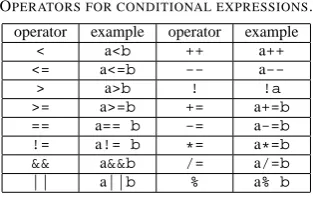
To assist students to understand the implementation of a logic or an algorithm in a Java code, we include elements representing operators in conditional expressions into blank elements. Table IV shows the corresponding 16 operators. To satisfy the uniqueness of the correct answers and avoid becoming too difficult for novice students, we classify all the operators in one conditional expression into the same group in the group selection category.
B. Introduction of Two Parameters
To adjust the difficulty of the generated fill-in-blank problem by controlling the ratio between the number of blank elements and non-blank ones in the problem code, we introduce the two parameters, namely BG (blank gap number) andCB (continuous blank number).
1) Blank Gap Number: The non-blanked elements in a
problem code become hints to solve the fill-in-blank prob-lem. As more non-blanked elements exist between blanked elements, it becomes easier. Thus, we try to control the difficulty of the problem by changing the number of non-blanked elements between non-blanked ones by introducing the
blank gap numberBG. To realize it, for the constraint graph, we generate an edge for each vertex with every vertex in the same statement in the code that exists within its BG neighbors, which is the modification of the condition (1) for the pair selection category. Here, we note that the previous algorithm actually adopts BG= 1 where at least one non-blanked element exists. For example, in the case ofBG= 2, bubbleSortat line 1 has an edge with static, void, (, andintso that at least two non-blanked elements exist in the problem code.
2) Continuous Blank Number: On the contrary, as more
[image:4.595.348.505.235.334.2] [image:4.595.44.266.337.468.2]the number of continuously blanked elements by introducing the continuous blank number CB. In addition, we note that when CB is2 or larger,BG must be set0. The following procedure describes the extension to realize it:
(1) Find a solution by applying the blank element selection algorithm withBG= 0.
(2) Change the last blanked element into a non-blanked one if the number of continuously blanked elements exceeds CB.
C. Improvement of Edge Generation
The analysis in the previous section showed that as the number of blanks increases, the rates of students with correct answers decreases. Consequently, even for the same Java code, the number of blanks determines the difficulty of the fill-in-blank problem. To select a larger number of blanks, we improve the edge generation method for the group se-lection category in the constraint graph. Instead of randomly selecting one vertex in the same group, we select the vertex that has the largest number of incident edges. Then, if this vertex is not selected for the blank, other vertices can be selected for blanks.
1) Improved Edge Generation Procedure: The following
procedure explains the details:
1) Generate the edge between two vertices for each vertex pair in the pair selection category.
2) Sort the vertex groups for the group selection category in the descending order of the group size.
3) Select one vertex for each group in 2) from the top by the following procedure:
(1) Calculate the degree of the vertices in the group. (2) Select the vertex that has the largest degree. If
two or more vertices have the same largest degree, randomly select one among them.
(3) Generate the edges between the vertex in (2) and the other vertices in the group.
2) Example: In the following code forbubbleSort, the fiveintin lines 1, 2, 3, 5, and 8 are grouped by the group selection category, where both the variable and the subscript for arraymust beintfrom line 1. Subsequently, at least oneint must not be selected as the blank element for the unique correct answer. With the employment of this group, we elaborate the improved edge generation method for the constraint graph.
1: public static void bubbleSort(int[] array){ 2: for (int i=array.length-1; i>0; i--) 3: for (int j=0; j<i; j++)
4: if (array[j]>array[j+1]){
5: int tmp=array[j];
6: array[j]=array[j+1];
7: array[j+1]=tmp;
8: for(int k:array){
9: System.out.print();
10: System.out.print(",");
11: }
12: System.out.println();
13: }
14: }
15: }
[image:5.595.324.486.257.400.2]16: }
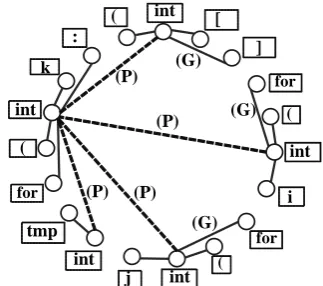
Figure 4 illustrates the corresponding five vertices and their incident vertices selected in the pair selection category forBG= 2. For example,intin line 1 has edges with(,[,
TABLE V
AVERAGE NUMBER OF BLANKS FOR DIFFERENTBGANDCB.
parameter previous extended
BG 1 3 2 1 0 0
CB 1 1 1 1 2 3
# of blanks 24.76 19.12 22.16 25.95 39.98 40.06
and]wherebubbleSortis not included in the constraint graph due to the condition (1) for the prohibited category. These edges are described by the straight lines with (G). Then, int in line 8 has the largest degree 4 among them. Therefore, we select int in line 8, and generate the edges between this vertex and the other four vertices forintthat are described by the dotted lines with (P).
int [
int
(
i
tmp (
]
for for
int k
: (
int
for
(
int j
(G)
(P)
(P) (P)
(P)
(G) (G)
1
Fig. 4. Example of improved edge generation method forbubbleSort.
D. Evaluation of Blank Number Change
First, we evaluate changes of the number of selected blanks by the proposed extensions using58 Java codes for fundamental data structure or algorithms in textbooks and Web sites [13]-[22]. We apply the previous algorithm and the extended algorithm whenBGandCB is changed from
0 to 3 respectively. Table V offers the average number of blanks for the58problem codes found by them. The previous algorithm assumesBG= 1andCB = 1, and the extended algorithm must adopt CB = 1 for BG ≥ 1, because at most one blank element can be selected continuously to have BGnon-blank elements between blank ones, and BG= 0
for CB ≥2, because two or more blank elements can be selected continuously.
Table V indicates that the extended algorithm withBG= 1 and CB = 1 can increase the number of blanks slightly by selecting better edges among them of the constraint graph from the previous algorithm. It also reflects that the larger BGcan decrease the number of blanks and the larger CB can increase it. Hence, we confirm that we can control the difficulty of generating fill-in-blank problems by changing the value of these newly introduced parameters.
E. Evaluation of Solution Performance
[image:5.595.47.270.600.746.2]TABLE VI
PARAMETER VALUES FOR PROBLEM GENERATIONS.
parameter L1 L2 L3 BG 3 1 0 CB 1 1 3
TABLE VII
STATISTICS OF GENERATED PROBLEMS.
Java code LOC # of blanks L1 L2 L3
Euclid 12 6 9 16
TrialDiv 19 14 19 38
ModExp 13 11 14 20
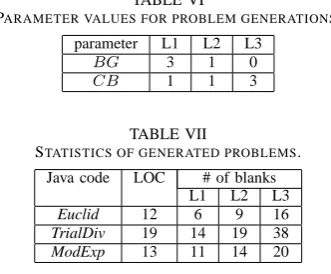
1) Problem Generation: As problem Java codes, we
adopted Java codes related to the RSA algorithm, namely
Euclid (calculate the GCD of two arguments using the Euclid
method), TrialDiv (calculate the GCD using the trial division method), and ModExp (calculate the modulo exponentiation of a big integer) [22]. For the two parameter values in the algorithm extension, we used the three sets in Table VI to generate problems with three levels, L1 (easy), L2 (middle), and L3 (hard), from each code. Table VII shows the LOC (the number of lines) in the problem code, the number of blanks in each problem at each difficulty level. As LOC is larger, the number of blanks increases for any difficulty level.
2) Problem Assignment to Students: Then, we divided the 33 students into three groups, A, B, and C, with the equal number randomly, and assigned one level for each problem to each group so that every student solves the different problems with the different levels. Thus, any student solved any level in our problem assignment. These students are currently taking
Network Security course and completed Java Programming
course in the last semester.
3) Solution Performance of Students: Table VIII shows
the solving problem level and the percentage of the correctly solved blanks by the students in each group for each code. This table indicates that in each group, the percentage for
TrialDiv is smaller than the others at any difficulty level (L).
Table IX shows the average correct rate for each group, each problem, and each level. First, in the groups, Group C has the highest average correct rate, where we can say that Group C is the best student group. Then, in the problems, the average correct rate for TrialDiv is the lowest, because this problem has the larger LOC and the larger number of blanks than other problems at any difficulty level. Finally, in the levels, L3 has the lowest average correct rate. However, L2 has the higher rate than L1, because Group B solved better than Group A for Euclid and Group C solved better than Group B for ModExp. We need to further investigate the relationship between the two parameter values for the difficulty level and the average correct rate of students, which will be in our future works.
TABLE VIII
SOLUTION PERFORMANCE FOR EACH GROUP.
Java code Euclid TrialDiv ModExp
Group L correct L correct L correct
rate rate rate
A 1 76% 2 71% 3 75%
B 2 87% 3 67% 1 73%
C 3 80% 1 78% 2 84%
TABLE IX
AVERAGE SOLUTION PERFORMANCE.
Group Problem Level
A 73% Euclid 81% L1 76% B 71% TrialDiv 70% L2 79% C 80% ModExp 77% L3 71%
VI. CONCLUSION
In this paper, we first presented an analysis of solu-tion results of fill-in-blank problems in Java Programming
Learning Assistant System (JPLAS) by students taking the
Java programming course, and showed that to advance Java programming skills, students need to solve a sufficient num-ber of problems with a less numnum-ber of answer submission trials. Next, we introduced three extensions of the blank
element selection algorithm, and evaluated changes of the
number of blanks by the extensions for58 Java codes, and the solution performance of students when we changed the two parameter values in the extension. In future works, we will adopt the better maximal clique algorithm to further increase the number of blanks, generate a large set of fill-in-blank problems using the algorithm, and apply them in Java programming courses.
REFERENCES
[1] N. Funabiki, Y. Matsushima, T. Nakanishi, and N. Amano,“A Java programming learning assistant system using test-driven development method,”IAENG Int. J. Computer Science, vol. 40, no. 1, pp. 38-46, Feb. 2013.
[2] Tana, N. Funabiki, and N. Ishihara,“A proposal of graph-based blank element selection algorithm for Java programming learning with fill-in-blank problem,”Proc. IMECS2015, pp. 448-453, March 2015. [3] N. Funabiki, S. Sasaki, Tana, and W.-C. Kao,“An operator
fill-in-blank problem for algorithm understanding in Java programming learning assistant system,”Proc. GCCE 2015, pp. 346-347, Oct. 2015. [4] K. K. Zaw, N. Funabiki, and W.-C. Kao, ”A proposal of value trace problem for algorithm code reading in Java programming learning assistant system,” Inf. Eng. Express, vol. 1, no. 3, pp. 9-18, Sep. 2015. [5] N. Ishihara, N. Funabiki, and W.-C. Kao, ”A proposal of statement fill-in-blank problem using program dependence graph in Java pro-gramming learning assistant system,” Inf. Eng. Express, vol. 1, no. 3, pp. 19-28, Sep. 2015.
[6] M. R. Garey and D. S. Johnson, Computers and intractability: A guide to the theory of NP-completeness, Freeman, New York, 1979. [7] JFlex, http://jflex.de/.
[8] jay, http://www.cs.rit.edu/∼ats/projects/lp/doc/jay/package-summary. html.
[9] M. Takahashi, Easy Java, Softbank Creative, 2013.
[10] Y. Kondo, Algorithm and data structure for Java programmers, Soft-bank Creative, 2011.
[11] ITSenka, http://www.itsenka.com/.
[12] tutorialspoint, http://www.tutorialspoint.com/java/index.htm. [13] Java program samples, http://www7a.biglobe.ne.jp/∼java-master/
samples/.
[14] Shellsort, http://www.thelearningpoint.net/computer-science/ arrays-and-sorting-shell-sort-with-c-program-source-code.
[15] L. Sinapova, Lecture Notes, http://faculty.simpson.edu/lydia.sinapova/ www/cmsc250/LN250 Weiss/Contents.htm.
[16] S. K. Chang, Data structures and algorithms, World Scientific Pub., USA, Oct. 2003.
[17] Dijkstra Algorithm, http://www.ifp.illinois.edu/∼angelia/ge330fall09 dijkstra l18.pdf.
[18] Prim Java, http://cs.fit.edu/∼ryan/java/programs/graph/Prim-java.html. [19] Graph Java, http://www.sanfoundry.com/java-program.
[20] Depth First Search, https://en.wikipedia.org/wiki/Breadth-first search. [21] Breadth First Search, https://en.wikipedia.org/wiki/Depth-first search. [22] M. Kaminaga, M. Yamada, and T. Watanabe, Cryptography using Java,