Soil erosion is one of the worldwide problems, especially in the agriculture field. It depends on land use, climate conditions, soil properties, ground slope and surface coverage. Much of the agricultural land suffers from because the soil is tilled and left without a protective cover of vegetation (Pimentel et al. 1995, Montgomery 2007). In the mining field, the similar conditions can be expected during the rehabilitation process to recover the nature; the topsoil is spread above the waste rock and tilled to relief the compaction to promote plant growth in the rehabilitation area. Topsoil spread is the most reliable way for the success of revegetation in the rehabilita-tion area because it contains abundant nutrient and microorganism necessary for plant growth. However, specific climate events such as squall easily accelerate soil erosion in tropical regions. Soil erosion can be defined as detachment, transportation and deposition of soil particles from one place to another by natural
phenomena such as rainfall, wind or gravitational forces. The soil erosion causes soil degradation due to severe erosion phenomena such as gully erosion, surface erosion, raindrop erosion and rill erosion (Jha and Kapat 2009, Ehiorobo and Izinyon 2013). Excess soil erosion causes the failure of revegetation in the rehabilitation area due to the loss of nutrient-rich soil and exposes the overburden which is poor as a planting base (Figure 1). Additionally, it is dif-ficult to control once severe erosion phenomena develop. Therefore, it is important for the success of rehabilitation in the disturbed land to predict soil erosion in advance, and establish the proper process to minimize the phenomenon.
Mati et al. (2000) predicted soil erosion by using the universal soil loss equation (USLE) and made soil erosion hazard map in the basin in Kenya. Research to predict soil erosion from mine waste rock dump in an open-cut mine of India was made by Yellishetty
Experimental study on soil erosion under different soil
composition using rainfall simulator
Akihiro Hamanaka
1*, Takashi Sasaoka
1, Hideki Shimada
1, Shinji Matsumoto
21Department of Earth Resources Engineering, Faculty of Engineering, Kyushu University,
Fukuoka, Japan
2Geological Survey of Japan, National Institute of Advanced Industrial Science and Technology (AIST),
Tsukuba, Japan
*Corresponding author: [email protected]
Citation: Hamanaka A., Sasaoka T., Shimada H., Matsumoto S. (2019): Experimental study on soil erosion under different soil
composition using rainfall simulator. Plant Soil Environ., 65: 181–188.
Abstract: Soil erosion is one of the major environmental problems in open-cut mines in tropical regions. It causes negative impacts including the removal of nutrient-rich topsoil, destroys aquatic habitat, dam and pond siltation, clogs river by deposition of sediment, and causes water pollution in the rehabilitation process. Soil texture is an im-portant factor to affect soil erosion. In this study, artificial rainfall experiment in the laboratory scale was conducted to clarify the mechanism of soil erosion under the different soil composition and to discuss the methods for minimi-zing soil erosion. The obtained results showed that the soil seal generated due to the presence of fine particle under high rainfall intensity is the main contributor to accelerate the soil erosion. Additionally, the surface coverage by the cover crops is the most effective measure to reduce soil erosion because both the coarse and fine contents runoff can be minimized while arranging of the slope angle is effective for reducing the runoff of coarse contents and the soil compaction is effective to reduce that of fine contents. Soil erosion can be minimized by selecting prevention method considering the type of soil because the prevention effect on soil erosion is different depending on the type of soil.
et al. (2013). They used the revised universal soil loss equation (RUSLE) to evaluate the impact of erosion on the local environment and discussed the effect of slope angle and length on erosion rate. Interesting approach to discuss the effect of soil chemical properties on soil erosion was done by Matsumoto et al. (2018). They found soil erosion rate was moderately increased under the acidic and alkaline conditions because the physical properties of soil were changed under different pH conditions: acidic conditions caused the aggregation of soil due to aluminum dissolution, whereas alkaline conditions weakened the connectivity between soil particles due to the repulsive force from the zeta potential. Additionally, many studies indicated the impor-tance of vegetation to reduce the soil loss and runoff (Valentin et al. 1999, Shi and Shao 2000, Nearing et al. 2005, Übelhör et al. 2014). Carrol and Tucker (2000) indicated the high risk of erosion on steeper gradients; however, the runoff and erosion can be reduced effectively due to the vegetation growth in the rehabilitation area of open-cut coal mine based on the field study. Davidová et al. (2015) showed
soil loss exponentially decreased with an increase of canopy cover. The effect of plant roots to reduce soil erosion was also described (Zuazo and Pleguezuelo 2008). However, Wang et al. (2015) indicated that the physical properties of soil such as bulk density and soil mechanical composition (sand content, silt content, clay content) should be taken into consider-ation though the covering soil surface was effective to reduce runoff and soil erosion.
In this work, the effect of soil composition on soil erosion is studied on the laboratory scale experiment using an artificial rainfall simulator. It was reported that soil backfilled to the rehabilitation area shows various soil compositions due to mixing overburden as contamination during the stripping and soil-stockpiling process (Hamanakaa et al. 2015). As the soil composition is an important factor to affect soil erosion, the effect of soil composition on soil ero-sion have to be investigated to establish the effective prevention methods.
MATERIAL AND METHODS
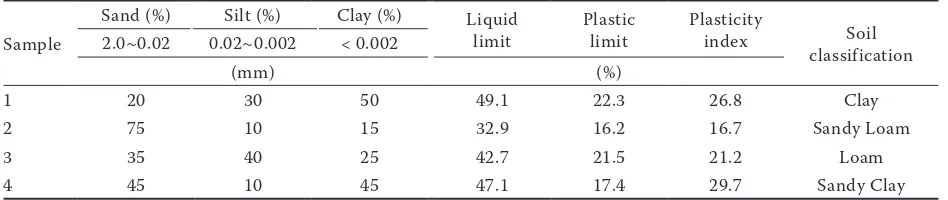
[image:2.595.65.290.94.267.2]Soil sample. Artificial soil samples were used to discuss the effect of soil composition on soil erosion easily in this study. Considering the initial situations of the rehabilitation process after soil backfilling, the physical characteristics of soil is the main factor to be related to soil erosion. Therefore, the chemical and biological characteristics of the soil are ignored in this study. Four soil samples were prepared by mixing a certain ratio of decomposed granite soil and bentonite which were not reactive materials. The soil compositions were determined based on the pre-survey in the mining field in Indonesia. Additionally, consistency indices which are the useful parameter to evaluate the erodibility of soil are also simulated with that of the mining field (De Ploey 1981). Table 1 shows the composition of soils prepared in this test. Sample 1 is classified as heavy clay which contains
Figure 1. Failure of revegetation due to the severe soil erosion in the rehabilitation area
Table 1. Soil composition
Sample
Sand (%) Silt (%) Clay (%) Liquid
limit Plastic limit Plasticity index Soil classification 2.0~0.02 0.02~0.002 < 0.002
(mm) (%)
1 20 30 50 49.1 22.3 26.8 Clay
2 75 10 15 32.9 16.2 16.7 Sandy Loam
3 35 40 25 42.7 21.5 21.2 Loam
[image:2.595.62.536.655.755.2]80% of the fine particles (silt and clay contents). On the other hand, sample 2 is a coarse-rich soil because it mainly contains the coarse size of soil particles (75% of sand content). Samples 3 and 4 are classified as light clay, but the ratios of coarse and fine contents are different.
Artificial rainfall experiment. A laboratory study was conducted to predict the amount of soil loss under various soil conditions by using an artificial rainfall simulator, which was prepared in our labora-tory. The advantages of this experiment are that soil erosion can be evaluated under the various condi-tions because it has flexibility for arranging rainfall intensity, topography and soil texture (Commandeur 1992). An artificial rainfall experiment is useful to assess soil erosion in the field in advance because this experiment can directly measure the amount of soil loss by rainfall. The equipment used is illustrated in
[image:3.595.79.287.91.353.2]Figure 2. Rainfall was simulated by drops of water free-falling, starting at zero velocity, from protrud-ing needles with an internal diameter of 0.9 mm (Dimogiannis et al. 2001). A dozen protruding nee-dles were installed every 10 mm. Furthermore, the artificial rainfall simulator was placed in the height of 4500 mm to achieve the terminal velocity of rain-drops. A rectangular-shaped bed sized 240 × 155 × 20 mm was filled with soil samples in a certain type of moisture content and soil hardness. Soil hardness is a parameter that can be measured by soil hardness equipment which shows the resistance force from the soil. This parameter could be used to assess the degree of soil compaction. The equipment used and the standard for evaluating the value is shown in Figure 3 and Table 2. The slope of the soil bed was changed by the pulley. The amount of soil erosion was defined by measuring the weight of soil loss after drying runoff water by oven with 105°C for 24 h. The soil loss was measured for 3 times for each experiment. Furthermore, the weight of coarse par-ticles (sand: 0.02~2 mm) and fine parpar-ticles (silt and clay: < 0.02 mm) were also measured in soil loss to discuss the effect of soil particle size on soil erosion. The conditions for the artificial rainfall experiment were determined to assume the rehabilitation area of open-cut mines in tropical regions as follows; rainfall intensity: 80 mm/h, duration of experiment: 60 min, slope angle: 35 degree, initial water content: 15%, bulk density: 1.5 g/cm3, soil hardness: 12~16 mm. The
[image:3.595.312.514.103.186.2]Figure 2. Schematic overview of rainfall simulator
Table 2. Standards for soil hardness test
Soil hardness (mm) Growing conditions of plants Evaluation of the planting base 27 < impossible for root growth insufficient
24~27 difficult for root growth bad 20~24 preventative for root growth sufficient 11~20 comfortable for root growth good < 11 inability for plant germination and settlement due to dryness sufficient
Water tank
Water inflow
Pressure head
Adjusting valve
h
Drop production needles
4500 mm
Soil bed
Figure 3. Soil hardness tester
Free movement
Scale of bearing
[image:3.595.64.539.670.756.2]data obtained from the artificial rainfall experiment are processed by using the Tukey-Kramer method to indicate the significant differences among results.
RESULTS AND DISCUSSION
Mechanism of soil erosion. Table 3 summarizes the results of artificial rainfall experiment. From these results, sample 4 that contains almost the same amount of coarse size and fine size shows the highest soil loss (77.24 g/h). On the other hand, sample 2 which is the most coarse-rich soil shows the lowest soil loss (27.16 g/h). These results are strongly affected by the generation of soil seal. Soil seal is formed by the impact of raindrop into the soil surface (Figure 4). The formation of a soil seal on soil surface usually reduces infiltration and increases runoff (Jing et al. 2008, Leary et al. 2009). Figure 5 shows the relationship between fine content and seal thickness. The seal thickness was measured by a visual check of soil cross-section. There is a good correlation between the two parameters. Sample 2 that shows the lowest soil loss does not generate soil seal because the fine content is not enough, meaning that soil loss is decreased in sample 2 due to the reduction of the surface runoff. Therefore,
soil erosion is strongly affected by soil seal which is generated under the fine-rich soil.
Figure 6 shows the relationship between coarse content and soil loss. The results show that soil loss is increased with an increase of coarse particles content in the soil which generates soil seal. This is due to two reasons. One is that coarse content is transported by surface runoff on the soil seal. Another is that the shear strength of soil seal is decreased by mixing coarse content.
[image:4.595.342.494.93.307.2]Accordingly, sample 4 that generates soil seal and contains much coarse content shows the highest soil loss due to transporting coarse particles by surface runoff and reduction of soil shear strength as a re-sistant force against soil erosion. As excessive soil erosion is suspected under such soil conditions, the effective countermeasure for minimizing soil erosion is discussed in the next section.
Table 3. Results of artificial rainfall experiment
Sample Soil loss Coarse grain loss Fine grain loss (g/h)
1 45.18b 4.20b 40.98a
2 27.16c 13.32ab 13.84b
3 51.90b 14.17ab 37.73ab
4 77.24a 22.01a 55.23a
[image:4.595.65.291.114.199.2]Different letters indicate the significant differences between the results at P < 0.05
Figure 4. Generation of soil seal
Soil seal
Soil seal
Soil layer
Figure 5. The relationship between fine content and
seal thickness Figure 6. The relationship between coarse content and soil loss
0 0.5 1.0 1.5 2.0 2.5 3.0
0 50 100
Se al th ic kn es s ( m m )
Fine content (%) Sample 1 Sample 2 Sample 3 Sample 4 0 20 40 60 80 100
0 20 40 60 80
So il lo ss (g )
Coarse content (%) Sample 1 Sample 2 Sample 3 Sample 4 0 0.5 1.0 1.5 2.0 2.5 3.0
0 50 100
Se al th ic kn es s ( m m )
Fine content (%) Sample 1 Sample 2 Sample 3 Sample 4 0 20 40 60 80 100
0 20 40 60 80
So il lo ss (g )
Coarse content (%) Sample 1 Sample 2 Sample 3 Sample 4 0 0.5 1.0 1.5 2.0 2.5 3.0
0 50 100
Se al th ic kn es s ( m m )
Fine content (%) Sample 1 Sample 2 Sample 3 Sample 4 0 20 40 60 80 100
0 20 40 60 80
So il lo ss (g )
Coarse content (%) Sample 1
[image:4.595.318.518.595.729.2] [image:4.595.78.277.595.729.2]Effective prevention of soil erosion. In this study, three control measures to prevent soil erosion are discussed as feasible methods to be applied in-situ: the effect of slope angle, the effect of soil compac-tion and applicacompac-tion of cover crops to the surface.
The purpose of arranging the slope angle for soil erosion is to control the tractive force through water flow. In this study, the slope angle was arranged by a pulley to 15 degrees.
Soil compaction inhibits root growth of planting. However, it can be contributed to the reduction of soil erosion due to increasing soil strength. This is discussed by arranging soil harnesses into compacted (19~21 mm) and loosened (8~10 mm) based on the previous test.
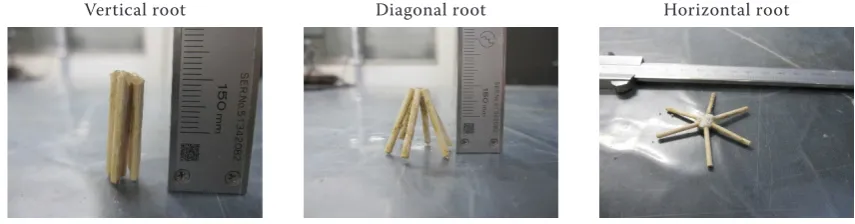
Vegetation has long been identified as the most effective way to minimize soil erosion and as an im-portant measure for soil conservation. Cover crops decrease soil detachment and transport by leaf cover and root establishment. Concerning the application of cover crops to the surface, the surface coverage was changed from 0% to 75% by an artificial plant made of aluminum foil with a toothpick (Figure 7). To discuss the effect of surface coverage solely without having an impact on surface runoff, the aluminum foil is a material for the cover which is waterproof to inhibit the water absorption and can be adjusted to the size of surface coverage easily. Furthermore, the effects of root on the reduction of soil erosion are dis-cussed by using three types of root model (Figure 8).
Considering the root growth, a half dozen of a tooth-pick of 10 mm and 20 mm length were used to make a root model and placed every 48 mm interval without overlapping each root (Figure 9).
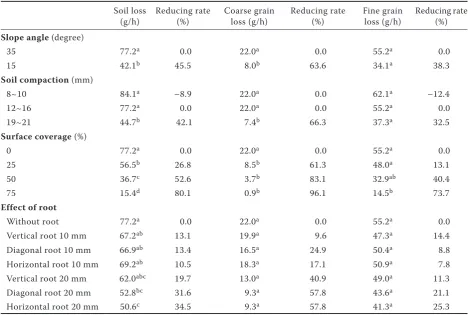
Table 4 summaries the results of reducing ratio for each countermeasure. Reducing rate was defined as the ratio of the decrement of soil loss based on the results of the previous experiment.
According to these results, the reducing rate of soil loss is 45.5% when the slope angle is 15 degree, mean-ing that the arrangmean-ing slope angle has a moderate ef-fect of reducing soil erosion. However, the thickness of the soil seal has not changed (Figure 10a). As the formation of soil seal is one of the main reasons to accelerate soil erosion, this countermeasure is not proper for fine-rich soil which generated it. However, the reducing rate of coarse content is 63.6% though that of fine content is 38.3%, meaning that it can be expected to have a certain level of effect for coarse-rich soil due to inhibition of transporting coarse particles by decreasing the tractive force through water flow.
[image:5.595.71.530.93.198.2]Soil compaction affects decreasing of the thickness of soil seal (Figure 10b) though the reducing rate of soil loss is not significantly different when the slope angle is changed (42.1% reduction when the soil is compacted). This is due to increasing soil strength against the impact of raindrops. In contrast to arrang-ing slope angle, it can be expected that this method is effective for fine-rich soils that generate soil seal.
Figure 7. Surface coverage by the artificial plant
0% surface coverage 25% surface coverage 50% surface coverage 75% surface coverage
Figure 8. Root model
[image:5.595.82.510.630.742.2]The wide range of surface coverage by cover crops is the most effective method to minimize soil erosion because the reducing rate of soil loss is the highest in this study: the reducing rate is more than 80% when the surface coverage is 75%. Considering that this experiment is carried out under high rainfall intensity and the thickness of soil seal is decreased with an increase of surface coverage as shown in
Figure 10c, it can be hypothesized that this reduction is attributed to the decreasing impact to the surface by raindrops. Gyuricza et al. (2015) also indicated the surface coverage reduced the thickness of soil seal with an increase of surface cover ratio. In other words, the best practice to minimize soil erosion in a tropical region is to inhibit the impact of rain-drops to surface. Besides, the prevention effect on soil erosion can be expected by the root establish-ment when the cover crops are planted. From the results of the effect of the root, a certain effect of decreasing soil erosion from 10.5% to 34.5% is found. Additionally, the reducing rate of 20 mm root length is higher than that of 10 mm length, meaning that the effect is advanced with root growth in all types of root. However, the reducing rate of soil loss in the vertical root is 19.7% when the length of the root is 20 mm; it is lower than that of other types of the root. This finding indicates that the root growth to the vertical direction does not significantly contribute to the reduction of soil erosion. From the results shown in Table 4, the reducing rate of fine grain loss in the vertical root is almost constant regardless the
[image:6.595.63.534.427.742.2]Figure 9. The layout of the root model (top view)
Table 4. Results of reducing rate for each countermeasure
Soil loss
(g/h) Reducing rate (%) Coarse grain loss (g/h) Reducing rate (%) Fine grain loss (g/h) Reducing rate (%)
Slope angle (degree)
35 77.2a 0.0 22.0a 0.0 55.2a 0.0
15 42.1b 45.5 8.0b 63.6 34.1a 38.3
Soil compaction (mm)
8~10 84.1a –8.9 22.0a 0.0 62.1a –12.4
12~16 77.2a 0.0 22.0a 0.0 55.2a 0.0
19~21 44.7b 42.1 7.4b 66.3 37.3a 32.5
Surface coverage (%)
0 77.2a 0.0 22.0a 0.0 55.2a 0.0
25 56.5b 26.8 8.5b 61.3 48.0a 13.1
50 36.7c 52.6 3.7b 83.1 32.9ab 40.4
75 15.4d 80.1 0.9b 96.1 14.5b 73.7
Effect of root
Without root 77.2a 0.0 22.0a 0.0 55.2a 0.0
Vertical root 10 mm 67.2ab 13.1 19.9a 9.6 47.3a 14.4
Diagonal root 10 mm 66.9ab 13.4 16.5a 24.9 50.4a 8.8
Horizontal root 10 mm 69.2ab 10.5 18.3a 17.1 50.9a 7.8
Vertical root 20 mm 62.0abc 19.7 13.0a 40.9 49.0a 11.3
Diagonal root 20 mm 52.8bc 31.6 9.3a 57.8 43.6a 21.1
Horizontal root 20 mm 50.6c 34.5 9.3a 57.8 41.3a 25.3
Different letters indicate the significant differences between the results at P < 0.05 Simulated root
240 mm 155 mm
Soil sample 48 mm
root length while the elongation of root improves the reducing rate of fine grain from 8.8% to 21.1% for the diagonal root and from 7.8% to 25.3% for the horizontal root, respectively. Considering that the seal thickness is not different for any type of root from Figure 10d, this is attributed to the reinforc-ing effect of soil shear strength as a resistant force against soil erosion. Plant root reinforces the soil by anchoring a weak soil mass to fractures in bed-rock, by crossing zones of weakness to more stable soil, and by providing long fibrous binders within a weak soil mass (Gray 1970, Waldron 1977). In this test, it can be hypothesized that soil loss is reduced in diagonal and horizontal root by reinforcing the soil seal as described above compared with that of vertical root due to the higher root density in the soil seal. Therefore, it can be said that selecting cover crops which have the root system to extend the wider range of soil surface should also be taken into consideration to minimize soil erosion in the rehabilitation area.
REFERENCES
Carroil C., Tucker A. (2000): Effects of pasture cover on soil erosion and water quality on central Queensland coal mine rehabilita-tion. Tropical Grasslands, 34: 254–262.
Commandeur P.R. (1992): Soil erosion studies using rainfall simula-tion on forest harvested areas in British Colombia. In: Proceed-ings of the International Symposium on Erosion, Debris Flows and Environment in Mountain Regions. Chengdu, July 1992. Davidová T., Dostál T., David V., Strauss P. (2015): Determining the
protective effect of agricultural crops on the soil erosion process using a field rainfall simulator. Plant, Soil and Environment, 61: 109–115.
De Ploey J. (1981): Some laboratory techniques for investigating land erosion. Erosion and Sediment Transport Measurements. In: Proceedings of the Florence Symposium, June 1981). Interna-tional Association of Hydrological Sciences, 133: 423–431. Dimogiannis D.G., Valmis S., Vyrlas P. (2001): A rainfall simulation
study of erosion of some calcareous soils. Global NEST Journal, 3: 179–183.
Ehiorobo J.O., Izinyon O.C. (2013): Monitoring of soil loss from ero-sion using geoinformatics and geotechnical engineering methods. Journal of Civil Engineering and Architecture, 7: 78–84.
Gray D.H. (1970): Effects of forest clear-cutting on the stability of natural slopes: Results of field studies: Interim report. Bulletin of Engineering Geology and the Environment, 7: 45–67.
Gyuricza C., Smutný V., Percze A., Pósa B., Birkás M. (2015): Soil condition threats in two seasons of extreme weather conditions. Plant, Soil and Environment, 61: 151–157.
[image:7.595.100.506.95.350.2]Hamanakaa A., Inouea N., Shimadaa H., Sasaokaa T., Matsui K., Miyajima I. (2015): Design of self-sustainable land surface against soil erosion at rehabilitation areas in open-cut mines in
Figure 10. The thickness of soil seal. (a) Slope angle; (b) soil compaction; (c) surface coverage and (d) effect of root 0 0.5 1.0 1.5 2.0 2.5 3.0
0 10 20 30 40
Se al th ic kn es s ( m m )
Slope angle (degree)
0 0.5 1.0 1.5 2.0 2.5 3.0
0 5 10 15 20 25
Se al th ic kn es s ( m m )
Soil hardness (mm)
0 0.5 1.0 1.5 2.0 2.5 3.0
0 20 40 60 80
Se al th ic kn es s ( m m )
Surface coverage (%)
0 0.5 1.0 1.5 2.0 2.5 3.0
0 10 20 30
Se al th ic kn es s ( m m )
Length of roots (mm)
Vertical root Diagonal root Horizontal root (a) (b) (c) (d) 0 0.5 1.0 1.5 2.0 2.5 3.0
0 10 20 30 40
Se al th ic kn es s ( m m )
Slope angle (degree)
0 0.5 1.0 1.5 2.0 2.5 3.0
0 5 10 15 20 25
Se al th ic kn es s ( m m )
Soil hardness (mm)
0 0.5 1.0 1.5 2.0 2.5 3.0
0 20 40 60 80
Se al th ic kn es s ( m m )
Surface coverage (%)
0 0.5 1.0 1.5 2.0 2.5 3.0
0 10 20 30
Se al th ic kn es s ( m m )
Length of roots (mm)
tropical regions. International Journal of Mining, Reclamation and Environment, 29: 305–315.
Jha V.C., Kapat S. (2009): Rill and gully erosion risk of lateritic ter-rain in South-Western Birbhum District, West Bengal, India. So-ciedade and Natureza, 21: 141–158.
Jing Y.-S., Zhang B., Thimm A., Zepp H. (2008): Anisotropy of soil hydraulic properties along arable slopes. Pedosphere, 18: 353–362. Leary D., Dicarlo D., Hickey C. (2009): Acoustic techniques for
studying soil-surface seals and crusts. Ecohydrology, 2: 257–262. Mati B.M., Morgan R.P.C., Gichuki F.N., Quinton J.N., Brewer T.R.,
Liniger H.P. (2000): Assessment of erosion hazard with the USLE and GIS: A case study of the Upper Ewaso Ng’iro North basin of Kenya. International Journal of Applied Earth Observation and Geoinformation, 2: 78–86.
Matsumoto S., Ogata S., Shimada H., Sasaoka T., Hamanaka A., Ku-suma G.J. (2018): Effects of pH-induced changes in soil physical characteristics on the development of soil water erosion. Geosci-ences, 8: 134.
Montgomery D.R. (2007): Soil erosion and agricultural sustain-ability. Proceedings of the National Academy of Sciences of the United States of America, 104: 13268–13272.
Nearing M.A., Jetten V., Baffaut C., Cerdan O., Couturier A., Hernandez M., Le Bissonnais Y., Nichols M.H., Nunes J.P., Renschler C.S., Sou-chére V., van Oost K. (2005): Modeling response of soil erosion and runoff to changes in precipitation and cover. Catena, 61: 131–154.
Pimentel D., Harvey C., Resosudarmo P., Sinclair K., Kurz D., Mc-Nair M., Crist S., Shpritz L., Fitton L., Saffouri R., Blair R. (1995): Environmental and economic costs of soil erosion and conserva-tion benefits. Science, 267: 1117–1123.
Shi H., Shao M.G. (2000): Soil and water loss from the Loess Plateau in China. Journal of Arid Environments, 45: 9–20.
Übelhör A., Gruber S., Schlayer M., Claupein W. (2014): Influence of row covers on soil loss and plant growth in white cabbage cul-tivation. Plant, Soil and Environment, 60: 407–412.
Valentin C., d’Herbés J.M., Poesen J. (1999): Soil and water compo-nents of banded vegetation patterns. Catena, 37: 1–24. Waldron L.J. (1977): The shear resistance of root-permeated
ho-mogeneous and stratified soil. Soil Science Society of America Journal, 41: 843–849.
Wang H., Wang X., Hao M., Li J. (2015): Effects of straw cover-ing methods on runoff and soil erosion in summer maize field on the Loess Plateau of China. Plant, Soil and Environment, 61: 176–181.
Yellishetty M., Mudd G.M., Shukla R. (2013): Prediction of soil ero-sion from waste dumps of opencast mines and evaluation of their impacts on the environment. International Journal of Mining, Reclamation and Environment, 27: 88–102.
Zuazo V.H.D., Pleguezuelo C.R.R. (2008): Soil-erosion and runoff prevention by plant covers. A review. Agronomy for Sustainable Development, 28: 65–86.