Propositional Satisfiability
Jo˜ao Marques-Silva
Department of Informatics, Technical University of Lisbon, IST/INESC/CEL, Lisbon, Portugal
Abstract. The ability to reduce either the number of variables or clauses in instances of the Satisfiability problem (SAT) impacts the expected computational effort of solving a given instance. This ability can actu-ally be essential for specific andhardclasses of instances. The objective of this paper is to propose new simplification techniques for Conjunctive Normal Form (CNF) formulas. Experimental results, obtainedon rep-resentative problem instances, indicate that large simplifications can be observed.
1
Introduction
Recent years have seen the proposal of several effective algorithms for solving Propositional Satisfiability (SAT), that include, among others, local search and variations, backtrack search improved with different search pruning techniques, backtrack search with randomization and restarts, continuous formulations and algebraic manipulation. (These different algorithms are further described and cited in [3].) Moreover, these algorithms have allowed efficiently solving different classes of instances of SAT. It is generally accepted that whereas most algo-rithms for solving SATcan be competitive in proving satisfiability for different classes of instances, backtrack search is preferred when the objective is to prove unsatisfiability. Nevertheless, algebraic simplification solutions are also known to be competitive for proving unsatisfiability in specific contexts [2].
The main goal of this paper is to propose and categorize new simplification techniques, and illustrate the effectiveness of algebraic simplification as a pre-processing tool for SATalgorithms. Moreover, we illustrate the application of the proposed simplification techniques in real-world instances of SAT.
The paper is organized as follows. We start with a few definitions in Section2. Next we address algebraic simplification, namely the techniques in this paper. Section4 provides experimental results on applying the proposed simplification techniques on real-world instances of SAT. Finally, Section5concludes the paper.
2
Definitions
This section introduces the notational framework used throughout the paper. Propositional variables are denotedx1, . . . , xn, and can be assigned truth values 0
R. Dechter (Ed.): CP 2000, LNCS 1894, pp. 537–542, 2000. c
(orF) or 1 (or T). In addition to letterx, and whenever necessary, we will use lettersy,w andzto denote variables. To denote specific variables we may also usexi, xj, xk, . . .. A literall is either a variablexi (i.e. a positive literal) or its complement¬xi(i.e. a negative literal). A clauseωis a disjunction of literals and a CNF formula ϕis a conjunction of clauses. When referring to specific clauses we will utilize subscriptsa, b, . . ., and when referring to sub-formulas of a CNF formula we will utilize subscriptsr, s, . . .. Disjunctions of literals, not necessarily representing clauses will be represented asα, β, γ, δ, .
3
Algebraic Simplification
Different formula simplification techniques have been proposed over the years. A detailed account of these techniques if provided in [3]. In this section we concentrate on two new techniques, namelysupport-set variable equivalenceand
inference of binary clauses.
3.1 Support Set Variable Equivalence
In many practical situations, a sub-formula ϕs of a CNF formula ϕ actually
describes a Boolean functionxi =f(y1, . . . , yk). For example, the sub-formula
ϕa = (y1∨ ¬x)∧(y2∨ ¬x)∧(¬y1∨ ¬y2∨x) describes the Boolean function
x=y1∧y2. More interestingly, if we have two sub-formulasϕa = (y1∨ ¬x)∧
(y2∨ ¬x)∧(¬y1∨ ¬y2∨x) andϕb= (y1∨ ¬z)∧(y2∨ ¬z)∧(¬y1∨ ¬y2∨z), then
we can conclude that x=y1∧y2 and z =y1∧y2. Hence, x and z are indeed equivalentand we can replacezwithxand vice-versa. Observe that, by suitable resolution operations, we could easily derive the clauses (x∨ ¬z)∧(¬x∨z), obtaining the same conclusion.
The previous example suggests a pattern-matching approach for identifying a setEof variables that can be expressed as a Boolean functionf of some other set S of variables (i.e.,the support set) and thus replace the variables in setE by a single variable. This approach is simply too time consuming for sets S of arbitrary size, and so we restrictS to be of size 2, i.e. we only consider Boolean functions of two variables.
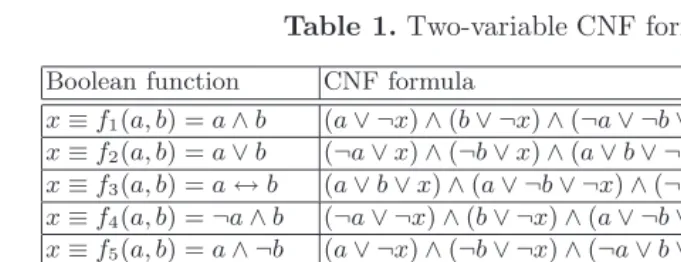
If the support setSis restricted to be of size 2, it becomes feasible to enumer-ate all possible Boolean functions of 2 variables, and determine theirredundant
CNF formulas associated with each Boolean function. This information is shown in Table1. (Observe that the missing six boolean functions are either constant 0 or 1, the actual function of asinglevariable or of its complement.) We can now apply a straightforward pattern matching algorithm to a CNF formula, and iden-tify setsEof variables with a common two-variable support set. These variables can then be replaced by a single variable. Clearly, after variable replacement we can apply well-known formula simplification techniques [3].
Table 1.Two-variable CNF formulas
Boolean function CNF formula
x≡f1(a, b) =a∧b (a∨ ¬x)∧(b∨ ¬x)∧(¬a∨ ¬b∨x) x≡f2(a, b) =a∨b (¬a∨x)∧(¬b∨x)∧(a∨b∨ ¬x)
x≡f3(a, b) =a↔b (a∨b∨x)∧(a∨ ¬b∨ ¬x)∧(¬a∨ ¬b∨x)∧(¬a∨b∨ ¬x) x≡f4(a, b) =¬a∧b (¬a∨ ¬x)∧(b∨ ¬x)∧(a∨ ¬b∨x)
x≡f5(a, b) =a∧ ¬b (a∨ ¬x)∧(¬b∨ ¬x)∧(¬a∨b∨x) x≡f6(a, b) =¬(a∧b) (a∨x)∧(b∨x)∧(¬a∨ ¬b∨ ¬x) x≡f7(a, b) =¬(a∨b) (¬a∨ ¬x)∧(¬b∨ ¬x)∧(a∨b∨x)
x≡f8(a, b) =¬(a↔b) (a∨b∨ ¬x)∧(a∨ ¬b∨x)∧(¬a∨b∨x)∧(¬a∨ ¬b∨ ¬x) x≡f9(a, b) =a∨ ¬b (¬a∨x)∧(b∨x)∧(a∨ ¬b∨ ¬x)
x≡f10(a, b) =¬a∨b (a∨x)∧(¬b∨x)∧(¬a∨b∨ ¬x)
Another interesting result, is that the equivalence reasoning conditions proposed by C.-M. Li in [2] are also superseded by support set equivalences andselective resolution (see [1,3] for a definition). We should observe, in particular, that the utilization of function f3 on two variables x= (a ↔ b) and y = (a ↔ b), for
deriving the equivalence between x and y, corresponds to Li’s inference rule (5) [2], the other rules being superseded by selective resolution, unit-clause rule and two-variable equivalence.
Despite the potential interest of identifying support sets of variables in a CNF formula, in the next section a further generalization is proposed, that subsumes variable equivalences based on two-variable support sets.
3.2 Generalized Inference of Binary Clauses
In this section we propose to study subsets of clauses for inferring binary clauses, which not only identify support set equivalences, but also provide more general conditions for deriving binary clauses. In what follows, all proposed conditions can be explained by resorting to resolution. However, it is in general extremely hard to decide to which clauses the resolution operation should be applied to, being computationally infeasible to apply the resolution operation to all possible pairs of clauses. The objective of studying sets of clauses is to indirectly select to which sets of clauses the resolution operation should be applied to.
Moreover, the reasoning technique to be described below is categorized in terms of how many binary clauses and ternary clauses are involved. Clearly, the size and number of k-ary clauses involved could be made arbitrary, but the computational overhead could become prohibitive. In general each proposed condition is classified as being of the form mB/nT, meaning that m binary clauses andnternary clauses are involved.
Let us start by considering an illustrative example. Let ϕc = (y1∨ ¬x)∧
(y2∨ ¬x)∧(¬y1∨ ¬y2∨z) be a sub-formula. The application of the resolution
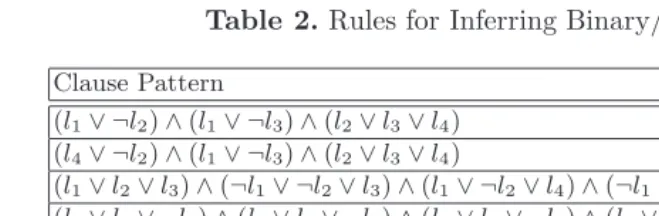
Table 2.Rules for Inferring Binary/Unit Clauses
Clause Pattern InferredClause(s)
(l1∨ ¬l2)∧(l1∨ ¬l3)∧(l2∨l3∨l4) (l1∨l4) (l4∨ ¬l2)∧(l1∨ ¬l3)∧(l2∨l3∨l4) (¬l3∨l4),(l1∨l4) (l1∨l2∨l3)∧(¬l1∨ ¬l2∨l3)∧(l1∨ ¬l2∨l4)∧(¬l1∨l2∨l4) (l3∨l4) (l1∨l2∨ ¬l3)∧(l1∨l2∨ ¬l4)∧(l1∨l2∨ ¬l5)∧(l3∨l4∨l5) (l1∨l2) (l1∨l2)∧(¬l1∨l2∨l3) (l2∨l3) (l1∨ ¬l2)∧(l1∨ ¬l3)∧(l1∨ ¬l4)∧(l2∨l3∨l4) (l1) (l1∨l2∨ ¬l3)∧(l1∨l2∨ ¬l4)∧(l3∨l4) (l1∨l2) (l1∨l2)∧(¬l1∨l3∨l4)∧(l2∨l3∨ ¬l4) (l2∨l3)
allows deriving the clause (x∨ ¬z). It is interesting to observe that we have just illustrated a different approach for provingxequivalent tozfor the first example of the previous section.
In general, let us consider a sub-formula of the formϕs = (l1∨ ¬l2)∧(l1∨
¬l3)∧(l2∨l3∨l4), wherel1, . . . , l4are any literals. The application of resolution
allows deriving the binary clause (l1∨l4). Since 2 binary clauses and 1 ternary
clause are involved in deriving the resulting binary clause, we say that 2B/1T reasoning was applied. The other form of 2B/1Treasoning is the following. Let the sub-formula beϕt= (l4∨ ¬l2)∧(l1∨ ¬l3)∧(l2∨l3∨l4). Then, application
of resolution allows deriving the binary clauses (l3∨l4) and (l1∨l4).
Additional forms of mB/nTreasoning can be established. Due to efficiency concerns, our analysis will be restricted to 2B/1T, 1B/1T, 1B/2T, 3B/1Tand 0B/4T. The resulting set of unit/binary clause inference rules is summarized in Table 2. Moreover, and from the previous examples and claims, we can readily conclude that support set variable equivalence (described in the previous section) is superseded by 2B/1Tand 0B/4Treasoning.
4
Experimental Results
This section evaluates the practical application of the algebraic simplification techniques described in this paper. These techniques can be evaluated according to two main metrics:
– The ability to effectively simplify the original formula.
– The effective reduction in the amount of search, when using formula simpli-fication techniques within a preprocessing engine for backtrack search SAT algorithms.
In this paper we concentrate on the ability to simplify the original formula. The reduction in the amount of search is analyzed in [3]. Moreover, the problem instances used in this section are also described in [3]
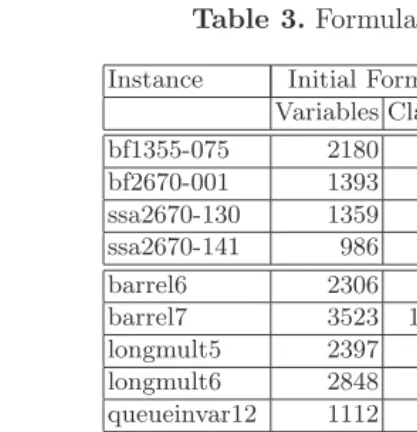
Table 3.Formula Simplification
Instance Initial Formula Final Formula Variables Clauses Variables Clauses bf1355-075 2180 6778 722 3075 bf2670-001 1393 3434 411 1252 ssa2670-130 1359 3321 440 1295 ssa2670-141 986 2315 283 883
barrel6 2306 8931 519 2209 barrel7 3523 13765 805 3467 longmult5 2397 7431 1483 5180 longmult6 2848 8853 1824 6376 queueinvar12 1112 7335 1049 9884 queueinvar16 1168 6496 1088 7114 c1908 1917 5096 658 2248 c1908 bug 1919 5100 659 2250 c2670 2703 6756 1220 3725 c2670 bug 2708 6696 1162 3553 dlx2 cc bug02 1515 12808 1486 13965 dlx2 cc bug08 1515 12808 1486 13890
the instances considered, large reductions in the number of variables and clauses can be achieved. In some cases (e.g. barrel6 and barrel7) the final number of variables is one fourth of the original number. Similar reductions can be observed in the number of clauses. Nevertheless, for some instances (e.g. queueinvar16
and dlx2 cc bug08) the amount of simplification in the number of variables is negligible. In these cases, it is interesting to observe an increase in the number of clauses, due to the application of clause inference techniques (see Section3.2).
5
Conclusions
This paper proposes new techniques for the algebraic simplification of proposi-tional formulas. These techniques have been incorporated into a preprocessing system to be used with any SATalgorithm. Preliminary experimental results, obtained on real-world instances of SAT, clearly demonstrate the effectiveness of the proposed techniques, allowing significant reductions in the sizes of the resulting CNF formulas.
References
1. J. F. Groote andJ. P. Warners. The propositional formula checker heerhugo. Tech-nical Report SEN-R9905, CWI, January 1999. 538,539
2. C.-M. Li. Integrating equivalency reasoning into davis-putnam procedure. In Pro-ceedings of the National Conference on Artificial Intelligence, August 2000. Ac-ceptedfor publication. 537,539
3. J. P. Marques-Silva. Algebraic simplification techniques for propositional satisfia-bility. Technical Report RT/01/2000, INESC, March 2000. 537,538,539,540