EOID the electrons generated by a microchannel elec-tron multiplier array are converted to photons by a phosphor screen and detected via an array of photo-diodes (Figure 7). Very high sensitivites have been reported, with benzene being detected at 7.5;10\14g levels.
Multidimensional gas chromatography (MDGC) is another technique that seeks to overcome the prob-lems involved in the analysis of multicomponent mix-tures of volatile constituents. It is based on the separ-ation of the constituents via one column and isolating the coeluted species in one or more cryotraps to be separated by a second column of different selectivity. MDGC is usually coupled with detectors such as IR and MS for increased speciRcity.
GC-MS has emerged as one of the premier methods for the rapid, convenient and sensitive analysis of pollutants. This development is partly a result of the public concern and legislative pressure for reliable monitoring of environmental quality. The commer-cial availability of relatively inexpensive, computer-interfaced, bench-top instruments has rendered the technique almost routine for cost-effective analysis. Even greater speeds and resolving powers of the fu-ture generations of instruments will augment the sig-niRcance of GC-MS in the environmentalReld.
See also: II/Chromatography: Gas: Detectors: Mass Spectrometry. Extraction: Solid-Phase Extraction. III/ Fungicides: Gas Chromatography. Herbicides: Gas Chromatography. Pesticides: Gas Chromatography. chlorinated Biphenyls: Gas Chromatography. Poly-cylic Aromatic Hydrocarbons: Gas Chromatography.
Further Reading
Berezkin VG and Drugov YS (1991)Gas Chromatography in Air Pollution Analysis. Amsterdam: Elsevier. Black RM, Clarke RJ, Read RW and Reid TJ (1994)
Ap-plication of gas chromatography}mass spectrometry and gas chromatography}tandem mass spectrometry
to the analysis of chemical warfare samples, found to contain residues of the nerve agent sarin, sulphur mus-tard and their degradation products.Journal of Chrom-atography A662: 301}321.
Bruner F (1993) Gas Chromatographic Environmental Analysis. New York: VCH Publishers.
Claussen FA (1997) Arsenic speciation of aqueous environ-mental samples by derivatization with thioglycolic acid methyl ester and capillary gas}liquid chromatography} mass spectrometry.Journal of Chromatographic Science
35: 568}572.
Jones FE (1994)Toxic Organic Vapors in the Workplace. Boca Raton, FL: Lewis Publishers.
Karasek FW, Hutzinger O and Safe S (eds.) (1985)Mass Spectrometry in the Environmental Sciences. New York: Plenum Press.
Keith LH (ed.) (1992)Compilation of E.P.A.’s Sampling and Analysis Methods. Grand Rapids, MI: Lewis Pub-lishers.
Sinha MP and Gutnikov G (1991) Development of a Minia-turized Gas Chromatograph}Mass Spectrometer with a Microbore Capillary Column and an Array Detector.
Analytical Chemistry63, 2012}2016.
Subramanian G (ed.) (1995)Quality Assurance in Environ-mental Monitoring,Instrumental Methods. Weinheim: VCH Publishers.
Tamilarasan R, Morabito PL, Lamparski L, Hazel-wood P and Butt A (1994) Determination of neutral chlorinated extractable organic compounds in water samples using large volume on-column injection capillary gas chromatography}mass spectrometry.
Journal of High Resolution Chromatography 17: 689}694.
Wang Z, Fingas M, Landriault Met al. (1998) IdentiR ca-tion and linkage of tarballs from the coasts of Vancouver Island and Northern California using GC/MS and iso-topic techniques. Journal of High Resolution Chrom-atography21(7): 383}395.
Wilkins CL (1994) Multidimensional GC for qualitative IR and MS of mixtures. Analytical Chemistry 66(5): 295A}301A.
Winegar ED and Keith LH (eds.) (1993) Sampling and Analysis of Airborne Pollutants. Boca Raton, FL: Lewis Publishers.
Pressurized Fluid Extraction
S. R. Sumpter, DuPont Agricultural Products, Wilmington, DE, USA
Copyright^ 2000 Academic Press
Introduction
PressurizedSuid extraction (PFE) is used to extract a wide variety of compounds from solid and semi-solid environmental samples. Soil is the predominant environmental solid extracted. Sediment samples are
also frequently extracted. Sludge, chimney brick,Sy ash and urban dust comprise other materials that are extracted using PFE. There are several reasons to use pressurized Suid extraction for environmental samples. PFE methods are:
E automated E easy to transfer
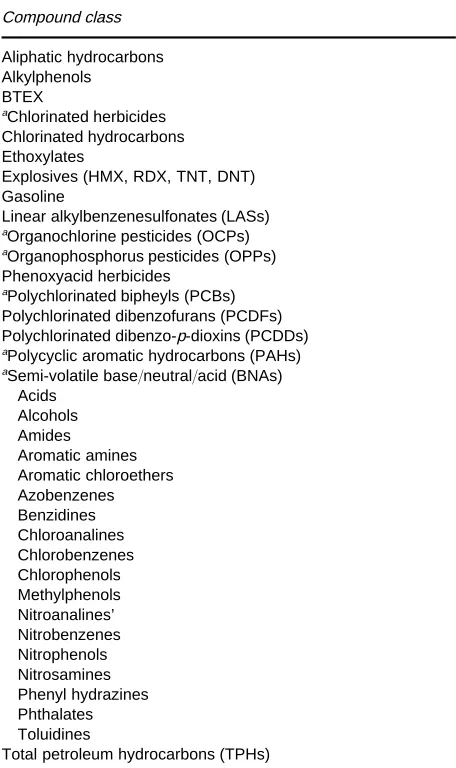
Table 1 Compound classes of environmental importance extracted using pressurized fluid extraction
Compound class
Aliphatic hydrocarbons Alkylphenols
BTEX
aChlorinated herbicides
Chlorinated hydrocarbons Ethoxylates
Explosives (HMX, RDX, TNT, DNT) Gasoline
Linear alkylbenzenesulfonates (LASs)
aOrganochlorine pesticides (OCPs) aOrganophosphorus pesticides (OPPs)
Phenoxyacid herbicides
aPolychlorinated bipheyls (PCBs)
Polychlorinated dibenzofurans (PCDFs) Polychlorinated dibenzo-p-dioxins (PCDDs)
aPolycyclic aromatic hydrocarbons (PAHs) aSemi-volatile base/neutral/acid (BNAs)
Acids Alcohols Amides Aromatic amines Aromatic chloroethers Azobenzenes Benzidines Chloroanalines Chlorobenzenes Chlorophenols Methylphenols Nitroanalines’ Nitrobenzenes Nitrophenols Nitrosamines Phenyl hydrazines Phthalates Toluidines
Total petroleum hydrocarbons (TPHs)
aCompounds extracted using U.S. EPA Method 3545.
E simple, requiring little expertise E acceptable to regulatory agencies.
Several PFE methods have been developed to extract compounds from environmental samples. These are listed inTable 1. These methods are summarized in the sections that follow. One promulgated method in particular has extensive applicability. This method is United States Environmental Protection Agency (EPA) Method 3545. It is suitable for the extraction of several compound classes from environmental solid and semisolid samples. Compound classes listed in Table 1 that are extracted using EPA Method 3545 are noted.
The authors of EPA Method 3545 found the PFE method gives recoveries comparable to those ob-tained by rigorous Soxhlet extraction and other tech-niques, such as shaking, supercritical Suid and sonication extraction methods. Compared to these techniques, PFE takes less time ((30 min) and con-sumes less solvent (15}30 mL). Using PFE, the method is applicable to the extraction of poly-chlorinated biphenyls (PCBs), semi-volatile base/ neutral/acids (BNAs), organophosphorous pesticides (OPPs) organochlorine pesticides (OCPs), polycyclic aromatic hydrocarbons (PAHs) and chlorinated herbicides from soil. Of all of the extraction condi-tions, only the extraction solvent is changed when extracting different compound classes. For example, acetone}hexane is used to extract a sample when analysing for OCPs and PCBs, methylene chlor-ide}acetone is used to extract a sample when analys-ing BNAs and OPPs, and acetone}methylene chloride acidiRed with phosphoric acid is used to extract a sample when analysing for chlorinated herbicides. Extraction conditions for Method 3545 are shown in
Table 2.
Relative recoveries of the PFE method (Method 3545) compared to other methods such as shaking or sonication extraction are summarized in Table 3. In this work, relative recoveries are the quotient of PFE recoveries divided by shaking, sonication, or Soxhlet extraction recoveries.
The following sections summarize details of critical sample preparation steps that are necessary before PFE, as well as the conditions used to extract the compounds listed inTable 1.
Applications
Aliphatic Hydrocarbons
Aliphatic hydrocarbons are readily extracted by PFE using aqueous and organic extraction solvents. Using organic extraction solvent, pentane, nonane, decane,
undecane, tetradecane, and pentadecane are efR -ciently extracted using the conditions listed in
Table 4. Due to its volatility, pentane recoveries are the lowest of these analytes. Pentane boils at 363C, so special precautions are required to keep it from evaporating from the extraction cell before the extraction is performed. To prevent loss of pen-tane, extraction cells are cooled and aluminium reten-tion discs are added into the tops of the extracreten-tion cells.
Water in the form of super-heated steam may also be used to extract aliphatic hydrocarbons. Dodecane, pentadecane, octadecane, heneicosane, tetracosane, heptacosane, triacontane, and tritriacontane are efR -ciently extracted from solid and semi-solid envi-ronmental samples using the conditions listed in
Table 2 Summary of sample preparation and extraction conditions used in EPA Method 3454 to extract PCBs, semi-volatile BNAs, OPPs, OCPs and chlorinated herbicides from solid and semisolid environmental samples
Extraction conditions Extraction analysis conditions
Sample preparation Grind sample to 100}200 mesh (150}75m particle size) Dispersing or drying agent Mix sample with anhydrous sodium sulfate or diatomaceous earth Sample size Up to 30 g if a dispersing agent is not used
Extraction cell volume 11, 22, or 33 mL cell, depending on sample size Extraction solvent OCPs and PCBs: 1 : 1 acetone : hexane
BNAs and OPPs: 1 : 1 methylene chloride : acetone
Chlorinated herbicides: 2 : 1 acetone : methylene chloride acidified with phosphoric acid
Temperature 1003C
Heat step 5 min
Static time 5 min
Flow type Static, dynamic, or mix of both
Number of cycles 1}5
Extraction pressure 2000 psi
Flush volume 60%of cell volume
Purge time 60 s
[image:3.568.51.518.602.688.2]Extraction conditions from USEPA SW-846, 3rd edn., Update III (July 1995) Test methods for evaluating solid waste, Method 3545, Accelerated solvent extraction. U.S. GPO: Washington, DC.
Table 3 Summary of pressurized fluid extraction validation data for EPA Method 3545. Reported relative recoveries for the various compounds are the results of the PFE method used divided by the U.S. EPA reference methods listed
Compound class U.S. EPA reference method %Relative recovery
Chlorinated herbicides 8150A (shake method) 113
Organochlorine pesticides 3541 (automated Soxhlet) 97
Organophosphorous pesticides 3540 (Soxhlet) 99
Polychlorinated biphenyls 3540 (Soxhlet) 98
Polycyclic aromatic hydrocarbons 3540 (Soxhlet) 105
Semivolatile base/neutral/acids 3541 (automated Soxhlet) 99
Data compiled from the following sources: Ezzell (1998)American Environmental Laboratory January/February 24; Ezzellet al. (1995) LC.GC 13: 390; and Richter et al. (1995) American Laboratory February, 24.
Alkylphenols
Alkylphenols are metabolites of alkylphenol ethoxyl-ates: a class of non-ionic surfactants that were used as cleaning agents and stillRnd use today. Alkylphenols are monitored in the environment as they pose poten-tial risk to animals. Time, and the amount of organic solvent, are saved in the pressurizedSuid extraction of alkylphenols from sediment. For the extraction, CO2extraction solvent is modiRed with organic sol-vent. Either methanol, ethanol, 1-butanol, 2-pro-panol, acetone, or dioxane may be used. Sediment spiked with heptylphenol and nonylphenol is extrac-ted with 100% recovery after 15 min extraction times. Longer times are required to extract 100% nonylphenol from the sediment. A dynamic extrac-tion time of 60 min with 27.5% methanol does not completely extract aged nonylphenol from soil.
Table 6shows a summary of sample preparation and extraction conditions for alkylphenols.
If the extractor does not allow the use of CO2, 100% methanol, ethanol, 1-butanol, 2-propanol,
acetone, or dioxan may be used as the extraction solvent. Since the solvent is typically evaporated be-fore analysis, the most volatile solvent should be used.
BTEX (Benzene, Toluene, Ethylbenzene, and Xylene)
BTEX (benzene, toluene, ethylbenzene, and xylene) mixtures are efRciently extracted from solid and semisolid environmental samples by PFE using or-ganic and aqueous solvents. BTEX mixtures are ex-tracted from sand spiked with BTEX by PFE using organic solvent and standard conditions described in Table 4. BTEX mixtures are also quantitatively ex-tracted by subcritical water using the conditions listed in Table 5.
Ethoxylates
Table 4 Summary of standard sample preparation and extrac-tion condiextrac-tions used to extract aliphatic hydrocarbons, BTEX, gasoline and TPH from soil
Extraction conditions Extraction/analysis conditions
Dispersing or drying agent None used
Sample size 10 g
Extraction cell volume 11 mL
Extraction solvent Methylene chloride for aliphatic hydrocarbons and BTEX
Temperature 1003C
Heat step 5 min
Static time 5 min
Flow type Mix of both static and dynamic
extraction
Number of cycles 1
Extraction pressure 1500 psi
[image:4.568.288.518.104.380.2]Extraction conditions from Ezzell JL and Richter BE (1996) Ameri-can Environmental Laboratory February, 16.
Table 5 Summary of sample preparation and extraction condi-tions used to extract aliphatic hydrocarbons, BTEX, PCBs, and PAHs from soil, sediment, sludge, and urban dust using water as the extraction solvent
Extraction conditions Extraction analysis conditions
Sample preparation Soil is homogenized Dispersing or drying agent None used
Sample size 0.2}0.5 g, cell void volume filled with sand
Extraction cell volume 0.5}0.8 mL (4.6 mm i.d.;30 mm stainless steel HPLC column or 4.6 mm i.d.;50 mm stainless steel SFE cell)
Extraction solvent HPLC grade water purged two hours with nitrogen to remove dissolved oxygen
Temperature 2503C
Extraction time 15 min
Flow type Dynamic, 1 mL\1min\1
Number of cycles 1
Extraction pressure 73.5 psi for aliphatic hydrocarbons and 735 psi for BTEX, PCBs, and PAHs
[image:4.568.50.279.468.678.2]Extraction conditions from Yang et al. (1997) Environmental Science and Technology 31: 430. Reproduced with permission from the American Chemical Society.
Table 6 Summary of sample preparation and extraction condi-tions used to extract alkylphenols, ethoxylates, and linear alkyl-benzene sulfonates from environmental solid and semi-solid sam-ples
Extraction conditions Extraction analysis conditions
Sample preparation Water was separated from sediment by centrifugation. Sediment was dried at ambient temperature and ground to a particle size of less than 10m and water content was adjusted to 10%(w/w). After filling the cells, empty space in the extraction cell was filled with 3 mm diameter glass beads. Any remaining space, 2 mL was filled with modifier solvent. Dispersing or drying agent None used
Sample size 1 g
Extraction cell volume 5 mL
Extraction solvent CO2, modified with methanol,
ethanol, 1-butanol, 2-propanol, acetone, or dioxane.
Temperature 1003C
Heat step None
Static time 10 min
Flow type Mix of static (10 min) and dynamic
(5}60 min) extraction
Number of cycles 1
Extraction pressure 2200 and 2940 psi
Krei{elmeier and Durbeck (1996)Fresenius Journal of Analytical Chemistry 354: 921.
PFE. Extraction conditions for octylphenol-9,5-ethoxylate, nonylphenol-13-ethoxylate and decyl-phenol monoethoxylate are the same as those for alkylphenols (see Table 6). Using the modiRed CO2as the extraction solvent with dynamic extraction, 60 min longer are required.
Explosives
Explosives are another important class of compounds that are monitored in the environment. They are monitored in military site or decommissioned site soil
since the explosives can potentially contaminate water supplies. PFE extracts HMX (octohydro-1,3,5,7-tetranitro-1,3,5,7-tetrazocine), RDX (hexa-hydro-1,3,5-trinitro-1,3,5-triazine), TNT (2,4,6-tri-nitrotoluene), and DNT (2,4-dinitrotoluene) using the conditions shown inTable 7.
The extraction solvent used depends on the analyti-cal technique preferred. Acetone is the best choice for GC and methanol is the best solvent for LC analysis. For the results shown inFigure 1, methanol was used as the extraction solvent. The extraction step takes 12 min per sample, resulting in 45 mL of extract.
Gasoline
Gasoline is extracted from spiked sand using the standard PFE conditions listed in Table 4. The aver-age recovery of gasoline using these conditions is 94.4%, as determined by IR detection.
Linear Alkylbenzenesulfonates
Table 7 Summary of sample preparation and extraction condi-tions used to extract explosives from soil
Extraction conditions Extraction analysis conditions
Sample preparation Soil is homogenized Dispersing or drying agent None used
Sample size 30 g
Extraction cell volume 33 mL
Extraction solvent Methanol or acetone
Temperature 1003C
Heat step 5 min
Static time 5 min
Flow type Mix of both static and dynamic
Number of cycles 1
Extraction pressure 1500 psi
Flush volume 60%of cell volume
Purge time 90 s
Extraction conditions from Ezzell (1998)American Environmental Laboratory January/February 24.
Figure 1 Average percent relative recovery data of explosives extracted from soil spiked at 3 mg kg\1 level. (Reprinted from
[image:5.568.51.279.80.241.2]Ezzell 1998. Copyright 1998 by International Scientific Com-munications, Inc.)
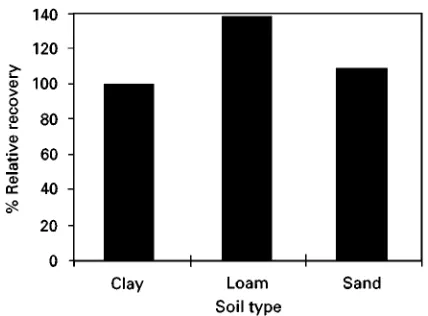
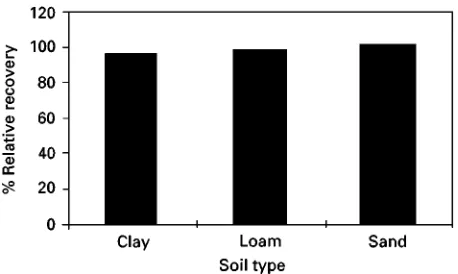
Figure 2 Average percent relative recovery data of herbicides extracted from three soil types. Soils were fortified with 50}500 and 500}5000g kg\1. (Data from Ezzellet al. 1995.)
Table 8 Summary of sample preparation and extraction condi-tions used to extract pyrithiobac sodium from soil
Extraction conditions Extraction analysis conditions
Sample preparation Remove sticks and rocks and break up clumps of soil Dispersing or drying agent Mix 10 g soil with 7 g of silica gel
Sample size 10 g
Extraction cell volume 22 mL cell
Extraction solvent Water
Temperature 1003C
Heat step 5 min
Static time 5 min
Flow type Mix of both static and dynamic
extraction
Number of cycles 1
Extraction pressure 200 psi
Flush volume 60%of cell volume
Purge time 60 s
linear alkylbenzenesulfonates (LAS) are the most common and can be found in waste water systems and river water. From these water sources, anionic surfactants partition to sediment. LAS are selectively extracted from sediment by PFE allowing simple quantitation by high performance liquid chromatog-raphy. Extraction conditions for linear LAS [linear decyl- up to tridecylbenzenesulfonate (LAS-10 to LAS-13)] are the same as those for alkylphenols listed in Table 6. Methanol is the best CO2 modiRer (at 2200 psi) for these compounds.
Pesticides
Pesticides including herbicides, insecticides and fungi-cides are broadly applied throughout the world to
generate greater harvests and to protect food sup-plies. As pesticides are present in soil, sediment and water, they are an important class of environmental compounds. Pesticides are extracted by PFE using organic and aqueous solvents.
Sample preparation and extraction conditions for chlorinated herbicides, OCPs, OPPs in soil using EPA Method 3545 are shown in Table 2. The method (Method 3545) speciRes the use of mixtures of or-ganic solvents to extract a wide variety of organo-chlorine and organophosphate pesticides and chlorin-ated herbicides.
[image:5.568.63.266.484.665.2] [image:5.568.290.517.529.710.2]Figure 3 Average percent relative recovery data of organo-chlorine pesticides extracted from three soil types. Soils were fortified at 5, 50 and 250g kg\1. (Data from Richteret al., 1995.
[image:6.568.294.514.59.202.2]Copyright 1995 by International Scientific Communications, Inc.)
Table 9 Twenty-four organophosphate pesticides extracted by EPA Method 3545
Azinphos methyl Chlorpyrifos Coumaphos Demeton-O,S Diazinon Dichlorovos Dimethoate Disulfoton EPN Ethoprop Fensulfothion Fenthion
Mevinphos Monocrotphos Naled Parathion ethyl Parathion methyl Phorate Ronnel Sulfotepp Sulprofos TEPP
Tetrachlorvinphos Tokuthion
[image:6.568.291.517.519.688.2]Figure 4 Average percent relative recovery data of organo-phosphorous pesticides spiked at low and high levels on three soil types and then extracted using EPA Method 3545. Soils were fortified with 250 and 2500g kg\1. (Data from Ezzellet al., 1995.)
Table 10 Summary of sample preparation and extraction con-ditions used to extract dioxins and furans from chimney brick, urban dust, fly ash and sediments
Extraction conditions Extraction analysis conditions
Sample preparation Grind soil to 100}200 mesh (150}75m particle size) Dispersing or drying agent Mix with anhydrous sodium sulfate or HydromatrixTM
Sample size 4}10 g
Extraction cell volume 11, 22 or 33 mL cell, depending on sample size
Extraction solvent Toluene, 15 mL
Temperature 1803C
Heat step 9 min
Static time 5 min
Flow type Static, dynamic, or mix of both
Number of cycles 1}2
Extraction pressure 2000 psi
Extraction condition reproduced from Richter et al. (1997) Chemosphere 34: 975, with permission from Elsevier Science.
eight chlorinated herbicides are shown in Figure 2. Relative recoveries are the quotient of PFE recoveries divided by shaker extraction recoveries.
Organic acids are extracted using organic solvents and by subcritical water. The advantages of using aqueous extraction solvent are (1) purchase and dis-posal costs are low and (2) it is environmentally friendly. Conditions used to selectively extract py-rithiobac sodium (the active ingredient in Staple威 herbicide, used to control broadleaf weeds in cotton) are listed inTable 8.
[image:6.568.51.278.579.709.2]Organochlorine pesticides (OCPs) are extracted us-ing the conditions listed inTable 2. Average relative recoveries for the 20 OCPs are shown in Figure 3. Relative recoveries are the quotient of PFE recoveries divided by automated Soxhlet extraction recoveries. Organophosphate pesticides (OPPs) listed in
Table 9are extracted from soil using the conditions listed inTable 2. Average relative recoveries for the 24 OPPs are shown in Figure 4. Relative recoveries are the quotient of PFE recoveries divided by Soxhlet extraction recoveries.
Polychlorinated Biphenyls
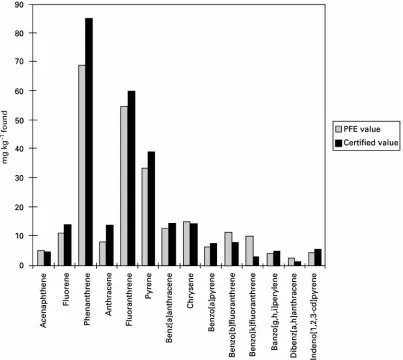
Figure 5 Comparison of amounts of PAHs found in PFE extracts and certified values. (Data from Richter, Jones, Ezzellet al. 1996.)
Polychlorinated Dioxins and Furans
Polychlorinated dibenzo-p-dioxins (PCDDs) and polychlorinated dibenzofurans (PCDFs) are environ-mental pollutants that are extracted from chimney brick, urban dust, Sy ash, soil and sediment using PFE. Conditions for the extraction of PCDDs and PCDFs are listed inTable 10.
PFE and Soxhlet extraction results of PCDDs and PCDFs levels found are essentially equivalent for the matrices tested. PFE required less time and solvent than Soxhlet extraction.
Polycyclic Aromatic Hydrocarbons
Polycyclic aromatic hydrocarbons (PAHs) are impor-tant environmental compounds being carcinogenic and mutogenic. They are extracted by organic vents and by subcritical water. Using organic sol-vents, PAHs are extracted from urban dust, sediment and soil using the PFE conditions listed in Table 2. Subcritical water extraction requires the conditions listed inTable 5. Results from certiRed reference
ma-terials indicate that PFE efRciently extracts PAHs from these matrices.Figure 5shows a comparison of the amounts of PAHs found in PFE extracts and certiRed values.
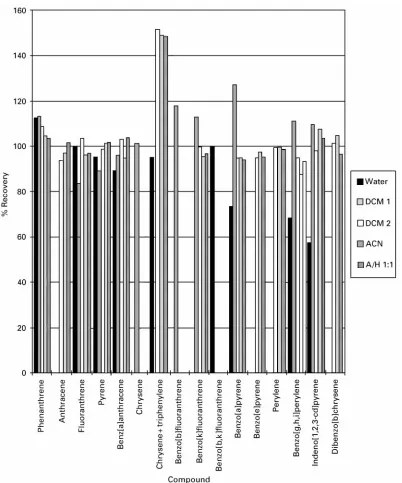
The following organic solvents also provide ad-equate extraction of PAHs in environmental samples: toluene/methanol 1 : 1 (v : v), toluene, methylene chloride, acetonitrile, hexane/acetone 1 : 1 (v : v) and water.Figure 6shows the amounts of PAHs found in urban dust (SRM 1649) extracts comparing various organic and aqueous extraction solvents.
Semi-Volatile Base/Neutral/Acid Compounds
Figure 6 Recovery of PAHs from urban dust (certified reference NIST SRM 1649) extracted by PFE. Extraction solvents were water (2503C, 725 psi) and methylene chloride/acetone 1 : 1. (Data for water extraction from Hawthorneet al., 1994.) Data for methylene chloride extraction (DCM 1) from Richteret al., 1995. Data for methylene chloride extraction (DCM 2) from Schantz et al., 1997.)
Total Petroleum Hydrocarbons
Total petroleum hydrocarbons (TPHs) are extracted from soil samples using the standard PFE conditions listed in Table 4. Levels of TPHs extracted by PFE and Soxhlet extraction are typically similar.
Future Applications
There are several reasons why analysts use PFE to extract analytes of interest from solid and semisolid
Figure 7 Average percent relative recovery data of 56 semi-volatile base/neutral/acid components extracted from three soil types using PFE. Soils were fortified at 250, 2500, and 12 500g kg\1. (Data from Richteret al. (1995) reproduced with
permission from International Scientific Communications Inc.)
will continue to use PFE to develop many more envir-onmental sample applications.
See also: II /Extraction: Supercritical Fluid Extraction. III/ Environmental Applications: Supercritical Fluid Ex-traction; Soxhlet Extraction. Superheated Water Mobile Phases: Liquid Chromatography.
Further Reading
Ezzell J (1998) The Use of SW-846 Method 3545 for automated extraction of environmental samples. Ameri-can Environmental Laboratory. 10: 24}25.
Ezzell JL and Richter BE (1996) Automated sample prep-aration for environmental laboratories using accelerated solvent extraction. American Environmental Laborat-ory. 16}18.
Ezzell J, Richter BE, Felix WD, Black SR and Meikle JE (1995) A comparison of accelerated solvent extraction
with conventional solvent extraction for organophos-phorus pesticides and hebicides.LC.GC13: 390}398. Hawthorne SB, Yang Y and Miller DJ (1994) Extraction of
organic pollutants from environmental solids with sub-and supercritical water. Analytical Chemistry. 66: 2912}2920.
Krei{elmeier A and Durbeck H-W (1996) Determination of alkylphenols and linear alkylbenzene sulfonates in sedi-ments applying accelerated solvent extraction (ASE).
Fresenius Journal of Analytical Chemistry. 354: 921}924.
Richter BE, Ezzell JL, Felix D, Roberts KA and Later DW (1995) An accelerated solvent extraction system for the rapid preparation of environmental organic compounds in soil.American Laboratory27: 24}28.
Richter BE, Jones BA, Ezzell JL, Porter NL, Avdalovic N and Pohl C (1996) Accelerated solvent extraction: a technique for sample preparation.Analytical Chem-istry68: 1033}1039.
Richter BE, Ezzell JL, Knowles DE, HoeSer F, Mattulat AKR, Scheutwinkel M, Waddell DS, Gobran T and Khurana V (1997)Chemosphere34: 975}978. Schantz MM, Nichols JJ and Wise SA (1997) Evaluation of
pressurisedSuid extraction for the extraction of envir-onmental matrix reference materials.Analytical Chem-istry69: 4210}4219.
USEPA SW-846, 3rd Edn., Update III (July 1995) Test Methods for Evaluating Solid Waste, Method 3545, Accelerated Solvent Extraction. Washington. U.S. GPO. Yang Y, Bowadt S, Hawthorn SB and Miller DJ (1995) Subcritical water extraction of polychlorinated bi-phenyls from soil and sediment.Analytical Chemistry. 67: 4571}4576.
Yang Y, Hawthorne SB and Miller DJ (1997) Class-selec-tive extraction of polar, moderately polar, and nonpolar organics from hydrocarbon wastes using subcritical water. Environmental Science and Technology. 31: 430}437.
Solid-Phase Microextraction
T. Nilsson, Technical University of Denmark, Lyngby, Denmark
Copyright^ 2000 Academic Press
Solid-phase microextraction (SPME) is a technique for the extraction of organic compounds from gas-eous, aqueous and solid matrices such as many environ-mental samples. It is rapid and simple, which makes it ideal for automation and in situmeasurements, and no harmful solvents are used. The principle of SPME is equilibration of the analytes between an organic polymeric phase coated on to a fused-silicaRbre and the sample matrix. The parameters of importance for the equilibration process are described below and
various environmental applications are discussed. Traditionally, SPME has been combined with analy-sis by gas chromatography (GC), and mainly aqueous samples have been analysed. This combination has proved to be sensitive, accurate and precise for the quantitative analysis of volatile organic compounds and different classes of pesticides. Solid samples can also be analysed by SPME in spite of the stronger matrix effects, and recently SPME has been coupled with liquid chromatography (LC) for the analysis of polar pesticides.