FM 3-06
(FM 90-10)
URBAN
OPERATIONS
JUNE 2003
HEADQUARTERS, DEPARTMENT OF THE ARMY
Field Manual HEADQUARTERS
No. 3-06 DEPARTMENT OF THE ARMY
Washington, DC, 1 June 2003
Urban Operations
Contents
Page
FIGURES... iv HISTORICAL VIGNETTES... vii PREFACE...viii
Chapter 1 URBAN OUTLOOK...1-1 The Prospect of Urban Operations ...1-2 Urban Perspective ...1-2 Historical Significance of Urban Areas in Warfare ...1-3 Modern Army Urban Operations ... 1-8
Chapter 2 URBAN ENVIRONMENT...2-1 A Complex Environment...2-2 Urban Terrain ...2-3 Urban Society ...2-14 Urban Infrastructure ...2-19
Chapter 3 URBAN THREAT...3-1 Asymmetry...3-2 Weapons of Mass Destruction ...3-2 Threat Operational Principles...3-3 Urban Threat Tactics ...3-6 Negative Effects of Urbanization ...3-11
Chapter 4 CONTEMPLATING URBAN OPERATIONS...4-1 Necessity of Urban Operations ...4-2 Characteristics of Major Urban Operations ...4-7 Integration into Land Operations ...4-10
Distribution Restriction: Approved for public release; distribution is unlimited.
Chapter 5 FOUNDATIONS FOR URBAN OPERATIONS... 5-1 Urban Operational Framework ... 5-1 Fundamentals of Urban Operations... 5-12 General Effects on Operations ... 5-16
Chapter 6 URBAN OFFENSIVE OPERATIONS... 6-1 Purpose of Urban Offensive Operations... 6-1 Characteristics of Urban Offensive Operations ... 6-2 Urban Offensive Operations and Battlefield Organization... 6-6 Forms and Types of Urban Offense ... 6-9 Urban Offensive Considerations ... 6-15
Chapter 7 URBAN DEFENSIVE OPERATIONS... 7-1 Purpose of Urban Defensive Operations ... 7-1 Characteristics of Urban Defensive Operations ... 7-2 Urban Defensive Operations and Battlefield Organization ... 7-5 Types of Urban Defense ... 7-5 Urban Defensive Considerations ... 7-10
Chapter 8 URBAN STABILITY OPERATIONS AND SUPPORT OPERATIONS... 8-1 Purpose of Urban Stability Operations and Support Operations ... 8-2 Characteristics of Urban Stability Operations and Support Operations ... 8-2 Urban Stability Operations, Support Operations, and Battlefield Organization ... 8-3 Types and Forms of Stability Operations and Support Operations ... 8-4 Considerations of Urban Stability Operations and Support Operations ... 8-6
Chapter 9 URBAN COMBAT SERVICE SUPPORT... 9-1 Urban CSS Characteristics ... 9-2 Logistics Preparation of the Theater... 9-4 CSS Functions ... 9-7 General Engineer Support ... 9-26 Civil-Military Operations ... 9-28
Appendix A SIEGE OF BEIRUT: AN ILLUSTRATION OF THE FUNDAMENTALS OF
Conduct of the Urban Operations... A-4 Lessons ... A-6 Summary ... A-10
Appendix B URBAN INTELLIGENCE PREPARATION OF THE BATTLEFIELD... B-1 Urbanization of IPB... B-1 Significant Characteristics ... B-4 Threat Considerations ... B-11 Urban IPB Tools and Products... B-16
Appendix C OPERATIONS IN SOMALIA: APPLYING THE URBAN OPERATIONAL
FRAMEWORK TO SUPPORT AND STABILITY... C-1 General Situation... C-1 Somali Operations ... C-2 Assess ... C-5 Shape ... C-7 Dominate ... C-7 Transition ... C-8 Summary ... C-9
Appendix D JOINT AND MULTINATIONAL URBAN OPERATIONS... D-0 Purpose ... D-0 Service Urban Capabilities ... D-1 Urban Functional Combatant Command Capabilities ... D-5 Multinational Considerations ... D-10
Figure Page
Page
Rome: A Microcosm of Urban Warfare ... 1-4 Seeing the Urban Area and Its Parts... 2-26 Tempo... 3-4 Identifying Soldiers from Civilians ... 3-8 Information and the Media... 3-10 Cultural and Religious Instability ... 3-14 Food and Water Shortages ... 3-14 Urban Insurgencies ... 3-16 Crime and Criminal Organizations ... 3-18 Applying the Urban Operational Framework: Panama – December 1989... 5-7 Example of Simple Communications Innovation: Israel’s Six-Day War – 1967.... 5-30 The Operational Context of Urban Operations: Brittany Ports – August to
September 1944 ... 6-2 Forms of Attack in the Urban Offense: Metz – 1944 ... 6-11 Isolating the Urban Area: Hue City – January to February 1968 ... 6-21 Creative Task Organization: Using Artillery in the Direct Fire Role ... 6-27 Bold Operational Maneuver to Seize an Urban Area: Inchon and
Seoul, Korea – September 1950 ... 6-30 Urban Defense in a Major Operation: Stalingrad – August 1942 to
January 1943 ... 7-7 Defensive Combat Power: Suez City, Egypt – October 1973... 7-13 Assessment of Security and Force Protection: Belfast, Northern Ireland... 8-9 Support of and Coordination with Civilian Authorities: The 1992 Los
Doctrine provides a military organization with a common philosophy, a language, a purpose, and unity of effort. To this end, FM 3-06 discusses major Army opera-tions in an urban environment. This environment, consisting of complex terrain, a concentrated population, and an infrastructure of systems, is an operational environment in which Army forces will operate. In the future, it may be the pre-dominant operational environment. Each urban operation will be distinct from any other—any other urban operation as well as similar types of operations in other environments. Each operation will differ because of the multitude of combi-nations presented by the threat, the urban area itself, the major operation of which it may be part (or the focus), and the fluidity of societal and geo-political considerations. Therefore, there will always exist an innate tension between Army doctrine, the actual context of the urban operation, and future realities. Commanders are responsible to strike the proper balance between preparing for future challenges and maintaining the capability to respond to current threats.
PURPOSE
This manual provides the analytical tools for evaluating an urban operation to determine if the operation is necessary for overall mission success. It also pro-vides the means to understanding and determining the impacts of the urban environment on military operations and provides information on managing, taking advantage of, and mitigating the effects of those impacts as appropriate. As such, this manual demonstrates how to apply the doctrinal principles in FM 3-0 to this unique environment.
SCOPE
Chapter 1 introduces theoretical and historical perspectives of urban operations that serve as the underlying basis for the rest of the manual. Chapter 2 discusses the characteristics of urban centers and populations as well as their impact on operations. It is unlikely that Army forces will ever operate in a benign urban environment; therefore, Chapter 3 discusses the varied nature of potential urban threats. An understanding of the complexities of the urban environment and the nature of the enemy is essential to sound decisionmaking. Chapters 4 and 5 dis-cuss the potential costs of urban operations as well as the effects on each battle-field operating system that the commander and his staff consider early in their planning. These chapters also outline an urban operational framework and spe-cific urban considerations that create the foundations necessary for successfully applying operational doctrine to an urban environment.
com-manders consider that most urban operations will involve some aspect of all four types of operations (although one may dominate) and plan accordingly.
APPLICABILITY
This manual is intended for commanders and their staffs at the brigade through corps level. It addresses the range of operations (both violent and nonviolent) throughout the spectrum of conflict that Army units will execute in urban settings. However, users should also consult JP 3-06 for specific joint information. Additionally, users should be familiar with FM 3-06.11, TC 90-1, and urban operations chapters, appendices, or sections found in other infantry, armor, combined arms, and proponent field manuals for the tactics, techniques, and procedures (TTP) and appropriate proponent information necessary to conduct tactical urban operations at the brigade level and below.
ADMINISTRATIVE INSTRUCTIONS
Chapter 2 defines “city” according to a the population size. However, in historical vignettes and accounts, the term “city” is applied in its common usage without specific regard to size to maintain conformity with most other historical reports. In this manual, the term “threat” is applied broadly to include an enemy force (conventional or unconventional), an armed belligerent in a peace operation, an-tagonistic or unfriendly elements of the civilian population, or some other hazar-dous condition in the urban environment that negatively influences mission ac-complishment. The term “hostile” is used as a subset of the threat and denotes a particular element of the urban population (individual, group, or organization) or one or more opposing armed factions in a peacekeeping operation. Both an enemy and a hostile have the intent to exploit Army vulnerabilities and negatively affect the urban operation. A hostile, however, is not engaging Army forces in protracted combat operations.
The term military operations on urban terrain (MOUT) is replaced by urban operations (UO). MOUT is an acronym from FM 90-10 Military Operations on
Urban Terrain that is superseded by this manual.
Otherwise, the glossary lists most terms used in FM 3-06 that have joint or Army definitions. Where Army and joint definitions are different, (Army) follows the term. Definitions for which FM 3-06 is the proponent manual (the authority) are marked with an asterisk (*). The proponent or amplifying manual for other terms is listed in parentheses after the definition.
The manual attempts to incorporate historical vignettes into each chapter where the account supports the doctrinal line of reasoning. Two historical vignettes, however, were included as appendices (A and C) because of their longer lengths. Unless this publication states otherwise, masculine nouns or pronouns do not refer exclusively to men.
This publication contains copyrighted material.
Urban Outlook
The ambiguous nature of the operational environment requires Army leaders who are self-aware and adaptive. Self-aware leaders under-stand their operational environment, can assess their own capabilities, determine their own strengths and weaknesses, and actively learn to overcome their weaknesses. Adaptive leaders must first be self-aware—then have the additional ability to recognize change in their operating environment, identify those changes, and learn how to adapt to succeed in their new environment.
FM 1
Given the prevalence of large cities throughout the world, Army forces, division size and larger, will likely be required to conduct operations in and around large urban areas. These operations will be in support of a joint force commander (JFC) conducting military operations pursuant to United States (US) national security policy. This manual is designed to facilitate the planning and conduct of the full range and spectrum of land operations in a complex urban environment. Each urban environment and urban operation is unique; prescribing specific doctrinal “solutions” for situations is impossible. Instead, this manual provides a framework to commanders and their staffs for understanding the urban environment, for analyzing and deciding whether urban operations (UO) are necessary or feasible, and for applying operational doctrine to this complex environ-ment. It also provides historical vignettes to help develop a refined analy-tical perspective and some planning points and tactics and techniques to assist in preparing for and conducting UO. Together, this information provides a foundation for approaching major UO, which, combined with other joint and Army doctrine, will help commanders and their staffs learn to adapt and succeed in this challenging environment.
CONTENTS
The Prospect of Urban Operations ...1-2Urban Perspective...1-2 Historical Significance of Urban
Areas in Warfare...1-3 Strategic Importance of Urban
Areas ...1-4 US Army’s Experience in Urban
Operations ...1-6
THE PROSPECT OF URBAN OPERATIONS
1-1. The world is in a period of massive urbanization. A trend of migration from rural to urban areas is occurring throughout the globe. This trend is especially evident in developing nations. Combined with the exponential growth of the global population in the last quarter century, this migration has created massive urban areas that hold the centers of population, government, and economics in their respective regions. In Western Europe, for example, over 50 percent of the land area is urbanized. Just over 30 years ago, only three urban areas in Asia contained at least eight million people. By 2015, estimates show that Asia will have 17 urban areas over ten million, and three of those will top 20 million residents. Almost half of today’s population resides in urban areas. Trends also indicate that less developed nations have more centralized societies in a few urban areas. Developed nations spread their centralized societies in several urban areas. In many cases, rapid urbanization has overburdened already weak infrastructures, scarce resources, and a fragile economic base. Given the global population, Army forces will likely conduct operations in and around urban areas—not as a matter of fate but as a deliberate choice linked to national objectives and
strategy and at a time, place, and method of the commander’s choosing.
Army Urban Operations
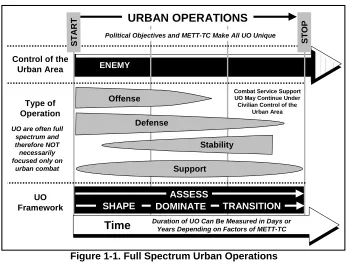
Army forces conduct UO either as one component of a larger operation or as a single operation focused totally on a specific urban environment. Major Army UO are often part of a joint and multinational effort requiring interagency and civil-military coordination that may include the full spectrum of Army operations. Commanders of Army major operations must determine if UO are essential to mission accomplishment. If so, commanders must carefully integrate the opera-tions into campaign planning to support the operational objectives of the JFC. Army leaders conducting UO must—
• Assess the urban area to determine decisive points.
• Shape the operation to set the conditions for success.
• Precisely mass the effects of combat power to rapidly dominate the area. • Then transition the urban area to the control of another agency or back to
legitimate civilian control.
URBAN PERSPECTIVE
ENEMY ARMY CIVIL Control of the
Urban Area
Type of Operation
S
T
A
R
T
ST
OP
Combat Service Support UO May Continue Under Civilian Control of the
Urban Area
UO Framework
Offense
Defense
Stability
Support UO are often full
spectrum and therefore NOT necessarily focused only on
urban combat
Political Objectives and METT-TC Make All UO Unique
ASSESS
DOMINATE TRANSITION SHAPE
URBAN OPERATIONS
[image:14.612.141.488.103.365.2]Time
Duration of UO Can Be Measured in Days or Years Depending on Factors of METT-TCFigure 1-1. Full Spectrum Urban Operations
1-3. When conceptualizing urban operations, commanders understand two important terms: urban area and urban environment. The first is a subset of the second. An urban area is a topographical complex where man-made construction or high population density is the dominant
feature. Focusing on urban areas means concentrating on the physical
aspects of the area and their effects on tactics, techniques, and procedures. The urban environment includes the physical aspects of the urban area as well as the complex and dynamic interaction and relationships between its key components—the terrain (natural and man-made), the population, and the supporting infrastructure—as
an overlapping and interdependent system of systems. Critical
elements of the infrastructure may lie far beyond the area’s physical con-fines. For example, the generating source providing power to the urban energy system is part of that system but may be located well outside of the urban area. Similarly, effects of the interaction between components of the infrastructure, located both inside and outside the urban area, extend well into smaller, neighboring urban areas and surrounding rural areas and often form their political, economic, and cultural focus. Understanding the total urban environment is essential to planning and conducting the full range of Army urban operations across the spectrum of conflict.
HISTORICAL SIGNIFICANCE OF URBAN AREAS IN WARFARE
hundred years later, the Roman Empire replaced Greece as the dominant world power although urban areas remained central to Roman warfare. Even Rome’s history can be viewed as a microcosm of urban warfare over the past two thousand years. Though military operations within the physical confines of many of these historic urban areas were not the norm, the focus of these operations was their conquest or control.
Rome
A Microcosm of Urban Warfare
During two millennia, Rome has been the center of at least 12 battles. The Gauls lay siege to Rome first in 387 BC. That first siege lasted six months and ended after the barbarians burnt much of the city. The surviving patrician families paid a ransom for the withdrawal of Brennus’ army. From 408 to 410 AD, the Goth leader, Alaric, successfully besieged Rome no less than three times. The Byzantine General Belisarius captured Rome twice from the Goths and withstood siege inside the city once between 536 and 549. Five hundred years later in 1084, Norman adventurer Robert Guiscard captured medieval Rome and sacked the city during a dispute between the Pope and the Holy Roman Empire. Forces of the Holy Roman Empire again stormed and captured the city to punish the Pope in 1527. During the Italian Revolution in 1849, a French army supporting the Pope captured the city from the Italian revolutionary army under Garibaldi. In 1944, the last military action took place in and around Rome when the US Fifth Army captured the city from the retreating German army. Rome’s turbulent history—fought over ethnic and religious differences, prestige, and military necessity—demonstrates the importance of urban areas in warfare and the various causes and combatants within this complex environment.
1-5. Although Rome last saw combat in 1944, urban areas have been no less prominent in warfare since that time. Beirut in Lebanon, Grozny in Chechnya, and Sarajevo in Bosnia-Herzegovina have been centers of conflict in the last 50 years. Urban areas, now more pervasive than ever before, will continue to be essential to successful operational and strategic warfighting. Today, armies cannot execute major military operations without the influence of surrounding urban environments (with the possible exception of the open desert).
STRATEGIC IMPORTANCE OF URBAN AREAS
1-6. Several reasons have attracted (and continue to attract) armies to combat in urban areas:
• A military force chooses to position itself in an urban area to capitalize on the perceived advantages offered by the environment. In contrast, an opposing force, by analyzing the factors of the situation, determines that it must enter the urban area to attack and destroy its enemy (or devote essential combat power to their isolation).
• The urban area’s infrastructure, capabilities, or other resources have significant operational or strategic value.
• The urban area’s geographical location dominates a region or avenue of approach.
1-7. Russia’s 1994 experience in Chechnya illustrates an increasingly impor-tant motivation for conducting urban operations. The Chechen rebels, after failing to engage Russian forces outside the city, chose to turn Grozny into the battlefield. Leaders of the defeated Chechen conventional forces recog-nized that fighting in the urban area provided them their best chance for success. The complexities of urban combat and the perceived advantages of defending an urban area mitigated their numerical and technological inferiority. The urban area provided the Chechens protection from fires, resources, interior lines, and covered and concealed positions and movement. Given such advantages offered by the environment, smaller or less-sophisticated military forces have similarly chosen to fight in urban areas. 1-8. Such advantages of operating in an urban environment also prompt forces to conduct an urban operation to facilitate a larger campaign plan and decisive battle in another location. The urban operation can focus the enemy on the urban area and allow other forces to conduct operations elsewhere. From a defensive perspective, an urban defense may gain time and space to reorganize forces in new defensive positions, to divert enemy forces from other critical tasks, or to prepare to conduct offensive operations. To some extent, these reasons motivated Soviet forces defending Leningrad and Stalingrad from the Germans in World War II. The stubborn defense per-mitted the Soviets to reorganize for later offensive operations. From an offen-sive perspective, an attack on an urban area may be a shaping operation used to divert resources from the decisive operation that will follow.
1-9. Armies also fight in an urban area to obtain some critical feature or resource in the area, such as a port facility. The desire to control an important seaport and access to the Persian Gulf largely motivated the Iranian and Iraqi struggle for Basra in the 1980s. Earlier, in 1944, British forces fought German units in Arnhem for control of the Rhine River Bridge. Other infrastructure of the urban environment may have operational or strategic significance and can compel military forces to attack or defend the area. As urban areas account for an increasing share of a country’s national income, often generating over 50 percent of gross national product, the stra-tegic implications for their control or influence become even greater.
1-11. Another reason for engaging in urban operations is the symbolic— historical, cultural, political, and even economic—importance of many urban areas. Often, capital cities—such as Rome, Paris, Seoul, and Berlin—are identified as the strategic centers of gravity of their respective nations. Possessing or threatening these urban areas may impact directly on the out-come of a conflict. The objective of Germany’s wars with France in 1870 and 1914 was ultimately Paris. Napoleon’s 1812 campaign had as its objective Moscow, as did Hitler’s 1941 offensive into Russia. The objective of the Soviet 1945 offensive was Berlin, and the North Vietnamese 1975 offensive had as its objective the South’s capital of Saigon. Still, history also reminds us that commanders assess the sustainability and decisiveness of operations directed toward these “prestige” objectives. For example, in 1812, Napoleon captured Moscow but had to evacuate it within 30 days. He lacked supplies and shelter, failed to destroy the Russian Army, and failed to defeat the political will of the Czar and the people. Similarly, the North Korean occupation of Seoul during the Korean War was equally indecisive.
US ARMY’S EXPERIENCE IN URBAN OPERATIONS
1-12. The US Army has a varied history of conducting operations to attack or defend larger urban areas. The American Revolution saw the Army conduct several urban operations. These operations included the unsuccessful defense of New York, the successful attack on Trenton, and the decisive siege and attack on British forces at Yorktown. The Mexican War also had a successful assault on the fortified city of Monterey and the decisive siege of Mexico City. During the American Civil War, the armies, in the tradition of Napoleonic maneuver warfare, avoided urban areas and fought in the open. However, the opposing armies frequently made urban areas their objective because of their importance as railheads. Success in the siege of several key urban areas—Vicksburg, Atlanta, and Petersburg—contributed to the Northern victory.
1-13. Following the Civil War, the US Army faced no large-scale urban combat for several generations. The Indian Wars, the Spanish-American War, the Philippine Insurrection, and even World War I did not require the Army to fight in large urban areas. Between the Civil War and World War II, the US Army fought in several urban areas worldwide supporting US com-mitments. These limited urban combat operations were small but essential parts of what were urban stability operations. From 1900 to 1901, the Army provided public security for a sector of Peking, China of around 50,000 inhabitants. The Army conducted UO and, in the course of the operation, the 9th US Infantry suffered 20-percent casualties while fighting in Tientsin. Punitive expeditions to places such as Siberia, Cuba, Philippines, Central America, and Mexico put the Army in various urban situations that required using military power, notably, the occupation and security of Vera Cruz, Mexico in 1914. In the context of these smaller-scale contingencies (SSCs), UO became a staple of US Army employment.
ally. Defending the urban area posed numerous challenges. Ultimately General MacArthur determined that he could best conduct its defense outside the city by defeating the enemy forces in combat on the invasion beaches or shortly after they landed. When Japanese forces defeated MacArthur’s Philippine Army in a series of engagements, MacArthur had to decide how best to protect the friendly populace of Manila. He had two choices: abandoning the city or waging a costly defense that would likely result in the city’s destruction, thousands of noncombatant casualties, and no operational advantage. He had little choice but to declare Manila an open city and move his forces to Bataan to wage an operational defense in the vain hope that a counteroffensive could relieve his isolated force. On 2 January 1942, Japanese forces entered Manila unopposed.
1-15. Had General MacArthur decided to defend Manila, his forces would have found scant doctrine in the Army regarding how to fight in an urban area. Doctrine for urban operations did not appear until early 1944, when faced with the possibility of fighting through the larger urban areas of Western Europe. At his time the US Army published FM 31-50, Attack on a
Fortified Position and Combat in Towns. This manual had the first formal
discussion of how the Army viewed urban combat. It was based on the Army’s limited experiences in the Mediterranean theater and the study of German and Soviet experiences on the Eastern front.
1-16. FM 31-50 emphasized a deliberate pace, individual and small unit ini-tiative, the liberal use of direct and indirect firepower, and decentralized command and execution. It focused on the urban area (as opposed to the envi-ronment); however, it did include policies towards the noncombatants. The manual was also focused at the regimental combat team level. Comple-menting the doctrine of FM 31-50 was the 1944 operations manual, FM 100-5. This latter manual emphasized the importance of combined arms actions and the need for extensive reconnaissance of prepared and defended cities. The Army successfully implemented this doctrine in several major instances of urban combat, most notably the capture of the first German city, Aachen, and hundreds of small-scale urban assaults on cities, towns, and villages across France, the Benelux, and Germany. Army forces also successfully employed this urban combat doctrine during the liberation of Manila in 1945.
1-17. The legacy of this era of Army operations was an effective tactical solu-tion to urban offensive combat: isolate the urban area, seize a foothold, and expand the foothold block by block until occupying the entire urban area and destroying the enemy. The doctrine’s emphasis on firepower kept friendly casualties to a minimum. Unfortunately, when enemy forces stoutly defended the urban area, the emphasis on firepower resulted in its virtual destruction and high casualties among noncombatants.
1-19. From the mid-1950s through the 1990s, the Army conducted UO in the United States in support of civil authorities during civil unrest and anti-Vietnam protests. Some operations involved numerous active and reserve component forces engaged in restoring public order. The Detroit riots of 1967 and the Los Angeles riots of 1992 required the commitments of active and National Guard units. In 1968, the Army deployed over 35,000 troops to Washington D.C., Chicago, and Baltimore following the death of Dr. Martin Luther King, Jr.
1-20. In the 1970s and 1980s, Army doctrine predominantly focused on urban areas and successfully fighting a conventional ground war against Soviet and Warsaw Pact forces in Central Europe. The 1979 FM 90-10, Military Opera
-tions on Urbanized Terrain (MOUT), described how to conduct urban
opera-tions against Soviet forces in Germany. Its concepts were never tested other than in simulation, and its approach to urban combat was not substantially different from that practiced by the Army since World War II. Despite previous doctrine’s admonition to avoid cities, the Army has had to fight in them in diverse circumstances.
MODERN ARMY URBAN OPERATIONS
1-21. Modern urban operations span the full range of possible applications of military power. At the high end of the spectrum of conflict is major theater war (MTW) dominated by offensive and defensive operations that, when undertaken, will commonly include urban operations. At the lowest level are a multitude of urban peacetime military engagement (PME) activities. These activities foster and strengthen alliances and coalitions as well as deter aggression on the part of potential threats. At mid-level between MTW and PME are SSC urban operations. As a result of being mid-range, any type of operation may potentially dominate an SSC; however, the various urban stability operations form the majority. At higher echelons, these separations are often viewed as levels of intensity. For the tactical units conducting urban operations, these divisions appear indistinct, as the intensity is often high despite where the operation falls within the level of conflict.
MAJOR THEATER WAR
1-22. While UO in a MTW can encompass the full range of Army operations, the offense and defense will be central and decisive to success. Although mindful of collateral damage and noncombatants, urban operations in a MTW (compared to urban operations in SSCs or as part of PME activities) will be the least constrained because vital national interests will be at stake. UO in a MTW, therefore, will require a significant investment of resources of all types. Specialized units such as psychological operations, civil affairs, and other special operations forces (SOF) will likely be in high demand. UO in a MTW will require an abundance of infantry and may require significant casualty replacements and medical support. Logistics to support the distinc-tive urban environment includes large amounts of lethal and nonlethal specialty munitions, such as smoke, precision field artillery rounds, demoli-tions, and hand grenades.
challenging. They will take one of two principal forms: fluid or siege. In a fluid urban combat operation, both sides may contend for position and advan-tage in the urban battlespace. The attacker will seek to quickly seize decisive points before the enemy is able to establish a cohesive defense. This will likely require the attacker to bypass enemy defensive positions whose occupa-tion or reducoccupa-tion are not critical to mission success. Conversely, the defender may use interior lines to shift forces in a fluid defense. In a siege, one side clearly has the initiative as the attacker, and the other side has the advan-tages of the defense. A siege situation can develop as a result of an initial fluid urban battle, or it may be a function of previous military operations that occurred outside the urban area. The Army doctrine’s emphasis on initiative, agility, depth, synchronization, and versatility generally supports the fluid form of urban combat; however, commanders also understand that the factors of METT-TC may support a longer-term, siege approach.
SMALLER-SCALE CONTINGENCIES
1-24. SSCs encompass a wide range of military operations that fall between MTW and PME and frequently involve urban operations. SSCs are conducted to facilitate diplomacy and support political initiatives, protect American lives and interests, and disrupt illegal activities. Joint task forces (JTFs) typically conduct SSCs although one service may provide the bulk of the force. During these urban contingencies, resources are often more limited and the restraints on applying combat power are greater as the need to maintain legi-timacy will grow in importance. Typically, Army forces will need the assis-tance of multinational partners, other agencies, local noncombatants, and nongovernmental organizations (NGOs) to successfully complete the mission.
PEACETIME MILITARY ENGAGEMENTS
1-25. UO, at the lowest level of conflict, may also take many forms. They serve to strengthen alliances and coalitions, discourage arms races, combat terrorism, and generally reduce the potential for instability and conflict. Combat in PME activities is not the norm. They are least likely to involve the use of force (when necessary, nonlethal is preferred). The presence of Army forces performing PME activities in foreign urban areas provides a visible sign of US commitment to peace and stability in that region. In many of these lower-intensity UO, Army forces often support other agencies. These other agencies actually plan and lead the operation. Army forces provide military capabilities (to include organization and leadership), manpower, equipment, and other resources not readily available. As with UO in SSCs, proactive and aggressive interaction and coordination with multinational partners, governmental and nongovernmental organizations, and the urban populace will be vital to success.
PREPARING FOR FUTURE URBAN OPERATIONS
• The psychological impact of intense, close combat against a well-trained enemy.
• The effects of noncombatants in close proximity to Army forces.
• The medical and logistic problems associated with operations in an urban area.
It recognizes the constraints of collateral damage and, therefore, emphasizes the development of flexible, effective, and understandable rules of engage-ment (ROE). These ROE help preclude soldiers from randomly using deadly force while allowing them sufficient latitude to accomplish the mission and defend themselves. Training in ROE also includes significant and periodic changes that test and develop flexibility in and adaptability to a fluid environment. Additionally, force preparedness mandates integrating simula-tions, exercises at urban training sites, and the actual use of urban terrain into tactical- and operational-level intra- and interservice training. Concurrent training extends from the individual soldier to the joint level. Additionally, preparedness also includes enhancing interoperability in regards to urban multinational and interagency operations.
1-27. Realistic UO training (as well as the conduct of real world operations) has the added benefit of identifying operational requirements and resultant changes necessary in our doctrine, organizations, materiel design, leadership, and soldier support (see Fig-ure 1-2). While technology (material) and organizational changes are critical, soldiers remain the decisive means for success. The technology and
organizational changes will be a critical enabler to achieve the agile, simul-taneous, and precise lethality required in urban operations. In the future, technology may lead to a radically new operational concept and approach to urban operations. Still, competent leaders and well-trained and disciplined soldiers will remain the decisive means for the Army to succeed in this complex, multidimensional, and noncontiguous urban environment.
TRAINING
ORGANIZATIONS LEADER
DEVELOPMENT SOLDIERS
DOCTRINE
MATERIAL
UO
Urban Environment
From a planning perspective, commanders view cities not just as a topographic feature but as dynamic entities that include hostile forces, local population, and infrastructure. Planning for urban operations requires careful IPB, with particular emphasis on the three-dimensional nature of the topography and the intricate social struc-ture of the population.
FM 3-0
Of all the environments in which to conduct operations, the urban envi-ronment confronts Army commanders with a combination of difficulties rarely found elsewhere. Its distinct characteristics result from an intricate topography and high population density. The topography’s complexity stems from the man-made features and supporting infrastructure super-imposed on the natural terrain. Hundreds, thousands, or millions of civil-ians may be near or intermingled with soldiers—friendly and enemy. This second factor, and the human dimension it represents, is potentially the most important and perplexing for commanders and their staffs to under-stand and evaluate. The intelligence preparation of the battlefield (IPB)
process remains unaffected by urban areas (see FM 34-130 and Appen-dix B); this chapter provides information essential to the conduct of the IPB for an urban environment.
Although urban areas possess general similarities, each environment is distinct and will react to and affect the presence and operations of Army forces differently. A tactical technique effective in one area may not be effective in another area due to physical differences, such as street
CONTENTS
A Complex Environment ...2-2Urban Terrain...2-3 Multidimensional Battlefield ...2-3 Broad Urban Patterns ...2-6 Lesser Street Patterns ...2-8 An Urban Model...2-9 Urban Society ...2-14 Potential Center of Gravity...2-14 General Population Size ...2-15
Group Size, Location, and
Composition ...2-16 Leadership and Organization...2-17 Interests and Actions...2-17 Interaction, Influence, or Control...2-18
A Cycle of Effects ... 2-18 Urban Infrastructure ... 2-19 Interdependence... 2-19 Separate Parts of a Whole ... 2-19 Structures and People ... 2-20 Impact on Future Operations ... 2-20 Resource Intensive ... 2-20 Communications and Information... 2-21 Transportation and Distribution ... 2-23 Energy ... 2-23 Economics and Commerce ... 2-24
Administration and Human
patterns or the type of building construction. An Army policy popular with one urban group may cause resentment and hostility in another due to diverse cultural differences. All difficulties potentially exist, but they increase the complexity for Army forces operating in urban areas. These difficulties range from conventional military forces to disease and starvation (see Chapter 3) to a pervasive media—often acutely present in intricate combinations. Thus, commanders at all levels make extraordi-nary efforts to assess and understand their particular urban environment to plan, prepare for, and execute effective urban operations (UO).
A COMPLEX ENVIRONMENT
2-1. Urban areas vary depending on their history, the cultures of their inhabitants, their economic development, the local climate, available building materials, and many other factors. This variety exists not only among urban areas but also within any particular area. The ever-changing mix of natural and man-made features in urban areas present commanders with some of the most difficult terrain in which to conduct military operations.
2-2. Although urban areas possess similar characteristics, no two are iden-tical. The sprawl of Los Angeles, for example, bears little physical resem-blance to New Delhi. Societal characteristics most significantly affect each area’s uniqueness and complexity. While complex, information about the ter-rain, its potential effects on operations, and how it changes over time may be determined with some degree of certainty. However, the human dimension is much more difficult to understand and assess, particularly its effects on mili-tary operations. Like any environment, the side that can best understand and
exploit the effects of the urban environment has the best chance of success.
TERRAIN
STRUCTUREINFRA-SOCIETY
Figure 2-1. Keys to Understanding the Urban Environment 2-3. Whether a large metropolis or
a small village, each urban environ-ment has an identifiable system of components that constantly change and interact. This “system of sys-tems” consists of the terrain, the
society, and the infrastructure that
links the two (see Figure 2-1). (These categories highlight the key aspects to understanding the urban environment and will be used throughout the manual; however, the civil-military operations (CMO)
discussion in Chapter 9 provides an alternate method for categorizing and assessing the effects of civil considerations in any operational environment.) 2-4. These systems are not separate and distinct categories but rather over-lapping and interdependent. Thoroughly analyzing these elements, along with the other factors of mission, enemy, weather, troops and support available, time, and civil considerations—
• Contributes to commanders’ situational understanding.
• Allows them to develop courses of action that apply appropriate resources against decisive points.
2-5. In stability operations and support operations, this understanding allows commanders to engage and dominate the decisive points critical to maintaining peace or restoring normalcy to the urban environment. Although each system is categorized into subordinate components or subsystems, com-manders often “step back” and visualize each system, the complex urban environment, and their area of operations (AO). This “systems thinking” aids commanders in uncovering key relationships and intersections that can help reveal centers of gravity (COGs) and decisive points.
2-6. To comprehend the urban environment and its components to the fullest extent possible, commanders carefully integrate and employ special opera-tions forces (SOF)—to include psychological operaopera-tions (PSYOP) and civil affairs units—and a myriad of other human intelligence (HUMINT) assets and regional, language, and cultural experts. The societal aspects and inte-grating infrastructure will challenge commanders’ assessment and under-standing. These aspects will also require greater dependence on nonmilitary and nongovernmental organizations (NGOs) and host-nation agencies for their information, knowledge, and expertise. This last consideration requires commanders to develop effective techniques and procedures for coordinating and interacting with these agencies.
URBAN TERRAIN
2-7. Although complex and difficult to penetrate with many intelligence, sur-veillance, and reconnaissance (ISR) assets, the terrain is the most recogniz-able aspect of an urban area. Truly understanding it, however, requires com-prehending its multidimensional nature. The terrain consists of natural and man-made features, with man-made features dominating; an analysis con-siders both. Buildings, streets, and other infrastructure have varied patterns, forms, and sizes. The infinite ways in which these factors can intertwine make it difficult to describe a “typical” urban area. However, these elements provide a framework for understanding the complex terrain in an urban area. Furthermore, man-made features significantly affect military systems and soldiers, and thus tactics and operations. General effects on urban operations are discussed in this chapter. Specific effects on battlefield operating systems (BOS) (see Chapters 5 and 9) and the range of operations (see Chapters 6, 7, and 8) are interwoven throughout the manual.
MULTIDIMENSIONAL BATTLEFIELD
2-8. Urban areas present an extraordinary blend of horizontal, vertical, interior, exterior, and subterranean forms superimposed on the natural relief, drainage, and vegetation. An urban area may appear dwarfed on a map by the surrounding countryside. In fact, the size and extent of the urban battlespace is many times that of a similarly sized portion of natural terrain. The sheer volume and density created by urban geometry can make UO resource intensive in time, manpower, and materiel.
cause (either intentionally or not) uncontrollable fires or the loss of electri-city. A power outage can cause flooding (especially in subsurface areas) by shutting down pumping stations. Entire buildings may be destroyed, elimina-ting reference points and leaving large piles of rubble. Additionally, buildings and other urban structures, damaged but not destroyed, can still be effective obstacles and possible booby traps. Their weakened construction and unstable structure increase the risk of injury to soldiers and civilians moving within them. (Engineers often determine whether the buildings can support occupation by Army forces or civilians.) The likely presence of toxic industrial materials (TIM) can create additional obstacles.
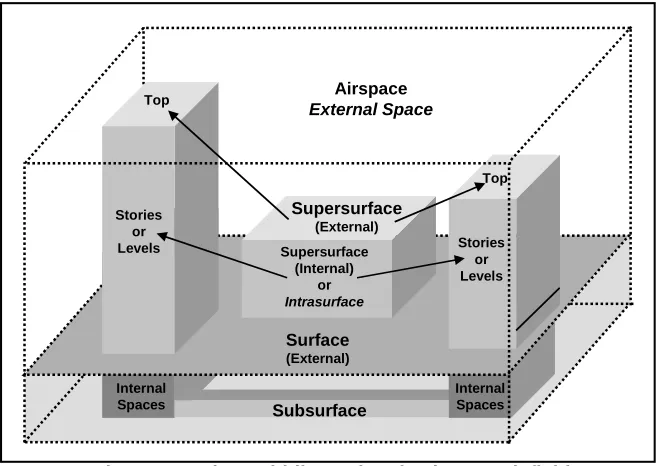
2-10. Commanders in other environments normally address the depth, breadth, and height of their AO in terms of two areas: airspace and surface. In an urban environment, they broaden their scope to include supersurface
and subsurface areas (see Figure 2-2). Although spatially separated, each
[image:25.612.131.462.316.549.2]area may be used as an avenue of approach or mobility corridor, line of com-munications (LOC), and engagement area.
Figure 2-2. The Multidimensional Urban Battlefield Airspace
External Space
Surface (External)
Subsurface Supersurface
(External)
Supersurface (Internal)
or Intrasurface
Internal Spaces Internal
Spaces Stories or
Levels Stories
or Levels Top
Top
2-11. Supersurface and subsurface areas magnify the complexity of the urban physical environment. Commanders consider activities that occur outside buildings and subterranean areas (the external space) as well as the activities that occur unseen in buildings and subterranean systems (the
internal space). The internal space further challenges command, control, and
Airspace
2-12. Aircraft and aerial munitions use the airspace as rapid avenues of ap-proach in urbanized areas. Forces can use aviation assets for observation and reconnaissance, aerial attack, or high-speed insertion and extraction of sol-diers, supplies, and equipment. Some surface obstacles, such as rubble, do not affect aviation assets. However, buildings of varying height and the increased density of towers, signs, power lines, and other urban constructions create obstacles to flight and the trajectory of many munitions (masking). These obstacles can limit low-altitude maneuverability in the urban airspace. Excellent cover and concealment afforded enemy gunners in an urban area increases aviation vulnerability to small arms and man-portable air defense systems (MANPADS), particularly when supporting ground forces.
Surface
2-13. Surface areas apply to exterior ground level areas, such as parking lots, airfields, highways, streets, sidewalks, fields, and parks. They often provide primary avenues of approach and the means for rapid advance. However, buildings and other structures often canalize forces moving along them. As such, obstacles on urban surface areas usually have more effect than those in open terrain since bypass often requires entering and transiting buildings or radical changes to selected routes. Where urban areas abut the ocean or sea, large lakes, and major rivers, the surface of these bodies of water may pro-vide key friendly and threat avenues of approach or essential LOCs and, therefore, may be a significant consideration for Army commanders. As such, amphibious and river-crossing operations may be an integral part of the over-all urban operation.
2-14. Larger open areas—such as stadiums, sports fields, school play-grounds, and parking lots—are often critical areas during urban operations. They can provide locations for displaced civilians, interrogation centers, and prisoner of war holding facilities. These areas also can afford suitable aircraft landing and pickup zones and artillery firing locations. They can provide logistic support areas and aerial resupply possibilities because they are often centrally located.
Supersurface
points of armored vehicles and unsuspecting aircraft. Overall, elevated firing positions reduce the value of any cover in surrounding open areas and permit engagement at close range without risk of immediate close assault. This area (and the subsurface area) requires commanders to think, plan, and execute ground operations vertically as well as horizontally. In this latter regard, UO share strong similarities with mountain operations (see FM 3-97.6).
Subsurface
2-16. These areas are subterranean or below surface level. They may serve as secondary and, in fewer instances, primary avenues of approach at lower tactical levels. When thoroughly reconnoitered and controlled, they offer excellent covered and concealed LOCs for moving supplies and evacuating casualties. They may also provide sites for caching and stockpiling supplies. Subsurface areas include the subways, tunnels, sewers, drainage systems, cellars, civil defense shelters, and other various underground utility systems. In older cities, they may include ancient hand-dug tunnels and catacombs. Both attacker and defender can use subsurface areas to gain surprise and maneuver against the rear and flanks of a threat and to conduct ambushes. However, these areas are often the most restrictive and easiest to defend or block. Their effectiveness depends on superior knowledge of their existence and overall design. Army commanders may need to consider potential ave-nues of approach afforded by the subsurface areas of rivers and major bodies of water that border urban areas. This particularly applies when operating as part of a joint task force (JTF) task organized with SOF or when opposing a threat with similar capabilities.
BROAD URBAN PATTERNS
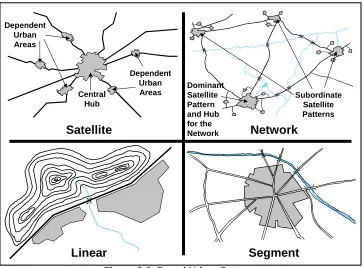
2-17. Four major urban patterns can influence UO (see Figure 2-3). Central to two of the patterns (satellite and network) is the hub or dominant urban area or pattern around which outlying urban areas or patterns radiate. (A segmented urban area, because it tends to be a larger urban area, can often be a hub.) In offensive and defensive operations, the hub serves as a pivot or strong point; as such, it often becomes a major obstacle to an attacker. If the attacker chooses to bypass the urban area (hub) located along his axis of advance without first isolating the area, he may expose his flank to attack from the hub as well as dependent urban areas or subordinate satellite patterns. Because the focus of stability operations and support operations is on people, commanders understand the value and influence of the hub to the economic, political, or cultural well being of the surrounding area. Whether or not a hub, commanders must remember that urban areas are not islands; all are connected to the surrounding rural (and other urban) areas through fluid and permeable boundaries and LOCs.
Satellite Pattern
supporting battle positions. Commanders should consider the effects of the outlying urban areas on operations within the hub, and, conversely, the effects of operations within the hub on outlying urban areas. Information operations (IO), for example, targeted primarily at the hub of a satellite pattern may subsequently influence outlying urban areas and achieve neces-sary effects without having to commit specific resources to these areas.
Linear
Segment
Network
Satellite
Central Hub
Dependent Urban Areas Dependent
Urban Areas
Subordinate Satellite Patterns Dominant
[image:28.612.133.497.189.457.2]Satellite Pattern and Hub for the Network
Figure 2-3. Broad Urban Patterns
Network Pattern
2-19. The network pattern represents the interlocking of the primary hubs of subordinate satellite patterns. Its elements are more self-sufficient and less supportive of each other, although a dominant hub may exist. Major LOCs in a network extend more than in a satellite pattern and take more of a rec-tangular rather than a convergent form. Its natural terrain may vary more than in a single satellite array. Operations in one area may or may not easily influence, or be influenced by, other urban areas in the pattern.
Linear Pattern
Segment Pattern
2-21. When dominant natural terrain, such as a river or man-made features (canals, major highways, or railways), divides an urban area, it creates a seg-mented pattern. This pattern often makes it easier for commanders to assign areas of operations to subordinate commanders. However, this pattern may fragment operations and increase risk to an operation requiring mutual support between subordinate units. Still, the segmented urban areas may allow commanders to isolate threats more easily in these areas and focus operations within segments that contain their decisive points. Although an integral part of the whole (the urban area), each segment may develop distinct social, economic, cultural, and political characteristics. This social
segmenting may benefit commanders faced with limited assets to influence or
control the urban populace. After thoroughly analyzing the society, they may be able to focus IO and populace and resources control measures against only specific segments that affect decisive operations. Commanders may need only to isolate other segments or may need to just monitor for any significant changes in the attitudes, beliefs, or actions of the civilians located there.
LESSER STREET PATTERNS
2-22. Lesser patterns in the urban area result from the layout of the streets, roads, highways, and other thoroughfares. They evolve from influences of natural terrain, the original designer’s personal prejudices, and the changing needs of the inhabitants. Street patterns (and widths) influence all BOS; however, they greatly affect maneuver, command and control, and combat service support. (In some portions of older Middle Eastern urban areas, the labyrinths of streets were designed only to allow two loaded donkeys to pass each other; tanks are too wide.) Urban areas can display any of three basic patterns and their combinations: radial, grid, and irregular (see Figure 2-4).
Figure 2-4. Basic Internal Street Patterns
Radial
Grid
Irregular
Radial
concentric loops or rings to larger radial patterns. Unless commanders carefully plan boundaries, routes, and axes of advance, their subordinate units’ movement or maneuver may be inadvertently funneled toward the center of urban areas with this pattern resulting in congestion, loss of momentum, and an increased potential for ambush or fratricide.
Grid
2-24. The most adaptable and universal form for urban areas is the grid pattern: lines of streets at right angles to one another forming blocks similar to the pattern of a chessboard. A grid pattern can fill in and eventually take over an original radial pattern. Grid patterns often appear to ease the assign-ment of boundaries for subordinates units. However, commanders also con-sider how the natural terrain influences operations and the establishment of control measures. They also consider the influence of the buildings and other structures lining these streets, such as their height and construction, before assigning boundaries and developing other control measures.
2-25. Describing boundaries and phase lines by easily recognizable features is as important in urban areas as elsewhere. If available, natural features are a better descriptor than man-made features that may be altered or unrecognizable. When Army forces work closely with local law enforcement agencies, commanders may not need to assess the effect of street patterns on the assignment of boundaries. Instead, commanders may assign boundaries overlaid on existing administrative boundaries used by local law enforcement agencies to increase interoperability and aid in unity of effort.
Irregular
2-26. In most urban areas, regardless of the original intent, plan, or vision, existing street patterns emerge from successive plans overlaid one on another. Some are well planned to fit with previous plans while others a hap-hazard response to explosive urban growth. The result may mix patterns. Urban engineers and planners may specifically design irregular patterns for aesthetic reasons (as in many suburban housing developments) or to conform to marked terrain relief. Irregular street patterns may alert commanders and analysts that the underlying natural terrain may exert greater influence over operations than in other portions of the urban area. Finally, irregular street patterns make the movement and maneuver of forces less predictable.
AN URBAN MODEL
Figure 2-5. An Urban Model CORE CORE
PERIPHERY
COMMERCIAL RIBBON AREA RESIDENTIAL
AREA
INDUSTRIAL AREA
OUTLYING HIGH-RISE AREA
2-28. This analysis helps to determine, in general terms, potential advan-tages and disadvanadvan-tages each portion of the urban area may have toward accomplishing the urban operation. However, construction materials and methods can vary drastically. Commanders identify specific building types and construction and understand weapons effects on them. If a commander desires precise effects, the chosen munitions or weapons system must be sufficiently accurate, capable of penetrating the target structure (without exiting the other side), and achieve effects within. Often noncombatants, critical infrastructure, or protected targets are in the vicinity. Commanders may need to determine if the surrounding walls or structures will sufficiently absorb or negate the blast or thermal effects of the weapon. Regardless, understanding the structure of buildings in the urban AO allows commanders to determine the best means to accomplish the mission.
Core
2-29. The core is the heart of the urban area, the downtown or central business district. Relatively small and compact, it contains a large percentage of the urban area’s shops, offices, and public institutions. Often, it houses the headquarters for commercial and financial activities and contains important cultural, historical, and governmental buildings. These activities prefer the core because of its accessibility. As the focal point of the transportation network, residents find the core the easiest part of the urban area to reach. It normally has the densest concentration of multistory buildings and subterranean features (underground parking garages, under-ground shopping centers, and basements).
areas. Most core areas have undergone constant redevelopment resulting in various types of construction. Commonly, brick buildings abound in the oldest part of the core; framed, heavy-clad structures in the next oldest part; and a concentration of framed, light-clad buildings in the newest part. The outer edge of the core, the core periphery, has ordinarily undergone less change than the core resulting in buildings of uniform height (commonly two to three stories in towns and five to ten stories in larger urban areas).
2-31. Generally, offensive operations focused in core areas (even when effec-tively isolated) will require greater resources—particularly manpower, time, and information—than in many other parts of the urban area. Mounted maneuver often proves more difficult in core areas because of fewer open areas, buildings closer to the streets, and more civilian vehicles. Rubbled buildings in central core areas (especially high-rise buildings) become greater obstacles to mobility as they can collapse on and easily block thoroughfares. Rubble piles can afford excellent covered and concealed positions for dismounted threat forces. Consequently, commanders use more dismounted forces as part of their combined arms operations. Conversely, the core may be critical to urban defensive operations, particularly older areas of heavier construction that afford greater protection. Despite potential difficulties, the core area may be key to accomplishing many stability or support missions since it houses much of the human activity that occurs in the urban area.
Industrial Area
2-32. Industrial areas often develop on the outskirts of the urban areas where commercial transportation is easiest (along airfields and major sea, river, rail, and highway routes). These areas will likely displace farther from the core and residential areas as urban planners recognize the potential threat of TIM. The dispersed pattern of the buildings provides sufficient space for large cargoes, trucks, and materiel handling equipment. These areas may provide ideal sites for logistic bases and maintenance sites. While older, heavier-clad structures may be found, new construction consists of low, large, flat-roofed factory and warehouse buildings with large parking areas and work yards. These structures generally have steel frame and lightweight exterior walls. Multistory structures usually have reinforced concrete floors and ceilings.
2-33. Toxic industrial chemicals and other TIM may be transported through an urban area (by rail, barge, truck, or pipeline) or found stored throughout. However, larger concentrations will exist in industrial areas, and their presence should concern Army forces operating near them.
tank at Bhopal, India, killing thousands and injuring hundreds of thousands. Figure 2-6 contains a small sampling of other toxic industrial chemicals along with their industrial or commercial usage that commanders may encounter in an urban area. The most common chemicals that pose a risk to Army forces are highly toxic irritant gases such as ammonia, chlorine, hydrogen chloride, and sulfur dioxide.
Toxic Industrial
Chemical Industrial/Commercial Uses
Ammonia Commercial Refrigerant, Fertilizer and Food Production, Petroleum, Explosives, Other Chemicals
Arsine Semiconductor Industry
Boron Trichloride Organic Catalyst, Soldering Magnesium Boron Trifluoride Chemical Catalyst, Aluminum Refining
Carbon Disulfide Industrial Solvent, Dry-Cleaning, Agriculture, Petroleum, Electroplating Chlorine Potable Water, Disinfectants, Metal Treatment, Plastics & Rubber
Diborane Plastics and Rubber
Ethylene Oxide Industrial Alcohols, Fumigant, Industrial Sterilant Fluorine Uranium Processing, Rocket Fuel
Formaldehyde Plastics, Fertilizers, Preservative/ Corrosion Inhibitor, Fungicide and Germicide, Pesticide, Pharmaceuticals
Fuming Nitric Acid Fertilizers, Explosives, Metal Processing, Pesticides, Rocket Fuel Hydrogen Bromide Chemical Industry, Pharmaceuticals
Hydrogen Chloride Fabrics, Semiconductors
Hydrogen Cyanide Pesticides, Other Chemicals, Pharmaceuticals, Electroplating Hydrogen Fluoride Glass Production, Chemical Catalyst
Hydrogen Sulfide Metallurgy, Agricultural Disinfectant
Phosgene Dyes, Pharmaceuticals, Herbicides & Insecticides Phosphorus Trichloride Metallurgy, Pesticides and Germicides, Gasoline Additive
Sulfur Dioxide Paper, Food Processing, Ice Production, Disinfectant, Leather Processing Sulfuric Acid Fertilizers, Petroleum, Iron and Steel Production, Battery Electrolyte Tungsten Electronics, Other Chemicals
Figure 2-6. Toxic Industrial Chemicals and Their Industrial or Commercial Uses
2-35. Standard chemical defense equipment may not protect against (and chemical detection devices may fail to detect) many toxic industrial chemi-cals. Therefore, the risk to soldiers operating near the chemicals may increase. Commanders vigilantly identify these potential hazards, carefully consider them as part of their overall vulnerability analysis, factor the anal-ysis into their risk assessment, and execute necessary contamination avoid-ance measures. Any assessment includes the chavoid-ance that toxic industrial chemicals may be deliberately released by a threat to gain advantage or accidentally released by friendly actions (see FM 3-21 and FM 3-14).
Outlying High-Rise Area
2-37. Similar to the urban core, units given the mission to clear these areas, or even portions therein, will need more resources—most notably personnel and time—to accomplish their mission. Commanders should consider courses of action that isolate these entire areas, multiple sections within these areas, or even individual buildings before assigning tasks. The tasks could rapidly drain a unit’s resources or unhinge other portions of the major operation. When defending, commanders who can integrate these areas in the defense will present the attacker with similar resource problems and may be appro-priate in a defense to delay. However, defending commanders ensure that the defense is arranged so that this portion cannot be easily isolated and bypassed. Defensive positions in structures may require extensive reinforce-ment due to light-clad construction.
Residential Area
2-38. Residential areas can be found dispersed throughout the urban area; however, large suburban areas (or sprawl) normally form on the outskirts. Residential areas often consist of row houses or single-family dwellings set in a grid or ringed pattern in a planned development project. Yards, gardens, trees, and fences usually separate the buildings in a residential area. Modern residential construction is often of light-clad, framed wood construction, or brick. The combined population of surrounding suburban areas often far out-numbers that of the urban area proper. Specific suburbs tend toward homo-geneity based on ethnicity, religion, economics, or some other social aspect. Commanders locate and analyze these areas to determine their impact on operations—often the most critical importance is the people located there (see the subsequent discussion in this chapter on the urban society).
2-39. In offensive and defensive operations, commanders determine whether operations pose an unacceptable physical risk to civilians. If so, they may have to relocate civilians to a safer area, perhaps another residential area. If not, commanders may implement a “stay-put” policy for that area and attempt to isolate the effects of the operation from them. During support operations, residential locations may be the initial focal point for operations since most of the permanent population is located there.
2-40. This area also contains a relatively recent urban phenomenon known
as shantytowns. These areas are commonly on unoccupied, low-value land in
not accommodate vehicular traffic. Similarly, the makeshift materials inhibit weapons effects less than many other parts of the urban area built more solidly. A tank round, for example, may go much farther and injure many more noncombatants than in an area where the primary building material is stone. Regardless, commanders consider the effects of their operations in this area, to include vehicles and weapons, as the weak structures increase the risk of fratricide, civilian casualties, and large, rapidly spreading fires.
Commercial Ribbon Area
2-41. Commercial ribbon areas are rows of stores, shops, and restaurants built along both sides of major streets that run through and between urban areas. These same types of areas often develop along the roads that connect one urban area to another (strip areas). The buildings uniformly stand two to three stories tall (about one story taller than the dwellings on the streets behind them).
URBAN SOCIETY
2-42. Although intricate, understanding the urban terrain is relatively straightforward in com-parison to compre-hending the multifaceted nature of urban society. UO often require Army forces to operate in close proximity to a high den-sity of civilians. Even evacuated areas can have a stay-behind population in the tens of thousands. This population’s pres-ence, attitudes, actions, communications with the
media, and needs may affect the conduct of operations. Homogeneity de-creases drastically as the size of the urban area inde-creases. Commanders take into account the characteristics of a population whose beliefs and interests vary based on factors. Figure 2-7 lists the factors. Civilian populations con-tinually influence, to varying degrees, operations conducted in an urban area. Thoroughly understanding these societal aspects and avoiding “mirror-imaging”—overlaying one’s own values and thought processes on top of the person or group one is trying to assess—will help to accurately anticipate civilian actions and response.
?
Ethnicity and Culture Government and Politics
Religion
Population Demographics
Health
Leadership and Prominent Personalities
History
KEY ASPECTS OF THE URBAN SOCIETY
Figure 2-7. Key Aspects of the Urban Society
POTENTIAL CENTER OF GRAVITY
forces is an advantage over hostile behavior. To influence or control their behavior, commanders first understand the society’s complex nature and character. Second, they understand and accept that every military action (or inaction) may influence the relationship between the urban population and Army forces, and, by extension, mission success. Lastly, they understand that Army forces may play only a supporting (but essential) role as part of an inte-grated and synchronized multiagency effort focusing all aspects of national power. With this awareness, commanders can take one or more actions:
• Coordinate and plan operations. • Implement effective programs.
• Take the immediate action necessary to maintain support of a friendly populace, neutralize or gain the support of hostile or neutral factions, or do any combination of these activities to achieve precise effects and accomplish the mission.
Without this understanding, commanders increase the risk that their actions, particularly concerning the urban population, may not have the intended and necessary effects.
2-44. Although the factor of civil considerations takes on added significance in UO, it is just one that commanders evaluate. Sometimes it may be the most important factor to consider as a COG. At other times it may be the least important as to be almost negligible. Its importance is not constant; it changes over time (like all factors). At the beginning of the operation, civil considerations may not be essential to mission accomplishment, but as the operation progresses this factor’s importance to success may increase. In other circumstances, the opposite may be true. Overall, commanders consider three objectives regarding the civilians of the urban area:
• Minimize their interference with urban operations. In offensive and defensive operations this means moving them away from combat operations. In all operations, it often requires centralizing them in one or more locations.
• Maximize their support of Army, joint, and multinational forces and government agencies.
• Observe the necessary legal, moral, and humanitarian obligations.
GENERAL POPULATION SIZE
2-45. Urban areas are com-monly classified according to the general size of their population instead of land-mass. Figure 2-8 lists cate-gories of urban areas with their defining population.
Category Population
Village 3,000 or less. Town Over 3,000 to 100,000.
City Over 100,000 to 1 million. Metropolis Over 1 million to 10 million. Megalopolis Over 10 million.
divisions do exist (either physical or ideologica