Chapter 22
ANTHRAX
ARTHUR M. FRIEDLANDER, M.D.*
INTRODUCTION AND HISTORY THE ORGANISM
EPIDEMIOLOGY PATHOGENESIS CLINICAL DISEASE
Cutaneous Anthrax Inhalational Anthrax
Oropharyngeal and Gastrointestinal Anthrax Meningitis
DIAGNOSIS TREATMENT PROPHYLAXIS
Prophylactic Treatment After Exposure Active Immunization
Side Effects SUMMARY
INTRODUCTION AND HISTORY
bacterial vaccine was developed, in 1881, by Louis Pasteur.3 During the latter half of the 19th century, a previously unrecognized form of anthrax ap-peared for the first time, namely, inhalational an-thrax.4 This occurred among woolsorters in En-gland, due to the generation of infectious aerosols of anthrax spores under industrial conditions, from the processing of contaminated goat hair and alpaca wool. It probably represents the first described oc-cupational respiratory infectious disease.
Owing to the infectiousness of anthrax spores by the respiratory route and the high mortality of in-halational anthrax, the military’s concern with an-thrax is with its potential use as a biological weapon. This concern was heightened by the revelation that the largest epidemic of inhalational anthrax in this century, in Sverdlovsk, Russia, in 1979, occurred after anthrax spores were released from a military research facility located upwind from where the cases occurred. Cases were also reported in animals located more than 50 km from the site.5,6
Anthrax, a zoonotic disease caused by Bacillus
anthracis, occurs in domesticated and wild
ani-mals—primarily herbivores, including goats, sheep, cattle, horses, and swine. Humans usually become infected by contact with infected animals or con-taminated animal products. Infection occurs most commonly via the cutaneous route and only very rarely via the respiratory or gastrointestinal routes. Anthrax has a long association with human his-tory. The fifth and sixth plagues described in Exo-dus may have been anthrax in domesticated ani-mals followed by cutaneous anthrax in humans. The disease that Virgil described in his Georgics is clearly anthrax in domestic and wild animals.1 And dur-ing the 16th to the 18th centuries in Europe, anthrax was an economically important agricultural disease. Anthrax was intimately associated with the ori-gins of microbiology and immunology, being the first disease for which a microbial origin was de-finitively established, in 1876, by Robert Koch.2 It also was the first disease for which an effective live
Bacillus anthracis is a large, Gram-positive,
spore-forming, nonmotile bacillus (1–1.5 µm x 3–10 µm). The organism grows readily on sheep blood agar aerobically and is nonhemolytic under these con-ditions. The colonies are large, rough, and grayish-white, with irregular, curving outgrowths from the margin. Both in vitro in the presence of bicar-bonate and carbon dioxide, and in tissue in vivo, the organism forms a prominent capsule. In tissue, the encapsulated bacteria occur singly or in chains
of two or three bacilli (Figure 22-1). The organism does not form spores in living tissue; sporulation
[image:2.612.305.540.435.643.2]THE ORGANISM
[image:2.612.56.289.533.688.2]Fig. 22-1. Gram’s stain of peripheral blood smear from a rhesus monkey that died of inhalational anthrax.
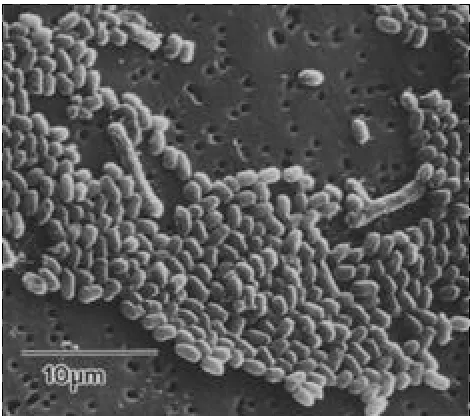
occurs only after the infected body has been opened and exposed to oxygen. The spores, which cause no swelling of the bacilli, are oval and occur cen-trally or paracencen-trally (Figure 22-2). They are very resistant and may survive in the environ-ment for decades in certain soil conditions. Bacte-rial identification is confirmed by demonstration
of the protective antigen toxin component, lysis by a specific bacteriophage, detection of capsule by fluorescent antibody, and virulence for mice and guinea pigs. Additional confirmatory tests to iden-tify toxin and capsule genes by the polymerase chain reaction have also been developed as research tools.
Anthrax occurs worldwide. The organism exists in the soil as a spore. The question remains unsettled as to whether its persistence in the soil is due to sig-nificant multiplication of the organism in the soil, or if it is due solely to cycles of bacterial amplification in infected animals whose carcasses then contaminate the soil.7,8 The form of the organism in infected ani-mals is the bacillus. Only when the organism in the carcass is exposed to air does sporulation occur.
Animals, domestic or wild, become infected when they ingest spores while grazing on contami-nated land or eating contamicontami-nated feed. Environ-mental conditions such as drought, which may pro-mote trauma in the oral cavity on grazing, are thought to increase the chances of acquiring anthrax, as Pasteur originally reported.9 Spread from animal to animal by mechanical means—by the biting flies,10 and from one environmental site to another by the nonbiting flies and by vultures8—has been suggested. Anthrax in humans is associated with agricul-tural, horticulagricul-tural, or industrial exposure to in-fected animals or contaminated animal products. In the less-developed countries, primarily in Africa, Asia, and the Middle East, disease occurs from con-tact with infected domesticated animals or contami-nated animal products. This includes handling con-taminated carcasses, hides, wool, hair, and bones; and ingesting contaminated meat. Cases associated with industrial exposure, rarely seen today, occur in workers processing contaminated hair, wool, hides, and bones. Direct contact with contaminated material leads to cutaneous disease, while inges-tion of infected meat gives rise to oropharyngeal or gastrointestinal forms of anthrax. Inhalation of a
sufficient quantity of spores, usually seen only dur-ing generation of aerosols in an enclosed space as-sociated with processing contaminated wool or hair, gives rise to inhalational anthrax.
Unreliable reporting makes it difficult to estimate with accuracy the true incidence of human anthrax. It was estimated in 1958 that worldwide between 20,000 and 100,000 cases occurred annually.11 In more recent years, anthrax in animals has been re-ported from 82 countries, and human cases continue to be reported from Africa, Asia, Europe, and the Americas.12 In the United States, the annual inci-dence of human anthrax has steadily declined— from about 127 cases in the early years of this cen-tury to about one per year for the past 10 years. The vast majority of cases have been cutaneous. Under natural conditions, inhalational anthrax is exceed-ingly rare, with only 18 cases having been reported in the United States in the 20th century.13 In the early years of this century, cases of inhalational anthrax were reported in rural villagers in Russia who worked with contaminated sheep wool inside their homes.14 Five cases of inhalational anthrax occurred in woolen mill workers in New Hampshire in the 1950s.15 During times of economic hardship and disruption of veterinary and human public health practices, such as occurs during war, there have been large epidemics of anthrax. The largest re-ported epidemic of human anthrax occurred in Zim-babwe from 1978 through 1980, with an estimated 10,000 cases. Essentially all were cutaneous, with very rare cases of gastrointestinal disease and eight cases of inhalational anthrax, although no autopsy confirmation was reported.16
EPIDEMIOLOGY
PATHOGENESIS
B anthracis possesses three known virulence
fac-tors: an antiphagocytic capsule and two protein exo-toxins, called the lethal and the edema toxins. The role of the capsule in pathogenesis was demon-strated in the early 1900s, when anthrax strains lack-ing a capsule were shown to be avirulent.17 In more recent years, the genes encoding synthesis of the
may contribute to the resistance of anthrax to lysis by serum cationic proteins.19
It was Koch, in his initial studies on anthrax, who first suggested the importance of toxins. In 1954, Smith and Keppie20 demonstrated a toxic factor in the serum of infected animals that was lethal when injected into other animals. The role of toxins in virulence and immunity was firmly established by many workers in the ensuing years.21–23 Advances in molecular biology in the last decade have pro-duced a more complete understanding of the bio-chemical mechanisms of action of the toxins and have begun to provide a more definitive picture of their role in the pathogenesis of the disease.
The genes encoding the synthesis of the two protein exotoxins are located on a 60-kb plasmid, distinct from that encoding for the capsule. In an environment of increased bicarbonate and carbon dioxide and increased temperature, such as is found in the infected host, there is increased transcription of the genes for synthesis of the two toxins,24–26 as well as for the capsule.27
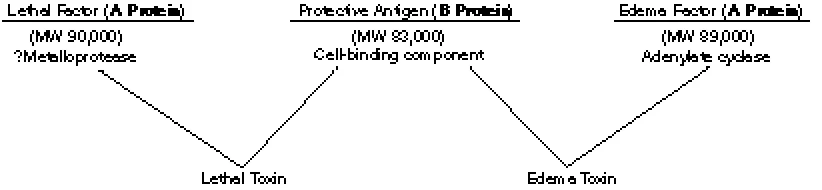
The anthrax toxins, like many bacterial and plant toxins, possess two components: a cell-binding, or B, domain; and an active, or A, domain that has the toxic and, usually, the enzymatic activity (Figure 22-3). The B and A anthrax toxin components are syn-thesized from different genes and are secreted as noncovalently linked proteins. The two toxins are unusual in that the B protein, called protective
anti-gen (MW 83,000), is shared by both toxins. Thus the
lethal toxin is composed of the protective antigen combined with a second protein, which is known as the lethal factor (MW 90,000). The lethal toxin is lethal for experimental animals28,29 and the lethal factor has been shown to possess homology to metalloproteases, although no direct enzymatic ac-tivity has yet been discovered.30
The edema toxin, consisting of the same protec-tive antigen together with a third protein, edema factor (MW 89,000), causes edema when injected into the skin of experimental animals.28,29 The edema
factor is a calmodulin-dependent adenylate cyclase, which elevates intracellular cyclic adenosine mono-phosphate, and which is likely to be responsible for the marked edema often present at the site of bac-terial replication.
Each of the three toxin proteins—the B protein and both A proteins—individually is without bio-logical activity. The critical role of the toxins in pathogenesis was established when it was shown that deletion of the toxin encoding plasmid18,31 or the protective antigen gene alone32 attenuates the organism. The lethal toxin also appears to be more important for virulence in a mouse model than the edema toxin.33
Recent studies in cell culture models have given a clearer understanding of the molecular interac-tions of the toxin proteins. Protective antigen first binds, most likely by a domain at its carboxy-ter-minus,34,35 to a specific cell receptor.36 Once bound, it is cleaved by a protease located on the cell sur-face,37,38 resulting in retention on the cell surface of a 63-kilodalton (kd) fragment of protective antigen. This cleavage creates a binding site on the protec-tive antigen to which either the lethal factor or the edema factor can bind with high affinity. The com-plex is then internalized and passes through an acidic vesicle and is translocated to the cell cytosol, where it expresses its toxic activity.
The situation in the infected animal may be some-what different, since the toxin proteins may exist in the serum as a complex of protective antigen and lethal factor.39 It is possible that the proteolytic ac-tivation of protective antigen necessary to form lethal or edema toxin may occur in interstitial fluid or serum rather than on the cell surface. The lethal or the edema toxin may then bind to target cells and be internalized.
[image:4.612.94.505.601.696.2]Infection begins when the spores are inoculated through the skin or mucosa. It is thought that spores are ingested at the local site by macrophages, in which they germinate to the vegetative bacillus with production of capsule and toxins. At these sites, the
riod is 1 to 5 days. The disease first appears as a small papule that progresses over a day or two to a vesicle containing serosanguinous fluid with many organisms and a paucity of leukocytes. The vesicle, which may be 1 to 2 cm in diameter, ruptures, leav-ing a necrotic ulcer. Satellite vesicles may also be present. The lesion is usually painless, and varying degrees of edema may be present around it. The edema may occasionally be massive, encompassing the entire face or limb, and is described by the term “malignant edema.” Patients usually have fever, bacteria proliferate and produce the edema and
le-thal toxins that impair host leukocyte function and lead to the distinctive pathological findings: edema, hemorrhage, tissue necrosis, and a relative lack of leukocytes. In inhalational anthrax, the spores are ingested by alveolar macrophages, which transport them to the regional tracheobronchial lymph nodes, where germination occurs.40
Once in the tracheobronchial lymph nodes, the local production of toxins by extracellular bacilli gives rise to the characteristic pathological picture: massive hemorrhagic, edematous, and necrotizing lymphadenitis; and mediastinitis (the latter is al-most pathognomonic of this disease).41 The bacilli can then spread to the blood, leading to septicemia with seeding of other organs and frequently caus-ing hemorrhagic mencaus-ingitis. Terminally, toxin is present in high concentrations in the blood,21 but both the site of toxin action and the molecular
mechanism of death remain unknown. Death is the result of respiratory failure associated with pulmo-nary edema, overwhelming bacteremia, and, often, meningitis.
Crude toxin preparations have been shown to impair neutrophil chemotaxis,42 phagocytosis,19 and killing.43 More recent work has shown that purified edema toxin impairs phagocytosis44 and priming for the respiratory burst45 in neutrophils, and also in-hibits the production of interleukin-6 (IL-6) and tumor necrosis factor (TNF) by monocytes, which may further impair host resistance.46 The lethal toxin is directly cytolytic for macrophages,47 caus-ing release of the potentially toxic cytokines IL-1 and TNF.48 Experimentally, animals can be protected against death from lethal toxin by depleting them of macrophages or blocking the effect of IL-1,48 but the role of these cytokines in death from infection remains to be established.
CLINICAL DISEASE
The military’s interest in anthrax is with defense against its use as an inhalational biological weapon. However, other forms of the disease are far more likely to be seen by medical officers—particularly when deployed to Third World countries—and are therefore included for completeness.
Cutaneous Anthrax
More than 95% of cases of anthrax are cutaneous (Figure 22-4). After inoculation, the incubation
pe-Fig. 22-4. (a) Cutaneous lesion of anthrax demonstrating eschar and edema in a man, following his handling of a contami-nated cow carcass in a rendering plant in Colorado. (b) Cutaneous lesion of anthrax with eschar (on the patient’s neck), on approximately day 15 of disease. The patient had worked with air-dried goat skins from Africa. Photograph a: Courtesy of Arnold Kaufmann, Ph.D., National Center for Infectious Disease, Centers for Disease and Control and Prevention, At-lanta, Ga. Photograph b: Reprinted from Binford CH, Connor DH, eds. Pathology of Tropical and Extraordinary Diseases. Vol 1. Washington, DC: Armed Forces Institute of Pathology; 1976: 121. AFIP Negative 75-4203-7.
[image:5.612.137.494.492.639.2]malaise, and headache, which may be severe in those with extensive edema. There may also be lo-cal lymphadenitis. The ulcer base develops a char-acteristic black eschar and after a period of 2 to 3 weeks the eschar separates, often leaving a scar. Septicemia is very rare, and with treatment mortal-ity should be less than 1%.
Inhalational Anthrax
[image:6.612.81.260.71.208.2]Inhalational anthrax begins after an incubation period of 1 to 6 days with nonspecific symptoms of malaise, fatigue, myalgia, and fever. There may be an associated nonproductive cough and mild chest discomfort. These symptoms usually persist for 2 or 3 days, and in some cases there may be a short period of improvement. This is followed by the sud-den onset of increasing respiratory distress with dyspnea, stridor, cyanosis, increased chest pain, and diaphoresis. There may be associated edema of the chest and neck. Chest X-ray examination usually shows the characteristic widening of the mediasti-num and, often, pleural effusions (Figure 22-5). Pneumonia has not been a consistent finding but can occur in some patients.5 While cases of inhala-tional anthrax have been rare in this century, sev-eral have occurred in patients with underlying pul-monary disease, suggesting that this condition may increase susceptibility to the disease.13 Meningitis is present in up to 50% of cases, and some patients may present with seizures. The onset of respiratory Fig. 22-5. This roentgenogram, taken on day 2 of illness, shows the lungs of a 51-year-old laborer with occupa-tional exposure to airborne anthrax spores. Marked me-diastinal widening is evident, with a small parenchymal infiltrate. Reprinted from Binford CH, Connor DH, eds. Pathology of Tropical and Extraordinary Diseases. Vol 1. Washington, DC: Armed Forces Institute of Pathology; 1976: 119. AFIP Negative 71-1290-2.
distress is followed by the rapid onset of shock and death within 24 to 36 hours. Mortality has been es-sentially 100% despite appropriate treatment.
Oropharyngeal and Gastrointestinal Anthrax
Oropharyngeal and gastrointestinal anthrax re-sult from the ingestion of infected meat that has not been sufficiently cooked. After an incubation period of 2 to 5 days, patients with oropharyngeal disease present with severe sore throat or a local oral or ton-sillar ulcer, usually associated with fever, toxicity, and swelling of the neck due to cervical or submandibu-lar lymphadenitis and edema. Dysphagia and res-piratory distress may also be present. Gastrointes-tinal anthrax begins with nonspecific symptoms of nausea, vomiting, and fever; these are followed in most cases by severe abdominal pain. The present-ing sign may be an acute abdomen, which may be associated with hematemesis, massive ascites, and diarrhea. Mortality in both forms may be as high as 50%, especially in the gastrointestinal form.
Meningitis
Meningitis may occur following bacteremia, as a complication of any of the other clinical forms of the disease. Meningitis may also occur, very rarely, without a clinically apparent primary focus. It is very often hemorrhagic, which is important diag-nostically, and almost invariably fatal (Figure 22-6).
[image:6.612.334.515.481.632.2]DIAGNOSIS
The most critical aspect in making a diagnosis of anthrax is a high index of suspicion associated with a compatible history of exposure. Cutaneous an-thrax should be considered following the develop-ment of a painless pruritic papule, vesicle, or ulcer —often with surrounding edema—that develops into a black eschar. With extensive or massive edema, such a lesion is almost pathognomonic. Gram’s stain or culture of the lesion will usually confirm the diagnosis. The differential diagnosis should include tularemia, staphylococcal or strep-tococcal disease, and orf (a viral disease of sheep and goats, transmissible to humans).
The diagnosis of inhalational anthrax is extraor-dinarily difficult, but the disease should be sus-pected with a history of exposure to a B anthracis– containing aerosol. The early symptoms are entirely nonspecific. However, (1) the development of res-piratory distress in association with radiographic evi-dence of a widened mediastinum due to hemorrhagic mediastinitis, and (2) the presence of hemorrhagic pleural effusion or hemorrhagic meningitis should suggest the diagnosis. Sputum examination is not helpful in making the diagnosis, since pneumonia is not usually a feature of inhalational anthrax.
Gastrointestinal anthrax is exceedingly difficult to diagnose because of the rarity of the disease and
its nonspecific symptoms. Only with a history of ingesting contaminated meat in the setting of an outbreak is diagnosis usually considered. Microbio-logic cultures are not helpful in confirming the di-agnosis. The diagnosis of oropharyngeal anthrax can be made from the clinical and physical find-ings in a patient with the appropriate epidemiologi-cal history.
Meningitis due to anthrax is clinically indistin-guishable from meningitis due to other etiologies. An important distinguishing feature is that the cerebral spinal fluid is hemorrhagic in as many as 50% of cases. The diagnosis can be confirmed by identifying the organism in cerebral spinal fluid by microscopy, culture, or both.
Serology is generally only of use in making a ret-rospective diagnosis. Antibody to protective anti-gen or the capsule develops in 68% to 93%49–52 of reported cases of cutaneous anthrax and 67% to 94%51,52 of reported cases of oropharyngeal an-thrax. A positive skin test to anthraxin (an unde-fined antigen derived from acid hydrolysis of the bacillus that was developed and evaluated in the former Soviet Union) has also been reported53 to be of value in the retrospective diagnosis of anthrax. Western countries have limited experience with this test.54
TREATMENT
tive. The optimal protection was afforded by com-bining antibiotics with active immunization.
Active Immunization
The only licensed human vaccine against anthrax is produced by the Michigan Department of Public Health. This vaccine is made from sterile filtrates
Prophylactic Treatment After Exposure
Experimental evidence58 has demonstrated that treatment with antibiotics beginning 1 day after exposure to a lethal aerosol challenge with anthrax spores can provide significant protection against death. All three drugs used in this study—cipro-floxacin, doxycycline, and penicillin—were effec-Penicillin is the drug of choice for anthrax. Cuta-neous anthrax without toxicity or systemic symptoms may be treated with oral penicillin. If evidence of spreading infection or systemic symptoms is present, then intravenous therapy with high-dose penicillin (2 million units administered every 6 h) may be initi-ated until a clinical response is obtained. Effective therapy will reduce edema and systemic symptoms but will not change the evolution of the skin lesion itself. Treatment should be continued for 7 to 10 days. Tetracycline, erythromycin, and chlorampheni-col have also been used successfully. These drugs
may be used for treatment of the rare case caused by naturally occurring penicillin-resistant organ-isms. Additional antibiotics shown to be active in vitro include ciprofloxacin, gentamicin, cefazolin, cepha-lothin, vancomycin, clindamycin, and imipenem.55–57 These drugs should be effective in vivo, but there is no reported clinical experience.
Inhalational, oropharyngeal, and gastrointestinal anthrax should be treated with large doses of intra-venous penicillin (2 million units administered ev-ery 2 h) with appropriate vasopressors, oxygen, and other supportive therapy.
of microaerophilic cultures of an attenuated, unen-capsulated, nonproteolytic strain (V770-NP1-R) of
B anthracis. The filtrate, containing predominantly
protective antigen, is adsorbed to aluminum hy-droxide. The final product also contains formalde-hyde, in a final concentration of no more than 0.02%, and benzethonium chloride 0.0025%, as preserva-tives. Some vaccine lots contain very small amounts of lethal factor and lesser amounts of edema factor, as determined by antibody responses in vaccinated animals,18,59,60 although this antibody response has not been reported in the limited observations in human vaccinees.61 Although protective antigen by itself is an effective immunogen,62 it is unknown whether the small amounts of lethal or edema fac-tor that are present in some lots of the vaccine con-tribute to its protective efficacy. The potency of vac-cine lots is determined by showing protection of parenterally challenged guinea pigs. There is no characterization of the amount and form of the pro-tective antigen or other toxin components in the vaccine. The vaccine is stored at 2°C to 8°C. The recommended schedule for vaccination is 0.5 mL given subcutaneously at 0, 2, and 4 weeks, followed by boosters of 0.5 mL at 6, 12, and 18 months. An-nual boosters are recommended if the potential for exposure continues.
The vaccine should be given to industrial work-ers exposed to potentially contaminated animal products imported from countries in which animal anthrax remains uncontrolled. These products in-clude wool, goat hair, hides, and bones. People in direct contact with potentially infected animals as well as laboratory workers should also be immu-nized. Vaccination is also indicated for protection against the use of anthrax in biological warfare. Approximately 150,000 service members received this licensed MDPH vaccine between 11 January and 28 February 1991 (25%–30% of the total U.S. forces deployed during the Persian Gulf War).
A live, attenuated, unencapsulated, spore vaccine is used for humans in the former USSR. The vac-cine is given by scarification or subcutaneously. Its developers claim it to be reasonably well tolerated and to show some degree of protective efficacy against cutaneous anthrax in clinical field trials.53
In the United States, immunization with the li-censed vaccine induced an immune response, mea-sured by indirect hemagglutination, to protective antigen in 83% of vaccinees 2 weeks after the first three doses,63 and in 91% of those tested after re-ceiving two or more doses.50 One hundred percent of the vaccinees develop a rise in titer in response to the yearly booster dose. When tested by an
en-zyme-linked immunosorbent assay, the current se-rological test of choice, more than 95% of vaccinees seroconvert after the initial three doses.61,64
A rough correlation between antibody titer to protective antigen and protection of experimental animals from infection exists after vaccination with the human vaccine. However, the exact relationship between antibody to protective antigen as measured in these assays, and immunity to infection remains obscure because the live, attenuated Sterne veteri-nary vaccine (made from an unencapsulated, toxin-producing strain) protects animals better than the human vaccine, yet it induces lower levels of anti-body to protective antigen.59–61
The protective efficacy of experimental protec-tive antigen-based vaccines produced from sterile culture filtrates of B anthracis was clearly demon-strated using various animal models and routes of challenge.21,65 A placebo-controlled clinical trial was conducted with a vaccine similar to the currently licensed U.S. vaccine.66 This field-tested vaccine was composed of the sterile, cell-free culture superna-tant from an attenuated, unencapsulated strain of
B anthracis—different from that used to produce the
licensed vaccine and grown under aerobic, rather than microaerophilic, conditions.67 It was precipi-tated with alum rather than adsorbed to aluminum hydroxide. The study population worked in four mills in the northeastern United States where B
anthracis–contaminated imported goat hair was
used. The vaccinated group, compared to a placebo-inoculated control group, was afforded 92.5% pro-tection against cutaneous anthrax, with a lower 95% confidence limit of 65% effectiveness. There were insufficient cases of inhalational anthrax to deter-mine whether the vaccine was effective against this form of the disease. This same vaccine was previ-ously shown to protect rhesus monkeys against an aerosol exposure to anthrax spores.67
There have been no controlled clinical trials in humans of the efficacy of the currently licensed U.S. vaccine. This vaccine has been extensively tested in animals and has protected guinea pigs against both an intramuscular60,61 and an aerosol chal-lenge.59 The licensed vaccine has also been shown to protect rhesus monkeys against an aerosol chal-lenge.58,68
Side Effects
licensed in the United States is reported to have a similar incidence of reactions.64,69 Local reactions considered significant consist of induration, erythema in an area larger than 5 cm in diameter, edema, pruritus, warmth, and tenderness. These reactions peak at 1 to 2 days and usually disappear within 2 to 3 days. Very rare reactions include edema extending from the local site to the elbow
or forearm, and a small, painless nodule that may persist for weeks. People who have recovered from a cutaneous infection with anthrax may have very severe local reactions.66 Systemic reactions are characterized by mild myalgia, headache, and mild-to-moderate malaise that lasts for 1 to 2 days. There are no long-term sequelae of local or systemic reactions.
SUMMARY
Anthrax is a zoonotic disease that occurs in domes-ticated and wild animals. Humans become infected by contact with infected animals or contaminated products. Under natural circumstances, infection oc-curs by the cutaneous route and only extremely rarely by the inhalational or gastrointestinal routes.
An aerosol exposure to spores causes inhalational anthrax. This form of the disease, which is of mili-tary concern because of its potential for use as a biological warfare agent, begins with nonspecific symptoms followed in 2 to 3 days by the sudden onset of respiratory distress with dyspnea,
cyano-sis, and stridor. It is rapidly fatal. Radiographic ex-amination of the chest often reveals the character-istic mediastinal widening, indicative of hemor-rhagic mediastinitis. Hemorhemor-rhagic meningitis fre-quently coexists. Given the rarity of the disease and its rapid progression, the diagnosis of inhalational anthrax is difficult to make. Treatment consists of massive doses of antibiotics and supportive care. Postex-posure antibiotic prophylaxis is effective in experimental animals and should be instituted as soon as possible after exposure. A licensed nonliv-ing vaccine is available for human use.
REFERENCES
1. Dirckx JH. Virgil on anthrax. Am J Dermatopathol. 1981;3:191–195.
2. Koch R. Die Aetiologie der Milzbrand-Krankheit, begründet auf die Entwicklungsgeschichte des Bacillus anthracis [in German]. Beiträge zur Biologie der Pflanzen. 1876;2:277–310.
3. Pasteur, Chamberland, Roux. Compte rendu sommaire des expériences faites à Pouilly-’le-Fort, près Melun, sur la vaccination charbonneuse [in French]. Comptes Rendus des séances De L’Académie des Sciences. 1881;92:1378– 1383.
4. LaForce FM. Woolsorters’ disease in England. Bull N Y Acad Med. 1978;54:956–963.
5. Abramova FA, Grinberg LM, Yampolskaya OV, Walker DH. Pathology of inhalational anthrax in 42 cases from the Sverdlovsk outbreak of 1979. Proc Natl Acad Sci U S A. 1993;90:2291–2294.
6. Walker DH, Yampolska L, Grinberg LM. Death at Sverdlovsk: What have we learned? Am J Pathol. 1994;144: 1135–1141.
7. Kaufmann AF. Observations on the occurrence of anthrax as related to soil type and rainfall. Salisbury Med Bull Suppl. 1990;68:16–17.
8. de Vos V. The ecology of anthrax in the Kruger National Park, South Africa. Salisbury Med Bull Suppl. 1990;68:19–23. 9. Wilson GS, Miles AA. Topley and Wilson’s Principles of Bacteriology and Immunity. Vol 2. Baltimore, Md: Williams
& Wilkins; 1955: 1940.
10. Davies JCA. A major epidemic of anthrax in Zimbabwe, III: Distribution of cutaneous lesions. Cent Afr J Med. 1983;29:8–12.
12. Fujikura T. Current occurrence of anthrax in man and animals. Salisbury Med Bull Suppl. 1990;68:1. 13. Brachman PS. Inhalation anthrax. Ann N Y Acad Sci. 1980;353:83–93.
14. Elkina AV. The epidemiology of a pulmonary form of anthrax. Zh Mikrobiol Epidemiol Immunobiol. 1971;48:112–116. 15. Plotkin SA, Brachman PS, Utell M, Bumford FH, Atchison MM. An epidemic of inhalation anthrax, the first in
the twentieth century, I: Clinical features. Am J Med. 1960;29:992–1001.
16. Davies JC. A major epidemic of anthrax in Zimbabwe. Cent Afr J Med (Zimbabwe). Part 1, 1982;28(12):291–298, Part 2, 1983;29(1):8–12, Part 3, 1985;31(9):176–180.
17. Bail O. Quoted in: Sterne M. Anthrax. In: Stableforth AW, Galloway IA, eds. Infectious Diseases of Animals. Vol 1. London, England: Butterworths Scientific Publications; 1959: 22.
18. Ivins BI, Ezzell JW Jr, Jemski J, Hedlund KW, Ristroph JD, Leppla SH. Immunization studies with attenuated strains of Bacillus anthracis. Infect Immun. 1986;52:454–458.
19. Keppie J, Harris-Smith PW, Smith H. The chemical basis of the virulence of Bacillus anthracis, IX: Its aggressins and their mode of action. Br J Exp Pathol. 1963;44:446–453.
20. Smith H, Keppie J. Observations on experimental anthrax: Demonstration of a specific lethal factor produced in vivo by Bacillus anthracis. Nature. 1954;173:869–870.
21. Lincoln RE, Fish DC. Anthrax toxin. In: Montie TC, Kadis S, Ajl SJ, eds. Microbial Toxins. Vol 3. New York, NY: Academic Press; 1970: 361–414.
22. Stephen J. Anthrax toxin. In: Dorner F, Drews J, eds. Pharmacology of Bacterial Toxins. Oxford, England: Pergamon Press; 1986: 381–395.
23. Leppla SH. The anthrax toxin complex. In: Alouf JE, Freer JH, eds. Sourcebook of Bacterial Protein Toxins. Lon-don, England: Academic Press; 1991: 277–302.
24. Bartkus JM, Leppla SH. Transcriptional regulation of the protective antigen gene of Bacillus anthracis. Infect Immun. 1989;57:2295–2300.
25. Uchida I, Hornung JM, Thorne CB, Klimpel KR, Leppla SH. Cloning and characterization of a gene whose product is a trans-activator of anthrax toxin synthesis. J Bacteriol. 1993;175:5329–5338.
26. Sirard J-C, Mock M, Fouet A. The three Bacillus anthracis toxin genes are coordinately regulated by bicarbonate and temperature. J Bacteriol. 1994;176:5188–5192.
27. Vietri NJ, Marrero R, Hoover T, Welkos SL. Identification and characterization of a trans-activator involved in the regulation of encapsulation by Bacillus anthracis. Gene. 1995;152(1):1–9.
28. Stanley JL, Smith H. Purification of factor I and recognition of a third factor of the anthrax toxin. J Gen Microbiol. 1961;26:49–66.
29. Beall FA, Taylor MJ, Thorne CB. Rapid lethal effects in rats of a third component found upon fractionating the toxin of Bacillus anthracis. J Bacteriol. 1962;83:1274–1280.
30. Klimpel KR, Arora N, Leppla SH. Anthrax toxin lethal factor contains a zinc metalloprotease consensus se-quence which is required for lethal toxin activity. Mol Microbiol. 1994;13:1093–1100.
32. Cataldi A, Labruyere E, Mock M. Construction and characterization of a protective antigen-deficient Bacillus anthracis strain. Mol Microbiol. 1990;4:1111–1117.
33. Pezard C, Berche P, Mock M. Contribution of individual toxin components to virulence of Bacillus anthracis. Infect Immun. 1991;59:3472–3477.
34. Singh Y, Klimpel KR, Quinn CP, Chaudhary VK, Leppla SH. The carboxyl-terminal end of protective antigen is required for receptor binding and anthrax toxin activity. J Biol Chem. 1991;266:15493–15497.
35. Little SL, Lowe JR. Location of receptor-binding region of protective antigen from Bacillus anthracis. Biochem Biophys Res Commun. 1991;180:531–537.
36. Escuyer V, Collier RJ. Anthrax protective antigen interacts with a specific receptor on the surface of CHO-K1 cells. Infect Immun. 1991;59:3381–3386.
37. Bhatnagar R, Singh Y, Leppla SH, Friedlander AM. Calcium is required for the expression of anthrax lethal toxin activity in the macrophagelike cell line J774A.1. Infect Immun. 1989;57:2107–2114.
38. Klimpel KR, Molloy SS, Thomas G, Leppla SH. Anthrax toxin protective antigen is activated by a cell surface protease with sequence specificity and catalytic properties of furin. Proc Natl Acad Sci USA. 1992;89: 10277–10281.
39. Ezzell JW Jr, Abshire TG. Serum protease cleavage of Bacillus anthracis protective antigen. J Gen Microbiol. 1992;138:543–549.
40. Ross JM. The pathogenesis of anthrax following the administration of spores by the respiratory route. J Pathol Bacteriol. 1957;73:485–494.
41. Dutz W, Kohout E. Anthrax. Pathol Annu. 1971;209–248.
42. Kashiba S, Morishima T, Kato K, Shima M, Amano T. Leucotoxic substance produced by Bacillus anthracis. Biken J. 1959;2:97–104.
43. Bail O, Weil E. Beiträge zum Studium der Milzbrandinfektion [in German]. Arch Hyg Bacteriol. 1911;73:218–264. 44. O’Brien J, Friedlander A, Dreier T, Ezzell J, Leppla S. Effects of anthrax toxin components on human
neutro-phils. Infect Immun. 1985;47:306–310.
45. Wright GG, Read PW, Mandell GL. Lipopolysaccharide releases a priming substance from platelets that aug-ments the oxidative response of polymorphonuclear neutrophils to chemotactic peptide. J Infect Dis . 1988;157:690–696.
46. Hoover DL, Friedlander AM, Rogers LC, Yoon I-K, Warren RL, Cross AS. Anthrax edema toxin differentially regulates lipopolysaccharide-induced monocyte production of tumor necrosis factor alpha and interleukin-6 by increasing intracellular cyclic AMP. Infect Immun. 1994;62:4432–4439.
47. Friedlander AM. Macrophages are sensitive to anthrax lethal toxin through an acid-dependent process. J Biol Chem. 1986;261:7123–7126.
48. Hanna PC, Acosta D, Collier RJ. On the role of macrophages in anthrax. Proc Natl Acad Sci U S A. 1993;90:10198– 10291.
49. Turnbull PCB, Leppla SH, Broster MG, Quinn CP, Melling J. Antibodies to anthrax toxin in humans and guinea pigs and their relevance to protective immunity. Med Microbiol Immunol. 1988;177:293–303.
51. Sirisanthana T, Nelson KE, Ezzell J, Abshire TG. Serological studies of patients with cutaneous and oral-orophar-yngeal anthrax from northern Thailand. Am J Trop Med Hyg. 1988;9:575–581.
52. Harrison LH, Ezzell JW, Abshire TG, Kidd S, Kaufmann AF. Evaluation of serologic tests for diagnosis of an-thrax after an outbreak of cutaneous anan-thrax in Paraguay. J Infect Dis. 1989;160:706–710.
53. Shlyakhov EN, Rubinstein E. Human live anthrax vaccine in the former USSR. Vaccine. 1994;12:727–730. 54. Pfisterer RM. Retrospective verification of the diagnosis of anthrax by means of the intracutaneous skin test
with the Russian allergen “anthraxin” in a recent epidemic in Switzerland. Salisbury Med Bull Suppl. 1990;68:80. 55. Lightfoot NF, Scott RJD, Turnbull PCB. Antimicrobial susceptibility of Bacillus anthracis. Salisbury Med Bull
Suppl . 1990;68:95–98.
56. Doganay M, Aydin N. Antimicrobial susceptibility of Bacillus anthracis. Scand J Infect Dis. 1991;23:333–335. 57. Mikesell P. Major, Medical Service, US Army. Investigator, Bacteriology Division, US Army Medical Research
Institute of Infectious Diseases, Fort Detrick, Frederick, Md. Personal communication, January 1991.
58. Friedlander AM, Welkos SL, Pitt MLM, et al. Postexposure prophylaxis against experimental inhalation an-thrax. J Infect Dis. 1993;167(5):1239–1243.
59. Ivins BE, Welkos SL. Recent advances in the development of an improved, human anthrax vaccine. Eur J Epidemiol. 1988;4:12–19.
60. Little SF, Knudson GB. Comparative efficacy of Bacillus anthracis live spore vaccine and protective antigen vaccine against anthrax in the guinea pig. Infect Immun. 1986;52:509–512.
61. Turnbull PCB, Broster MG, Carman JA, Manchee RJ, Melling J. Development of antibodies to protective anti-gen and lethal factor components of anthrax toxin in humans and guinea pigs and their relevance to protective immunity. Infect Immun. 1986;52:356–363.
62. Ivins BE, Welkos SL. Cloning and expression of the Bacillus anthracis protective antigen gene in Bacillus subtilis. Infect Immun. 1986;54:537–542.
63. Johnson-Winegar A. Comparison of enzyme-linked immunosorbent and hemagglutination assays for deter-mining anthrax antibodies. J Clin Microbiol. 1984;20:357–361.
64. Pittman PRE. Lieutenant Colonel, Medical Corps, US Army. Chief, Clinical Investigation, Medical Division, US Army Medical Research Institute of Infectious Diseases, Fort Detrick, Frederick, Md. Personal communica-tion, January 1994.
65. Hambleton P, Carman JA, Melling J. Anthrax: The disease in relation to vaccines. Vaccine. 1984;2:125–132. 66. Brachman PS, Gold H, Plotkin SA, Fekety FR, Werrin M, Ingraham NR. Field evaluation of a human anthrax
vaccine. Am J Public Health. 1962;52:632–645.
67. Wright GG, Green TW, Kanode RG Jr. Studies on immunity in anthrax, V: Immunizing activity of alum-precipi-tated protective antigen. J Immunol. 1954;73:387–391.
68. Ivins BE, Fellows PF, Pitt MLM, et al. Efficacy of a standard human anthrax vaccine against Bacillus anthracis aerosol challenge in rhesus monkeys. Salisbury Med Bull Suppl. 1996;87(suppl):125–126.