The neural mechanisms underlying error processing have been the subject of much research (Ridderinkhof, Ullsperger, Crone, & Nieuwenhuis, 2004); however, how error-related neural activity influences posterror changes in behavior remains relatively unclear. In particular, it is unclear which error-related neural processes are associated with sustained adaptive changes in behavior that help us avoid repeating a mistake. The ability to adjust our behav-ioral responses following an error is critical to everyday life and provides the foundation for learning many complex skills. Healthy adults learn from their mistakes remarkably
quickly, often making only one mistake before adapting their behavior (Noble, 1957). Conversely, difficulty in ad-justing behavior following an error, or making the same error repeatedly, is characteristic of a number of clinical conditions (Barbarotto, Capitani, Jori, Laiacona, & Moli-nari, 1998; Kopp & Rist, 1994; Russell & Jarrold, 1998).
A range of evidence implicates the posterior medial frontal cortex (pMFC) in error processing (Gehring, Goss, Coles, Meyer, & Donchin, 1993; Ridderinkhof et al., 2004; Ullsperger & von Cramon, 2003) and in-cludes the finding that many clinical conditions are
as-317 Copyright 2007 Psychonomic Society, Inc.
Avoiding another mistake: Error and posterror
neural activity associated with
adaptive posterror behavior change
RobeRt HesteR
University of Queensland, St. Lucia, Queensland, Australia
Natalie baRRe
University of Melbourne, Parkville, Victoria, Australia
JasoN b. MattiNgley
University of Queensland, St. Lucia, Queensland, Australia
JoHN J. Foxe
Nathan S. Kline Institute for Psychiatric Research, Orangeburg, New York
aNd HugH gaRavaN
Nathan S. Kline Institute for Psychiatric Research, Orangeburg, New York and Trinity College, Dublin, Ireland
The magnitude of posterior medial frontal cortex (pMFC) activity during commission of an error has been shown to relate to adaptive posterror changes in response behavior on the trial immediately following. In the present article, we examined neural activity during and after error commission to identify its relationship to sustained posterror behavior changes that led to performance improvements several trials into the future. The standard task required participants to inhibit a prepotent motor response during infrequent lure trials, which were randomly interspersed among numerous go trials. Posterror behavior was manipulated by introducing a dynamic condition, in which an error on a lure trial ensured that the next lure would appear within two to seven go trials. Behavioral data indicated significantly higher levels of posterror slowing and accuracy during the dynamic condition, as well as fewer consecutive lure errors. Bilateral prefrontal cortex (PFC) and pMFC activity during the posterror period, but not during commission of the error itself, was associated with increased posterror slowing. Activity within two of these regions (right PFC and pMFC) also predicted success on the next lure trial. The findings support a relationship between pMFC/PFC activity and adaptive posterror behavior change, and the discrepancy between these findings and those of previous studies—in the present study, this relationship was detected during the posterror period rather than during commission of the error itself—may have resulted from the requirements of the present task. Implications of this discrepancy for the flexibility of cognitive control are discussed.
identified across studies, nor is it consistent across all par-ticipants within a study. We expected that by making a performance failure predictive of future trial presentation and thereby ensuring that another test of cognitive con-trol of the type just failed would appear quickly (within the next seven trials), the salience of an error would be increased. Previous studies have found that increasing the salience of an error via financial punishment (Tay-lor et al., 2006; Yeung, Holroyd, & Cohen, 2005) or em-phasizing accuracy over speed (Falkenstein, Hoormann, Christ, & Hohnsbein, 2000; Gehring et al., 1993) results in increased pMFC activity and greater posterror slow-ing. We therefore predicted that participants would show significantly more posterror slowing during the dynamic condition than during the standard condition. Commission errors were expected to elicit significant blood oxygen level dependent (BOLD) signals from the pMFC. Given the previous evidence of a relationship between the mag-nitude of posterror slowing and pMFC activity, we pre-dicted that pMFC activity would be greater for errors in the dynamic condition than in the standard condition.
Presenting the next lure trial at least two and no more than seven trials after a commission error provided a vari-able posterror block of trials that could be used to examine posterror neural activity. In addition to inducing posterror slowing, the imminent presentation of the next lure was also expected to induce significant BOLD activity in the dlPFC region during the posterror period. Given previous findings of a relationship between posterror slowing and pMFC activity, we expected that the dynamic condition—in which a greater number of trials showing posterror slow-ing was predicted—would show a higher level of posterror period pMFC activity than would the standard condition. On the basis of previous findings of a relationship between speed of responding and lure trial performance, we also predicted an association between posterror slowing, dlPFC activity during the posterror block, and performance on the next lure trial. Although a number of studies have demon-strated a relationship between error-related pMFC activ-ity and posterror performance, this relationship has so far been found only in the trial that immediately follows com-mission of an error. We examined this relationship during the dynamic condition, comparing neural activity associ-ated with adaptive errors—errors followed by successful sociated with dysfunctional pMFC responses to errors
(Carter, MacDonald, Ross, & Stenger, 2001; Gehring & Knight, 2000; Kaufman, Ross, Stein, & Garavan, 2003). The magnitude of neural activity in the pMFC has also been related to adaptive posterror changes in response behavior, such as improvement in response speed follow-ing an error, which suggests increases in cognitive control (Kerns et al., 2004), or generalized slowing of responding, which, it is argued, reflects more cautious posterror behav-ior (Debener et al., 2005; Garavan, Ross, Murphy, Roche, & Stein, 2002; Gehring et al., 1993; Hajcak, McDonald, & Simons, 2003). These studies have also suggested that adaptive posterror changes in behavior appear to stem from a relationship between error-related activity in the pMFC and posterror activity in the dorsolateral prefrontal cortices (dlPFC) (Garavan et al., 2002; Kerns et al., 2004). For example, Kerns and colleagues found that higher lev-els of error-related pMFC activity during a Stroop task were associated with greater right dlPFC activity on the next trial, which in turn was associated with slowed re-sponse speeds during that trial (or with the magnitude of posterror slowing). Such research has focused primarily on immediate posterror changes in executive control be-havior, in which the error and behavior change are in close temporal proximity (typically, in consecutive trials). The present study sought to answer two questions: First, does error-related neural activity influence adaptive changes in behavior beyond the trial immediately following an error? Second, is error-related neural activity or posterror neural activity predictive of performance (i.e., not repeating an erroneous response) several trials in the future?
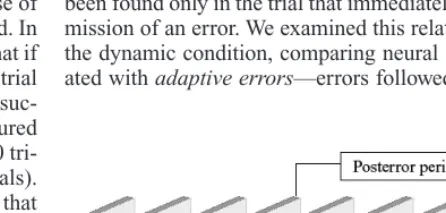
[image:2.576.263.486.554.661.2]A two-alternative forced choice task was employed while fMRI data was acquired. The task presented a series of random letters that for 90% of trials (go trials) required the same rapid buttonpress response (thus creating a potency for this response). When the same letter was pre-sented on two consecutive trials (a lure trial), participants were required to provide the alternative response. The dif-ficulty that participants typically experience in inhibiting a highly prepotent response was utilized in the present task to induce a large number of errors for the purpose of analysis. Two conditions of the task were administered. In the dynamic condition, participants were instructed that if they made an error in a lure trial, then the next lure trial would appear in the next 2–7 trials (see Figure 1). A suc-cessful response to a lure trial, on the other hand, ensured that the next lure trial would not appear for at least 10 tri-als (appearing instead between the 11th and 15th tritri-als). In the standard condition, participants were instructed that their performance did not influence the trial sequence, and lure trials were pseudorandomly placed every 2–15 trials. The aim of this design was to encourage adaptive post-error behavior during the dynamic condition—that is, to slow responses to go trials following a commission error. Past research indicates that commission errors are asso-ciated with faster than average response speed and that successful inhibitions are associated with slower than average response speed (Bellgrove, Hester, & Garavan, 2004). Although posterror slowing typically occurs with-out a specific manipulation’s inducing it, it is not rwith-outinely
Nvidia Video Card) that was interfaced with the MR scanner dur-ing acquisition of fMRI data. Stimuli were back projected onto a screen at the foot of the scanner bed, with a headcoil-mounted mir-ror enabling participants to view stimuli. The participants responded to each stimulus using the right hand, entering their responses on a two-button MR-compatible response box (Fibre-Optic Response Pads, Current Designs, Philadelphia, PA).
Image Acquisition
Functional MR images were acquired at St. Vincent’s Hospital, Melbourne, using a whole-body 1.5-tesla Siemens Vision scanner with a gradient-echo echoplanar imaging (EPI) sequence. The scan-ner was equipped with a standard radio frequency birdcage headcoil for signal transmission and reception. Lateral head stabilizers were used to minimize head movement. EPI images were acquired using a gradient-echo pulse sequence and sequential slice acquisition (TR 2,000 msec, TE 48 msec, flip angle 78º; 18 contiguous slices of 6-mm thickness, 10% gap, in-plane resolution of 1.8 1.8 pixels in a FOV of 240 mm). Each functional run began with two volume acquisitions that were later discarded, to allow for steady-state tissue magnetization. A total of 188 EPI volumes were collected for each functional run, and a total of eight functional runs were performed for each participant. Activation data were registered to high-resolution T1-weighted isotropic (1-mm3) structural MPRAGE images to local-ize the pattern of physiological changes associated with the task.
Data Analysis
All analyses were conducted using AFNI software Version 2.56 (afni.nimh.nih.gov/afni/). Following image reconstruction, the time series data were time shifted (using Fourier interpolation) to remove differences in slice acquisition times and then motion corrected using 3-D volume registration (least-squares alignment of three translational and three rotational parameters). Activation outside the brain was also removed using edge detection techniques.
Separate hemodynamic response functions at 2-sec temporal res-olution were calculated using deconvres-olution techniques for success-ful lure responses (stops) and errors of commission (errors) in both the standard and the dynamic conditions. Dynamic condition errors were further classified according to whether they had been preceded by correct or erroneous lure performance. Only those preceded by correct performance were considered to be dynamic condition error events, because of the potential differences created by the posterror manipulation in the dynamic condition.
Block activation functions for the posterror block of go trials were identified as the image acquisitions between lure trials; these acti-vation functions always coincided with the beginning of the 2-sec TR cycle. Because all trials were presented at 1 Hz, the posterror block spanned from the second go trial after a lure error to the final go trial preceding the next lure trial. For the purposes of analysis, posterror blocks of only seven trials were used in both the dynamic and the standard conditions, despite larger posterror blocks in the standard condition. To provide an equivalent period for comparison, the length and location of posterror periods in the dynamic condition were transposed to the posterror periods in the standard condition. Due to the temporal spacing of lures, the creation of blocks follow-ing standard errors did not overlap with other events of interest.
A mixed regression analysis was used whereby posterror blocks were calculated as a percentage of change relative to baseline. The baseline in this design was an implicit one and was indicative of on-going and remaining task-related processing after the variance re-lated to the other types of events had been removed. Separate impulse response functions (IRFs) were calculated for the four event-related conditions: standard stops and errors and dynamic stops and errors. A nonlinear regression program determined the best-fitting gamma variate function for these IRFs (Cohen, 1997) as previously described (Garavan, Ross, & Stein, 1999). The area under the curve of the gamma variate function was expressed as a percentage of the area under the baseline. The percentage area (event-related activation) and percentage change map (block activation) voxels were resampled at performance on the next lure trial—with that associated
with maladaptive errors—errors followed by failed per-formance on the next lure trial.
METHoD
Participants
Fifteen healthy volunteers (8 females and 7 males; mean age
23.4 years, range 21–29) participated in the experiment. All of the participants provided written informed consent, which was ap-proved by ethics committees at the University of Melbourne and St. Vincent’s Hospital, Melbourne.
Experimental Protocols
A two-alternative forced choice response task was administered in which random letters of the alphabet were presented serially at 1 Hz. The participants were instructed to press a button (the “1” button) at the appearance of each letter in the sequence, except when the same letter was presented consecutively (see Figure 1), in which case they were to press the “2” button. Stimulus duration was 700 msec and was followed by a 300-msec blank interstimulus interval screen. Stimuli were presented in two different conditions. In the standard condition, lure trials were pseudorandomly interspersed among 960 go trials. The number of go trials separating lure trials ranged between 1 and 15, with the gap between lure trials randomly selected from within this range (although this gap always consisted of an odd number of go trials, to ensure that lure trials always coincided with the beginning of an image acquisition).
The dynamic condition repeated the stimulus presentation and re-sponse parameters from the standard condition, except that the partic-ipants were instructed that their performance on lure trials would in-fluence the task trial sequence. Incorrect responses to lure trials—that is, making the prepotent go response (pressing the “1” button again) rather than the alternate lure response (pressing the “2” button)— ensured that the next lure would be presented in 2 to 7 trials (at least 1 go trial separated all lure trials so that lures were never presented on consecutive trials). Conversely, correct responses to lure trials ensured that the next lure would not be presented for at least 10 trials (the 11th at the earliest, the 15th at the latest). The aim of this design was to encourage more cautious posterror responding, which would be reflected in slower response times (RTs) for go trials in the posterror blocks that separated lure trials. Slower response speeds in go trials that precede lure trials in inhibition tasks have been associated with improved performance (Bellgrove et al., 2004; Ridderinkhof, Nieu-wenhuis, & Bashore, 2003), and this relationship suggests that the additional time provides more opportunity for the alternate response to overcome the prepotent go response in the response selection race (Logan, Cowan, & Davis, 1984). The larger gap between lure trials following correct lure responses was required to ensure sufficient separation of critical events for an event-related fMRI analysis.
Before entering the MRI scanner, the participants practiced two novel blocks of each condition to ensure that they understood the task instructions and how their performances would influence trial sequence in the dynamic condition. Four blocks of 260 trials each were administered for each condition during MRI data collection, with each block separated by a short break. All four blocks of a con-dition were administered consecutively, with the order of concon-ditions counterbalanced across participants. The participants were informed which condition was being administered prior to each block of trials. During the scanner session, on average, 88 lure trials were adminis-tered in the standard condition (ranging from 85 to 90), and 89 were administered in the dynamic condition (ranging from 77 to 109). The average delay between error events was also not significantly different between the conditions (the standard condition averaged a 10.1-trial delay; the dynamic condition, a 10.7-trial delay).
condition were approximately 32 msec slower than those in the dynamic condition. Accuracy performance for go tri-als during the standard and dynamic conditions was 99% and 98%, respectively. RTs for lure errors in the standard condition were significantly faster than the equivalent go trial RTs, whereas error and go trial RTs were not signifi-cantly different in the dynamic condition. The latter effect may have been influenced by the relatively fast go trial RTs in the dynamic condition. The large interlure gap following a successful inhibition in this condition appeared to increase the average speed of go trial responses, presumably because participants were aware that the next 10 trials would be go stimuli and that they therefore did not need to process the stimulus before making a response. For example, the mean go RT for these 10 trials was 268 msec for the dynamic con-dition and 312 msec for the standard concon-dition.
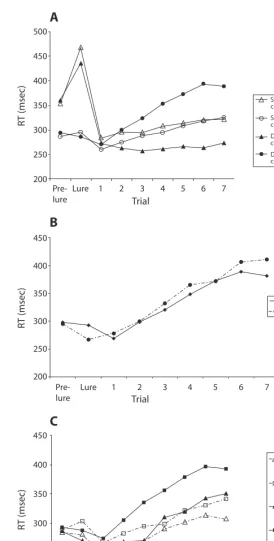
Posterror slowing was assessed by creating difference scores, which were calculated by subtracting the go trial RT for each of the seven trials following a lure error from the RT for the go trial prior to the lure (see Figure 2). This difference score approach was taken to ensure that the ef-fect of an error on phasic response behavior was captured, thereby minimizing the effect of other task manipulations on go trial RTs and consequently on posterror slowing (e.g., the effect mentioned in the paragraph above). A 2 (condition: standard vs. dynamic) 7 (number of trials) repeated measures ANOVA was used to compare posterror slowing across conditions; it indicated that the dynamic condition showed significantly more posterror slowing than did the standard condition: 49 msec (average of the seven posterror trials) versus 9 msec [F(1,14) 31.4, p .01]. The interaction between condition and trial was also significant [F(6,84) 9.8, p .01], with post hoc tests (corrected for multiple comparisons) indicating signifi-cantly more posterror slowing for the dynamic condition during Trials 1–7. A within-condition, repeated measures ANOVA revealed that in the standard condition, Posterror Trials 5, 6, and 7 were executed significantly more slowly than they were in the prelure baseline condition ( p .05, corrected), whereas Posterror Trials 3–7 in the dynamic condition were executed significantly more slowly than they were in the prelure condition. Unexpectedly, in both conditions, the go trial RT for the trial immediately fol-lowing an error was faster than the RTs for both the trial 1-mm3 resolution, then warped into standard Montreal Neurological
Institute (MNI) space, and then spatially blurred with a 3-mm isotro-pic RMS Gaussian kernel.
To ensure that activation produced during the posterror period did not overlap with activation produced by the events, an additional analysis that accommodated the hemodynamic lag of the posterror period was performed. Blocks corresponding to the posterror peri-ods were convolved with a standard hemodynamic response and all analyses were repeated. This analysis produced results identical to those of the initial analysis, so only the results from the first analysis will be reported.
Group activation maps for each event type were determined with one-sample t tests against the null hypothesis of zero event-related activation changes (i.e., no change relative to tonic task-related ac-tivity). Significant voxels passed a voxelwise statistical threshold (t 4.14, p .001) and were required to be part of a larger 142-µl cluster of contiguous significant voxels. Thresholding was deter-mined through Monte Carlo simulations and resulted in a 5% prob-ability of a cluster’s surviving due to chance.
The activation maps were then combined within categories but across conditions, deriving three Or maps: standard and dynamic stops, errors, and posterror periods after errors. For example, the er-rors Or map includes the voxels of activation indicated as significant according to either the standard errors map or the dynamic errors map. The mean activation for clusters in the combined maps was calculated for each condition for the purposes of an ROI analysis, and these data were used for a series of pairwise comparisons be-tween conditions (standard vs. dynamic), corrected using a modified Bonferroni procedure for multiple comparisons (Keppel, 1991).
Secondary analyses. Due to the interest in the relationship
be-tween error-related pMFC activity and future performance, an addi-tional analysis was performed. Errors in the dynamic condition were divided into two categories: adaptive or maladaptive, depending on whether performance on the next lure trial after an error was suc-cessful (adaptive), or incorrect (maladaptive). The posterror blocks were reclassified in the same way, to enable examination of the post-error neural activity that preceded success or failure on the next lure trial. The analysis focused on the dynamic condition because of the manipulation of posterror slowing behavior, which directly linked posterror slowing with success on the next lure trial. The analyses followed the same steps as outlined above, with the addition of a new multiple regression analysis to estimate percentage of event-related activation change on the basis of the newly categorized adaptive and maladaptive errors (determined by the participant’s performance) for the events of interest. All analyses used the same measure of base-line activity (tonic go trial activity). Because the dynamic condition, which has the capacity to confound the spatial extent of activity in whole-brain analyses (Murphy & Garavan, 2005), had a lower num-ber of events, we chose to perform an ROI analysis that compared the relevant events’ activity using the clusters of activity from the original event-related analysis. The mean activation for the ROIs was then calculated using the voxel-level percentage change estimates for each event type, deriving mean activation scores for adaptive and maladaptive errors and for posterror blocks. The estimates were com-pared using repeated measures t tests, corrected via the modified Bonferroni procedure for multiple comparisons (Keppel, 1991).
RESulTS
Behavioral Results
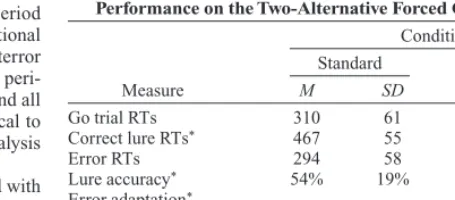
[image:4.576.261.489.83.183.2]Participants responded correctly to a higher proportion of lures in the dynamic condition than in the standard condition (see Table 1): 69% correct responses versus 54%. Similarly, participants avoided making two consecutive errors more often during the dynamic condition than during the stan-dard condition: 77% avoidance versus 56%. Go trial RTs did not differ between the conditions, nor did the RTs for error responses; however, correct lure responses in the standard
Table 1
Mean Response Times (RTs, in Milliseconds) With Standard Deviations and Percentages of Accuracy and Adaptation for Performance on the Two-Alternative Forced Choice Tasks
Condition
Standard Dynamic
Measure M SD M SD
Go trial RTs 310 61 289 58
Correct lure RTs* 467 55 435 52
Error RTs 294 58 285 41
Lure accuracy* 54% 19% 69% 14% Error adaptation*
(avoiding consecutive
Figure 2. Mean response times (RTs) for the go trial preceding an error (the prelure trial), for lure errors, and for the seven posterror go trials in the follow-ing conditions. Panel A displays successful and fail performances in the stan-dard and dynamic conditions. Panel B displays performances in the dynamic condition, classified according to whether an error response was preceded by correct performance on the previous lure (first) or an error (second). Panel C displays levels of posterror slowing in both conditions classified according to performance on the following lure trial, with adaptive errors defined as ac-curate performance on the next lure trial, and maladaptive errors as failed performance (i.e., another error) on the next lure trial.
500
450
400
350
300
250
200
450
400
350
300
250
200
450
400
350
300
250
200 Pre-lure
Lure 1 2 3 4 5 6 7
Pre-lure
Lure 1 2 3 4 5 6 7
Pre-lure
Lure 1 2 3 4 5 6 7
RT
(m
se
c)
RT
(m
se
c)
RT
(m
se
c)
Standard condition success Standard condition failure Dynamic condition success Dynamic condition failure
First error Second error
Standard condition− maladaptive Standard condition− adaptive Dynamic condition− maladaptive Dynamic condition− adaptive
A
Trial
Trial
Trial
B
according to performance on the subsequent lure trial (see Figure 2C). The analysis revealed significantly more post-error slowing when performance on the next lure trial was successful (adaptive posterror slowing) than when it failed (maladaptive): 53 versus 7 msec [F(1,12) 13.2, p .01]. Imaging Results
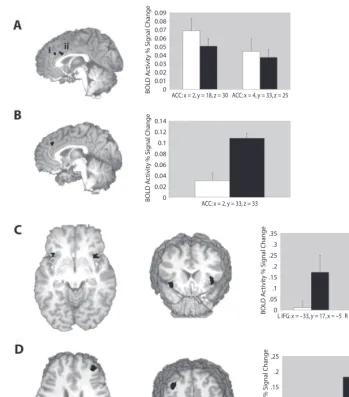
Errors. Errors were associated with two clusters of significant activity in the posterior medial frontal cortex (see Figure 3A). The centers of mass for both clusters of that preceded the error and the trial on which the error
itself was made (see Figure 2A). We repeated this analysis for the dynamic condition to check the potential for lure position (i.e., whether a lure had been preceded by an error or a correct lure response) to influence posterror behavior. Figure 2B demonstrates that lure position did not influ-ence posterror behavior.
[image:6.576.78.428.47.444.2]Given the interest in the influence of posterror behavior changes on future performance, the analysis described above was repeated after each posterror period was categorized
Figure 3. Event-related brain activity. In the bar graphs, white bars represent activity in the
standard condition and black bars, activity in the dynamic condition. (A) Sagittal view (x slice 4)
of significant clusters of event-related anterior cingulate cortex (ACC) activity in the i and the ii
clusters (Montreal Neurological Institute [MNI] coordinates: x 2, y 18, z 30 and x 4, y 33,
z 25). Activity in these clusters was the same both for errors committed in the standard condition
and for those committed in the dynamic condition. (B) Sagittal view (x 2) of the ACC activity
cluster during the posterror period (MNI coordinates: x 2, y 33, z 33). This cluster showed
significantly more activity in the dynamic than in the standard condition. (C) Axial and coronal
views of the bilateral inferior frontal/insula gyrus (IFG) (z5, y 21) clusters of activity from
the posterror period. (D) Axial and coronal views of the right middle frontal gyrus (MFG) (z 27,
y 40). All of these clusters showed significantly more activity during the dynamic condition than
during the standard condition, and activity in the right middle and inferior frontal clusters during the dynamic condition was also predictive of future performance improvements.
0.09 0.08 0.07 0.06 0.05 0.04 0.03 0.02 0.01 0
BOLD
A
ctivity % Signal Change
ACC: x = 2, y = 18, z = 30 ACC: x = 4, y = 33, z = 25
0.14 0.12 0.1 0.08 0.06 0.04 0.02 0
BOLD
A
ctivity % Signal Change
ACC: x = 2, y = 33, z = 33
.35 .3 .25 .2 .15 .1 .05 0
BOLD
A
ctivity % Signal Change
L IFG: x = –33, y = 17, x = –5 R IFG: x = 36, y = 21, x = 1
.25
.2
.15
.1
.05
0
BOLD
A
ctivity % Signal Change
to be associated with subsequent lure performance. Three regions—the right middle frontal, right inferior frontal/ insula, and right anterior cingulate cortex—showed sig-nificantly greater activity during adaptive posterror slow-ing than durslow-ing maladaptive posterror slowslow-ing.
DISCuSSIoN
Error-related neural activity in the pMFC has been as-sociated with immediate adaptive changes in response behavior. The results of the present study suggest that de-liberately slowing responses after an error, in an effort to avoid making the same mistake on an upcoming trial, was associated with the magnitude of posterror-related pMFC activity but not with activity during commission of the error itself. Posterror slowing was observed in both exper-imental conditions, although to a significantly greater ex-tent in the dynamic condition. The latter condition trained participants to expect another critical (lure) trial to quickly follow an error, providing an incentive for more cautious response behavior and hence greater posterror slowing. This behavior change clearly benefited performance, with increases in the magnitude of posterror slowing associated with increased accuracy on the subsequent lure trial. De-spite these behavioral findings, error-related pMFC activ-ity was not statistically different for the standard and the dynamic conditions. Only activity in the occipital cortex and thalamus (medial dorsal nucleus) was greater for the dynamic condition.
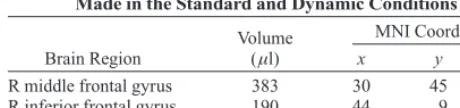
More surprisingly, activity in the right prefrontal cortex (x 30, y 45, z 32; Brodmann area 9), previously as-sociated with posterror conflict adaptation effects (Kerns et al., 2004), was greater for standard condition errors that preceded smaller amounts of posterror slowing. Kerns et al. found that activity in the right middle frontal gyrus (x 30, y 34, z 37; Brodmann area 9) during the trial following an error was associated with increased posterror conflict adaptation and greater ACC activity during the error trial that had preceded it. We acknowledge that our results may have been influenced by unexpected differ-ences in baseline performances during the two conditions. For example, RTs for errors (relative to RTs for go trials) activity were located in the right anterior cingulate cortex
(MNI coordinates: x 4, y 33, z 25, and x 2,
y 18, z 30), which falls within the rostral cingulate zone highlighted by Ridderinkhof et al.’s (2004) review of performance monitoring. Within these functionally de-fined ROIs, no significant difference was seen between BOLD activity for the standard condition errors and that for the dynamic condition errors. Unexpectedly, the trend of activity suggested greater activity for the standard con-dition, where there was significantly less posterror slow-ing. Activity in three other regions differentiated errors in the standard and dynamic conditions (see Table 2). Right middle frontal, inferior frontal, and caudate regions all showed significantly greater activity for standard condi-tion errors, whereas no region of activity showed signifi-cantly higher levels during the dynamic condition. The right middle frontal cluster (x 30, y 45, z 32, Brod-mann area 9) is located proximal to the region identified by Kerns et al. (2004) (x 30, y 34, z 37) as as-sociated with behavioral adjustments in response speed following an error.
Posterror neural activity. Activity during the stan-dard and dynamic conditions was also compared for the variable block of activity following errors. Two patterns emerged. The first consisted of significantly greater ac-tivity in the right ACC (MNI coordinates: x 2, y 33,
z 33), right middle frontal, and bilateral inferior frontal/ insula (the center of mass is located in the inferior fron-tal gyrus, specifically in the pars orbifron-talis, but the extent of the activity does include the insula), in comparison with the pattern of activity in the standard condition (see Table 3 and Figure 3). The second pattern showed deacti-vation of the left midorbital and posterior cingulate during both the standard and the dynamic conditions, with the level of deactivation significantly greater in the dynamic condition.
[image:7.576.19.249.75.129.2]Adaptive versus maladaptive errors. A secondary analysis of the dynamic condition was performed to com-pare adaptive and maladaptive errors. Adaptive errors were succeeded by correct performance on the following lure trial, whereas maladaptive errors were succeeded by another lure error. The ROIs from the initial error-related and posterror block period analyses were used to maxi-mize the power of the analysis (Hester, Fassbender, & Ga-ravan, 2004; Murphy & GaGa-ravan, 2005), with both event-related activity during errors and posterror block activity compared across the two categories (adaptive vs. mal-adaptive). A comparison of error-related activity did not reveal any significant differences between adaptive and maladaptive errors. However, posterror activity did appear
Table 2
Regions of Event-Related Neural Activity Differentiating Errors Made in the Standard and Dynamic Conditions
Volume (µl)
MNI Coordinates
Brain Region x y z
R middle frontal gyrus 383 30 45 32 R inferior frontal gyrus 190 44 9 14
R caudate 158 18 23 17
Table 3
Regions of Neural Activity Differentiating Posterror Periods in the Standard and Dynamic Conditions
Volume MNI Coordinates Brain Region (µl) x y z
Dynamic Standard
R middle frontal gyrus 987 33 40 27
L inferior frontal/insula 357 33 17 5
R inferior frontal/insula 238 36 21 1
R anterior cingulate cortex 196 2 33 33
Standard Dynamic
gyrus was associated with accurate performance. It is ar-gued that the purpose of such task-induced deactivation in the default mode network is to optimize task performance through the allocation of resources to task-related regions and away from task-irrelevant ones (Drevets & Raichle, 1998). Although we found greater levels of posterror pe-riod deactivation for default mode network regions (the midorbital gyri and the posterior cingulate) during the dy-namic condition—the condition with greater levels of suc-cess and posterror improvement of performance—activity levels in these regions did not predict future success during the dynamic condition.
Our results appear to support the critical relationship that the pMFC and prefrontal regions have to posterror changes. In addition to demonstrating greater activity in these regions during the periods of peak behavioral change, the results suggest that such activity was adaptive, insofar as it predicted changes in behavior that led to future suc-cess. The results do, however, present an inconsistency with the extant literature. Previous studies have indicated that increases in error-related activity, coinciding with the incorrect behavioral response, were related to posterror slowing (Debener et al., 2005; Garavan et al., 2002) or to speeding of responses (conflict adaptation effects) (Kerns, 2006; Kerns et al., 2004) in the trial immediately follow-ing the error. Similarly, pMFC activity response locked to the error has been related to increased prefrontal activity during the subsequent posterror trial (Kerns et al., 2004). Our results identify a similar neuroanatomical relation-ship, but place it in the period after an error has occurred rather than during the same period as the error. How might the inconsistency with past results be reconciled?
Although the timing of activity in the present study ap-pears to be inconsistent with previous results, it is worth-while to consider the relationship between task require-ments, brain activity, and behavior. Previous studies have shown that heightened pMFC activity coincides with an error that immediately precedes behavior change in the form of response speed changes on the very next trial. Typically, these studies have administered tasks whose every trial is critical, in that a random distribution of tri-als ensures that the trial following an error could require immediate changes in behavior. In contrast, the present task never presented two lure trials in succession (in order to enable fMRI analysis), meaning that the participants were aware that the trial immediately following an error would never be a critical trial. The behavioral data indicate that the RT for a trial immediately following an error was faster than the RT for the error trial or for the trial pre-ceding the error. Posterror slowing did not occur until the second trial after an error, after which the magnitude of slowing appeared to increase linearly. The fact that pMFC and dlPFC activity appeared to be delayed until the block period after an error had been made, rather than occurring during the error event, appears to coincide with the delay in implementing adaptive posterror behavior.
Interpretation of the inconsistency between the past studies and the present one is made more complex by the latter’s use of block-related analysis, which averages neu-ral activity over a series of posterror trials. Typically, pre-were significantly faster in the standard condition than in
the dynamic condition. This effect has previously been associated with both higher levels of inattentiveness and compensatory increases in neural activity for inhibition-related cortical regions (Bellgrove et al., 2004). Future studies might resolve the origin of this effect by paramet-rically manipulating the incentive for posterror slowing within a single task condition—by, for example, providing feedback during errors that indicates approximately when the next lure will appear (e.g., within the next 5, 10, or 15 trials).
Although error-related activity did not show the ex-pected relationship to adaptive posterror behavior, amounts of neural activity in the posterror period (the block of go trials that preceded the next lure trial) did correlate with the magnitude of posterror slowing and accuracy. The dy-namic condition, which had greater amounts of posterror slowing and fewer consecutive lure errors than did the standard condition, elicited significantly greater activity than did the standard condition in the right pMFC, right middle frontal, bilateral inferior frontal, and left cerebel-lum. Furthermore, posterror activity in three of these re-gions (right pMFC, right middle frontal, and right inferior frontal) was predictive of future success. When posterror periods in the dynamic condition were divided by posterror lure performance, those periods that preceded successful adaptation of performance (i.e., a correct response on the next lure trial), as compared with periods that preceded another lure error, had significantly greater activity in the right prefrontal and pMFC regions. RTs for the posterror periods in this comparison revealed significantly greater posterror slowing during the adaptive posterror periods than during the maladaptive periods.
dynamic condition. RTs increased for each go trial follow-ing an error, as though the nonappearance of the expected posterror lure trial increased expectancy, and therefore cautiousness, with each ensuing go trial.
Our results, when combined with others derived from examinations of the relationship between cortical activ-ity and posterror modulations of cognitive control, appear to speak to the flexibility of cognitive control, particu-larly as implemented by the pMFC. Although the pres-ent study suggests that increased cognitive control was implemented in association with increased pMFC activ-ity across multiple trials, it would appear that the timing of pMFC interventions may have been a consequence of task demands. Studies to date have shown that increased cognitive control is associated with activity increases in the pMFC several trials before the critical trial (Hester, Murphy, et al., 2004; Ridderinkhof et al., 2003), within a trial (Magno, Foxe, Molholm, Robertson, & Garavan, 2006), or across consecutive trials (Hajcak et al., 2003; Kerns et al., 2004; MacDonald et al., 2000; Polli et al., 2005). Although our findings further support evidence of the relationship between pMFC/PFC activity and subse-quent changes in cognitive control, they leave open the question of what properties of an error initiate this dy-namic relationship.
AuTHoR NoTE
This research was supported by Australian Research Council Grant DP0556602 to R.H. and University of Melbourne Collaborative Re-search Grant 21028 to R.H. and J.J.F. The assistance of Nick Trost and Mark Lourenz, Medical Imaging Department, St. Vincent’s Hospital, Melbourne; Mark Bellgrove, University of Queensland; and Kevin Murphy, National Institutes of Health, is gratefully acknowledged. Correspondence should be addressed to R. Hester, Queensland Brain Institute, University of Queensland, St. Lucia, QLD 4072, Australia (e-mail: [email protected]).
REFERENCES
Aron, A. R., Fletcher, P. C., Bullmore, E. T., Sahakian, B. J., &
Robbins, T. W. (2003). Stop-signal inhibition disrupted by damage to
right inferior frontal gyrus in humans. Nature Neuroscience, 6, 115-116.
Aron, A. R., Robbins, T. W., & Poldrack, R. A. (2004). Inhibition
and the right inferior frontal cortex. Trends in Cognitive Sciences, 8, 170-177.
Barbarotto, R., Capitani, E., Jori, T., Laiacona, M., & Molinari, S.
(1998). Picture naming and progression of Alzheimer’s disease: An analysis of error types. Neuropsychologia, 36, 397-405.
Bellgrove, M. A., Hester, R., & Garavan, H. (2004). The functional
neuroanatomical correlates of response variability: Evidence from a response inhibition task. Neuropsychologia, 42, 1910-1916.
Botvinick, M., Nystrom, L. E., Fissell, K., Carter, C. S., &
Cohen, J. D. (1999). Conflict monitoring versus selection-for-action
in anterior cingulate cortex. Nature, 402, 179-181.
Brass, M., & von Cramon, D. Y. (2004). Decomposing components of
task preparation with functional magnetic resonance imaging. Journal
of Cognitive Neuroscience, 16, 609-620.
Brown, J. W., & Braver, T. S. (2005). Learned predictions of error
likelihood in the anterior cingulate cortex. Science, 307, 1118-1121.
Carter, C. S., Macdonald, A. M., Botvinick, M., Ross, L. L.,
Stenger, V. A., Noll, D., & Cohen, J. D. (2000). Parsing executive
processes: Strategic vs. evaluative functions of the anterior cingulate cortex. Proceedings of the National Academy of Sciences, 97, 1944-1948.
Carter, C. S., MacDonald, A. W., III, Ross, L. L., & Stenger, V. A.
(2001). Anterior cingulate cortex activity and impaired self- monitoring vious research examined only event-related neural
activ-ity, whereas the present study included both event-related and block-related activity. For example, the increase in dynamic posterror block activity may have been due to a phasic increase within the block of trials or a sustained increase across them, potentially the results of different behavioral mechanisms at work. The temporal insensitiv-ity of block-related analysis limits our abilinsensitiv-ity to further examine these questions with the available data, but it does pose an interesting question for further studies.
Another consideration is the influence that trial se-quence information had on the relationship between error and posterror behavior. In many of the paradigms typi-cally described in the literature, errors implicitly inform participants that their response styles have become incon-sistent with the task requirements and that they need to increase their level of control to successfully complete future trials of similar difficulty. In the present task, this relationship was made explicit to participants, in that an error would always induce the presentation of another high-control trial among the ensuing seven trials. It is unclear how the explicitness of this relationship, which potentially increases the task relevancy of errors not seen in other tasks examining these processes, may have influ-enced the brain–behavior relationships. The inconsistency between the present study’s findings and those of previous studies may, therefore, stem from the differences in the paradigms used—in particular, the delay between critical trials in the present study.
Kerns, J. G., Cohen, J. D., MacDonald, A. W., III, Cho, R. Y.,
Stenger, V. A., & Carter, C. S. (2004). Anterior cingulate conflict
monitoring and adjustments in control. Science, 303, 1023-1026.
Kopp, B., & Rist, F. (1994). Error-correcting behavior in schizophrenic
patients. Schizophrenia Research, 13, 11-22.
Lawrence, N. S., Ross, T. J., Hoffmann, R., Garavan, H., &
Stein, E. A. (2003). Multiple neuronal networks mediate sustained
attention. Journal of Cognitive Neuroscience, 15, 1028-1038.
Logan, G. D., Cowan, W. B., & Davis, K. A. (1984). On the ability
to inhibit simple and choice reaction time responses: A model and a method. Journal of Experimental Psychology: Human Perception &
Performance, 10, 276-291.
MacDonald, A. W., III, Cohen, J. D., Stenger, V. A., & Carter, C. S.
(2000). Dissociating the role of the dorsolateral prefrontal and anterior cingulate cortex in cognitive control. Science, 288, 1835-1838.
Magno, E., Foxe, J. J., Molholm, S., Robertson, I. H., &
Gara-van, H. (2006). The anterior cingulate and error avoidance. Journal
of Neuroscience, 26, 4769-4773.
Murphy, K., & Garavan, H. (2005). Deriving the optimal number of
events for an event-related fMRI study based on the spatial extent of activation. NeuroImage, 27, 771-777.
Noble, C. E. (1957). The length–difficulty relationship in compound
trial-and-error learning. Journal of Experimental Psychology, 54, 246-252.
Pochon, J. B., Levy, R., Poline, J. B., Crozier, S., Lehéricy, S.,
Pil-lon, B., et al. (2001). The role of dorsolateral prefrontal cortex in the
preparation of forthcoming actions: An fMRI study. Cerebral Cortex,
11, 260-266.
Polli, F. E., Barton, J. J., Cain, M. S., Thakkar, K. N., Rauch,
S. L., & Manoach, D. S. (2005). Rostral and dorsal anterior
cingu-late cortex make dissociable contributions during antisaccade error commission. Proceedings of the National Academy of Sciences, 102, 15700-15705.
Ridderinkhof, K. R., Nieuwenhuis, S., & Bashore, T. R. (2003).
Er-rors are foreshadowed in brain potentials associated with action moni-toring in cingulate cortex in humans. Neuroscience Letters, 348, 1-4.
Ridderinkhof, K. R., Ullsperger, M., Crone, E. A., &
Nieuwen-huis, S. (2004). The role of the medial frontal cortex in cognitive
control. Science, 306, 443-447.
Russell, J., & Jarrold, C. (1998). Error-correction problems in
au-tism: Evidence for a monitoring impairment? Journal of Autism &
Developmental Disorders, 28, 177-188.
Sakai, K., & Passingham, R. E. (2003). Prefrontal interactions reflect
future task operations. Nature Neuroscience, 6, 75-81.
Taylor, S. F., Martis, B., Fitzgerald, K. D., Welsh, R. C.,
Abel-son, J. L., Liberzon, I., et al. (2006). Medial frontal cortex
activ-ity and loss-related responses to errors. Journal of Neuroscience, 26, 4063-4070.
Ullsperger, M., & von Cramon, D. Y. (2003). Error monitoring using
external feedback: Specific roles of the habenular complex, the reward system, and the cingulate motor area revealed by functional magnetic resonance imaging. Journal of Neuroscience, 23, 4308-4314.
Yeung, N., Holroyd, C. B., & Cohen, J. D. (2005). ERP correlates
of feedback and reward processing in the presence and absence of response choice. Cerebral Cortex, 15, 535-544.
(Manuscript received February 3, 2007; revision accepted for publication September 12, 2007.) of performance in patients with schizophrenia: An event-related fMRI
study. American Journal of Psychiatry, 158, 1423-1428.
Chambers, C. D., Bellgrove, M. A., Stokes, M. G., Henderson,
T. R., Garavan, H., Robertson, I. H., et al. (2006). Executive
“brake failure” following deactivation of human frontal lobe. Journal
of Cognitive Neuroscience, 18, 444-455.
Cohen, M. S. (1997). Parametric analysis of fMRI data using linear
systems methods. NeuroImage, 6, 93-103.
Debener, S., Ullsperger, M., Siegel, M., Fiehler, K., von
Cra-mon, D. Y., & Engel, A. K. (2005). Trial-by-trial coupling of
concur-rent electroencephalogram and functional magnetic resonance imag-ing identifies the dynamics of performance monitorimag-ing. Journal of
Neuroscience, 25, 11730-11737.
De Zubicaray, G. I., Andrew, C., Zelaya, F. O., Williams, S. C. R., &
Dumanoir, C. (2000). Motor response suppression and the prepotent
tendency to respond: A parametric fMRI study. Neuropsychologia,
38, 1280-1291.
Dosenbach, N. U., Visscher, K. M., Palmer, E. D., Miezin, F. M.,
Wenger, K. K., Kang, H. C., et al. (2006). A core system for the
implementation of task sets. Neuron, 50, 799-812.
Drevets, W., & Raichle, M. (1998). Reciprocal suppression of
re-gional cerebral blood flow during emotional versus higher cognitive processes: Implications for interactions between emotion and cogni-tion. Cognition & Emotion, 12, 353-385.
Falkenstein, M., Hoormann, J., Christ, S., & Hohnsbein, J. (2000).
ERP components on reaction errors and their functional significance: A tutorial. Biological Psychology, 51, 87-107.
Garavan, H., Ross, T. J., Murphy, K., Roche, R. A., & Stein, E. A.
(2002). Dissociable executive functions in the dynamic control of be-havior: Inhibition, error detection, and correction. NeuroImage, 17, 1820-1829.
Garavan, H., Ross, T. J., & Stein, E. A. (1999). Right hemispheric
dominance of inhibitory control: An event-related functional MRI study. Proceedings of the National Academy of Sciences, 96, 8301-8306.
Gehring, W. J., Goss, B., Coles, M., Meyer, D., & Donchin, E.
(1993). A neural system for error detection and compensation.
Psy-chological Science, 4, 385-390.
Gehring, W. J., & Knight, R. T. (2000). Prefrontal–cingulate
interac-tions in action monitoring. Nature Neuroscience, 3, 516-520.
Hajcak, G., McDonald, N., & Simons, R. F. (2003). To err is
auto-nomic: Error-related brain potentials, ANS activity, and posterror compensatory behavior. Psychophysiology, 40, 895-903.
Hester, R., Fassbender, C., & Garavan, H. (2004). Individual
dif-ferences in error processing: A review and reanalysis of three event-related fMRI studies using the GO/NOGO task. Cerebral Cortex, 14, 966-973.
Hester, R., Murphy, K., Foxe, J., Foxe, D., Javitt, D., &
Gara-van, H. (2004). Predicting success: Patterns of cortical activation and
deactivation prior to response inhibition. Journal of Cognitive
Neuro-science, 16, 776-785.
Kaufman, J. N., Ross, T. J., Stein, E. A., & Garavan, H. (2003).
Cingu-late hypoactivity in cocaine users during a GO–NOGO task as revealed by event-related fMRI. Journal of Neuroscience, 23, 7839-7843.
Keppel, G. (1991). Design and analysis: A researcher’s handbook (3rd
ed.). Englewood Cliffs, NJ: Prentice Hall.
Kerns, J. G. (2006). Anterior cingulate and prefrontal cortex activity in
an fMRI study of trial-to-trial adjustments on the Simon task.