Preface i
Preface
The purpose of this manual is three-fold. First, it describes Canada’s army in all of its aspects. These include its origins, history, and contribution to building and defending the nation; the vital role it plays in serving Canadian interests at home and around the world; its understanding of conflict and approach to operations; and how it will continue to serve Canada into the 21stCentury. Second, it shows that the army is a unique social institution which reflects Canadian values and character within the framework of military professionalism and the requirements for warfighting. Finally, and most importantly, Canada’s Armyestablishes the doctrinal foundation for the professional competency of all ranks in the army, and serves as the basic source document for all instruction and training leading to that end.
circumstance. As such, the ethos forms the bedrock of the army’s preparedness in peace and is key to its effectiveness in war and operations other than war.
There is one underlying theme throughout Canada’s Army: that Canada’s soldiers, as military professionals, play an indispensable role in guarding and promoting national well-being. To this end, the army carries out training and conducts operations in support of sovereignty and territorial defence; is on call to Canadians in times of emergency and civil disaster; contributes to international stability through involvement in peace support operations around the world; and operates with other elements of the Canadian Forces and the armed forces of allies to deter aggression and, when directed, to restore the peace where it has been broken. Comprising citizen volunteers from every province and territory, and operating as a bilingual force with unity of purpose and effort, the army constitutes national beliefs and ideals in action. Its ser-vice in the cause of peace and its sacrifices and achievements in war have helped acquire for Canada a respected place in the community of nations. For these reasons ordinary Canadians, with or without military experience, are encouraged to read this manual. They will see that their army proudly reflects the best of themselves, serving not only the needs of the nation, but helping Canadians make a difference in the world.
iii
Table of Contents
Table of
Contents
Chapter One:
Serving Canada in Peace and War
The Army’s Purpose . . . 2
History and Evolution — A Tradition of Service . . . 5
The Origins of Today’s Army . . . 15
Chapter Two:
Professionalism and Ethos —
The Army’s Essence
The Profession of Arms . . . 30Unlimited Liability and the Military Ethos . . . 33
The Army’s Moral and Physical Components . . . 38
Command and Duties . . . 46
Chapter Three:
The Army and National Defence
Canadian Defence Policy . . . 56Canada’s Strategic Environment . . . 57
The Army’s Mission and Tasks. . . 63
Chapter Four:
The Nature of Conflict
The Security Environment . . . 68Chapter Five:
Operations
The Basis for Operational Success . . . 84
Operational Readiness and Effectiveness . . . 90
Conducting Operations . . . 95
Chapter Six:
The Army and the Future —
Trends and Requirements
Canadians and their Army . . . 108Future Conflict . . . 111
Marking the Course Ahead . . . 120
List of Figures
Figure 1 Design of the Army . . . 39Figure 2 Army Command and Structure Within the CF . . . 48
Figure 3 The Spectrum of Conflict and Continuum of Operations . . . 73
Figure 4 Levels of Conflict . . . 79
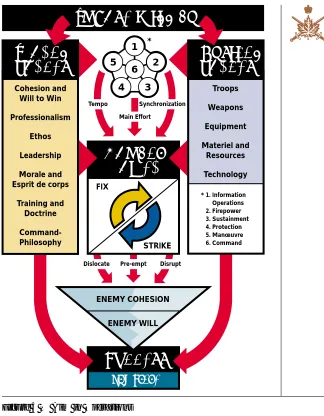
Figure 5 Aim in Operations . . . 101
Figure 6 Operational Art . . . 102
[image:7.396.79.362.38.575.2]Chapter One:
[1]
Serving Canada
in Peace and War
The Army’s Purpose
Introduction. Canada’s army is the land element of the unified Canadian Forces (CF). Made up of Regular and Reserve (Militia) components, the army’s primary purpose is to defend the nation and, when called upon, to fight and win in war. The army fulfils this function when it maintains a military deterrence capability which is credible and visible during peacetime, and by being able to undertake combat operations if deterrence fails. Although the sea and air elements of the Canadian Forces have a similar role and are equally vital for national defence, the army alone possesses the capability to seize and hold ground, dominate terrain, and physically protect land-based resources and people. As such, it is a strategic and decisive element of national power. At the same time, the army’s members constitute a unique subset of Canadian society. Although governed by the imperatives of mili-tary professionalism, being citizen volunteers they are, and must remain, reflective of the fundamental values of Canadian society.
In no battle did the Corps ever fail to take its objective; nor did it lose an inch of ground, once that battle was consolidated; and in the 51 months that it had been in the field the Canadian Corps had never lost a single gun. I think one cannot be accused of immodesty in claiming that the record is somewhat unique in the history of the world’s campaigns.
Chapter One: Serving Canada in Peace and War 3
It is within the context of reflecting and defending those values that the army serves the nation and fulfils its purpose.
Defending Canada.Geographically, Canada is the world’s second largest country, with a relatively small population of 30 million concentrated mostly in its southern parts and along a 5 000 kilometre border with the United States. Consequently, its defence and security requirements are governed by these circum-stances. These requirements call for Canada to possess sufficient military capability to respond to threats to national security; pro-tect and project sovereignty over all of Canada’s vast land mass and maritime areas; maintain freedom of action in international affairs; and fulfil collective security obligations to allies and as a member of the United Nations. The army has particular respon-sibilities in all of these areas, contributing to Canada’s defence and security in the following direct and indirect ways:
■ Conducting operations alone or jointly with the navy and air force and, when directed, with the armed forces of other nations, to deter and contain aggression against Canada and Canada’s allies. This entails designating army units and formations for specific missions and tasks (see Chapter 3).
■ Asserting Canadian sovereignty in remote regions of the country by displaying a visible military presence in the form of training and support to the Canadian Rangers, and by the frequent conduct of unit and subunit exercises in these regions.
■ Ensuring the maintenance of public order and safety in Canada and the continuance of legally constituted govern-ment when acting in Aid of the Civil Power. This is the last recourse of Government when other public services and institutions become unable to fulfil these functions.
security, as well as undertaking activities that are of direct benefit to Canadians. The army promotes these interests by:
■ Providing individuals and units for peace support opera-tions, arms control verification, disaster relief, and other activities which contribute to the prevention of global conflict, the resolution of disputes, and the lessening of human suffering.
■ Giving the Government of Canada policy-making flexibility by permitting it a wide range of options and responses in times of crisis. This includes the ability to project a reso-lute and authoritative presence to influence or resolve situa-tions. Without this capability, Canada’s ability to function effectively as a sovereign state could be impaired.
■ In Canada, assisting civil authorities, when so directed, in law enforcement tasks, search and rescue, disaster control, and provision of logistical support to major events and undertakings.
■ Offering Canadian youth an opportunity to serve their country in a challenging and rewarding manner as either Regular or Reserve soldiers. Service in the army helps instil pride of citizenship and self discipline, and provides valuable leadership, technical, and life skills that not only benefit individuals, but Canadian society in general.
■ Enhancing and promoting Canadian unity, identity and pride. The army fully represents Canada’s bilingual char-acter, being composed of English, French and bilingual language units, and operates and trains as a bilingual force. At the same time, Canadian soldiers come from every province and territory and reflect a host of cultural backgrounds, but all serve with one purpose and within one Canadian army. These attributes, coupled with the army’s record of service in peace and war, make it a national institution in which all Canadians can take pride.
presence of army units and bases across Canada and by the purchase from Canadian companies of matériel and services to meet the army’s operational and training requirements.
Summary.The army exists first and foremost to defend Canada and protect vital national interests. It does this by maintaining and contributing to a deterrence capability based on force of arms as provided for and directed by the Government of Canada. It further contributes to international peace and security by provid-ing forces for collective defence and contributprovid-ing to international peacekeeping and other peace support operations. Within Canada, the army serves the nation in a variety of ways, including pro-moting national unity and well-being, and fulfilling a number of domestic functions. Central to the army’s purpose and role is its capability to apply force across the spectrum of conflict and continuum of operations (see Chapter 4). It is this capability which provides security to Canadians and, ultimately, upholds Canada’s constitutional imperatives of Peace, Order and Good Government.
History and Evolution —
A Tradition of Service
Introduction.It has often been said that Canadians are an “unmilitary people.” Indeed, Canadians are generally unconcerned with military affairs except in those times when they have been directly threatened or felt compelled to fight in defence of their own freedom or that of others. However, even a cursory study of our history reveals it to be a vivid tapestry interwoven with
Chapter One: Serving Canada in Peace and War 5
The new subjects could send into the field about 18 000 men … above one half with as much valour, and more zeal, and more military knowledge for America, than the regular troops of France.
military strands. These strands begin in the distant past with the warrior traditions of Canada’s aboriginal peoples, continue through the period of European settlement, and mark our evolution from dependent colony to self-governing nation. They are especially evident in Canada’s military efforts during the First and Second World Wars. Today, these strands can be seen in the various activities undertaken by the army at home, and in its service in the cause of peace around the world.
The First Nations.The Concise Oxford Dictionarydefines “army” as an “organized force for fighting on land.” In this sense, there have always been armies on Canadian soil. The First Nations, up until the first part of the 19thCentury, possessed fighting organizations and individual warriors of the first order who were courted as allies by both the French and English in their struggle for North America. The military prowess of the Iroquois proved particularly vital to the British, especially in 1775–76 when the Mohawks and other Six Nations tribes under Chief Joseph Brant (Thayendanegea) disrupted American operations along the St. Lawrence and in upper New York. Later, in the War of 1812, the substantial native contribution under Tecumseh and other allied chiefs proved critical for the defence of Upper Canada. Indeed, Tecumseh’s ability to inspire, and his personal courage, place him among Brock and de Salaberry as one of the war’s out-standing leaders. This commitment to Canada’s defence by her First Nations and Métispeoples has endured through both World Wars and the Korean conflict. It is reflected today in native partici-pation in the Canadian Rangers and service throughout the army.
were Canadiens— and a system of forts and garrisons which extended in a great arc from Cape Breton in the east to the headwaters of the Mississippi in the west. In contrast, while protection of the Anglo-American colonies on the Atlantic seaboard was the responsibility of the Royal Navy, frontier defence was almost entirely a militia affair, with British regular soldiers only appearing in significant numbers during the Seven Years’ War (1756–1763). Thus, in Nova Scotia, the first Captains of Militia were appointed at Canso as early as 1720, while in 1749, Halifax was established virtually as a military colony, being settled by discharged British soldiers and sailors. The Nova Scotia Militia itself was proclaimed in 1753.
During the protracted French-English struggle for supremacy in North America, Canadienmilitia played a major role in the effort to contain Anglo-American attempts at westward expansion. Natural woodsmen and highly adept in the native style of forest warfare, they contributed to the French victory over George Washington in 1755 at Great Meadows, and to the disaster inflicted on General Braddock’s forces at the Monongahela River. The Canadiens’
military skills came to be well appreciated by British commanders who subsequently established “Ranger” and “Light Infantry” units to operate in the same manner. In the end, however, British sea power and general military superiority won the day, culminating on 13 September 1759 in Wolfe’s victory over Montcalm outside the gates of Quebec. By terms of the Treaty of Paris of 1763, Canada was formally ceded by France to Britain. The French presence in North America, however, had become irrevocably established. It brought with it a language, culture and traditions, including a valiant military one which, together with British influ-ences, would shape the future Canadian state.
The Path to Nationhood.The military requirement to defend Canada did not end with the British conquest. Rather, invasion, war, and threats of war marked Canadians’ experience through-out the latter part of the 18thand most of the 19thcenturies. During this period, Canada’s soldiers — Militia and Regulars,
French and English speaking, as well as native warriors — would play a crucial part in the struggle to defend Canada’s right to independent existence, and to secure the conditions for its evo-lution to political nationhood. There would be three occasions when this struggle would involve a call to arms.
The American Revolution.The first of these calls was in 1775 when an American army under Generals Montgomery and Arnold invaded Canada in an attempt to bring it into the revolution of the Thirteen Colonies against England. Although Montreal was cap-tured and Quebec besieged, determined resistance by British Regulars and Canadienmilitia, coupled with French Canadians’ refusal to join in the cause, forced abandonment of the attempt. The greatest impact of the American Revolution from a Canadian perspective was the migration — often forced — of 50 000 United Empire Loyalists into the Canadas, Nova Scotia and New Brunswick. This influx of people also included a large proportion of the Six Nations Iroquois who, having lost their traditional lands because of their fidelity to England, were compensated with new territo-ries in Canada along the Grand River and upper St Lawrence. This massive influx of Loyalist refugees, many of whom were veterans of Loyalist regiments, brought with it a strong antipa-thy towards republican political and social attitudes. This greatly influenced subsequent political and military developments in Canada, including engendering in English Canadians a strong attachment to the British Crown. At the same time, the emer-gence of a revolutionary and increasingly powerful United States posed a serious military threat to Canada. In response, measures were taken to improve defence preparedness, including creation of the first regular units made up of Canadians. These “fencibles,” as they were called, were part of the British army establishment, but were generally restricted to service in their home colonies. The state of the Militia was also improved, and in Upper Canada and the Maritimes it was re-organized on a county and district system.
embarked on a second attempt to capture Canada. Indeed, this now almost forgotten conflict may be seen as Canada’s own war of independence, with English and French Canadians taking up arms in the common cause of preserving their rights and freedoms. Although British troops bore the largest part of what was often very bloody fighting, Canadian fencibles, militia, and Natives were critical to the effort. From a military operations perspective, the war is notable for the superb leadership and professional abilities displayed by Major-General Isaac Brock and Lieutenant-Colonel Charles de Salaberry. Brock, Commander in Upper Canada (Ontario), immediately upon learning of the outbreak of war, directed the capture of the American post at Michilimackinac at the northern tip of Lake Huron. This achieved a key strategic objective of aligning the Native tribes of the Northwest to the British side. Then per-sonally leading a force of regulars, militia and provincial marine, and supported by Native warriors under Tecumseh, Brock then marched on and captured Detroit. By these rapid, decisive actions, the United States was forced onto the defensive in all of the Northwest, and the upper Great Lakes made secure. Meanwhile, in Lower Canada (Quebec), French Canadians readily responded to the crisis, the Voltigeurs Canadiens— a fencible regiment — quickly mobilizing and seeing action in both theatres of operations. At Chateauguay, one of the war’s most important actions was fought when de Salaberry — a French Canadian professional soldier in British army service — commanding a force of only 400 Canadiens, turned back a 3 000-strong American column advancing on Montreal. Other significant events in the war included the repulse of an American landing at Queenston in which Brock was killed, the ravaging of the Niagara frontier, the burnings of York (Toronto) and Washington, the heroic stand and death of Tecumseh at the Battle of the Thames, major naval engagements on the Great Lakes, and the particularly violent but indecisive battle at Lundy’s Lane. In the end, the Americans failed in their objec-tive to conquer Canada. The Treaty of Ghent, which ended the conflict in December 1814, directed a return to the pre-war status quo. Despite this conclusion, Canadians took justifiable pride in having successfully resisted a much stronger foe while preserving
their country. Moreover, the sacrifices they had made, and the notable victories achieved, had the lasting impact of engender-ing in Canadians a patriotism, confidence and pride upon which future military endeavours would be built.
The Fenian Raids.The third and last occasion when Canadians were compelled to take up arms to meet the military threat from the south was during the Fenian Raids of 1866–71. The Fenian Brotherhood was an association of Irish Americans — over 10 000 of them veterans of the just-ended US Civil War — whose inten-tion was to win freedom for Ireland by striking at Britain’s colonies in North America. The danger was sufficiently grave, especially in light of United States hostility to Britain (on account of perceived British sympathy for the Confederacy during the Civil War), to result in the mobilization of more than 20 000 Canadian volunteer Militia. The most serious action occurred on 2 June 1866 when a force of approximately 850 Fenians engaged 900 Militia at Ridgeway in the Niagara region before retiring back into the United States, leaving a number of dead and wounded on both sides. The Fenians continued to be a menace through 1870 and 1871 when the last raids were repulsed by Militia forces at Eccle’s Hill in Quebec and along the Canada/US border in Manitoba. While militarily the raids achieved little, their political impact was immense, serving to raise the consciousness of the Canadian and Maritime provinces regarding their defence needs. The realization that these needs could only effectively be provided for within a common political framework was one of the major factors which spurred the British North American colonies to seek union, leading to Canadian Confederation in 1867.
continued. The construction of the great fortifications at Halifax, Quebec and Kingston, as well as the impressive Rideau Canal (under Col John By), generated vital economic growth, and pro-moted settlement and commerce. In British Columbia between 1858 and 1863, the Royal Engineers systematically surveyed the southern part of the colony, founded the town of New Westminster, developed roads and infrastructure, and supervised the building of the famous 700 kilometre Cariboo Highway. Military surveyors further determined the Canada-US border from Lake of the Woods through to the Rocky Mountains. The Royal Military College, estab-lished in 1876 in Kingston, also served an important function by turning out officer graduates with technical and engineering skills that were applied to opening up the vast Canadian interior and developing its resources.
Securing the Canadian West.The orderly and non-violent settling of the Canadian West can be credited in large measure to the success of three major military operations. The first of these was in 1870 in response to the provisional Government which had been set up by Métisleader Louis Riel in the Red River Colony, now Manitoba. The Canadian government, con-scious of the need to demonstrate its sovereignty in this newly acquired territory, immediately launched a military expedition under British Colonel Garnet Wolseley. Wolseley’s force included two composite Militia battalions — the Ontario Rifles and the Quebec Rifles — drawn from existing units in Ontario and Quebec. The Red River campaign, although an arduous exercise for the troops who had to traverse much of northern Ontario by foot and shallow draft boat in miserable weather was, in the end, anticli-mactic: upon the Force’s arrival in Red River, Riel fled to the United States. The two militia battalions, however, remained on garrison duties in Manitoba until 1877, providing a useful military presence.
The second major event in securing the West might be characterized as Canada’s first peacekeeping operation. In 1874, prompted by the Cypress Hills massacre of the peaceful Assiniboine by
ing American hunters, and further concerned that the US Army might carry its military campaign against the Sioux and other Plains tribes over the border into Canada, the Prime Minister, Sir John A. MacDonald, ordered what today would be called a preventative deployment of forces. A 300 man para-military cavalry force — the North West Mounted Police — was raised and dispatched to assert Canadian sovereignty in the West, main-tain law and order, and ensure orderly settlement. Recruiting many of its members from the Militia, including almost all of its officers and NCOs, the force succeeded in establishing an official Canadian presence throughout the vast territory, arrested law-breakers and, by its fair and impartial dealings, won the confidence and respect of both settlers and the resident Native tribes. The contribution of the North West Mounted Police to the security of the Canadian west is not forgotten. Although they eventually became the Royal Canadian Mounted Police their military roots are unmistakable.
Railway only partially completed, the troops had to haul guns and equipment over frozen lakes and trails where the line stopped. Despite many difficulties, including severe administrative deficien-cies and inadequate training, the troops displayed great stamina, courage and will. Major engagements were fought at Fish Creek, Cut Knife Hill and Batoche. Total casualties on the Government side amounted to 38 killed and 115 wounded, with the insurgents’ losses estimated to be somewhat higher. Most impressive, how-ever, was the speed with which the troops accomplished their mission — Riel was captured only eight weeks after the first shots were fired. The success of this operation and its predecessors had important and lasting impact. They enabled the security of the Canadian West and established the conditions for its orderly settlement and development. They also highlighted the impor-tance of viable and effective military forces to the defence and projection of Canadian national interests.
The Far North.Asserting sovereignty and assisting in the development of Canada’s North has been an important task for the army, beginning with the Klondike gold rush of 1898. During that event, which attracted thousands of American prospectors and adventurers into Canadian territory, the Yukon Field Force — drawn from the Permanent Militia — was dispatched to assist in maintaining civil order and ensuring that Canadian sovereignty was upheld. Later, from 1923 to 1959 the Royal Canadian Corps of Signals established, operated and maintained the Northwest Territories and Yukon Radio System. Following the Second World War, the North West Highway System (The Alaska Highway) was maintained by the Royal Canadian Engineers and other elements of the Canadian Army. More recently, air strips to service northern communities have been constructed by Canadian soldiers, while today, northern exercises and troop deployments, supported by the air force, continue to provide a Canadian military presence in the Arctic and in remote coastal regions.
Aiding The Civil Power.Throughout its existence, the army has been the ultimate guarantor of public safety in Canada, ensuring
the rule of law when this has been beyond the capabilities of police and civil authorities. The most striking recent examples of this responsibility occurred during the “October Crisis” of 1970 in response to the terrorist threat posed by the Front de la Liberation du Québec, and in 1990 at Kanesatake (Oka) when heavily armed Mohawk “Warriors” set up barricades and prevented police and civic officials from carrying out their duties. Acting in both instances as the civil power’s “force of last resort,” the pro-fessional, disciplined response of the army calmed public fears and ensured the continued functioning of civil and legal processes.
Assisting Civil Authorities.The army’s professionalism and multi-purpose capability has enabled it to carry out a wide range of tasks, including rendering assistance to civil authorities and agencies in times of emergency, natural disaster and civil disturbances. Thus, the army has not only provided troops and equipment to fight floods and forest fires and aid in search and rescue, it has also helped ensure public safety during police strikes, violent unrest in penitentiaries, and other events which threat-ened public safety. Its organizational and administrative skills, coupled with its extensive logistical resources, have also been frequently called upon to assist in the hosting of major national and international events in Canada such as the Olympic and Commonwealth Games and the G-7 heads of government meeting. In carrying out these functions, the army readily demonstrates its utility and versatility in peacetime.
Canadian Army Lieutenant-General E.L.M. Burns. Since that time, over 100 000 Canadians have served on peace support operations around the world. More than 100 Canadian soldiers have given their lives in such service.
The Origins of Today’s Army
The Militia Act of 1855.While the army’s institutional roots go back to the early colonial era, its modern genesis is the Province of Canada Militia Actof 1855. This Act established the concept of a volunteer force of Militia which would be uniformed and armed, even in peacetime, and would carry out annual training for which its members could draw pay. The essence of this system has continued to the present, and a number of today’s Reserve army units are able to trace their lineage directly to military organizations formed as a result of this legislation.
The Regular Force.The first “permanent” units of the Canadian Militia were not formed until October 1871 when two batteries of garrison artillery were raised to replace depart-ing British troops at the citadels in Quebec and Kingston. These two units were the earliest nucleus of what would become the regular army and are perpetuated today in A and B Batteries of the 1st Regiment, Royal Canadian Horse Artillery. The Canadianization of the
Chapter One: Serving Canada in Peace and War 15
We believe that the maintenance of an overwhelming superiority of force on the side of peace is the best guarantee today of the maintenance of peace.
– Lester Pearson, 25 September 1948
profession of arms following the withdrawal of British troops from Canada, however, was a gradual process, and the next regular units were not created until 1883 when the Cavalry School Corps and the Infantry School Corps were established to train the Non-Permanent Militia. These two units continue today, respec-tively, as The Royal Canadian Dragoons and The Royal Canadian Regiment. On the command side, the senior military officer in Canada remained a British general officer until 1908, when the first Canadian Chief of the General Staff — Brigadier-General W.D. Otter — was appointed.
The South African War 1899–1902.A strong sense of Imperial commitment on the part of many Canadians led the Liberal Government of Wilfrid Laurier in 1899 to raise and despatch two Canadian contingents to fight as part of the British effort against the Boers in South Africa. All told, nearly 8 000 Canadians served in the war, which marked the first time Canadian units were officially raised for overseas service. Drawn from the Permanent and Non-Permanent Militia, Canadian soldiers distinguished them-selves at Paardeberg where a large Boer force was defeated, and at Liliefontein where three Victoria Crosses were won. The result was not only an outpouring of national pride at home but the beginnings of an international reputation for the fighting qualities of the Canadian soldier.
of merit, disciplined initiative, and proper preparation and plan-ning. Superimposed on these attributes was a determination to succeed and an unassuming self-confidence and quiet pride on the part of the ordinary soldier. The result was a fighting force of outstanding quality and capability, renowned for developing innovative solutions to seemingly intractable operational problems. The Corps’ successful assault on Vimy Ridge in April 1917 [see next page], where both the French and British had earlier failed, is one of the best examples of this way of war in action.
Operationally, the Canadian Corps served under British command, and while initially most of its senior staff officers were British, by war’s end the great majority of its brigade and divisional comman-ders were Canadian. By 1917, the growing professionalism of the Corps had evolved to the level which enabled the appointment of its first Canadian commander, Lieutenant-General Sir Arthur Currie. Under Currie, the Corps affirmed the principle established in South Africa that Canadians fight best as a national force under their own leaders. It also acquired growing autonomy, extending to operational matters. Thus, in August 1917, Currie accepted the difficult mission to capture Passchendaele Ridge, but only on con-dition that it be done with the whole of his force. And he declined to have the Corps transferred to the British Fifth Army, lacking confidence in its commander. Currie’s success at Passchendaele, although accomplished at great cost, confirmed the Corps’ out-standing fighting ability. From that time to war’s end, in a role shared with the Australian Corps, it served as the spearhead of every British offensive. During the final “100 Days,” from the breakthrough at Amiens — the German army’s darkest day — to the entry into Mons on 11 November 1918, the Canadian Corps engaged and defeated 47 German divisions, nearly a quarter of the total German forces on the Western Front. This success was unsurpassed by any other allied formation and is attributable not only to superior moral and material factors, but also to the devel-opment by Canadians of effective combined arms operations in which infantry, engineers, tanks, artillery, and aircraft were coor-dinated to bring maximum effect to bear on the enemy. By war’s
The Battle of Vimy Ridge
By 1916 the First World War had become stalemated, the casualty rate at Verdun and the Somme alone reaching almost two million men. Early in 1917, the Allies prepared another massive offensive, ever determined to achieve the elusive breakthrough. This time, plans called for a major French push in the south between Rheims and Soissons, combined with British diversionary attacks in the North about Arras. The Germans meanwhile had established new and more formidable defences in force, including on Vimy Ridge. This imposing, barren feature dominated the Douai plain reaching some 120 metres in height and running approximately six kilometres north-west to southeast. Twice earlier in the war, attempts to take it by both the British and the French had failed and, by April 1917, it formed a key part of the German defence. The Canadian role in the planned offensive was now to capture this ridge.
The task was formidable. The slopes on the ridge were interlaced with an elaborate system of trenches, dugouts and tunnels heavily protected by barbed wire and machine guns, and defended from a distance by German artillery. The enemy had even installed electric lights, a telephone exchange, and a light railway to maintain supplies of ammunition.
Chapter One: Serving Canada in Peace and War 19
give the troops protected approaches; roads and light railways were built; signal and supplies were readied, and advance dressing stations put in place to ensure immediate treatment of casualties. Elaborate fire planning was undertaken including aerial photography to pinpoint enemy batteries, com-munication trenches and machine gun emplacements. The troops, too, were fully prepared. Detailed rehearsals took place behind the line over models and mockups of the ridge, with every soldier becoming thoroughly familiar with the ground he would attack over and the tasks expected of him. Preliminary bombardment began on 20 March. It was intensified from 2 April — the Germans calling this period “the week of suffering.” On the night of 8 April all was ready and the infantry moved to their attack posi-tions. At dawn on Easter Monday, 9 April, all four divisions of the Canadian Corps swept up the ridge in the midst of driving wind, snow and sleet. Preceded by a perfectly timed artillery barrage, the Canadians advanced. By mid afternoon all four of the divisions were in command of the whole crest of the ridge with the exception of two features known as Hill 145 and the Pimple. Three days later these too were taken.
end the Canadian Corps had become regarded as the most pow-erful self-contained striking force on any battlefront, its soldiers equal to the finest troops of any nation in the war. It was this performance, coupled with the great sacrifice. incurred — 60 000 Canadian dead and 232 000 wounded — which earned Canada signatory status on the Treaty of Versailles and its own seat at the League of Nations.
Between the World Wars.In the inter-war years, both the Permanent and Non-Permanent Active Militia components of the army were neglected by the governments of the day who were preoccupied with fighting the Great Depression and, moreover, believed that Canada would never again be involved in a major conflict. While Princess Patricia‘s Canadian Light Infantry and the Royal 22eRégiment were added to the regular force (Permanent Active Militia) rolls in 1919, maintaining the profes-sional skills required for modern war became very difficult, and little meaningful training was conducted. While a few officers were given the opportunity to attend the British staff and defence colleges, or serve with British forces on attachment, in general the army was neglected during this period. Its regular component numbered only about 4 000 men and was woefully ill-equipped, while non-permanent units were all well below effective strength and provided sufficient funds for only a few days training a year. This remained the situation up to the out-break of the Second World War in September 1939 when, apart from small arms and a few obsolete artillery pieces, the army possessed only four modern anti-aircraft guns, four anti-tank guns and 14 light tanks.
Chapter One: Serving Canada in Peace and War 21
largest of the three armed services and, in a sense, the most national. While the Royal Canadian Air Force and Royal Canadian Navy both served with great distinction in the Second World War, they found their identities submerged to some extent in the British forces with which they fought. The army, however, served under Canadian command up to the Army Headquarters level, and was seen by many as the embodiment of national spirit.
The experiences of the army in the Second World War differed widely from those in the First World War. Apart from two battalions (the Royal Rifles of Canada and the Winnipeg Grenadiers) overwhelmed by the Japanese at Hong Kong in December 1941, the army did not see action until 19 August 1942 when two brigades of 2ndCanadian Division, together with Royal Marine Commandos, and supported by large naval and air forces, conducted an amphibious raid on the port of Dieppe in occupied France. The casualties were heavy, and the town not taken; however no one could deny the valour of the troops, and the lessons learned contributed to the success of the assault on Normandy in June 1944.
It was not until July 1943 that the Canadian Army became involved in a protracted campaign, with 1stCanadian Division and 1stCanadian Army Tank Brigade taking part in the invasion of Sicily. By Spring of 1944, all of ICanadian Corps was fighting in Italy. The Corps played an important part in the Liri Valley offen-sive which led to the capture of Rome, and again in the autumn during the heavy fighting which broke the Gothic line and led to the capture of Rimini and Ravenna. In Northwest Europe, 3rdCanadian Division and 2ndArmoured Brigade took part in the invasion of France, with IICanadian Corps coming into action in July 1944. In the same month, Headquarters First Canadian Army took over
Soldiers from the 1stCanadian
responsibility for the left sector of the Allies’ flank, which it held until the end of the war. In the breakout from the Normandy bridge-head in August 1944, and the battle of the Falaise Gap which followed, Canada’s army played a great part, and sustained sig-nificant losses. It took the Channel ports by storm and then cleared the Scheldt estuary, which was essential for the allied logistics effort. In February 1945 the Canadian Army, with several British divisions under command, drove southeast to clear the corridor between the Rhine and Maas rivers and prepared the way for the crossing of the Rhine. This task was completed by 10 March, again at great cost; but the damage inflicted upon the German Army in this Battle of the Rhineland was such as to preclude its offering very effective opposition in the later fighting east of the Rhine. In March 1945 First Canadian Army, now joined by ICanadian Corps from Italy, pushed the enemy back into the Netherlands, and after weeks of hard fighting liberated the Dutch people on 5 May. By the war’s end, First Canadian Army’s line stretched from the lower Rhine almost to Bremen, and eight divisions (five Canadian, two British and one Polish) were fighting under its command.
In the course of the war the Canadian Army steadily developed itself into a first class fighting force capable of taking on the most demanding of tasks, and displayed outstanding courage and stamina against a resolute and determined enemy. Its contribution to the final victory, together with the efforts of Royal Canadian Navy and the Royal Canadian Air Force, made Canada an important allied power. Once again, however, the price was high. Of the 630 052 Canadians who served in the active army — 370 000 of them in Europe — 22 917 gave up their lives.
army were upheld, the most notable example being the heroic stand made at Kap’yong by Second Battalion, Princess Patricia’s Canadian Light Infantry, which earned the unit a United States Presidential Unit Citation. In all, the army suffered over 1 500 battle casualties in Korea including a total of 312 killed in action plus a further 204 non-battle fatalities. Korea was the third most costly overseas conflict in Canada’s history.
The Army and NATO.In 1951, while Canadian soldiers were fighting in Korea, 27 Canadian Infantry Brigade was taking up station in northern Germany to join the armies of the North Atlantic Treaty Organization (NATO). Established two years previously, NATO reflected a new understanding by Canadians that their security was now best met within an effective system of collective defence. This overseas stationing of forces, the first ever in peacetime, also made it clear that Canada considered its first line of defence as beginning on the other side of the Atlantic. The Canadian brigade group’s operational role on NATO’s Central Front, blocking critical approaches (first along the inter-corps boundary in Northern Army Group between the British and Belgians, then later in Central Army Group between the Germans and Americans) was a vital one. It demonstrated not only the inherent flexibility of Canadian soldiers to work with those of other nations, but also the high regard the Canadian army was accorded in NATO circles. Meanwhile, within Canada the Canadian Air-Sea Transportable (CAST) Brigade Group, along with the Allied Command Europe (ACE) Mobile Force Battalion Group, were kept at a high state of readiness for the defence of NATO’s northern flank. In 1986 one of the largest Canadian army exercises of the Cold War — Ex Brave Lion— was held, which saw the deployment of the CAST Brigade Group to northern Norway. Service in NATO remained the cornerstone of Canadian army training and operational capability through to the end of the Cold War when, in 1993, all Canadian combat forces were withdrawn from Germany.
The Growth of Peacetime Professionalism.Following the end of the Second World War, the Regular army was established
with a strength of 25 000. It was organized into an Area Command structure, providing staffs, training establishments and personnel to assist the administration and training of the Militia. A full time staff college for the advanced training of officers was set up in Kingston, Ontario, while the field force was used to maintain a small but effective brigade-group size organization called the “Mobile Striking Force” which, supported by the Royal Canadian Air Force, focused on continental defence and developing a capability for operating in the arctic. By the mid 1950s, with the NATO task assuming prominence, the Regular army grew to just under 50 000 in a total armed forces regular establishment of just over 126 000, and became, for the first time, larger than the Militia. With defence expenditures comprising close to 25 per cent of the national budget, the army was also able, for the first time in peace, to acquire modern weapons and equipment, including tactical nuclear delivery systems. The Militia, however, waned — the strategic assessment of the day seeing any future war, if not prevented or contained by forces in being, quickly becoming nuclear and being of short duration. The result was a serious erosion of Militia capabilities and morale, a situation which persisted until the late 1970s when conventional forces were once again given priority.
Chapter One: Serving Canada in Peace and War 25
Unification and Official Bilingualism.One of the most significant post-Second World War developments affecting the army was the unification of the Royal Canadian Navy, the Canadian Army and the Royal Canadian Air Force in 1968. With unification, the army ceased to exist as a legally established entity, becoming Mobile Command and the “land environment” of the Canadian Forces. Although the regimental system sur-vived, centralized personnel and management policies and the creation of new unified “branches” brought major changes to the army and its method of operating. The adoption of official bilingualism in the Canadian Forces at the same time provided greater opportunities for French Canadians to serve their country in their mother tongue. It also enabled the army to more effec-tively recruit from that portion of the Canadian population which had previously tended to distance itself from military service because of language barriers. The creation of francophone artillery, engineer, signal, armour and service support units, in addition to the existing Royal 22eRégiment, gave the army a more
distinctly Canadian character and enhanced its operational flexibility and capability.
Post Cold War Challenges.The fall of the Berlin Wall in November 1989 and the collapse of the Soviet Union in December 1991, coupled with the pressing requirement to bring under control an ever-increasing national debt, resulted in a shift in national priorities for Canadians. Although planned allocations for defence were drastically cut and Canadian Forces in Germany withdrawn, the number and scale of Canadian Forces operations actually intensified. This was in large measure due to increasing conflict and instability in various parts of the world which resulted in the army being committed to a number of new international peace support operations. Although Canada ended
1. Because 1stCanadian Division comprised only two manoeuvre brigades
its long-standing UN battalion commitment to Cyprus in 1993, new and more demanding missions quickly replaced it. Thus, despite diminishing resources, Canadian soldiers found them-selves serving in Somalia, Cambodia, Afghanistan, former Yugoslavia, Rwanda, Haiti and a number of other areas of conflict. At one point, over 2 200 Canadian soldiers out of a regular army establishment of 20 000 were deployed on UN operations, with some soldiers completing one mission only immediately to begin another. At the same time, the army became a force of “veterans,” a large proportion of soldiers witnessing combat firsthand in Bosnia, and on a scale unknown to the army since the Korean War.
Chapter One: Serving Canada in Peace and War 27
Chapter Two:
Professionalism
and Ethos —
[2]
Professionalism
and Ethos —
The Army’s Essence
The Profession of Arms
Introduction.Canada’s army is an all volunteer force comprising Regular and Reserve soldiers integrated to form a Total Force for service in peace and war. Canadian soldiers are members of the profession of arms by virtue of the obligations and duties they assume, the military ethos which governs their service, and the function they fulfil.
Nature and Legitimacy. The nature of the profession of arms in Western tradition, and its moral legitimacy, derives from the “Just War” doctrine developed by Saint Augustine in the 5thCentury, and the accumulated body of thought, custom, expe-rience, and precedent on what constitutes acceptable conduct in war. The Law of Armed Conflict— encompassing the various Geneva and Hague conventions, as well as the judgements ren-dered at the Nuremberg and Tokyo war crimes tribunals at the end of the Second World War — further sets out the legal param-eters within which the military profession must operate, including
If the military instrument starts generating policies outside the professional sphere, it must be checked, for this is not its business.
Chapter Two: Professionalism and Ethos 31
duties and responsibilities of commanders and soldiers. Governed by these long standing moral and legal imperatives, the profession of arms is thus established on the following principles:
■ Service on behalf of a legitimate moral authority (for the Canadian army, the people of Canada through the Crown), and being responsible to such authority;
■ The conduct of military operations within prescribed norms such as the Law of Armed Conflict, the concept of military chivalry, and the acceptance of limitations on violence; and,
■ The requirement for members of the profession to manifest a high standard of discipline, to protect the weak and defenceless in their charge, and to act always in the common good.
Function.Within this context, the function of the profession of arms in contemporary society, as stated by General Sir John Hackett, “…is the ordered application of force in the resolution of a social problem at the request of a properly constituted authority.” The possession, use, and control of lethal force is what gives the military profession unique standing and import within the broader society it serves. It must be emphasized, however, that as the philosopher Nicholas Rescher states, “…in being a member of the profession of arms one does not cease to be a citizen, a responsible person, or a human being.” Indeed the professional soldier is expected to be these things all the more.
Attributes of Professionalism.The renowned American sociologist and political scientist Samuel P. Huntington, in his classic work The Soldier and the State, identifies the hallmarks of a profession as being Responsibility, Expertise and Corporateness. Because of the unique function of the military profession, how-ever, these attributes are uniquely defined within the military context. Hence —
it is directly assigned to officers in the charge made to them upon commissioning to “… carefully and diligently discharge [their] duty” and “… to observe and follow Orders and Directions … in pursuance of the trust … reposed in [them].” It is also reflected in the Oath of Allegiance that Canadian Forces’ members swear, as well as, the dedicated and apolitical manner in which they must serve the nation. Responsibility further requires Canadian Forces’ comman-ders to render objective military advice to political leacomman-ders; to implement loyally and effectively decisions and policies of the Government; to be responsive to the needs and interests of the personnel in their charge; and to be account-able for actions they take. This concept of responsibility is what most distinguishes professional armies in a democ-racy, anchoring their value system and establishing the linkage between soldiers and their fellow citizens.
■ Expertise. This is reflected in the military professional’s extensive and authoritative knowledge in the field of armed conflict, including what constitutes appropriate military actions during peace and war. It encompasses leadership and management skills required for planning, preparing and executing complex military operations, as well as sound understanding of the capabilities of personnel, weapons, and equipment. Expertise is acquired through formal education, self study, training, and experience.
Chapter Two: Professionalism and Ethos 33
and branch structure; the system of base and unit messes; and the myriad of customs, ceremonies and traditions which characterize service in the Canadian Forces, and render it distinct from other institutions.
Unlimited Liability
and the Military Ethos
Unlimited Liability.What makes the military profession different from all others is the “unlimited liability” its members embrace in their service to the nation. Under this unwritten clause of the military contract, Canadian Forces’ members are obliged to carry out duties and tasks without regard to fear or danger, and ultimately, to be willing to risk their lives if the situation requires. This obligation is not often invoked in peacetime. It is worth recalling, however, that Canadian servicemen and women have been on operational service on more than fifty occasions since the end of the Korean War, most often as United Nations peacekeepers. More than 100 Canadian soldiers have been killed on such duties, and many more have been maimed and injured. While unlimited liability is generally associated with service in war, it is always pre-sent in military service, and its existence lends a dignity to the mil-itary profession which is difficult to deny or denigrate. This liability is what most distinguishes the Canadian Forces institutionally and its members individually from the rest of Canadian society.
The military code by which we live is much the same as that which guides all honourable men. The big difference lies in the consequence of observing or violating it. For the officer, the consequences go beyond the personal to affect the lives of many soldiers, the outcome of battles, and sometimes may even determine the future security of Canada.
The Military Ethos.In the Canadian Forces the concept of unlimited liability is inextricably linked to, and at the same time sustained by, a shared set of beliefs, values, and a moral code commonly known as the military ethos. While no single docu-ment can fully articulate this ethos, it is nonetheless implicit in the very nature of the profession of arms and in the demands and expectations it makes upon military members. Hence, the military ethos forms the basis of all aspects of service in the Canadian Forces, setting forth the principles and ideals which men and women of the Canadian Forces must subscribe to, both collectively and as individuals. Its fundamental values are integrity, courage, loyalty, selflessness, and self-discipline. This ethos further requires dedication to country, the honouring of Canadian values, and commitment to professional excellence.
The Army’s Expression of the Military Ethos.Within the Canadian army, the military ethos is further amplified and applied in a manner which recognizes the army’s unique func-tion and role which, in its barest essence, requires soldiers to close with and defeat an enemy in face to face combat. Hence, the military ethos is in part a warrior’s code; overall, it is an all-encompassing military philosophy and moral culture derived from the imperatives of military professionalism, the requirements of the battlefield and the demands war makes on the human char-acter. The army’s expression of the military ethos is anchored on four precepts which are incumbent on every soldier at every rank level. These are:
■ Duty. Duty is manifested in responsibility and devotion to Canada; loyalty to superiors, peers and subordinates alike; courage, resolve and competence in the execution of tasks; pursuit of professional knowledge and self-development; use of initiative; application of judgement, intellect and decisiveness; and subordination of self to mission at all times. Duty for leaders additionally entails being aware of and tending to the needs of subordinates.
com-Chapter Two: Professionalism and Ethos 35
mitted to act in accordance with these values. Hence, it consists of ethical, principled behaviour; transparency in actions; speaking and acting with honesty and candour; the pursuit of truth regardless of consequences; a passionate dedication to fairness and justice; possessing moral courage; and most importantly, always doing what is right.
■ Discipline. Discipline is first and foremost self-discipline. It is a state of mind which instils self-control and, in battle, helps fortify individuals against the corroding influence of fear. It encompasses immediate obedience to lawful orders and directives; a high standard of personal conduct and deportment; and the display of fortitude, endurance and resiliency in the face of adversity. Discipline is essential to success in operations and is therefore demanded of both the individual soldier and the group under all conditions and circumstances. Because it is the sinew of cohesion and the foundation of professional excellence, a high standard of discipline is the most important quality that soldiers must possess.
■ Honour. Honour lies in being loyal to unit and faithful to comrades; granting quarter to an opponent and respecting fully the law of armed conflict, including treating surrendered enemy and non-combatants humanely and protecting them from harm; adhering to professional values and upholding the traditions of the service; and displaying gallantry, courtesy, dignity, and chivalry in one’s everyday actions and conduct.
instead of the obligations of the profession. Equally serious is the potential for a rogue form of the military ethos to arise which is divorced from responsibility and focused on erroneous concepts of elitism and honour, leading in turn to ill-discipline and break-down of professional and ethical values. When individuals and units fail to live up to the expectations of the military ethos, they are unable to perform to the standard demanded and risk failure or defeat when committed to operations. Moreover, the public confidence and trust, so crucial for armed forces in a democracy, becomes seriously weakened, and the credibility and legitimacy of units so affected, called into question.
The Military Ethos and the Soldier.Conversely, a properly formed ethos reinforces professional and ethical values and provides all ranks in the army with clear understanding of the fundamental moral purpose which underlies their service. It not only instils con-fidence and courage, but provides direction and guidance which enables soldiers to do their duty, including the taking of life if nec-essary, but within clear guidelines provided by the ethos. In short, the military ethos enables the soldier to differentiate between right and wrong, between what is necessary and what is criminal. In an operational environment, the precepts of Duty, Integrity, Discipline, and Honour provide soldiers with both freedom in personal action and a code of conduct which will assist them in choosing the right thing to do, especially if orders do not cover a particular situation, or are unclear or ambiguous. At the same time, internalizing the military ethos provides soldiers with immense personal satisfaction which comes from knowing that they belong to something which is fundamentally good, noble and greater than one’s self. While it requires serious personal commitment, it also confers rewards which only dedication, effort and self sacrifice can produce. A healthy military ethos is essential to the army. It must be nurtured, sustained and accurately transmitted through training, the army’s organizational culture, and particularly by its leaders.
Chapter Two: Professionalism and Ethos 37
important responsibilities of commanders at all levels. It begins by recognizing that moral factors are superior in war and that soldiers are the fundamental instrument in all army operations. It further requires adherence to those traditional military virtues which have been battle tested and shared by professional soldiers since the dawn of history. These virtues are not merely adornments; indeed, the ability of the army to discharge its main function is positively dependent on them. They are manifest in soldiers whose officers lead by example and demand their practice at all times and in all places. This ethos is further nurtured by defence man-agement policies and organizational structures which encourage and support the unique social and working environment of soldiers — one that is rich in comradeship and tradition, and which exudes shared values and unity of purpose. Thus the role of the regimental system which gives the individual soldier a sense of
being an important part of a greater whole, of being directly linked to the sacrifices and achievements of the past, and of being a personal stakeholder affecting what transpires in the future. Equally important in sus-taining the military ethos is the affirmation of soldierly identity through the preservation of traditional symbols and terminology such as dress, rank and skill badges. This blend of tangible and intangible components, welded to the requirements of military professionalism and effected by competent, caring leaders, is what promotes and sustains the military ethos and estab-lishes the basis for operational success.
War and the Professional Soldier.Although ori-ented to arms and the application of violence, in the same way that a physician is not a lover of sickness, the
professional soldier is not a lover of war. Rather, the professional soldier is acutely aware of war’s horrors and of the need to be prepared for them. It is the existence of war as an inherent part of the human condition, and the requirement to conduct and manage it within established constraints and moral boundaries, which neces-sitates the military ethos and justifies the profession of arms.
The Army’s Moral and
Physical Components
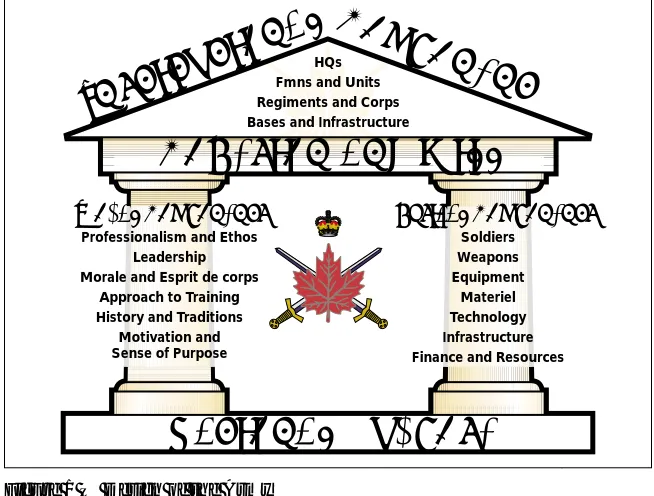
Introduction.Because war and armed conflict are conducted on moral and physical planes (see Chapter 4), Canada’s army com-prises both moral and physical components (see Figure 1). Moral components are those spiritual, psychological, intellectual and sociological factors which enable soldiers to overcome fear and defeat an enemy in battle or successfully carry out a mission. They encompass the army’s professionalism and ethos; the quality of its leadership; its morale and esprit de corps; its approach to train-ing; its history and traditions; and, ultimately, its motivation and sense of purpose. These things contribute most to creating cohe-sion in units and instilling in soldiers the will to fight on until the battle is won or the mission accomplished.
The army’s physical components, on the other hand, are those tangible, material assets that it requires to fight, operate, train, and sustain itself. It includes numbers of soldiers; the quality and quantity of its matériel; its technology; its infrastructure; and its financial and resource base. While military operations cannot be successfully carried out without adequate material resources, the army’s moral components are the decisive and, therefore, most important element of its makeup. This is because they are soldier-centered and, as such, have the greatest impact on the success or failure of operations.
Cohesion and Will.The army’s successes in war and, indeed, all operations, derives from an effective integration and applica-tion of its moral and physical components at two levels that of the individual soldier and that of the team or group. At the indi-vidual level, this integration engenders in soldiers the personal
The emotional ties among the men, and between men and their officer … is the single most potent factor in preventing breakdown.
Chapter Two: Professionalism and Ethos 39
will, as well as gives them the means, i.e. weapons and equip-ment, to fight, and to accomplish their mission. At the group level, this integration provides that sine qua nonfor forces in operations cohesion.
[image:46.396.34.361.40.288.2]The Importance of Cohesion.Cohesion is the most impor-tant requirement of a combat force and must be developed and protected above all else. Cohesion, in its simplest sense, is unity. It is that vital attribute which binds and focuses the will and per-sonal effort of individual soldiers in a force with synergistic effect
Figure 1 — Design of the Army
The foundation or base of the Canadian army is national purpose, the preservation of which provides the army with its raison d’être. Erected on this base are the army’s
two supporting pillars — its Moral and Physical components. These pillars are capped by, and at the same time support, the capstone — Cohesion and Will, the “glue” of the army and its combat potential. The pillars and the capstone hold up the roof which represents the army’s institutional components, these being its organizational structure as well as its personnel, matériel, and equipment holdings.
C o h e s i o n a n d W i l l
N a t i o n a l P u r p o s e
I n
s t
i t
u t
i o
n a
l C o
m
p o
n e
n t
HQs Fmns and Units Regiments and Corps Bases and Infrastructure
Moral Components
Professionalism and Ethos Leadership Morale and Esprit de corps
Approach to Training History and Traditions
Motivation and Sense of Purpose
towards a common aim or objective. Cohesion is a product of both moral and physical factors. Its essence, however, is high morale and shared beliefs, anchored by discipline. Cohesion is what most generates combat power and enables a commander to impose will on an opponent, or to dominate a situation. Thus, the overriding aim in battle is to do everything, both morally and physically, to break the cohesion of the enemy, while at the same time protecting and enhancing the cohesion of one’s own force. Without cohesion, individual will and the soldiers’ capacity for combat is dissipated, weakened and even destroyed, producing group ineffectiveness and, in the end, defeat.
Chapter Two: Professionalism and Ethos 41
Developing Cohesion and Will.Developing cohesion in a force and superior will in soldiers requires a comprehensive approach, the most important elements being:
■ Leadership. Leadership is an art which most people can learn. It is defined as the way of influencing human behaviour in order to accomplish a mission in the manner desired by the leader. Good leadership is the foundation for high professional standards and underlies all activities which lead to military success. It is what most inspires individuals with the will to victory and shapes them into a cohesive, effective force in pursuit of a common cause. Good leadership requires that commanders maintain and promote the military ethos at all times, reflecting it espe-cially in their own actions. They must recognize the impor-tance of discipline, morale, care of subordinates, good equipment, and the efficient administration of soldiers including rewarding them for jobs well done. Leaders have a particular responsibility with regard to training and the professional development of subordinates, who are a direct reflection of themselves. Leaders must further work to create an environment of mutual trust between ranks, as Canadian troops will only follow those in whom they have confidence and respect. Most importantly, commanders must lead by example.
■ Morale and Esprit de Corps. A high level of morale among soldiers and esprit de corpswithin units enhances team-work and enables soldiers personally and collectively to willingly withstand hardship and danger, overcome fear, and act resolutely against an opponent. Good morale and
esprit de corpsare founded on and sustained by faith in leaders, maintenance of standards, a strong and warm sense of comradeship, having good matériel support, oppor-tunities for sport and recreation and the desire to uphold the standards and traditions of those who have gone before.
end, training must emphasize all-arms co-operation and the importance of every individual to the collective effort. It must provide soldiers with not just functional skills, but a thorough understanding of the individual and combined efforts required for operational success. It is a command responsibility to establish training goals and standards that meet these requirements to provide the means and resources and to evaluate such training.
■ Motivation. Soldiers who are highly motivated come together readily and work enthusiastically as a team. Shared motivation in turn builds cohesion and strengthens personal will. Motivation depends in part on adequate resources — in effect, the soldier’s tools — and also on a continuing sense of purpose. While it is the job of commanders to establish purpose, it ultimately derives from national will and public support. Soldiers, generally, will be unable to remain motivated in pursuit of causes they do not under-stand, which lack public endorsement, or for which they are not trained or equipped. National support for the army, especially during operations, is as important as the provision of resources and matériel.
Chapter Two: Professionalism and Ethos 43
mobilization, as well as possess redundancy in vital leadership and combat skills.
■ Self-Respect. A good reputation and positive self-image fosters high morale, self discipline, individual courage and other personal characteristics which build cohesion and the will to win. Thus, soldiers who are self-respecting will readily eschew drugs, alcohol abuse, anti-social conduct and other self-indulgent or nihilistic behaviour which is anathema to military professionalism and, indeed, to civilized society. The development of self-respect comes from personal accomplishment in having done something to be proud of, including competing and winning both as an individual and as part of a team. It is reinforced by taking pride in one’s drill, dress and deportment; possessing sound moral and ethical convictions; earning and being accorded trust; being physically fit through sports and tough demanding training; receiving interest, concern, and loyalty from peers and superiors; and being granted public recognition and appreciation for individual effort and performance.
■ Defence Management Policies. Management is a function of command and should never be confused with it. On its own, it is the science of employing resources, people, material, time, and money in the efficient and effective accomplishment of a mission. For purposes of developing cohesion and will, it is best effected by empathetic leader-ship. It entails instituting training, personnel and other policies which build morale and esprit de corpswhile reinforcing professionalism and the military ethos. It further requires actions which recognize the needs of individual soldiers including their families and which address the exigencies of service life. Defence management policies must espe-cially ensure for the continuing care and concern of those wounded or injured in the course of their service.
back to the Roman legions and even earlier. The regimental system is of critical importance to the army as it is within the regiment or branch that the military ethos is most visibly embodied and practiced. Its utility and value further lies in the strong sense of comradeship it fosters among members of a regiment and in its tribal/familial nature which bonds soldiers in devotion, loyalty and selflessness to each other, contributing powerfully to unit cohesion. Deriving from the regimental system of the British Army, the Canadian vari-ant reflects Canadian values, history, geography, and the particular character of the Canadian soldier. The regimental system is most effective and valuable in wartime. In peace-time, it must be carefully managed to ensure that it does not assume greater importance than the corporate well-being of the army as a whole, nor unduly favour or preju-dice individuals in lieu of merit. Regimental considerations must never be allowed to impinge on professional or oper-ational requirements; nor should the regimental system be embraced in a way which might fragment or weaken the army’s need for institutional cohesion.
■ Adequacy of Resources. As demonstrated by the Canadian Corps in the First World War, possessing weapons, equip-ment and material, in adequate quantity and quality, con-tributes significantly to developing cohesion and superior will in a force. Without such resources force cohesion becomes difficult to sustain, individual will is affected, and the likelihood of success reduced. Although moral factors, in general, are key to operational success, wars can never be fought nor operations conducted on a moral basis alone, especially