An Analysis of the
Shaft
Distributed Denial of Service
Tool
By Sven Dietrich, Neil Long
and David Dittrich
Introduction
This is an analysis of theShaft distributed denial of service(DDoS) tool. Denial of service is a tech-nique to deny access to a resource by overloading it, such as packet flooding in the network context. Denial of service tools have existed for a while, whereas distributed variants are relatively recent. The distributed nature adds the “many to one” relationship. Throughout this analysis, most ac-tual host names have been modified or removed.
Historical overview
Shaft belongs in the family of tools discussed earlier, such as Trinoo, TFN, Stacheldraht, and TFN2K. As in these related tools, there are hand-ler (or master) and agent programs. The general concepts related to these tools can be found in a Distributed Intruder Tools Workshop Report held in November 1999 at the Computer Emergency Re-sponse Team Coordination Center (CERT/CC) in Pittsburgh, Pennsylvania, USA:
http://www.cert.org/reports/dsit_workshop.pdf. The chronological order of development is: Trinoo, TFN, Stacheldraht, Shaft, and TFN2K. Trinoo, TFN, and Stacheldraht were analyzed in [5], [6], and [7] respectively. TFN2K was recently analyzed in [1].
In the first two months of 2000, DDoS attacks against major Internet sites (such as CNN, ZDNet, Amazon etc.) have brought these tools further into the limelight. A few papers covering DDoS can be found at:
http://packetstorm.securify.com/distributed/ http://staff.washington.edu/dittrich/misc/ddos/ http://www.cert.org/advisories/CA-99-17-denial-of-service-tools.html
Analysis
Shaftnode was recovered, initially in binary form, in late November 1999, then in source code form for the agent. Distinctive features are the ability to switch handler servers and handler ports on the fly, making detection by intrusion detection tools difficult from that perspective, a “ticket” mechanism to link transactions, and the particular interest in packet statistics.
The network:
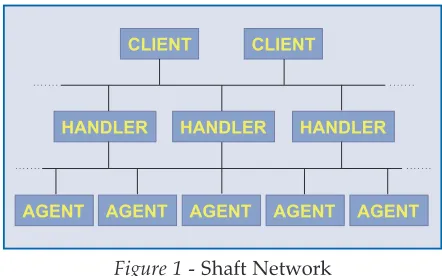
client(s)Zhandler(s)Zagent(s)Zvictim(s) The Shaft network is made up of one or more handler programs (shaftmaster) and a large set of agents (shaftnode). The attacker uses a telnet pro-gram (client) to connect to and communicate with the handlers.
A Shaft network is depicted in Figure 1.
Network Communication
Client to handler(s): 20432/tcp Handler to agent(s): 18753/udp Agent to handler(s): 20433/udp
Shaft (in the analyzed version, 1.72) is modeled after Trinoo, in that communication between han-dlers and agents is achieved using the unreliable IP protocol UDP. (See Stevens [18] for an exten-sive discussion of the TCP and UDP protocols). Remote control is via a simple telnet connection to the handler. Shaft usesticketsfor keeping track of its individual agents. Both passwords and ticket numbers must match for the agent to exe-cute the request. A simple letter-shifting (Caesar cipher, see Schneier [17]) is also used.
Commands
The command structure is divided into the agent and handler command syntax groups. The attacker interacts with the handler via a command line.
Agent Command Syntax
Accepted by agent and replies generated back to the handler:
size <size>
Size of the flood packets.
39
CLIENT
AGENT CLIENT
HANDLER
AGENT AGENT
AGENT AGENT
[image:1.595.320.541.323.461.2]HANDLER HANDLER
May 2000, Page 40 Information Security Bulletin Generates a “size” reply.
type <0|1|2|3> Type of DoS to run:
0 UDP, 1 TCP,
2 UDP/TCP/ICMP, 3 ICMP
Generates a “type” reply. time <length>
Length of DoS in seconds Generates a “time” reply. own <victim>
Add victim to list of hosts to perform denial of service on
Generates a “owning” reply. end <victim>
Removes victim from list of hosts (see “own” above)
Generates a “done” reply. stat
Requests packet statistics from agent Generates a “pktstat” reply.
alive
Are you alive?
Generates a “alive blah” reply. switch <handler> <port>
Switch the agent to a new handler and handler port
Generates a “switching” reply. pktres <host>
Request packet results for that host at the end of the flood
Generates a “pktres” reply. Sent by agent:
new <password> Reporting for duty
pktres <password><sock><ticket> <packets sent>
Packets sent to the host identified by <ticket> number
Handler (shaftmaster) Command Syntax
Little is known about the handler, but this is a speculation, pieced together from clues, of how its command structure could look like:
mdos <host list>
Start a distributed denial of service attack (mdos = massive denial of service?) directed at <host list>. Sends out “own host” messages to all agents.
edos <host list>
End the above attack on <host list>. Sends out “end host” messages to all agents.
time <length>
Set the duration of the attack. Sends out “time <length>” to all agents.
size <packetsize>
Set the packetsize for the attack (8K maximum as seen in source).
Sends out “size packetsize” to all agents.
type <UDP|TCP|ICMP|BOTH> Set the type of attack:
UDP packet flooding, TCP SYN packet flooding, ICMP packet flooding, or
all three (here BOTH = ICMP and IP protocols)
Sends “type <type>” to all agents. +node <host list>
Add new agents -node <host list>
Remove agents from pool ns <host list>
Perform a DNS lookup on <host list> lnod
List all agents ltic
List all tickets (transactions?) pkstat
Show total packet statistics for agents Sends out “stat” request to all agents.
alive
Send an “alive” to all agents. A possible argument to alive is “hi” stat
show status? switch
become the handler for agents Send “switch” to all agents. ver
show version exit
Password protection
con-nection to the handler port is obviously a weak-ness.
Detection
Binaries and their behavior
As with previous DDoS tools, the methods used to install the handler/agent are the same as in-stalling any program on a compromised Unix sys-tem, with all the standard options for concealing the programs and files (use of hidden directories, “root kits”, kernel modules, etc.) See Dittrich’s Trinoo analysis [5] for a description of possible in-stallation methods for this type of tool.
Precautions have been taken to hide the default handler in the binary code. In the analyzed code, the default handler could be defined as follows:
#define MASTER “2:3/279/1/2" which would translate into 192.168.0.1 (fictitious address used here) using the same simple cipher mentioned above. Port numbers are munged before actual use, e.g.
#define MASTER_PORT 20483 is really port 20433.
All these techniques intend to hide the critical information from prying eyes performing foren-sics on the code. The program itself tries to hide itself as a legitimate Unix process (httpd in the default configuration).
Looking at strings in the shaftnode application reveals the following:
>strings -n 3 shaftnode pktres
switch alive stat end own time type size httpd 23:/33/75/28
Unable to fork. (do it manually) shift
new %s
size %s %s %s %s type %s %s %s %s time %s %s %s %s owning %s %s %s %s switched %s %s %s done %s %s %s %s pktstat %s %s %s %lu alive %s %s %s blah %d.%d.%d.%d
Error sending tcp packet from %s:%i to %lu:%i
pktres %s %i %i %lu
Upon launch, the Shaft agent (the shaftnode) re-ports back to its default handler (its shaftmaster) by sending a “new <upshifted password>” command. The default password of “shift” found
in the analyzed code would thus be “tijgu”. Therefore a new agent sends “new tijgu” and all subsequent messages transmit that password. Only in one case does the agent shift in the op-posite direction for one particular command, e.g. “pktres rghes”. It is unclear at the moment whether this is intentional or not.
Incoming commands arrive in the format: “command <upshifted password> <command arg><socket><ticket> <optional args>”
For most commands, the password and socket/ ticket need to have the right magic to generate a reply and the command to be executed.
Message flow diagram between handler H and agentA:
Initial phase: AZH: “new”, f(password) Running loop:HZA: cmd, f(password),
[args], Na, Nb AZH: cmdrep, f(password),
Na, Nb, [args] - f(X) is the Caesar cipher function on X - Na, Nb are numbers (tickets, socket
numbers)
- cmd, cmdrep are commands and command acknowledgments
- args are command arguments.
The flooding occurs in bursts of 100 packets per host, with the source port and source address randomized. This number is hard-coded, but need not be. Whereas the source port spoofing works only if the agent is running as a root privi-lege process, the author has added provisions for packet flooding using the UDP protocol and with the correct source address in the case the process is running as a simple user process. It is noteworthy that the random function is not prop-erly seeded, which may lead to predictable source port sequences and source host IP sequences. Source port = (rand() % (65535-1024)+1024), where % is the mathematical ‘mod’ operator. This will generate source ports greater than 1024 at all times.
Source IP = rand()%255.rand()%255.rand()%255.rand()%255 The source IP numbers can (and will) contain a zero in the leading octet.
May 2000, Page 43 Information Security Bulletin For the type, the client can select UDP, TCP
SYN, or ICMP packet flooding, or the combina-tion of all three. Even though there is the poten-tial of having a different type and packet size for each set of victim hosts, this feature is not ex-ploited in this version.
The author of Shaft seems to have a particular interest in statistics, namely packet generation rates of its individual agents. The statistics on packet generation rates are possibly used to de-termine the “yield” of the DDoS network as a whole. This would allow the attacker to stop adding hosts to the attack network when it reached the necessary size to overwhelm the vic-tim network, and also to know when it is neces-sary to add more agents to compensate for loss of agents due to attrition during an attack (as the agent systems are identified and taken off-line.) Currently, the ability to switch host IP and port for the handler exists, but the listening port for the agent remains the same. This may, however, change in the future.
A sample attack
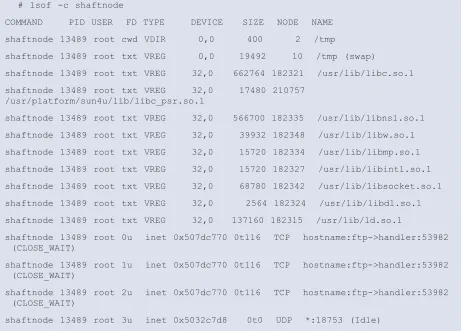
In this section we will look at a practical example of a Shaft attack, as seen from the attacking net-work’s perspective. Figure 2 shows what the Unix “lsof” command [10] will show about a shaftnode agent:
As one can see, the agent is waiting to receive commands on its default UDP port number 18753. The TCP connection back to the handler remains unexplained to date.
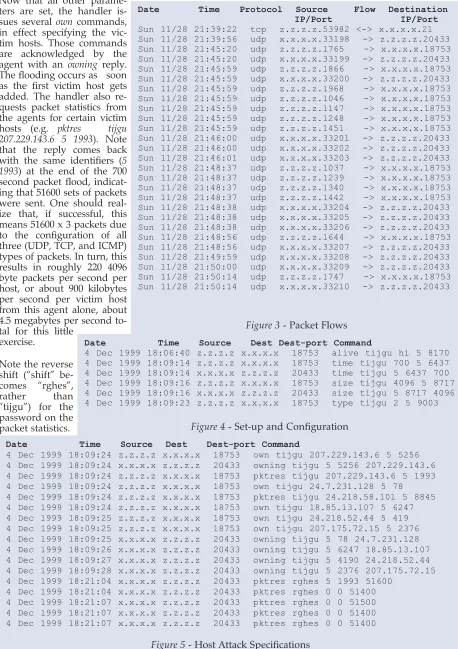
Packet flows are listed in Figure 3.
There is considerable activity between the han-dler (z.z.z.z) and the agent (x.x.x.x) as they go through the command request and ac-knowledgement phases. A test of the impact of ICMP packet flooding on the local network itself may also occur, although the sheer volume of data preclude a listing in this paper.
Let us look at the individual phases from a later attack.
Setup and configuration phase
This is illustrated in Figure 4. The handler issues an “alive” command, and says “hi” to its agent, assigning a socket number of5and a ticket num-ber of 8170. We will see that this ”socket num-ber" will persist throughout this attack. A time period of 700 seconds is assigned to the agent, which is acknowledged. A packet size of 4096 bytes is specified, which is again confirmed. The last line indicates the type of attack, in this case “the works”, i.e. UDP, TCP SYN and ICMP packet flooding combined. Failure to specify the type would make the agent default to UDP packet flooding.
# lsof -c shaftnode
COMMAND PID USER FD TYPE DEVICE SIZE NODE NAME shaftnode 13489 root cwd VDIR 0,0 400 2 /tmp
shaftnode 13489 root txt VREG 0,0 19492 10 /tmp (swap)
shaftnode 13489 root txt VREG 32,0 662764 182321 /usr/lib/libc.so.1 shaftnode 13489 root txt VREG 32,0 17480 210757
/usr/platform/sun4u/lib/libc_psr.so.1
shaftnode 13489 root txt VREG 32,0 566700 182335 /usr/lib/libnsl.so.1 shaftnode 13489 root txt VREG 32,0 39932 182348 /usr/lib/libw.so.1 shaftnode 13489 root txt VREG 32,0 15720 182334 /usr/lib/libmp.so.1 shaftnode 13489 root txt VREG 32,0 15720 182327 /usr/lib/libintl.so.1 shaftnode 13489 root txt VREG 32,0 68780 182342 /usr/lib/libsocket.so.1 shaftnode 13489 root txt VREG 32,0 2564 182324 /usr/lib/libdl.so.1 shaftnode 13489 root txt VREG 32,0 137160 182315 /usr/lib/ld.so.1
shaftnode 13489 root 0u inet 0x507dc770 0t116 TCP hostname:ftp->handler:53982 (CLOSE_WAIT)
shaftnode 13489 root 1u inet 0x507dc770 0t116 TCP hostname:ftp->handler:53982 (CLOSE_WAIT)
shaftnode 13489 root 2u inet 0x507dc770 0t116 TCP hostname:ftp->handler:53982 (CLOSE_WAIT)
[image:4.595.56.522.429.760.2]shaftnode 13489 root 3u inet 0x5032c7d8 0t0 UDP *:18753 (Idle)
Next is the list of hosts to attack and the ones from which statistics are to be obtained upon completion (Figure 5).
Now that all other parame-ters are set, the handler is-sues severalown commands, in effect specifying the vic-tim hosts. Those commands are acknowledged by the agent with an owning reply. The flooding occurs as soon as the first victim host gets added. The handler also re-quests packet statistics from the agents for certain victim hosts (e.g. pktres tijgu 207.229.143.6 5 1993). Note that the reply comes back with the same identifiers (5 1993) at the end of the 700 second packet flood, indicat-ing that 51600 sets of packets were sent. One should real-ize that, if successful, this means 51600 x 3 packets due to the configuration of all three (UDP, TCP, and ICMP) types of packets. In turn, this results in roughly 220 4096 byte packets per second per host, or about 900 kilobytes per second per victim host from this agent alone, about 4.5 megabytes per second to-tal for this little
exercise.
Note the reverse shift (“shift” be-comes “rghes”, rather than “tijgu”) for the password on the packet statistics.
Detection at the network level
Scanning the network for open port 20432 will reveal the presence of a handler on your LAN.
[image:5.595.79.537.125.774.2]Date Time Protocol Source Flow Destination IP/Port IP/Port Sun 11/28 21:39:22 tcp z.z.z.z.53982 <-> x.x.x.x.21 Sun 11/28 21:39:56 udp x.x.x.x.33198 -> z.z.z.z.20433 Sun 11/28 21:45:20 udp z.z.z.z.1765 -> x.x.x.x.18753 Sun 11/28 21:45:20 udp x.x.x.x.33199 -> z.z.z.z.20433 Sun 11/28 21:45:59 udp z.z.z.z.1866 -> x.x.x.x.18753 Sun 11/28 21:45:59 udp x.x.x.x.33200 -> z.z.z.z.20433 Sun 11/28 21:45:59 udp z.z.z.z.1968 -> x.x.x.x.18753 Sun 11/28 21:45:59 udp z.z.z.z.1046 -> x.x.x.x.18753 Sun 11/28 21:45:59 udp z.z.z.z.1147 -> x.x.x.x.18753 Sun 11/28 21:45:59 udp z.z.z.z.1248 -> x.x.x.x.18753 Sun 11/28 21:45:59 udp z.z.z.z.1451 -> x.x.x.x.18753 Sun 11/28 21:46:00 udp x.x.x.x.33201 -> z.z.z.z.20433 Sun 11/28 21:46:00 udp x.x.x.x.33202 -> z.z.z.z.20433 Sun 11/28 21:46:01 udp x.x.x.x.33203 -> z.z.z.z.20433 Sun 11/28 21:48:37 udp z.z.z.z.1037 -> x.x.x.x.18753 Sun 11/28 21:48:37 udp z.z.z.z.1239 -> x.x.x.x.18753 Sun 11/28 21:48:37 udp z.z.z.z.1340 -> x.x.x.x.18753 Sun 11/28 21:48:37 udp z.z.z.z.1442 -> x.x.x.x.18753 Sun 11/28 21:48:38 udp x.x.x.x.33204 -> z.z.z.z.20433 Sun 11/28 21:48:38 udp x.x.x.x.33205 -> z.z.z.z.20433 Sun 11/28 21:48:38 udp x.x.x.x.33206 -> z.z.z.z.20433 Sun 11/28 21:48:56 udp z.z.z.z.1644 -> x.x.x.x.18753 Sun 11/28 21:48:56 udp x.x.x.x.33207 -> z.z.z.z.20433 Sun 11/28 21:49:59 udp x.x.x.x.33208 -> z.z.z.z.20433 Sun 11/28 21:50:00 udp x.x.x.x.33209 -> z.z.z.z.20433 Sun 11/28 21:50:14 udp z.z.z.z.1747 -> x.x.x.x.18753 Sun 11/28 21:50:14 udp x.x.x.x.33210 -> z.z.z.z.20433
Figure 3- Packet Flows
Date Time Source Dest Dest-port Command
4 Dec 1999 18:06:40 z.z.z.z x.x.x.x 18753 alive tijgu hi 5 8170 4 Dec 1999 18:09:14 z.z.z.z x.x.x.x 18753 time tijgu 700 5 6437 4 Dec 1999 18:09:14 x.x.x.x z.z.z.z 20433 time tijgu 5 6437 700 4 Dec 1999 18:09:16 z.z.z.z x.x.x.x 18753 size tijgu 4096 5 8717 4 Dec 1999 18:09:16 x.x.x.x z.z.z.z 20433 size tijgu 5 8717 4096 4 Dec 1999 18:09:23 z.z.z.z x.x.x.x 18753 type tijgu 2 5 9003
Figure 4- Set-up and Configuration
Date Time Source Dest Dest-port Command
4 Dec 1999 18:09:24 z.z.z.z x.x.x.x 18753 own tijgu 207.229.143.6 5 5256 4 Dec 1999 18:09:24 x.x.x.x z.z.z.z 20433 owning tijgu 5 5256 207.229.143.6 4 Dec 1999 18:09:24 z.z.z.z x.x.x.x 18753 pktres tijgu 207.229.143.6 5 1993 4 Dec 1999 18:09:24 z.z.z.z x.x.x.x 18753 own tijgu 24.7.231.128 5 78 4 Dec 1999 18:09:24 z.z.z.z x.x.x.x 18753 pktres tijgu 24.218.58.101 5 8845 4 Dec 1999 18:09:24 z.z.z.z x.x.x.x 18753 own tijgu 18.85.13.107 5 6247 4 Dec 1999 18:09:25 z.z.z.z x.x.x.x 18753 own tijgu 24.218.52.44 5 419 4 Dec 1999 18:09:25 z.z.z.z x.x.x.x 18753 own tijgu 207.175.72.15 5 2376 4 Dec 1999 18:09:25 x.x.x.x z.z.z.z 20433 owning tijgu 5 78 24.7.231.128 4 Dec 1999 18:09:26 x.x.x.x z.z.z.z 20433 owning tijgu 5 6247 18.85.13.107 4 Dec 1999 18:09:27 x.x.x.x z.z.z.z 20433 owning tijgu 5 4190 24.218.52.44 4 Dec 1999 18:09:28 x.x.x.x z.z.z.z 20433 owning tijgu 5 2376 207.175.72.15 4 Dec 1999 18:21:04 x.x.x.x z.z.z.z 20433 pktres rghes 5 1993 51600
4 Dec 1999 18:21:04 x.x.x.x z.z.z.z 20433 pktres rghes 0 0 51400 4 Dec 1999 18:21:07 x.x.x.x z.z.z.z 20433 pktres rghes 0 0 51500 4 Dec 1999 18:21:07 x.x.x.x z.z.z.z 20433 pktres rghes 0 0 51400 4 Dec 1999 18:21:07 x.x.x.x z.z.z.z 20433 pktres rghes 0 0 51400
[image:5.595.74.543.130.753.2]May 2000, Page 45 Information Security Bulletin For detecting idle agents, one could write a
pro-gram similar to George Weaver’s trinoo detector. Sending out “alive” messages with the default password to all nodes on a network on the de-fault UDP port 18753 will generate traffic back to the detector, making the agent believe the detec-tor is a handler.
This program does not provide for code updates (like TFN or Stacheldraht). This may imply “rcp” or “ftp” connections during the initial intrusion phase (see also [5]).
The program uses UDP traffic for its communica-tion between the handlers and the agents. Con-sidering that the traffic is not encrypted, it can easily be detected based on certain keywords. Performing an “ngrep” [11] for the keywords mentioned in the syntax sections above, will lo-cate the control traffic, and looking for TCP pack-ets with sequence numbers of 0x28374839 may locate the TCP SYN packet flood traffic. Source ports are always above 1024, and source IP num-bers can include zeroes in the leading octet. Strings in this control traffic can be detected with the “ngrep” program using the same tech-nique shown in [5], [6], and [7]. For example,
# ngrep -i -x “alive tijgu” udp # ngrep -i -x “pktres|pktstat” udp
will locate the control traffic between the han-dler and the agent, independently of the port number used.
There are also two excellent scanners for detect-ing DDoS agents on the network: Dittrich’s dds [8] and Brumley’srid[2].
ddswas written to provide a more portable and less dependent means of scanning for various DDoS tools. (Many people encountered prob-lems with Perl and the Net::RawIP library [15] on their systems, which prevented them from using the scripts provided in [5], [6], and [7].) Due to time contraints during coding, dds does not have the flexibility necessary to specify arbi-trary protocols, ports, and payloads. A modified version of dds, geared towards detecting only Shaft agents, can be found at:
http://sled.gsfc.nasa.gov/~spock/
A better means of detecting Shaft handlers and agents would be to use a program like rid, which uses a more flexible configuration file mecha-nism to define ports, protocols, and payloads. A sample configuration for rid to detect the Shaft control traffic as described:
start shaft
send udp dport=18753 data="alive tijgu hi 5 1918"
recv udp sport=20433 data="alive" nmatch=1
end shaft
Defenses
To protect against the effects of the multiple types of denial of service, we suggest that you review the other papers (see [1, 3, 5, 6, 7]) and other methods of dealing with DDoS attacks being dis-cussed and promoted (see [9]). For example, rate-limiting is considered effective against ICMP packet flooding attacks, while anti-spoof filters and egress filters at the border routers can limit the problems caused by attacking agents faking source addresses. Regular scanning for the presence of DDoS tools is another excellent strategy.
Further evolution
While the author(s) of this tool did not pursue the use of encryption of its control traffic, such an evolution is conceivable, since a Caesar cipher is used to obfuscate the password. A transition to Blowfish or other stream ciphers is realistic, and changing the communication protocol to ICMP, much like TFN, is conceivable. The use of multicast protocols for both communication and packet flooding is also possible.
To date, no source code for the Shaft handler (shaftmaster) has been obtained or analyzed. At this stage, we believe that the code is private. This would mean that the authors could likely change defaults; the probability of detecting “script kiddie” copycats using default values as analyzed here is low. This provides strong impe-tus for rapid and widespread detection efforts to identify agents before this change.
Conclusion
References
[1] Barlow, Jason and Woody Thrower. TFN2K - An Analysis
http://www2.axent.com/swat/News/TFN2k_Analysis.htm
[2] Brumley, David. Remote Intrusion Detector.
http://theorygroup.com/Software/RID
[3] CERT Distributed System Intruder Tools Workshop Report
http://www.cert.org/reports/dsit_workshop.pdf
[4] CERT Advisory CA-99-17 Denial-of-Service Tools
http://www.cert.org/advisories/CA-99-17-denial-of-ser-vice-tools.html
[5] Dittrich, David. The DoS Project’s trinoo distrib-uted denial of service attack tool
http://staff.washington.edu/dittrich/misc/trinoo.analysis
[6] Dittrich, David. The “Tribe Flood Network” distrib-uted denial of service attack tool
http://staff.washington.edu/dittrich/misc/tfn.analysis
[7] Dittrich, David. The “Stacheldraht” distributed de-nial of service attack tool
http://staff.washington.edu/dittrich/misc/stacheldraht.analysis
[8] Dittrich, David, Marcus Ranum, George Weaver, David Brumley et al.
http://staff.washington.edu/dittrich/dds
[9] Dittrich, David, Distributed Denial of Service (DDoS) Attacks/Tools
http://staff.washington.edu/dittrich/misc/ddos/
[10] lsof:
http://vic.cc.purdue.edu/
[11] ngrep:
http://www.packetfactory.net/Projects/ngrep/
[12] Packet Storm Security, Distributed denial of ser-vice attack tools
http://packetstorm.securify.com/distributed/
[13] Phrack Magazine, Volume Seven, Issue Forty-Nine, File 06 of 16, [Project Loki]
http://www.phrack.com/search.phtml?view&article=p49-6
[14] Phrack Magazine Volume 7, Issue 51 September 01, 1997, article 06 of 17 [LOKI2 (the implementation)]
http://www.phrack.com/search.phtml?view&article=p51-6
[15] Net::RawIP:
http://quake.skif.net/RawIP
[16] tcpdump:
ftp://ftp.ee.lbl.gov/tcpdump.tar.Z
[17] Schneier, Bruce. Applied Cryptography, 2nd edi-tion, Wiley.
[18] Stevens, W. Richard and Gary R. Wright. TCP/IP Illustrated, Vol. I, II, and III., Addison-Wesley.
[19] Zuckerman, M.J. Net hackers develop destructive new tools. USA Today, 7 December 1999.
http://www.usatoday.com/life/cyber/tech/review/crg681.htm
Dr. Sven Dietrich is a Senior Secu-rity Architect working for Raytheon ITSS at the NASA Goddard Space Flight Center. He received a B.Sc. in Mathematics and Computer Science, a M.S. and a Doctor of Arts in Math-ematics from Adelphi University, New York. Dr. Dietrich’s primary ef-forts focus on deployment of pub-lic-key technology, the building of a public-key infrastructure (PKI) for NASA, intrusion detection, and the security of Internet Protocol (IP) communications in space. For his in-volvement in the latter he has recently received the NASA GSFC National Resource Group Achievement Award. Before joining Raytheon ITSS in 1997, he served on the faculty at Adelphi University for six years. He is actively involved in the computer security field inside and outside of NASA and randomly gives presentations and talks on the subject. Dr. Neil Long is a Senior Systems Administrator at Oxford University, England and a former academic (Ph.D., B.Sc. Ma-terials Science) who has been involved in computer security incident handling for about 8 years. He is a member of OxCERT (Oxford University computer emergency response team and member of FIRST) and serves on the steering com-mittee member for the FIRST organisation (Forum of Inci-dent Response and Security Teams). Since the career switch there has been little need to publish although he has given several presentations and seminars and views computer se-curity as an endless source of new research material.
Dave Dittrich is a Senior Security Consultant at the University of Washington, supporting Unix workstation users on campus. Dave has spoken at various user groups and computer conferences from Seattle, Washington to as far away as Darwin, Australia. In his spare time, Dave enjoys photogra-phy (a side business) and telemark skiing (ski mountaineering and racing.) Dave is most widely known for his technical analyses of the Trinoo, Tribe Flood Net-work, and Stacheldraht distributed denial of service attack tools. His home page can be found at