FM 3-34.2
(formerly FM 90-13-1)
Combined-Arms
Breaching
Operations
Headquarters,
Department of the Army
DISTRIBUTION RESTRICTION: Approved for public release; distribution is unlimited.
This reprint includes
C3, FM 3-34.2
Change 3
Headquarters
Department of the Army
Washington, DC, 11 October 2002
Combined-Arms Breaching Operations
1. Change FM 3-34.2, 31 August 2000, as follows:
Remove Old Pages
Insert New Pages
E-13
E-13
2. A bar ( ) marks new or changed material.
3. File this transmittal sheet in front of the publication.
DISTRIBUTION RESTRICTION: Approved for public release; distribution is unlimited.
By Order of the Secretary of the Army:
ERIC K. SHINSEKI
General, United States Army
Chief of Staff
Official:
DISTRIBUTION:
Active Army, Army National Guard, and US Army Reserve:
To be distributed in accordance
with the initial distribution number 115012, requirements for FM 3-34.2.
JOEL B. HUDSON
Administrative Assistant to the
Change 2
Headquarters
Department of the Army
Washington, DC, 26 February 2001
Combined-Arms Breaching Operations
1. Change FM 3-34.2, 31 August 2000, as follows:
Remove Old Pages
Insert New Pages
C-13 and C-14
C-13 and C-14
2. A bar (
|
) marks new or changed material.
3. File this transmittal sheet in front of the publication.
DISTRIBUTION RESTRICTION: Approved for public release; distribution is unlimited.
By Order of the Secretary of the Army:
Official:
ERIC K. SHINSEKI
General, United States Army
Chief of Staff
Administrative Assistant to the
Secretary of the Army
0102307
DISTRIBUTION:
Active Army, Army National Guard, and U.S. Army Reserve
: To be distributed in
accordance with the initial distribution number 115012, requirements for
FM 3-34.2
C1
Change 1
Headquarters
Department of the Army
Washington, DC, 15 November 2000
Combined-Arms Breaching Operations
1. Change FM 3-34.2, 31 August 2000, as follows:
Insert New Pages
E-1 through E-13
2. A bar (
) marks new or changed material.
3. File this transmittal sheet in front of the publication.
DISTRIBUTION RESTRICTION: Approved for public release; distribution is unlimited.
By Order of the Secretary of the Army:
ERIC K. SHINSEKI
General, United States Army
Chief of Staff
Official:
0030702
DISTRIBUTION:
Active Army, Army National Guard, and US Army Reserve:
To be distributed in accordance
with the initial distribution number 115012, requirements for FM 3-34.2.
JOEL B. HUDSON
Administrative Assistant to the
Field Manual Headquarters
No. 3-34.2 Department of the Army
Washington, DC, [pending date]
Combined-Arms Breaching Operations
Contents
Page
PREFACE ... iv
Chapter 1 OBSTACLE BREACHING THEORY... 1-1
Definitions ... 1-1 Breaching Tenets ... 1-4 Intelligence... 1-4 Breaching Fundamentals... 1-6 Breaching Organization ... 1-7 Mass ... 1-11 Synchronization ... 1-13 Breaching Operations in Support of Deliberate and
Hasty Attacks... 1-18 Planning Sequence ... 1-18
Chapter 2 BREACHING OPERATIONS... 2-1
Planning ... 2-1 Receipt of Mission ... 2-1 Mission Analysis ... 2-3 Course-of-Action Development... 2-4 Course-of-Action Analysis (War Game)... 2-9 Preparation... 2-10 Execution ... 2-12
Distribution Restriction: Approved for public release; distribution is unlimited.
______________________________
ii
FM 3-34.2
Page
Chapter 3 LANE AND BYPASS MARKING ... 3-1
Lane-Marking System... 3-1 Lane-Marking Terms ... 3-2 Entrance Markers... 3-2 Handrail Markers... 3-2 Exit Markers ... 3-2 Entrance-Funnel Markers... 3-3 Final-Approach Markers... 3-3 Far-Recognition Markers... 3-3 Traffic-Control Posts and Guides ... 3-3 Levels of Lane Marking and Patterns ... 3-4 Initial Lane Marking ... 3-4 Intermediate Lane Marking ... 3-6 Full (Two-Way) Lane Marking ... 3-9 Commander’s Guidance for Lane Marking ... 3-11 Movement Through the Lane ... 3-11 Lane Maintenance and Responsibilities of Traffic
Through Lanes ... 3-13 Lane-Marking Devices ... 3-17 Bypass Marking ... 3-19 Marking Requirements Under the North Atlantic
Treaty Organization... 3-19 Commanders’ Responsibilities... 3-19 Marking Patterns and Devices ... 3-19 Complex Obstacles ... 3-21
Chapter 4 BREACHING REHEARSALS ... 4-1
Planning... 4-1 Types ... 4-1 Combined-Arms Rehearsal... 4-1 Battle Drill... 4-2 Techniques ... 4-2
Appendix A METRIC CONVERSION CHART ... A-1
Appendix B THREAT MINE OPERATIONS ... B-1
Mine Operations ... B-1 Foreign-Mine Data ... B-6
Appendix C OBSTACLE-REDUCTION TECHNIQUES... C-1
Mechanical... C-18 Electronic ... C-26 Manual ... C-27
Appendix D BREACHING SCENARIO AND SPECIAL PLANNING CONSIDERATIONS... D-1
Sample Breaching Operation ... D-1 Considerations for Restricted Terrain ... D-9 Considerations for Military Operations in Urbanized Terrain ... D-11 Planning... D-11 Method of Entry ... D-12 Obstacle Intelligence ... D-14 Breaching Fundamentals... D-14
Appendix E ROUTE CLEARANCE ... E-1
Methods and Levels ... E-1 Clearance Methods... E-1 Sweep Levels ... E-3 Equipment ... E-4 Interim Vehicle-Mounted Mine Detector ... E-4 MiniFlail... E-6 Planning ... E-6 Intelligence... E-6 Fundamentals ... E-7 Organization ... E-7 Mass ... E-7 Synchronization ... E-7 Planning Considerations ... E-8 Task Organization ... E-12 Support Force ... E-12 Security Force... E-12 Sweep Force... E-13
GLOSSARY ... Glossary-1
BIBLIOGRAPHY... Bibliography-1
iv
Preface
FM 3-34.2 provides combined-arms commanders, from company to brigade, and their staffs with the doctrine, tactics, and techniques needed to successfully overcome obstacles. It provides the commander with breaching fundamentals and information for planning, preparing, and executing breaching operations. This manual gives the coordinating and special staff officer a basis for synchronizing all combat multipliers during a breaching operation.
This is not a stand-alone manual. The user must have a fundamental understanding of the concepts outlined in FMs 5-71-2, 5-71-3, 5-71-100, 17-98, 20-32, 34-130, 71-1, 71-2, 71-3, 100-5, 100-7, 101-5, and 101-5-1. This manual also implements Standardization Agreement (STANAG) 2036.
Appendix A contains a metric conversion chart.
The proponent for this publication is HQ, TRADOC. Send comments and recommendations on Department of the Army (DA) Form 2028 directly to Commandant, United States (US) Army Engineer School, ATTN: ATSE-DOT-DD, Directorate of Training, 320 Engineer Loop, Suite 336, Fort Leonard Wood, Missouri 65473-8929.
Obstacle Breaching Theory
Breaching operations are conducted to allow maneuver despite the
presence of obstacles. Obstacle breaching is the employment of a
combination of tactics and techniques to advance an attacking force to the
far side of an obstacle that is covered by fire. It is perhaps the single, most
difficult combat task a force can encounter. Understanding breaching
theory is the first step to understanding breaching tactics. Breaching is a
synchronized combined-arms operation under the control of a maneuver
commander. Breaching operations begin when friendly forces detect an
obstacle and begin to apply the breaching fundamentals, and they end
when battle handover has occurred between follow-on forces and a unit
conducting the breaching operation. Bulling through or forcing through is
not a breaching operation. Bulling through is a decision made when a
commander must react immediately to extricate his force from an
untenable position within an obstacle and no other breaching operations
are possible. When a force is in a minefield receiving fires and taking
heavy losses, the commander may decide to immediately bull through the
minefield rather than withdraw or reduce the obstacle.
DEFINITIONS
1-1. The following definitions are inherent to obstacle breaching and are used throughout this manual:
• Obstacle. An obstacle is any obstruction that is designed or employed to disrupt, fix, turn, or block the movement of an opposing force (OPFOR) and to impose additional losses in personnel, time, and equipment on the OPFOR. Obstacles can exist naturally (existing), be man-made (reinforcing), or be a combination of both. A complex obstacle is a combination of different types of individual obstacles that requires more than one reduction technique (explosive, mechanical, manual) to create a lane through the obstacle. A reinforcing obstacle is an obstacle that is specifically constructed, emplaced, or detonated th r o u g h m i l i t a r y ef f o r t. ( Fo r m o r e i n fo r m a ti o n on o b s ta cl e classification, see FM 90-7.) The types of reinforcing obstacles are—
! ! !
! Tactical. A tactical obstacle is employed to disrupt enemy
formations, turn them into a desired area, fix them in position under direct and indirect fires, or block their penetration while multiplying the effects and capabilities of firepower.
! ! !
! Protective. A protective obstacle is employed to assist a unit in
FM 3-34.2
1-2 Obstacle Breaching Theory
• Lane. A lane is a route through, over, or around an enemy or friendly obstacle that provides safe passage of a passing force. The route may be reduced and proofed as part of a b reachi ng opera tion, be constructed as part of the obstacle, or be marked as a bypass.
• Reduction. This is a task to create and mark lanes through, over, or around an obstacle to allow the attacking force to accomplish its mission. Normally, engineers and reduction assets are used to reduce an obstacle.
• Proofing. Proofing verifies that a lane is free of mines and that the width and trafficability of the point of breach are suitable for the assault force. Proofing can be conducted visually (against surface-laid minefields), electronically (mine detectors), or mechanically (mine-clearing rollers [MCRs]). Proofing is conducted when the risk of live mines remaining in the lane exceeds the risk of loss (lives and equipment) to enemy fires while waiting to complete proofing. Some m i n es a r e r e si s ta n t to so m e r ed u c ti o n a s se ts ; f or e x a m p l e, magnetically fused mines may be resistant to a mine-clearing line charge (MICLIC). Proofing is vitally important, considering the vast variety of mines in use. It should always be planned for a breaching operation; however, the time available, the threat, or the mission may dictate that proofing not be done.
• Clearing. This is the total elimination or neutralization of an obstacle or a portion of the obstacle. Clearing operations are not conducted under fire and are usually performed by follow-on engineer forces. • Breach area. The breach area is established and fully defined by the
hi gher hea dqu arters (H Q) of the un it conduc ti ng b rea chi ng operations. It is the area where a breaching operation occurs. The area must be large enough to allow the attacking unit to deploy its support force and extend far enough on the far side of the obstacle to allow follow-on forces to deploy before leaving the breach area. One technique is to establish the breach area using phase lines (PLs) or unit boundaries. The PL defining the far side of the breach area may be established as a battle handover line (BHL).
• Farside objective. The farside objective is the immediate objective of the attacking unit’s assault force, and it may be oriented by the terrain or the enemy force. The higher HQ assigns the objective; however, the attacking unit normally subdivides the objective into smaller objectives to assign responsibilities and to control and focus the assault of subordinate forces. When breaching as part of a larger force, seizing the farside objective provides the necessary maneuver space for the higher unit’s follow-on forces to move securely through the lanes, assemble or deploy, and continue the attack without enemy interference.
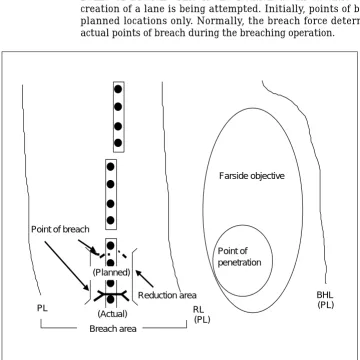
• Point of penetration. This is the location, which is identified on the ground, where the commander concentrates his efforts at the enemy’s weakest point to seize a foothold on the farside objective. This is achieved along a narrow front through maneuver and direct and indirect fires that are accurately placed against enemy forces. A commander conducting a breaching operation establishes a point of penetration that supports planning locations for the reduction area and the seizure of the farside objective.
• Reduction area. This is a number of adjacent points of breach that are under the control of the breaching commander. The commander conducting the attack determines the size and location of the reduction area that supports the seizure of a point of penetration (see
Figure 1-1).
[image:11.612.136.496.275.635.2]• Point of breach. This is the location at an obstacle where the creation of a lane is being attempted. Initially, points of breach are planned locations only. Normally, the breach force determines the actual points of breach during the breaching operation.
Figure 1-1. Breach Area
Farside objective
Point of penetration
BHL (PL) PL
Breach area
Reduction area Point of breach
(Planned)
(Actual) RL
FM 3-34.2
1-4 Obstacle Breaching Theory
BREACHING TENETS
1-2. Successful breaching operations are characterized by applying breaching tenets. These tenets should be applied whenever an obstacle is encountered in the area of operations (AO), whether during an attack or during a route clearance operation. The tenets are—
• Intelligence.
• Breaching fundamentals. • Breaching organization. • Mass.
• Synchronization.
INTELLIGENCE
1-3. Success depends largely on the force commander’s ability to see the battle
space. He must identify how the enemy is using the terrain to minimize the
risk of surprise. This is particularly true when attempting to counter the enemy’s use of obstacles. The force commander does this with the intelligence preparation of the battlefield (IPB) process. During the IPB process, the situation template (SITEMP) is developed. The SITEMP is a graphic depiction of expected threat dispositions based on threat doctrine and the effects of the battle space for a particular course of action (COA). Based on the commander’s estimates, the staff develops a SITEMP for multiple enemy COAs. The SITEMP helps drive the maneuver planning in support of war gaming and the development of the event template. The SITEMP also drives the decisions the commander must be prepared to make. The commander uses the decision-support template (DST) to convey these decisions in graphic form. The IPB process helps achieve success by focusing available intelligence-gathering assets toward answering the commander’s priority intelligence requirements (PIR). Intelligence that is gathered later by recon becomes the foundation for developing and revising a SITEMP. (See Appendix B for information on threat mine operations.)
1-4. Time-constrained planning requires the rapid development of the enemy’s SITEMP. A minimal SITEMP, complete with templated obstacles, allows the development of an initial event template and provides initial PIR for the intelligence-collection plan (ICP). At a minimum, the unit can template an obstacle trace that is precise, as far as the location, and represents the total expected enemy countermobility effort but does not depict individual obstacles. The staff plots the actual composition of the trace based on incoming obstacle reports. Adequate time for intelligence collection is critical in developing an accurate picture of the battle space, yet time is normally in short supply. While templating is essential to focus the ICP, too much time can be spent on templating at the expense of intelligence, surveillance, and reconnaissance (ISR).
OBSTINTEL helps the S2 determine the enemy’s intentions, plans, and defense strength. The force engineer is the unit’s expert on enemy countermobility capabilities. He assists the S2 in templating enemy obstacles, analyzing OBSTINTEL, and analyzing the effects of terrain.
1-6. An unverified enemy template can lead to disaster because the force may aim an attack at the wrong place. Units may deploy to reduce expected obstacles early, wasting mission time to feel their way into nonexistent obstacles; or they may blunder into an unexpected obstacle or an enemy engagement area (EA).
1-7. OBSTINTEL can be a critical indicator to verify an enemy template. The force’s Operations and Training Officer (US Army) (S3), S2, and engineer establish effective OBSTINTEL collection by determining specific obstacle IR. Examples of information that is needed to fulfill obstacle IR include—
• The location of existing and reinforcing obstacles. • The orientation and depth of obstacles.
• Conditions of the soil (in the case of a minefield) to determine the ability to use tank plows.
• The presence, location, and type of wire. • Lanes and bypasses.
• The composition of the minefield (buried or surface-laid antitank [AT] and antipersonnel [AP] mines, antihandling devices [AHDs], and the depth of the mines).
• Types of mines and fuses.
• The location of enemy indirect-fire systems that can fire into the breach area.
• The composition of complex obstacles. • Areas between successive obstacle belts.
1-8. OBSTINTEL is particularly important for discovering the types of mines and mine fuses the enemy has employed. The engineer depends on this information since he must determine which reduction techniques offer the best chance for success and minimize the risk to the breach force. This may require a dismounted recon patrol to examine mines within a minefield. The enemy may employ security patrols, have forces overwatching the obstacle, or place forces within the obstacle to prevent obstacle recon.
1-9. Obtaining OBSTINTEL requires dedicated collection assets. These assets identify survivability positions and obstacle emplacement activity. Aviation units, who are tasked to perform recon in the area, may be able to provide valuable OBSTINTEL information. Ground-surveillance radar may also provide useful information.
FM 3-34.2
1-6 Obstacle Breaching Theory
templated or confirmed obstacles. This team has the flexibility to dismount and develop the details of the obstacle. Personnel engaged in a recon mission for OBSTINTEL should be used rarely, if ever, to reduce obstacles during the mission; although they make ideal guides to breach forces for subsequent breaching operations. Inadvertent detonation during reduction may compromise engineers and scouts, defeating the recon mission. It may also compromise the entire attack. FM 5-170 describes capabilities, limitations, and employment concepts of engineer recon teams.
BREACHING FUNDAMENTALS
1-11. Suppress, obscure, secure, reduce, and assault (SOSRA) are the breaching fundamentals that must be applied to ensure success when breaching against a defending enemy. These fundamentals will always apply, but they may vary based on the specific battle-space situation (mission, enemy, terrain, troops, time available, and civilian considerations [METT-TC]).
Suppress
1-12. Suppression is a tactical task used to employ direct or indirect fires or an electronic attack on enemy personnel, weapons, or equipment to prevent or degrade enemy fires and observation of friendly forces. The purpose of suppression during breaching operations is to protect forces reducing and maneuvering through an obstacle.
1-13. Effective suppression is a mission-critical task performed during any breaching operation. Suppressive fires in sufficient volume serve to secure the reduction area. Successful suppression generally triggers the rest of the actions at the obstacle. Fire control measures ensure that all fires are synchronized with other actions at the obstacle. Although suppressing the enemy overwatching the obstacle is the mission of the support force, the breach force should be able to provide additional suppression against an enemy that the support force cannot effectively suppress.
Obscure
1-14. Obscuration must be employed to protect forces conducting obstacle reduction and the passage of assault forces. Obscuration hampers enemy observation and target acquisition and conceals friendly activities and movement. Obscuration smoke deployed on or near the enemy’s position minimizes its vision. Screening smoke employed between the reduction area and the enemy conceals movement and reduction activities. It also degrades enemy ground and aerial observations. Obscuration must be carefully planned to provide maximum degradation of enemy observation and fires, but it must not significantly degrade friendly fires and control.
Secure
overwatching units, as necessary. The far side of the obstacle must be secured by fires or be occupied before attempting any effort to reduce the obstacle. The attacking unit’s higher HQ has the responsibility to isolate the breach area by fixing adjacent units, attacking enemy reserves in depth, and providing counterfire support.
1-16. Identifying the extent of the enemy’s defenses is critical before selecting the appropriate technique to secure the point of breach. If the enemy controls the point of breach and cannot be adequately suppressed, the force must secure the point of breach before it can reduce the obstacle.
1-17. The breach force must be resourced with enough maneuver assets to provide local security against the forces that the support force cannot sufficiently engage. Elements within the breach force that secure the reduction area may also be used to suppress the enemy once reduction is complete.
Reduce
1-18. Reduction is the creation of lanes through or over an obstacle to allow an attacking force to pass. The number and width of lanes created varies with the enemy situation, the assault force’s size and composition, and the scheme of maneuver. The lanes must allow the assault force to rapidly pass through the obstacle. The breach force will reduce, proof (if required), mark, and report lane locations and the lane-marking method to higher HQ. Follow-on units will further reduce or clear the obstacle when required. Reduction cannot be accomplished until effective suppression and obscuration are in place, the obstacle has been identified, and the point of breach is secure. Obstacle-reduction techniques are discussed in more detail in Appendix C.
Assault
1-19. A breaching operation is not complete until—
• Friendly forces have assaulted to destroy the enemy on the far side of the obstacle that is capable of placing or observing direct and indirect fires on the reduction area.
• Battle handover with follow-on forces has occurred, unless no battle handover is planned.
BREACHING ORGANIZATION
FM 3-34.2
1-8 Obstacle Breaching Theory Support Force
1-21. The support force’s primary responsibility is to eliminate the enemy's ability to interfere with a breaching operation. It must—
• Isolate the reduction area with fires.
• Mass and control direct and indirect fires to suppress the enemy and to neutralize any weapons that are able to bring fires on the breach force.
• Control obscuring smoke to prevent enemy-observed direct and indirect fires.
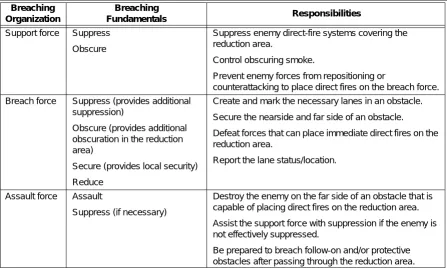
[image:16.612.75.522.129.398.2]1-22. Suppression is critical for a successful breaching operation; therefore, allocation of adequate forces to the support force is essential. The commander must allocate enough direct- and indirect-fire systems to the support force to allow it to accomplish its missions. When resourcing the support force, consider the losses it will receive as it fights its way into its support-by-fire (SBF) position. To increase the survivability of the support force, the commander may establish critical friendly zones (CFZs) in support of the support force once it has occupied its SBF positions. A CFZ is an area, usually a friendly unit or location, that the maneuver commander designates as critical to protect an asset whose loss would seriously jeopardize the mission. Covered by a radar sector, the CFZ supports counterfire operations by providing the most responsive submission of targets to the fire-support system when rounds impact inside the CFZ. (For more detailed information on CFZs, see FM 6-121.)
Table 1-1. Relationship Between Breaching Organization and Breaching Fundamentals
Breaching Organization
Breaching
Fundamentals Responsibilities
Support force Suppress
Obscure
Suppress enemy direct-fire systems covering the reduction area.
Control obscuring smoke.
Prevent enemy forces from repositioning or
counterattacking to place direct fires on the breach force.
Breach force Suppress (provides additional suppression)
Obscure (provides additional obscuration in the reduction area)
Secure (provides local security)
Reduce
Create and mark the necessary lanes in an obstacle.
Secure the nearside and far side of an obstacle.
Defeat forces that can place immediate direct fires on the reduction area.
Report the lane status/location.
Assault force Assault
Suppress (if necessary)
Destroy the enemy on the far side of an obstacle that is capable of placing direct fires on the reduction area.
Assist the support force with suppression if the enemy is not effectively suppressed.
1-23. The support force must seize an SBF position, seeking maximum protection from the terrain. If possible, the support force should follow a covered or concealed route to the SBF position, take up its assigned sectors of fire and observation, and begin to engage the enemy. It may have to make some adjustments to its direct-fire plan if the situation dictates. Observation is particularly critical. Artillery observers with the support force may initially bring indirect fires on enemy positions to fix and suppress the enemy. The support force adjusts the artillery-delivered obscuring smoke, if necessary, to protect the breach and assault forces as they approach the reduction area.
Breach Force
1-24. The breach force assists in the passage of the assault force by creating, proofing (if necessary), and marking lanes. (For more information on the initial lane-marking pattern, see Chapter 3.) The breach force is a combined-arms force. It includes engineers, reduction assets, and enough maneuver forces to provide additional suppression and local security. The breach force may apply portions of the following breaching fundamentals as it reduces an obstacle:
• Suppress. The breach force must be allocated enough maneuver forces to provide additional suppression against various threats, including—
! ! !
! Enemy direct-fire systems that cannot be effectively observed and
suppressed by the support force due to the terrain or the masking of the support force’s fires by the breach force as it moves forward to reduce the obstacle.
! ! !
! Counterattacking and/or repositioning forces that cannot be
engaged by the support force.
• Obscure. The breach force employs vehicle-mounted smoke systems and smoke pots, if necessary, for self-defense and to cover lanes while the assault force is passing.
• Secure. The breach force secures itself from dismounted threat forces who are providing close-in protection of the obstacle. The breach force also secures the lanes through the tactical obstacles, once they are created, to allow safe passage of the assault force.
• Reduce. The breach force performs its primary mission of reducing the obstacle. To support the development of a plan to reduce the obstacle, the composition of the obstacle system must be an IR.
• Assault. The breach force assaults through the point of breach to the far side of an obstacle and seizes the reduction area.
1-25. The breach force is comprised of two subordinate elements—security and reduction:
• Security element. The security element is comprised primarily of maneuver forces. It is normally responsible for providing additional suppression, obscuration, and local security.
FM 3-34.2
1-10 Obstacle Breaching Theory
[ACEs], dismounted engineers, a nd so forth). It is norma lly responsible for reducing the obstacle.
Chapter 2 provides more details on the roles, responsibilities, and command
and control (C2) of the security and reduction elements.
1-26. The breach force must be able to deploy and begin reducing the obstacle as soon as enemy fires have been suppressed and effective obscuration is achieved. It can expect enemy artillery fires within a matter of minutes. CFZs should be activated at the point of breach before the commitment of the breach force.
1-27. Engineers within the breach force are allocated with the reduction assets necessary to clear mines, nonexplosive obstacles, and small gaps. Scouts, engineers, or other recon assets are also capable of finding local bypasses or existing lanes in the obstacle system.
1-28. The commander allocates engineers and reduction assets based on the number of lanes required, the terrain, and the type of obstacle. The breach force must be able to create a minimum of one lane for each assaulting company or two lanes for the assaulting task force (TF).
1-29. The commander should plan for a 50 percent loss of mobility assets in close combat. As a planning factor, he should allocate one engineer platoon with the necessary reduction assets to create and mark one lane.
1-30. After the breach force has reduced the obstacle and passed the assault force through, the breach force may be required to hand over the lane to follow-on units. At a minimum, the lanes must be marked and their locations and conditions reported to higher HQ and follow-on units as prescribed in the unit’s standing operating procedures (SOP).
Assault Force
1-31. The assault force’s primary mission is to destroy the enemy and seize terrain on the far side of the obstacle to prevent the enemy from placing direct fires on the created lanes. The assault force may be tasked to assist the support force with suppression while the breach force reduces the obstacle.
1-32. The assault force must be sufficient in size to seize the point of penetration. Combat power is allocated to the assault force to achieve a minimum 3:1 ratio on the point of penetration. In a breaching operation, particularly TF and above, the assault force normally maneuvers as a separate force attacking through a reduced obstacle. However, breach and assault assets may maneuver as a single force when conducting lower-level breaching operations, such as an independent company team conducting an attack.
1-33. If the obstacle is defended by a small enemy force, assault and breach forces’ missions may be combined. This simplifies C2 and provides more immediate combat power for security and suppression.
must assume control for direct fires on the assault objective as support and breach forces’ fires are lifted or shifted.
MASS
1-35. Breaching is conducted by rapidly applying concentrated efforts at a point to reduce the obstacle and penetrate the defense. Massed combat power is directed against the enemy’s weakness. The location selected for breaching depends largely on the weakness in the enemy’s defense, where its covering fires are minimized. If friendly forces cannot find a natural weakness, they create one by fixing the majority of the enemy force and isolating a small portion of it for attack.
Support Force
1-36. The support force suppresses the enemy to eliminate effective fires on the breach force. Smoke and terrain are used to help isolate the force under attack. Suppression requires the commander to mass enough overwatching direct fires to protect the breach force.
1-37. Normally, the TF isolates and destroys platoon-size elements in succession, starting with the platoon identified as the easiest to overwhelm. In
Figure 1-2, the TF commander employs a tank company team to fix two
defending platoons and uses screening smoke (target AA1102) to help isolate the platoon selected for attack. Objective (OBJ) Cowboy has been identified by the TF commander as the point of penetration. The center and eastern platoons are suppressed by direct and indirect fires from a second tank company team.
Figure 1-2. Technique for Achieving Mass in the Breach
•••
••
OBJ COWBOY AA1101
•••
•••
AA1103
• •
• •
• •
• • • • • •
(+)
(-)
• • • • • • •
• • •
• • •
•
• • • •
•
xx
x x
v
v
v
v
x
x x
A A
11
02 AA
11 04
x
x
x
FM 3-34.2
1-12 Obstacle Breaching Theory
1-38. The support force should be provided with reduction assets to reduce the impact that unexpected obstacles or scatterable minefields have on their approach to and occupation of SBF positions. Failure to do so may greatly impact on synchronizing the entire breaching operation. As a technique, a unit may create a mobility reserve that supports the main effort throughout the operation. Initially, the mobility reserve may support the support force until it has seized its SBF positions and then shift its support to the breach or assault force.
Breach Force
1-39. The commander also masses engineers and reduction assets to reduce the obstacle. The breach force is organized and equipped to use several different reduction techniques in case the primary technique fails; for example, if a key vehicle is destroyed or if casualties render dismounted engineers ineffective. Additional reduction assets are present to handle the unexpected. Normally, 50 percent more reduction assets than required for obstacle reduction are positioned with the breach force.
1-40. The breach force masses reduction efforts against the obstacle to ensure that it will successfully create enough lanes. A mounted TF-size assault force requires at least two lanes, but more lanes will speed passage through the danger area. The breach force attempts to simultaneously create as many lanes as necessary to ensure the rapid passage of the assault force through the obstacle system. This may require the breach force to simultaneously use a combination of mechanical, explosive, and manual techniques. For example, an engineer platoon may use two MICLICs as the primary technique to reduce a minefield. As soon as the engineer platoon fires the second MICLIC, engineer squads employ manual explosive techniques to create three additional lanes through the minefield. The commander must carefully plan and synchronize the creation of additional lanes to reduce the potential for fratricide with assaulting troops. The distance between the lanes depends on the enemy, the terrain, the need to minimize the effects of enemy artillery, the direct-fire plan of the support force, C2, and reduction-site congestion.
Assault Force
1-41. Achieving necessary mass for the assault requires the breach force to open enough lanes through the obstacle to permit rapid passage and the buildup of forces on the farside. The size of the assault force determines the number of lanes initially created. A mounted TF requires one lane per assaulting company team. A dismounted assault force requires one lane for each leading assault platoon. The tactical situation may require additional lanes to quickly pass a large assault force through the obstacle to achieve sufficient combat-power ratio.
1-42. The principle of mass influences the selection of the point of breach; the task organization of the support, breach, and assault forces; and the integration of engineers in movement or attack formations. Figure 1-2, page 1-11, shows a technique to achieve mass in the breach.
company team cannot simultaneously mass sufficient fires, reduce the obstacle, and assault the defending position unless it is a simple obstacle defended by no more than one platoon. A TF should have a combat-power ratio of 3:1 to reduce an obstacle defended by a company, and a TF is normally the echelon used to execute a breach. A brigade has sufficient combat power to attack a complex, well-defended obstacle; but a brigade has difficulty deploying all its combat power within range. Normally, a brigade breaches by isolating a small segment of the defense (platoon or company) that the TF can then attack as the breaching echelon. If obstacles and defenses are in-depth, mass is achieved by passing additional TFs through the obstacle to continue the attack.
SYNCHRONIZATION
1-44. Breaching operations require precise synchronization of the breaching fundamentals by support, breach, and assault forces. Failure to synchronize effective suppression and obscuration with obstacle reduction and assault can result in rapid, devastating losses of friendly troops in the obstacle or the enemy’s EA.
1-45. A combined-arms breach is a complex operation by nature. Support, breach, and assault forces must apply the SOSRA breaching fundamentals within a short time and distance. The support force masses its direct fires and controls indirect fires in concert with breach and assault forces’ maneuvers. The commander must employ smoke at the right time and place to maximize its effectiveness or risk hampering his own target acquisition and C2. The breach force must have the right reduction asset for the type of obstacle encountered. Engineers must ensure that they do not prematurely exhaust reduction assets needed to reduce subsequent obstacles. Table 1-2, page 1-14, shows the complexity of a combined-arms breach.
1-46. The commander ensures synchronization through proper planning and force preparation. Fundamentals to achieve synchronization are—
• Detailed reverse planning. • Clear subunit instructions. • Effective C2.
• Well-rehearsed forces.
Detailed Reverse Planning
FM 3-34.2
1-14 Obstacle Breaching Theory
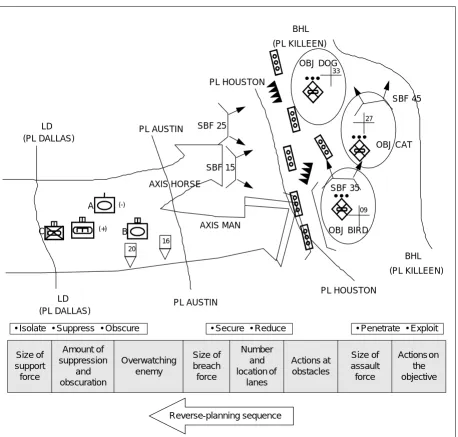
that achieves adequate suppression, obscuration, and security. He also creates sufficient lanes to rapidly project combat power on the point of penetration and the far side of the objective, not just to the far side of the obstacle. Reverse planning gives purpose to the breaching plan that supports mission accomplishment.
1-48. The commander begins developing COAs as discussed in FM 101-5. He determines relative combat-power ratios, generates options, and arrays forces to accomplish the mission. He then develops the scheme of maneuver, including actions on the objective. In Figure 1-3, a three-company-team TF is conducting a deliberate attack to destroy a motorized infantry company (MIC) in the defense. The commander believes seizing OBJ Cat to be decisive. This is the point from which reverse planning of actions on the objective begins. The commander uses Team C to seize the initial foothold (OBJ Bird) (point of penetration) into the enemy’s defense. The focus of breach planning is to get Team C to its objective. The number and location of lanes are driven by Team C’s maneuver on OBJ Bird as the assault force. The commander now plans how the breach force must maneuver to reduce the obstacle. Supporting fires from Company A and Team B in SBFs 15 and 25 are planned to support the reduction of the obstacle and the assault on the objective. Reverse planning continues to drive the maneuver formation to ensure that forces are in the correct relative positions to accomplish their missions.
Table 1-2. Breach Complexity
Action Element Time
(Minutes) Controlled By
Develop the situation (verify the boundary of the enemy obstacle system).
Force in contact M to 2 S3
Maneuver the support force into the overwatch position.
Support M + 2 to 15 Support cdr
Maneuver the assault force into the covered assault position.
Assault M + 2 to 15 Assault cdr
Call for artillery. DS artillery M + 2 to 15 FSO
Build smoke. Mortars M + 5 to 10 FSO
Suppress the enemy with direct fires. Support M + 15 to 29 Support cdr
Suppress the enemy with artillery fires. DS artillery M + 10 to 29 FSO Maintain smoke. DS artillery/mortars M + 10 to 30 FSO
Maneuver the breach force to the breach location.
Breach M + 20 to 23 Reduction cdr
Reduce the obstacle, and prepare two lanes. Breach M + 23 to 30 Engineer ldr
Place smoke pots. Breach M + 23 to EOM Reduction cdr
Shift direct fires off the objective. Support M + 29 to 30 Assault cdr
Shift indirect fires beyond the objective. DS artillery M + 29 to 30 Assault cdr
Assault to destroy the enemy on the far side of the obstacle.
Assault M + 30 to 45 Assault cdr
Clear Subunit Instructions
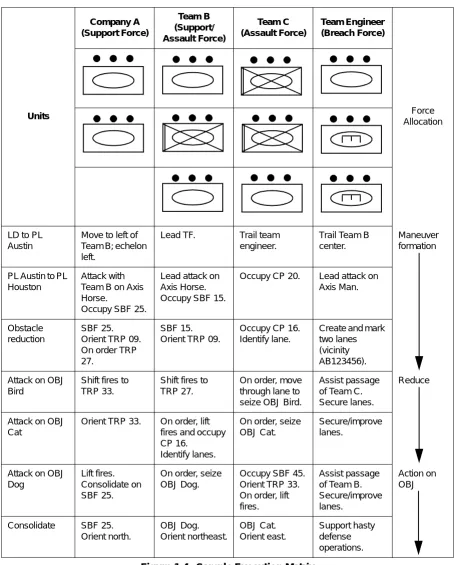
[image:23.612.89.547.102.539.2]1-49. Subordinate units must clearly understand their missions, how their missions relate to the phases of the operation, and what role adjacent units play in the overall plan. The commander may use an execution matrix to synchronize his forces. An execution matrix is a superb synchronization tool, and it lists subunit instructions sequentially in relation to key events or the sequence of the attack. It also provides subordinate commanders with an understanding of how their missions and those of adjacent units fit into the overall plan. More importantly, it allows subordinates to better track the battle and coordinate their own maneuver with that of adjacent units. This is critical to achieving unity of effort between support, breach, and assault
Figure 1-3. Reverse Planning Size of support force Amount of suppression and obscuration Overwatching enemy Size of breach force Number and location of lanes Actions at obstacles Size of assault force Actions on the objective • Isolate • Suppress • Obscure • Secure • Reduce • Penetrate • Exploit
FM 3-34.2
1-16 Obstacle Breaching Theory
forces. Figure 1-4 shows a sample execution matrix for the scheme of maneuver in Figure 1-3, page 1-15.
Units Company A (Support Force) Team B (Support/ Assault Force) Team C (Assault Force) Team Engineer (Breach Force) Force Allocation
LD to PL Austin
Move to left of Team B; echelon left.
Lead TF. Trail team engineer.
Trail Team B center.
Maneuver formation
PL Austin to PL Houston
Attack with Team B on Axis Horse.
Occupy SBF 25.
Lead attack on Axis Horse. Occupy SBF 15.
Occupy CP 20. Lead attack on Axis Man.
Obstacle reduction
SBF 25. Orient TRP 09. On order TRP 27.
SBF 15. Orient TRP 09.
Occupy CP 16. Identify lane.
Create and mark two lanes (vicinity AB123456).
Attack on OBJ Bird
Shift fires to TRP 33.
Shift fires to TRP 27.
On order, move through lane to seize OBJ Bird.
Assist passage of Team C. Secure lanes.
Reduce
Attack on OBJ Cat
Orient TRP 33. On order, lift fires and occupy CP 16.
Identify lanes.
On order, seize OBJ Cat.
Secure/improve lanes.
Attack on OBJ Dog
Lift fires. Consolidate on SBF 25.
On order, seize OBJ Dog.
Occupy SBF 45. Orient TRP 33. On order, lift fires.
Assist passage of Team B. Secure/improve lanes.
Action on OBJ
[image:24.612.71.525.135.700.2]Consolidate SBF 25. Orient north. OBJ Dog. Orient northeast. OBJ Cat. Orient east. Support hasty defense operations.
Effective C2
1-50. Effective C2is paramount to mission success. C2is integrated into the plan through the use of maneuver and fire control measures and the positioning of key leaders to see the battle space. Maneuver control measures enable the commander to graphically convey his intent, scheme of maneuver, and subunit instructions. Relating subunit actions to the terrain is critical to successful execution.
1-51. In Figure 1-3, page 1-15, the commander uses PLs to initiate the breaching operation and to control actions on the objective. At PL Austin, the support force maneuvers to occupy SBFs 15 and 25. The assault force occupies checkpoint (CP) 16 to prevent premature advancement to the obstacle, reduction-site congestion, and the engagement of forces before lanes are created and marked. The commander uses target reference points (TRPs) on obvious terrain features to orient, focus, and shift suppressive direct and indirect fires.
1-52. Key leaders must be able to see the battle space to make informed decisions. Nowhere is this more true than during the breaching operation. The commander must position himself where he can best control the battle. Since effective suppression is the most critical event during breaching operations, the commander may position himself with the support force. This enables him to personally influence fire control and facilitate the necessary cross talk between breach and assault forces. The S3 may initially move with the breach force to track the progress of obstacle reduction and anticipate the commitment of the assault force. A commander who feels that his personal influence is required with the breach or assault force must make a conscious effort to track the entire battle and must not focus completely on the reduction of the obstacle or the assault itself.
Well-Rehearsed Forces
1-53. The most effective synchronization tool available to the commander is the rehearsal. The inherent complexity of the breaching operation makes rehearsals at every level essential to success. The commander must give his subordinates time to plan how they will execute their assigned missions and time to rehearse the plan with their unit. The TF facilitates rehearsals by preparing rehearsal sites and managing their use. The TF commander must be sensitive to the impact TF-level rehearsals have on subordinate planning and preparation, and he must carefully choose the time and place of the rehearsal. Company teams rehearse their support, breach, and assault roles. TF rehearsals focus on synchronizing the maneuver of support, breach, and assault forces to achieve the breaching fundamentals. Rehearsals also highlight key events that must be coordinated during breach execution.
Typical Breaching Operations
FM 3-34.2
1-18 Obstacle Breaching Theory
BREACHING OPERATIONS IN SUPPORT OF DELIBERATE AND
HASTY ATTACKS
1-55. Attacks take place along a continuum based on the knowledge of the enemy’s capabilities and disposition and the intentions and details of the friendly force’s planning and preparation. The terms deliberate attack and
hasty attack refer to the opposite ends of that continuum and describe
characteristics of the attack:
• Deliberate attack. Friendly forces have more knowledge of the enemy situation and have more time to plan and prepare for the enemy. With this knowledge, friendly forces conducting the deliberate attack can develop detailed plans, task-organize to accomplish the mission, and execute rehearsals down to the lowest levels.
• Hasty attack. The enemy situation is vague, or it changes rapidly. Friendly forces have little or no time to plan or prepare for this type of operation. Because the primary purpose of the hasty attack is to maintain momentum or take advantage of the enemy situation, it is normally conducted only with the resources that are immediately available.
1-56. Breaching operations may be required to support an attack anywhere along the continuum. During a deliberate attack, friendly forces, such as engineers and smoke platoons, are task-organized before the attack to best support the concept of the operation. In a hasty attack, there may be insufficient time to task-organize assets, such as engineers and reduction assets, in the best manner. Additionally, the unit may not have time to plan the breaching operation in detail but may have to rely on the unit’s SOP for execution. Regardless of where the attack falls along the continuum, the breaching tenets apply when conducting the breaching operation in support of the attack.
PLANNING SEQUENCE
1-57. The scheme of maneuver, engineer operations, fires, air defense, and actions at obstacles are all based on the same SITEMP. Planners develop the breaching plan using the following sequence:
• Reverse planning begins with actions on the objective. Table 1-3. Types of Breaching Operations Versus Enemy Sizes
Enemy Overwatching the Obstacle
Maneuver Units Conducting Breaching Operations
Brigade TF Company
MIBN X
MIC O X
MIP O X
NOTES:
• Actions on the objective drive the size and composition of the assault force.
• The size of the assault force determines the number and location of lanes to be created.
• Lane requirements and the type of obstacle drive the amount and type of mobility assets task-organized to the breach force.
• The ability of the enemy to interfere with the reduction of the obstacle determines the size and composition of the security element in the breach force.
Breaching Operations 2-1
Chapter 2
Breaching Operations
For a breaching operation, a unit develops a scheme of maneuver
specifically designed to cross an obstacle and continue a mission.
Maneuver company teams, TFs, and brigades can conduct breaching
operations. Normally, a TF executes a breaching operation and the
company teams are assigned as support, breach, and assault forces. Units
will conduct a breaching operation when—
•
The force-allocation ratio indicates that a confirmed enemy
situation is bey ond t he s ubord inate unit’s capabilities t o
successfully conduct a breaching operation. (When companies
cannot successfully conduct a breaching operation, the battalion
will.)
•
A subordinate unit has failed in its attempt to breach an enemy’s
tactical obstacles.
NOTES:
1. See Appendix D for a breaching scenario and special planning
considerations for breaching operations in restricted terrain.
2. See Appendix E for information on route clearance operations.
PLANNING
2-1. Units develop plans to conduct a breaching operation using the following military decision-making process (MDMP):
Step 1. Receipt of mission. Step 2. Mission analysis. Step 3. COA development.
Step 4. COA analysis (war game). Step 5. COA comparison.
Step 6. COA approval. Step 7. Orders production.
The following paragraphs highlight key portions of the MDMP as it applies to the planning of a breaching operation. For a complete discussion of the MDMP, see FM 101-5.
RECEIPT OF MISSION
deliver the products as soon as they become available. Intelligence products are essential for the unit to begin developing its own intelligence products and to facilitate parallel planning.
2-3. Upon receiving the higher HQ SITEMP, the unit develops standard terrain products using TerraBase II or a similar computer-software program. (For examples of TerraBase products, see FM 5-71-3.) This set of terrain products is called a terrain-visualization mission folder. (For more information on this subject, see FM 5-105.) Terrain products that support the planning of a breaching operation should be included in the unit’s SOP and may include—
• Visible area plots from each of the templated enemy locations to the expected EA.
• Visible area plots from potential SBF positions and points of breach to the templated enemy location.
• Oblique view of the AO.
• Perspective view of intervisibility lines.
• Visible area plots from named areas of interest (NAIs), when NAIs are developed.
2-4. Visible area plots from each of the templated enemy locations help determine if the enemy would select these locations. For example, the enemy would not select a location directly behind a small hill because the hill would prevent the enemy from firing into a kill sack. Additionally, by combining the visible area plots on an overlay, the enemy’s ability to mass fires is more easily understood. It also helps select SBF locations, obscuration locations, and sectors of fires and helps determine the breach organization for future operations.
2-5. Visible area plots from potential SBF positions and points of breach assist future planning by allowing the commander to visualize the support and breach forces’ ability to suppress the enemy. Multiple plots along the length of an SBF position may be necessary to fully understand the suitability of an SBF position.
2-6. An oblique view of the AO helps the commander better visualize the terrain. A perspective view of intervisibility lines in the AO allows him to visualize how the unit can best use the terrain during a breaching operation. It also provides an idea of how the enemy may use the intervisibility lines when positioning its assets and special munitions.
2-7. Visible area plots from developed NAIs can be used to provide positioning guidance for observation posts (OPs). These products are issued to recon assets who are tasked to provide information on various NAIs.
2-8. When receiving a mission, pay particular attention to the actions the higher HQ takes in support of the breaching operation or its decisions that influence the breaching operation. Responsibilities of the higher HQ include—
• Resourcing the unit conducting the breaching operation with addi tional or sp ecial assets n ot normally tas k- organ iz ed to subordinate units.
FM 3-34.2
Breaching Operations 2-3 • Using scatterable mines (SCATMINEs), deep fires, attack helicopters, and close air support (CAS) to isolate the farside objective and prevent a successful enemy counterattack.
• Planning a forward passage of lines by follow-on forces through the unit conducting the breaching operation. This must include a plan to upgrade/maintain lanes through the obstacle and to create additional lanes, if necessary, for the passage of follow-on forces.
• Providing criteria to transition to its own breaching operation.
MISSION ANALYSIS
2-9. During mission analysis, the commander conducts the IPB. A product of the IPB process is the SITEMP. The SITEMP is a graphic depiction of expected threat disposition if it adopts a particular COA. The staff must combine higher HQ intelligence with its knowledge of the enemy to produce a SITEMP with the necessary detail to successfully plan a breaching operation. A SITEMP should include—
• Likely enemy EAs.
• The location and orientation of enemy forces.
• Counterattack objectives and the location of enemy reserve elements. • The location and range of all direct- and indirect-fire systems (tanks,
AT weapons, artillery).
• Enemy obstacle systems, including tactical and protective obstacles a n d S C A T M I N E s . T h e t e m p l a t e m u s t d e p i c t t h e e n e m y ’ s countermobility capability.
• The enemy’s use of nuclear, biological, chemical (NBC) weapons, including the ranges of delivery systems.
• The location of enemy target-acquisition assets.
• Likely air avenues of approach (AAs), including fixed and rotary-wing aircraft.
• Positioning of enemy air-defense artillery (ADA) assets.
2-10. Selecting the initial commander’s critical-information requirements (CCIR) is a part of mission analysis, and it is crucial to begin planning recon operations that will result in useful intelligence, including OBSTINTEL. Typical CCIR for a breaching operation may include the—
• Location, composition, and orientation of the obstacle and available bypasses in the vicinity of the reduction area and the point of penetration (PIR).
• Location and composition of enemy forces that are capable of employing direct and indirect fires on the point of breach (PIR). • Maintenance status and location of all reduction assets (friendly forces
information requirements [FFIR]).
• Status of commitment criteria for the breach force (PIR and FFIR).
COURSE-OF-ACTION DEVELOPMENT
2-11. When developing a COA, the commander must remember that the breaching operation is only a portion of the higher HQ operation. The unit must ensure that the end state of the COA supports the higher HQ concept of the operation. As stated in FM 101-5, one of the criteria that each developed COA must meet is completeness. In a breaching operation, units use detailed reverse planning, develop a plan to achieve the breaching fundamentals, develop clear subunit instructions to develop a complete COA, and begin to synchronize the operation.
2-12. The detailed reverse-planning process, the SITEMP, and the terrain products produced during mission analysis are used to determine the size and composition of support, breach, and assault forces. The reverse-planning process begins with actions on the objective and includes templated enemy obstacles.
2-13. The assault force’s task and purpose drive its composition. The assault force’s mission is to seize terrain on the farside of the obstacle to prevent the enemy from placing direct fires on created lanes. Consider the following when determining the assault force’s size and composition:
• Higher HQ requirements in terms of seizing or securing objectives. • The terrain.
• The expected disposition, composition, and strength of the enemy when the assault force is committed.
2-14. The assault force’s size determines the number and location of lanes to be created. The breach force creates and marks lanes through or around obstacles to support the rapid passage of the assault force. An assaulting company team requires a minimum of one lane, and an assaulting TF requires at least two lanes.
2-15. Lane requirements and the type of obstacle drive the amount and type of reduction assets task-organized to the breach force. As stated in Chapter 1, the commander should plan for the loss of about 50 percent of his reduction assets during a breaching operation. To ensure that the breach force is adequately resourced, the initial allocation of assets is continually reviewed as additional intelligence information (including OBSTINTEL) is received.
2-16. The enemy’s ability to interfere with obstacle reduction determines the size and composition of the security element in the breach force. The security element’s size and composition within the breach force can also be determined through the—
• Terrain analysis and the terrain’s impact on the support force’s ability to suppress the enemy.
• Amount of terrain the breach force will occupy at the obstacle during reduction and the extent that the breach force will mask the fires of the support force.
• Analysis of the enemy’s expected reaction to the reduction effort.
FM 3-34.2
Breaching Operations 2-5 required and the support force’s size and composition. Expected losses that the support force will incur from the line of departure (LD) to the SBF position due to maintenance and enemy air, chemical, and artillery attacks should be considered. Additionally, analyzing the enemy’s equipment type, range, and lethality can indicate the expected losses that the support force will incur while in an SBF position.
2-18. When developing COAs for a breaching operation, consider the following:
• Suppress.
■ Identify the support force’s axis of advance to SBF positions. The
support force’s mobility requirements must be identified based on the SITEMP and its axis of advance to SBF positions.
■ Establish SBF positions for each element in the support force. ■ Establish TRPs to control the support and breach forces’ direct
fires.
■ Determine the location and size of CFZs to protect the support
force.
■ Plan essential indirect-fire targets to assist in suppressing the
enemy.
■ Develop a plan for lifting or shifting direct and indirect fires. ■ Deploy the support force into a position to fire simultaneously on
the enemy from several directions, if possible.
■ Attack by fire before or during obstacle reduction to suppress an
overwatching enemy. If circumstances allow, forces may bypass the obstacle and assault the overwatching enemy before reduction. If the assault successfully eliminates the enemy, it also eliminates direct fires on the breach force. If the assault does not succeed in destroying the enemy, it fixes them and reduces the enemy’s ability to place fires on the breach force. Direct- and indirect-fire suppression from the support force is necessary to support this assault.
■ Use fires to suppress the enemy’s indirect fires. The enemy’s
indirect fires are extremely dangerous during a breaching operation since the breach force may be exposed for a lengthy period. Friendly artillery and air assets support the breaching operation by attacking enemy overwatch positions, mobile reserves, and artillery positions that are capable of firing on the point of breach. Friendly forces jam enemy fire control nets. The fire-support officer (FSO) designates points of breach as CFZs for a target-acquisition battery so that enemy artillery is treated as a priority target for counterbattery support.
• Obscure.
■ Determine the location of smoke target(s).
■ Identify terrain features that mask the force’s point of breach, and
a double-edged sword because it may attract enemy attention and degrade friendly target acquisition and C2.
■ Determine the quantity, location, and type of obscurant required
to screen breach and assault forces and obscure enemy fires. This is particularly important for breaching complex obstacles where the breach force is exposed for an extended time. Smoke is important in deceiving the enemy as to the breaching location and interfering with enemy fires. If smoke platoons are available, synchronize them with artillery-delivered and organic smoke.
■ Determine smoke requirements by using FM 3-50. Blanket, haze,
or curtain-screening smoke degrades enemy observation of assault and breach forces. A smoke platoon is capable of providing support for a 0.5- to 1.4-kilometer front. Friendly forces use a combination of carefully placed smoke pots and indirect fires to augment smoke support. Howitzers and mortars supporting friendly forces can build and maintain smoke, but smoke effectiveness depends on the number and rate of smoke rounds delivered. Using indirect fire to provide smoke competes with the friendly force’s high-explosive (HE) and dual-purpose improved conventional munition (DPICM) missions against an enemy. A commander must decide the priority for the use of indirect fire, and his decision must be clear to subordinates. Vehicles equipped with smoke-grenade launchers can provide local smoke for reduction operations and for troop passage during an assault. However, these systems are self-defense mechanisms and friendly forces must not rely on them to supply all obscuration for a breaching operation.
• Secure.
■ Plan direct-fire control measures as necessary.
■ Use terrain and the positioning of nearside and farside security
SBF near the point of breach to facilitate the survivability of the breach force.
■ Plan a CFZ and ADA coverage around the reduction area for
survivability and security of the breach force.
■ Plan local security at the breach site to suppress overwatching
enemy forces that are close to the obstacle. • Reduce.
■ Identify primary and alternate reduction techniques.
■ Determine the tentative location of lanes and the separation
between lanes.
■ Determine the breach force’s task organization.
■ Position the breach force, and identify positions and routes that it
uses as it maneuvers toward the obstacle to minimize its impact on hindering the support force’s suppressive fires.
• Assault.
■ Plan to pass the assault force through lanes created in the
obstacle.
FM 3-34.2
Breaching Operations 2-7
■ Develop SBF positions to be occupied by the assault force to
facilitate passage of follow-on forces.
■ Plan direct- and indirect-fire control measures that support the
seizure of the farside objective.
■ Identify all mobility requirements for the COA, including whether
the assault force requires engineer support for reducing protective obstacles and fortifications within the defensive position.
2-19. Each element within the breach organization must completely understand which tasks it is responsible for in breaching operations. Additionally, each COA should identify which force is the main effort throughout the breaching operation. For example, the COA should define when the main effort shifts from the support force to the assault force. The following are the different types of forces and their tasks and responsibilities:
• Support force.
■ Suppress enemy elements capable of placing direct fires on the
point of breach to protect the breach force.
■ Suppress enemy elements capable of placing direct fires on the
assault force. This may require the adjustment of SBF positions.
■ Call for and adjust indirect fires, including obscuration. A combat
observation lasing team (COLT) or Striker will be required for Copperhead munitions.
■ Fix enemy forces that are capable of repositioning.
• Breach force.
■ Reduce lanes in the obstacle.
■ Provide local security (farside and nearside).
■ Provide additional suppression of enemy forces overwatching the
obstacle.
■ Mark and report the location of created lanes.
■ Assist the passage of the assault force through created lanes.
• Assault force.
■ Seize the farside objective. ■ Reduce protective obstacles.
■ Prevent enemy direct fire from interfering with follow-on forces as
they pass through lanes.
■ Provide clear routes to the BHL for follow-on forces. ■ Conduct battle handover with follow-on forces.
2-20. The assault force’s mission is unique. It must reduce the enemy’s protective obstacles, assault the enemy’s position, and secure terrain that is essential to the passage of follow-on forces. The assault-force commander must thoroughly understand the higher HQ scheme of maneuver. The following information is particularly important:
• Objectives the assault force must seize.
• The number of lanes the breach force plans to create to facilitate the passage of the assault force.
• The higher HQ plan to provide suppressive fires and/or obscuring smoke.
• Planned points of breach and the point of penetration.
• Lane requirements (number and lane-marking type) to support the passage of follow-on forces.
• The sequence of follow-on units to be passed through lanes and the criteria to begin passing follow-on units through lanes that the assault force created.
2-21. Typically, the enemy emplaces protective obstacles 50 to 500 meters in front of its positions and between its forward platoons and companies. These obstacles are designed to prevent a mounted assault and to fix or break up a dismounted assault. Close-in obstacles may be a combination of wire, AP and AT mines, fortifications, and entrenchments. All obstacles are covered by direct fire. Mines may be surface-laid or buried and well-camouflaged. Mines can be deployed with AHDs that are command-detonated or trip-wire-activated.
2-22. The assault force commander considers the following breaching fundamentals when developing his plan:
• Suppress. If a company team is the assault force as part of a TF breaching operation, other company teams within the TF will normally have the responsibility to suppress the enemy from designated SBF positions on the objective area. These teams may be the same support force that protected the breach force; however, terrain factors may require repositioning to provide effective support for the assault force.
• Obscure. Mortars and vehicle-mounted obscurants are primary means of obscuration for the assault force. It may also employ hand-h el d s m oke g r en a d es a n d sm o ke po ts to p r ov i de a d d i ti o n a l obscuration. If available, smoke may be employed away from the point of breach to confuse enemy forces as to the disposition of the assault force.
• Secure. Local security must be established before conducting reduction operations on protective obstacles.
• Reduce.
■ The assault force’s reduction efforts center on creating
dismounted/mounted lanes in protective obstacles, reducing fortifications, and widening lanes to support follow-on forces. The commander should task-organize the assault force with sufficient reduction assets to create a minimum of one lane per assaulting platoon. There may be insufficient time to reorganize engineers and reduction assets to the assault force after crossing the LD. Therefore, engineers and reduction assets supporting the assault force are task-organized to the maneuver force they will support.
■ During the planning process, the assault force commander must
FM 3-34.2
Breaching Operations 2-9 mounted assault allows the use of tank plows and MICLICs. During a dismounted assault, friendly forces rely on manual o b s t a c l e r e d u c t i o n , w h i c h i s v e r y t i m e - c o n s u m i n g. T h e composition of follow-on forces must also be considered. This may require widening initial lanes that the assault force created, especially when a dismounted assault is followed by mechanized follow-on forces.
■ The assault force normally decentralizes C2 for the plan’s
execution. For this reason, an assault force commander must allocate engineers, reduction assets, and demolitions to squads and platoons to provide reduction capability throughout his force. • Assault. Below-ground operations require clearing the enemy’s trench
lines and bunker complexes. Dismounted infantry and engineers, in concert with tanks and Bradley fighting vehicles (BFVs), conduct these operations. These actions must be planned in detail and rehearsed to ensure proper execution. See FMs 71-1 and 7-10 for more information.
COURSE-OF-ACTION ANALYSIS (WAR GAME)
2-23. When planning a breaching operation, war gaming is critical to refine the COA, including—
• Task-organizing support, breach, and assault forces.
• Developing a DST, identifying triggers to support obscuration, committing breach and assault forces, and shifting fires.
• Identifying and/or confirming the locations of decision points, NAIs, targeted areas of interest (TAIs), and other information that is needed to support decision points.
• Refining CCIR and incorporating them into the ISR plan/graphics. • Refining the fire-support plan/graphics, including the obscuration
plan.
• Confirming the obstacle template according to the TF R&S plan.
2-24. The commitment of the breach force is a critical decision point that must be included in the DST. The commander must thoroughly analyze what criteria must be met before the breach force begins obstacle reduction. Commitment criteria elements may include the following:
• Destruction of certain vehicles or a certain number of vehicles. • Effective suppression of the enemy by the support force. • Effective obscuration of the enemy.
• Remaining strength of the support force.
• Remaining reduction assets available to the breach force. • Activation of CFZ.
• Air-defense assets in position.