Chromosomal G
1
C Content Evolution in Yeasts:
Systematic Interspecies Differences, and GC-Poor Troughs
at Centromeres
Denise B. Lynch
1, Mary E. Logue
1, Geraldine Butler
1, and Kenneth H. Wolfe*
,21Conway Institute of Biomedical and Biomolecular Sciences, University College Dublin, Belfield, Dublin 4, Ireland
2Smurfit Institute of Genetics, Trinity College, Dublin 2, Ireland
*Corresponding author: E-mail: [email protected].
Accepted:3 July 2010
Abstract
The G þC content at synonymous codon positions (GC3s) in genes varies along chromosomes in most eukaryotes. In
Saccharomyces cerevisiae, regions of high GC3s are correlated with recombination hot spots, probably due to biased gene conversion. Here we examined how GC3s differs among groups of related yeast species in theSaccharomycesandCandida clades. The chromosomal locations of GC3s peaks and troughs are conserved among fourSaccharomycesspecies, but we find that there have been highly consistent small shifts in their GC3s values. For instance, 84% of allS. cerevisiaegenes have a lower GC3s value than theirS. bayanusorthologs. There are extensive interspecies differences in theCandidaclade both in the median value of GC3s (ranging from 22% to 49%) and in the variance of GC3s among genes. In three species—Candida lusitaniae, Pichia stipitis, and Yarrowia lipolytica—there is one region on each chromosome in which GC3s is markedly reduced. We propose that these GC-poor troughs indicate the positions of centromeres because inY. lipolyticathey coincide with the five experimentally identified centromeres. InP. stipitis, the troughs contain clusters of the retrotransposon Tps5. Likewise, inDebaryomyces hansenii, there is one cluster of the retrotransposon Tdh5 per chromosome, and all these clusters are located in GC-poor troughs. Locally reduced GþC content around centromeres is consistent with a model in which Gþ C content correlates with recombination rate, and recombination is suppressed around centromeres, although the troughs are unexpectedly wide (100–300 kb).
Key words: centromeres, GþC content, fungi,Saccharomyces,Candida.
Introduction
G þC content varies substantially within the genomes of most eukaryotes, a phenomenon first noted by Bernardi et al. (1985)who introduced the term ‘‘isochore’’ to describe a region of homogeneous GþC content. In the era of ge-nomics, it has become possible to study the isochore struc-tures of genomes in detail and to examine the process by which the G þ C content of a gene or genomic region can change during evolution (Eyre-Walker and Hurst 2001; Duret et al. 2006; Duret and Galtier 2009). Pro-nounced differences can exist both within a genome (e.g., in rice, where the GþC content at synonymous codon positions—GC3s—of different genes ranges from about 43% to 92%; Wang et al. 2004) and between genomes (e.g., human genes tend have more extreme GC3s values,
at both ends of the scale, than their mouse orthologs;
Mouchiroud et al. 1988).
Variation in the GþC content along yeast chromosomes was first reported inSaccharomyces cerevisiaebySharp and Lloyd (1993). They used a sliding-window approach and found that groups of consecutive genes on S. cerevisiae chromosome III ranged from about 35% to 50% in their GC3s values. Later analyses confirmed that similar patterns exist on most otherS. cerevisiaechromosomes (Dujon 1996;
Bradnam et al. 1999). A link between GþC content vari-ation and recombinvari-ation was initially suggested by the dis-coveries that smaller chromosomes are slightly richer in GC3s (Bradnam et al. 1999) and have a higher recombina-tion rate per unit length (because a minimum of one cross-over must occur on each chromosome per meiosis;Kaback
ªThe Author(s) 2010. Published by Oxford University Press on behalf of theSociety for Molecular Biology and Evolution.
This is an Open Access article distributed under the terms of the Creative Commons Attribution Non-Commercial License (http://creativecommons.org/licenses/by-nc/ 2.5), which permits unrestricted non-commercial use, distribution, and reproduction in any medium, provided the original work is properly cited.
et al. 1992;Mancera et al. 2008) and that recombination hot spots tend to occur in local peaks of G þC content (Gerton et al. 2000;Birdsell 2002; Mancera et al. 2008). For several years, it was unclear which of these two factors drove the other: whether a high local GþC content could increase the local recombination rate (Gerton et al. 2000;
Petes and Merker 2002) or whether the presence of a recom-bination hot spot could (over time) elevate the GþC con-tent in the nearby genomic region (Birdsell 2002; Marais 2003). Recent evidence from many different eukaryotic sys-tems has pointed toward the latter alternative, and biased gene conversion is likely to be the molecular mechanism by which it occurs (Duret and Galtier 2009). However, this con-clusion was called into question recently by Marsolier-Kergoat and Yeramian (2009)and Tsai et al. (2010) who found that recent nucleotide substitution patterns in differ-ent genomic regions did not fit the predictions of the biased gene conversion model.Tsai et al. (2010)proposed that this inconsistency is the result of a change in the life cycle of Sac-charomycesspecies, caused by the emergence of mating-type switching.
GC-biased gene conversion (gBGC) is a phenomenon in which heteroduplex DNA containing a mismatch between an A/T base and a G/C base is preferentially corrected in favor of the G/C base (for instance, repairing an A:G mis-match so that it becomes a C:G pair rather than an A:T pair). Consequently, a heterozygote will produce more ga-metes carrying the G/C allele than the A/T allele, increasing the chance that the G/C allele will eventually become fixed in the population. gBGC has been observed to occur in many eukaryotes including S. cerevisiae (Birdsell 2002;
Marais 2003;Mancera et al. 2008). Regions of heterodu-plex DNA are primarily formed during meiotic recombina-tion, so if a species is prone to gBGC then regions of its genome that are recombination hot spots will tend to increase in GþC content to a greater extent than other regions. These increases will be particularly evident at less-constrained positions, such as the synonymous third posi-tions of codons, and will lead to a local correlation between recombination rate and GC3s in species that have variable recombination rates along chromosomes (Galtier et al. 2001;Birdsell 2002;Duret and Galtier 2009). GþC content of intergenic regions may also be informative, but because these regions cannot readily be aligned among the yeast species we consider here (Cliften et al. 2001), it is difficult to be certain that any base composition differ-ences in intergenic regions are the result of mutation pro-cesses rather than insertions/deletions. For this reason, our analyses are mostly based on GC3s profiles.
GþC content variation in theS. cerevisiaegenome was analyzed in great detail because it was the first eukaryotic genome sequence to become available (Goffeau et al. 1996), but this aspect has received much less attention in the other yeast genomes that have been published more
recently (more than two dozen species in the Saccharomy-cotina). Because some of these genomes are known to have average GþC contents that are substantially different from that inS. cerevisiae(Dietrich et al. 2004;Souciet et al. 2009) and in view of the dramatic GþC content discontinuity that was recently demonstrated in theLachancea kluyveri ge-nome (Payen et al. 2009), we wondered how the isochore structure of yeast genomes evolves. To examine this topic, we chose to focus mainly on two groups of closely related yeasts for which genome sequences are available: the Sac-charomycesspecies (formerly called Saccharomyces sensu stricto; Kellis et al. 2003) and the Candidaclade species (Butler et al. 2009).
Methods
Sequence Data and Species Nomenclature
Sources of downloaded data are given in supplementary table S1(Supplementary Materialonline). For data obtained from National Center for Biotechnology Information (Pichia stipitis,P. pastoris,Kluyveromyces thermotolerans, Zygosac-charomyces rouxii,Yarrowia lipolytica, andEremothecium gossypii) or Ge´nolevures (L. kluyveri,Z. rouxii,Candida glab-rata, andK. lactis), Perl scripts were used to obtain coding sequences using GenBank—or EMBL—format description files and chromosomal sequences. ForC. parapsilosis, con-tig sequences were obtained from the Sanger Institute, and a Broad Institute annotation supplemented with in-house annotations was used. Following the revision of the names of yeast genera by Kurtzman (2003), no species are classified as ‘‘Saccharomyces sensu lato’’ and the genus Saccharomyces is monophyletic. Therefore, we refer to the clade consisting ofS. cerevisiae,S. para-doxus,S. mikatae, andS. bayanussimply as Saccharomy-cesinstead of ‘‘Saccharomyces sensu stricto.’’
Calculation of GC3s Values
Perl scripts were written to calculate GC3s percentages for each gene. GC3s is the GþC content at the third position of all codons except TAA, TAG, TGA, TGG, and ATG codons. For species that translate the CTG codon as serine instead of leucine, we also excluded CTG codons. Genes with fewer than 100 codons, or whose annotated coding region lengths were not a multiple of three base pairs, were not used in GC3s calculations.
Identification of Orthologs between Species
Orthology was defined by best reciprocal Blast hits of pro-tein sequences. The analysis reported infigure 1andtable 1
used only genes that have orthologs inS. cerevisiae, and the analyses shown infigures 2,4, and 5andsupplementary figure S2H–K (Supplementary Material online) used only
genes that have orthologs in C. albicans. The analysis in
figure 3used only genes with orthologs in all nineCandida clade species. All other analyses used all annotated genes for which a GC3s percentage could be calculated.
Sliding-Window Analysis Method
For Saccharomycesspecies (fig. 1), genes were ordered as found in the S. cerevisiae genome. In figure 2, both C. albicans and C. dubliniensis genes were ordered
according to theC. albicansgenome. For all other species, genes are plotted in their native order. A sliding-window method similar to that of Sharp and Lloyd (1993) was used. We plotted the average GC3s of 15 adjacent genes using a step size of one gene. Infigure 1, where a species did not have orthologs of all 15 genes in anS. cerevisiae window, the GC3s average was calculated from the re-maining available genes. This procedure allows the same number of windows to be obtained from each interspe-cies comparison.
FIG. 1.—GC3s profiles of chromosomes inSaccharomycesspecies. ForSaccharomyces cerevisiae, the values plotted are a moving average of 15 adjacent genes along each chromosome. Complete chromosomal sequences fromS. paradoxus,S. mikatae, andS. bayanusare not available (instead, we have large contigs), so for these species we used theS. cerevisiaegene order to calculate the moving average. The locations of known inversions and translocations (Kellis et al. 2003) are indicated; numbers on arrows indicate paired breakpoints. Dots mark the positions ofS. cerevisiaecentromeres. Centromeres in the other three species are inferred to be at the same locations based on experimental data for fiveS. bayanuscentromeres (SbCENa, SbCEN1,SbCEN6,SbCEN7, andSbCEN8corresponding toS. cerevisiae CEN2,CEN1,CEN11,CEN10, andCEN14, respectively;Huberman et al. 1986; Yamane et al. 1999) and on the presence of the point centromere consensus sequence at all 16 sites in each ofS. paradoxus,S. mikatae, andS. bayanus (supplementary file S2e,Supplementary Materialonline, ofKellis et al. 2003).
Results
Systematic Shifts in GC3s inSaccharomycesSpecies and betweenC. albicansandC. dubliniensis Saccharomyces paradoxus,S. mikatae, andS. bayanusare the closest known relatives ofS. cerevisiae(Kurtzman and Robnett 2003). In terms of their levels of synonymous nu-cleotide sequence divergence (Ks) or their levels of amino acid sequence divergence, theSaccharomyces species are approximately as different from each other as humans
[image:4.595.98.504.373.696.2]are from rodents (Kellis et al. 2003;Dujon 2006). The 4 Sac-charomycesspecies all have 16 chromosomes and these are colinear except for 9 reciprocal translocations and 20 inver-sions among them (Fischer et al. 2000;Kellis et al. 2003). We identified orthologous genes between each of the otherSaccharomyces species andS. cerevisiae, calculated GC3s for a moving average of 15 adjacent genes in each species, and plotted these values according to the chromo-somal order of the genes inS. cerevisiae. ForS. cerevisiae, this is identical to the approach previously used bySharp and Table 1
Regression Analysis for GC3s Values inSaccharomycesSpecies
Species 1 Species 2
No. genes compared
Correlation
coefficient (r) Slope (m) SE of slope Intercept (c)
SE of intercept
Saccharomyces cerevisiae S. bayanus 4,731 0.86 1.592 0.013 0.163 0.005
S. cerevisiae S. mikatae 4,917 0.88 0.908 0.007 0.027 0.003
S. cerevisiae S. paradoxus 5,107 0.92 0.910 0.005 0.041 0.002
S. bayanus S. mikatae 4,479 0.86 0.476 0.004 0.160 0.002
S. bayanus S. paradoxus 4,619 0.87 0.468 0.004 0.178 0.002
S. mikatae S. paradoxus 4,807 0.89 0.853 0.006 0.068 0.002
NOTE.—The equation of the best-fit regression line for each comparison isy5mxþc, whereyis the GC3s value of a gene in species 2 andxis its GC3s value in species 1. All slopes are significantly different from unity (P,1039byt-test, calculated using the TDIST function in Microsoft Excel). SE, standard error.
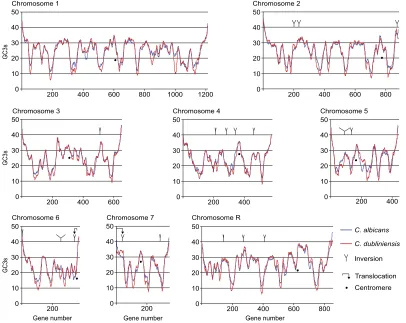
FIG. 2.—Chromosomal GC3s profiles inCandida albicansandC. dubliniensis. Chromosomal rearrangements of five or more genes are indicated by ‘‘Y’’ for inversions and hooked arrows for translocations. Genes are shown in the order that they occur inC. albicans.Dots show the positions of centromeres inC. albicans(Sanyal et al. 2004).
Lloyd (1993)andBradnam et al. (1999), except that we did not weight genes by length. In general, the locations of peaks and troughs of GC3s in the four species coincide (fig. 1), so that, for example, the most GþC–rich region in each of the four genomes is on the right arm of chromo-some III. There are, however, chromo-some strikingly consistent dif-ferences among the species. Saccharomyces bayanus has the highest GC3s values andS. mikataehas the lowest val-ues throughout the whole genome. The interspecies differ-ences are greatest in the areas around GC3s peaks, whereas in the troughs, all species have more similar GC3s values. When the GC3s values for individual genes are compared betweenS. bayanusandS. cerevisiae, the values are seen to be highly correlated (r 5 0.86), but the slope of the best-fit line is significantly different from 1 (table 1; supple-mentary fig. S1,Supplementary Materialonline). A slope dif-ferent from 1 indicates that the difference in base composition between the species is not uniform across all genes but instead varies systematically, with greater diver-gence in GC-rich genes than in GC-poor genes. The most GC-rich genes in S. bayanus have GC3s of about 90%, whereas their S. cerevisiae orthologs have GC3s of only about 67% (supplementary fig. S1,Supplementary Material
online). Similarly, the slopes of the best-fit regression lines for all other pairs ofSaccharomycesspecies are significantly different from 1 (table 1), indicating systematic and statis-tically significant patterns of divergence.
The patterns of variation of GC3s inCandidaspecies have not been examined before. We used the same sliding-window approach and found that although theC. albicans genome is overall more GC poor than theS. cerevisiae ge-nome (median GC3s values 26% and 36%, respectively), theC. albicansgenome contains a similar pattern of alter-nating regions with different GC3s contents (fig. 2). The troughs in this species reach 11% GC3s, whereas the ‘‘GC-rich’’ peaks are generally only about 35% GC3s, except near the telomeres where GC3s reaches 40–45%. The
ele-vation of GC3s near the telomeres is not restricted to sub-telomeric gene families (which are less extensive than inS. cerevisiae;van het Hoog et al. 2007) but extends well into chromosomal regions that contain single-copy genes with conserved synteny in other Candidaspecies. For example, near the left end ofC. albicanschromosome 1, the first gene with GC3s,35% isorf19.6090which is 28 kb (16 anno-tated genes) away from the beginning of the chromosome sequence.
The extent of sequence divergence betweenC. albicans and C. dubliniensisis approximately the same as among the Saccharomyces species (Jackson et al. 2009). To compare their GC3s profiles, we sorted theC. dubliniensisgenes into the same chromosomal order as theirC. albicansorthologs and then applied a sliding window of 15 genes (fig. 2). The peaks and troughs in the twoCandidaspecies are at similar chromosomal locations, but the troughs in C. dubliniensis are even more GC poor (reaching a minimum of 6% GC3s).
Variation of GC3s among Species in the Candida
Clade
We examined the evolution of yeast G þC contents and isochore structures on a broader evolutionary scale using the genome sequences of nine species in the ‘‘Candida cla-de’’—the clade of species that translate the codon CTG as serine instead of leucine (Butler et al. 2009). The GC3s val-ues of these Candidaspecies vary quite widely. The most GC-poor species is C. tropicalis with a median GC3s of 22%, and the most GC rich isC. lusitaniaewith a median of 49% (fig. 3). Viewed from a phylogenetic perspective (Butler et al. 2009), species that are more closely related to each other tend to have more similar G þC contents. There is a GC-poor clade (C. tropicalis, C. albicans, and C. dubliniensis), an intermediate clade (C. parapsilosis and Lodderomyces elongisporus), and a GC-rich clade (C. lusitaniae,C. guilliermondii, andP. stipitis). Debaryomy-ces hansenii is the only exception to this trend: its GC3s
FIG. 3.—Distribution of GC3s values among nine species in theCandidaclade. A set of 3,687 orthologous genes was identified among all these species, and the values for each species were grouped into bins of 5% intervals. The phylogenetic tree on the right is modified fromButler et al. (2009) and is derived from 644 single-gene families.
values are intermediate but it clusters phylogenetically within the high-GC clade, which suggests thatD. hansenii may be declining in GþC content.
Species at the center of the distribution infigure 3, such asL. elongisporus, show a relatively low variance of GC3s values among genes. In contrast, the species at the extrem-ities show both a larger variance and a skewed distribution, with a long tail of GC3s-rich genes inC. lusitaniaeand long tails of GC3s-poor genes inC. tropicalisandC. dubliniensis. Sliding-window plots of GC3s content for individual Can-dida clade species are included in supplementary figure S2 (Supplementary Material online). The differences be-tween species in the amount of GC3s variance are illustrated by comparison of the plot forL. elongisporus, which is al-most flat, to that for C. tropicalis, which contains deep troughs (supplementary fig. S2I and J, Supplementary Material online). We do not know the Gþ C content of the common ancestor of theCandidaclade, but it is clear that the GþC content of at least someCandidalineages must have changed extensively in the time since this ances-tor existed and that the GþC contents of groups of neigh-boring genes on the chromosome tend to change in concert.
GC-Poor Troughs and Centromere Locations
The chromosomal GC3s profiles of some of the more GC-richCandidaclade species are very distinctive. The pattern on the larger chromosomes ofC. lusitaniaeis particularly in-teresting (fig. 4). GC3s is relatively low at the telomeres (;45%), increases gradually toward the center of the chro-mosomes reaching peaks of;70%, and then plunges to a narrow trough of;40%. All eight chromosomes in this
species show similar patterns, with one obvious GC-poor trough on each chromosome, but for some chromosomes, the trough is close to one end (chromosomes 2, 4, and 8) and the corresponding telomeric region is not as GC poor as on other chromosomes.Pichia stipitisshows a similar pat-tern of one deep GC-poor trough per chromosome (fig. 5), but this species does not show the same pattern of elevated GþC content on each side of the trough that was seen inC. lusitaniae.
Because there is one striking trough per chromosome in bothC. lusitaniaeandP. stipitis, we hypothesized that these troughs might mark the locations of centromeres. The cen-tromere is the only known genomic feature that occurs ex-actly once per chromosome, so there are no other obvious candidate causes of the troughs. Our approach uses a sliding window (to reduce sampling error), so each trough in C. lusitaniaeandP. stipitiscannot be mapped directly to a sin-gle specific intergenic region but instead to a window of 15 consecutive genes. However, for every trough, we were able to identify one unusually large intergenic region within the window with the lowest GC3s, and we propose these as candidate centromere locations (table 2). Centromere loca-tions have not been determined experimentally in any spe-cies of theCandida clade (fig. 3) except C. albicans and C. dubliniensis (Sanyal et al. 2004; Padmanabhan et al. 2008). Even though the centromeres in C. albicans and C. dubliniensis are not located in GC-poor troughs (fig. 2), we nevertheless suggest that the centromeres of C. lusitaniaeandP. stipitishave been subject to a mutational process that has formed the troughs by making the DNA in the region around the centromere become GC poor (see Discussion).
Chromosome 1 Chromosome 2 Chromosome 3
Chromosome 4 Chromosome 5 Chromosome 6 Chromosome 7 Chromosome 8
30 40 50 60 70 80
200 400 600 800 30
40 50 60 70 80
30 40 50 60 70 80
30 40 50 60 70 80
30 40 50 60 70 80
30 40 50 60 70 80
30 40 50 60 70 80
200 400 600 800 200 400 600
200 400 600 200 400 200 200 30 200
40 50 60 70 80
GC3s
GC3s
Gene number Gene number Gene number Gene number Gene number
Candida lusitaniae
FIG. 4.—GC3s profiles ofCandida lusitaniaechromosomes.
[image:6.595.65.531.95.321.2]Analysis of theY. lipolyticagenome provides support for the hypothesis that GC3s-poor troughs can, for some spe-cies, indicate centromere locations.Yarrowia lipolyticais an outgroup to both theCandidaandSaccharomyces clades (Dujon et al. 2004; Butler et al. 2009) and is one of the few yeast species in which centromeres have been identified experimentally (Vernis et al. 1997,2001). We find that the GC3s profiles ofY. lipolyticachromosomes each contain one distinct GC-poor trough and that these coincide with the locations of the five experimentally determined centromeres on chromosomes A–E (fig. 6). Chromosome F is the only Y. lipolytica chromosome for which no centromere was
cloned (Vernis et al. 2001). A centromere location for chro-mosome F was predicted bioinformatically when the genome was sequenced (Dujon et al. 2004), but this prediction does not coincide with the location of the GC-poor trough. We suggest that the location predicted by Dujon et al. (2004)
is incorrect and that the centromere of chromosome F lies at the bottom of the adjacent trough (fig. 6).
Retroelements and Centromere Locations
InP. stipitis,Jeffries et al. (2007)noted that all the copies of the Ty5-like retrotransposon Tps5 occurred in clusters and 60
50
40
30
200 400 600 800 1000 Chromosome 1
200 400 600 800 60
50
40
30
Chromosome 2 Chromosome 3
200 400 60
50
40
30
Chromosome 4 60
50
40
30
200 400 200 400 60
50
40
30
Chromosome 5
GC3s
GC3s
Chromosome 6 60
50
40
30
200 400
Chromosome 7
200 60
50
40
30
Chromosome 8 60
50
40
30
200 Gene number Gene number Gene number Gene number Gene number
Retrotransposon Tps5 cluster
Pichia stipitis
[image:7.595.92.502.89.270.2]FIG. 5.—GC3s profiles ofPichia stipitischromosomes. Vertical bars mark the positions of Tps5 retrotransposon clusters.
Table 2
Locations of GC-Poorest 15-Gene Windows inPichia stipitis and Candida lusitaniaeand Sizes of the Largest Intergenic Regions within Them
Chromosome
Windowa Longest intergenicb
GC3s (%) Start bpc End bpc Nadird From To Length
P. stipitischromosome 1 35.4 2,230,753 2,332,231 PICST_53251 PICST_28862 PICST_53466 14,594 P. stipitischromosome 2 35.4 1,661,496 1,736,483 PICST_30000 PICST_70083 PICST_41273 38,214 P. stipitischromosome 3 34.9 1,399,674 1,477,779 PICST_35641 PICST_30981 PICST_30986 24,208 P. stipitischromosome 4 37.3 1,011,423 1,076,401 PICST_58121 PICST_58121 PICST_31542 26,877
P. stipitischromosome 5 33.4 624,197 682,494 PICST_46516 PICST_32086 PICST_46124 17,264
P. stipitischromosome 6 36.8 856,936 916,894 PICST_32891 PICST_78946 PICST_32901 30,150
P. stipitischromosome 7 36.9 235,679 324,031 PICST_33311 PICST_14352 PICST_73528 16,278
P. stipitischromosome 8 37.0 265,747 351,425 PICST_50504 PICST_91563 PICST_33721 36,077
C. lusitaniaechromosome 1 38.3 1,045,088 1,078,544 CLUG_00526 CLUG_00522 CLUG_00523 4,853 C. lusitaniaechromosome 2 40.5 1,791,934 1,818,051 CLUG_02107 CLUG_02104 CLUG_02105 3,283 C. lusitaniaechromosome 3 38.6 1,146,534 1,178,953 CLUG_02875 CLUG_02872 CLUG_02873 4,375
C. lusitaniaechromosome 4 39.9 121,683 157,316 CLUG_03260 CLUG_03262 CLUG_03263 4,681
C. lusitaniaechromosome 5 44.0 270,454 316,945 CLUG_04242 CLUG_04241 CLUG_04242 3,924
C. lusitaniaechromosome 6 41.3 260,220 298,959 CLUG_04968 CLUG_04966 CLUG_04967 4,919
C. lusitaniaechromosome 7 39.1 358,422 394,057 CLUG_05422 CLUG_05420 CLUG_05421 3,248
C. lusitaniaechromosome 8 38.2 147,355 176,623 CLUG_05668 CLUG_05669 CLUG_05670 5,773
aFifteen-gene window with the lowest average GC3s value on the chromosome. Only genes withC. albicansorthologs are considered in these columns. b
Longest intergenic region within the 15-gene window. All annotated genes are considered in these columns.
cBeginning and end coordinates of the genes at the ends of the window. dGene with the lowest individual GC3s value within the window.
[image:7.595.49.544.494.692.2]that there is one cluster on each chromosome. These clus-ters are easily visualized in dot matrix plots and typically con-tain a mixture of intact elements, truncated elements, and solo long terminal repeats (supplementary fig. S3A, Supple-mentary Materialonline). We find that the GC-poor troughs in P. stipitis coincide with these retrotransposon clusters (fig. 5). The open reading frames within the Tps5 elements are not the cause of the GC-poor troughs that we observe because our GC3s analysis ignored all retroelements. Several subfamilies of Tps5 elements exist, but they are all structur-ally most similar to Tdh5 of D. hansenii and Tca5 of C. albicans(Plant et al. 2000;Neuveglise et al. 2002). The Tdh5 elements ofD. hanseniialso form one cluster per chro-mosome (supplementary fig. S3B,Supplementary Material
online), so we suggest that these are possible centromere locations in that species. Comparing these Tdh5 clusters to the GC3s profile plots for D. hansenii (supplementary fig. S4,Supplementary Materialonline) shows that although all of them are located in or near local GC-poor troughs, the troughs do not stand out and are often not the deepest on their chromosome. In the more distantly related speciesC. albicans, there are only two copies of the Tca5 element in the sequenced genome (strain SC5314), and these are not close to the known locations of any of its eight centro-meres. Although we hypothesize that the Tps5/Tdh5 clus-ters in P. stipitis and D. hansenii are associated with centromeres, we do not suggest that the retrotransposon sequence itself has any role in centromere function. Rather, we suggest that the association is caused by preferential in-tegration of retrotransposons into centromeric chromatin in P. stipitisandD. hanseniiand that this association is a recent one, as it only occurs in these two closely related species.
Using the Candida Gene Order Browser (Fitzpatrick et al. 2010), we found that there is partial conservation of
syn-teny, both among some of the centromere locations we pro-posed in P. stipitis, D. hansenii, and C. lusitaniae and between these putative centromeres and some of the known centromeres of C. albicans and C. dubliniensis. For example, nine genes near the known centromere of C. albicanschromosome 5 have orthologs in the GC-poorest window onP. stipitischromosome 5, and this window also contains a Tps5 cluster (fig. 7). Four of these genes also have orthologs in the GC-poorest window onC. lusitaniae chro-mosome 3, and four other genes nearC. albicans CEN5have orthologs located close to the Tdh5 cluster onD. hansenii chromosome D. Gene order conservation in these regions is not perfect, but it is known that small inversions fre-quently scramble the local gene order inCandidaspecies (Seoighe et al. 2000). In total, we found synteny relation-ships involving 4 of the 8C. albicans/C. dubliniensis centro-meres, providing connections to GC-poor troughs or retrotransposon clusters on 4 P. stipitis chromosomes, 2 D. hanseniichromosomes, and 2C. lusitaniaechromosomes (fig. 7andsupplementary fig. S5,Supplementary Material
online). These observations provide support for the hypoth-esis that the GC-poor troughs mark centromeres in some species. However, these four examples were the only ones we could find; the other troughs inP. stipitisandC. lusitaniae are not in regions of gene order conservation between these two species or withC. albicans/C. dubliniensiscentromeres. We also examined the pattern of variation of intergenic G þ C content (supplementary fig. S6, Supplementary Material online), as opposed to GC3s in genes. In both C. lusitaniaeandP. stipitis, intergenic GþC varies within a much smaller range (approximately 36–44% GþC) than was seen in GC3s. A sliding-window approach shows that in C. lusitaniae, the putative centromeres (longest intergenic regions in table 2) are located within local troughs of Chromosome A
200 400 600 40
50 60 70
80 Chromosome B Chromosome C Chromosome D
Chromosome E Chromosome F 200 400 600 800
40 50 60 70 80
40 50 60 70 80
40 50 60 70 80 40 50 60 70 80
40 50 60 70 80
200 400 600 800 200 400 600 800 1000
200 400 600 800 1000 1200 1400 200 400 600 800 1000 1200
known centromere
proposed centromere (Dujon et al 2004)
GC3s
GC3s
Gene number Gene number
proposed centromere (this study)
Yarrowia lipolytica
FIG. 6.—GC3s profiles ofYarrowia lipolyticachromosomes. Dots mark the positions of the known centromeres on chromosomes A–E (Vernis et al.
2001). On chromosome F, the arrow marks the centromere position proposed byDujon et al. (2004), and the circle marks the location suggested by our analysis (near gene YALI0F14619g).
GþC–poor intergenic regions, but these troughs are much less dramatic than those seen for GC3s. The putative cen-tromeres of C. lusitaniae are also located in some of the most GþC–poor intergenic spacers in its genome ( supple-mentary fig. S6E, Supplementary Material online). Pichia stipitisdoes not show the same trend, but the GþC content of its putatively centromeric intergenic regions is affected by the presence of the Tps5 arrays.
Discussion
Our results for the Saccharomyces species and for C. albicans versusC. dubliniensisreveal two main attrib-utes of G þ C content evolution among closely related yeast species. First, the pattern of variation along the chro-mosome is conserved. The locations of peaks and troughs among these species tend to coincide, even though large numbers of nucleotide substitutions have occurred at syn-onymous codon sites. This observation could be consistent with a model in which recombination determines the local GþC content via biased gene conversion (Birdsell 2002;
Duret and Galtier 2009) but only if the locations of recom-bination hot spots are conserved on orthologous chromo-somes among the species. Recent analysis of one chromosome shows that recombination hot spots are con-served betweenS. cerevisiaeandS. paradoxus(Tsai et al. 2010), which suggests that they may be conserved on all chromosomes among allSaccharomycesspecies. The
con-servation of recombination profiles is surprising (Tsai et al. 2010), as recombination hot spot locations are not even conserved between human and chimpanzee, two mam-mals that diverged much more recently than the Saccha-romycesspecies (Ptak et al. 2005;Winckler et al. 2005) and which probably have identical GC3s profiles because they are colinear and only 1% divergent in sequence (Chimpanzee Sequencing and Analysis Consortium 2005;Elhaik et al. 2009).
Second, even within this framework of conserved peak and trough locations, the actual GC3s values of orthologous genomic regions can shift significantly and systematically between species (figs. 1and2). The shifts cause an orches-trated change in GC3s values, so that the GC richness or poorness of each gene relative to other genes is largely un-changed. We think that the most probable cause for these shifts is factors that can change the overall recombination rate (per year) in a species, affecting all hot spots and cold spots uniformly. Such factors could include, but are not lim-ited to, changes in the sequences of proteins involved in re-combination (directly altering the rere-combination rate) or the mismatch repair system (affecting the gene conversion bias parameter b;Duret and Galtier 2009) and changes in the effective population size, which will affect the rate of fixa-tion of nucleotide substitufixa-tions. The frequency of meiotic recombination in particular is likely to be highly variable among species in theCandidaclade because some species (C. lusitaniae, P. stipitis, and D. hansenii) have complete
2 1 P S H 6 1 2 4. 9 1f r o 3 6 1 3. 9 1f r o 6 6 1 3. 9 1f r o 7 6 1 3. 9 1f r o 8 N P R 9 6 1 3. 9 1f r o 0 5 9 1 5 _ 6 3 d C 0 2 9 1 5 _ 6 3 d C 0 1 9 1 5 _ 6 3 d C 0 0 9 1 5 _ 6 3 d C 0 9 8 1 5 _ 6 3 d C 0 8 8 1 5 _ 6 3 d C 0 7 8 1 5 _ 6 3 d C 3 7 8 2 0 G U L C 2 7 8 2 0 G U L C 1 6 1 3. 9 1f r o 0 2 2 4. 9 1f r o 7 1 2 4. 9 1f r o 7 XI R 4 C R O 0 4 9 1 5 _ 6 3 d C 0 3 9 1 5 _ 6 3 d C 0 6 9 1 5 _ 6 3 d C 0 7 9 1 5 _ 6 3 d C 7 0 8 6 4 T S CI P 1 8 0 2 3 T S CI P 2 8 0 2 3 T S CI P 1 6 9 6 4 T S CI P 1 3 5 7 4 T S CI P 1 6 7 3 8 T S CI P 6 1 5 6 4 T S CI P 3 8 0 2 3 T S CI P 5 8 0 2 3 T S CI P 4 2 1 6 4 T S CI P 8 5 9 9 5 T S CI P 4 7 8 2 0 G U L C 5 7 8 2 0 G U L C 1 7 8 2 0 G U L C 0 7 8 2 0 G U L C 9 6 8 2 0 G U L C 8 6 8 2 0 G U L C 0 7 1 3. 9 1f r o 0 6 8 1 5 _ 6 3 d C 5 7 0 2 3 T S CI P 7 7 8 2 0 G U L C 6 7 8 2 0 G U L C
Tps5 Tps5 Tps5
7 6 8 2 0 G U L C 6 6 8 2 0 G U L C 4 kb intergenic CEN CEN 17 kb intergenic chr. 5 C. albicans chr. 5 C. dubliniensis 6 5 5 6 0 D 2 a h e D 8 7 5 6 0 D 2 a h e D 0 0 6 6 0 D 2 a h e D 2 2 6 6 0 D 2 a h e D 4 4 6 6 0 D 2 a h e D 6 6 6 6 0 D 2 a h e D 8 8 6 6 0 D 2 a h e D 4 3 5 6 0 D 2 a h e D 0 7 2 6 0 D 2 a h e D 11 genes 6 1 1 6 0 D 2 a h e D 0 3 8 5 0 D 2 a h e D 5 genes 0 2 7 5 0 D 2 a h e D 4 genes chr. 5 P. stipitis chr. 3 C. lusitaniae chr. D D. hansenii Tdh5
Tdh5 Tdh5 Tdh5
18 kb intergenic
Tdh5
FIG. 7.—Partial synteny conservation betweenCEN5 of Candida albicans andC. dubliniensis and proposed centromeres in Pichia stipitis, C. lusitaniae, andDebaryomyces hansenii.Vertical lines indicate orthologous genes. Gray ovals show the GC-poorest 15-gene window inP. stipitis, D. hansenii, andC. lusitaniaei, and the name of the gene with the lowest individual GC3s value in this window is surrounded by a bold box (some genes at the ends of windows are not shown).
sexual cycles and others (C. albicans) have no known mech-anism of meiosis (Tzung et al. 2001; Forche et al. 2008;
Butler et al. 2009;Reedy et al. 2009). However, Spo11-de-pendent recombination in a parasexual cycle has been ob-served inC. albicans(Forche et al. 2008), and even if it has no true meiosis, it could also experience gBGC during mi-totic recombination.
We found one deep GC-poor trough per chromosome in three species (C. lusitaniae,P. stipitis, andY. lipolytica) and propose that they mark the locations of centromeres. This proposal is based on four arguments: 1) colocalization with five experimentally determined centromeres inY. lipolytica; 2) partial synteny conservation with known centromeres of C. albicans/C. dubliniensis; 3) colocalization of the GC-poor troughs with clusters of retroelements inP. stipitis, consid-ering that retroelements cluster near centromeres in many eukaryotes (e.g.,Paterson et al. 2009); and 4) the simple fact that no genetic element other than the centromere is known to occur in precisely one copy per chromosome. We also identified putative centromere locations in D. hanseniibased on the presence of one Tdh5 retroelement cluster per chromosome. In other yeast species, transpos-able elements are known to have preferences for integrating into particular regions of the genome (Voytas and Boeke 2002). To our knowledge, transposable elements with a preference for integration at centromeres have not been described previously in ascomycete yeasts, although they are known in some filamentous ascomycetes (Cambareri et al. 1998;Galagan and Selker 2004).
What mechanism could form GC-poor troughs around centromeres? Meiotic recombination is known to be sup-pressed near centromeres across a wide variety of eukar-yotes that have been examined (Choo 1998), includingS. cerevisiae (Lambie and Roeder 1986; Mancera et al. 2008). The molecular mechanism by which this effect occurs remains unknown. The gBGC model proposes that local G þC content is determined by the local recombination rate, so it predicts that GþC content should be low near centromeres.
There are two very different types of centromere struc-tures among the yeasts studied here (Ishii 2009):S. cerevi-siaeand other species in theSaccharomyces/Kluyveromyces clade have ‘‘point’’ centromeres (Hieter et al. 1985; Heus et al. 1993; Kitada et al. 1997; Pribylova et al. 2007), whereasC. albicans,C. dubliniensis, andY. lipolyticahave ‘‘regional’’ centromeres (Vernis et al. 2001; Sanyal et al. 2004;Padmanabhan et al. 2008). Point centromeres are ge-netically determined (their DNA sequence is necessary and sufficient for their function), whereas regional centromeres are epigenetically determined (Ketel et al. 2009;Malik and Henikoff 2009). Point centromeres are small (,200 bp) and have a strongly conserved consensus sequence near which a single Cse4-containing nucleosome binds, whereas re-gional centromeres lack a consensus and bind several
Cse4 nucleosomes over a region of up to 5 kb (Padmanabhan et al. 2008;Malik and Henikoff 2009).
The species in which we observe deep GC-poor troughs are all expected (from their phylogenetic position) to have regional centromeres, but the troughs are much larger than the expected size of the centromeres themselves. For exam-ple, the two peaks flanking the trough onC. lusitaniae chro-mosome 3 (fig. 4) are 132 kb apart, and there are 75 annotated genes between them. Even the region in which GC3s is,50% is 36–48 kb long on eachC. lusitaniae chro-mosome (supplementary table S2,Supplementary Material
online). Similarly, the peaks flanking the trough onP. stipitis chromosome 7 (fig. 5) are 244 kb apart, and onY. lipolytica chromosome D (fig. 6), the distance is 301 kb. In S. cerevisiae, the zone of recombination suppression around each centromere is only about 10 kb (average value from
supplementary table 1, Supplementary Materialonline, of
Mancera et al. 2008). Our results can therefore be inter-preted from either of two viewpoints. One is that the troughs are caused by reduction of gBGC at centromeres, in which case recombination around the centromere must be suppressed over a much larger area inC. lusitaniae, P. stipitis, andY. lipolyticathan inS. cerevisiae. Under this interpretation,figure 4also suggests that there is a gradient of recombination rates along each chromosome arm in C. lusitaniae.The alternative view is that GC-poor troughs inC. lusitaniae, P. stipitis, and Y. lipolytica are simply too large to have been caused by recombination suppression and gBGC and so must have a different, unidentified, cause. Why do all yeast species not show GC-poor troughs around centromeres? In fact, reexamination of chromo-somal GC3s for other sequenced Saccharomycotina species with point centromeres (which can be identified bioinfor-matically;Dujon et al. 2004;Souciet et al. 2009) shows that virtually all the point centromeres lie in locally GC-poor re-gions. This property was not noticed before because for many species with point centromeres, the trough is not the lowest one on the chromosome. The data forS. cerevi-siaeare shown infigure 1and for other point centromere species (C. glabrata, Z. rouxii, E. gossypii, K. lactis, Lachancea thermotolerans, andL. kluyveri) in supplemen-tary fig. S2 (Supplementary Material online). Therefore, C. albicansand its close relativeC. dubliniensis stand out as unusual, among the species whose centromeres are map-ped, because their centromeres are not in local GC-poor troughs (fig. 2), but these are also the two most GC-poor species in our whole study.
It is also interesting to note that there may be a correlation between the presence of deep centromeric GC3s troughs and the absence of one of the two possible pathways for meiotic recombination, theMSH4/MSH5pathway (Richard et al. 2005; Butler et al. 2009;Reedy et al. 2009). Msh4/ Msh5-dependent recombination inS. cerevisiae is subject to crossover interference, and deleting the genes reduces
crossing over by 2- to 3-fold (Ross-Macdonald and Roeder 1994;Hollingsworth et al. 1995). If we use a 10% GþC content difference between peak and trough as a rule of thumb to define ‘‘deep’’ troughs, then we find that all the species with deep troughs at their centromeres lack MSH4andMSH5, both among the regional centromere spe-cies (Y. lipolytica,C. lusitaniae, andP. stipitis) and among the point centromere species (E. gossypiiandL. thermotolerans), whereas most species in which centromeric troughs are weaker (such asK. lactis) or absent (such asC. albicans) re-tain these two genes. The only exceptions to this correlation among the species we studied areC. guilliermondiiandD. hansenii, which lackMSH4/MSH5 but do not show deep troughs at centromeres (centromeres are not mapped exper-imentally in either of these species, but neither of them shows deep troughs anywhere in its genome; supplemen-tary fig. S2K,Supplementary Materialonline).
As the link between GC3s troughs and centromeres has only been validated experimentally inY. lipolytica, it would be of interest to test the centromere locations we have pro-posed for other species. We are currently carrying out val-idation experiments for the centromeres ofC. lusitaniae. It would also be of interest to investigate whether a depression of GC content around the centromere occurs in other tax-onomic groups such as animals and to examine the proper-ties of holocentric organisms.
Supplementary Material
Supplementary tables S1 and S2 and figures S1–S6
are available at Genome Biology and Evolution online (http://www.oxfordjournals.org/our_journals/gbe/).
Acknowledgments
This study was supported by Science Foundation Ireland and Irish Research Council for Science, Engineering and Technol-ogy. We thank David Fitzpatrick for constructing the phylo-genetic tree infigure 3.
Literature Cited
Bernardi G, et al. 1985. The mosaic genome of warm-blooded vertebrates. Science 228:953–958.
Birdsell JA. 2002. Integrating genomics, bioinformatics, and classical genetics to study the effects of recombination on genome evolution. Mol Biol Evol. 19:1181–1197.
Bradnam KR, Seoighe C, Sharp PM, Wolfe KH. 1999. GþC content variation along and amongSaccharomyces cerevisiaechromosomes. Mol Biol Evol. 16:666–675.
Butler G, et al. 2009. Evolution of pathogenicity and sexual reproduction in eightCandidagenomes. Nature 459:657–662.
Cambareri EB, Aisner R, Carbon J. 1998. Structure of the chromosome VII centromere region inNeurospora crassa: degenerate transposons and simple repeats. Mol Cell Biol. 18:5465–5477.
Chimpanzee Sequencing and Analysis Consortium. 2005. Initial sequence of the chimpanzee genome and comparison with the human genome. Nature 437:69–87.
Choo KHA. 1998. Why is the centromere so cold? Genome Res. 8:81–82. Cliften PF, et al. 2001. SurveyingSaccharomycesgenomes to identify functional elements by comparative DNA sequence analysis. Genome Res. 11:1175–1186.
Dietrich FS, et al. 2004. The Ashbya gossypiigenome as a tool for mapping the ancient Saccharomyces cerevisiaegenome. Science 304:304–307.
Dujon B. 1996. The yeast genome project: what did we learn? Trends Genet. 12:263–270.
Dujon B. 2006. Yeasts illustrate the molecular mechanisms of eukaryotic genome evolution. Trends Genet. 22:375–387.
Dujon B, et al. 2004. Genome evolution in yeasts. Nature 430:35–44. Duret L, Eyre-Walker A, Galtier N. 2006. A new perspective on isochore
evolution. Gene 385:71–74.
Duret L, Galtier N. 2009. Biased gene conversion and the evolution of mammalian genomic landscapes. Annu Rev Genomics Hum Genet. 10:285–311.
Elhaik E, Landan G, Graur D. 2009. Can GC content at third-codon positions be used as a proxy for isochore composition? Mol Biol Evol. 26:1829–1833.
Eyre-Walker A, Hurst LD. 2001. The evolution of isochores. Nat Rev Genet. 2:549–555.
Fischer G, James SA, Roberts IN, Oliver SG, Louis EJ. 2000. Chromosomal evolution inSaccharomyces. Nature 405:451–454. Fitzpatrick DA, O’Gaora P, Byrne KP, Butler G. 2010. Analysis of gene
evolution and metabolic pathways using theCandidaGene Order Browser. BMC Genomics. 11:290.
Forche A, et al. 2008. The parasexual cycle inCandida albicansprovides an alternative pathway to meiosis for the formation of recombinant strains. PLoS Biol. 6:e110.
Galagan JE, Selker EU. 2004. RIP: the evolutionary cost of genome defense. Trends Genet. 20:417–423.
Galtier N, Piganeau G, Mouchiroud D, Duret L. 2001. GC-content evolution in mammalian genomes: the biased gene conversion hypothesis. Genetics 159:907–911.
Gerton JL, et al. 2000. Global mapping of meiotic recombination hotspots and coldspots in the yeastSaccharomyces cerevisiae. Proc Natl Acad Sci U S A. 97:11383–11390.
Goffeau A, et al. 1996. Life with 6000 genes. Science 274:546, 563–567.
Heus JJ, Zonneveld BJ, Steensma HY, van den Berg JA. 1993. The consensus sequence of Kluyveromyces lactis centromeres shows homology to functional centromeric DNA from Saccharomyces cerevisiae. Mol Gen Genet. 236:355–362.
Hieter P, et al. 1985. Functional selection and analysis of yeast centromeric DNA. Cell 42:913–921.
Hollingsworth NM, Ponte L, Halsey C. 1995. MSH5, a novel MutS homolog, facilitates meiotic reciprocal recombination between homologs in Saccharomyces cerevisiae but not mismatch repair. Genes Dev. 9:1728–1739.
Huberman JA, Pridmore RD, Ja¨ger D, Zonneveld B, Philippsen P. 1986. Centromeric DNA from Saccharomyces uvarum is functional in Saccharomyces cerevisiae. Chromosoma 94:162–168.
Ishii K. 2009. Conservation and divergence of centromere specification in yeast. Curr Opin Microbiol. 12:616–622.
Jackson AP, et al. 2009. Comparative genomics of the fungal pathogens Candida dubliniensis and C. albicans. Genome Res. 19:2231–2244.
Jeffries TW, et al. 2007. Genome sequence of the lignocellulose-bioconverting and xylose-fermenting yeast Pichia stipitis. Nat Biotechnol. 25:319–326.
Kaback DB, Guacci V, Barber D, Mahon JW. 1992. Chromosome size-dependent control of meiotic recombination. Science 256:228–232. Kellis M, Patterson N, Endrizzi M, Birren B, Lander ES. 2003. Sequencing and comparison of yeast species to identify genes and regulatory elements. Nature 423:241–254.
Ketel C, et al. 2009. Neocentromeres form efficiently at multiple possible loci in Candida albicans. PLoS Genet. 5:e1000400. Kitada K, Yamaguchi E, Hamada K, Arisawa M. 1997. Structural analysis
of aCandida glabratacentromere and its functional homology to theSaccharomyces cerevisiaecentromere. Curr Genet. 31:122–127. Kurtzman CP. 2003. Phylogenetic circumscription ofSaccharomyces, Kluyveromycesand other members of the Saccharomycetaceae, and the proposal of the new genera Lachancea, Nakaseomyces, Naumovia, Vanderwaltozyma and Zygotorulaspora. FEMS Yeast Res. 4:233–245.
Kurtzman CP, Robnett CJ. 2003. Phylogenetic relationships among yeasts of the ’Saccharomycescomplex’ determined from multigene sequence analyses. FEMS Yeast Res. 3:417–432.
Lambie EJ, Roeder GS. 1986. Repression of meiotic crossing over by a centromere (CEN3) in Saccharomyces cerevisiae. Genetics 114:769–789.
Malik HS, Henikoff S. 2009. Major evolutionary transitions in centromere complexity. Cell 138:1067–1082.
Mancera E, Bourgon R, Brozzi A, Huber W, Steinmetz LM. 2008. High-resolution mapping of meiotic crossovers and non-crossovers in yeast. Nature 454:479–485.
Marais G. 2003. Biased gene conversion: implications for genome and sex evolution. Trends Genet. 19:330–338.
Marsolier-Kergoat MC, Yeramian E. 2009. GC content and recombina-tion: reassessing the causal effects for theSaccharomyces cerevisiae genome. Genetics 183:31–38.
Mouchiroud D, Gautier C, Bernardi G. 1988. The compositional distribution of coding sequences and DNA molecules in humans and murids. J Mol Evol. 27:311–320.
Neuveglise C, Feldmann H, Bon E, Gaillardin C, Casaregola S. 2002. Genomic evolution of the long terminal repeat retrotransposons in hemiascomycetous yeasts. Genome Res. 12:930–943.
Padmanabhan S, Thakur J, Siddharthan R, Sanyal K. 2008. Rapid evolution of Cse4p-rich centromeric DNA sequences in closely related pathogenic yeasts,Candida albicansand Candida dublin-iensis. Proc Natl Acad Sci U S A. 105:19797–19802.
Paterson AH, et al. 2009. The Sorghum bicolor genome and the diversification of grasses. Nature 457:551–556.
Payen C, et al. 2009. Unusual composition of a yeast chromosome arm is associated with its delayed replication. Genome Res. 19:1710–1721. Petes TD, Merker JD. 2002. Context dependence of meiotic re-combination hotspots in yeast: the relationship between recombi-nation activity of a reporter construct and base composition. Genetics 162:2049–2052.
Plant EP, Goodwin TJ, Poulter RT. 2000. Tca5, a Ty5-like retrotransposon fromCandida albicans. Yeast 16:1509–1518.
Pribylova L, Straub M-L, Sychrova H, de Montigny J. 2007. Character-isation ofZygosaccharomyces rouxiicentromeres and construction of firstZ. rouxiicentromeric vectors. Chromosome Res. 15:439–445. Ptak SE, et al. 2005. Fine-scale recombination patterns differ between
chimpanzees and humans. Nat Genet. 37:429–434.
Reedy JL, Floyd AM, Heitman J. 2009. Mechanistic plasticity of sexual reproduction and meiosis in the Candida pathogenic species complex. Curr Biol. 19:891–899.
Richard GF, Kerrest A, Lafontaine I, Dujon B. 2005. Comparative genomics of hemiascomycete yeasts: genes involved in DNA replication, repair, and recombination. Mol Biol Evol. 22: 1011–1023.
Ross-Macdonald P, Roeder GS. 1994. Mutation of a meiosis-specific MutS homolog decreases crossing over but not mismatch correc-tion. Cell 79:1069–1080.
Sanyal K, Baum M, Carbon J. 2004. Centromeric DNA sequences in the pathogenic yeastCandida albicansare all different and unique. Proc Natl Acad Sci U S A. 101:11374–11379.
Seoighe C, et al. 2000. Prevalence of small inversions in yeast gene order evolution. Proc Natl Acad Sci U S A. 97:14433–14437. Sharp PM, Lloyd AT. 1993. Regional base composition variation along
yeast chromosome III: evolution of chromosome primary structure. Nucleic Acids Res. 21:179–183.
Souciet JL, et al. 2009. Comparative genomics of protoploid Saccha-romycetaceae. Genome Res. 19:1696–1709.
Tsai IJ, Burt A, Koufopanou V. 2010. Conservation of recombination hotspots in yeast. Proc Natl Acad Sci U S A. 107:7847–7852. Tzung KW, et al. 2001. Genomic evidence for a complete sexual cycle in
Candida albicans. Proc Natl Acad Sci U S A. 98:3249–3253. van het Hoog M, et al. 2007. Assembly of theCandida albicansgenome
into sixteen supercontigs aligned on the eight chromosomes. Genome Biol. 8:R52.
Vernis L, et al. 1997. An origin of replication and a centromere are both needed to establish a replicative plasmid in the yeast Yarrowia lipolytica. Mol Cell Biol. 17:1995–2004.
Vernis L, et al. 2001. Only centromeres can supply the partition system required forARSfunction in the yeastYarrowia lipolytica. J Mol Biol. 305:203–217.
Voytas DF, Boeke JD. 2002. Ty1 and Ty5 ofSaccharomyces cerevisiae. In: NL Craig, R Craigie, M Gellert, and AM Lambowitz, editors. Mobile DNA II. Washington DC: ASM Press. p. 631–662.
Wang HC, Singer GA, Hickey DA. 2004. Mutational bias affects protein evolution in flowering plants. Mol Biol Evol. 21:90–96.
Winckler W, et al. 2005. Comparison of fine-scale recombination rates in humans and chimpanzees. Science 308:107–111.
Yamane S, H Karashima, H Matsuzaki, T Hatano, S Fukui. 1999. Isolation of centromeric DNA from Saccharomyces bayanus. J Gen Appl Microbiol. 45:89–92.
Associate editor:Dmitri Petrov