70C-044-03a Computers
Amdahl
580
Systems
MANAGEMENT SUMMARY
Since its initial introduction in November 1980, the
Amdahl 580 Series of large-scale processors has been
ex-panded to include a comprehensive line of plug-compatible
mainframes. Two recent additions to this product line, the
5867 dual processor and the 5868 multiprocessor, have
strengthened Amdahl's competitive position in the price/
performance race against IBM's latest 308X models.
Am-dahl's commitment to performance upgradability is further
demonstrated by the growth path which exists between the
new models and existing models of the 580 product line.
The 5840 and 5850 uniprocessors can be upgraded to the
5867 and 5868. The 5867 and 5868 can be upgraded,
respectively, to the 5870 dual processor and 5880
multipro-cessor. Depending upon the environment, the 5867 and
5868 processors offer 1.25 to 1.4 times more performance
than that of the most powerful 580 uniprocessor, the 5860.
A number of enhancements to current 580 Series models
have been made in an effort to provide the large-system
user with increased performance and larger configurations.
The uniprocessor models, the 5840 and 5850, now support
up to 64 megabytes of main storage while the high-end 5880
features up to 128 megabytes of main storage in
single-image mode or 64 megabytes of main storage on each
processor of the 5880 in partitioned mode. Also, the
maxi-mum number of channels on the 5880 has been expanded
to 48 I/O channels in single-image mode. In addition, new
shipments of the 5850 uniprocessor provide users with a
five to seven percent improvement in processor
performance.
1>
Amdahl Corporation's top of the line is its 580 Series of high-performance, plug-com-patible mainframes. All seven models in the series are fully compatible with comparable IBM hardware and software, and aim to offer improved price/performance over their IBM counterparts.
MODELS: 5840, 5850, 5860, 5867, 5868, 5870, and 5880.
CONFIGURATION: One (5840, 5850, 5860, and 5867) or two CPUs (5868, 5870, and 5880), 16 to 128 megabytes of memory, and 16 to 48 channels.
COMPETITION: IBM 308X, NAS AS/9000 Series.
PRICE: Base purchase prices are $2,000,000 (5840), $2,350,000 (5850), $2,600,000 (5860), $3,410,000 (5867), $4,070,000 (5868), $4,220,000 (5870), and $4,720,000 (5880).
CHARACTERISTICS
MANUFACTURER: Amdahl Corporation, 1250 East Ar-ques Avenue, Sunnyvale, California 94086. Telephone (408) 746-6000. In Canada: One First Canadian Place, Suite 3940, P.O. Box 123, Toronto, Ontario, M5X 184
Canada. Telephone (416) 862-7479. ~
The Amdahl Model 5860 is the most powerful uniprocessor that Amdahl has ever produced. This member of the Amdahl 580 family represents an evolutionary exten-sion to the product line and offers a compatible growth path for Amdahl 470 users. The 5860 has twice the processing power of Amdahl's 470V/8. Standard features on the 5860 include 16 I/O channels, 16MB of main storage, two 32K high-speed buffers, power distribu-tion unit, system console and air cooling.
70C-044-03b Computers
Amdahl 580 Systems
I>
PROCESSORS AND PERIPHERALSThe performance increases of the 580 are made possible
through improvements in system design, technology, and
packaging, according to Amdahl. The processor
incorpo-rates a five-phase pipeline design which reduces the
num-ber of machine cycles per instruction. This technique
produces a maximum execution rate of one instruction per
cycle. The 470 systems, for comparison, execute one
in-struction per two cycles. The processor cycle time in the
580 is 23
1/4nanoseconds. The memory cycle time is 280
nanoseconds. Data paths are 8 bytes wide, compared to 4
bytes in the 470, and the 580 uses a dual-bus structure to
interconnect all functional units. Two 32K high-speed
buff-ers (HSB), using the 470 "nonstore-through" technique,
permit data to be modified in the buffer rather than in main
storage. One HSB is used for rapid access to instructions
and the other HSB is for fast access to data-a method
Amdahl says reduces the interference between the
instruc-tion fetching and execuinstruc-tion activities.
The system's block multiplexer channels all support the
datastreaming feature, and can transmit data at up to six
megabytes per second. The initial Input/Output Processor
(lOP), with up to 15 block multiplexer channels, has a
maximum aggregate data rate of 50 megabytes per second.
Higher data rates can be obtained by adding a second lOP.
Up to 256 subchannels are available on every channel, and
subchannel queueing is provided as a standard feature. Up
to 4 byte multiplexer channels are offered in the 580
Console Complex, each having a data rate of 200K bytes
per second.
Extensive use of LSI technology and component packaging
contributes to the system's overall performance. The 580
systems, like the 470, are all air cooled. The LSI chips used
in the 580 have a higher density than those in the 470, but
generate less heat. High-speed 4K RAM modules are
used-for microcode control stores, registers, and HSBs. These
RAMs, plus the LSI chips, are intermixed on 14-layer
Multiple Chip Carriers (MCC) that can implement· an
entire system function. Up to 121 LSI chips and RAM
modules can be mounted on each MCC. Only eight MCCs
are needed for a basic 580, including five for the CPU, and
one each for the lOP, System Service Processor (SSP), and
Memory Bus Controller (MBC). A ninth MCC is required
when increasing the block multiplexer channels from 16 to
the maximum 48. Up to 13 MCCs can be accommodated in
the LSI "stack," a 5.6- cubic-foot enclosure with its two side
walls made up of printed circuit boards for interconnecting
the MCCs. The 580 employs a dual-bus design with
eight-byte data paths. The A-Bus carries data from the SSP, lOP,
and CPU to the MBC, which manages the system's
memo-ry
activities. The B-Bus returns data to these three
compo-nents from the MBC.
System compatibility is a key element of the Amdahl 580.
To provide increased flexibility in this important area, the
580 uses Distributed Microcode on its Instruction Unit
(I-Unit), Execution Unit (E-Unit), lOP, MBC, and the
SSP. Amdahl claims this approach results in shorter
con-trol paths and reduced contention. The microcode concon-trol
1:>
~ MODELS: Amdahl 5840 (single processor), 5850 (single processor), 5860 (single processor), 5867 (dual processor), 5868 (multiprocessor), 5870 (dual processor), 5880 (multiprocessor).
DATE ANNOUNCED: November 1980 (5860 and 5880); October 1981 (5870); September 1982 (5850); June 1983 (5840); March 1984 (5867 and 5868).
DATE OF FIRST DELIVERY: Model 5860, 3rd quarter 1982; Model 5850, 3rd quarter 1983; Model 5840, 4th quarter 1983; Model 5870, 2nd quarter 1984; Model 5867, 3rd quarter 1984; Model 5868, lst quarter 1985; Model 5880, lst quarter 1985.
DATA FORMATS
All data formats, instruction formats, and other architectur-al features completely follow IBM System/370 architecture. BASIC UNIT: 8-bit bytes. Each byte can represent 1 alpha-numeric character, 2 BCD digits, or 8 binary bits. Two consecutive bytes form a "half word" of 16 bits, while 4 consecutive bytes form a 32-bit "word."
FIXED-POINT OPERANDS: Can range from 1· to 16 bytes (1 to 31 digits plus sign) in decimal mode; 1 half word (16 bits) or 1 word (32 bits) in binary mode.
FLOATING-POINT OPERANDS: 1 word, consisting of 24-bit fraction and7-bit hexadecimal exponent, in "short" format; 2 words, consisting of 56-bit fraction and· 7-bit hexadecimal exponent, in "long" format; or 4 words in "extended precision" format.
INSTRUCTIONS: 2, 4, or 6 bytes in length, which usually specify 0, 1, or 2 memory addresses, respectively. INTERNAL CODE: EBCDIC (Extended Binary-Cod~
Decimal Interchange Code).
SYSTEM CONFIGURATION
The Amdahl 580 is built from several interrelated compo-nents. Each element is implemented in a Multiple Chip Carrier (MCC), which contains all logic and circuitry re-quired, in a compact package. All functions are housed within the 580 mainframe, and include the followblg: • Instruction Unit (I-Unit), which processes instructions
and controls the CPU
• Execution Unit (E-Unit), which performs the required computations
• Storage Unit (S-Unit), which manages the system's oper-and storage oper-and retrieval activities
• Instruction Buffer (I-Buffer), that provides high:-speed buffer storage for instruction streams
• Operand Buffer (O-Buffer), that provides similar storage capabilities for operand data
These components make up the Central Processor (CPU). Additional 580 elements include:
• Input/Output Processor (lOP), which manages I/O re-quests and provides up to 15 block multiplexer channels, and up to 4 byte multiplexer channels at 200K-bytes-per-second.
• Console Processor, which monitors CPU functions, pro-vides maintenance and diagnostic routines via the System
Support Processor ( S S P ) . · ~ © 1984 DATAPRO RESEARCH CORPORATION, DELRAN, NJ 08075 USA
REPRODUCTION PROHIBITED
70C-044-03c Computers
Amdahl 580 Systems
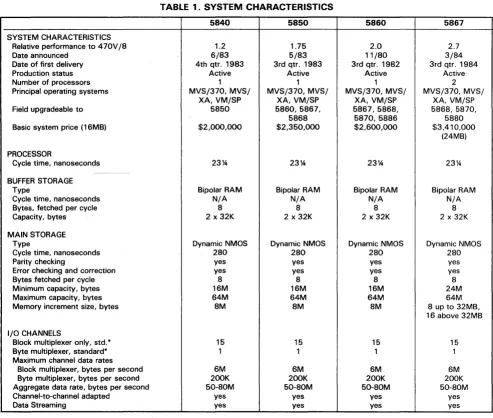
TABLE 1. SYSTEM CHARACTERISTICS
5840 5850 5860 5867
SYSTEM CHARACTERISTICS
Relative performance to 4 70V /8 1.2 1.75 2.0 2.7
Date announced 6/83 5/83 11/80 3/84
Date of first delivery 4th qtr. 1983 3rd qtr. 1983 3rd qtr. 1982 3rd qtr. 1984
Production status Active Active Active Active
Number of processors 1 1 1 2
Principal operating systems MVS/370, MVS/ MVS/370, MVS/ MVS/370, MVS/ MVS/370, MVS/
XA, VM/SP XA, VM/SP XA, VM/SP XA, VM/SP
Field upgradeable to 5850 5860,5867, 5867,5868, 5868,5870,
5868 5870,5886 5880
Basic system price (16MB) $2,000,000 $2,350,000 $2,600,000 $3,410,000
(24MB)
PROCESSOR
Cycle time, nanoseconds 23% 23% 23% 23%
BUFFER STORAGE
Type Bipolar RAM Bipolar RAM Bipolar RAM Bipolar RAM
Cycle time, nanoseconds N/A N/A N/A N/A
Bytes, fetched per cycle 8 8 8 8
Capacity, bytes 2 x 32K 2 x 32K 2 x 32K 2 x 32K
MAIN STORAGE
Type Dynamic NMOS Dynamic NMOS Dynamic NMOS Dynamic NMOS
Cycle time, nanoseconds 280 280 280 280
Parity checking yes yes yes yes
Error checking and correction yes yes yes yes
Bytes fetched per cycle 8 8 8 8
Minimum capacity, bytes 16M 16M 16M 24M
Maximum capacity, bytes 64M 64M 64M 64M
Memory increment size, bytes 8M 8M 8M 8 up to 32MB,
16 above 32MB
I/O CHANNELS
Block multiplexer only, std." 15 15 15 15
Byte multiplexer, standard" 1 1 1 1
Maximum channel data rates
Block multiplexer, bytes per second 6M 6M 6M 6M
Byte multiplexer, bytes per second 200K 200K 200K 200K
Aggregate data rate, bytes per second 50-80M 50-80M 50-80M 50-80M
Channel-to-channel adapted yes yes yes yes
Data Streaming yes yes yes yes
·Channels should total 16 in 5840, 5850, 5860, 5867, and 5870; 32 in 5868 and 5880.
t:>
store, typically centralized, is now distributed to the same MCC as the functional unit it controls. The performance of each functional unit can then be customized for optimum performance. Another factor, I/O protocol compatibility, is reduced to a single PCB, the Channel Interface Handler. Modifications to accommodate protocol changes are made simply by updating the Channel Interface Handler. A new hardware/firmware product called Macrocode will support the machine-check and channel-check capabilities of the 580. Amdahl indicated that Macrocode will play an impor-tant role in implementing future system compatibility tech-niques. Macrocode, along with hardware and microcode, will be used on the Amdahl 580 to implement System/370 Extended Architecture.System reliability, availability, and serviceability are per-formed via several methods: 1) advanced error-:-checking and correction (ECC) circuitry, such as main memory ECC, buffer ECC, bus parity checking, E-Unit parity and residue checking, and instruction retry; 2) history RAMs which record bus and microcode transactions on an audit trail; 3) diagnostic circuitry integral with each MCC; and 4) im-proved component packaging, particularly in the MCC.t>
~ • Memory Bus Controller (MBC), which controls data ac-cesses to the Main Storage Unit (MSU), data bus trans-fers, and provides overall system coordination and timing facilities
A second lOP can be configured giving the 580 a maximum of 31 block multiplexer channels per CPU.
The 580 comes in the 5840, 5850, and 5860, which are uniprocessors; the 5867 and 5870, a dual-processor arrange-ment; and the 5868 and 5880, a dual-CPU complex. The 5867 couples a 5850 CPU complex with a second 580 CPU; the 5870 couples a 5860 CPU complex. The 5868 is based on two tightly coupled 5850 CPU s while the 5880 is based on two tightly coupled 5860 CPUs. The 5840, 5850, 5860, 5867, and 5870 have a maximum of 64 megabytes of memo-ry. The 5868 and 5880 support up to 128 megabytes of main memory. The 5840 is rated at 1.2 times the performance of the Amdahl 470V /8, the 5850 is 1.5 times the 470V /8, the 5860 is rated at 2.0 times the performance of the 470V /8, the 5867 and 5868 are rated at 2.7 times the performance of the 470V /8, the 5870 reportedly has 70 percent more power than the 5860, and the 5880 is rated at 3.5 times the 470V /8.
TECHNOLOGY
As in the 470 series of processors, the 580 makes extensive use of large-scale integration (LSI) chips using high-perfor- ~
[image:3.613.61.554.77.495.2]---"
70C-044-03d Computers
Amdahl 580 Systems
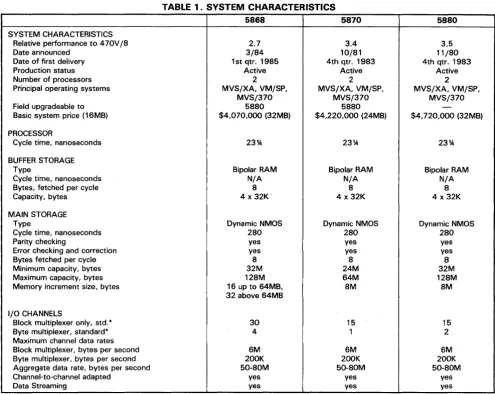
TABLE 1. SYSTEM CHARACTERISTICS
5868 5870 5880
SYSTEM CHARACTERISTICS
Relative performance to 4 70V /8 2.7 3.4 3.5
Date announced 3/84 10/81 11/80
Date of first delivery 1 st qtr. 1985 4th qtr. 1983 4th qtr. 1983
Production status Active Active Active
Number of processors 2 2 2
Principal operating systems MVS/XA, VM/SP, MVS/XA, VM/SP, MVS/XA, VM/SP,
MVS/370 MVS/370 MVS/370
Field upgradeable to 5880 5880
-Basic system price (16MB) $4,070,000 (32MB) $4,220,000 (24MB) $4,720,000 (32MB)
PROCESSOR
Cycle time, nanoseconds 23% 23% 23%
BUFFER STORAGE
Type Bipolar RAM Bipolar RAM Bipolar RAM
Cycle time, nanoseconds N/A N/A N/A
Bytes, fetched per cycle 8 8 8
Capacity, bytes 4 x 32K 4 x 32K 4 x 32K
MAIN STORAGE
Type Dynamic NMOS Dynamic NMOS Dynamic NMOS
Cycle time, nanoseconds 280 280 280
Parity checking yes yes yes
Error checking and correction yes yes yes
Bytes fetched per cycle 8 8 8
Minimum capacity, bytes 32M 24M 32M
Maximum capacity, bytes 128M 64M 128M
Memory increment size, bytes 16 up to 64MB, 8M 8M
32 above 64MB
I/O CHANNELS
Block multiplexer only, std.* 30 15 15
Byte multiplexer, standard* 4 1 2
Maximum channel data rates
Block multiplexer, bytes per second 6M 6M 6M
Byte multiplexer, bytes per second 200K 200K 200K
Aggregate data rate, bytes per second 50-80M 50-80M 50-80M
Channel-to-channel adapted yes yes yes
Data Streaming yes yes yes
·Channels should total 16 in 5840, 5850, 5860, 5867, and 5870; 32 in 5868 and 5880.
t:>
SOFTWARE AND SUPPORTThe 580 systems are completely compatible with IBM
Systemj370 operating systems; in particular MVSjSP
Re-leases 1 and 2, VMjSP ReRe-leases 1 and 2, as well as all
available Amdahl software products. Amdahl's Universal
Timesharing System (UTS), based on the UNIX operating
system developed by Bell Laboratories, is now available.
Amdahl has announced it will support IBM's MVSjSP
Version 2 and related data management facilities, also
known as the Systemj370 Extended Architecture, or MVSj
XA. In particular, the company said it will support the
31-bit addressing required in the new Extended Architecture
mode, not only in its 580 Series, but also in its 470V /7
Series and 470V /8 product lines. Releases 1 and 2 ofIBM's
VMjSP and VMjSP High Performance Option program
products will also be supported. Amdahl supports the new
3880 Storage Control Models 11 and 13.
Centralized system maintenance and troubleshooting are
provided by the 580 Console Complex. Console
mainte-nance features include 1) Scan-InjScan-Out to record and
t>
~ mance eniitter-coupled logic (ECL) circuitry. Up to 400 of these circuits can be contained on a single LSI chip, com-pared to only 100 circuits per chip on the 470. In spite of its obviously increased packing density, a 580 chip generates only slightly more heat than a 470 chip. The 580, like the 470, is air cooled.
A new high-speed 4K RAM module was developed by Amdahl to handle such functions as Distributed Microcode control storage, high-speed buffer (HSB) storage, and sys-tem registers.
Amdahl combines up to 121 RAM and logic chips on a Multiple Chip Carrier (MCC). This increased packing den-sity, with almost three times the number of chips per MCC as the 470, permits the implementation of an entire system function on a single MCC. Each system MCC is arranged in a small (only about 5.6 cubic feet) stack with a maximum of 13 MCCs possible. Each ofthe two stack side walls incorpo-rates a 12-layer printed circuit board for MCC-to-MCC interconnections. A minimum of 8 MCCs is required for a basic 580 system. Compared to the 470, with as many as 59 MCCs required, the 580 provides more internal data paths and increased reliability.
Combining all functional units together are two data buses, the A-Bus and B-Bus. Each bus moves unidirectionally, and has a 72-bit-wide data path. The two buses are integral ~
© 1984 DATAPRO RESEARCH CORPORATION, DELRAN, NJ 08075 USA REPRODUCTION PROHIBITED
[image:4.615.59.555.74.468.2]70C-044-03e Computers
Amdahl 580 Systems
1:>
recreate a particular condition; 2) isolation of faulty
com-ponents at the console; 3) execution of diagnostic routines
by the console; 4) error logging; 5) access to Hardware
History Tables to assist in fault analysis; 6) Dynamic Error
Analysis to analyze the error logs; and 7) dynamic
monitor-ing of selected I/O channels. In addition, the 580 can access
the Amdahl Diagnostic Assistance Center (AMDAC).
COMPETITIVE POSITION
The Amdahl 580 Series competes directly with IBM's 308X
line of large-scale mainframes. The timely introduction of
the new 580 models and the 580 Series enhancements
followed closely on the heels of IBM's own announcement
of six new processors: the 3083 Model groups EX, BX, and
JX; the 3081 Model groups
ax
and KX; and the 3084
Model group QX. According to IBM, the new models are
enhanced versions of the previous 308X models. In terms
of price/performance comparisons, the expanded 580
prod-uct line directly responds to IBM's recent revisions.
Specifi-cally, the improved 5860 competes with the new 3081
ax;
the new 5867 and 5868 oppose IBM's 3081KX; and the
5870 and 5880 compete with IBM's 3084QX. Unlike the
older IBM 308X models which cannot be field upgraded to
the newer models, the Amdahl models feature full
compati-bility and field upgradacompati-bility across the entire product line.
However, IBM has recently tried to appease users with the
older 308X models by offering an optional
performance-improvement feature that causes the older models to
per-form closer to the level of the new models.
Plug-compatible rival National Advanced Systems has also
reacted to the new IBM line with the addition of five new
models to its AS/80X3 family. Although the new NAS
product line does offer current users with a field-upgrading
capability across intermediate and large-scale processor
levels, the new models cannot surpass the expanded main
memory and channel configurations of the Amdahl
equipment.
ADVANTAGES AND RESTRICTIONS
The expansion of Amdahl's 580 Series enables this
plug-compatible manufacturer to retain a highly competitive
position in the price/performance race against IBM.
Amdahl has succeeded in diversifying its 580 product line
across uniprocessor, dual-processor, and multiprocessor
levels. The increase of main memory to 64 megabytes on all
580 models along with the anticipated availability for
128-megabyte main storage and 48 input/output channels on all
multiprocessor models provide a clear advantage in
pro-cessing power. In addition to the performance
improve-ments, Amdahl has reduced purchase prices on larger 580
models by 3 to 14 percent and reduced prices on selected
model upgrades. However, maintenance charges for
exist-ing models were not reduced.
Another major advantage of the Amdahl 580 Series is
complete compatibility with IBM 370 operating systems
and all available Amdahl software offerings. Amdahl's
support of both MVS/370 and MVS/XA is further
en-hanced by the 580 Conversion Assist Feature. This feature
t:>
~ parts of the stack side walls, and provide shorter data paths, simplified physical connections, and a reduction in the number of connections required among functional units. The A-Bus transports data from the· Console, I/O Processor (lOP), and CPU to the Memory Bus Controller (MBC). The B-Bus returns data to these units from the MBC.
CENTRAL PROCESSOR
Within the Amdahl 580 CPU, two instruction functions are continuously performed in parallel: Instruction Fetch (I-Fetch) and instruction execution.
The I-Fetch component provides a double word of instruc-tion flow and holds it in the Instrucinstruc-tion Word Buffer (IWB) in the I-Unit until needed for execution. With each cycle instructions are moved in and out of the IWB at the rate of one, two, or three halfwords of instruction data.
INSTRUCTION UNIT (I-Unit): The I-Unit controls in-struction execution and processes system interrupts. Specif-ic functions of the I-Unit include:
• Instruction fetching, decoding, and buffering • Determining effective operand addresses • Provide register access for operands
• Maintain overlapped pipeline processing technique via control of Storage Unit (S-Unit), Execution Unit (E-Unit), and I/O Processors (lOPs)
After an instruction is fetched, a five-phase pipeline opera-tion takes over. The pipeline concept, also used in the Amdahl 470, permits the I-Unit to have several instructions in various phases of execution simultaneously. With each processor cycle another instruction enters the pipeline from the IWB. The instruction preceding it moves into the next phase of execution. By the fifth processor cycle, at maximum execution rate, five instructions are in the pipeline simulta-neously, in different execution phases. Since instruction flow involves five basic steps, at the maximum execution rate the result is an effective rate of one instruction per machine cycle. For comparison, the 470 executes at a maximum rate of one instruction per two cycles. This increased execution rate permits the 580 to execute twice as fast as Amdahl's previous top-end system, the 470V /8.
Extensive parity checking is performed throughout the I-Unit. All incoming instructions are checked for parity, and the results are checked again after completion of execu-tion. All control registers and the program status word are checked each time they are used. In addition, parity is checked for the timer and the address generation function, and parity is also maintained for all program-referable data. The 580 I-Unit is compatible with the IBM System/370 Principles of Operation opcodes. These elements are imple-mented within the CPU by a mixture of hardware, micro-code, and a new class of firmware called Macrocode. Critical system functions are implemented in hardware for fastest execution, while other less critical functions can be imple-mented in microcode resident on the MCC used by the 1-Unit. Macrocode is planned for future system enhancements.
STORAGE UNIT (S-Unit): All I-Unit data requests are processed by the S-Unit. Virtual-to-absolute address trans-lations are performed in the S-Unit, which includes a Translation Lookaside Buffer (TLB) to facilitate rapid vir-tual-to-absolute translations. Data traffic between the CPU data buffers and main memory is controlled by the S-Unit. It also provides the bus interface between the CPU and the rest of the 580.
70C-044-03f Computers
Amdahl 580 Systems
1:>
makes possible the splitting of a 580 system into two logical
systems or environments to allow for the operation of
MVS/370 in one environment and MVS/XA in another.
Starting with July 1984 shipments, the additional purchase
of certain software products will no longer be required. At
this time, VM/Extended Channel Support, MVS/Extended
Channel Support, MVS/SP Assist, MVS/SE Assist, and
MVS/SE Support will be shipped as part of macrocode, an
innovative firmware facility. IBM's ACP (Airline Control
Program) is no longer being commercially offered.
Amdahl has postponed the initial release of the 5868, 5870,
and 5880 models. The vendor's cautious behavior is
proba-bly the result of manufacturing difficulties encountered
with early shipments of the 5860. Further delays could
jeopardize the solid position Amdahl has established for
itself in the PCM marketplace.
USER REACTION
Four Amdahl 580 users responded to Datapro's 1984
Com-puter Survey. One of the respondents had installed the
Model 5850 while the remaining three rated their 5860
installations. One system had been purchased, one was
leased from a third-party vendor, and two were leased
directly from the manufacturer. All four users indicated
that their systems had been installed during the third and
fourth quarters of 1983. One of the systems was used for
manufacturing, one for retail/wholesale, and two were
installed at government locations. The most common
ap-plications being processed included accounting/billing,
payroll/person-nel, and order processing/inventory with
ad-ditional emphasis on engineering/scientific, and
purchas-ing applications.
All four respondents reported that over 60 local and remote
terminals/workstations were installed. The majority of
sys-tems featured from 16 to less than 32 megabytes of main
memory and the most widely used operating system was
MVS. Every respondent was using both a Data Base
Man-agement System and a Communications Monitor. When
asked about plans concerning future acquisitions, the users
revealed intentions to expand present hardware and data
communications facilities along with additional software
from other suppliers. Furthermore, the respondents
en-dorsed the system with a recommendation for other users
and indicated that the system had fulfilled expectations.
As part of the survey, the users were asked to rate their
Amdahl equipment from excellent to poor. A weighted
average was then calculated based on the total number of
responses. A summary of these ratings is included in the
following table.
1:>
~ A double word of data is accessed each cycle by the S-Unit from its high-speed buffers (HSB). The four storage arrays in the S-Unit: the data array, the data select array, the tag array, and the TLB array, are accessed simultaneously during this activity. The data array has 512 thirty-two-byte lines organized within its primary and alternate partitions, and contains the actual data lines. The tag array mirrors the data array in organization, and contains TLB pointers that indicate the pages to which the data lines belong. The data select array facilitates the virtual address selection process. The TLB array contains the virtual-to-absolute address translations.
Since the 580 processes I-Fetch and execution functions separately, two high-speed buffers (HSB) for instructions and operands are provided. Both the Instruction Buffer (I-Buffer) and the Operand Buffer (O-Buffer) have 32K bytes of storage, are two-way, set-associative, and are orga-nized into primary and alternate partitions of 512 thirty-two-byte lines. If a line of requested data is not present within an HSB, the S-Unit sends a message to main memo-ry requesting the desired line.
The high-speed TLB has 512 entries organized into primary and alternate partitions of 256 translations to speed virtual to absolute address translations. Within each TLB entry is Segment Table Origin (STO) information which eliminates the need for a separate STO stack, as in the 470. Address translations conform to the Systemj370 structure. EXECUTION UNIT (E-Unit): The E-Unit executes the arithmetic and logical instructions contained in the 580's instruction set. Operands and opcodes are received fromj returned to either the O-Buffer or the I-Unit Register Facility as required by the specific instruction. Performance is enhanced within the instruction pipeline via concurrent activity on two separate instructions by the E-Unit Logic Unit and Checker (LUCK) and the various execution-cycle processes (multiply, add, shift, pack, and decimal correct). LUCK and execution phase operations require one proces-sor cycle. In addition, the 580 uses an 8-byte-wide data path, compared to a 4-byte path in the 470. Amdahl has optimized certain logic algorithms used with frequently executed in-structions to improve execution speeds.
ADDITIONAL PROCESSOR FEATURES: Other fea-tures of the Systemj370 found in the Amdahl 580 processors include control registers, direct addressing, double word buffer, machine check handling, multiple bus architecture, channel command retry, channel indirect addressing, byte-oriented operand feature, console audible alarm, remote console, remote data link, console file, extended control mode, and program event recording.
Machine check handling analyzes errors and attempts re-covery by retrying the failed instruction if possible. If retry is unsuccessful, it attempts to correct the malfunction or to isolate the affected task. Channels have the capability to perform channel command retry, a channel and control-unit procedure that causes a command to be retried without requiring an I/O interruption. Channel Indirect Addressing (CIA) is a companion feature to dynamic address transla-tion, providing data addresses for I/O operations. CIA permits a single channel command word to control the transmission of data that crosses noncontiguous pages in real main storage. If CIA is not indicated, then channel one-level (direct) addressing is employed. The byte-oriented operand feature permits storage operands of most
non-privileged operations to appear on any byte boundary. In- ~
© 1984 OAT APRO RESEARCH CORPORATION, DELRAN, NJ 08075 USA REPRODUCTION PROHIBITED
l>
70C-044-03g Computers
Amdahl 580 Systems
Excellent Good Fair Poor WA*
Ease of operation 2 2 0 0 3.50
Reliability of system 2 2 0 0 3.50
Reliability of peripherals 3 I 0 0 3.75 Maintenance service:
Responsiveness 3 1 0 0 3.75
Effectiveness 2 2 0 0 3.50
Technical support:
Trouble-shooting 0 4 0 0 3.00
Education I 3 0 0 3.25
Documentation 0 3 I 0 2.75
Manufacturer's software:
Operating system I 2 1 0 3.00
Compilers/Assemblers 1 2 0 0 3.33
Applications software 0 3 0 0 3.00
Ease of programming 0 2 1 0 2.66
Ease of conversion 0 3 0 0 3.00
Overall satisfaction 1 2 0 0 3.33
*Weighted Average based on a scale of 4.0 for Excellent. 0
structions must appear on even byte addresses. The console audible alarm is a device activated when predetermined events occur that require operator attention or intervention for system operation. Remote consoles are available in addition to the standard console. The remote data link allows establishment of communications with a technical data center to remotely diagnose system malfunctions. The console file is the basic microprogram loading device for the system, containing a read-only file device. The media read by this device contains all the microcode for field engineer-ing device diagnostics, basic system features, and any op-tional system features. The extended control mode (EC) is a mode in which all features of the System/370 computing system, including dynamic address translation, are opera-tional. Program event recording is a hardware feature used to assist in debugging programs by detecting and recording program events.
The optional Channel-to-Channel Adapt~r permits direct communications between an Amdahl 580 and an IBM Sys-tem/370, 303X, or 308X via a standard I/O channel. It can be attached to a block multiplexer channel and uses one control unit position on either channel. In an interconnection between an Amdahl 580 and an IBM processor, either system can be equipped with the Channel-to-Channel Adapter, and it is required on only one of the interconnected channels. Up to two CCAs can be implemented in a system. The Two-Byte Interface, with up to four available per lOP, doubles the bandwidth of the data path between the channel and the control units which support this option.
The 580/ Accelerator provides users of Amdahl's 5840 and 5850 with access to the power of a larger processor during periods of increased demand. Depending on the installed processor and desired performance level, the user can select one of three options: 5840 accelerated to 5850 level, 5850 accelerated to 5860 level, and 5840 accelerated to 5860 level. The 580/Conversion Feature assists users of systems con-verting from IBM MVS/370 to the MVS/XA operating environment. This feature combines 580 hardware circuitry with macrocode to split the 580 system into two logical systems with MVS/370 operating in one environment and MVS/XA operating in another.
The High-Speed Floating Point Feature is designed for use by large-system users with significant scientific processing needs. The feature provides additional computational capa-bilities that enables selected 580 processors (5860, 5870, and 5880) to make use of the floating-point instruction set.
OPERATIONAL MODE: Amdahl 580 operates in the Extended Control (EC) mode. In the EC mode, the Program Status Word (PSW) and the layout of the. permanently assigned lower main storage area are altered to support Dynamic Address Translation and other new system control functions; therefore, virtual-storage-oriented operating sys-tems must be used.
The 580 can also operate in the Extended Architecture (XA) mode. This capability supports 31-bit addressing, with real and virtual address sizes of2 billion bytes. Normal EC mode supports 24-bit addressing with a maximum of 16 million bytes of real and virtual address space per user program. The 580 will support bimodal operation, in which user programs with 24- and 31-bit addresses, can execute concur-rently, and a dynamic channel subsystem. Implementation of this capability will be available during the second quarter of 1984.
REGISTERS: Sixteen 32-bit general registers are used for indexing, base addressing, and as accumulators. Other pro-gram-visible registers are the same as in the System/370. Machine-dependent registers contained in the 580 proces-sors are not visible to the user and may differ from the System/370.
INSTRUCTION REPERTOIRE: The Amdahl 580 in-struction set consists of the complete System/370 Universal Instruction Set, including the five System/370 instructions for Dynamic Address Translation.
PHYSICAL SPECIFICATIONS: Environmental condi-tions for 580 processors are included in the following table.
Temperature Range U nderfloor Temperature Relative Humidity Range
( noncondensing) Maximum Wet Bulb
Temperature
Heat Output (BTUs/hr) Power Consumption Power Required
Mainframe dimensions (LxWxH) Mainframe weight
60° to 90° F (16° to 3r C) 50° to 66° F (10° to 19° C) 35% to 55%
51,500 22 to 27 KVA 208V, 415 Hz 208V, 60 Hz 230V, 50 Hz 380V, 50 Hz 415V, 50 Hz
Both 4-wire and three-phase 123"
x
36" x 70"(312 cm x 91 cm x 178 cm) 3600 lb.
(1630 kg) Minimum configuration 256" x 128"
room dimensions (L x W) (650 cm x 325 cm)
MAIN STORAGE
STORAGE TYPE: Dynamic NMOS; 16K chips. CYCLE TIME: 280 nanoseconds.
CAPACITY: 16 to 128 megabytes.
CHECKING: Error checking and correction (ECC) circuit-ry in main memocircuit-ry performs automatic correction of all single-bit errors and detection of all double-bit and most other multiple-bit memory errors.
STORAGE PROTECTION: Storage protection facilities are comparable to those implemented in the IBM
System/370. ~
70C-044-03h Computers
Amdahl 580 Systems
~ RESERVED STORAGE: The 580 processors reserve an area in lower memory for such purposes as interrupt han-dling routines, CPU ID, channel ID, and machine-check logouts.
The Amdahl 580 Main Storage Unit (MSU) uses four-way line interleaving and four-way quarterline (each quarterline is 8 bytes in length) multiplexing to provide up to 64 megabytes of storage. The data bus paths are 72 bits (double word) wide, and transfer 8-byte messages, plus,parity, be-tween the MSU and the Memory Bus Controller (MBC) every cycle. The most common data bus transactions are MSU data fetches, and the 580's bus system has been optimized to support this activity.
MEMORY BUS CONTROLLER (MBC): The primary data traffic manager within the 580 is the MBC. A key element in the instruction execution process of the 580, the MBC receives requests from the CPU, I/O Processor, or console over the A-Bus. The MBC includes the following components:
• Data Integrity Unit, which assures that copies of a cur-rently-accessed data line which also exist in other system elements, such as the MSU and the two HSBs, contain the same data
• Interrupt Router, which directs external system interrupts to the CPU
• Timer Complex, which provides System/370 timing facili-ties such as the time-of-day clock, clock comparator, CPU timer, and interval timer
• I/O Router, which translates logical channel addresses to real addresses, formats them for lOP or console action, and facilitates channel reconfiguration
• Main Storage Controller (MSC), which provides the cor-rect control signals for MSU memory requests, and gener-ates error checking and correction (ECC) codes. Once a request has entered the MSU from the MBC, the MSU accesses four quarter lines from one of the four inter-leaves present and latches them within the Main Storage Data-Out Register. The quarterlines (actually a 32-bit data line) are then routed over the B-Bus (move-in data path) to the appropriate component, such as the S-Unit, lOP, or console.
INPUT/OUTPUT CONTROL
The Amdahl 580 handles I/O activities with an Input/ Output Processor (lOP) and up to 15 block multiplexer channels as standard. A second lOP is optional per CPU, and can provide an additional 16 block multiplexer channels in increments of eight channels. Each channel has 256 subchannels and can accommodate data transfer speeds up to 6.0 megabytes per second. The maximum aggregate data rate for the initial lOP with 16 channels is approximately 50 megabytes per second. Utilizing the second lOP increases the aggregate rate to approximately 80 megabytes per second.
The lOP is based on three components: 1) the I/O Control-ler (IOC), 2) the Bus HandControl-ler, and 3) the 16 Interface Handlers associated with the channels. An lOP, which includes the 10C and Bus Handler, is implemented on a single MCC. The 10C and Bus Handler are shared by the 16 channels.
Data flowing in and out of the lOP moves over the 580's two buses. The Bus Handler is the interface to the A-Bus and B-Bus for the lOP, and provides data buffering when needed. The 10C provides the processing capabilities of the
lOP, and manages the Bus Handler and the 16 Interface Handlers. Normal data transfer activities, including channel bus and tag manipulation, and data buffering, are done by the Interface Handlers.
Data and commands are fetched directly from the Main Storage Unit, rather than from a shared HSB. This reduces contention between the I/O subsystem and the CPU. Subchannel Queuing, a n~w 580 feature, holds I/O activities that have been denied access to the system, typically a result of a busy device or channel. The held request is then released for processing once the desired device or channel frees up. The feature helps to reduce the CPU load. CONSOLE INPUT/OUTPUT
The command center of the 580 is the Console Complex, which provides an operator's console interface, and is the primary means of conducting both local and remote system diagnostics. The Console Complex and its associated com-ponents are implemented in microcode and contained in a single MCC.
The Console Complex includes the following:
• Microcoded System Support Processor with two mega-bytes of memory, capable of executing a subset of the Amdahl 580 instruction set
• An I/O channel, associated with one hard disk and two floppy disks
• Up to two local and two remote CRT/keyboard units, comparable to IBM 3277
• A system scanning facility
• Modem control facilities for access to Amdahl Diagnostic Assistance Center (AMDAC)
• A Bus Handler for attachment to the system's A-Bus and B-Bus.
PERIPHERAL EQUIPMENT
The Amdahl 580 systems can utilize all IBM System/370, 303X, and 308X input/output and mass storage devices, as well as their plug-compatible counterparts from independent vendors. Detailed coverage of many of these peripherals can be found in Volume 2 of DATAPRO 70.
COMMUNICATIONS CONTROL
Amdahl has two Communications Processors, the 4705 and the 4705E. The 4705 was announced in October 1980, and the 4705E in April 1983. Both models are program compati-ble with the IBM 3705-11. The 4705 has approximately 1.8 times the power of the 3705-11 and has 64K to 512K bytes of memory, in 64K-byte increments. The 4705E has approxi-mately 2.4 times the power of the 3705-11 and has 256K to 1M-byte of memory, in 256K-byte increments. Up to 352 communications lines can be connected, and the start/stop, BSC, and SDLC protocols are supported. The 4705 and 4705E models are compatible with IBM 3705 communica-tions software and access methods.
SYSTEM RELIABILITY
To ensure consistently high levels ofreliability, availability, and serviceability in the 580, Amdahl has incorporated a wide range offeatures utilizing the 580's design, technology,
and packaging. ~
© 1984 DATAPRO RESEARCH CORPORATION, DELRAN, NJ 08075 USA REPRODUCTION PROHIBITED
70C-044-03i Computers
Amdahl 580 Systems
~ • Sophisticated ECC circuitry, including Main Storage ECC, buffer ECC, parity checking in the buses and E-Unit, and instruction retry
• History RAMs that provide an audit trail of system activities
• Diagnostic circuitry contained within each MCC • Improved fault isolation from denser LSI design, which
can implement an entire system function on a single MCC • Improved reliability through fewer overall connections in
the LSI and MCC packaging
• RAMs and LSI circuitry packaged on the same MCC SERVICE AND SUPPORT
Amdahl's commitment to the efficient maintenance of the 580 is reflected both in the 580 itself and Amdahl's field-support organization.
The Console Complex is the hub of all diagnostic operations in the 580. Diagnostic functions in the System Support Processor are implemented in microcode for greater reliabil-ity, and include:
• Re-creation of a failed system condition through scan-in/ scan-out records
• Isolation of defective Field Replaceable Units (FRUs) with an internal console-generated program
• An enhanced Maintenance Analysis Language to permit scanning the system trouble log and execute diagnostic routines as needed
• Access to history logs to aid in error diagnosis • History logs analyzed by the Dynamic Error Analysis
program
• Selective channel monitoring via the Integrated Channel Analyzer.
AMDAHL DIAGNOSTIC ASSISTANCE CENTER (AMDAC): Located at Amdahl headquarters in Sunnyvale, the East Coast center in Columbia, MD, Toronto, and London, AMDAC is maintained 24 hours per day and 7 days per week by technical support specialists to solve difficult problems that cannot be resolved by field engineer-ing on site. Via the modem in the Console Complex, an on-line telephone hookup can be established between AMDAC and the customer system. AMDAC maintains a variety of system consoles, any of which can perform standard
diag-nostic tests on the user's system. Program Temporary Fixes (PTFs) can also be implemented on a 580 via the Console Complex.
Field Support Centers (FSC), located worldwide, help insure a smooth transition at installation time. In addition, FSCs are chartered to analyze and correct problems in supported operating systems.
SOFTWARE
Amdahl offers complete functional compatibility with IBM 360/370/303X/308X software. Op.erating systems support-ed include OS/VS1, SVS, MVS, MVS/SP, MVT, VM/370, VM/SP, and ACP. Support is included for such major IBM subsystems as HASP, ASP, TSO, TCAM, JES2, JES3, VTAM, TSCS, CMS, and IPCS.
VM/PERFORMANCE ENHANCEMENT (VM/PE): This product improved the performance and availability of an MVS system when running under VM/SP.
VM/SOFTW ARE ASSIST (VM/SA): This product proves virtual machine performance under VM/SP by im-proving privileged instruction simulation.
UNIVERSAL. TIMESHARING SYSTEM (UTS): This product provides a UNIX-based timesharing system for use on System/370 architecture processors.
CMS/ ACCELERATOR (CMS/XL): This product is de-signed to improve performance in a CMS-intensive environ-ment by reducing system overhead and system disk contention.
PRICING
The Amdahl 580 systems are offered for purchase or for lease under two- or four-year operating lease plans. Leases can be renewed for 12-month periods. Lease payments must be made monthly in advance. Lease payments include the lessee charge, property taxes, and insurance, but not mainte-nance charges. The minimum lease term for a system up-grade is 12 months. Leases can be terminated after two years upon payment of 30 percent of the total remaining rental payments. A 90-day written notice is required for cancella-tion. For users wishing to purchase leased equipment, pur-chase credits of 55 percent of each monthly payment are allowed to a maximum aggregate credit of 50 percent of the purchase price. The purchase credit applies either to the original lessee or the current lessee.
Monthly maintenance charges are not included in lease charges. Maintenance is provided for 24 hours per day and 7
days per week. ~
70C-044-03j Computers
Amdahl 580 Series
EQUIPMENT PRICES
PROCESSORS AND MAIN MEMORY
5840 CPU Complex; includes two 32K-byte buffer storage units, one- or two-byte multi-plexer channels, console with maintenance processor, power distribution unit; main memory and channels as listed below.
With 16,777,216 bytes of main memory and: 16 channels
24 channels 32 channels
With 25,165,824 bytes of main memory and: 16 channels
24 channels 32 channels
With 33,554,432 bytes of main memory and: 16 channels
24 channels 32 channels
With 50,331,648 bytes of main memory and: 16 channels
24 channels 32 channels
With 67,108,864 bytes of main memory and: 16 channels
24 channels 32 channels
5850 CPU Complex; includes two 32K-byte buffer storage units, one- or two-byte multi-plexer channels, console with maintenance processor, power distribution unit; main memory and channels as listed below.
With 16,777,216 bytes of main memory and: 16 channels
24 channels 32 channels
With 25,165,824 bytes of main memory and: 16 channels
24 channels 32 channels
With 33,554,432 bytes of main memory and: 16 channels
24 channels 32 channels
With 50,331,648 bytes of main memory and: 16 channels
24 channels 32 channels
With 67,108,864 bytes of main memory and: 16 channels
24 channels 32 channels
5860 CPU Complex; includes two 32K-byte buffer storage units, two-byte multiplexer channels, console with maintenance processor, power distribution unit; main memory and channels as listed below.
With 16,777,216 bytes of main memory and: 16 channels
24 channels 32 channels
With 25,165,824 bytes of main memory and: 16 channels
24 channels 32 channels
*Includes 24-hour/7-day seNice; applies to both purchased and leased systems.
Purchase Monthly Price Maint.*
($) ($)
1,550,000 8,200 1,680,000 8,400 1,810,000 8,600
1,650,000 8,600 1,780,000 8,800 1,910,000 9,000
1,750,000 9,000 1,800,000 9,200 2,010,000 9,400
1,950,000 9,800 2,080,000 10,000 2,210,000 10,200
2,150,000 10,600 2,280,000 10,800 2,410,000 11,000
1,850,000 9,350 1,980,000 9,550 2,110,000 9,750
1,950,000 9,750 2,080,000 9,950 2,210,000 10,150
2,050,000 10,150 2,180,000 10,350 2,310,000 10,550
2,250,000 10,950 2,380,000 11,150 2,510,000 11,350
2,450,000 11,750 2,580,000 11,950 2,710,000 12,150
2,150,000 9,850 2,280,000 10,050 2,410,000 10,250
2,250,000 10,250 2,380,000 10,450 2,510,000 10,650
© 1985 DATAPRO RESEARCH CORPORATION, DELRAN, NJ 08075 USA REPRODUCTION PROHIBITED
2-Year 4-Year Lease Lease
($) ($)
102,045 81,635 109,260 87,405 116,475 93,175
109,740 87,790 116,955 93,560 124,170 99,330
117,435 93,945 124,650 99,715 131,865 105,485
132,825 106,255 140,040 112,025 147,255 117,795
148,215 118,565 155,430 124,335 162,645 130,105
119,900 95,920 127,115 101,690 134,330 107,460
127,595 102,075 134,810 107,845 142,025 113,615
135,290 108,230 142,505 114,000 149,720 119,770
150,680 120,540 157,895 126,310 165,110 132,080
166,070 132,850 173,285 138,620 180,500 144,390
132,650 106,120 139,865 111,890 147,080 117,660
140,345 112,275 147,560 118,045 154,775 123,815
~
70C-044-03i Computers
Amdahl 580 Systems
~ • Sophisticated ECC circuitry, including Main Storage ECC, buffer ECC, parity checking in the buses and E-Unit, and instruction retry
• History RAMs that provide an audit trail of system activities
• Diagnostic circuitry contained within each MCC • Improved fault isolation from denser LSI design, which
can implement an entire system function on a single MCC • Improved reliability through fewer overall connections in
the LSI and MCC packaging
• RAMs and LSI circuitry packaged on the same MCC SERVICE AND SUPPORT
Amdahl's commitment to the efficient maintenance of the 580 is reflected both in the 580 itself and Amdahl's field-support organization.
The Console Complex is the hub of all diagnostic operations in the 580. Diagnostic functions in the System Support Processor are implemented in microcode for greater reliabil-ity, and include:
• Re-creation of a failed system condition through scan-in/ scan-out records
• Isolation of defective Field Replaceable Units (FRUs) with an internal console-generated program
• An enhanced Maintenance Analysis Language to permit scanning the system trouble log and execute diagnostic routines as needed
• Access to history logs to aid in error diagnosis • History logs analyzed by the Dynamic Error Analysis
program
• Selective channel monitoring via the Integrated Channel Analyzer.
AMDAHL DIAGNOSTIC ASSIST ANCE CENTER (AMDAC): Located at Amdahl headquarters in Sunnyvale, the East Coast center in Columbia, MD, Toronto, and London, AMDAC is maintained 24 hours per day and 7 days per week by technical support specialists to solve difficult problems that cannot be resolved by field engineer-ing on site. Via the modem in the Console Complex, an on-line telephone hookup can be established between AMDAC and the customer system. AMDAC maintains a variety of system consoles, any of which can perform standard
diag-nostic tests on the user's system. Program Temporary Fixes (PTFs) can also be implemented on a 580 via the Console Complex.
Field Support Centers (FSC), located worldwide, help insure a smooth transition at installation time. In addition, FSCs are chartered to analyze and correct problems in supported operating systems.
SOFTWARE
Amdahl offers complete functional compatibility with IBM 360/370/303X/308X software. Op.erating systems support-ed include OS/VSl, SVS, MVS, MVS/SP, MVT, VM/370, VM/SP, and ACP. Support is included for such major IBM subsystems as HASP, ASP, TSO, TCAM, JES2, JES3, VTAM, TSCS, CMS, and IPCS.
VM/PERFORMANCE ENHANCEMENT (VM/PE): This product improved the performance and availability of an MVS system when running under VM/SP.
VM/SOFTW ARE ASSIST (VM/SA): This product proves virtual machine performance under VM/SP by im-proving privileged instruction simulation.
UNIVERSAL TIMESHARING SYSTEM (UTS): This product provides a UNIX-based timesharing system for use on System/370 architecture processors.
CMS/ ACCELERATOR (CMS/XL): This product is de-signed to improve performance in a CMS-intensive environ-ment by reducing system overhead and system disk contention.
PRICING
The Amdahl 580 systems are offered for purchase or for lease under two- or four-year operating lease plans. Leases can be renewed for l2-month periods. Lease payments must be made monthly in advance. Lease payments include the lessee charge, property taxes, and insurance, but not mainte-nance charges. The minimum lease term for a system up-grade is 12 months. Leases can be terminated after two years upon payment of 30 percent of the total remaining rental payments. A 90-day written notice is required for cancella-tion. For users wishing to purchase leased equipment, pur-chase credits of 55 percent of each monthly payment are allowed to a maximum aggregate credit of 50 percent of the purchase price. The purchase credit applies either to the original lessee or the current lessee.
Monthly maintenance charges are not included in lease charges. Maintenance is provided for 24 hours per day and 7
days per week. ~
70C-044-03j Computers
Amdahl 580 Series
EQUIPMENT PRICES
Purchase Monthly Price Maint.*
($) ($)
PROCESSORS AND MAIN MEMORY
5840 CPU Complex; includes two 32K-byte buffer storage units, one- or two-byte multi-plexer channels, console with maintenance processor, power distribution unit; main memory and channels as listed below.
With 16,777,216 bytes of main memory and:
16 channels 1,700,000 8,200
24 channels 1,830,000 8,400
32 channels 1,960,000 8,600
With 25,165,824 bytes of main memory and:
16 channels 1,830,000 8,600
24 channels 1,960,000 8,800
32 channels 2,090,000 9,000
With 33,554,432 bytes of main memory and:
16 channels 1,960,000 9,000
24 channels 2,090,000 9,200
32 channels 2,220,000 9,400
With 50,331,648 bytes of main memory and:
16 channels 2,220,000 9,800
24 channels 2,350,000 10,000
32 channels 2,480,000 10,200
With 67,108,864 bytes of main memory and:
16 channels 2,480,000 10,600
24 channels 2,610,000 10,800
32 channels 2,740,000 11,000
5850 CPU Complex; includes two 32K-byte buffer storage units, one- or two-byte multi-plexer channels, console with maintenance processor, power distribution unit; main memory and channels as listed below.
With 16,777,216 bytes of main memory and:
16 channels 2,010,000 8,500
24 channels 2,140,000 8,700
32 channels 2,270,000 8,900
With 25,165,824 bytes of main memory and:
16 channels 2,140,000 8,900
24 channels 2,270,000 9,100
32 channels 2,400,000 9,300
With 33,554,432 bytes of main memory and:
16 channels 2,270,000 9,300
24 channels 2,400,000 9,500
32 channels 2,530,000 9,700
With 50,331,648 bytes of main memory and:
16 channels 2,530,000 10,100
24 channels 2,660,000 10,300
32 channels 2,790,000 10,500
With 67,108,864 bytes of main memory and:
16 channels 2,790,000 10,900
24 channels 2,920,000 11,100
32 channels 3,050,000 11,300
5860 CPU Complex; includes two 32K-byte buffer storage units, two-byte multiplexer channels, console with maintenance processor, power distribution unit; main memory and channels as listed below.
With 16,777,216 bytes of main memory and:
16 channels 2,300,000 9,850
24 channels 2,430,000 10,050
32 channels 2,560,000 10,250
*Includes 24-hour/7-day service; applies to both purchased and leased systems.
© 1985 DA T APRO RESEARCH CORPORATION, DELRAN, NJ 08075 USA REPRODUCTION PROHIBITED
2-Year 4-Year Lease Lease
($) ($)
102,045 81,635 109,260 87,405 116,475 93,175
109,740 87,790 116,955 93,560 124,170 99,330
117,435 93,945 124,650 99,715 131,865 105,485
132,825 106,255 140,040 112,025 147,255 117,795
148,215 118,565 155,430 124,335 162,645 130,105
119,900 95,920 127,115 101,690 134,330 107,460
127,595 102,075 134,810 107,845 142,025 113,615
135,290 108,230 142,505 114,000 149,720 119,770
150,680 120,540 157,895 126,310 165,110 132,080
166,070 132,850 173,285 138,620 180,500 144,390
132,650 106,120 139,865 111,890 147,080 117,660
..
70C-044-03i Computers
Amdahl 580 Systems
~ • Sophisticated ECC circuitry, including Main Storage ECC, buffer ECC, parity checking in the buses and E-Unit, and instruction retry
• History RAMs that provide an audit trail of system activities
• Diagnostic circuitry contained within each MCC • Improved fault isolation from denser LSI design, which
can implement an entire system function on a single MCC • Improved reliability through fewer overall connections in
the LSI and MCC packaging
• RAMs and LSI circuitry packaged on the same MCC SERVICE AND SUPPORT
Amdahl's commitment to the efficient maintenance of the 580 is reflected both in the 580 itself and Amdahl's field-support organization.
The Console Complex is the hub of all diagnostic operations in the 580. Diagnostic functions in the System Support Processor are implemented in microcode for greater reliabil-ity, and include:
• Re-creation of a failed system condition through scan-in/ scan-out records
• Isolation of defective Field Replaceable Units (FRUs) with an internal console-generated program
• An enhanced Maintenance Analysis Language to permit scanning the system trouble log and execute diagnostic routines as needed
• Access to history logs to aid in error diagnosis • History logs analyzed by the Dynamic Error Analysis
program
• Selective channel monitoring via the Integrated Channel Analyzer.
AMDAHL DIAGNOSTIC ASSISTANCE CENTER (AMDAC): Located at Amdahl headquarters in Sunnyvale, the East Coast center in Columbia, MD, Toronto, and London, AMDAC is maintained 24 hours per day and 7 days per week by technical support specialists to solve difficult problems that cannot be resolved by field engineer-ing on site. Via the modem in the Console Complex, an on-line telephone hookup can be established between AMDAC and the customer system. AMDAC maintains a variety of system consoles, any of which can perform standard
diag-nostie tests on the user's system. Program Temporary Fixes (PTFs) can also be implemented on a 580 via the Console Complex.
Field Support Centers (FSC), located worldwide, help insure a smooth transition at installation time. In addition, FSCs are chartered to analyze and correct problems in supported operating systems.
SOFTWARE
Amdahl offers complete functional compatibility with IBM 360/370/303X/308X software. Operating systems support-ed include OS/VS1, SVS, MVS, MVS/SP, MVT, VM/370, VM/SP, and ACP. Support is included for such major IBM subsystems as HASP, ASP, TSO, TCAM, JES2, JES3, VTAM, TSCS, CMS, and IPCS.
VM/PERFORMANCE ENHANCEMENT (VM/PE): This product improved the performance and availability of an MVS system when running under VM/SP.
VM/SOFTW ARE ASSIST (VM/SA): This product proves virtual machine performance under VM/SP by im-proving privileged instruction simulation.
UNIVERSAL TIMESHARING SYSTEM (UTS): This product provides a UNIX-based timesharing system for use on System/370 architecture processors.
CMS/ACCELERATOR (CMS/XL): This product is de-signed to improve performance in a CMS-intensive environ-ment by reducing system overhead and system disk contention.
PRICING
The Amdahl 580 systems are offered for purchase or for lease under two- or four-year operating lease plans. Leases can be renewed for 12-month periods. Lease payments must be made monthly in advance. Lease payments include the lessee charge, property taxes, and insurance, but not mainte-nance charges. The minimum lease term for a system up-grade is 12 months. Leases can be terminated after two years upon payment of 30 percent of the total remaining rental payments. A 90-day written notice is required for cancella-tion. For users wishing to purchase leased equipment, pur-chase credits of 55 percent of each monthly payment are allowed to a maximum aggregate credit of 50 percent of the purchase price. The purchase credit applies either to the original lessee or the current lessee.
Monthly maintenance charges are not included in lease charges. Maintenance is provided for 24 hours per day and 7
days per week. ~
~
70C-044-03j
Computers
Amdahl 580 Systems
EQUIPMENT PRICES
PROCESSORS AND MAIN MEMORY
5840 CPU Complex; includes two 32K-byte buffer storage units, one or two byte multi-plexer channels, console with maintenance processor, power distribution unit; main memory and channels as listed below.
With 16,777,216 bytes of main memory and: 16 channels
24 channels 32 channels
With 25,165,824 bytes of main memory and: 16 channels
24 channels 32 channels
With 33,554,432 bytes of main memory and: 16 channels
24 channels 32 channels
With 50,331,648 bytes of main memory and: 16 channels
24 channels 32 channels
With 67,108,864 bytes of main memory and: 16 channels
24 channels 32 channels
5850 CPU Complex; includes two 32K-byte buffer storage units, one or two byte multi-plexer channels, console with maintenance processor, power distribution unit; main memory and channels as listed below.
With 16,777,216 bytes of main memory and: 16 channels
24 channels 32 channels
With 25,165,824 bytes of main memory and: 16 channels
24 channels 32 channels
With 33,554,432 bytes of main memory and: 16 channels
24 channels 32 channels
With 50,331,648 bytes of main memory and: 16 channels
24 channels 32 channels
With 67,108,864 bytes of main memory and: 16 channels
24 channels 32 channels
5860 CPU Complex; includes two 32K-byte buffer storage units, two byte mUltiplexer channels, console with maintenance processor, power distribution unit; main memory and channels as listed below.
With 16,777,216 bytes of main memory and: 16 channels
24 channels 32 channels
With 25,165,824 bytes of main memory and: 16 channels
24 channels 32 channels
*Includes 24-hourf7-day service; applies to both purchased and leased systems NC-No charge
Purchase Price
($)
2,000,000 2,150,000 2,300,000
2,160,000 2,310,000 2,460,000
2,320,000 2,470,000 2,620,000
2,640,000 2,790,000 2,940,000
2,960,000 3,110,000 3,260,000
2,350,000 2,500,000 2,650,000
2,510,000 2,660,000 2,810,000
2,670,000 2,820,000 2,970,000
2,990,000 3,140,000 3,290,000
3,310,000 3,460,000 3,610,000
2,600,000 2,750,000 2,900,000
2,760,000 2,910,000 3,060,000
© 1984 DA T APRO RESEARCH CORPORATION, DELRAN, NJ 08075 USA REPRODUCTION PROHIBITED
Monthly 2-Year 4-Year Maint.* Lease Lease
($) ($) ($)
8,200 102,045 81,635 8,400 109,260 87,405 8,600 116,475 93,175
8,600 109,740 87,790 8,800 116,955 93,560 9,000 124,170 99,330
9,000 117,435 93,945 9,200 124,650 99,715 9,400 131,865 105,485
9,800 132,850 106,255 10,000 140,400 112,025 10,200 147,255 117,795
10,600 148,215 118,565 10,800 155,430 124,335 11,000 162,645 130,105
8,500 119,900 95,920 8,700 127,115 101,690 8,900 134,330 107,460
8,900 127,595 102,075 9,100 134,810 107,845 9,300 142,025 113,615
9,300 135,290 108,230 9,500 142,505 114,000 9,700 149,720 119,770
10,100 150,680 120,540 10,300 157,895 126,310 10,500 165,110 132,080
10,900 166,070 132,850 11,100 173,285 138,620 11,300 180,500 144,390
9,850 132,650 106,120 10,050 139,865 111,890 10,250 147,080 117,660
10,250 140,345 112,275 10,450 147,560 118,045
10,650 154,775 123,815 ~
Amdahl 580 Systems
Purchase Monthly Price Maint.*
($) ($)
With 33,554,432 bytes of main memory and:
16 channels 2,350,000 10,650
24 channels 2,480,000 10,850
32 channels 2,610,000 11,050
With 50,331,648 bytes of main memory and:
16 channels 2,550,000 11,450
24 channels 2,680,000 11,650
32 channels 2,810,000 11,850
With 67,108,864 bytes of main memory and:
16 channels 2,750,000 12,250
24 channels 2,880,000 12,450
32 channels 3,010,000 12,650
5867 A ttached CPU Complex consists of a 580 CPU tightly coupled to a 5850 CPU Com-plex; includes two 32K-byte buffer storage units per CPU, two-byte multiplexer channels, console with maintenance processor and power distribution unit per CPU; main memory and channels as listed below.
With 25,165,824 bytes of main memory and:
16 channels 2,850,000 12,500
24 channels 2,980,000 12,700
32 channels 3,110,000 12,900
With 33,554,432 bytes of main memory and:
16 channels 2,950,000 12,900
24 channels 3,080,000 13,100
32 channels 3,210,000 13,300
With 50,331,648 bytes of main memory and:
16 channels 3,150,000 13,700
24 channels 3,280,000 13,900
32 channels 3,410,000 14,100
With 67,108,864 bytes of main memory and:
16 channels 3,350,000 14,500
24 channels 3,480,000 14,700
32 channels 3,610,000 14,900
5868 Dual CPU Complex; includes two 32K-byte buffer storage units and two-byte multi-plexer channels per CPU, console with maintenance processor and power distribu-tion unit for each CPU; main memory and channels as listed below.
With 33,554,432 bytes of main memory and:
32 channels 3,410,000 13,950
48 channels 3,670,000 14,350
With 50,331,648 bytes of main memory and:
32 channels 3,610,000 14,750
48 channels 3,870,000 15,150
With 67,108,864 bytes of main memory and:
32 channels 3,810,000 15,550
48 channels 4,070,000 15,950
With 100,663,296 bytes of main memory and:
32 channels 4,210,000 17,150
48 channels 4,470,000 17,550
With 134,217,728 bytes of main memory and:
32 channels 4,610,000 18,750
48 channels 4,870,000 19,150
5870 Attached CPU Complex consists of a 580 CPU tightly coupled to a 5860 CPU Com-plex; includes two 32K-byte buffer storage units per CPU, two-byte multiplexer channels, console with maintenance processor and power distribution unit per CPU; main memory and channels as listed below.
With 33,554,432 bytes of main memory and:
16 channels 3,470,000 16,300
24 channels 3,600,000 16,500
32 channels 3,730,000 16,700
*Includes 24-hour/7-day service; applies to both purchased and leased systems.
JUNE 1985 © 1985 DA T APRO RESEARCH CORPORATION, DELRAN, NJ 08075 USA REPRODUCTION PROHIBITED
70C-044-03k Computers
2-Year 4-Year Lease Lease
($) ($)
148,040 118,430 155,255 124,200 162,470 129,970
163,430 130,740 170,645 136,510 177,860 142,280
178,820 143,050 186,035 148,820 193,250 154,590
173,980 139,185 181,195 144,955 188,410 150,725
181,675 145,340 188,890 151,110 196,105 156,880
197,065 157,650 204,280 163,420 211,495 169,190
212,455 169,960 219,670 175,730 226,885 181,500
207,650 166,120 222,080 177,660
223,040 178,430 237,470 189,970
238,430 190,740 252,860 202,280
269,210 215,360 283,640 226,900
299,990 239,980 314,420 251,520