LEABHARLANN CHOLAISTE NA TRIONOIDE, BAILE ATHA CLIATH TRINITY COLLEGE LIBRARY DUBLIN OUscoil Atha Cliath The University of Dublin
Terms and Conditions of Use of Digitised Theses from Trinity College Library Dublin
Copyright statement
All material supplied by Trinity College Library is protected by copyright (under the Copyright and Related Rights Act, 2000 as amended) and other relevant Intellectual Property Rights. By accessing and using a Digitised Thesis from Trinity College Library you acknowledge that all Intellectual Property Rights in any Works supplied are the sole and exclusive property of the copyright and/or other I PR holder. Specific copyright holders may not be explicitly identified. Use of materials from other sources within a thesis should not be construed as a claim over them.
A non-exclusive, non-transferable licence is hereby granted to those using or reproducing, in whole or in part, the material for valid purposes, providing the copyright owners are acknowledged using the normal conventions. Where specific permission to use material is required, this is identified and such permission must be sought from the copyright holder or agency cited.
Liability statement
By using a Digitised Thesis, I accept that Trinity College Dublin bears no legal responsibility for the accuracy, legality or comprehensiveness of materials contained within the thesis, and that Trinity College Dublin accepts no liability for indirect, consequential, or incidental, damages or losses arising from use of the thesis for whatever reason. Information located in a thesis may be subject to specific use constraints, details of which may not be explicitly described. It is the responsibility of potential and actual users to be aware of such constraints and to abide by them. By making use of material from a digitised thesis, you accept these copyright and disclaimer provisions. Where it is brought to the attention of Trinity College Library that there may be a breach of copyright or other restraint, it is the policy to withdraw or take down access to a thesis while the issue is being resolved.
Access Agreement
By using a Digitised Thesis from Trinity College Library you are bound by the following Terms & Conditions. Please read them carefully.
Colorectal Cancer Screening
M.D. Thesis
2007
Declaration
a) This thesis has not been submitted as an exercise for a degree at this or any other
University.
b) This thesis is entirely my own work.
c) I agree that the Library may lend or copy this thesis upon request. This
permission covers only single copies made for study purposes, subject to normal
conditions o f acknowledgement.
SUMMARY
Colorectal cancer is a m ajor public health burden and is the most common cause o f
mortality from cancer in Europe. O ver the last tw o decades robust evidence from
randomised clinical trials and case-control series have confirmed that the mortality from
colorectal cancer can be reduced by screening. The challenge over the next decade is
how to implement this in clinical practice. This is what we set out to answer with this
thesis.
Not all individuals are equal when it comes to screening and those with a family history
o f colorectal cancer are at a higher risk o f developing colorectal cancer. These
individuals with a moderate to high family history risk merit a more intensive screening
approach with colonoscopy. We examined the feasibility o f setting up a family screening
clinic where after consultation with the individual a colonoscopy is offered on a
dedicated screening list. Colonoscopy was performed in 405 individuals and revealed
adenomatous polyps in 18.3% with 2% having high grade dysplasia and 2.2% having
multiple polyps. Colorectal cancer was present in 1.5%.
For those at average risk o f developing colorectal cancer most evidence points towards
screening with faecal occult blood testing. As in any screening programme a compliance
rate o f over 60% is necessary for effectiveness. Little is known about the acceptance o f
colorectal cancer screening in Ireland. We organised a screening programm e with faecal
those w ho agreed to participate. O bviously such a poor com pliance w ould render any
national screening program m e ineffective. A public aw areness cam paign is necessary in
Ireland to im prove understanding o f colorectal cancer and the success o f screening.
W ith this in m ind w e carried out a questionnaire on the know ledge o f colorectal cancer
screening am ong Irish individuals. From ou r results, w ith the aid o f a focus group, we
developed an inform ation leaflet on colorectal cancer screening. W e found that this
inform ation leaflet helped to im prove the aw areness surrounding colorectal cancer.
G eneral Practitioners play a pivotal role in any screening program m e and we w ere
pleased therefore w ith their response to a questionnaire on colorectal cancer screening.
T he overw helm ing m ajority o f G eneral Practitioners favours colorectal cancer screening
and w ould participate in any national screening program m e.
F inally we looked at a new screening tool for colorectal cancer, faecal tum our m arker
M 2-PK . A lthough four random ised controlled trials involving over 300,000 individuals
have found that faecal occult blood testing reduces colorectal cancer m ortality by h a lf
am ong those w ho participate, faecal occult blood testing is often criticized for its low
sensitivity. T he holy grail o f colorectal cancer screening is a non-invasive screening tool
w ith a high sensitivity and specificity. In our study faecal tum our m arker M 2-P K m ay be
Acknowledgements
I would like to state that this thesis is predominantly my own work: The study design,
the collection and analysis o f data, and the writing o f this manuscript. However I had
help from others.
P rof Colm O ’M orain generated the topic for this thesis and participated in the study
design. He also reviewed the manuscript.
Ellen Shiel assisted in the laboratory providing advice on ELISA methodology.
Maria Campbell as Health Promotions Officer w'as an integral part o f the Bow'el Cancer
Awareness Week. She helped form the focus group that developed our leaflets and
posters and was present each day at our information stand.
Gerard O ’Connor lent his expertise to the design o f the faecal occult blood testing, in
Dedication
I would like to thank Prof. Colm O ’M orain for his help and guidance throughout this thesis, and indeed his support both personally and professionally. When I first met P ro f O ’M orain he spoke o f cancer screening and his enthusiasm and com m itm ent to screening has remained undiminished. I considered m yself fortunate back then to have the
opportunity to work for him and with the passage o f time I realise how fortunate I really was. When colorectal cancer screening is im plemented in Ireland it will be due in no small part to his ceaseless work at an international and national level.
During my time in the Adelaide & M eath Hospital 1 worked with people who inspired me, certainly influenced me, helped me, sometimes ju st listened to me, shared a coca- cola, and whom I now consider friends. I smile as 1 find m yself passing on their words of wisdom to others and laugh as 1 recount one o f our many stories.
Abbreviations
Adelaide, Meath, and National Children’s Hospital AMNCH
Adenomatous polyposis coli APC
American Gastroenterological Association AGA British Society o f Gastroenterology BSG
Colorectal Cancer CRC
Construction W orkers’ Health Trust CWHT
Deoxyribonucleic acid DNA
Faecal occult blood test FORT
Familial adenom atous polyposis FAP
Hereditary nonpolyposis colorectal cancer HNPCC
M icrosatellite instability MSI
M ismatch repair MMR
Odds Ratio OR
Oesophagogastroduodenoscopy OGD
Positron Emission Tom ography PET
Quality Adjusted Life Years QALYS
Relative risk RR
Standardized incidence ratios SIR
Contents
Chapter One; Introduction Pages 9-73
Chapter Two: High-risk individuals Pages 74-89
Chapter Three: Average-risk individuals Pages 90-95
Chapter Four: National screening programme Pages 96-120
Chapter Five: A novel screening marker Pages 121-132
Chapter Six: Discussion Pages 133-151
Chapter One
Introduction
Colorectal cancer
Colorectal cancer is the leading cause o f mortality from cancer in Europe. In population- based studies the overall five-year survival from colorectal cancer is only sixty percent, which reflects the fact that a large num ber o f patients present at a late stage.' Survival o f cancer depends on the degree to which the cancer has spread. If colorectal cancer can be detected at an early stage, the prognosis is excellent and early colonic cancer has a five year survival in excess o f 97%.
Currently 80% o f colorectal cancers are diagnosed when the cancer has spread beyond the bowel wall and as a result the average five year survival remains disappointingly low at 40%.^ ^ The only way to improve colorectal cancer survival figures is through
screening and early detection, and studies have shown that early colonic cancers account for 20% o f all lesions detected by screening among asymptomatic individuals.^'* Over the last two decades robust evidence from randomised clinical trials and case-control series have confim ied that the mortality from colorectal cancer can be reduced by screening. Indeed among those who participate in colorectal cancer screening the mortality from colorectal cancer has been halved.^ The challenge over the next decade is how to implement this in clinical practice.
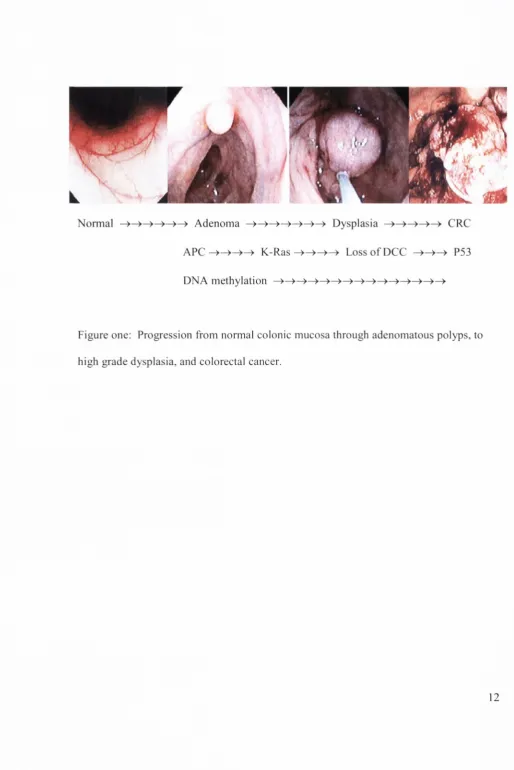
The European Council has stated that colorectal screening should be provided for all individuals aged 50-74 years in a quality assured p r o g r a m m e . T h e development o f colorectal cancer from normal colonic mucosa through to adenom atous polyps, high grade dysplasia, and finally colorectal cancer is a slow process, taking over ten to fifteen years. As such colorectal cancer represents an ideal cancer for screening and early detection.
screening and subsequent removal o f polyps will lead to a reduction in colorectal cancer incidence.
Adenom atous polyps and colorectal cancer
Molecular, genetic and clinical research indicate that colorectal cancer usually proceeds through a discontinuous process from normal m ucosa, to increased cellular proliferation, to early benign adenom a, to adenoma with advanced histological features, and finally to invasive cancer and metastases.'^ Epidemiologic data show that there is a parallel prevalence o f adenom as and cancers in both high and low incidence countries, with the average age o f adenom a patients being about 7-8 years younger than that o f colorectal cancer patients.
Small simple tubular adenom as are found in over 30% o f older adults and have a very low malignant potential. Studies indicate that most remain static or m ay actually regress with time, whereas only a few grow and develop advanced histological features.'^ Small simple tubular adenom as contain only the earliest occurring genetic alterations found in more advanced adenom as, and only a few appear to develop the additional acquired genetic changes needed to stimulate accelerated cellular division, growth and
No n n a l > Ad e n o ma — > Dyspl asi a CRC
A P C - > ^ ^ ^ K - R a s - > ^ - ^ ^ L o s s o f D C C P53
[image:13.545.5.520.39.810.2]D irect colonoscopy screening studies report that the prevalence o f advanced adenom as in asym ptom atic adults over the age o f 50 is 5% in w om en and 9% in m en.'^ These
advanced adenom as have a m uch higher m alignant potential. In a retrospective review o f patients w ith unresected polyps > 1cm, who had been follow ed by serial barium enem a exam inations over a six year period 83 (37% ) o f the polyps enlarged and 21 invasive cancers developed at a previous polyp site. The cum ulative risk o f m alignancy at the site o f an index polyp > lc m w as 2.5% at 5 years, 8% at 10 years, and 24% at 20 years.
A recent report suggested that the rate o f carcinom a occurring in polyps is m uch less than p reviously thought and furtherm ore that the chance o f m alignancy in a polyp < 1 cm w as very low. In this retrospective review o f 3,225 resected polyps the rate o f
adenocarcinom a detected w as 0.07% for polyps <1 cm, 2.41% for polyps 1-2 cm , and 19.35%) for polyps >2 cm .'^ C ontradictory evidence w as presented from a study o f 1933 resected polyps < 1cm: A dvanced histology including carcinom a w as found in 10.1%) o f adenom as 5-10m m in size and in 1.7%o o f adenom as < 5mm. C arcinom a w as found in
1 R
0.9%) o f adenom as 5 - 10m m in size. In light o f this polypectom y and histological evaluation o f all polyps > 5m m w ould seen prudent.
Evidence that p olypectom y reduces the incidence o f colorectal cancer cam e initially from the N ational Polyp Study in the U nited States. T his study addressed the issue that
with three reference groups." O f the 3371 adenomatous polyps removed during the National Polyp Study, 7.7% showed moderate dysplasia and 6.2% showed high grade dysplasia, 2.5% severe dysplasia and 3.7% in situ carcinoma. The percentage o f adenomas with high-grade dysplasia increased significantly with increased size with an odds ratio, OR, o f 4.8 for adenomas 0.6-1 cm, and 20.3 for an adenom a > 1 cm. The percentage o f adenomas with high-grade dysplasia also increased with increasing villous component with an OR o f 5.9 for a l-25%> villous com ponent and an OR o f 20.2 for a 76-
100% villous component. Patients with multiple adenomas were more likely to have an adenoma with high-grade dysplasia at 13.8% than patients with a single adenoma at 7.3%, giving an OR o f 2.0 for multiplicity. The percentage o f patients with high-grade dysplasia in an adenoma increased with patient age with an OR o f 1.0 for those aged 40- 49 years, 1.3 for those 50-59 years, 2.2 for those 60-69 years, 2.5 for those aged 70-70 years, and 3.6 for those aged more than 80 years compared to those aged less than 40 years. Interestingly there was no difference between men and women as regards the occurrence o f high-grade dysplasia.'^ High-risk adenom as are thus those > 1cm, with villous component, and multiple adenomas.
Flat adenomatous polyps
a higher prevalence o f high grade dysplasia and are more likely to rapidly advance to invasive cancer than adenom atous polyps.^®
A prospective study o f 211 patients assessed the prevalence o f flat and depressed colorectal adenomas in the US. Flat and depressed adenomas were found in 22.7% and invasive cancer was present in 4.5% o f these lesions in contrast with the adenomatous polyps detected which contained no cancer. The average size o f all flat and depressed adenomas containing high-grade dysplasia or cancer, was significantly smaller than the adenom atous polyps containing high-grade dysplasia, 10.75mm vs. 20mm.^’
The prevalence o f flat and depressed colorectal cancer lesions in the UK was determined when a single endoscopist performed a high magnification colonoscopy with
chromoscopy o f 850 patients. A total o f 285 flat adenomatous polyps were found, with high grade dysplasia in 44.6%. O f the adenom atous polyps high grade dysplasia was present in only 17%. O f the 14 protruberant carcinomas 93% were in the left colon and o f the 10 flat carcinomas 90% were in the right colon. O f the protruberant adenomas with high grade dysplasia 95% were in the left colon in contrast 82% o f the flat lesions
O ' ) with high grade dysplasia were found in the right colon.
the right colon. This may have a bearing on a putative reduction in colorectal cancer incidence with colorectal cancer screening secondary to polypectomy.^^
To date in the majority o f screening trials published, follow-up is not sufficiently long to clarify the effect o f detecting and removing adenomas on colorectal cancer incidence. Those groups with an extended follow-up have produced conflicting data. Mandel et al followed up their Minnesota Colon Cancer Control Study for 18 years, and found 417 colorectal cancer cases developed in the annual screening group, 435 in the biennial screening group, and 507 in the control group. The cumulative incidence per 1000 o f colorectal cancer was 32 in the annual screening group, 33 in the biennial screening group, and 39 in the control group. Over 18 years both annual and biennial screening with a rehydrated faecal occult blood test (FOBT) significantly reduced the incidence o f colorectal cancer by 20% and 17% respectively.^'^
to polypectom y the low sensitivity o f the FO BT for adenom atous polyps is undoubtedly im portant. Im proving the sensitivity b y rehydration as w as done b y M andel et al leads to an increased num ber o f colonoscopies. In the Funen study 5.3% o f those screened had a colonoscopy. H ow ever in the M innesota study 28% o f those w ith a biennial rehydrated
25 FO B T and over 40% o f those w ith an annual rehydrated FO BT had a colonoscopy. L ong-term follow -up is needed from other screening trials before w e m ay claim that screening reduces the incidence o f colorectal cancer in addition to reducing the m ortality from colorectal cancer.
R isk stratification and colorectal cancer
C olorectal cancer screening in average risk individuals is advised from 50 years o f age onw ards. H ow ever certain individuals, w ith a higher risk o f developing colorectal cancer, m erit screening at a younger age. These high-risk individuals m ay be identified from their fam ily history. O ne in nine individuals diagnosed w ith colorectal cancer have a fam ily history o f colorectal cancer. In V astm anland county in Sw eden 411 patients w ere diagnosed w ith colorectal cancer during a three year period. The fam ily history o f 400 o f these individuals {91%) w as obtained: Five patients (1.2% ) w ere diagnosed as having hereditary nonpolyposis colorectal cancer, or H N PC C , eight (1.9% ) had at least three relatives w ith colorectal cancer in a first- or second- degree relationship, and a dom inant pattern o f inheritance but no age specifications, and thirty four (8.3%>) had at least one first-degree relative w ith colorectal cancer. No patient w ith fam ilial
Familial adenomatous polyposis
FAP accounts for < 1% o f cases o f colorectal cancer and is autosomal dominant.^’ It arises from gennline mutations o f the adenomatous polyposis coli (AFC) gene located on
28 chromosome 5q21, however in 22-46% o f cases it arises as a spontaneous mutation. The AFC gene is a tum our suppressor gene encoding a protein with a role in cell adhesion, signal transduction, and transcriptional activation. More than 300 different disease-causing mutations have been identified and can be found in 80-90% o f FAF families. Age o f presentation, density o f colonic polyposis and highest cancer risk correlates with the mutation location with the most dense polyposis arising from mutations o f the mid-portion o f the gene.
D uodenal polyposis can be classified into five stages according to criteria proposed by S pigelm an w ith a 2.3% risk o f cancer w ith 1-4 sm all tubular polyps and a 36.4% risk o f cancer w ith > 20, large, or villous polyps.^'
In attenuated FA P there are m ore than 20 cum ulative colorectal adenom atous polyps w ith a m ore proxim al distribution. There is an 80% lifetim e risk o f colorectal cancer and a later onset o f disease w ith polyps presenting in m id to late 20s and colorectal cancer in the 50s. R oughly 10%> o f patients w ith attenuated FA P have germ -line m utations in APC.-^” -^
R ecently germ line m utations o f the M Y H gene have been identified in som e patients w ith no identifiable APC gene m utation but w ith m ultiple colorectal adenom as. The M YH gene is a base excision gene that m ediates oxidative dam age to deoxyribonucleic acid, DNA; it appears to be autosom al recessive w ith bi-allelic m utations necessary for the m utation. Lim ited inform ation is yet available on the spectrum o f m utations in M YH. Age o f occurrence o f polyps is older than FAP, and polyps typically num ber < 100. H eterozygous m utations m ay m arginally influence the risk o f colorectal carcinoma.'^'*
The American Gastroenterological Association, AGA, advises annual sigmoidoscopy beginning at age 10-12 years, and in the case o f attenuated FAP colonoscopy beginning in the late teens or early 20s, depending on the age o f polyp expression in the family.'^^ The British Society o f Gastroenterology, BSG, advises annual sigm oidoscopy from age 13-15 years until age 30 years, and at three to five year intervals thereafter until age 60 years. Oesophagogastroduodenoscopy, OGD, is advised at 3 yearly intervals from age 30, and more frequently if there is extensive p o ly p o s is .B a s e d on Spigelm an’s
classification o f duodenal polyps one proposed OGD schedule is 5 yearly intervals for 1- 4 small tubular polyps, 3 yearly intervals for 5-20 tubulovillous polyps, and 1-2 yearly intervals with > 20 villous or large polyps.
Hereditarv nonpolvposis colorectal cancer
The mismatch repair proteins, MMR, function as “DNA caretakers” to maintain the fidelity o f genomic DNA during replication. The loss o f M M R activity only occurs in cells that inactivate both alleles o f the MMR gene. The genes involved are M L H l, MSH2, MSH6, M LH3, P M S l, PMS2, TGFBR2, and E X O l, with M LH l and MSH2 accounting for greater than 95% o f cases."" The effect o f M M R loss is microsatellite instability, MSL M icrosatellites are short, repetitive sequences located throughout the genome, but prim arily in introns, and insertions or deletions leads to genomic instability and a rapid accum ulation o f somatic mutations in oncogenes and tumour suppressor genes.
Many colon cancers demonstrate mutations in a small percentage o f microsatellite repeats but if a tum our shows 30-40% or more markers that are unstable it is scored as M SI-high, if less than 30-40% o f markers are unstable the tum our is designated as MSI-low. A panel o f five mononucleotide and dinucleotide microsatellite loci are used to detect MSI, namely BAT25, BAT26, D2S123, D5S346, and 0178250."'^ Immunohistochemistry can also detect mismatch repair gene defects with loss o f expression o f the M LH l or MSH2 genes in 100% o f those with MSI-high, and normal expression o f M LH l or MSH2 in 93% o f those with MSl-stable."*'^ The decision to conduct either MSI testing or immunohistochemistry resides in local expertise.
identified in 70.3% o f the carriers and 29.2% o f the controls. The adenom as in the carriers occurred at an earlier age, were larger, had a higher proportion o f villous components, and/or high grade dysplasia. Immunohistochem istry for hM LH l and anti- PMS2 on those known carriers o f an hM LH l germline mutation, and hM SH2 on those known carriers o f hM SH2 germline mutations was carried out on 31 adenomas from 22 o f the carriers. The M M R proteins were found to be absent in 23 o f the adenomas. The 8 adenomas with MMR protein staining showed low-grade dysplasia. The MMR gene defect is thus involved in the early development and malignant transform ation o f adenom atous polyps in HNPCC.'*"^
Paradoxically, although patients with HNPCC are affected by colon cancer at young ages and have tum ours with histopathological features that suggest aggressive tum our
behaviour, the clinical outcomes for HNPCC patients with colon cancer are typically better than outcomes for patients with sporadic colon cancer. HNPCC patients with colorectal cancer have an improved 5-year survival (76% vs. 54%) on a stage-for-stage basis com pared with patients with sporadic cancers.'^^ MSI tum ours have an increased number o f lymphoid aggregates in the peritumoural tissue, and it is thought these may slow tum our progression via IL-4 and TN F-a production.
criteria for MSI testing.'^* Under the revised Bethesda guidelines tum ours should be tested for MSI if colorectal cancer is diagnosed in a patient who is less than 50 years o f age; regardless o f age in the presence o f synchronous/metachronous colorectal cancer or a HNPCC-associated tumour including endom etrial, stomach, ovarian, pancreas, ureter and renal pelvis, biliary tract, and brain; colorectal cancer in a patient under 60 years o f age with the M SI-high histology o f a tum our with infiltrating lymphocytes, C rohn’s-like lymphocytic reaction, mucinous/signet-ring differentiation, or medullary growth pattern; when colorectal cancer is diagnosed in one or more first-degree relatives with a HNPCC- associated tumour, with one o f the cancers being diagnosed under 50 years o f age; when colorectal cancer is diagnosed in two or more first- or second-degree relatives with a HNPCC-associated tumour, regardless o f age.
If immunohistochemical staining or microsatellite testing confirms MSI, germ-line testing o f MSH2/MLH1 is recommended. If the mutation is identified, at-risk relatives should be referred for genetic counseling and endoscopic screening if the mutation is present. If no germ-line mutation is found relatives should be referred for endoscopic screening. Germline M MR mutations are found in 45-60% o f families meeting HNPCC criteria, and finding MSI in patients with colorectal cancer increases the likelihood o f finding germline M M R mutations to over 60%. The Bethesda guidelines have a good sensitivity o f 96%, but only a moderate specificity o f 27% for identifying M SI-high
The AGA recommend that individuals with HNPCC should have a colonoscopy every 1 - 2 years beginning at aged 20-25 years, or 10 years earlier than the youngest age o f colon cancer diagnosis in the family, whichever is the earlier.^^ The BSG recommend biennial colonoscopy starting at aged 25 years, or 5 years younger than the first cancer case in the family, whichever is the earlier, and continuing to 75 years o f age. In families with cases o f gastric cancer biennial OGDs should begin at aged 50 years o f age, or five years less than the first gastric cancer case in the family, whichever is the earlier.'^^ In women annual surveillance for endometrial cancer should begin between 25 and 35 years with annual pelvic examination and transvaginal ultrasound scan.^'
Familial colorectal cancer
While relatives o f patients with rare genetic syndromes such as FA ? and HNPCC certainly benefit from an intensive screening programme, the majority o f “familial” colorectal cancer is seen in first-degree relatives o f patients with colorectal cancer. From population studies it is estimated that 9.4% have a first-degree relative with colorectal cancer.^^ Whether or not these individuals should be screened, when screening should occur, and how frequently screening should be is far less clear cut.
only symptomatic patients. Several endoscopic studies have documented a high prevalence o f adenomatous polyps in asymptomatic first degree relatives o f colorectal cancer patients. Most o f these studies were retrospective and without a control population.^^'^* Four o f these studies were prospective but again lacked a control population.^®'®'"^^'®^ Two studies used flexible sigmoidoscopy.^"*'^^ (See table one)
Guillem et al were the first to evaluate colonoscopic findings in asymptomatic individuals with and without a family history o f colorectal cancer: They compared the detection rate o f neoplasms in 181 asymptomatic first-degree relatives o f colorectal cancer patients with that in 83 asymptomatic individuals in a prospective trial. The overall detection rate o f adenomatous polyps in the family-risk group was 14.4% and in the control group 8.4%. The first-degree relatives developed colonic adenomas at an earlier age than the controls, and this difference was most striking in men. Logistic regression analyses revealed that age, male sex, and first-degree relative status were independent risk factors for the presence o f colonic adenomatous polyps with a relative risk, RR, o f 2.32, 2.86, and 3.49 respectively. In first-degree relatives a greater proportion o f the polyps were proximal to the splenic flexure than in controls, 48% vs. 25%, and the proportion o f polyps with marked cytological atypia appeared to be greater in first-degree relatives than in controls,
S T U D Y A D E N O M A S F O U N D IN T H O S E W IT H A F IR S T -D E G R E E R E L A T IV E W IT H C R C
A D E N O M A S F O U N D IN T H O S E W IT H O U T A F A M IL Y H IS T O R Y O F C R C
G ry sk a et al, 1987*’'^ G ro ssm a n et al, 1988^' M cC o n n ell et al, 1990^^ B ak er et al, 1990^^ L u ch te feld et al, 1991^^ G u ille m et al, 1992^^ M e a g h e r et al, 1992*"^ S te p h en so n et al, 1993^^ W u C S e t a l , 1995™ B azz o li et al, 1995^' P a rie n te et al, 1998^^ H u n t et al, 1998^^ D o w lin g et al, 2000^“^ S y rig o s et al, 2002^^
63% o f 49 in d iv id u a ls 18% o f 154 in d iv id u a ls 12% o f 125 in d iv id u a ls 27%) o f 201 in d iv id u a ls
10.6% o f 143 in d iv id u a ls 14.4%) o f 181 in d iv id u a ls 46%o o f 429 in d iv id u a ls
13%o o f 92 in d iv id u a ls 9.9% o f 213 in d iv id u a ls 69%) o f 39 in d iv id u a ls 23.2% o f 185 in d iv id u a ls 8%) o f 137 in d iv id u a ls 14%) o f 236 in d iv id u a ls 11%) o f 249 in d iv id u a ls
5.8%o o f 137 in d iv id u a ls 8.4%) o f 83 in d iv id u a ls
10%) o f 30 in d iv id u a ls
36%) o f 358 in d iv id u a ls 17.3%) o f 370 in d iv id u a ls
T a b le one: A d e n o m a to u s y ie ld in p ro sp e c tiv e c o lo n o sc o p y stu d ie s o f in d iv id u a ls w ith a first d eg ree re la tiv e w ith co lo re c ta l can cer.
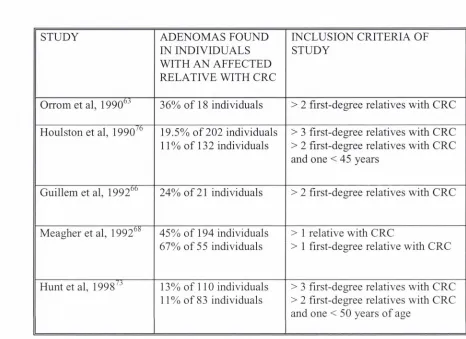
[image:27.543.71.502.141.605.2]Prospective studies o f colonoscopic screening in individuals with two or more affected first degree relatives have generally been small. (See table two.) Adenomas found at colonoscopy have ranged from 24% o f 21 individuals, to 36% o f 18 and 39 individuals.^^
^ Stephenson et al found adenomas in 10% o f 20 people with either two or more relatives affected or a relative younger than 45 years affected.^^ A large report found neoplasia in 19.5% o f 202 individuals with three or more affected relatives and in 11% o f
132 individuals with two first degree relatives or a relative aged under 45 y e a r s . H u n t et al found adenomas in 11% o f 83 people with either two or more relatives with colorectal cancer, a first degree relative with colorectal cancer under the age o f 50 years, or both a first and second degree relative with colorectal cancer, one o f whom was less than 50 years o f age.^'^
STUDY ADENOM AS FOUND IN INDIVIDUALS WITH AN AFFECTED RELATIVE WITH CRC
INCLUSION CRITERIA OF STUDY
Orrom et al, 1990^ ’ 36% o f 18 individuals > 2 first-degree relatives with CRC Houlston et al, 1990^^ 19.5% o f 202 individuals
11% o f 132 individuals
> 3 first-degree relatives with CRC > 2 first-degree relatives with CRC and one < 45 years
Guillem et al, 1992^^ 24% o f 21 individuals > 2 first-degree relatives with CRC
M eagher et al, 1992^*^ 45% o f 194 individuals 67% o f 55 individuals
> 1 relative with CRC
> 1 first-degree relative with CRC
Hunt et al, 1998^’ 13% o f 110 individuals 11% o f 83 individuals
[image:29.542.38.504.99.438.2]> 3 first-degree relatives with CRC > 2 first-degree relatives with CRC and one < 5 0 years o f age
Table two: Adenomatous yield in prospective colonoscopy studies o f individuals with more than one first degree relative with colorectal cancer.
Bazzoli et al set out to determine if asymptomatic patients with only one first-degree relative with colon cancer should have a colonoscopy. Over a two year period in
Bologna colonoscopies were performed on 397 asymptomatic patients, 39 o f whom had a first-degree relative with colorectal cancer. Adenomatous polyps were found in 155, 69%, o f patients with one first-degree relative with colorectal cancer and in only 36%>, o f those w ithout a family history. Multiple logistic regression analysis o f risk factors associated with adenomatous polyps revealed an adjusted odds ratio o f 1.4 for male sex,
1.6 for age over 50 years old, and 1.9 for one first-degree relative having colorectal cancer. This study confirmed previous reports that patients with a family history of colorectal cancer have an increased risk o f developing adenomatous polyps, but more specifically it shows that even individuals with only one first-degree relative with colorectal cancer should be screened.^’
Pariente et al in a larger study substantiated these findings. They performed a
colonoscopy in 185 first-degree relatives o f patients with colorectal cancer and compared the findings o f 370 individuals without a family history o f colorectal cancer. Adenomas were found in 23.2% o f the family history group and 17.3%> o f the controls, OR o f 1.5 for all adenomas, 2.5 for large adenomas. The characteristics o f the index cancer patient influenced the prevalence o f high-risk adenomas in the first-degree relatives with an OR o f 5.2 when the index case was less than 65 years, an OR o f 2.2 when the index case was
The influence o f the index cases age is in accordance with findings from St John et al. In a case-control study medical histories were sought from 7493 first-degree relatives o f patients with colorectal cancer and 1046 individuals without a family history o f colorectal cancer. The reported diagnosis o f colorectal cancer were confirmed in 79% o f instances. The OR o f developing colorectal cancer was 1.8 for those with one affected relative compared to those with no family history o f colorectal cancer. This increased to an OR o f 3.7 when the affected relative was less than 45 years o f age.^*
A recent population based study assessed the risk o f colorectal cancer associated with a family history. Familial risk was estimated from a cohort analysis o f the relatives o f 767 patients who developed colorectal cancer between 1993 and 1998 in Calvados. A trained interviewer asked all participants about their family history o f cancer, and the diagnosis was confirmed in 78% o f cases. The expected numbers o f cancers were calculated from Calvados incidence rates o f colorectal cancer. The risk o f developing colorectal cancer for those with a family history o f colorectal cancer was 1.54 compared to those without a family history. This risk appeared to be greater, but not significantly so, for first degree relatives than for second degree relatives, RR 1.71 compared with RR 1.22.*®
A systematic review and meta-analysis o f published case-control and cohort studies, between 1958 and 1999, which have quantified familial risk o f colorectal cancer, was performed by Johns, et al. (See figure 2) Twenty case-control studies reporting the risk o f colorectal cancer in relatives o f colorectal cancer were identified. Ten o f these used controls ascertained from the general population, and 10 used hospital patient controls. In total 16,225 patients who had first degree relatives with colorectal cancer and 29,755 matched controls were included. Seven studies excluded cases with FAP or premalignant bowel disease. In eight studies diagnoses o f colorectal cancer in relatives were confirmed w herever possible. Seven cohort studies reporting the risk o f colorectal cancer in
D uncan. N=100 Ponz d e Leon. N=778 C entonze. N=238
Woolf. N=484 Fisher. N=256 Maire. N=340 Boutron. N=480 Rozen. N=1084 Kotake. N=726 Bonnelli. N=1269
St Jo h n . N=1046
Macklin, N=145
Kune. N=1412
Lovett. N=209
LeM erchant. N=2384
Thun. N=6896
LaVechhia. N=2988 K arner-H anusch. N=100
HalL N=277
F u ch s. N=119116 New com b. N=2976
Negri. N=6107
Poole. N=2121
Kerber. N=4403
Goldgar. N=4010
C a rs te n s e n . N=1470 Com bined. N=161415
[image:33.542.80.500.121.525.2]RR
10
100
Figure two: Funnel plot o f relative risk o f colorectal cancer associated with having at least one first-degree relative with colorectal cancer.
Using all studies, the pooled RR is 2.25 for developing colorectal cancer among individuals with a first degree relative with colorectal cancer. Eleven o f the studies distinguished between colon cancer with a RR o f 2.42, and rectal cancer with a RR of
1.89. There was no statistically significant difference between right and left sided colorectal cancer. Fourteen studies reported separate parent-offspring and sibling
familial colorectal cancer risks. The estimates o f parent-offspring RR ranged from 1.3 to 10, with a pooled RR o f 2.26. For siblings the RR ranged from 1.8 to 11 with a pooled RR o f 2.57. Six studies reported the risk o f colorectal cancer associated with having more than one affected first-degree relative, with the RR ranging from 2.2 to 9.4 and the pooled RR being 4.25. Seven studies reported risks o f colorectal cancer by age at diagnosis o f colorectal cancer in the index case, and in all the risks were greatest for those relatives o f cases diagnosed young. The pooled RR o f colorectal cancer is 3.87 in relatives o f cases diagnosed > 45 years, 2.25 between 45 and 59 years, and 1.82 in those > 59 years. In addition nine studies reported the risk o f colorectal cancer associated with adenomas in a first degree relative, and found a RR o f 1.99. This meta-analysis provides strong evidence for screening those with a first-degree relative with colorectal cancer, the moderate risk “familial” group.*'
Since then attempts have been made to clarify the appropriate age at which to begin screening in moderate-risk individuals. Colorectal neoplasia is rare under the age o f 50 years and the appropriateness o f colonoscopy at less than 50 years o f age in individuals at moderate risk may be questioned. This view was supported in a cohort o f 232
neoplastic lesions were detected by colonoscopy in 33 participants (14%), four had an advanced adenoma and two had cancer. Only one advanced adenoma was detected in a participant below the age o f 50 years.^"^ In contrast a cohort o f 249 asymptomatic individuals who had one or two first-degree relatives with colorectal cancer colonoscopy detected neoplastic lesions in 27 (11%), fourteen had an advanced adenoma and no cancers were detected. Nearly half o f the adenomas detected, 44.4%, were discovered in asymptomatic individuals who were <50 years old.^^ In light o f these contradictory findings further studies are needed to determine if screening should begin in those < 50 years old.
Studies have also revealed that screening intervals for individuals at moderate risk due to their family history should be shorter than those for average risk individuals.
Colonoscopy was performed on 436 asymptomatic individuals and adenomas were found in 172 o f these. A repeat colonoscopy was then offered at 3 years to all. Polyps were found in 9 individuals who had an initial normal colonoscopy: 2 o f these had no family history o f colorectal cancer and 7 had a family history o f colorectal cancer. Polyps were found in 46 individuals who had a previous polypectomy; 26 had no family history and 20 had a family history o f colorectal cancer. M ultivariate analyses showed that adenoma size >10mm, tubulovillous pathology, severe dysplasia, and a first-degree relative with colorectal cancer were significant risk factors for the presence o f adenomas 3 years
82
history o f colorectal cancer led to a fourfold higher risk o f adenom a growth, but no increased adenoma incidence.
The etiology o f the increased family risk o f colorectal cancer, w hether environmental or hereditary, has been addressed in studies. According to a Nordic twin study 60% o f colorectal cancer is due to environmental effects, 35% to hereditary factors, and 5% to shared environmental effects.*"^ The question was examined ftirther from the nationwide Swedish Family-Cancer Database which included all individuals bom in Sweden after 1931 and their biological parents, totaling over 10 million individuals. A total o f 37,873 colorectal cancers were recorded in offspring and parents from 1991 to 2000. The standardized incidence ratios, SIRs, in offspring when a parent had colorectal cancer were 1.78.
colorectal cancer among those whose sibling had colorectal cancer was independent of the age difference thus indicating a hereditary effect.^^
The accumulating evidence for familial risks is acknowledged in guidelines for colorectal cancer screening. The BSG recom mend that individuals with one first degree relative affected by colorectal cancer aged less than 45 years, or with two affected first degree relatives should have a colonoscopy at consultation about family history or between the ages o f 35-40 years, whichever is the later, and a repeat colonoscopy at 55 y e a r s . T h e AGA adopted a broader strategy and recom mend that individuals with a first-degree relative with colon cancer when less than 60 years, or with two first-degree relatives diagnosed with colorectal cancer at any age should have screening colonoscopy starting at age 40 years or 10 years younger than the earliest diagnosis in the family, whichever comes first. The colonoscopy should then be repeated every 5 years.^^
Mitchell et al assessed the accuracy o f a family history o f colorectal cancer reported by relatives compared with the actual diagnosis o f colorectal cancer among relatives. A clinical nurse specialist conducted face to face interviews with 199 colorectal cancer patients and 133 healthy individuals. The family histories obtained from these individuals encompassed 5637 first and second degree relatives. The family history provided was linked to a computerised cancer registry data to determine the accuracy. The cancer registry data revealed a total o f 148 confirmed cases o f colorectal cancer among first-degree relatives or second-degree relatives, o f which only 62 were reported correctly by the interviewees. The interviewees had a sensitivity o f 56% and a
specificity o f 99% for reporting colorectal cancer among first-degree relatives.
For reporting colorectal cancer among the second-degree relatives the interviewees had a sensitivity o f 27% and a specificity o f 99%. This indicates that a large proportion o f colorectal cancer cases go unreported by family relatives. Five o f the interviewees reported a family history that met criteria indicating a need for surveillance, but only two o f these five families were confirmed by the cancer registry data. The cancer registry data through record linkage identified a further four interviewees who warranted surveillance, who did not report a family history o f such. Therefore only two o f six families, who should have been recommended for surveillance, were identified at
interview. The sensitivity o f interview in terms o f identifying appropriate individuals for
home. Reporting inaccuracies may be more extreme where family history is taken in a busy clinic.*^
This was confirmed by Church et al, who reviewed the charts o f two hundred in-patients to determine the level o f family history noted. In the initial review a family history o f colorectal cancer was sought in only 45 o f the 100 charts, with an accuracy o f 80% for colorectal cancer. In the second review four years later the recording o f family history o f colorectal had increased to 61 o f the 100 charts, but the accuracy for colorectal cancer had not improved much at 74%.*^
Consideration should be given as to how often a family history o f cancer is sought, how detailed a history is obtained, and how accurate that information received is. If we wish to be serious about screening those individuals at increased risk o f colorectal cancer due to their family history then specifically asking about this should be as routine as soliciting a family history for cardiovascular risk factors. M ost individuals are aware o f their family history o f cardiovascular disease and in an analogous manner routine questioning o f a colorectal cancer history will increase the accuracy. The benefit o f repeated
questioning was demonstrated in a study o f 125 patients who underestimated their family history risk o f colorectal cancer. Further questioning via telephone and a mailed
questionnaire seeking a family history o f colorectal cancer led to a reduction in those who reported having no family history from 31.2% to 13.5%, and an increase in those
A zealous cam paign to increase the frequency and accuracy w ith w hich a fam ily history o f colorectal cancer is sought, w hile indicated, m ust be tem pered by the know ledge that w ith an increasing public aw areness there will be an increasing dem and from the public, concerned about their risk and seeking investigations. Indeed screening clinics in the U K have seen a six fold increase in colorectal cancer fam ily history referrals over the last few years, not all being necessary.
A verage risk individu als
The benefit o f colorectal cancer screening in average risk individuals is often lost in the myriad screening options and recom mendations available. Although there is now a consensus that colorectal cancer screening will reduce mortality there is no consensus on the best screening tool. The four possible screening options cited in various guidelines are FOBT, sigmoidoscopy, colonoscopy, barium enema, or a combination thereof Cost-effective analysis do not help distinguish between the strategies with the median incremental cost-effectiveness ratios being €9950/life-year saved, €13,200/Iife-year saved, and €10,000/life-year saved, for FOBT, sigmoidoscopy, and colonoscopy respectively compared with no s c r e e n i n g . T h u s all screening options are well within the $50,000 per life year saved that society is willing to pay.*^’^
The European Union reveals equal disparity in practice. Italy, Germany, and Poland have implemented national colorectal cancer screening programmes using colonoscopy, but uptake is disappointingly low at less than 10%. In France a population-based study o f over 91,000 individuals has confirmed the feasibility o f FOBT screening and a national screening programme utilizing FOBT is to be im plem ented.'^' In the UK the feasibility o f FOBT screening was confirmed in a pilot study o f two sites covering a population o f one million p e o p l e . H o w e v e r the follow-up o f a sigmoidoscopy screening trial is awaited before a decision is made on which screening modality to implement nationally in the UK.'®'^
Double contrast barium enema
As can be anticipated from such diverse attitudes on screening options there are drawbacks to each. Although double contrast barium enema is recommended for
Sigmoidoscopy
Two thirds o f adenomas and cancers are located in the rectum and sigmoid colon, which is within reach o f the flexible sigmoidoscopy, a procedure which takes only five minutes, requires no sedation and only a self-administered enema to clear the bowel, making it an attractive screening option. Retrospective case controlled studies provide evidence that sigmoidoscopy prevents colorectal carcinoma. The use o f sigmoidoscopy in 261 patients who died o f colorectal carcinoma was contrasted with that o f 868 control patients. The OR for exposure to sigmoidoscopy was 0.3 for the control group when compared with the group with colorectal c a n c e r . T h i s conclusion is supported by that o f a larger case- controlled study involving 16351 patients with colorectal cancer and 16,351 patients in the Veterans Affairs (VA) system. Compared with controls, patients with colorectal cancer were less likely to have had an endoscopic procedure o f the large bowel before being diagnosed with cancer, OR 0.51 for colon cancer and OR 0.44 for rectal cancer.'^^ Four population-based flexible sigmoidoscopy trials were carried out on the strength o f existing evidence.
In Norway 799 individuals aged 50-59 years were randomized to flexible sigmoidoscopy or no screening. All who had polyps detected at sigmoidoscopy went on to have a fiill colonoscopy and polypectomy. During the 13 year follow up a reduction in colorectal cancer incidence o f 80% and in colorectal mortality o f 50% was observed in the screened group. Very high acceptance rates for sigmoidoscopy were achieved at 81%>, a figure that
In the UK 354,262 individuals aged 55-64 years were invited to participate in a flexible sigmoidoscopy screening trial with only 55% responding positively. Participants were then randomized to flexible sigmoidoscopy screening or a control group. Attendance among those assigned screening was 70% giving an overall acceptance rate of 33.6%) for flexible sigmoidoscopy. Those with high risk distal lesions were referred for
colonoscopy. The detection rate for cancer was 3.5 per 1000 and long-term follow-up is awaited on the effect on colorectal cancer incidence and mortality.''*^
An Italian trial invited 1170 individuals, aged 55-59 years, living in Turin to participate in a flexible sigmoidoscopy screening trial. The uptake was low with just 24%o, 278 individuals complying. Long-term follow-up is awaited again.
The Prostate, Lung, Colorectal and Ovarian (PLCO) cancer screening trial in the US enrolled 77,465 individuals aged 55-74 years. A total of 64 658 subjects, 83.5%), underwent screening flexible sigmoidoscopy, with 23.4% o f these having a polyp or mass. The detection rate for cancer, for each 5-year age group, was 1.1-2.5 for women and 2.4-5.6 for men per 1000 screened, and of the 169 cancers detected 130,11 Vo, were stage I or II. Again follow-up data is awaited."^
results o f a flexible sigmoidoscopy. Advanced colonic neoplasia was found in 10.6% o f individuals and sigmoidoscopy identified only 70.3% o f these.” ' In a tandem study colonoscopy was performed in 1463 women. Although the incidence o f advanced colonic neoplasia was lower in women at 4.9%, flexible sigmoidoscopy identified only 34.7% o f these lesions."^
Imperial et al in a study o f nearly 2000 individuals undergoing screening colonoscopy addressed the issue o f advanced proximal neoplasia among those with no distal polyps, that is those individuals whose sigmoidoscopy would not indicate the need for a
colonoscopy yet who harbour advanced proximal neoplasia in their proximal bowel. The prevalence o f proximal neoplasia among individuals with no distal polyps was 1.5%, among those with distal hyperplastic polyps 4%, among those with distal tubular
adenomas 7.1%, and among those with distal advanced neoplasms 11.5%. In total nearly half, 23 o f the 50 individuals, with advanced proximal neoplasia had no distal p o ly p s." ’^
A study o f 1,988 asymptomatic individuals attempted to define predictors o f proximal neoplasia in those without distal adenomatous pathology. Comparing the 55 patients with isolated advanced proximal neoplasia with the 1,933 patients without, they were significantly older at 64.5 years vs. 57 years; more likely to have a family history o f colorectal cancer at 21.8% vs. 13.4%; more likely to be current smokers at 25.5%> vs.
The fear o f missing isolated advanced proximal neoplasia has led some to believe that screening flexible sigmoidoscopy is as illogical as screening only one breast during mammography, and has become a very persuasive argum ent against using flexible sigmoidoscopy as a screening tool."^ In reality no screening programme is ever one hundred percent effective and only 2-5% o f asymptomatic individuals are believed to have isolated advanced proximal neoplasia."^
The real concern surrounding sigmoidoscopy is its acceptance rate and its invasiveness as a screening test in asymptomatic individuals. In studies, which represent the ideal
clinical situation, the acceptance rate varies from 24-80%.'^^ Screening
sigmoidoscopy is an invasive procedure and is associated with risks which may not be acceptable in an asymptomatic individuals: a perforation rate o f 1 in 25,000, bleeding in 3.2%, and pain in 14%."^
Colonoscopv
Evidence-based guidelines place greatest weight on large-scale randomized trials, but the corroboration for colonoscopy comes from small case-control studies or indirect evidence where the primary aim o f the study did not set out to detennine the efficacy o f
colonoscopy in screening for colorectal cancer. In the landmark US National Polyp Study after an initial clearing colonoscopy, where all polyps were removed, 1418 patients
populations. The effect o f removing all adenom as was to reduce the incidence o f subsequent cancer by between 76% and 90%. This was the first time that a well- designed, controlled, prospective study dem onstrated that colonoscopic removal o f all adenomas in the colon and rectum successfully interrupted the adenoma-carcinoma sequence and prevented most cancers from developing."
A recent European study confirmed the findings o f the US National Polyp Study. A m ulti-center Italian study followed 1693 patients, after resection o f at least one adenom a >5mm in diam eter for a mean o f 10.5 years. They found that the incidence o f
metachronous cancer, compared with that o f a reference population , was reduced by 75%, with six colorectal cancer cases occurring in the cohort compared with an expected
17.7 colorectal cancer cases.
Case-control studies have evaluated the feasibility o f colonoscopy in colorectal cancer screening. A colonoscopy screening study conducted at thirteen VA medical centres enrolled 3196 individuals. A total o f 1171 individuals, 37.5%, had adenomatous polyps. Advanced disease that is an adenoma greater than 10mm, or with villous features or high- grade dysplasia, or invasive cancer was present in 329 individuals, 10.5%. In total 2.6% o f individuals had cancer or adenoma with high-grade dysplasia and most o f these, 73.5% were identified before there was nodal involvement or distal spread.
A dvanced colonic lesions were found in 63 subjects, 12.5%, 4 invasive cancers, 35 tubular adenomas with moderate or severe dysplasia, 15 large tubular adenomas, and 9
1 7 1 villous adenomas.
It should be borne in mind that both these studies enrolled individuals who wished to participate in colorectal cancer screening, and population-based studies reveal that the acceptance rate for colonoscopy as a screening tool is less than 20%.'^^
The sensitivity o f colonoscopy for colorectal cancer is over 95% in retrospective studies o f patients who developed colorectal cancer, and 96.7% in prospective FOBT screening t r i a l s . B a c k - t o - b a c k colonoscopy studies reveal that the miss rates for polyps > 1cm is 0-6%, and for polyps < 1cm 15-27%>.'^^ Back-to-back colonoscopy may however overestimate the sensitivity o f colonoscopy, and colonoscopy may not be the gold standard we believe it to be. Using advanced technology and intensive bowel
preparation, virtual colonoscopy followed by colonoscopy reveals that the sensitivity o f colonoscopy for polyps more than 10mm was 92.3%, with a miss rate o f 12%>.
Sensitivities for polyps more than 8mm were 91.5%, and for polyps more than 6mm 87.5%). Two polyps were malignant, both were detected on virtual colonoscopy and one
1 j n was missed on colonoscopy before the results o f the virtual colonoscopy was revealed.
Improving the quality o f colonoscopy techniques is estimated to reduce interval cancers by up to 5 0 % .'’^’
Aside from sensitivities another key issue with regard to colonoscopy screening is associated complications. As colonoscopy is invasive it is associated with risks and a retrospective review o f 6066 colonoscopies performed in one Swedish county from 1979 to 1995 analysed this. The overall morbidity was 0.4%, 0.2% for diagnostic colonoscopy and 1.2% for therapeutic colonoscopy. The most frequent com plications were bleeding in 0.2% and perforation in 0.1 %>. There was no m o r ta lity .A lth o u g h the risk associated with a single colonoscopy is small the cumulative risk o f repeat screening colonoscopy may outweigh the benefit obtained from screening colonoscopy. '
Inadequate screening capacity is also an important barrier to colorectal cancer screening. Colonoscopy is the final pathw'ay o f all colorectal cancer screening. Depending on which faecal test is used 2-15%> o f participants will need a colonoscopy.' Between 5-10%> o f participants undergoing screening flexible sigmoidoscopy screening will need a
up to 25% o f patient will already have had a colonoscopy. Thus 45-50% o f those aged 50-70 years can be expected to attend for colonoscopy.'^^
In 2002 in the US 2.8 million flexible sigmoidoscopies and 14.2 million colonoscopies were perform ed with a potential available capacity o f 6.7 million flexible
1 “K l
sigmoidoscopies and 8.2 million colonoscopies. Sufficient capacity exists to screen the unscreened population with FOBT within one year. To screen the unscreened population with flexible sigmoidoscopy using all available capacity would take six year, and using h alf the available capacity ten years. Using all the available capacity it would take five years to screen the unscreened population with colonoscopy, and using h alf the available capacity four years.
A large multi-centre prospective study in the UK assessed the availability and quality o f colonoscopy in a cross-section o f gastroenterology centres in the UK. A total o f 9223 colonoscopies were carried out over a four month period in 68 endoscopy units in three National Health Service regions. The mean number o f colonoscopies performed was 142 in the district general hospitals and 213 in the teaching hospitals, and caecal intubation was disappointingly low at 76.6%. The conclusion from this study was that the
Faecal O ccult B lood T esting
T here are a num ber o f problem s w ith FO B T w hich m ay lim it its use in population based
screening program m es. The sensitivity o f FO BT varies w ith the protocol used. The
sensitivity o f FO B T for CR C ranges from 26-69% , and for adenom as 9-36%
O f those w ith a positive unrehydrated FO BT 5-1 8%> w ill have a cancer and 2 0-40% will have a large polyp or c a n c e r . ^ F u r t h e r m o r e efforts to increase sensitivity in the
M innesota trial by rehydration resulted in an unacceptably high false positive rate w ithout
any gain in the num ber o f cancers detected. The M innesota trial did reveal that w ith
annual testing, the program m e sensitivity for detecting cancer is as high as 90% w ith faecal occult blood testing.
In addition although FOB screening m ight be expected to detect adenom as, all three
published trials show ed that screening had no effect on cancer incidence. In all cases
reduced m ortality w as secondary to earlier detection and treatm ent o f established
colorectal cancers in the screened population.'"'^ The N ottingham group have follow ed
up their cohort for 11 years and to date there is no reduction in the incidence o f colorectal
cancer am ong those s c r e e n e d . T h e Funen group after 17 years o f follow up have a
sim ilar incidence o f colorectal cancer am ong those screened and those not. H ow ever
the M innesota group, w hich show ed the largest reduction in colorectal cancer m ortality,
revealed that over 18 years both annual and biennial screening w ith FO B significantly
C om pliance w ith FOB testing is a problem . In clinical practice m any patients w ho enroll in screening program m es that use FO B testing do not undergo m ore than one test.'"^^ In the tw o European population-based studies only 60% o f eligible subjects participated in the first screening round and 40% in all the screening rounds.*
G uaiac-based FO BT depend on faecal blood to catalyze the phenolic oxidation o f guaiac in the presence o f hydrogen peroxide to produce a blue chrom ogen. U nfortunately there can be false positives: The peroxidase present in m any fresh fruit and vegetables, anim al haem oglobin and m yoglobin m ay all cause a false positive. In addition high-dose
supplem ents o f vitam in C will inhibit the guaiac reaction leading to a false negative result. A recent review has suggested that dietary restriction is not required w hen using guaiac-based FO BT and this will have im portant im plications for com pliance w ith screening.''’^ The m ost com m only used guaiac tests are the H em occult II and H em occult- SEN SA. A lthough H em occult II w as used w ith rehydration in the M innesota trial to increase sensitivity it was associated w ith a high rate o f false positive tests com pared w ith un-rehydrated H em occult 11.''*^ H em occult-SE N SA has a higher sensitivity but a higher false positive rate than H em occult II.
quantitative result using an autom ated analytical procedure. As a result the positivity threshold can be varied to achieve an increased sensitivity w ith low ered specificity or a decreased sensitivity w ith an increased specificity. The optim al positivity threshold depends on the ability or capacity o f the health care system to evaluate positive tests w ith colonoscopy. It represents a balance betw een the costs incurred due to evaluation o f false positive FO B Ts if the specificity is decreased com pared w ith the im proved cancer
detection rate if the sensitivity is increased.
Im m unochem ical FO B Ts m ay be used on a single sam ple collection, w ithout the need for dietary restriction, thus potentially increasing compliance.'"** H ow ever one notew orthy study has show n that the sensitivity o f im m unochem ical FO BT increases from 56% for one day collection, to 83% w ith a tw o day collection, and 89% w ith a three day
c o l l e c t i o n . T h u s three-day stool collection appears the m ost prudent even for im m unochem ical FO BT.
Sensitivity, specificity and the positive predictive value o f Hemoccult II, Hemoccult Sensa, and Heme Select were assessed in a large population based study o f over 10,000 individuals over a one year period. A positive FOBT was found in 2.5% with Hemoccult II, 3% with a com bination o f Hemoccult Sensa and Heme Select, 5.9%> with Heme Select, and 13.6% with Hem occult Sensa. The sensitivity was lowest with Hemoccult II at 37.1%, the com bination o f Hemoccult Sensa and Heme Select had a sensitivity o f 65.6%, Heme Select 68.8%, and Hemoccult Sensa 79.4%>. Specificity was 86.7%> with
Hemoccult Sensa, 94.4% with Heme Select, 9 1 3 % with the combination o f Hemoccult Sensa and Heme Select, and 91.1% with H emoccuh 11.''^'* Therefore the
im munochemical FOBT Heme Select improves on Hemoccult II screening, with more carcinoma and polyps detected and only a slight increase in colonoscopies perfonned. A two-tier approach in which Heme Select is used to confirm a positive guaiac-based
Hemoccult Sensa also improves on Hemoccult II screening. However the two-tier approach will most certainly affect compliance and so may be ill-advised.
Evidence for Faecal Occult Blood Testing
In the M innesota trial, 46,551 volunteers aged betw een 50 and 80 years w ere random ised to screening using annual FO BT, biennial FO BT, and a control group. B ecause o f the nature o f the participants com pliance w as high w ith 90% com pleting at least one
screening, all the screenings w ere com pleted by 46.2% o f the annual group and 59.7%> o f the biennial group. The positivity rate w as 2.4% for un-rehydrated FOB and 9.8% for rehydrated FOB. D uring the study period 38% o f those screened annually and 28%> o f those screened biennially had at least one colonoscopy. The incidence o f colorectal cancer w as alm ost identical in the three groups, 323 in the annual screening, 323 in the biennial screening group, and 356 in the control group. H ow ever the cum ulative annual m ortality rate from colorectal cancer w as low er in the annually screened group, 5.88 per
1000, than in the biennially screened group, 8.33 per 1000, and the control group, 8.83 per 1000.
In the Nottingham trial 152,850 individuals aged 50-74 years were randomly assigned to a biennial screening group with an un-rehydrated FOBT or to a control group. To keep the false-positive rate to a minimum a repeat test was sent to individuals with up to four positive squares, with instructions to restrict their diet. Individuals with five or more positive squares at the first test or those with one or more positive squares at the retest were offered colonoscopy. Acceptance o f screening ranged from 29% to 74% according to the general practice screened, with 38.2% completing all the FOBT, 21.4%> completing at least one, and 40.4% not completing any. 2.1 %> o f people needed colonoscopy after their first FOB screen, and 1.2%> needed colonoscopy on rescreening FOBTs. In total 4% o f all individuals who underwent FOBT had a positive result and required colonoscopy.
com pliance, o f approxim ately 50% , and a relatively short follow -up tim e, o f m edian 7.8
Q
years, a 15% reduction in m ortality w as show n using biennial FOBTs.
In the Funen trial 30967 people w ere assigned to biennial screening and 30966 w ere assigned to the control group. C olonoscopy w as offered to those individuals w ith one or m ore positive squares. D uring the five rounds o f screening the positivity rate w as 0.8-
1.4% and overall 4.3% o f the screened population underw ent colonoscopy. In the screened group 120 colorectal cancers w ere detected and 270 adenom as w ere detected.
195 colorectal cancers occurred in non-responders, 148 interval cancers occurred and 483 cancers developed in the control group.
The proportion o f early stage A cancer was higher in the screening group than in the control group 22% vs. 11%, and the proportion o f advanced cancer stage C and D was low er in the screened group than in the control group 39% vs. 47% . The num ber o f deaths due to colorectal cancer was low er in the screened group than in the control group,
182 vs. 230. In sum m ary K ronborg dem onstrated that biennial screening by FO B T with a com pliance o f 67% , over 10 years o f follow up could reduce colorectal cancer m ortality by up to 18%.''*'
META-ANALYSIS OF FOB
STUDY No
Mandel
46,551
Hardcastle 152,850
Kronborg 61,933
Kewenter 68,308
Total
329,642
Relative risk
1
[image:59.544.1.496.85.633.2]1173 need to be screened over 10 years to prevent 1 death
Figure three: Funnel plot o f relative risk o f colorectal cancer associated w ith faecal occult blood testing.