Abstract— This study gives an overview of the development of computer simulator that quantitatively evaluates the effectiveness of the evacuation guidance methods for tourists. The majority of past studies intensively focused on the movements of targeted residents in disaster sites, while there is a very limited investigation on visitors, such as tourists and business persons. In a disaster situation, most tourists tend to converge at a limited number of big rails stations in order to keep their way home or get any information, which may result in crowding and panic. So, it is important to study the evacuation guidance methods for tourists in advance and design all necessary guidelines. This study presents a support system for a simulation about disaster refuge in large areas for tourists. In the simulation for supporting evacuation guidance targeting tourists, it was difficult to simulate the massive number of movements of tourists simply because their actions are very much varied and the area is wide. Therefore, we propose a simulator based on cellular automaton. To present the simulation result in a visually comprehensive way, we paid attention to the colors assigned to the cell. And thus, we conducted an evaluation to estimate optimum colors and got interviews experts about our system.
Keywords
Color representation, Interface, Cell-based simulation, Disaster prevention, Tourist
I. INTRODUCTION
arthquake occurs rather frequently in Japan. Tremendous large-scale earthquakes have occurred until now, and more large-scale earthquakes are expected to occur in the very near future. Therefore, Japanese people constantly pay much attention to news about the earthquake and we witness the efforts of various local governments in planning for natural disaster. On the other hand, Japan is a hot destination for tourists. In recent years, the number of foreign tourists has increased significantly. In 2016, it is shown that the number of foreign visitors reached 3.18 million [1]. Yet, disaster
Manuscript received Dec. 8, 2017. This work was supported by JSPS KAKENHI Grant Number JP16K21484.
Toshihiro is with the Graduate School of Information Science and Engineering Ritsumeikan University, Shiga, Japan. (corresponding author, phone: +81-77-561-3445; e-mail: [email protected]).
Takayoshi Kitamura is with the College of Information Science and Engineering, Ritsumeikan University, Shiga, Japan ([email protected]) Tomoko Izumi is with the Faculty of Information Science and Technology, Osaka Institute of Technology, Osaka, Japan ([email protected]).
Yoshio Nakatani is the College of Information Science and Engineering, Ritsumeikan University, Shiga, Japan ([email protected])
measures targeting tourists are rarely implemented.
Tourists may not have sufficient knowledge for evacuation, such as the geographical information in a country they visit, and the availability of evacuation facilities. And, most probably chaos will occur in disaster. Therefore, it is vitally important to study the evacuation guidance methods for tourists in advance and design all necessary guidelines. The Kyoto City, one of Japan's hottest visiting spot, is a global hotspot for visitors all over the world which attracts more than 55 million tourists annually [1]. Thus, in Kyoto city, evacuation guidance based on gradual evacuation method is chosen for study [2] in order to avoid confusion from mixing up tourists and local residents at a station. However, it is difficult to predict what kind of situation will occur if a huge number of tourists follow the gradual evacuation guidance in any tourist spots scattered in a wide area at the time of disaster.
Therefore, we focus on tourists as target evacuees, and we have proposed a system to support for developing evacuation guidance methods by simulating evacuation behaviors over a wide area [3]. Nevertheless, even in this system, we also face a problem that it is only on limited paths that the behavior can be simulated.
So, in this research, we propose a support system of developing tourism evacuation guidance method by simulator using a cellular automata method. We divide the target areas to some square cells and express the situations of evacuees in each cell by various colors. In this sense, it is essential to display the simulation results scattering over a wide area for the reviewer in an understandable way. In this paper, we show the evaluation results for color representation in a cell-based evacuation guidance simulation and show the interviews about our system with the experts.
II.RELATED STUDIES
A.Existing Studies on Tourists’ Evacuation Behaviors
Tourists stay only for a short period of time, and it is commonly considered that their behaviors at the time of a disaster are different from local residents. The local government of Kyoto city summarizes the general behavioral characteristics of tourists at the time of disaster [4]:
1) There is no land intuition for tourists, it is difficult for them to master the location for evacuation, the direction to evacuate, the time required for evacuation, etc. 2) They tend to gather in the vicinity of the railway station,
etc. to escape the afflicted area, or to gather information.
A Study of Color Representation for Interface of
Cell-based Evacuation Guidance Simulation
for Tourists
Toshihiro Naka, Takayoshi Kitamura, Tomoko Izumi, and Yoshio Nakatani
3) They have insufficient knowledge about the potential hazard of the place.
4) The number of visitors is rather massive, and they are mixed with local residents, then there would be difficulties when the two groups have to move together. In addition, Nishino et al. [5] conducted a survey about the awareness of disaster on the assumption of evacuation from earthquake fires, for tourists sightseeing in the Kiyomizu area of Kyoto City, and revealed the below:
5) Evacuation behaviors of tourists can be classified into four large categories, Intention-oriented, Exploratory, Directional behaviors and others. The Intention-oriented type has clear, specific destinations such as stations and sightseeing spots on their minds, and they head for there. The explorative type prefers to go explore for a safe place without a clear goal destination. The directional type aims for a safe direction without a clear destination. 6) Evacuation behavior after an earthquake is strongly
influenced by the dwelling history of the tourists. 7) Tourists heads for sightseeing-related facilities for
evacuation, such as transportation facilities and travel spots.
8) In the case of fire, there would be more people who do not or cannot follow the evacuation guidance, and evacuation guidance of tourism operators becomes less likely to function well compared with a situation after earthquake without fires.
In this study, we try to look into the characteristics of tourist evacuation behavior and fit them into the simulator tourist model.
B.The Behavior Models for Evacuation
There are studies on the evacuation behavior model conducted by Kumagaya [6] and Lee [7] and others. According to Lee's research, the evacuation behavior can be divided into two groups: the crowd walking and the following model. The walking speed of the crowd walking group is determined by the crowd density, and when the crowd density becomes 1.5 people/m2 or more, it is impossible to overtake within the crowd. The walking speed, in this case, is said to be determined by collective conditions. On the other hand, the walking speed of the group ‘follow-up’ is determined by the relative relationship with the predecessor. The people in this group walk in a manner that follows the preceding evacuees. Furthermore, in the research of Morimoto et al. [8], they propose the behavior introducing the psychology of pedestrians to change the exit taking account of congestion in the evacuation of buildings. Although there are many kinds of research on the modeling of evacuation behaviors in disaster, research on a support system assuming a place of considering tourists as a target and consideration of guidance methods has hardly been conducted.
C.The Simulator for Developing Evacuation Guidance
Emori et al. [3] propose a support system for reviewing evacuation guidance method for tourists who can simulate gradual evacuation guidance with Kyoto city as the target area. In this system, it is required to designate the number of tourists at each point, the evacuation route from there, and the evacuation destination on an electronic map. Then, evacuation status can be displayed on the map at different
time intervals. Also, the degree of congestion at each point is also visually displayed by drawing a circle of a size corresponding to the degree of congestion. So, congestion caused by the specified guidance method is presented to the examiner.
However, there is a problem in the system of Emori et al; although it presents evacuating visitors on each road are being visualized, it shows the situation only on the limited roads is from the initial point of evacuees entered by the reviewer to evacuation centers or stations. The calculation is not performed for areas that are not covered. Therefore, the examiner cannot figure out the evacuation and the congestion situation other than the designated escape route. In this research, we propose a method to divide target area by cell and perform simulation so as to solve this problem and express the situations of evacuees in each cell by various colors.
III. OUTLINE OF THE PROPOSAL
A.System Condition for Examination Evacuation Method
In this section, we are going to have a detailed explanation of the study flow. First, we summarize the conditions of the system required for a support system of the evacuation guidance method review. There are many existing studies on evacuation behavior simulation, but there are problems like the usage examination done by local governments. Another problem is that the area to be simulated is sometimes limited only within a building or a very small area. Since a large amount of calculation is required for a wider range of simulations, a high-performance computer is required or it would take a very long time to calculate, and it is thus inappropriate for repeated use in the field of examination. Also, since it is not assumed that general users are going to use it, it is difficult for amateurs to set parameters related to evacuation behaviors.
There are also few studies that assumed tourists as evacuees. As mentioned in the previous section, the research of Emori et al. [3] proposes a system to study the evacuation guidance method for tourists, but the simulation target is limited on specific roads, and we consider this problematic.
The followings are the examples of conditions of the evacuation behavior simulator that can be used in a place where local governments considering evacuation guidance methods for tourists.
1) It reduces the amount of calculation of simulation. 2) It is possible to simulate a whole, wide area.
3) The examiner can set parameters related to the evacuation guidance method easily.
4) Results of simulation on the evacuation guidance method from the examiner’s input are displayed so that the reviewer can easily see it.
5) It considers tourists as target evacuees.
In the next section, the outline of the proposal is presented for a system that satisfies these conditions.
B.Calculation method
In this section, we are going to describe the contents of a study on a system that satisfies the conditions described in the previous section.
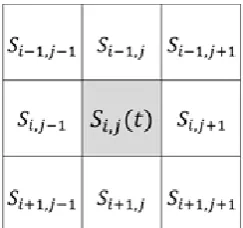
target road but also for a wide target area, it is necessary to simplify the calculation. In the research of Emori et al. [3], all agents on all designated roads were simulated, but applying this method to all roads is difficult due to the computational complexity problem. Therefore, in this study, the calculation using cellular automaton method is used. In this way, the space represented by a two-dimensional plane is partitioned by lattices (cells), and states of the partitioned area are allocated to the cells. The number of states of each cell is a definite. The next state of the cell is determined by the state transition rule defined in advance from the current state Si,jof the cell and the current states Si-1,j-1, …, Si+1,j+1 of the eight
adjacent cells (Fig.1).
In the existing evacuation behavior simulation based on the cellular automata method, agents are placed in the cell and each agent decides the cell and state to shift to next from the state of staying cell and neighboring cells [9]. However, when agents are generated for each evacuee in this way, the calculation load on the wide area simulation is extremely high. And therefore, instead of treating evacuees in the cell as individual agents, only the number of evacuees for each attribute in the cell is held as data.
Since attribution of a cell has been shown that it will be affected by tourism facilities such as transportation facilities and sightseeing spots, the following attributes are specifically considered.
Visiting spots
Shelters
Open Spaces, such as parks
Accommodations
Transportation facilities such as stations
Fireplace
[image:3.595.107.229.492.606.2]As for the fireplace, we consider this site as the attribute of a cell because there is a change in evacuation behavior when a fire occurs [5].
Fig. 1. States of the current and the neighboring cells of Cellular Automaton
C.Modeling tourists
In this section, we will explain factors that move the behavior of tourists. First, we would like to describe the leaders who can influence the evacuation behavior of tourists. The examiner will consider what type of evacuation route and how to induce efficient and safe guidance. In this case, the examiner has to consider how to arrange a limited number of leaders [2]. In the captioned research of Emori et al. [3], an arrangement function of an inducer is also proposed. Therefore, also in our system based on cell automata, the inducer is placed in the cell designated by the examiner. The leader does not move to the neighboring cells
and keeps staying in the specified cell.
Next, we consider attributes of tourists who are evacuees. In this study, we consider both evacuees who follow induction and evacuees who do not follow guidance, which was considered in the study of Emori et al. [3].
The behavior model of evacuees who follow guidance is as follows: It moves according to the evacuation route entered by the examiner. However, a certain percentage of evacuees following the guidance in each cell does not follow the induction. This percentage will be higher if there are sightseeing spots, open areas, accommodation, transport facilities, and fire placement sites in the resident cells and neighboring. If the destination cell is a place of fire occurrence, move to one of the cells adjacent to the destination cell. When evacuees arrive at the cell of the specified evacuation center, the movement ends.
Next, the follows are the behavior models of the evacuees who do not follow guidelines. We classify evacuees who do not follow guidance into three types: intention-oriented type, explorative type, and directional type as indicated research of by Nishino et al [5]. The classification follows the ratio indicated in the existing study [5]. Intention-oriented type moves toward the nearest sightseeing spot, transportation facilities or evacuation center. They are set to their destination at first, then move to the neighboring cells according to the shortest path to the destination. The explorative type randomly selects the neighboring cells as their next cell, but if there are sightseeing spots, evacuation centers, vacant lots, transportation facilities in the neighboring cells, they move there and stay. The directional type continues to move in a randomly decided direction first, but if there are sightseeing spots, evacuation centers, vacant lots, transportation facilities in neighboring cells, they move there and stay. In either case, if the destination cell is a place of fire occurrence, it moves to one of the cells adjacent to the destination cell. However, refugees who do not follow the guidance reach to the cell where an inducer is located, some of them selected with a certain percentage will follow the induction.
D.Input / output interface
In this section, we describe the input/output interface to the examiner. For the input, the examiner can input the following matters.
Evacuation starting points
Number of people at the evacuation starting points
Evacuation routes to induce
Cells where to place an inducer
Cells of fire occurrence
Regarding the setting of each point, it can be set by selecting the corresponding cell. The number of people at the evacuation starting point is entered in the specified field. For evacuation routes, cells corresponding to the routes are selected by consecutive selection.
discussion in our next section.
E.Outline of prototype system
In this research, we build a prototype system using artisoc 4.0 developed by Structural Planning Laboratory [10]. While executing a simulation, it is possible that the examiner adjusts the execution speed of the simulation, so the following buttons are set on the screen of the system (Fig.2):
1) "Execute" button: Start simulation
2) "Step Execution" button: Execute simulation for one step
3) "Pause" button: Pause simulation 4) "Stop" button: End simulation
[image:4.595.307.560.110.406.2]5) "Execute Wait" button: Adjust simulation execution speed on the analog scale
Fig. 2. The buttons in the prototype simulator.
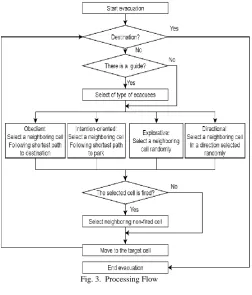
A rough progress of the entire simulation of this system is shown in Fig.3. When the evacuation starts, evacuees judge destination. If own cell is not the destination, evacuees search inducer. If evacuees follow the guidance, they change their type of refuge to obedient one. So, evacuees select a neighboring cell following shortest path to the destination.
However, if evacuees do not follow guidance, evacuees select one of three types of evacuee: Intention-oriented type, explorative type, and directional type. Intention-oriented type selects a neighboring cell following shortest path to a park. Intention-oriented type selects a neighboring cell randomly. Directional type selects a neighboring cell in a direction determined randomly when they change their type to directional one. However, if the selected cell is fired, evacuees decide non-fired cell neighboring to the selected cell as the next cell. If evacuees reach the target destination, evacuation end.
IV. SYSTEM EVALUATION
In this research, we are planning to present evacuation status in simulation to investigators by expressing the state of each cell in color. Therefore, it is commonly believed that the choice of the color has a big influence on the recognition of the evacuation situation. The color should be easy for the reviewer to recognize. Therefore, we conducted experiments on impressions received when various colors were drawn in cells on the electronic map. This section describes this experiment and its results.
A.Objectives of the Experiment
Since evacuees have several attributes, it is necessary to draw multiple colors to represent the states of the cell. In this experiment, three colors of red, yellow and blue were selected to express the state of evacuees. And four colors are set to represent attributes of cells as special facilities. In this
experiment, we examine which color is readily and visually recognized when these were drawn on the simulation screen at the same time, examine.
Fig. 3. Processing Flow
TABLEI
COLORS USED IN EXPERIMENTS
Attribute Color
name RGB
Displayed color Evacuee Red R:255 G:0 B:0
Evacuee Yellow R:255 G:255 B:0 Evacuee Blue R:0 G:0 B:255
Park lime R:0 G:255 B:0 Inducer Purple R:128 G:0 B:128
Fire Grey R:123 G:123 B:123 Destination Black R:0 G:0 B:0
B.Experiment method
Table I shows the names of the color used in this experiment, their RGB value, and the actual illustration of the colors. It represents 7 colors for 5 attributes, evacuee, park, inducer, fire, and destination.
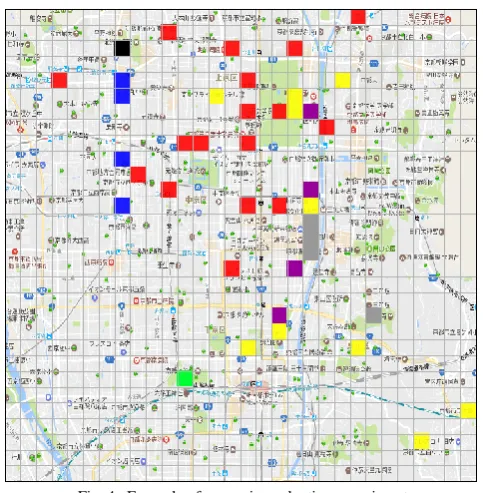
[image:4.595.44.293.243.335.2]Fig. 4. Example of screen in evaluation experiment
C.Cell state change
We look into the change of the color applied to the cell. Initially, evacuees are assigned to a cell inputted by the examiner. The evacuees are classified into two types: One is obedient, and the other is non-obedient. The non-obedient type evacuees decide their movement based on the flow defined in Section III-E. Note that the initial type of evacuees is neither obedient nor non-obedient. Evacuees of the initial type moves to the neighboring cell selected randomly. They set their type when they meet an inducer.
In this experiment, the desired destination (e.g., evacuation shelter) and the non-desired destination are set in one cell respectively. The desired one is Kitano-tenmangu, which is colored by black, and the non-desired one is Umekoji park colored by green. The obedient evacuees move to the neighboring cells following the shortest path to Kitano-tenmangu. The destination of non-obedient evacuees is Umekoji park, they continue their movement according to the process flow in Fig.3 until they reach the destination. If they visit cells where an inducer is assigned, they change their type, obedient or non-obedient, with a certain probability, which is designated by the examiner. If the target cell to move has fire attribute then the evacuees change their next cell to the neighboring non-fired cell. They travel at the constant speed during simulation.
In this experiment, we conducted three experiments changing the number of colors representing the evacuees. In the case that we use only one color, all of the evacuees are represented by red. In the case of using two colors, all of the evacuees are represented by red initially. When they meet an inducer and change their type, the obedient evacuees are represented by blue, and the non-obedient evacuees are represented by red. In the last case where we use three colors, evacuees of initial type are assigned red, the obedient ones are assigned blue, and the non-obedient ones are assigned yellow.
In the t step of the calculation, if a certain cell is painted with color x, this destination cell is painted with color x at t+1 step. Evacuees who have reached destination do not move, so
color x is disabled.
D.Experimental collaborators and experiment procedure
We showed a usage example of this system to 9 experts from 20-54 age, with 7 male and 2 female, from the Disaster and Crisis Management Office of Kyoto in order to inspect the effectiveness of the system in December 2017. Table Ⅱ shows details of experimental collaborators. They were given the evaluation settings, and input them to our system. Collaborators also set 4 cells as an inducer whose color is purple. They were located in Kawaramachi Dori. Experts set the obedient rate of evacuees. The rate was 91% and 69% as indicated research of by Nishino et al [5]. In addition, there is three type of colors of evacuees: one color, two colors, and three colors. In other words, We conducted six times experiments by two type of obedient rate and three type of colors. TableⅢshows the evacuation settings used during the evaluation of this system. We asked experts to sit in front of the display and ask them to watch the simulation for 10 minutes. After that, we conducted an evaluation questionnaire.
TABLEⅡ
ATTRIBUTES OF EXPERIMENT COLLABORATORS
Number of experiment
collaborators 9 Sex Male:7 , Female:2 Age 20-54 Current job experience(year) 1-10
TABLEⅢ
EVACUATION SETTINGS
The evacuation guidance guides the evacuees from Gion-shijo to Kitano-tenmangu. At the same time, non-obedient evacuees are head for Umekoji park. Inducers are located at Kawaramachi Dori. Two types of obedient rate are 91% and 69%. Three types of color representation are one color, two colors, and three colors.
E.Experimental Results and Discussion
We showed the system screen to the experts and evaluated using the following questions:
“Can you confirm the change of evacuation when you change arrangements of inducer?”
“Can you confirm the change of evacuation when you change the rate of obedience?”
“Is it easy to find out the evacuation visually when the evacuee color is only one color?”
“Is it easy to find out the evacuation visually when the evacuee colors are two colors?"
“Is it easy to find out the evacuation visually when the evacuee colors are three color?”
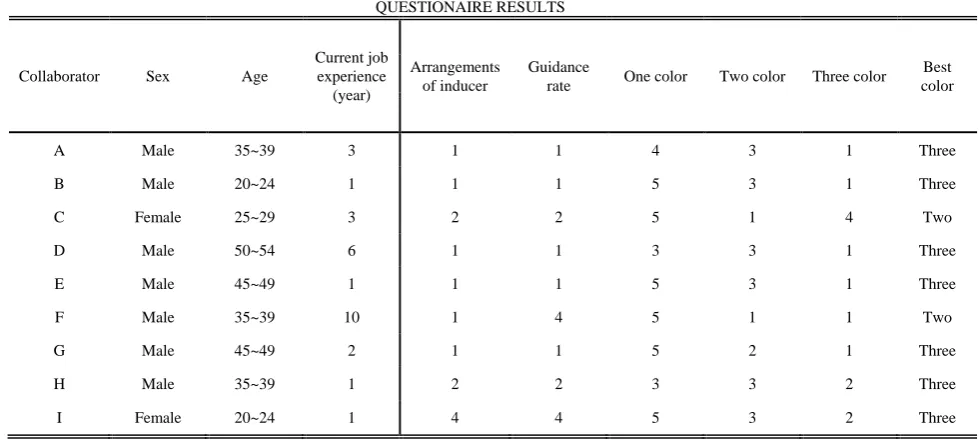
“How many evacuation colors is the best for you?”. Table Ⅳ shows the results. The evaluation represents 1:excellent, 2:good, 3:average, 4:below average, 5:poor.
We were able to obtain good evaluation results about the examination of the evacuation about “Can you confirm the change of evacuation?”.
find out the evacuation visually when the evacuee color is only one color?". The evaluators pointed out that one color is difficult to find out the motion of each cell visually for evaluators. However, we were able to obtain good evaluation results about two and three colors of the evacuee. The best number of color is three colors.
Furthermore, in this evaluation, we found out experts need some improvement this system: They required the function of 1) Setting for the place, four seasons and time zone that
many tourists come.
2) Setting changes in the condition at the time of disaster (morning, daytime, evening, night time).
3) Setting the situation when the evacuees can be an inducer.
4) Setting evaluation and visualization that each of the inducers works together.
5) Clarifying differentiation of representation between real inducer and direction board.
V. CONCLUSION
In this research, we investigate the support system which is used when evaluator discussed evacuation method. We discussed this color represent it should be considered at that time by cellular automaton and simulator suggestion. In particular, examination for evaluating recognition of color representation was carried out by members of the expert. The evaluation expressed in color by one color, two colors and three colors when the state of evacuees move on the screen. As a result, representation of three colors is the best to recognize visually of others.
In addition, we found requirement specification. 1) Place, four seasons and time zone.
2) Changes in the condition.
3) The situation when the evacuees can be an inducer. 4) The situation the inducer works together.
5) Real inducer and Direction board.
If we can meet these requirement specifications, this system becomes increasingly effective. In addition, we are
able to contribute more specific evacuation plan with other simulators.
REFERENCES
[1] Kyoto City Industrial Tourism Department, “General survey of tourism in Kyoto”, 2017.
[2] Kyoto City Fire Department, “A guideline for support people who are unable to return home after disasters,” 2013.
[3] N.Emori, T.Kitamura, T.Izumi, and Y.Nakatani, “A support system for developing tourist evacuation guidance,” Journal of Information
Processing Society of Japan, vol.78, pp.151–152, 2016.
[4] Kyoto City Local Finance Department (Crisis Management Office), “A survey of evacuation simulation of disaster prevention measure for tourists in an earthquake”, 2012.
[5] T. Nishino, K. Ohashi, and A. Hokugo, “Tourists behavioral tendency expected in post-earthquake fire evacuation,” Journal of the Architectural Institute of Japan, vol. 81, no. 719, pp. 1–8, 2016. [6] Y. Kumagai, “Evacuation model theory (Urban planning),” vol. 89, pp.
40–50, 1976.
[7] J. Lee, “development of support model for evacuation advisory for large crowd and motion of pedestrian for leading crowd,” Dissertation thesis, Graduate School of System and Information Engineering, University of Tsukuba, 1992.
[8] Y. Morimoto, O. Kurita, and K. Tanaka, “An Evaluation Model for Evaluation Behavior in a Congested Buildings Considering the Pedestrians Choice Behavior of Exit,” Journal of the City Institute of
Japan, vol.50, no.3, 2015
[9] F. Ohi and M. Onogi, “A simulation of evacuation dynamics of pedestrians in case of emergency by a 2-dimensional cellular automaton method,” Journal of Transaction of the Operation Research
Society of Japan, vol.51, pp.94–111, 2008.
[10] S. Yamagata, “Introduction to multi-agent simulation by artisoc” Tokyo: Hayama book studio, 2007.
TABLE Ⅳ
QUESTIONAIRE RESULTS
Collaborator Sex Age
Current job experience
(year)
Arrangements ofinducer
Guidance
rate One color Two color Three color Best color
[image:6.595.54.544.71.291.2]