Further Reading
Adams, BA and Holmes EL (1935)J.Soc.Chem.Ind., 54. Dale JA and Irving J (1992) Comparison of strong base resin types. In: Slater MJ (ed.) Ion Exchange Ad-vances } Proceeding of IEX’92, pp. 33}40. Lon-don/New York: Elsevier Applied Science.
Golden LS and Irving J (1972) Osmotic and mechanical strength in ion-exchange resins.Chemistry and Industry, 837}844.
Mikes J (1958)J.Polym.Sci., 30, 615}23.
Williamson WS and Irving J (1996) A preliminary compari-son of Type II and Type III strong base anion resins at the new Plymouth power station, New Zealand. In: Grieg JA (ed.) Ion Exchange Developments and Ap-plications } Proceedings of IEX’96, pp. 43}50. UK: The Royal Society of Chemistry.
ION EXCHANGE: ZEOLITES
See III / ZEOLITES: ION EXCHANGERS
ION FLOTATION
L. O. Filippov, Laboratoire Environnement et Mine&ralurgie, INPL-ENSG, Nancy, France Copyright^ 2000 Academic Press
Introduction
Sebba published a paper in 1959 in which he
dis-cussed a new method (ion Sotation) for recovering
solute from dilute solutions by adding surfactant, with subsequent adsorption of the solute onto bubbles. The principles of the process and the
charac-teristics of the solute}surfactant product formed in
solution were discussed in his monograph on ion
Sotation published in 1962. The method rapidly
be-came popular and researchers in several countries have studied various aspects of the separation of metallic ions, trace elements, molecules, inorganic anions and organic matter from aqueous solutions. Many laboratory-scale studies have been carried out, most of them aimed at development, analytical
ap-plications, water puriRcation, resource recycling,
re-moving radionuclides from solutions, and recovering metals from sea water.
A comprehensive development of all aspects of the subject was presented in a monograph on adsorptive bubble separation techniques, edited by Lemlich in 1972, in which details and applications of ion and
precipitateSotation methods were reported by Pinfold.
The research group directed by Grieves made an important contribution to the theoretical and applied
aspects of ion and precipitate Sotation during the
1960s, particularly on wastewater treatment. They
showed that Sotation efRciency of long-chain
sur-factants was the result of physicochemical aspects of particle growth and dispersion. But the adsorption of surfactant onto the solid and gas phases was
identi-Red as a factor limiting bubble-particles attachment
in some cases of ionSotation.
The adsorption of the surface-active solutes to the
gas}liquid interface was studied by Rubin. An
analy-sis based on the Gibbs and Langmuir isotherm and on an originally developed approach of long-chain ion adsorption in a solution containing several surface-active species was used to determine the effect of their concentrations on the ratio of distribution
coef-Rcients. This author also described the kinetic
para-meters for ion and precipitateSotation.
A detailed review of the precipitate and adsorbing
colloidSotation technique with a comprehensive
lit-erature review appears in the monograph published in 1983 by Clarke and Wilson.
Golman has given a qualitative description of the
chemical and kinetic aspects of ionSotation and some
industrial applications, including the removal of
mol-ybdenum from solutions of hydrometallurgicalS
Figure 1 Schematic classification of the adsorptive bubble-separation techniques. (Reproduced with permission from R Lemlich (1972)Adsorptive Bubble Separation Techniques. New York: Academic Press. Copyright.)
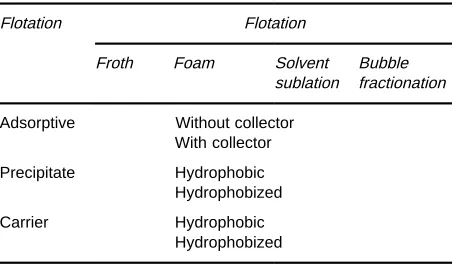
Table 1 Classification of ion-recovery method Flotation Flotation
Froth Foam Solvent sublation
Bubble fractionation Adsorptive Without collector
With collector Precipitate Hydrophobic
Hydrophobized Carrier Hydrophobic
Hydrophobized
Relatively few studies on this subject have been published recently. They focus mainly on extending the applications of the method. The progress made in
column Sotation techniques, especially with bubble
generation systems, offers hydrodynamic
condi-tions favourable for ion Sotation. Filippov has
re-ported on the results of recent pilot-scale studies
applying this technique to precipitate and ion S
ota-tion. It was demonstrated that aggregate formation and destruction under low dissipation energy are the
parameters controlling precipitate Sotation. The
combined use of column and bubble spargers in ion
Sotation provided a removal rate for metals
equiva-lent to that of laboratory-scale trials.
Phenomenology and Classi
\
cation
Separation by adsorption onto bubbles is based on the difference between the surface activities of the solute species. These species can be ionic, molecu-lar, or colloidal, and their adsorption onto the
bubble}liquid interface depends on their
surface-active, adhesion or electric properties. A species that is not adsorbed onto bubbles can be made to do so by adding a surfactant to the solution.
The classiRcation of methods based on these
separ-ation phenomena are shown inFigure 1. Lemlich called
these processes ‘adsbubble (adsorptive bubble) separ-ation methods’, while the term ‘adbubble method’ was recommended by Sasaki, since the method involves
both adsorption and adhesion. The classiRcation of
these techniques in Figure 1 is based on the formation of the foam, which leads to two main groups:
E foam adsorptive separation and
E non-foaming bubble separation.
The nature of the entity is introduced later.
The Golman classiRcation based on the phenomena
at the various levels of process leads to another
classi-Rcation of ion recovery process (Table 1). This
classi-Rcation take into account:
E the type of phase that accumulates theSoated
spe-cies: foam, scum, organic or aqueous phase;
E the nature of the components to be adsorbed onto
the bubble surface: ions or molecules, particles of the precipitate or carrier; and
E the collector use to modify the hydrophobic
prop-erties of the entities
Ion Flotation
De\nition
Ion Sotation, developed by Sebba, is a
surface-inactive separation method that involves the removal
of ions or molecules (colligend) from aqueous
solu-tion by adding surfactant, that is adsorbed onto the
surface of rising bubbles. The surfactant}colligend
[image:2.568.290.516.579.711.2]Figure 2 Colligend recoveryR (1, 2) and surfactant residual concentrationC(RX)r(1, 2) vs. surfactant consumption for a given
sublat solubility productPs: 1,1!Ps"10\9, 2,2!Ps"10\10.
Solid lines, calculated results from eqn (1);*, experimental re-sults of ion flotation of ReO\4 with laurylammonium chloride,
LA"3.9;10\7. (Adapted from AM Golman (1982) Ionnaya
Flotatsiya, p. 42. Moscow: Nedra.)
only at the higher concentrations produced by prefer-ential adsorption on the bubble surface. The process is calledadsorptionionSotation if the sublat is a
sol-uble complex or a pair of ions. The process is
ad-hesionionSotation if the sublat forms a new phase in
aqueous solution. A hydrophobic product (scum) is
formed at the surface of the solution by destruction of the rising bubbles.
The formation of foam is not necessary for ion
Sotation. The hydrophobic nature of the scum makes
it stable on the solution surface. A foam thin-layer phase may be needed to isolate the scum from the liquid phase and to evacuate it later to avoid it redis-solving. Stable foam is a factor limiting the
applica-tion of ion Sotation, because it requires less foam
formed or a lower gas rate. Solution entrainment also decreases the colligend concentration in the foam.
If the formation of a foam during ion Sotation is
undesirable or impossible (i.e. recovery of organic
ions or quantitative separation), the process of
sol-vent sublationis used. This method involves spread-ing a thin immiscible organic solvent layer on the
surface of the water causing dissolution of theS
oat-ing sublat.
Theory
There are several ways to describe ionSotation and to
determine the quantity of surfactants required for optimal separation. One considers the bubble surface to be an ion exchanger owing to surfactant adsorp-tion. The charge created is compensated for by the adsorption of inactive ions of opposite charge. Jorne and Rubin assumed that the radius of the hydrated ions determined the maximum approach of opposite ions to the bubble surface, based on the theory of a double electrical layer. Their theoretical
calcu-lations were conRrmed experimentally. Another
ap-proach highlights the stability constants of soluble compounds (complexes and pairs of ions) formed by the surfactant with the colligend and an oppositely charged ion, according to Moore and Philipps. Some believe that a solid phase is formed (assumed to be two-dimensional) in the adsorption layer on the bubble surface. These assumptions mostly concern
the adsorption mechanism of ionSotation.
Sebba and Golman used the product of the
activ-ities of the collector and colligend (LA) to explain
adhesion. The equilibrium of the system is
deter-mined by the constant of stability of sublat KA and
the solubility of its molecular form SAM, when
LA"KASAM. If we assume that a sublat Sotation
occurs as a colloid rather than molecules, the
frac-tion P of the stoichiometric ratio of collector/
colligend molar concentrations is given according to
Golman by:
P"R#l m
KLA fm
RXfAl(1!R)lCmA#l
[1]
whereRis the rate of colligend recovery;fRX, fAare
the surfactant RX and colligend A activity coefR
-cients respectively;CAis the colligend concentration;
m and l are the stoichiometric coefRcients of the
reaction of sublation of A by RX.
The parameter (LA)P/Rcalculated from this formula
allows the deduction of the value ofLAthat is needed
to obtain a recovery Rfor a given . This formula
does not take into consideration changes in the ionic
strengthIwith collector concentration. However, for
the characteristic colligend concentrations and for
being practically stoichiometric the parameter
Idoes not limit the application of this approach. This
was conRrmed by Golman for the ion Sotation of
various species.
The inSuence of the surface-active species
co-ncentration and solubility product PS of sublat
(PS"constant for I"constant) on the recovery of
the colligend and the residual surfactant
concentra-tion is given in Figure 2. This conRrms the
experi-mental results. It is preferable to carry out ionic
Sotation in the concentration ranges of the collector
so thatP"1 (values of are stoichiometric).
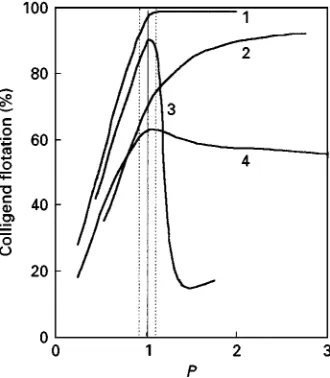
Figure 3 Dependence of the flotation of various colligends on the fraction (P) of collector : colligend ratio (): (1) Ge3##
tetra-decylammonium chloride (st"2); (2) ReO4\#laurylammonium
(st"1); (3) Cr6# with hexadecylammonium bromide (st"
1.04); (4) Ga3##amide oxime (st"3). (Adapted respectively
from: (1,2) AM Golman (1983)Fiziko-khimitcheskie Aspekty Ion-noi Flotatsii, p. 245, Moscow: Nauka; (3) The Chemical Engineer-ing Journal 9: R Grieves Foam Separations: A Review, 93, Copy-right (1975), with permission from Elsevier Science; (4) with permission from A Masuyama et al.Industrial Engineering Chem-ical Research 29: 290, Copyright (1990) American ChemChem-ical Society.)
considerable residual concentration of collector in
the bulk solution when P'1 decreases the process
efRciency (economic). This makes it difRcult to
reuse a solution without puriRcation and/or
environ-mental problems. The excess collector also prevents
Sotation because of secondary adsorption onto
bub-bles and sublat surfaces if the sublat is solid, as demonstrated by Grieves and Golman.
Colligend : Collector Ratio
Ion Sotation operates with dilute solutions of the
colligend (10\5 to 10\3mol L\1). Higher colligend
concentrations require signiRcant collector
consump-tion, increasing the operation costs. The ratio of
collector and colligend molar concentrations is one of
the main parameters of ionSotation. The changes in
the amount of colligend removed withis shown in
Figure 3, which are typical of ion-Sotation systems.
As noted by Pinfold, the ratiorequired for
com-plete Sotation must be at least stoichiometric (st).
This is true for the adhesion mechanism of ionS
ota-tion, but with adsorpota-tion, the amount of collector
that can Soat without sublation depends on the
bubble residence time in the liquid. The colligend cannot be completely removed in this case with a
stoichiometric. The experimental results of Doyle,
available in the literature, show that slightly more than stoichiometric amounts (P"1.1}1.2) of sodium dodecyl sulfate were needed to reduce the heavy metals ion concentration to very low levels.
More-over, the curve behaviour around pointP"1 in
Fig-ure 3 could indicate the mechanism of ionSotation.
Role of Electrolytes and Anions
The role of electrolytes is signiRcant during the
collec-tor-colligend and sublat}bubbles interaction. Their
role must be taken into account because of their signiRcant quantities in real industrial solutions. Elec-trolytes modify the ionic strength and can react with
the collector. For I"constant, two cases are
pos-sible:
1. The opposite-charged ion forms a soluble product with the collector. The separation is more selective for higher colligend and for low opposite-charged ion concentrations. A higher collector
concentra-tion than that required by also renders ion
Sotation more efRcient.
2. The collector}colligend interaction product is
in-soluble. A critical concentration of the opposite
ion can be deRned, below which it does not react
with the collector and consequently does not inS
u-ence further colligend recovery.
Changing the ionic strength by adding NaCl allows
the selective separation of metal oxyanions (MeO4\
or MeO2\) with
hexadecyldimethylbenzylam-monium chloride as collector (Figure 4). The
recov-ery of oxyanionSotation as a function of p[NaCl]
illustrates the phenomena described above.
The change in ionic strength of the medium caused by adding anions reduces the effectiveness of ion
Sotation. TheSotation of dichromate with a
quater-nary amine (adhesion mechanism) is blocked in the
sequence, according to Grieves: PO3\
4 'SO24\'
Cl\. The recovery of Fe(CN)4\
6 with a cationic
collec-tor is inSuenced by: CN\'NO\3'Cl\'SO24\'
CO2\
3 'PO34\'P2O47\. This contradiction can be
explained by the process taking place in each case.
The foamSotation of dichromate is controlled by
the preliminary formation of a solid phase followed by adsorption onto bubbles (similar to precipitate
Sotation). The adsorption of differently charged
ions inSuences surface hydration of the bubbles and
the precipitate, the importance of which is directly
related to the charge of the anion. FerricyanideS
Figure 4 Effect of the negative logarithm of the sodium chloride concentration on the percentage flotation of each of five metal oxyanions. (Reprinted fromThe Chemical Engineering Journal 9: R Grieves Foam Separations: A Review, 93, Copyright (1975), with permission from Elsevier Science.)
surface can cause solvent to dissolve and become adsorbed onto the bubble surface instead of the col-lector. Under these conditions the lower charged anions neutralize the adsorbed collector, so that it is
no longer available toSoat the colligend.
pH
Ion Sotation is particularly sensitive to the pH
be-cause the pH determines the nature and the charge of the collector (the degree of ionization) and the col-ligend (hydrolysis), and causes variations in the ion-collecting mode. Pinfold also notes that the following phenomena that can take place when the pH changes:
E colligend hydroxides may form, and precipitate
Sotation may take place instead of ionSotation;
E extreme values of pH blockSotation because the
ionic strength is higher;
E the stability of scum could be affected because
of sublat redispersion in the solution.
Temperature
The temperature inSuences all aspects of ion S
ota-tion, i.e. the collector and sublat solubility, the sublat
particle size and the Sotation results. Its role were
conRrmed by Grieves for the Sotation of Cr6# at
pH"4.1 with quaternary amine salts with
hydrocar-bon chains of C14, C16 and C18. The collector used
acted as a precipitant, dispersing and Socculating
agent depending on the temperature, determining the orientation of the collector molecules adsorbed on the sublat surface. The surfactant also acted as foaming agent because of the free collector adsorbed on the bubbles.
Optimal metal removal with C16- and C18-amine
salts occurred with "1.04 and 33 or 403C. The
abrupt drop in removal rate at higher values ofwas
explained by excess surfactant adsorbing to the par-ticles, stabilizing them and preventing further
ag-gregation. One of the most signiRcant conclusions
deduced from these experiments is that the particles
of the precipitate '25m are completely removed
from solution, while almost no particles(7m are
Soated.
Precipitate Flotation
According to Pinfold, precipitateSotation includes all
processes in which an ionic species is precipitated in the liquid phase and is subsequently removed by
at-tachment to the bubble surface. It is difRcult to
clearly distinguish between ‘ion Sotation’ and
‘pre-cipitate Sotation’ when a collector is used as a
pre-cipitation agent.
If the colligend is Rrst precipitated by a
non-sur-face-active ion and made hydrophobic by adsorption
of a surfactant, the process is termedprecipitateU
ota-tion of theTrst kind. Many studies have been carried out on the removal of metal ions from aqueous solu-tion (i.e. sea water) by this method. Heavy metals are generally precipitated with an alkali as the hydroxide
and then removed bySotation with an ionic collector.
The other insoluble salts (sulRde, carbonate, sulfate)
can be precipitated.
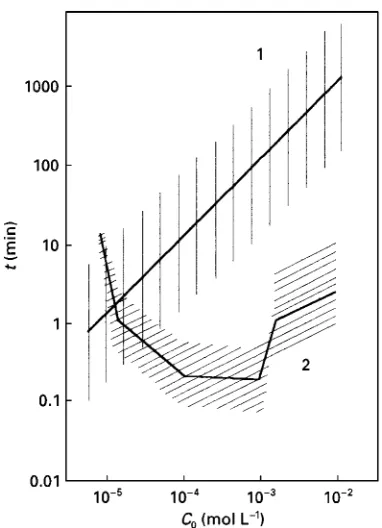
Figure 5 Comparison of the kinetic of adsorption and adhesion mechanism of ion flotation. (1) Adsorption mechanism; (2) ad-hesion mechanism. (Adapted from AM Golman (1982)Ionnaya Flotatsiya, p. 29. Moscow: Nedra.)
Colligend Collector
Ba2# Laurylsulfonate-Na
Ag(S2O3)\ Cetyldiethylbenzylammonium-Br
UO2(CO3)43\ Cetyltrimethylammonium-Br
H3W6O321\ Laurylammonium-Cl
H3Mo7O324\ Cetylpyridinium acetate
Cetyltrimethylammonium-Br Amine-C14
Ge3# Laurylammonium-Cl
Cetyltrimethylammonium-Br
agent) is hydrophobic. The following precipitants have been used for various metal ions: benzoinoxime
(Mo, Cu), benzoylacetone (U), -furyldioxime (Ni),
hydroxyquinoline (Cu, Zn, U), -nitroso--naphthol
(Ag, Co, Pd), dodecylpyridinium with a collector (Sr, V), etc.
Kinetics
IonSotation controlled by adhesion is a
precipitate-like Sotation because the sublat formed is a solid
phase that can also be Socculated by adding active
chemical agents or by the action of the collector. The
two ionicSotation modes (adsorption and adhesion)
may be distinguished at the level of particle}bubble
interaction, depending on the nature of the sublat.
E The sublat formed is an ionic pair or a soluble
complex (adsorption): the adsorption activity of these species on the bubbles determines the ef-fectiveness of the process.
E The sublat is formed in the liquid phase as particles
of 10\3 to 10\1m: the interaction of the sublat
and the bubbles is controlled by the diffusion
of the particles in the hydrodynamicRelds of the
bubbles.
E The sublat is a precipitate with micron- or
milli-metre-sized particle: the interaction results in sedi-mentation of the particles of negligible mass on the bubbles if the surface forces support the attach-ment of the entities.
The time necessary for 90}99% colligend recovery at
colligend concentrations of 10\5 to 10\2mol L\1
indicates that sublatSotation as a precipitate is
kin-eticically preferable than Sotation of the molecules
(Figure 5). The Sotation mechanism was concluded from independent experiments on the solubility prod-uct, microscopy, separation of the precipitated phase
by centrifugation andRltration.
Few studies on the kinetics of ion Sotation are
published, while there are many papers on mineral
particleSotation. However the kinetic parameters of
the process determine the practical applications of
Sotation because they determine the scale-up
proced-ure adopted.
Apparatus: Future Developments
Almost all ionSotation tests are carried out in cells
(batch or continuous mode) equipped with a sin-tered-glass device to generate bubbles. The use of the column-type cells allows the user to: vary the intro-duction point of the collector and feed solution con-taining the colligend; vary the height of the foam;
carry out sampling and/or in situ measurements if
radioactive ‘tracers’ are used.
The most recent bubble-generating systems make
columnSotation aSexible tool for ionSotation.
A study of sublat formation and its structural or-ganization showed that a column 75 mm in diameter
and 3 m high could be used for ionSotation (Cr6#)
and for precipitate Sotation (molybdenum). The
bubble diameter determined the efRciency of
sep-aration by ion and precipitate Sotation because of
collision probability and aggregate stability in the microturbulence created by the rising bubbles. The
Sotation with small bubbles as in the dissolved-gas
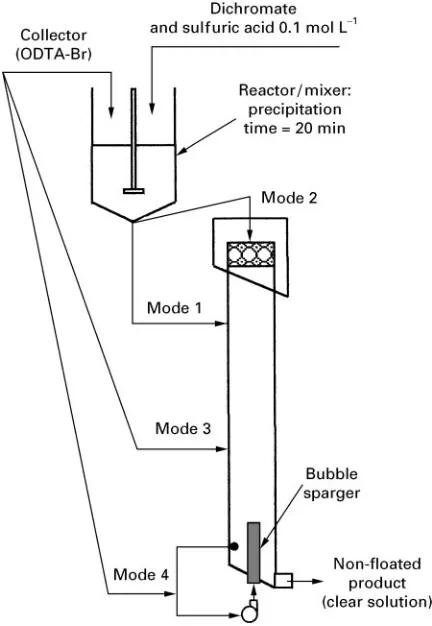
Figure 6 Ion flotation modes using column for Cr6#recovery
with ODTA-Br. Mode 1: precipitation}flotation. Mode 2: foam fractionating. Mode 3: ion flotation. Mode 4: precipitation on bub-bles. (Reprinted from Filippov LOet al. Physicochemical mecha-nisms and ion flotation possibilities using column for Cr6#
recovery from sulphuric solutions,International Journal Mineral Processing 51: 229, Copyright (1997), with permission from Elsevier Science.)
bubbles. In addition, theSotation mechanism in this
kind of technique, in which several small rising
bubbles are trapped in a large precipitateSoc
struc-ture, can cause transfer of the liquid present in the aggregate to the froth and reduce the separation efRciency.
Ion Flotation in a Column
The ionSotation of Cr6#from sulfuric acid solutions
(pH 1.5}2.0) with octadecyltrimethylammonium
bromide (ODTA-Br) as collector is particularly
dif-Rcult because a single chemical acts as precipitating,
Socculating, dispersing and frothing agent. This is in
addition to the problems of Soating an element of
negligible mass. It is thus nearly impossible for the precipitate to become adsorbed on bubbles because of an electrical charge of the same sign (owing to free collector) on the bubbles and precipitate particles.
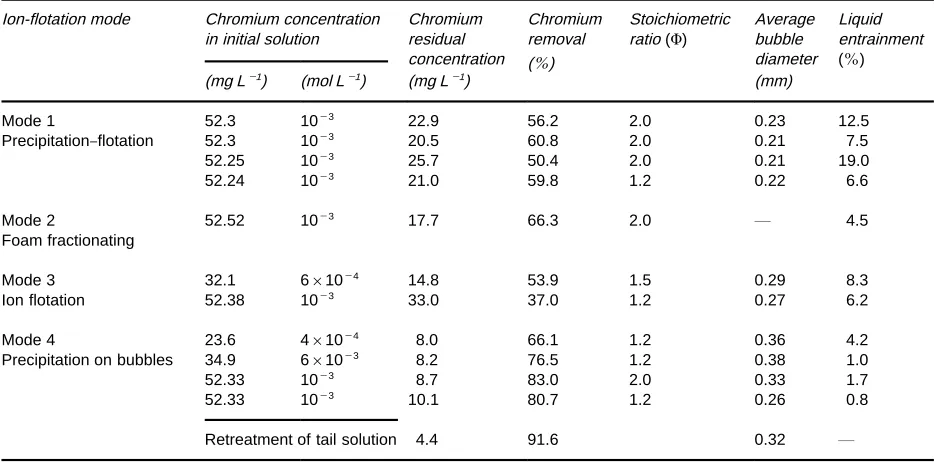
Several modes of ion Sotation have been tested on
a pilot scale (Figure 6).
In the classical mode of ion Sotation
(precipita-tion}Sotation as described by Grieves), only the
200}240m diameter bubbles provide a low
chro-mium recovery of 56.2}60.8%. An exceptionally
stable, loaded froth with the liquid (7.0}19.0%) was
carried over, which decreased the separation efR
-ciency (Table 2). Some column/bubble generator
assemblies can be used to solve the problems of bubble-precipitate electrostatic repulsion and colli-sion. It has thus been possible to develop a new mode
of ion Sotation in which the chromium solution
is introduced directly at the feeding point of column and the collector is introduced to the bubble generator. The strong surfactant properties of the collector caused to be adsorbed on the bubbles so that the chromium was precipitated on the gas phase. This
new method gives about 81.6% Cr6# removal by
columnSotation for a"1.2 and a liquid residence
time of 15}20 min. Retreatment of the solution
can increase the total Cr recovery to 91.6%,
with a Cr residual concentration of 4.5 mg L\1,
which corresponds to separation results by R
ltra-tion.
Precipitate Column Flotation
The limiting conditions for molybdenum metal}
organic precipitateSotation in columns are owing to
aggregate stability under the turbulence created by upward movement of bubbles, which depends
dir-ectly on the average bubble diameter. Pilot-scaleS
o-tation studies revealed the fundamental inSuence of
the average bubble diameter and dissipation energy on molybdenum recovery in the form of precipitate
obtained with the collector -benzoin oxime for
a molar concentration ratio of 2. It was therefore necessary to identify a bubble-size distribution and
the gas hold-up in the column to ensure theSotation
of low hydrophobic precipitateSocs, as they are
ex-tremely brittle with very low values of dissipated
energy (0.01}0.05 W kg\1). Destruction is
condi-tioned by the aggregation mechanism (cluster}cluster
type) and not only causes meanSoc size to decrease
from 150}350m to 30}50m, but also produces
very Rne particles that could elude collision with
bubbles. Bubble spargers (Microcel, Flotaire, Imox) tested on a pilot scale provided the required values
of these parameters for efRcient column Sotation
(recovery up to 95%) of the precipitate for low
super-Rcial gas (Jg"0.22}0.55 cm s\1) and feedSow rates
(Jl"0.19}0.47 cm s\1). An adjustment of the Jg/Jl
ratio to optimal hydrodynamic conditions in counter-current pilot column corroborated laboratory-scale
tests in the cell equipped with a Rne porosity frit
Table 2 Main results on the hexavalent chromium removal by column flotation according to Figure 6a
Ion-flotation mode Chromium concentration in initial solution
Chromium residual concentration
Chromium removal
Stoichiometric ratio ()
Average bubble diameter
Liquid entrainment (%) (mg L\1) (mol L\1) (mg L\1)
(%)
(mm)
Mode 1 52.3 10\3 22.9 56.2 2.0 0.23 12.5
Precipitation}flotation 52.3 10\3 20.5 60.8 2.0 0.21 7.5
52.25 10\3 25.7 50.4 2.0 0.21 19.0
52.24 10\3 21.0 59.8 1.2 0.22 6.6
Mode 2 52.52 10\3 17.7 66.3 2.0 * 4.5
Foam fractionating
Mode 3 32.1 6;10\4 14.8 53.9 1.5 0.29 8.3
Ion flotation 52.38 10\3 33.0 37.0 1.2 0.27 6.2
Mode 4 23.6 4;10\4 8.0 66.1 1.2 0.36 4.2
Precipitation on bubbles 34.9 6;10\3 8.2 76.5 1.2 0.38 1.0
52.33 10\3 8.7 83.0 2.0 0.33 1.7
52.33 10\3 10.1 80.7 1.2 0.26 0.8
Retreatment of tail solution 4.4 91.6 0.32 *
a(Reprinted from Filippov LOet al. Physicochemical mechanisms and ion flotation possibilities using column for Cr6#recovery from
sulphuric solutions,International Journal Mineral Processing 51: 229, Copyright (1997) with permission from Elsevier Science.)
Other Ion Flotation Related Processes
Bubble Fractionation
This is the partial separation of components within a solution by the selective adsorption of surfactants,
colloid or ultraRne particle species onto the bubble.
The effect of separation is demonstrated by a concentration gradient along the column-like cell that allows removal of a colligend-rich solution from the top and depleted solution from the bottom of the
cell. Separation efRciency clearly decreases with
increasing column diameter as a result of axial dif-fusion of rising bubbles, which breaks up the concen-tration gradient.
Adsorbing Colloid Flotation or Carrier Flotation
This consists of the preliminary capture of colligend by the carrier particles (by adsorption, absorption, or
co-precipitation), followed by charged-bubble S
ota-tion. Ion-exchange resin, activated charcoal, or the precipitate particles can be used as a carrier. The
carrier particles can have Sotation properties or be
made hydrophobic by adding collector.
Molecular Flotation (Koisumi)
This is the recovery of molecules using a surfactant.
The name molecular Sotation is use for allSotation
processes that involve the recovery of the molecular
colligend or those analogous to ionSotation.
Further Reading
Clarke AN and Wilson DJ (1983)Foam Flotation.Theory and Applications. New York: Marcel Dekker.
Filippov LO, Joussemet R and Houot R (1997) Physicochemical mechanisms and ionSotation possibili-ties using column for Cr6# recovery from sulphuric solutions.International Journal of Mineral Processing 51: 229.
Filippov LO, Joussemet R and Houot R (2000) Bubble spargers in columnSotation: adaptation to precipitate
Sotation.Minerals Engineering13: 37.
Grieves RB (1975) Foam separations: A review.The Chem-ical Engineering Journal9: 93.
Grieves RB, Bhattacharya D and Ghosal JK (1976) Surfac-tant}colligend particle size effects on ion flotation: InSuences of mixing time, temperature, and surfactant chain length. Colloid and Polymer Science, 254: 507.
Karger BL, Grieves RB, Lemlich R, Rubin AJ and Sebba F (1967) Nomenclature recommendations for adsorp-tive bubble separation methods.Separation Science 2: 401.
Lemlich R (ed.) (1972)Adsorptive Bubble Separation Tech-niques. New York, London: Academic Press.
Nicol SK, Galvin KP and Engel MD (1992) IonSotation }potential application to mineral processing.Minerals Engineering5: 1259.
Sebba F (1959) Concentration by ionSotation.Nature184: 1062.