Abstract— Energy potentials in three selected sites within Lagos
metropolitan were studied using three-, four- and five-years hourly wind speed data collected from Nigeria Meteorological Agency (NIMET) Lagos, Nigeria. Two-parameter Weibull, statistical analysis and power curve of Aeolos-V1000W were used to analyze the data. The results showed that annual mean wind speed at a height of 10m ranged between 1.86 and 3.05 m/s while 58.70% to 84.86% of the wind speed data were found to be less than 3.0m/s. The annual mean wind power densities (WPD) at height 10m are 60.66, 13.17 and 8.4 𝑾𝒎−𝟐 for Ikeja,
Lagos Roof and Lagos Marine respectively. The annual WPD for height 50m are 244.18, 61.81 and 42.55 𝑾𝒎−𝟐for Ikeja,
Lagos Roof and Lagos Marine respectively. The annual electrical energy output simulated from Aeolos-V1000W at height 10 – 100 m showed the values of 270.1 to 691.0 kWh, 140.6 to 494.8 kWh and 184.3 to 494.8 kWh for Ikeja, Lagos Marine and Lagos Roof respectively. The capacity factor at height 10 – 100m revealed the values of 0.1784 to 0.4509, 0.0671 to 0.2826 and 0.0275 to 0.1988 for Ikeja, Lagos Roof and Lagos Marine respectively. These results indicate that wind speed profiles in Lagos metropolis have feasible potential for small scale wind turbine applications at height 20 – 100 m in Ikeja and at height 90 – 100 m in Lagos Roof. The annual electrical energy output of the wind turbine at Ikeja site from height 70 – 100m surpasses the current average electrical energy consumption per household in Lagos.
Index Terms— energy potential, Lagos roof, wind power
density, wind turbine applications.
I. INTRODUCTION
nergy is a key component in the economic progress and social development of any nation [1, 2]. Energy can be classified into two forms: Renewable and Nonrenewable. Nonrenewable resources such as crude oil, gas and coal are the energy sources that are depletable while renewable resources such as solar, wind, hydropower, geothermal and tidal are inexhaustible sources of energy [3, 4].
Manuscript received June 1, 2019; revised June 3, 2019. Stochastic Analysis of Energy Potentials of Wind in Lagos Metropolis.
Olawale Olaniyi Emmanuel Ajibola is with the First Technical University Ibadan (On Sabbatical), KM 15, Ibadan – Lagos Express Way ([email protected]) and University of Lagos, Akoka, Yaba, Lagos 100213 Nigeria (Phone: +234 – 802 – 302 – 5053, e-mail: [email protected], [email protected])
Oluwaseyi Jessy Balogun is with Department of Biomedical Engineering, University of Lagos, Akoka, Yaba, Lagos 100213 Nigeria (e-mail: [email protected], [email protected]).
Nigeria government in collaboration with UNDP in 2006 initiated Nigeria Renewable Energy Master Plan (REMP) and in 2015 Federal Executive Council approved National Renewable Energy and Energy Efficiency Policy (NREEEP). These policies were aimed at increasing the contribution of Renewable Energy to account for 10% of Nigerian total energy consumption by 2025 [5, 6]. Lagos, a megacity in southwest region of Nigeria with population of about 25 million, is central to commercial and industrial activities of the nation. Electricity supply to Lagos metropolis from the national grid account for only 20% of total energy requirement of Lagos State. The grid system in Nigeria is powered by hydropower and turbo generators only. Currently, Lagos has energy deficit of over 4000 megawatts [7, 8, 9, 10]. At least 40% of Lagos residents have no access to electricity supply from the grid and 80% of households rely on fossil fuel generators [11]. The average annual energy consumption per household in Lagos is 548kWh which is marginally poor compared to other contemporary megacities like New York, Delhi, Sao Paulo and Cairo with 7140 kWh, 3240 kWh, 4800 kWh and 8888 kWh respectively [12, 13, 14, 15, 16, 17]. Also, the dependence of the populace on generators to power homes produce carbon emission which is hazardous to health of the people and the environment [18]. In resolving this electricity supply gap to create pollution free atmosphere, Lagos State government entered a memorandum of understanding with Federal Government on private controlled power industry and energy mix. Alternative energy resources like biomass, solar and wind were identified to solve the electricity crisis [19].
Wind energy is receiving global attention due to its green energy prowess. Compared to solar, the cost per kWh of wind power is much lower [20]. The power from the wind will never cease if the sun is rising, and the earth’s revolution is continuous. Wind results from the movement of air masses due to atmospheric pressure gradients caused by differential solar heating of the earth’s surface. The pressure gradient creates mechanical energy that is converted into electrical energy in the wind turbine. Electricity generated from the wind depends on many factors like the irregularity of solar heating, the Coriolis effect of earth’s rotation and local geographical conditions [3, 20].
Lagos annual average onshore wind speed profile at 10 m height ranges from 2.1 to 3.0 m/s. The wind energy potential is very abundant in the coastal areas where wind speed of 4.7 m/s was observed at 30 m height along Lekki Beach [21, 22, 23]. Many researchers have made immense contributions estimating the energy potentials of some locations in Lagos. Ajayi et al. [24] studied wind energy potential of ten sites in the south western region of Nigeria using twenty-four years wind speed data at 10m height. The result revealed that Lagos
Olawale O.E., Ajibola and Oluwaseyi J., Balogun
Member, IAENG
Stochastic Analysis of Energy Potentials of
Wind in Lagos Metropolis
and Oyo states were suited for large scale generation of energy with average wind speeds range of between 2.9 and 5.8 m/s. Prior to this study, Ajayi et al. [25] carry out a pre-assessment study of a potential site for wind farm establishment using 21 years monthly mean wind speeds from 11 stations across south-west geopolitical zones in Nigeria. The study developed a model that showed that Ikeja, Lagos Island (Roof) and Lagos Marine have 4.67 m/s, 5.03 m/s and 3.72 m/s average wind speed respectively. [26] investigated the wind energy potentials of coastal stations of Calabar and Lagos using power law and diabatic methods. It was found that Lagos has stronger wind speeds than Calabar. [27] studied wind energy potential in five locations in southwestern part of Nigeria using monthly mean wind speed data of 51 years. The methods of 2-parameter Weibull distribution among other statistical analyses were used. The results showed that the modal wind speed at height of 10 m ranged from 3.0 to 5.9 m/s. The annual mean power density at Ikeja is 387.07 Wm−2. However, there are few reported cases of wind energy potentials of the metropolitan cities of Lagos at elevated height above 10m. For wind energy to serve as alternative energy source in Lagos State, it is imperative to possess the knowledge of wind speed profiles in the locations where wind electricity conversion system is to be sited. The focus of this study is to evaluate the wind energy potentials at a height of between 10m and 100m in three locations namely: Ikeja, Lagos Marine, and Lagos Roof within Lagos Metropolis, and to simulate the output energy of a small-size commercial vertical axis wind turbine (VAWT) on the wind profiles. The information from this study will be helpful to individuals, organizations and governments in decision making in respect of investment on wind energy resources in Lagos State.
II. MATERIALS AND METHODS
The Lagos wind speed data used in this study were collected from Nigeria Meteorological Agency (NIMET), Oshodi, Lagos. The geographical coordinates of the synoptic stations where the wind speed data were captured at a height of 10m by a cup-generator anemometer are given in Table 1. The accuracy of the anemometer instrument is ±2% [24]. Hourly wind speed data for a period of 3, 4 and 5 years were obtained for Lagos Roof, Ikeja and Lagos Marine respectively. Twenty-four (day and night) hourly wind speed data is available at Ikeja, while diurnal (12 hours) wind speed data are obtainable from Lagos Marine and Lagos Roof (or Island). The day-light wind speed data of Ikeja were used in this study. The hourly (diurnal) wind speed data has advantages over average monthly wind speed data in the accurate analysis of energy potential of a site and energy production of a wind turbine [3]. Table 1 summarizes the geographical locations of the three synoptic stations in Lagos.
TABLEI
GEOGRAPHICALLOCATIONOFTHREESYNOPTICSTATIONSINLAGOS
Station Latitude (N)
Longitude (E) Altitude (m)
Period
Ikeja 6.35′ 3.20′ 39.4 2012 –
2013 Lagos
Marine
6.26′ 3.25′ 2.0 2008 –
2012 Lagos
Roof
6.26′ 3.25′ 2.0 2009 –
2011
Weibull probability distribution has been used for stochastic analyses of the wind speed profiles, since two-parameter Weibull distribution function is the most appropriate, accepted and recommended distribution function for wind speed data analysis. This is because it gives a better fit for measured hourly wind speed probability density distributions than other statistical functions [3, 24, 25, 28, 29]. According to [30], Weibull parameters at known height can estimate wind parameters at another height. The two-parameter Weibull probability density function 𝑓(𝑣)and the cumulative distribution function 𝐹(𝑣)are given by Equations 1 and 2 respectively. The probability density function indicates the probability of the observed wind at a given velocity v, while cumulative distribution function of velocity v implies that the probability that the wind velocity is not greater than v, or is within a given range of wind speed. Interpreting scale (c) and shape (k) are the two parameters of Weibull distribution, the shape factor is a parameter that reflects the breadth of a distribution of wind speed whilst scale factor is associated with mean wind speed. The shape and scale factors are estimated from equations (3) and (4) [3, 24]:
𝑓(𝑣) = (𝑘 𝑐) (
𝑣
𝑐) 𝑘−1
exp [− (𝑣 𝑐)
𝑘
] (1) 𝐹(𝑣) = 1 − 𝑒−(𝑣𝑐)
𝑘
(2)
𝑘 = (𝜎 𝑉𝑚)
−1.086
1 ≤ 𝑘 ≤ 10 (3) 𝑐 = 𝑉𝑚
Γ(1+1
𝑘)
(4)
where 𝑓(𝑣) is the probability of observed wind speed (v), k (shape factor) is dimensionless Weibull parameter, c is Weibull scale parameter (in meter per second) and Γ(𝑥) = ∫ 𝑡0∞ 𝑥−1𝑒−𝑡𝑑𝑡 is the gamma function. The Weibull parameters were determined using standard deviation approach. This procedure is very useful if mean wind speed standard deviation is available. In addition, it gives better results compared to graphical method and has relatively simple expression when compared with other methods [31]. The 𝑉𝑚 (in meter per second) is the mean wind speed calculated by Equation (5) where σ is the standard deviation of wind speed data computed applying Equation (6) [32, 33].
𝑉𝑚= 1
𝑛∑ 𝑉𝑖
𝑛
𝑖=1 (5) 𝜎 = [1
𝑛∑ (𝑉𝑖− 𝑉𝑚)
2 𝑛
𝑖=1 ]
0.5
(6) where 𝑉𝑖 is the value of the wind speed recorded per hour. Other two significant wind speeds are probable wind speed,
𝑉𝐹 and the wind speed carrying maximum energy, 𝑉𝐸. They are as expressed in Equations (7) and (8) respectively [27]: 𝑉𝐹= 𝑐 (
𝑘−1
𝑘 )
1 𝑘
(7) 𝑉𝐸= 𝑐 (
𝑘+2
𝑘 )
1 𝑘
(8) The most probable wind speed corresponds to the peak of the probability density function, while the wind speed carrying maximum energy can be used to estimate the wind turbine designed or rated wind speed. For optimal performance of the wind turbine system in a site, the wind speed carrying maximum energy should be as close as possible to rated speed of the wind turbine [3].
III. WIND SPEED AND WEIBULL PARAMETERS VARIATION WITH HEIGHT
are measure at a height of 10m. These observed wind speed data is different from the wind speed at wind turbine hub height. The wind speed at the hub height is crucial for wind power application. Thus, the observed wind speeds are adjusted to the wind turbine hub height using the power law expression given by Equation (9) [48]:
𝑉
𝑉0= (
ℎ ℎ0)
𝛼
(9) where V is the wind speed at the hub height h, 𝑉0 is wind speed at the original height
ℎ
0 and α is the surface roughness coefficient and is assumed to be 0.143 (or 1/7) in many applications [34]. Weibull probability density function can also be used to obtain the extrapolated values of wind speed at different heights. The following expression give the scale factor c and form factor k of the Weibull distribution as a function of height [35];𝑐(ℎ) = 𝑐0( ℎ ℎ0)
𝑛
(10)
𝑘(ℎ) =
𝑘0[1−0.088 ln[𝑐0]][1−0.088 ln[10ℎ]] (11)
𝑛 =
[0.37−0.088 ln[𝑐0]][1−0.088 ln[10ℎ]] (12) where 𝐶0 and 𝐾0 are the scale factor and shape parameter respectively at the measured height ℎ0. The exponent n corresponds to height h.
IV. WIND POWER DENSITY (WPD)AND WIND ENERGY DENSITY (WED)
The mean wind power density can be estimated by using the Equation (13) below [36]:
𝑃𝐷= 𝑃(𝑉)
𝐴 =
1
2𝜌𝑉𝑚
3 (13) Where 𝑃(𝑉) is the wind power (in Watt), 𝑃𝐷 is the wind power density (Watt per square meter), ρ is air density at the site (assumed to be 1.225 kgm-3 in this study) and A is the
area swept by the rotor blades. The wind power density is generally used to classify the wind energy resource [37]. However, the wind power density can be obtained from Weibull probability density function using Equation (14) [37]:
𝑊𝑃𝐷 = 𝑃𝐷 = 𝑃(𝑉)
𝐴 =
1
2𝜌𝑐
3Γ (1 +3
𝑘) (14) The mean energy density (𝐸𝐷) over a period T is the product of the mean power density and period T, and it is expressed as [38]:
𝑊𝐸𝐷 = 𝐸𝐷 = 1
2𝜌𝑐
3Γ (1 +3
𝑘) 𝑇 (15) V. WIND TURBINE ENERGY OUTPUT AND
CAPACITY FACTOR
A wind turbine can operate optimally if designed based on the wind profile of the site. This is because the rated power, cut-in and cut-off wcut-ind speeds must match with wcut-ind characteristics of the site [39]. The performance of a wind turbine installed in a given location can be evaluated by the amount of mean power output over a period (𝑃𝑚𝑒𝑎𝑛) and the conversion efficiency or capacity factor of the turbine. The capacity factor 𝐶𝑓 is defined as the ratio of the mean power output to the rated electrical power (𝑃𝑅) of the wind turbine [40]. The mean power output 𝑃𝑚𝑒𝑎𝑛 and the capacity factor 𝐶𝑓 of a wind turbine can be estimated using Equations (16) and (17) based on Weibull distribution function [3]:
𝑃𝑚𝑒𝑎𝑛= 𝑃𝑅( 𝑒−(𝑉𝑐𝑐 )
𝑘
−𝑒−(𝑉𝑟𝑐 ) 𝑘
(𝑉𝑟𝑐)𝑘−(𝑉𝑐𝑐)𝑘
− 𝑒−(𝑉𝑂𝐹𝐹𝑐 ) 𝑘
) (16)
𝐶𝑓 =
𝑃𝑚𝑒𝑎𝑛
𝑃𝑅 (17) where 𝑉𝑐, 𝑉𝑟 and 𝑉𝑂𝐹𝐹 are cut-in wind speed, rated wind speed and cut-off wind speed respectively. For an investment in wind power to be cost effective, capacity factor ≥ 0.25 [41].
VI. SIMULATION OF WIND TURBINE ENERGY OUTPUT
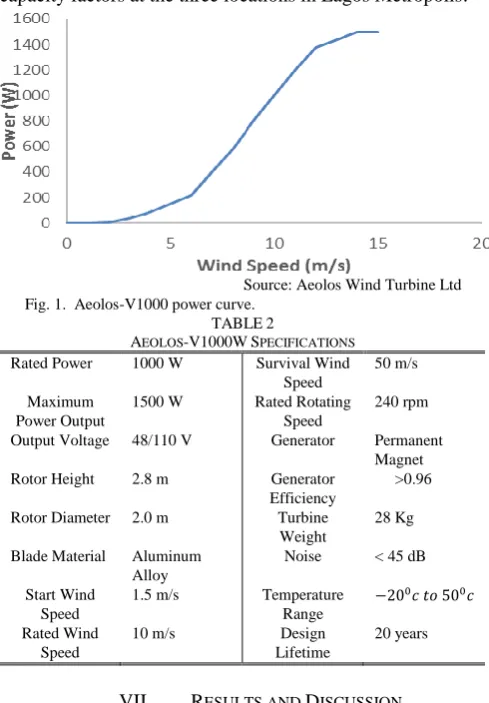
[image:3.595.305.550.310.662.2]The transformation from wind speed to power by an individual wind turbine is well characterized by the wind turbine power curve [42]. The wind turbine power curve for Aeolos-V1000 was used in this study. Aeolos-V1000 is a Vertical Axis Wind Turbine (VAWT) manufactured by Aeolos Wind Energy Ltd in Denmark. Aeolos-V1000 is a small wind turbine with rated power of 1000 watts designed for low wind speed. Table 2 shows the specification of Aeolos-V1000. The wind turbine power curve displayed in Figure 1 is used to simulate electrical power outputs and the capacity factors at the three locations in Lagos Metropolis.
Source: Aeolos Wind Turbine Ltd Fig. 1. Aeolos-V1000 power curve.
TABLE2
AEOLOS-V1000WSPECIFICATIONS
Rated Power 1000 W Survival Wind Speed
50 m/s
Maximum Power Output
1500 W Rated Rotating Speed
240 rpm
Output Voltage 48/110 V Generator Permanent Magnet Rotor Height 2.8 m Generator
Efficiency
>0.96
Rotor Diameter 2.0 m Turbine Weight
28 Kg
Blade Material Aluminum Alloy
Noise < 45 dB
Start Wind Speed
1.5 m/s Temperature Range
−200𝑐 𝑡𝑜 500𝑐
Rated Wind Speed
10 m/s Design
Lifetime
20 years
VII. RESULTS AND DISCUSSION
Table 3 showed that the maximum annual wind speeds for Lagos Roof, Lagos Marine and Ikeja range from 6.67 to 8.75 m/s, 5.14 to 10.29 m/s and 18.0 to 21.61 m/s sequentially. The same table reveals annual average wind speed values that drift from 1.69 to 2.0 m/s in Lagos Roof, 1.22 to 1.77 m/s in Lagos Marine and 2.52 to 3.30 m/s in Ikeja. Hence, Ikeja has the highest annual average wind speed while Lagos Marine have the lowest. The result of a Weibull stochastic analysis on the wind speed data at height 10 m for all the years considered is also displayed in Table 3. Here, the analysis showed values of 1.17≤ k ≤1.49, 1.79 ≤ c ≤ 2.21, 0.35 ≤𝑉𝐹≤1.05, 2.65≤ 𝑉𝐸 ≤3.21 and 12.54≤ WPD ≤ 13.77 for Lagos Roof; 1.12 ≤ k ≤ 2.39, 1.27 ≤ c ≤ 2.56, 0.17 ≤ 𝑉𝐹≤ 1.98, 1.89 ≤ 𝑉𝐸≤ 3.58 and 4.34 ≤ WPD ≤ 12.19 for Lagos Marine; 1.18 ≤ k ≤ 1.48, 2.72 ≤ c≤ 3.65, 0.68≤ 𝑉𝐹≤1.71, 5.62≤ 𝑉𝐸≤7.72 and 33.97 ≤ WPD ≤ 78.79 for Ikeja. For low values of Weibull shape factor k ≤1.5, Lagos Roof and Ikeja experienced gusty winds while Lagos Marine with k ≥2.0 witnessed steady winds [43].
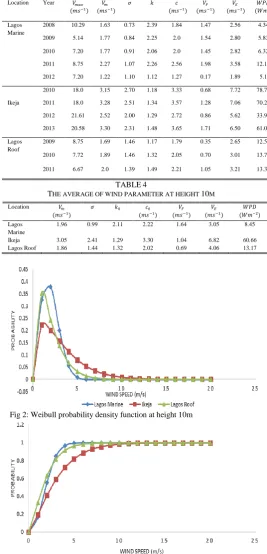
In Table 4, the average values of wind speed parameters at height 10 m for the year 2008 – 2013 in the three locations are presented. The overall mean wind speed (𝑉𝑚), shape factor (𝑘𝑜), scale factor (𝑐0), probable wind speed (𝑉𝐹), wind speed carrying maximum energy (𝑉𝐸) and wind power density (WPD) ranged between 1.86 and 3.05m/s, 1.29 and 2.11m/s, 2.02 and 3.30m/s, 0.69 and 1.64 m/s, 3.05 and 6.82 m/s, 8.45 and 60.66 Wm−2 respectively. It is observed that Ikeja has the highest average wind speed of 3.05 m/s followed by Lagos Marine with mean wind speed of 1.96 m/s and the lowest is Lagos Roof with average wind speed of 1.86 m/s. The values of (𝑉𝐹, 𝑉𝐸) for Ikeja, Lagos Marine and Lagos Roof are (1.04, 6.82), (1.64, 3.05) and (0.69, 4.06) respectively. These values of 𝑉𝐹 correspond to the peak of Weibull density function in figure 2. The value of 𝑉𝐸is mostly used to rate wind turbine speed. Therefore, all the three locations wind speed profiles at height 10m are adequate for wind energy application because majority of wind turbines produce electrical power from wind speed of 3 m/s and above [3, 25]. Wind power density of Ikeja is 60.66
Wm−2, Lagos Marine is 8.45 Wm−2, and Lagos Roof is 13.17 Wm−2. They all fall into wind power class one (1) at height 10 m. Figure 3 shows Weibull cumulative distribution graph for the three locations in Lagos metropolis. It is obvious that 58.70%, 81.47% and 84.86% of the wind speed data are less than 3 m/s in Ikeja, Lagos Roof and Lagos Marine sequentially.
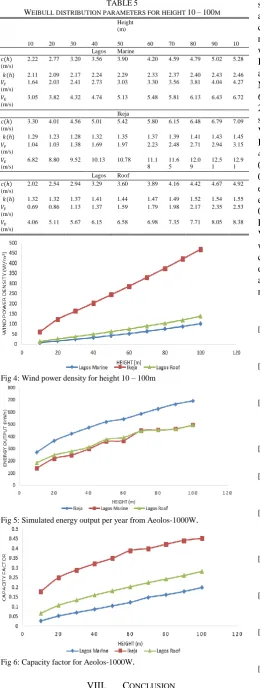
Table 5 contains the Weibull distribution parameters for height 10 – 100 m while Figure 4 is a plot of the computed WPD for the height 10 – 100m in the three locations. The WPD at height 50m, 80m and 100m in Ikeja are 244.18, 373.96 and 467.49 Wm−2, for Lagos Roof they are 61.81, 103.26 and 137.57 Wm−2, and for Lagos Marine they are 42.55, 74.89 and 100.21 Wm−2 respectively. The wind power density in Ikeja is classified as two (2) at the height of 50 m while Lagos Roof and Lagos Marine have wind power density class of one (1) at height 50m. Figure 5 shows the simulated electrical energy output at the height 10 – 100m per year from Aeolos-V1000W (wind turbine) in all the three locations of Lagos. At the height of 10 m, 30 m, 50 m, 70 m and 100 m the wind speed profile in Ikeja produces annual electrical energy output of 270.10 kWh, 421.91 kWh, 519.61 kWh, 585.46 kWh and 690.95 kWh respectively. Using the same heights, the corresponding values of energy output are 140.62 kWh, 248.46 kWh, 359.11 kWh, 447.23 kWh and 494.79 kWh for Lagos Marine whilst 184.34 kWh, 278.4
kWh, 376.02 kWh, 444.20 kWh and 493.97 kWh for Lagos Roof. It was observed that the output energy profiles are the same for Lagos Marine and Lagos Roof, especially, from height 70 m to 100 m. Finally, Figure 6 displayed the plot of the capacity factor against vertical height 10 – 100m for Aeolos-V1000W in all the three locations in Lagos. The capacity factor ranged between 0.1784 and 0.4509 in Ikeja, 0.0275 and 0.1988 in Lagos Marine and 0.0671 and 0.2826 in Lagos Roof.
TABLE3
WIND PARAMETERS AT HEIGHT 10M IN THREE LOCATIONS
TABLE4
[image:4.595.295.563.180.736.2]THE AVERAGE OF WIND PARAMETER AT HEIGHT 10M
Fig 2: Weibull probability density function at height 10m
Fig 3: Weibull cumulative distribution at height 10m
Location Year 𝑉𝑚𝑎𝑥 (𝑚𝑠−1)
𝑉𝑚 (𝑚𝑠−1)
𝜎 𝑘 𝑐
(𝑚𝑠−1) 𝑉𝐹 (𝑚𝑠−1)
𝑉𝐸 (𝑚𝑠−1)
𝑊𝑃𝐷 (𝑊𝑚−2)
Lagos Marine
2008 10.29 1.63 0.73 2.39 1.84 1.47 2.56 4.34 2009 5.14 1.77 0.84 2.25 2.0 1.54 2.80 5.83 2010 7.20 1.77 0.91 2.06 2.0 1.45 2.82 6.32 2011 8.75 2.27 1.07 2.26 2.56 1.98 3.58 12.19 2012 7.20 1.22 1.10 1.12 1.27 0.17 1.89 5.1 2010 18.0 3.15 2.70 1.18 3.33 0.68 7.72 78.79 Ikeja 2011 18.0 3.28 2.51 1.34 3.57 1.28 7.06 70.24 2012 21.61 2.52 2.00 1.29 2.72 0.86 5.62 33.97 2013 20.58 3.30 2.31 1.48 3.65 1.71 6.50 61.08 Lagos
Roof
2009 8.75 1.69 1.46 1.17 1.79 0.35 2.65 12.54 2010 7.72 1.89 1.46 1.32 2.05 0.70 3.01 13.77 2011 6.67 2.0 1.39 1.49 2.21 1.05 3.21 13.39
Location 𝑉𝑚 (𝑚𝑠−1)
𝜎 𝑘0 𝑐0 (𝑚𝑠−1)
𝑉𝐹 (𝑚𝑠−1)
𝑉𝐸 (𝑚𝑠−1)
𝑊𝑃𝐷 (𝑊𝑚−2)
Lagos Marine
1.96 0.99 2.11 2.22 1.64 3.05 8.45
Ikeja 3.05 2.41 1.29 3.30 1.04 6.82 60.66
TABLE5
WEIBULL DISTRIBUTION PARAMETERS FOR HEIGHT 10–100M Height
(m)
10 20 30 40 50 60 70 80 90 10
Lagos Marine
𝑐(ℎ)
(m/s)
2.22 2.77 3.20 3.56 3.90 4.20 4.59 4.79 5.02 5.28
𝑘(ℎ) 2.11 2.09 2.17 2.24 2.29 2.33 2.37 2.40 2.43 2.46
𝑉𝐹
(m/s)
1.64 2.03 2.41 2.73 3.03 3.30 3.56 3.81 4.04 4.27
𝑉𝐸
(m/s)
3.05 3.82 4.32 4.74 5.13 5.48 5.81 6.13 6.43 6.72
Ikeja
𝑐(ℎ)
(m/s)
3.30 4.01 4.56 5.01 5.42 5.80 6.15 6.48 6.79 7.09
𝑘(ℎ) 1.29 1.23 1.28 1.32 1.35 1.37 1.39 1.41 1.43 1.45
𝑉𝐹
(m/s)
1.04 1.03 1.38 1.69 1.97 2.23 2.48 2.71 2.94 3.15
𝑉𝐸
(m/s)
6.82 8.80 9.52 10.13 10.78 11.1 8
11.6 5
12.0 9
12.5 1
12.9 1 Lagos Roof
𝑐(ℎ)
(m/s)
2.02 2.54 2.94 3.29 3.60 3.89 4.16 4.42 4.67 4.92
𝑘(ℎ) 1.32 1.32 1.37 1.41 1.44 1.47 1.49 1.52 1.54 1.55
𝑉𝐹
(m/s)
0.69 0.86 1.13 1.37 1.59 1.79 1.98 2.17 2.35 2.53
𝑉𝐸
(m/s)
4.06 5.11 5.67 6.15 6.58 6.98 7.35 7.71 8.05 8.38
Fig 4: Wind power density for height 10 – 100m
Fig 5: Simulated energy output per year from Aeolos-1000W.
Fig 6: Capacity factor for Aeolos-1000W.
VIII. CONCLUSION
In this work, wind energy potentials in three locations in Lagos, viz: Ikeja, Lagos Marine and Lagos roof were investigated. The study established that annual mean wind
speeds for Ikeja, Lagos Marine and Lagos Roof are 3.05, 1.96 and 1.86 m/s respectively, with annual values of wind speed carrying maximum energy of 6.82, 3.05 and 4.06 m/s respectively based on Weibull distribution function. The wind speed data revealed 58.70%, 81.47% and 84.86% of Ikeja, Lagos Roof and Lagos Marine are less than 3m/s. The annual mean power densities at height 50m for Ikeja, Lagos Marine and Lagos Roof are 244.18 Wm−2, 42.55 Wm−2 and 61.81 Wm−2. This makes Ikeja to have wind power of class 2 while Lagos Marine and Lagos Roof is class 1. The simulated annual electrical energy output using Aeolos-V1000W power curve ranges from 270.10 to 690.95 kWh for Ikeja, 140.62 to 494.79 kWh for Lagos Marine and 184.34 to 493.70 kWh for Lagos Roof. The capacity factor ranges from 0.178 to 0.451 in Ikeja, 0.028 to 0.199 in Lagos Marine and 0.067 to 0.283 in Lagos Roof. Using wind turbine to generate electricity in Ikeja and Lagos Roof sites produce electrical energy that are cost effective because the capacity factor ≥ 0.25 from height of 20 to 100 m in Ikeja and 90 to 100m in Lagos Roof. The electrical output energy of the Aeolos-V100W at height 70 m and above in Ikeja exceed 548 kWh which is the current average annual electrical energy consumption per household in Lagos. To this end, wind energy is a viable source of energy in residents of Ikeja. It is also deployable as an alternative source of energy for Lagos roof.
REFERENCES
[1] Ajibola, O.O.E., Kakulu, M. and Balogun, O.J. (2018a); Development of a site assessment scheme for hybrid wind/solar electricity generation. ABUAD Journal of Engineering Research and Development. Vol.1, No. 2, pp. 1 – 7.
[2] Ajibola, O.O.E, Ibidapo-Obe, O. and Balogun, O.J. (2018b). Developing Sustainable Renewable Energy for Rural Dwellers’ Energy Sufficiency. ABUAD Journal of Engineering Research and Development, Vol.1, Issue 1, pp. 1 – 7.
[3] Oyedepo, S.O., Adaramola, M.S., and Paul, S.S. (2012). Analysis of wind speed data and wind energy potential in three selected locations in South-east Nigeria. International Journal of Energy and
Environmental Engineering, Vol. 3:7. https://doi.org/10.1186/2251-6832-3-7
[4] Ajibola, O.O.E., Fagbamila, T.T., and Balogun, O.J. (2016). Experimental Investigation of Energy Potentials of Kitchen Organic Waste. Journal of Engineering Research, Vol. 21(1): 133 – 140. [5] Renewable Energy Master Plan (REMP) (2005). Energy Commission
of Nigeria (ECN) and United Nation Development Program (UNDP). Retrieved May 26, 2018. Available at:
http://iceednigeria.org/backup/workspace/uploads/nov.-2005.pdf [6] National Renewable Energy and Energy Efficiency Policy (NREEEP)
(2015). Ministry of Power, Federal Republic of Nigeria. Retrieved May 24, 2018. Available at:
www.power.gov.ng/down-load/NREEE%20Policy%202015%20FEC%20APPROVED%20Cop y.pdf
[7] Roseline Okere (2017). Lagos Suffer Shortfall of Electricity Supply. The Guardian. Available at:
https://guardian.ng/business-services/lagos-suffer-shorfall-of-electricity-supply/ (Accessed: 26 May, 2018).
[8] Nigeria Electricity Hub (2015). Lagos Receives Only 20% of its Power Requirement – Ambode. Available at:
www.nigeriaelectricityhub.com/2015/12/11/lagos-receives-only-20-of-its-power-requirement-ambode/
[9] Mohammed Shosanya (2015). Lagos gets 10% of power needed –
Official. Daily Trust.
https://-www.dailytrust.com.ng/news/business/lagosgets10ofpowerneededoffi cial/107855.html
[10] Monsur Olowoopejo (2014). Lagos Requires 5000 MW to attain Power Stability. Vanguard. Retrieved at:
www.energy.gov.ng/index.php?option=com_content&view=article&a id=111 (Accessed 26 May 2018).
[image:5.595.46.307.52.742.2]www.atkinsglobal.com/~/media/files/A/Atkinscorporate/group/sectors documents/urbandevelopment/FPC_Lagos_Leaflet_Lowr-es.pdf. (Accessed 26 May 2018).
[12] Siemens and Economic Intelligent Unit (2011). African Green City Index: Assessing the environmental performance of Africa’s major cities. Siemens AG Publisher, Munchen Germany.
[13] Prayas (Energy Group) (2016). Residential Electricity Consumption in India: What do we know? Mudra Publisher, Pune.
[14] Nidhi Tewathia (2014). Determinants of the Household Electricity Consumption: A Case Study of Delhi. International Journal of Energy Economics and Policy, Vol.4 (3):pp. 337 – 348.
[15] Coelho, S.T., Goldemberg, J. (2013). Energy Access: Lessons learned in Brazil and perspectives for replication in other developing countries. Energy Policy,
http://dx.doi.org/10.1016/j.enpol.2013.05.062
[16] National Population Commission (2014). Nigeria Demographic and Health Survey 2013. ICF International, Rockville, Maryland, USA. [17] Olaleye, S.O. and Akinbode, S.O. (2012). Analysis of Household’s
Demand for Alternative Power Supply in Lagos State, Nigeria. Current Research Journal of Social Science, Vol 4(2), pp. 121 – 127. [18] Akinyemi, M.L. and Usikalu, M.R. (2013). Investigation of Carbon
Monoxide Concentration from Anthropogenic Sources in Lagos, Nigeria. International Journal of Physical Sciences, Vol.8 (21), pp. 1128 – 1132.
[19] National Council on Power (2014). The Transition Issues from Public to Private Sector Controlled Power Industry. Retrieved at:
www.power.gov.ng/nationalcouncilonpower/Lagos.pdf.
[20] Wei Tong (2010). Fundamentals of wind energy. WIT Transactions on State of the Art in Science and Engineering, Vol.44, pp. 1 – 48. doi:10.2495/978-1-84564-205-1/01.
[21] Agbetuyi, A.F., Odigwe, I.A., Awelewa, A.A. and Awosope, C.O.A. (2013). Wind Power Potential and Integration in Africa. International Journal of Development and Sustainability, Vol. 2(1), pp. 232 – 239. [22] Sambo, A.S. (2009). The Challenges of Sustainable Energy
Development in Nigeria. Paper presented to the “Nigerian Society of Engineers Forum”, 2nd April 2009. Shehu Yar’Adua Center, Abuja. [23] Federal Ministry of Power and Steel (2006). Renewable Electricity
Action Program (REAP). International Centre for Energy, Environment and Development. Available at:
www.iceednigeria.org/backup/workspace/uploads/dec.-2006-2.pdf (Accessed 27 May 2018).
[24] Ajayi, O.O., Fagbenle, O.R., Katende, J., Ndambuki, J.M., Omole, D.O. and Badejo, A.A. (2014). Wind Energy Study and Energy Cost of Wind Electricity Generation in Nigeria: Past and Recent Results and a Case Study for South West Nigeria. Energies, Vol. 7, pp.8506 – 8534.
[25] Ajayi, O.O., Fagbenle, R.O., Katende, J. Omotosho, O.A. and Aasa, S. (2012). Analytical Predictive Model for Wind Energy Potential Estimation: A Model for Pre-assessment Study. Journal of Applied Sciences, Vol, 12(15): 450 – 458.
[26] [44] Oluleye, A. and Ogungbenro, S.B. (2011). Estimating the Wind Energy Potential over the Coastal Stations of Nigeria Using Power Law and Diabatic Methods. African Journal of Environmental Science and Technology, Vol.5 (1), pp. 985 – 992.
[27] Nwawuike, N. and Okogbue, E.C. (2014). Assessment of Wind Energy Potential as a Power Generation Source in Five Locations of Southwestern Nigeria. Journal of Power and Engineering, Vol. 2(5), pp. 1 – 3.
[28] [40] Morrissey, M.L. and Cook, W.E. (2009). An Improved Method for Estimating the Wind Power Density Distribution Function. Journal of Atmospheric and Oceanic Technology, Vol. 27, pp. 115 – 1164. [29] Dufo-Lopez and Bernal-Agustin, J.L. (2012). New Methodology for
the Generation of Hourly Wind Speed Data Applied to the Optimization of Stand-Alone Systems. Energy Procedia, 14(2012), pp. 1973 – 1978.
[30] Kang, D., Ko, K. and Huh, J. (2018). Comparative Study of Different Methods for Estimating Weibull Parameters: A Case Study on Jeju Island, South Korea. Energies, 11,356, doi: 10.3390/en11020356. [31] Kumar, K.S.P and Gaddaba, S. (2015). Statistical Scrutiny of Weibull
Parameters for Wind Energy Potential Appraisal in the Area of Northern Ethiopia. Renewables, 2:14, doi.org/10.1186/s40807-015-0014-0.
[32] Akpinar, E.E. and Akpinar, S. (2004). An Assessment on Seasonal Analysis of Wind Turbine Characteristics. Energy Conversion and Management, 46, 1848 – 1867.
[33] Celik, A.N. (2003). Energy Output Estimation for Small-Scale Wind Power Generators Using Weibull-representative Wind Data. Journal of Wind and Industrial Aerodynamic, 91(5), pp. 693 – 707.
[34] Zekai Sen, Abdusselam Altunkaynak, and Tarkan, Erdik (2012). Wind Velocity Vertical Extrapolating Extend Power Law. Advances in Meteorology, Vol.2012, pp. 1 – 6, doi:10.1155/2012/178623. [35] Kidmo, D.K., Danwe, R., Daka, S.Y. and Djongyang, N. (2015).
Statistical Analysis of Wind Speed Distribution Based on Six Weibull Methods for Wind Power Evaluation in Garoua, Cameroon. Revue des Energies Renouvelables, Vol. 15(1), pp. 105 – 125.
[36] Ahmed Siraj (2015). Wind Energy: Theory and Practice, Third Edition. PHI Learning Pvt. Ltd.
[37] Osinowo, A.A., Lin X., Zhao D., and Zheng K. (2017). On the Wind Energy Resources and Its Trend in the East China Sea. Journal of Renewable Energy, Volume 2017, pp. 1 – 14.
[38] Egware, H.O., Onochie, U.P. and Ighodaro, O.O. (2016). Prospects of Wind Energy for Power Generation in University of Benin. International Journal of Thermal and Environmental Engineering, Vol. 13(1), pp. 23 – 28.
[39] Sedaghat, A., Hassanzadeh, A., Jamali, J., Mastafaeipour, A., and Chen, W. (2017). Determination of Rated Wind Speed for Maximum Annual Energy Production of Variable Speed Wind Turbines. Elsevier Applied Energy, Vol. 205(1), pp. 781 – 789.
[40] [53] Sajid, A., Song-Moon, L. and Choon-Man, J. (2017). Techno-Economic Assessment of Wind Energy Potential at Three Locations in South Korea Using Long-Term Measured Wind Data. Energies, Vol. 10, pp. 1 – 24.
[41] [58] Vaughn Nelson (2013). Wind Energy: Renewable Energy and the Environment. Second Edition. CRC Press.
[42] Mu, G., Yang, M., Wang, D., Gangui, Y., and Yue, Q. (2016). Spatial Dispersion of Wind Speeds and Its Influence on the Forecasting Error of Wind Power in a Wind Farm. Journal of Modern Power Systems and Clean Energy, Vol. 4(2), pp: 265 – 274.
[43] Halchak, V., Syrotyuk, S. and Syrotyuk, V. (2015). The Relationship between the parameters of wind speed. Econtechmod, International Quarterly Journal, Vol. 4(4), pp. 95 – 100.
BIOGRAPHY
Ajibola Olawale Olaniyi Emmanuel received BSc (Hons) in Mathematics from University of Ibadan, Nigeria in 1990, both MSc in Engineering Analysis and PhD in Systems Engineering in 1995 and 2009 respectively from University of Lagos also in Nigeria. He is the Dean of the Faculty of Engineering and Technology, First Technical University, Ibadan, Oyo State, Nigeria; immediate past Chair of Department of Biomedical Engineering at the College of Medicine of the University of Lagos and, Senior Lecturer and immediate past Coordinator of Postgraduate Programmes at the Department of Systems Engineering, Faculty of Engineering, University of Lagos, Lagos, Nigeria. His research interest spans Bioinspired Modelling and Simulations, Development of portable but cost effective biomedical devices; Rehabilitation Medicine, Engineering Education and Energy Engineering. He has published widely both in National and International Journals. He is a member of Biomedical Engineering Society (BMES) in the USA, and International Association of Engineers (IAENG), Hong Kong, and he is a registered member of the Council for the Regulation of Engineering in Nigeria (COREN).