School of Engineering
Department of Mechanical & Manufacturing Engineering
CFD modelling of the cross-flow
through normal triangular tube arrays
with one tube undergoing forced
vibrations or fluidelastic instability
Beatriz de Pedro, Jorge Parrondo, Craig Meskell, Jesús Fernández Oro
Published in Journal of Fluids and Structures (2016)
CITATION INFORMATION:
“CFD modelling of the cross-flow through normal triangular tube arrays with one tube undergoing forced vibrations or fluidelastic instability” B de Pedro, J. Parrondo, C. Meskell, J.F. Oro, Journal of Fluids and Structures, Volume 64, (2016), Pages 67–86
CFD modelling of the cross-flow through normal
triangular tube arrays with one tube undergoing forced
vibrations or fluidelastic instability.
Beatriz de Pedroa∗, Jorge Parrondoa, Craig Meskellb, Jes´us Fern´andez Oroa
aSchool of Engineering, Univeristy of Oviedo, Spain bTrinity College Dublin, Ireland
Abstract
A CFD methodology involving structure motion and dynamic re-meshing
has been optimized and applied to simulate the unsteady flow through
nor-mal triangular cylinder arrays with one single tube undergoing either forced
oscillations or self-excited oscillations due to damping-controlled fluidelastic
instability. The procedure is based on 2D URANS computations with a
com-mercial CFD code, complemented with user defined functions to incorporate
the motion of the vibrating tube. The simulation procedure was applied to
several configurations with experimental data available in the literature in
order to contrast predictions at different calculation levels. This included
static conditions (pressure distribution), forced vibrations (lift delay relative
to tube motion) and self-excited vibrations (critical velocity for fluidelastic
instability). Besides, the simulation methodology was used to analyze the
propagation of perturbations along the cross-flow and, finally, to explore the
effect on the critical velocity of the Reynolds number, the pitch-to-diameter
ratio and the degrees of freedom of the vibrating cylinder.
Keywords:
Fluidelastic Instability, Numerical model, Tube arrays, Critical velocity,
Disturbance propagation
1. Introduction
Cylinder arrays subject to cross-flow such as in shell-and-tube heat
ex-changers may undergo self-excited vibrations of high amplitude and high
po-tential for structural damage (Weaver and Fitzpatrick (1988); Pettigrew and
Taylor (2003a); Pettigrew and Taylor (2003b)). The phenomenon, which
is referred to as fluidelastic instability (FEI), can be triggered by either a
fluid-damping controlled mechanism, which only requires motion of one tube
with one degree of freedom, or a fluid-stiffness controlled mechanism, which
requires the coupled motion of several tubes (Chen (1983a); Chen (1983b);
Paidoussis and Price (1988)). FEI has been largely studied experimentally in
the past, with the main purpose of establishing critical flow velocities as the
limiting conditions that ensure stability. However, the data collected of
crit-ical velocity for each main geometrcrit-ical configuration usually show significant
scatter. This is attributed to the wide variety of factors with potential to
influence the phenomenon, including pitch ratio (P/d), number of rows and
columns in the array, degrees of freedom, accuracy of cylinder position in the
array, details of structural parameters of each cylinder in the array, Reynolds
number, turbulence intensity and presence of other excitation mechanisms.
veloc-ity can be obtained by means of the so-called unsteady flow model (Chen
(1983a); Chen (1983b)), but it requires the previous determination (usually
experimentally) of an extensive set of dynamic force coefficients that
rep-resent terms dependent on tube position, velocity and acceleration. These
force coefficients are not easy to obtain and are strongly dependent on
ge-ometry and reduced velocity. Because of that, several theoretical models
have been proposed intended to yield critical conditions for FEI from the
estimation of the fluid forces on the tubes, based on different simplifying
assumptions (Price (1995)). For instance, the so-called quasi-steady model
by Price and Paidoussis (1984) assumes that the fluid-dynamic forces on the
tubes can be obtained by performing static flow calculations with a
cylin-der slightly shifted from equilibrium and then introducing a phase delay for
the resulting static forces. Later, Granger and Paidoussis (1996) proposed a
more elaborated quasi-unsteady model in which the fluid-dynamic forces are
expressed as a combination of transient functions, in order to represent the
memory effect induced in the flow due to the diffusion and convection of thin
vorticity layers from the surface of the vibrating cylinders. Requiring much
less empirical input, Lever and Weaver (1986a), developed a semi-analytical
model in which the flow passes through the arrays along wavy streamtubes
whose cross area fluctuates lagging the motion of the neighboring vibrating
cylinders. In this simplified system, the fluid-dynamic forces on the
cylin-ders can be computed by applying the 1D unsteady flow equations (Lever
and Weaver (1986b)).
phe-nomena up to some extent, but their flow simplifications and the need for
empirical data limit their effectiveness as prediction tools. Indeed, the best
potential for the detailed description of the flow without empirical data
cor-responds to CFD models and that capability should allow for more reliable
predictions of the critical velocity for FEI. Moreover, CFD offers the
possi-bility of simulating the dynamic response of the flow-structure system even
operating at unstable regimes, for which the non-linear terms are dominant.
The latter is key to explore possible new situations involving FEI
phenom-ena, such as in the area of fluid kinetic energy conversion.
In recent years, several researchers have applied CFD models to analyze
the dynamic flow-structure interaction that leads to FEI. Particular attention
has been paid to the case of arrays with only one flexible cylinder undergoing
forced vibrations, because it is convenient to study the correlation between
tube motion and the associated flow fluctuations. Hassan et al. (2010) used
CFD simulations for in-line and normal triangular arrays with one cylinder
subject to forced vibration in order to estimate the unsteady force coefficients
on the tubes. After verifying good agreement between predicted critical
ve-locities and experimental data, they further investigated the effects of pitch
ratio and Reynolds number. This approach was later extended to explore
the delay of the perturbations induced in the flow by an oscillating
cylin-der in a normal triangular array (Hassan and El Bouzidi (2012)) as well as
the corresponding fluctuations in the cross-area of the passing streamtubes
(El Bouzidi and Hassan (2015)). Khalifa et al. (2013b) performed CFD
to model the velocity fluctuations previously measured in wind tunnel
(Khal-ifa et al. (2013a)) and to extend their analysis to lower reduced velocities.
They obtained good correlation between predictions and measurements, and,
besides, they obtained improved estimations of critical velocity when
intro-ducing a CFD derived phase lag function in the model by Lever and Weaver
(1986a), Lever and Weaver (1986b). Following a different approach,
Ander-son et al. (2014) developed a simplified numerical model for a small in-line
group of cylinders, one of them oscillating, with special focus on the
tempo-ral variations induced in the boundary layers and, ovetempo-rall, on the regions of
flow attachment and separation. They concluded that the effective time lag
between fluid forces and tube motion has two components dependent on flow
velocity and vibration amplitude respectively.
In line with these investigations, this paper presents a CFD study on the
fluid-dynamic vibrations due to damping-controlled FEI of one single flexible
tube in normal triangular arrays. The simulations were developed with the
ANSYS-Fluent 12.1 software (ANSYS (2013)). The model incorporates the
motion of vibrating cylinders by means of a special User Defined Function,
so that the domain is remeshed at every time step. First, the main
calcula-tion parameters including boundary condicalcula-tions and turbulence model were
selected by contrasting the predictions of pressure distribution on cylinders
with the measurements conducted by Mahon and Meskell (2009) under static
conditions. Then, dynamic simulations with one oscillating tube located at
the third row were carried out for the sets of configurations tested by Mahon
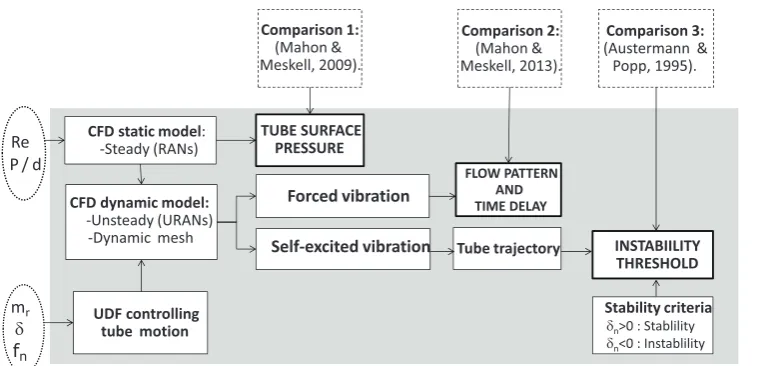
and Popp (1995) under conditions of self-excited vibration. This
method-ology, which pursued the validation of the CFD model at different levels of
calculation, is depicted in Fig.1. Finally, simulations were conducted to
ex-plore the effects of Reynolds number, pitch ratio and degrees of freedom of
the vibrating cylinder.
2. CFD Model and Static Calculations
For this study, several normal triangular tube arrays were considered with
pitch-to-diameter ratios between 1.25 to 1.58, including the value of 1.32 that
Mahon and Meskell (2009, 2013) used in their experiments as well as the
val-ues of 1.25 and 1.375 used by Austermann and Popp (1995). In all cases, the
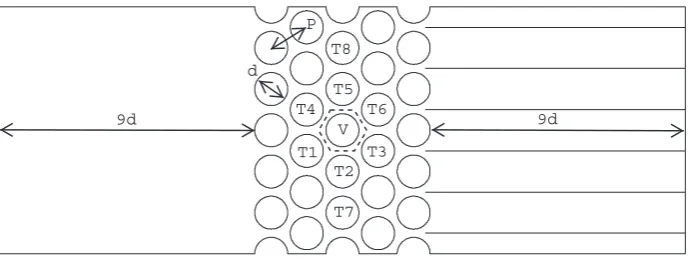
array consisted of five rows of six cylinders, as shown in Fig.2. The cylinder
diameter was always 38 mm.
For the simulations involving cylinder motion, the flexible cylinder was
allocated in the third row (tube TV in Fig. 2). According to the
experi-mental study by Austermann and Popp (1995), that position for the flexible
tube would yield the lowest critical velocity for damping-controlled FEI of
normal triangular arrays with P/d=1.25, and also with P/d=1.375 if the
mass-damping parameter is less than about 30.
The calculation domain extended both upstream and downstream from
the cylinder array with lengths equivalent to nine tube diameters.
showed the presence of large scale oscillations in the region downstream the
array. While this type of oscillations may actually take place in practice
(Olinto et al. (2009); de Paula et al. (2012)), they are not considered to be
related to the FEI mechanism. Hassan et al. (2010) also observed this
be-haviour in their computations and they decided to truncate the domain from
the last row of the array as a means to suppress the appearance of those
large scale structures. However, this procedure implies imposing boundary
conditions (constant outlet pressure) on the flow through the array itself, and
that may affect the propagation of disturbances throughout the flow, which is
crucial for the development of the FEI phenomenon. In the present model, as
an alternative strategy to allow for a reasonable distance between array and
domain outlet while preventing large scale oscillations, full-slip guide plates
were placed behind each tube of the last row, parallel to main stream (Fig.2).
To discretize the domain, a specially refined grid was used around each
cylinder in the array that was composed of quadrilateral cells with an initial
thickness of 0.06 mm at the tube wall and a growth factor of 1.15 in the
radial direction until the 13th line. This ensured y+ values of the order of 1
for all the simulations conducted. The rest of the domain was meshed with
triangular cells of progressively greater size when separating from the array.
In order to prepare the model to deal with cylinder oscillations, a
hexag-onal region was defined surrounding the vibrating tube (Fig.2), in which the
triangular cells could either shrink or expand depending on the instantaneous
the oscillating tube moved without undergoing deformation. This approach
meant that, during computations involving cylinder motion, the mesh did
not degrade with excessive distortion for cylinder displacements well above
4% of the tube diameter even for the smallest pitch-to-diameter ratio of 1.25
(as shown in Fig.3).
To begin with, a series of computations was performed under static
con-ditions, i.e. no tube vibration. These tests were intended to select the most
appropriate calculation parameters when comparing predictions to the wind
tunnel data obtained by Mahon and Meskell (2009), who measured the static
pressure distribution around the surface of cylinder labeled TV in Fig.2 for
the caseP/d=1.32 and several cross-flow velocities. These pressure data have
been non-dimensionalized by defining the pressure coefficient:
P∗ = Ps(θ1)−Ps0
2ρU
2
p
+ 1 (1)
where Ps is the static pressure at location θ on the tube surface, Ps0 is the
maximum static pressure (atθ=0◦),ρis the fluid density and Up is the pitch
velocity. As an example, Fig.4 compares Mahon and Meskell’s experimental
data to the predictions obtained for an upstream air velocity of 2 m/s when
using three different turbulence models: a standard k −ω, a k −ω with
shear stress transport corrections (k−ω SST) and ak−ϵ with
renormaliza-tion group (k−ϵRNG) complemented with non-equilibrium wall treatment
rea-sonably well the experimental data, although the standardk−ω model gives
the closest fit in the wake region. This is within expectations since k −ω
models are considered more appropriate than k−ϵ to deal with separated
flow areas, but in the case of closely packed arrays that feature is less relevant
than in cases of unconstrained wakes.
On the other hand, the two k −ω models are seen to be more prone
to yield asymmetric predictions of pressure around the cylinders than the
k −ϵ RNG. Different degrees of flow asymmetry depending on the
turbu-lence model can be also observed in the computations reported by Iacovides
et al. (2014), who used detailed LES simulations of the flow across an in-line
square array to contrast the predictions from RANS simulations with five
different turbulence models. Interestingly, the predictions closest to the LES
results corresponded to the k −ϵ model in that study. Since the FEI
phe-nomenon is usually associated to vibrations in the transverse direction, it is
key to estimate accurately the lift forces and they are mostly influenced by
the pressure unbalance at the regions around Θ = 90◦ and Θ = 270◦ (Fig.
4), where pressure is minimum. According to this criterion the k−ϵ RNG
model was selected for the subsequent computations.
Another computation series explored the effect of the type of boundary
condition at the channel sides downstream of the array. Specifically, first
they were modeled as full-slip walls and secondly as planes with periodic
repetition of the flow variables. Fig.5 shows the respective pressure
and T8 in Fig.2. Again, some degree of flow asymmetry can be expected
during the iteration process between different cylinders even if they belong
to the same row. The periodic boundary condition is not necessarily
sym-metrical, since strictly it imposes the limitation that the flow field is C1
continuous across the boundary. Despite this, in the present case it was seen
to produce the most symmetrical flow in the domain (Fig.5b), with pressure
distributions around the three cylinders that are almost identical. This can
be attributed to the less rigid restrictions imposed on the flow by the periodic
boundaries (for instance, they allow through-flow), which favor the
attenua-tion of possible symmetrical disturbances formed during the computaattenua-tional
process downstream the half cylinders at the channel sides. In consequence
the boundary conditions at the channel sides were defined as periodic for
the rest of cases tested. This symmetric pattern for the stream can also be
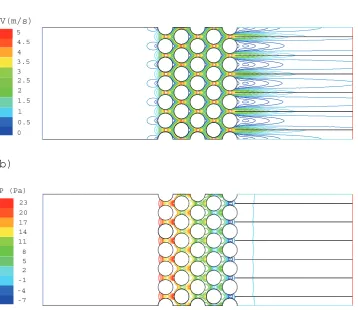
appreciated in Fig.6, which shows typical contours of velocity magnitude and
static pressure obtained from steady flow simulations.
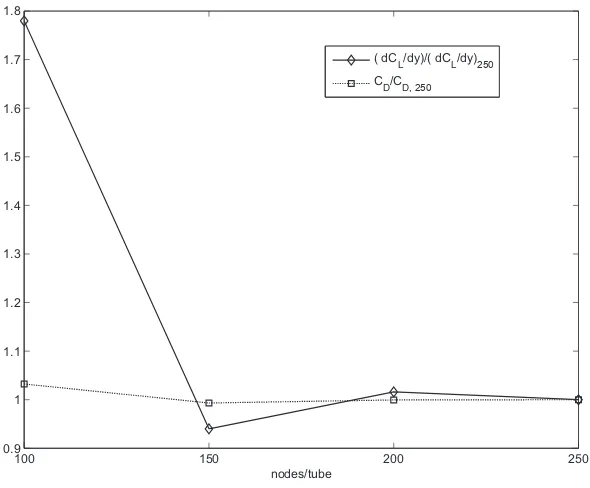
Finally, the effect of cell size was analyzed by comparing the fluid forces
computed for meshes with four different refinement degrees. Each mesh was
characterized by the number of cells adjacent to each tube along its perimeter,
which varied between 100 and 250. In particular the reference magnitudes
considered for contrast were the derivative of the lift coefficient on tube TV
(Fig.2) with respect to its transverse position and the drag coefficient at
neutral position, which are the relevant parameters used in the quasi-steady
theory by Price and Paidoussis (1984). In each case, the derivative of the lift
from calculated lift force data on tube TV when it was held apart from its
neutral position at±0.5% of tube diameter in the transverse direction. Fig.7
shows the results obtained for the array of P/d = 1.25, expressed in values
relative to the data for the most refined mesh. It is seen that above 150 nodes
per tube mesh the differences both in drag and lift derivative are reasonably
small. The bulk of the simulations reported in this paper corresponds to the
mesh with 200 nodes/tube, for which the difference with respect to the 250
nodes/tube mesh was less than 1.6% for the lift derivative and 0.06% for the
drag. The corresponding total number of cells in the domain ranged from
2.8×10⁵ for P/d= 1.25 to 4×10⁵ for P/d=1.58.
3. Forced oscillations in the transverse direction
3.1. Flow fluctuations
The first series of dynamic simulations corresponded to the case of tube
TV in motion under harmonic forced oscillation in the transverse direction,
in order to explore the transmission of perturbations along the air stream
through the array. For that purpose, a special routine (User Defined
Func-tion, ANSYS (2013)) was coupled to the CFD code so that the tube position
and velocity, as well as the domain grid, could be conveniently updated at
every time step during calculations. In addition, fifteen points were selected
along a stream channel that passes by tube TV (Fig.8), in order to monitor
their velocity vector and pressure during computations. Of them, positions
e-k are distributed in the region adjacent to tube TV at a radial distance
equilibrium position). The other nodes are located at similar positions with
respect to the preceding and posterior cylinders (T1 and T3). Each of these
nodes is associated to a linear coordinate S along the stream, with S=0 at
node h (Fig.8). For these simulations the time step was set to 0.5 ms, which
corresponds to 256 steps per oscillation. This time step was considered small
enough to not affect the results since the steps/cycle are about three times
higher than the values recommended by Hassan et al. (2010) for equivalent
simulations under forced vibrations.
•Flow distribution at maximum displacement
Fig.9 shows the calculated contours of velocity, vorticity and static pressure
(P/d=1.25,d=38mm, U0=1.26 m/s) in the region surrounding the vibrating
tube (at 7.81 Hz) at the instant of maximum tube displacement (3% of tube
diameter towards the top side of the image). The general velocity pattern
(Fig.9 a) correlates well with the visualization picture obtained for a normal
triangular tube array with P/d =1.5 by Scott (1987) (reported in Khalifa
et al. (2012)). It clearly shows how the main stream of air detaches from
each cylinder (T1, T4, TV) and, after an inflexion region at a somewhat
lower velocity, reattaches to the next one. The main stream flows along
channels or streamtubes that resemble the ideal pattern depicted by Yetisir
and Weaver (1993a), Yetisir and Weaver (1993b) for staggered arrays, though
the velocity in those channels is far from uniform. Compared to the modified
pattern used by El Bouzidi and Hassan (2015), the present computations
support excluding a small stagnation zone on the front of the tubes, but
The flow dettachment can also be noticed in the vorticity map (Fig. 9b),
which highlights the positions with high velocity gradients. Maximum
vortic-ity values are located on the boundary layers along the tubes, which
eventu-ally result in flow separation. The latter is characterized by two tongue-like
vorticity projections from the rear of the tubes, one at each side,
represent-ing the transition between wake and main stream. Granger and Paidoussis
(1996) consider the diffusion and convection of these thin vorticity layers
as the origin for the lag of the fluid forces with respect to cylinder motion.
Finally, pressure (Fig. 9c) is seen to be lowest in the gap region between
cylinders of the same row, where velocity is highest, and is high at the
stag-nation zone on the front of each cylinder (TV, T3, T6) as well as in the wakes
(T1, T4, TV).
Comparing the upper and lower halves of the maps of Fig. 9 reveals
asym-metries that are due to the shifted position of tube TV from equilibrium and
to the time lag with which the flow accommodates to the tube motion. The
latter produces a kind of waving flag effect at the border of the wakes from
the oscillating tube and the fixed cylinders. At the instant of Fig. 9, the
sep-aration between tubes TV and T5 is lowest while it is largest between TV and
T2. Because of that, the flow passing between cylinders T1 and T4 deviates
down at higher rate than up, and so the velocity of the main stream through
tubes TV and T1 is higher than through TV and T4. Also, the wake from T4
has swelled until nearly merging with the stagnation zone on TV, creating a
below tube TV than above it, the average velocity at the gap between TV
and T2 is lower than between TV and T5 (the opposite regarding average
pressure), i.e. the flow-rate distribution has not yet reached proportionality
to the gap size. Downwards, the passage between TV and T3 is analogous
to the region between TV and T1, whereas the passage between TV and T6
resembles the region between TV and T4, including the wake swelling effect
toward the stagnation zone on tube T6 despite the low average pressure on
top of tube TV.
•Velocity fluctuations
Fig.10 shows the normalized amplitude and phase of the velocity
fluctua-tions at 7.8 Hz computed at each node for upstream velocitiesU0= 0.63, 1.26
and 1.89 m/s (reduced pitch velocity Ur=10.6, 21.2 and 31.8; pitch Reynolds
number Re= 8×10³, 1.6×10⁴ and 2.4×10⁴). Despite the range covered,
the three amplitude curves are very similar. This can be attributed to the
low value of the cylinder velocity with respect to the cross stream and, also,
it indicates little dependence on the Reynolds number. Node c exhibits the
most noticeable effect of flow velocity variation: its velocity amplitude
de-cays fast when increasing the flow velocity because this provokes the wake of
tube T1 stretch downstream so that node c gets out progressively from the
wake border into the main stream. As expected, far from the vibrating tube
the velocity amplitude decreases both up and downstream, with nearly no
fluctuation at node a. However, the velocity amplitude is also low between
nodes f and h, despite being close to the position of maximum channel
correspond to nodes c-e and, overall, i-m, which represent locations near the
regions of flow separation from tubes T1 and TV respectively. Hence, they
can be attributed to the wake oscillations lagging the motion of tube TV.
The formation of disturbances at these regions is consistent with the memory
effect that Granger and Paidoussis (1996) described due to the diffusion and
convection of thin vorticity layers from the oscillating tube surface. These
vorticity layers have been highlighted in the vorticity map of Fig. 9b.
De-spite tube TV oscillates only in the y-direction, the velocity fluctuations are
considerably higher in the x-direction, except for nodes a-c.
These predictions can be compared to the computations performed by
Hassan and El Bouzidi (2012) for a normal triangular array with P/d=1.35,
who focused in the propagation upstream of the disturbances induced by
an oscillating cylinder at the fourth row, under a range of flow velocity and
Reynolds number. Similar to the present study, their predictions were little
dependent on the reduced velocity, unless it had very low values. For
re-duced velocities in the range of the current tests, their data showed that the
amplitude of velocity fluctuations gets a minimum close to zero at a
posi-tion approximately equivalent to node g, in line with the current predicposi-tions.
However, further upstream their data showed a relatively constant amplitude
of about 0.02×U0 until approaching the preceding cylinder, i.e. they did
not predict any high fluctuations in the region of nodes c-d as in the present
study. It is unclear whether this difference between predictions is due to a
different selection of reference nodes or to different values for the parameters
Regarding the velocity phase (Fig. 10b) at the nodes with high
ampli-tude, from c to e the phase is close to 0◦, i.e., its velocity is approximately in
phase with the motion of TV, whereas at node j (where amplitude is
maxi-mum) the phase is about 25◦-30◦. From node j to o the phase increases quite
progressively up to about 60◦ for the smallest flow velocity. This confirms
that in the stream channels between T1 and TV and between TV and T3,
the instantaneous flow-rate is close to highest when tube TV is at top
posi-tion. On the contrary, the velocity phase at node h is about 105◦-115◦, thus
confirming that the increment in flow-rate below TV when it is at top
posi-tion is partially counterbalanced by the increment in cross-secposi-tion between
TV and T2 (as previously deduced from Fig. 9a). Again, these predictions
differ substantially from the phase data computed by Hassan and El Bouzidi
(2012), who reported relatively constant values upstream (at about 190◦)
and downstream (at about 140◦) whereas the phase got a deep minimum in
the vicinity of s∼0.
Besides, Fig. 10b shows that the slope of the phase progression from
node j to o is dependent on the reduced velocity Ur, the higher Ur the lower
the slope. This suggests that the velocity disturbances induced by TV travel
downstream at a propagation speed that increases with Ur. For any given
Ur, the phase curve is slightly less steep (i.e. faster propagation) before node
l. This is so because nodes j-k are right in the area of disturbance
forma-tion (wake border close to separaforma-tion point) and so they are affected very
speed estimated after performing a linear fit of the phase data for the last
four nodes l-o, each at its curvilinear coordinate S. For the three cases, the
determination coefficient R2 is above 0.985. The ratio between the
distur-bance propagation speed and the gap velocity is seen to take values between
0.8 for Ur=31.83 and 0.88 for Ur=10.61, i.e. it reduces just 10% in spite of
tripling Ur.
Ur Ug (m/s) Vd (m/s) R2 Vd/Ug
10.61 3.15 2.76 0.997 0.88
21.22 6.30 5.29 0.986 0.84
[image:18.595.186.426.280.373.2]31.83 9.45 7.59 0.986 0.80
Table 1: Propagation velocities Vd of the disturbances downstream the flow detachment
region of tube TV.
These results can also be compared to the findings by Khalifa et al.
(2013a) based on hot-wire measurements in the cross-flow through a parallel
triangular array with P/d=1.54. Like in the present study, they identified
the region of flow detachment from the vibrating cylinder as the source for
flow disturbance propagation, which is in line with Granger and Paidoussis
(1996) explanation for the flow memory effect. Besides, Khalifa et al. (2013a)
observed that the propagation speed downstream was proportional to the gap
velocity, with a factor of about 0.52. Certainly, the higher value of this factor
in the present study can be attributed to the different array configurations
regarding both P/d (1.25 instead of 1.54) and geometry (normal triangular
lanes, while the flow through a normal triangular array follows a more
tortu-ous route, so that when a tube is displaced, there can be flow crossing from
one lane to the next.
Khalifa et al. (2013a) also observed clear propagation upstream, at a
speed about 20% lower than downstream. This is not so in the present study
probably because of the array geometry: the oscillations of tube TV also
in-duce significant oscillations in the wakes from upstream tubes T1 and T4, so
that their wake borders can be considered as secondary disturbance sources
that interfere with the main perturbations from tube TV. According to these
results, considering a constant speed for the disturbance propagation through
normal triangular arrays, which is in line with the usual assumptions in Lever
and Weaver’s theory (1986a,b), would be reasonable for propagation
down-stream from the vibrating cylinder. However, it appears to be too simplistic
for propagation upstream, i.e. a more complex propagation model would be
required for this case.
Finally, the results presented in Fig. 10 indicate very little dependence
on the reduced velocity in the range of the tests, but that independence is
not expected to stand for lower reduced velocities as observed in the
com-putations by Hassan and El Bouzidi (2012) for a normal triangular array
and Khalifa et al. (2013b) for a parallel triangular array. In particular, the
latter obtained that the velocity phase when reducing the flow velocity to
very small values evolves to a state of 0◦ upstream and 180◦ downstream,
•Pressure fluctuations
Fig.11 shows the static pressure fluctuations in amplitude and phase (relative
to the position of tube TV). These pressure fluctuations are the consequence
of the kinetic energy variations along the flow and the corresponding local
accelerations as the flow adapts to the cylinder oscillations. Now highest
fluctuations are seen to correspond to nodes h-j for the three flow velocities
tested. That is the zone where flow decelerates while detaching from the
oscillating tube, again in line with Granger and Paidoussis (1996). In fact,
the pressure pattern of Fig. 11 resembles reasonably closely the pressure
measurements performed around a vibrating cylinder by Mahon and Meskell
(2009) for a similar array (normal triangular,P/d=1.32), including the
pres-sure dip at node i (S/d=+0.25).
Considering the pressure phase, there is a minimum at node i that gets
deeper for increasing values of Ur, while in the neighbour nodes (h, j, k)
fluctuations are seen to be approximately in phase with the motion of tube
TV, i.e. pressure there is highest when tube TV is at the top position as in
Fig.9c. This is so because, at that instant, the local cross-section is largest
and so the stream velocity is lowest, and, besides, the wake is well separated
from nodes j-k and the stagnation region on cylinder T3 is growing towards
tube TV. For that situation, the flow-rate along the monitored lane is close
to highest because of the enlarged cross-section at h-j. This increases the
velocity downstream (l-o) while pressure there reduces to a minimum. For
velocities tested. Upstream, the pressure phase also evolves towards values in
the range of 180◦ at nodes a-b, but the progression is quite different
depend-ing on the flow velocity. For the lowest Ur the variation in pressure phase is
smoother, though there is some ridge at e-f that is related to the oscillations
of the wake from the precedent cylinder T1. Increasing Ur, however, results
in another 180◦ shift near node g, at which the pressure amplitude reduces
almost to zero.
3.2. Fluid force retardation parameter
A second series of computations were focused on the time delay of the
fluid-dynamic force applied on the oscillating tube during its motion, which
is key in the development of damping-controlled FEI. In particular, these
computations were designed to reproduce the conditions of the experimental
study by Mahon and Meskell (2013), who used a normal triangular array
with P/d= 1.32 andd = 38 mm in which a single cylinder at the third row
could be forced to vibrate transversely while subject to air cross-flow. They
measured the time delay between lift and tube acceleration for upstream
ve-locities from 2 to 10 m/s, which gives reduced pitch veve-locities from 25.4 to
127.6 and Reynolds numbers from 2.2×10⁴ to 11.2×10⁴ (based on pitch
velocity). Present simulations were conducted for that velocity range with
tube TV (Fig. 2) oscillating at 8.6 Hz and amplitude of 1% of tube diameter,
in correspondence with some of Mahon and Meskell´s experiments.
accelera-parameter µ (Eq. 2):
µ= τ Up
d (2)
This retardation parameter is similar to the one introduced by Price and
Paidoussis (1984) in their quasi-steady model, though the conditions
as-sumed for that theory (linear lift forces derived from steady flow tests on
arrays with one statically shifted tube) are very different from the current
dynamic tests. In the latter case, fluid forces are expected to contain both
stiffness and damping components, i.e. they are related not only to tube
position but also to tube velocity. In fact, Meskell and Fitzpatrick (2003)
determined experimentally those two components for the same array of the
current tests under a variety of flow velocities, revealing the non-linear
char-acter of the damping term.
Fig. 12 shows the calculated retardation parameter as a function of air
flow velocity. It also includes the experimental values corresponding to
Ma-hon and Meskell’s tests (2013) for vibrations at 8.6 Hz, after normalizing
their reported data with pitch velocity instead of upstream velocity. For low
velocities, there is a significant discrepancy between predictions and
measure-ments: the measured µvalues lay between 1.2 and 1.4, whereas predictions
give values forµwell above 2, with a maximum of 2.32 atUr∼50. For higher
air flow velocities, the predicted µreduces progressively with final values in
the order of 1, suggesting some further reduction ofµfor air velocities above
the upper limit of the tests. The experimental data are somewhat scatter,
veloci-ties tested. In fact, the agreement between predictions and measurements is
remarkable for Ur >70.
Considered as a whole, Mahon and Meskell’s data indicate little variation
of µ with the air flow velocity, with an average value of µ=1.3. Indeed, this
value is in very good agreement with Price and Paidoussis’s suggestion of
µ ∼ O(1) (1984), despite the different conditions mentioned above between
the quasi-steady theory and the current dynamic tests. Besides, that value
is in line with the predictions now obtained except for the low range of flow
velocities tested (Ur <70). Here, the high values predicted for µindicate an
excessive ratio between the force delay and the residence time associated to
the main stream, the latter being inversely proportional to the air velocity
(Eq. 2). This means that if, for instance, the reduced velocity were halved
fromUr = 80 to Ur= 40, the time delay of the fluid-dynamic force would be
doubled under a constant µbasis, whereas current predictions would give an
increment by a factor of 3. The reason for the discrepancy between µ
pre-dictions and Mahon and Meskell’s data for the low range of flow velocities is
uncertain. Nonetheless, the agreement achieved forUr >70 was satisfactory
enough to justify further exploration on new dynamic tests, as described in
the next section.
4. Self-excited vibrations
For the simulations reported in this section, the user defined function
the computed instantaneous fluid-dynamic forces in the tube motion equation
(Eq. 3), considered as a single degree-of-freedom system in the transverse
direction:
F(¨y,y, y, U˙ 0)y =msy¨+csy˙+ksy=Fy(t) (3)
This means that the only movable tube of the array (TV in Fig. 2) was
prevented to shift streamwise due to drag, so that the array pattern did
not become distorted. The new user defined function allowed that, at each
time step, the tube position and grid were updated after using a discretized
version of Eq. (3) (derivatives approximated by finite difference ratios) to
determine the new instantaneous tube velocity based on a second-order
back-ward scheme.
The typical simulation procedure began with a pre-calculation for steady
flow and all cylinders static, in order to establish appropriate initial
condi-tions for the dynamic calculacondi-tions. Then the dynamic simulation for
un-steady flow was launched, i.e. tube TV (Fig. 2) was set free to move
accord-ing to the fluid forces computed at each time step. Since the startaccord-ing flow
was never perfectly symmetrical, the initial lift force was non-zero and this
triggered the oscillation of tube TV about its equilibrium position (displaced
about 10−3×d). As expected for air cross-flow, the added mass effects were
small and the oscillations took place at the tube natural frequency as defined
by its mass ms and rigidity ks. Depending on the cross flow velocity, the
vibration amplitude could either decay or amplify (Fig. 13). In the first
case the net damping of the system is positive and so the system is stable,
dynamically unstable. The latter corresponds to damping controlled
fluide-lastic instability.
The damping of the system can be estimated by monitoring the tube
motion and analyzing the amplitude decay (or growth). It was noticed that
the resulting damping coefficient might be distorted depending on the time
step. In consequence, preliminary simulations were undertaken to explore
that effect for the reference case of P/d=1.25, natural frequency fn= 9.42
Hz and mass-damping parameter mrδ = 26.7. The cross-flow had an
up-stream velocity of 1.58 m/s, for which this reference case is unstable. Fig. 14
compares the predictions obtained for six time steps from ∆t=0.7 to ∆t=0.1
ms, with the damping values normalized by the damping with ∆t=0.1 ms.
As expected, the predictions show very little variation for sufficiently small
values of the time step, approximately below 0.2 ms. All subsequent
simula-tions were conducted with a time step of ∆t=0.15 ms, for which the relative
deviation against the damping with ∆t=0.1 ms was 0.13%. This gives about
700 steps per oscillation, which is considerably higher than the steps/cycle
used in other studies (Hassan et al. (2010)).
Fig. 15 shows the time evolution of the tube vibration amplitude as
ob-tained from the envelope curves of the tube response for the case P/d=1.25
and mrδ=18.7, when subjected to six cross-flows with velocity ranging from
U0=0.89 m/s to U0=1.17 m/s. At low velocity the slope of the curves is
negative, thus indicating that the net damping is positive and so the system
the damping coefficient gets smaller, until a velocity at which the slope turns
positive and so the damping becomes negative and the system can said to
be unstable. That velocity represents the critical threshold for fluidelastic
instability.
This method for delimiting the critical velocity was put into practice for
the cases tested in wind tunnel by Austermann and Popp (1995), who used
arrays with P/d=1.25 and P/d=1.375 in which a single tube located at the
third row (like tube TV in Fig. 2) oscillated only in the transverse direction
(tube diameterd=38 mm, natural frequency fn=9.42 Hz). In fact, that tube
was prevented to shift downstream, as the tube equilibrium position was
cor-rected by adjusting the mounts of the cylinder with a computer controlled
system. This arrangement is thus equivalent to a single-degree-of-freedom as
assumed for the CFD simulations reported in this section. By means of a
precise regulation of the damping of that tube, Austermann and Popp
ob-tained very accurate data of critical velocity for ranges of the mass-damping
parameter from 11 to 70 for P/d=1.25, and from 11 to 42 for P/d=1.375.
For the simulations, the cross-flow velocity was progressively increased at
intervals equivalent to 5% of the experimental critical value. Fig.16 compares
Austermann and Popp’s data of reduced critical velocity to the current CFD
predictions, represented by the highest Ur tested that showed stable regime
behavior and the lowest Ur that showed unstable regime. The relevant data
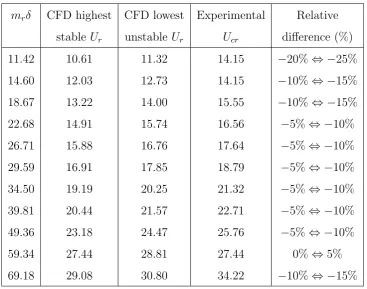
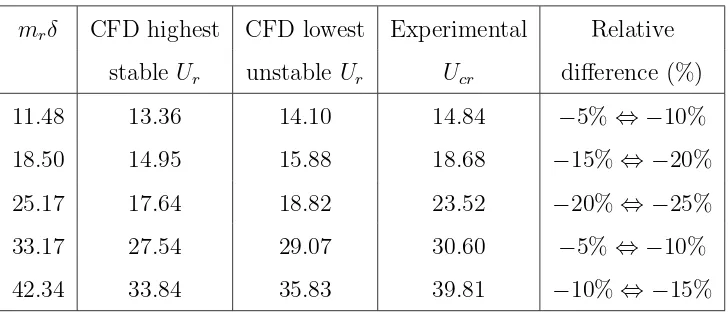
is collected in Tables 2 and 3. It is observed that, though the predictions
most cases it is only by about 5-10%. Hence, the simulation procedure can be
regarded to give reasonable conservative estimates of the critical velocity for
FEI, and this justifies applying the method to explore the effect of different
system parameters, as reported in the next section.
mrδ CFD highest CFD lowest Experimental Relative
stableUr unstable Ur Ucr difference (%)
11.42 10.61 11.32 14.15 −20% ⇔ −25%
14.60 12.03 12.73 14.15 −10% ⇔ −15%
18.67 13.22 14.00 15.55 −10% ⇔ −15%
22.68 14.91 15.74 16.56 −5%⇔ −10%
26.71 15.88 16.76 17.64 −5%⇔ −10%
29.59 16.91 17.85 18.79 −5%⇔ −10%
34.50 19.19 20.25 21.32 −5%⇔ −10%
39.81 20.44 21.57 22.71 −5%⇔ −10%
49.36 23.18 24.47 25.76 −5%⇔ −10%
59.34 27.44 28.81 27.44 0% ⇔5%
[image:27.595.122.490.236.525.2] [image:27.595.123.487.239.525.2]69.18 29.08 30.80 34.22 −10% ⇔ −15%
mrδ CFD highest CFD lowest Experimental Relative
stableUr unstable Ur Ucr difference (%)
11.48 13.36 14.10 14.84 −5%⇔ −10%
18.50 14.95 15.88 18.68 −15% ⇔ −20%
25.17 17.64 18.82 23.52 −20% ⇔ −25%
33.17 27.54 29.07 30.60 −5%⇔ −10%
[image:28.595.124.488.123.279.2]42.34 33.84 35.83 39.81 −10% ⇔ −15%
Table 3: Comparison of predicted critical velocity and experimental data from Austermann and Popp (1995) for the P/d=1.375 tube array.
5. Effect of system parameters
5.1. Reynolds number
It was considered the reference case of P/d=1.25 and mrδ = 26.7
sub-ject to air cross-flow (υ = 1.51×10⁻⁵ m2/s), which corresponds to one of
the experimental data by Austermann and Popp (1995). For this case, the
Reynolds number based on tube diameter (d=38mm) and gap velocity at
experimental critical conditions (Ug=6.3 m/s) was Re = 1.6×10⁴. Again,
simulations were carried out for successive flow velocity increments of 5%
of the experimental critical value, but now the fluid viscosity was increased
accordingly, so that the Reynolds number did not change. This procedure of
viscosity adaptation was repeated for four higher Reynolds numbers, up to
105. The results are presented in Fig.17. It is seen that the critical velocity
for FEI, as delimited by the highest Ur in stable regime and the lowestUr in
unstable regime, increases by about 20% within the range of Reynolds
limit of Re= 105.
This moderate influence of Reis consistent with the study by Charreton
et al. (2015), who collected data from the literature of lift coefficients on
statically displaced cylinder for relatively high values ofRe. On the contrary
the effect of Rebelow 200, as obtained by these researchers from both
com-putations and experiments on a parallel triangular array, was very strong.
Besides, the trend of increasing Ur for higher Re is consistent with specific
experimental studies (Chen and Jendrzjczyk (1981); Mewes and Stockmeier
(1991)) and with the high and scattered values of the critical velocity
usu-ally observed in practice for arrays subjected to intensely turbulent flows
(Weaver and Fitzpatrick (1988); Au-Yang et al. (1991); Pettigrew and
Tay-lor (2003a)). That scatter, with variations in critical velocity well above 20%,
might be related to an increasing slope of Ur atRe∼105 as obtained in the
current study, which suggests still further increments of critical velocity with
Re.
From the current simulations, the predictions under controlled moderate
Reynolds number conditions (Re ∼ 104) might be considered as an
appro-priate low-bound estimation for the critical velocity in practice. However,
further research would be required to characterize the conditions in which
that result can be extended to other configurations. For instance, in case
of two-phase flow the effect of Re can be totally masked, as deduced from
the measurements by Sawadogo and Mureithi (2013) of the fluid forces on a
two-phase cross-flow with different void fractions. On the other hand, Mahon
and Meskell (2012) demonstrated that if the quasi-steady theory is to be
reconciled with the trends observed in experimental data for critical
veloc-ity in single phase flow, the fluid force coefficients must exhibit a Reynolds
number dependency. Although this was shown for parallel triangular arrays,
it is probable that the same argument could be applied to normal triangular
arrays.
5.2. Pitch ratio
Starting again from the reference conditions of P/d=1.25, mrδ = 26.7
and air cross-flow, the previous simulation procedure was now applied on
four new arrays with successively greater pitch ratios, up to 1.58. Now the
fluid viscosity was kept constant, so Re varied proportionally to the air
ve-locity. The results are presented in Fig.18. From P/d=1.25 to 1.375 the
critical velocity is seen to increase about 10%, whereas for higher P/dvalues
the effect appears to be much smaller. In fact, the trend becomes uncertain
because the variations observed are of the order of the increments in stream
velocity between consecutive simulations for a given P/d.
The increment of critical velocity with tube spacing is in agreement with
the results from different experiments and theoretical models (Price (1995)).
In particular the results obtained are consistent with the predictions reported
by Hassan et al. (2010) for normal triangular arrays when changingP/dfrom
1.35 to 1.75, which gave values for Ur about 20% higher. However a further
increment to P/d=2.5 produced a much higher variation in Uc, well above
The current results suggest defining a limit P/d whose critical velocity
would be a reasonable estimate of critical velocities for higher pitch ratios, at
least up to the highest p/d value now tested. For the particular conditions of
these tests (normal triangular arrays, one flexible tube with a 1DOF,mrδin
the order of 25-30) that limitP/dvalue could be laid in the interval 1.3-1.35.
On the contrary lower pitch ratios would require specific estimations of the
corresponding critical velocity. According to this, engineering design criteria
that do not include the effect of pitch ratio, as is usually the case (Au-Yang
et al. (1991)), might give unconservative estimations of critical velocity for
very low P/d values. These conclusions derive from numerical tests for a
very specific configuration, so further research would be required to extend
them to other cases.
5.3. Degrees of freedom
Up to this point, the motion of the vibrating tube TV was restricted to
the transverse direction, but now the user defined function was modified to
relax that condition and allow motion in the streamwise direction as well.
The motion equations considered for the two-degree-of-freedom (2DOF) tube
were:
F(¨x,x, x, U˙ 0)x =msx¨+csx˙ +ksx=F(t)x (4)
F(¨y,y, y, U˙ 0)y =msy¨+csy˙+ksy=F(t)y (5)
with identical values of mass and structural damping and rigidity in both
orthogonal directions. Fig.19 shows a typical trajectory of tube TV after
the drag force on the tube is non-zero, first the tube crosses some distance
downstream, further than the new equilibrium position (∆x = O ∼ 10−2d).
Since there is also some unbalance in the transverse direction, tube TV
un-dergoes oscillations both streamwise and transversely to the main stream,
thus composing an orbital motion. However, the amplitude of the
stream-wise oscillation decays rapidly, and very quickly the remaining vibrations
take place mostly in the transverse direction, like a 1DOF system. Again,
these transverse oscillations can either reduce or increase along time, as is
the case in Fig.19. The former corresponds to stable regime and the latter
to unstable, i.e. to damping-controlled FEI.
Another series of simulations was conducted to estimate the critical
veloc-ity corresponding to P/d=1.25 over the range of mrδ tested by Austermann
and Popp but now with two degrees of freedom allowed for tube TV. The
fluid viscosity was kept constant so that Re varied accordingly to flow
ve-locity. Because of the 2DOF, the equilibrium position of TV became shifted
downstream approximately between 1% and 5% of the inter-cylinder gap for
the range of cross-velocities tested. Fig.20 shows the new predictions, along
with the experimental data of Andjelic (1988) for mrδ=11.42 (reported in
Austermann and Popp (1995)). He determined the critical velocity with the
same experimental set up of Austermann and Popp (1995) but without any
means to correct variations in the equilibrium position due to drag.
There-fore, his configuration was equivalent to the current 2DOF simulations. The
most noticeable effect is the drop from the previous predicted critical
drop is similar to the experimental difference between the critical velocity of
Austermann and Popp (1995) (see Fig. 16a) for the corrected geometry, and
the single point determined by Andjelic (1988) for the case with the shifted
cylinder. Certainly, more experimental data would be required to achieve an
adequate support for these predictions.
According to them, small variations in the equilibrium position of the
flex-ible tube can affect significantly the critical velocity for damping-controlled
instability. In particular, the estimations for normal triangular arrays of low
P/d with a 1DOF flexible tube can be unconservative by 25-30% if
com-pared to the case of a small shift downstream for that tube. In consequence,
though the instability is still associated to oscillations in the transverse
di-rection, simulations intended to estimate FEI thresholds should also allow
for cylinder displacement streamwise.
A separate issue is whether these critical velocities for arrays with a 2DOF
flexible tube are representative of the critical conditions for fully flexible
ar-rays. Khalifa et al. (2012) studied the ratio between critical velocities under
both situations by selecting data from the literature for the main array
ge-ometries and from a new experimental study on a parallel triangular array.
The collected data is scant and sparse and no numerical result was finally
provided for the normal triangular geometry. However they pointed out that
Scotts (1987) tests in water tunnel did not show FEI development in normal
triangular arrays with one single flexible tube (P/d=1.33 and 1.5), whereas
op-position to the results obtained in wind tunnel by Austermann and Popp
(1995), as well as the current numerical predictions, reveals the considerable
influence of the mass-damping parameter on the dominant FEI mechanism
(damping-controlled or stiffness-controlled). Therefore, the estimation of
sta-bility limits of fully flexible tube arrays from data for arrays with one single
flexible tube may be reasonable for specific configurations but it is not to be
generalized (Khalifa et al. (2012)).
6. Conclusions
A CFD methodology involving structure motion and dynamic re-meshing
has been put into practice to simulate the self-excited vibrations due to
damping-controlled fluidelastic instability in a normal triangular cylinder
ar-ray with a single flexible tube located in the third row. URANS 2D
compu-tations were performed with the commercial code Fluent 12.1 complemented
with user defined functions to account for the flexible tube motion.
Appro-priate model parameters regarding mesh refinement, boundary conditions,
turbulence model and time step were selected by comparing calculations to
experimental data under static conditions (Mahon and Meskell (2009)) as well
as to ensure minimum influence on predictions. In particular, large-scale
dis-turbances downstream the array were avoided by using parallel guide plates
instead of truncating the computation domain at the last row like in other
precedent models.
ex-perimental data reported in the literature regarding i) time lag of lift
coeffi-cient under transverse forced vibrations withP/d=1.32 (Mahon and Meskell
(2013)) and ii) critical velocity for 1DOF FEI withP/d=1.25 andP/d=1.375
over a range of the mass-damping parameter (Austermann and Popp (1995)).
In the case of lift lag under forced vibration, the predictions obtained
for the retardation parameter µ were in remarkable agreement with Mahon
and Meskell’s measurements for reduced pitch velocities in the range 70-130,
denoting a decaying trend for µ. However, in the range 25-65 the
predic-tions of µwere excessively high in about 75%. The average value of Mahon
and Meskell’s data is µ=1.3, which agrees reasonably well with Price and
Paidoussis (1984) suggestion of µ=O ∼(1) (1984), despite the different
con-ditions between the quasi-steady theory and the current dynamic tests.
Besides, the analysis of the velocity and pressure fluctuations along the
stream suggests that the main flow disturbances originate in the region of
flow detachment from the vibrating tube, in line with Granger and Paidoussis
(1996) explanation for the flow memory effect and with the experimental data
obtained by Khalifa et al. (2013a) for a parallel triangular array. Downstream
the vibrating tube, velocity perturbations were observed to propagate at a
speed of about 0.84 times the gap velocity, whereas propagation upstream
exhibited a complex pattern. This was attributed to the oscillations induced
in the wake of the anterior cylinders, which would behave as secondary
In the case of the simulations with a 1DOF cylinder developing FEI, the
predictions can be considered particularly satisfactory, since the critical
ve-locities estimated under Austermann and Popp’s conditions resulted to be
just 5-10% below the experimental values in most cases. This capability of
the present CFD procedure was then applied to investigate the effect of
mod-ifying some parameters of the system. It was found that increasing the pitch
ratio from 1.25 to 1.375 resulted in an increment of critical velocity of the
order of 10%, with little variation for higher P/d values up to 1.58 (highest
P/d tested). Analogously, augmenting the Reynolds number also provoked
the shift of the critical velocity towards higher values. This might suggest
defining a limit pitch ratio so that the estimations obtained for that limit
pitch ratio and low Reynolds number could be used as reasonable
conser-vative bounds of the instability thresholds for higher tube spacing. On the
contrary, arrays with lower tube spacing would require specific estimations
of critical velocity.
Finally, the consideration of a second degree of freedom for the flexible
tube, thus allowing motion both in the transverse direction and streamwise,
showed that the critical velocities reduced by 25-30% though the instability
still took place in the transverse direction. According to this, the
compu-tations intended to estimate critical velocities for FEI should include
two-degree-of-freedom tubes in order to obtain reasonable conservative
predic-tions.
nu-merical tests on a specific configuration (normal triangular array with a single
flexible tube) under certain operating conditions. Further research is required
to verify whether these conclusions can be extended to other array
configu-rations.
Acknowledgment
The authors gratefully acknowledge the financial support received from the
Spanish Ministry of Economy and Competitiveness (project
MCE-DPI-2012-36464) as well as the PhD grant BP-12054 awarded to Ms. de Pedro by the
mr
fn
Re P / d
Comparison 3:
(Austermann &, Popp,,1995).
UDF.controlling tube motion
CFD.static model:
7Steady (RANs)
INSTABIILITY. THRESHOLD Comparison 1:
(Mahon &, Meskell,,2009).,
CFD.dynamic model:
7Unsteady (URANs) 7Dynamic mesh
Tube trajectory SelfGexcited vibration
Forced vibration
FLOW.PATTERN. AND. TIME.DELAY Comparison 2:
(Mahon &, Meskell,,2013).,
Stability criteria n>0,:,Stablility
n<0,:,Instablility
[image:38.595.114.499.292.475.2]TUBE.SURFACE. PRESSURE
V
T1 T3
T8
T7 P
d
9d
9d T4
T5 T6
[image:39.595.138.483.321.452.2]T2
Static tube T5
[image:40.595.112.503.230.521.2]Vibrating tube TV
! *" #! $%" $(! &&" &'! %$" %)! +!,*
+!,& ! !,& !,* !,) !,( $ $,&
-./0
1
2
-34567896:;<=-><;< ?+-G-@;<:><7> ?+G-@@A
?+-6-BCD-.:E:-6F,-G<==0
Ƞ
[image:41.595.127.490.239.523.2]U
!" # $%" $& ''" '( %$" %) * +!
* +' +' +! +) +& $
,-./
0
1
,
,
2& 23 2(
!" # $%" $& ''" '( %$" %) * +!
* +' +' +! +) +& $
,-./
0
1
,
, 2456,2& 2456,23 2456,2( b)
[image:42.595.182.421.155.605.2]a)
5 4.5 4 3.5 3 2.5 2 1.5 1 0.5 0
V(m/s)
P (Pa)
-7 -4 -1 2 5 11 14 17 20 23
8
a)
[image:43.595.130.489.215.525.2]b)
Figure 6: Contours of (a) velocity magnitude and (b) static pressure, computed with the static model (P/d=1.25,U0=0.89 m/s) with thek−ϵ-RNG turbulence model and periodic
!"" !#" $"" $#" "%&
! !%! !%$ !%' !%( !%# !%) !%* !%+
,-./01234/ 5
5 65.781.9:165.781.9: !"
[image:44.595.160.455.256.500.2]7>17>#$ !"
j
a b c
d e
f
g h i j k
l m n o
S=-55 S=-27.5 S=0 S=27.5 S=55
Y X
T4 T6
T1 T3
TV S(mm)
U
[image:45.595.141.465.276.471.2]T2 T5
V(m/s) 0 0.7 1.4 2.1 2.8 3.5 4.2 4.9 5.6 6.3 7
a b c d e f g h i j k l m n o
TV T1 T3 T4 T6 P(Pa) -5 50 0 5 10 15 20 25 30 35 40 45
a b c d e f g h i j k l m n o
TV T1 T3 T6 T4 a) b) c) Vort. (1/s) 1e+3 8e+2 6e+2 4e+2 2e+2 0e+0 -2e+2 -4e+4 -6e+2 -8e+2 1e+3 T5 T5 T2 T5 T2 2
-Figure 9: Instantaneous distribution of the (a) velocity magnitude (b) vorticity and (c) static pressure, forP/d=1.25U0=1.26 m/s and tube TV oscillating transversely at 7.8Hz
[image:46.595.151.448.130.609.2] ! ! " " #$% &' $' & & ' )&*&"+" ' )&*&!!! '
)&*& ,
#$% -. / 0 1 &2 34 & & ' )&*&"+" ' )&*&!!! '
)&*& ,
a) b) a b c d e f g h i j
k l m
n o a b c d e f g h i
j k l
m n o
[image:47.595.165.433.141.611.2]
Figure 10: Amplitude and phase lag (relative to tube TV position) of the velocity fluc-tuation for three reduced velocities, with tube TV oscillating at 7.8Hz and amplitude of
!
" # $ ! " %&' ()&) ( ( + ,(-(.$. + ,(-(!!! + ,(-( ! ! %&' ) / 0 1 2 (3 45 ( ( +,(-(.$. +,(-(!!! + ,(-( # a) b) a ! " # $ % & ' ( ! " # $ % &
! "
#
$ % &
' (
) !!!!!!!!!!"
[image:48.595.160.421.168.590.2]!#!!!$ !% !&
! "! #! $! %!! % ! %"! !&$
% %& %&" %&# %&$ & &" &#
'
(
)
) *+,)
[image:49.595.143.470.237.504.2]-./01).12)-345366)7 !%89)
! " # $ % %! %" %# %$ ! !! &%
& '( '(
)*)+,-*
./
0
1% &2
[image:50.595.143.465.245.511.2]! " # $ % & '( )(((*# +!
+# +% +, ! !+! !+#
(-(./0
!
3
! !
"
(
[image:51.595.119.483.240.529.2](
!" #" #! $" $! %" %! &" &! !" '&
'( ') # #'$ #'& #'( #')
*
+ "," *
-".
"*
1.05·Uc
exp
c exp
U
0.9·U 0.95·U
0.85·U
0.8·U
c
c
c exp
exp
exp
exp
c CFD Instability threshold
[image:52.595.115.469.252.496.2]nº cycles
Figure 15: Envelope curves of tube response for cross-flow velocity increasing from stable to unstable regime (P/d=1.25,mrδ=26.7, Ucexp=critical velocity determined by
10 20 30 50 60 70 10
20 30 40
m
r
U r
Experimental critical velocity (U r= Ucr
exp )
CFD highest U
r in stable regime CFD lowest U
r in unstable regime
10 20 30 40 50
10 20
30 40 50
mr
Ur
Experimental critical velocity (U
r=Ucr
exp)
CFD highest U
r in stable regime CFD lowest U
r in unstable regime
a)
[image:53.595.165.463.126.645.2]b)
pre-! " # $ % & ' () *+()++" (#,#
($ ($,#
(% (%,#
(& (&,#
(' (',#
) ),#
-. / +0
+
+
123+4564.78+/
0+59+78:;<.+0.65=.
123+<>?.78+/
[image:54.595.121.478.251.513.2]0+59+@978:;<.+0.65=.
Figure 17: Effect of Reynolds number on the predicted critical velocity (P/d=1.25,mrδ=
!"# !$ !$# !% !%# !# !## !&"
!&% !&' !&( ! ! " ! % ! ' ! (
)*+
,
-*,
-.
/
0
0
12304564.780,-059078:;<.0-.65=.
1230<>?.780,
[image:55.595.141.460.262.512.2]-0590@978:;<.0-.65=.
0 0.1 0.2 0.3 0.4 0.5 0.6 0.7 0.8 0.9 1 -1.4
-1.2 -1 -0.8 -0.6 -0.4 -0.2 0 0.2 0.4
x/x
0
y
[image:56.595.124.475.248.515.2]/y 0
! "! #!
! $! %! &!
! "! #! '!
(
)
* )
+
+
+,-.+/01/234+345672+*
)+8)290:429+6;+<.,
+,-.+7=>234+?@345672+*
)+8)290:429+6;+<.,
"+,-.+/01/234+345672+*
)+8)290:429+6;+<.,
"+,-.+7=>234+345672+*
)+8)290:429+6;+<.,
"+,-.+2A82)0(2@457+BC@9D270:E+ FGGH+
[image:57.595.113.494.254.487.2]!"#$!%&'!() *!"#$!%()
References
Anderson, B., Hassan, M., Mohany, A., 2014. Modelling of fluidelastic
in-stability in a square inline tube array including the boundary layer effect.
Journal of Fluids and Structures 132, 362–375.
Andjelic, M., 1988. Stabilitatsverhalten querangestromter rohrbundel mit
versetzter dreieckteilung. Dissertation, Institute of Mechanics, University
of Hannover, Germany.
ANSYS, 2013. Fluent user ’s guide.
Au-Yang, M. K., Blevins, R. D., Mulcahy, T. M., 1991. Flow-induced
vi-bration analysis of tube bundlesa proposed, section iii appendix n:
Non-mandatory code. Journal of Pressure Vessel Technology 113, 257–267.
Austermann, R., Popp, K., 1995. Stability behaviour of a single flexible
cylin-der in rigid tube arrays of different geometry subjected to cross-flow.
Jour-nal of Fluids and Structures 9 (3), 303 – 322.
Charreton, C., B´eguin, C., Yu, K. R., ´Etienne, S., 2015. Effect of reynolds
number on the stability of a single flexible tube predicted by the
quasi-steady model in tube bundles. Journal of Fluids and Structures 56, 107–
123.
Chen, S. S., 1983a. Instability mechanisms and stability criteria of a group
of circular cylinders subjected to cross-flow, part i: Theory. Journal of