2
3
Lauren M. Guillette & Susan D. Healy 4
School of Biology 5
University of St Andrews 6
St Andrews KY9 16TH 7
UK 8
9
Contact author: Susan D. Healy, email: [email protected] 10
11
Key words: Animal cognition, Building, Construction, Nests, Physical cognition, Tool 12
making 13
14
16
Abstract 17
In the last decade tool manufacture in birds has transformed the landscape of animal 18
cognition. As tool manufacture, however, is rare and practised by species that are not 19
commonplace it is not a particularly useful model for investigating the evolution of physical 20
cognition. Based on recent evidence, we argue that nest building, which bears considerable 21
phenotypic resemblance to tool making, is more useful for examining not only the role that 22
cognition may play in construction behaviours, but also the neural underpinning of those 23
behaviours and, ultimately their evolution. We substantiate our view with recent evidence 24
that building by birds involves changes in dexterity, is experience-dependent and involves 25
activity in, at least, motor, reward and social network brain regions as well as in the 26
cerebellum. 27
29
Introduction 30
Building by animals is a surprisingly neglected behaviour, surprising because it is key to 31
reproductive success for many species and, of more recent relevance, because it bears a 32
striking phenotypic similarity to tool making [1,2]. For a behaviour with such a broad 33
taxonomic spread across orders of animals (e.g. birds [3], reptiles [4], rodents [5], primates 34
[6], fish [7,8], and many social insects [9]), we still know remarkably little about how these 35
animals know what structure to build. These structures include beaver dams, caddis larvae 36
cases, antlion larvae pits, bowers, fish, chimpanzee and bird nests. In striking contrast, a 37
considerable amount of research effort has been addressed to another form of construction 38
behaviour, tool manufacture and use. Although much of this effort is based on the apparent 39
value of tool making for our understanding of the evolution of physical cognition (how 40
animals acquire, process and use information about the physical world [10–13]), the rarity of 41
tool making does not, in our view, make it a system of general applicability. Although tool 42
making has been explicitly separated, by definition, from all other building behaviours 43
[14,15] we contend that due to the significant phenotypic similarity that tool making shares 44
with nest building, nest building, due to its greater amenability to experimental manipulation, 45
to neural investigation and to phylogenetic analyses, may prove a more useful ‘model’ 46
system. 47
48
Recent empirical evidence 49
In the 19th century several observers, including Alfred Russel Wallace, concluded that 50
building by birds (of nests), like that of man, was dependent on their experience [16]. 51
however, the common view, even in the 21st century, is that nest building by birds is innate 53
[19–23]. Firm and widespread though this view may be, it has been held in the face of little to 54
no evidence. That is, until relatively recently. Data are now steadily accumulating to show 55
that birds modify where they build, what they build and how they build it, in response to 56
experience. 57
Field evidence for a significant component of experience-dependence in nest building comes 58
largely from observations that, after suffering predation on their nest, birds will move to a 59
different site to build their next nest [25]. The structure of the nests of some birds also varies 60
depending on their geographical location [26,27], although it is not clear whether this 61
variation in due to real-time responses by individuals to local conditions or to selection. That 62
selection can act on nest morphology is shown by the evolution of the addition of domes to 63
nests built by those babbler species that build their nests on the ground, thought to be a 64
response to increased predation risk [28]. 65
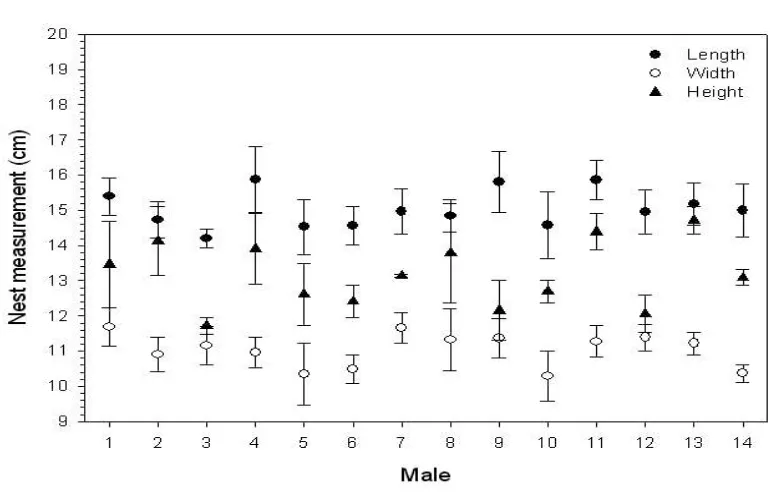
The demonstration that there is low to no repeatability of the morphology of nests built by 66
male Southern Masked weavers (Ploceus velatus, Botswana) and male Village weavers (P. 67
cucullatus, Nigeria [29,30]) strongly suggest that the building of these nests is not achieved 68
by a fixed-action pattern or behaviour that is ‘hard-wired’ rather, that individual builders do 69
modify their behaviour depending on their experience/their environment (see Figures 1 and 70
2). This interpretation is further supported by the observations that male Southern Masked 71
weavers rarely complete a nest before they begin the construction of the next [31] and that 72
these males improve their material handling skills as they drop fewer pieces of grass the more 73
nests they build. 74
Although weavers have significant appeal because they build a beautiful, apparently complex 75
questions in building because experimental manipulations of building behaviour in the field 77
are not straightforward. Zebra finches, Taeniopygia guttata, however, which breed 78
essentially on demand in the laboratory [32], are a useful model for building behaviour. And, 79
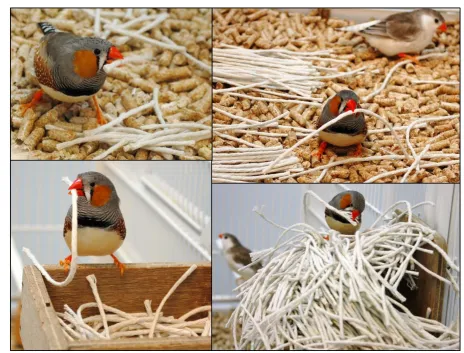
importantly, while a zebra finch nest may not be a thing of beauty to the untrained eye, data 80
are accumulating to show that zebra finches learn multiple components of their nest building 81
(Figure 4). For example, adult males learn to associate their own reproductive success with 82
the colour of the material with which they build the nest: males that successfully reared 83
chicks from a nest built with material of a colour they did not like, subsequently switched 84
their preference to the colour of the successful material, when given another opportunity to 85
build [33]. 86
Furthermore, and importantly for a builder, male zebra finches also learn both how to 87
manipulate material and about the structural properties of the material with which they build. 88
Both these features were shown by nest-building male zebra finches provided with a nest-box 89
that had either a large (10cm diameter) or small entrance (5cm diameter), and with nest 90
material of two different lengths, short (20-22cm with 4.5-5.5cm stiff middle section) and 91
long (25-27cm with 11.5-13.5cm stiff middle section). Birds with a box of either entrance-92
size could carry the short material directly into the box but only the birds with the large nest-93
box entrance could readily use the long material. From the outset, males with the large 94
entrance nest box took materials of both lengths into their box while the males with the small 95
nest-box entrance preferred to take the short material. Over the course of the experiment, 96
however, the small nest-box entrance males modified the way in which they held the material 97
so that they could take both lengths of material into the nest box [34]. This change in material 98
handling shows firstly that dexterity with physical objects changes with experience but also 99
that by changing the way they manoeuvred the material through the entrance these builders 100
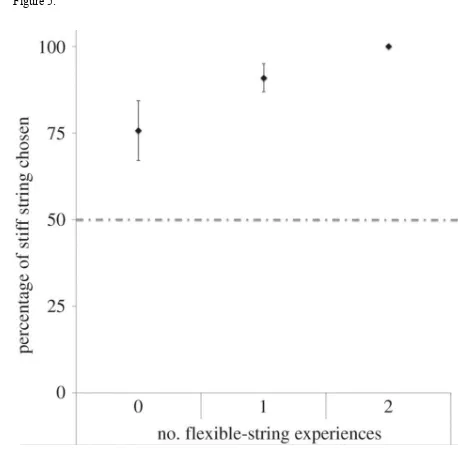
finch males also learn to select among nest material that is most suitable for their nest: 102
builders given several experiences of building with either flexible or stiff string, all 103
eventually preferred the stiffer material, which is also the most efficacious building material 104
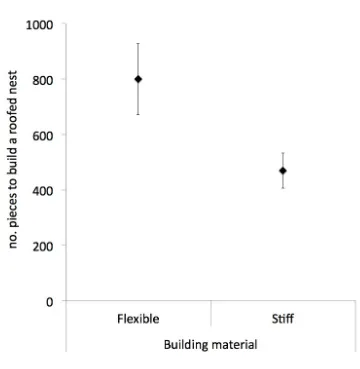
(see Figures 5-7). It takes nearly twice as many pieces of flexible string to build a complete 105
nest than it does to build a nest with the stiff material [35]. Builder zebra finches will also 106
modify the colour of material with which they prefer to build depending on the colour of 107
environment in which they build so as to camouflage their nest [36]. 108
Although these data all show that builders learn from their own experience, social learning 109
also has at least some part to play. For example, migratory flycatchers (Ficedula albicollis 110
and F. hypoleuca) use information provided by resident tit species (Parus major and P. 111
caeruleus) when choosing where to build their nest [37–39]. The migrants used at least two 112
kinds of information, firstly with regard to the location of nest building. The flycatchers 113
chose, from two possible boxes each marked with an arbitrary geometric symbol, to build in 114
those boxes marked with the same geometric symbol as that marking a nearby box occupied 115
by a tit nest [37]. The propensity of the flycatchers to near to the nest occupied by tit nests 116
also increased as the number of offspring in those nests increased [40]. It is plausible, then, 117
that birds may also pay attention to conspecifics when deciding what material to use or the 118
structure to build. 119
120
Nest building in the brain 121
As the zebra finch is the iconic system for examining the neural and hormonal underpinnings 122
of song learning [41], the wealth of data on its neuroanatomy [32] means that it is also a 123
useful species in which to begin investigating the neural bases of building behaviour. Early 124
anterior motor pathway, which is typically implicated in motor learning and sequencing [42], 126
the dopaminergic reward circuit, and social behaviour network in zebra finch builders [43], 127
specifically in relation to the number of times builders picked up and deposited material into 128
the growing nest and time spent in the nest by the female [43]. Nest building, itself, also 129
appears to be rewarding as targeted neuronal populations in implicated brain areas show: (1) 130
activity increases in mesotocinergic populations of builders compared to controls; (2) activity 131
is higher in vasotocinergic populations and dopaminergic populations the longer a builder 132
spends in the nest with his mate; and (3) activity is also higher in vasotocinergic cells the 133
more material a builder picks up [44]. Of the additional brain areas that may be involved in 134
building behaviour [45,46], the cerebellum holds especial promise: a phylogenetic analysis 135
shows that nest complexity increases with cerebellar foliation (the amount of surface folding 136
[47]). Given that the cerebellum is involved in cognitive processes such as learning, memory 137
and language ability in humans [48] and tool-use in birds [49] and primates [50,51], it will be 138
useful to determine its role in nest building. 139
The male zebra finch and weaver builders are, however, just the beginning to the possible 140
value nest building might hold for our understanding of physical cognition. For example, sex-141
differences in physical cognition in the brain and behaviour can be elucidated because who 142
builds the nest (the male, the female, or both) varies among species. Moreover, one might 143
explore the ontogeny of nest building by manipulating the features of the nest into which a 144
chick hatches and the materials to which it is exposed in early life, one could investigate the 145
function of the nest structure [52,53] and the degree to which natural and sexual selection 146
have acted on the structure [54,55], as well as exploring a whole range of mechanistic 147
underpinnings, including the role of hormones. 148
In sum, we propose that nest-building behaviour is a useful model system to examine the 149
nest-building behaviour, because in this group the behaviour is ubiquitous, with variation in 151
the identity of the builder, in material use, in the physical manipulations required to build a 152
nest as well as in the final nest structure (e.g., ranging from scrapes on a beach to self-153
incubating mound nests and hanging baskets of weavers [56]) and is very amenable to 154
experimental manipulation. Thus nest-building can be examined using both existing 155
frameworks [13] for the study of comparative cognition: behaviour of closely related species 156
that face different ecological pressures where different cognitive abilities may be favoured 157
and the behaviour of more distantly related species that face similar environmental pressures 158
where we might expect convergence in cognitive abilities. 159
160
Acknowledgements 161
We thank the BBSRC (BB/I019502/1,SDH; Anniversary Future Leader Fellowship 162
BB/M013944/1, LMG) for funding. Thanks to Eira Ihalainen for providing photographs of 163
zebra finches and Ida Bailey and Kate Morgan for providing photographs of cape weavers 164
and to Ida Bailey for providing a previously unpublished graph (Fig. 5). 165
166
References 167
1. Healy, S. D., Walsh, P. T. & Hansell, M. H. 2008 Nest building by birds. Curr. Biol. 168
18, 271–273. 169
2. Hansell, M. H. & Ruxton, G. D. 2008 Setting tool use within the context of animal 170
construction behaviour. Trends Ecol. Evol. 23, 73–78. (doi:10.1016/j.tree.2007.10.006) 171
3. Hansell, M. H., Ruxton, G. D. & Ennos, a. R. 2014 Collected and self-secreted 172
building materials and their contributions to compression and tension structures. Biol. 173
J. Linn. Soc. 112, 625–639. (doi:10.1111/bij.12288) 174
4. Lovich, J. E., Agha, M., Yackulic, C. B., Meyer-wilkins, K., Bentley-Condit, V., 175
movements, and lack of long- term nest site fidelity in Agassiz’s desert tortoises at a 177
wind energy facility in southern California. Calif. Fish Game 100, 404–416. 178
5. Sager, T. N., Kirchhoff, J., Mørk, A., Van Beek, J., Thirstrup, K., Didriksen, M. & 179
Lauridsen, J. B. 2010 Nest building performance following MPTP toxicity in mice. 180
Behav. Brain Res. 208, 444–449. (doi:10.1016/j.bbr.2009.12.014) 181
6. Van Casteren, A., Sellers, W. I., Thorpe, S. K. S., Coward, S., Crompton, R. H., Myatt, 182
J. P. & Ennos, A. R. 2012 Nest-building orangutans demonstrate engineering know-183
how to produce safe, comfortable beds. Proc. Natl. Acad. Sci. 109, 6873–6877. 184
(doi:10.1073/pnas.1200902109) 185
7. Barber, I., Nairn, D. & Huntingford, F. A. 2009 Nests as ornaments: revealing 186
construction by male sticklebacks. Behav. Ecol. 12, 390–396. 187
(doi:10.1093/beheco/12.4.390) 188
8. Rushbrook, B. J., Dingemanse, N. J. & Barber, I. 2008 Repeatability in nest 189
construction by male three-spined sticklebacks. Anim. Behav. 75, 547–553. 190
(doi:10.1016/j.anbehav.2007.06.011) 191
9. Erens, H., Mujinya, B. B., Mees, F., Baert, G., Boeckx, P., Malaisse, F. & Van Ranst, 192
E. 2015 The origin and implications of variations in soil-related properties within 193
Macrotermes falciger mounds. Geoderma 249-250, 40–50. 194
(doi:10.1016/j.geoderma.2015.03.003) 195
10. Teschke, I., Wascher, C. A. F., Scriba, M. F., von Bayern, a M. P., Huml, V., Siemers, 196
B. & Tebbich, S. 2013 Did tool-use evolve with enhanced physical cognitive abilities? 197
Philos. Trans. R. Soc. Lond. B. Biol. Sci. 368, 20120418. (doi:10.1098/rstb.2012.0418) 198
11. Wimpenny, J. H., Weir, A. a S., Clayton, L., Rutz, C. & Kacelnik, A. 2009 Cognitive 199
processes associated with sequential tool use in new Caledonian crows. PLoS One 4. 200
(doi:10.1371/journal.pone.0006471) 201
12. Seed, A. & Byrne, R. 2010 Animal tool-use. Curr. Biol. 20, 1032–1039. 202
(doi:10.1016/j.cub.2010.09.042) 203
13. Shettleworth, S. J. 2010 Cognition, Evloution and Behavior. 204
14. Shumaker, R. W., Walkup, K. R. & Beck, B. B. 2011 Animal Tool Behavior - The use 205
and manufacture of tools by animals. Revised an. Baltimore, MD: The Johns Hopkins 206
University Press. 207
15. Smith & Bentley-Condit, V. 2010 Animal tool use: current definitions and an updated 208
comprehensive catalog. Behaviour 147, 185–32A. 209
(doi:10.1163/000579509X12512865686555) 210
16. Wallace, A. R. 1867 The philosophy of birds’ nests. Intellect. Obs. 11, 413–420. 211
17. Collias, E. C. & Collias, N. E. 1964 The development of nest-building behavior in a 212
18. Collias, N. . & Collias, E. C. 1984 Nest Building and Bird Behaviour. Princeton, NJ: 214
Princeton University Press. 215
19. Sargent, T. D. 1965 The Role of Experience in the Nest Building of the Zebra Finch. 216
Auk 82, 48–61. 217
20. Dixon, C. 1902 Birds’ Nests: An Introduction to the Seience of Caliology. BiblioLife. 218
New York; London: Federick A. Stokes Company; Grant Richards. 219
21. Burns, F. L. 1924 The philosophy of birds’nests and comparative caliology in 220
consideration of some local Nidicolous birds. Wilson Bull. 36, 77–88. 221
22. Raval, J. V 2011 Morphometric study of birds’ nests. Int. J. Zool. Res. 2, 30–35. 222
23. Raby, C. R. & Clayton, N. S. 2009 Prospective cognition in animals. Behav. Processes 223
80, 314–324. (doi:10.1016/j.beproc.2008.12.005) 224
24. Goodfellow, P. 1977 Birds as Builders. New York: Arco Publishing Company, Inc. 225
25. Lima, S. L. 2009 Predators and the breeding bird: Behavioral and reproductive 226
flexibility under the risk of predation. Biol. Rev. 84, 485–513. (doi:10.1111/j.1469-227
185X.2009.00085.x) 228
26. Mainwaring, M. C. et al. 2012 Latitudinal variation in blue tit and great tit nest 229
characteristics indicates environmental adjustment. J. Biogeogr. 39, 1669–1677. 230
(doi:10.1111/j.1365-2699.2012.02724.x) 231
27. Deeming, D. C., Mainwaring, M. C., Hartley, I. R. & Reynolds, S. J. 2012 Local 232
temperature and not latitude determines the design of Blue Tit and Great Tit nests. 233
Avian Biol. Res. 5, 203–208. (doi:10.3184/175815512X13528874959581) 234
28. *Hall, Z. J., Street, S. E., Auty, S. & Healy, S. D. 2015 The coevolution of building 235
nests on the ground and domed nests in Timaliidae. Auk 132, 584–593. 236
(doi:10.1642/AUK-15-23.1) 237
Phylogenetic analyses were used to test wehther Old World babblers (Timaliidae) that build 238
domed nests are more likely to build them on the ground than in trees. Babbler species that 239
build cup-shaped nests build their nests higher from the ground than do babbler species that 240
build domed nests. It is presumably the increased predation pressure suffered by birds 241
building on or near the ground that lead to the evolution of domed nests. This was the first 242
study to formally identify the evolutionary pathways leading to diversity in nest structure in 243
this group of birds. 244
245
29. Walsh, P. T., Hansell, M. H., Borello, W. D. & Healy, S. D. 2010 Repeatability of nest 246
morphology in African weaver birds. Biol. Lett. 6, 149–51. 247
30. Walsh, P. T., Hansell, M. H., Borello, W. D. & Healy, S. D. 2011 Individuality in nest 249
building: do southern masked weaver (Ploceus velatus) males vary in their nest-250
building behaviour? Behav. Processes 88, 1–6. (doi:10.1016/j.beproc.2011.06.011) 251
31. **Walsh, P. T., Hansell, M. H., Borello, W. D. & Healy, S. D. 2013 Are elaborate bird 252
nests built using simple rules? Avian Biol. Res. 6, 157–162. 253
(doi:10.3184/175815513X13629302805186) 254
Observations of nest building by male Southern Masked Weavers were used to distinguish 255
between two explanations that could explain the production of the structurally complex nest 256
built by these birds. As males continued to work on apparently complete nests (occupied by 257
a female) when they had begun to build subsequent nests, the simple rules consistent with 258
stigmergy or stereotypy are not sufficient to explain building in this species. These data 259
suggest that building weavers can identify when the nest is sufficiently functional rather than 260
complete, a degree of building flexibility previously unrecognised 261
32. Healy, S. D., Haggis, O. & Clayton, N. S. 2010 Zebra Finches and cognition. Emu 110, 262
242–250. 263
33. Muth, F. & Healy, S. D. 2011 The role of adult experience in nest building in the zebra 264
finch, Taeniopygia guttata. Anim. Behav. 82, 185–189. 265
(doi:10.1016/j.anbehav.2011.04.021) 266
34. Muth, F. & Healy, S. D. 2014 Zebra finches select nest material appropriate for a 267
building task. Anim. Behav. 90, 237–244. (doi:10.1016/j.anbehav.2014.02.008) 268
Male zebra finches were presented with a nest-box with an entrance hole that was either 269
small or large and with nest-material that was either long and short. Birds initially chose the 270
most appropriate material for their nest box type: males with a box with a small entrance hole 271
selected the short nest material, while males with a box with a large entrance hole were 272
indifferent to material choice. With experience, males with a box with a small entrance hole 273
changed their material handling technique: they initially carried materal to the nest by 274
holding the material in the middle, but changed to holding the material at one end. They 275
could, then, carry both the short and long material through the small entrance. This shows 276
that male zebra finches attend to physical properties of nest material and learn to handle 277
novel nest material efficiently. 278
35. **Bailey, I. E., Morgan, K. V, Bertin, M., Meddle, S. L. & Healy, S. D. 2014 Physical 279
cognition: birds learn the structural efficacy of nest material. Proc. R. Soc. B Biol. Sci. 280
281, 1–6. 281
Male zebra finches were given several experiences building a nest using nest material that 282
varried in rigidity. With increasing nest building experience, males increasingly preferred the 283
stiffer material. As the nests that were built with only flexible material required, on average, 284
over twice as many pieces of material to complete a nest it appears that birds select nest 285
material based on one of its structural properties: rigidity, and that male zebra finches learn to 286
36. **Bailey, I. E., Muth, F., Morgan, K., Meddle, S. L. & Healy, S. D. 2015 Birds build 288
camouflaged nests Birds build camouflaged nests. 132, 11–15. (doi:10.1642/AUK-14-289
77.1) 290
Male zebra finches were given two nest materials of different colours with which to build: 291
one colour matched the colour of the nest cup and surrounding cage walls, the second colour 292
material did not. Males predominantly built using the material of the colour that matched the 293
background colour of the nest cup and cage walls. This study shows that male zebra finches 294
select nest material to camouflage their nest relative to the background. 295
37. Seppänen, J.-T. & Forsman, J. T. 2007 Interspecific social learning: novel preference 296
can be acquired from a competing species. Curr. Biol. 17, 1248–1252. 297
(doi:10.1016/j.cub.2007.06.034) 298
38. **Loukola, O. J., Seppänen, J.-T., Krams, I., Torvinen, S. S. & Forsman, J. T. 2013 299
Observed fitness may affect niche overlap in competing species via selective social 300
information use. Am. Nat. 182, 474–83. (doi:10.1086/671815) 301
Great tit nests were experimentally manipulated to contain either five or 13 eggs. The 302
entrance hole of the nest boxes in which these nests were built were marked with an arbitrary 303
geometric symbol. A second empty nest box, marked with a different symbol, was put up 304
next to the occupied box. Two additional nest boxes, bearing symbols that corresponded to 305
those on the two existing boxes, were put up some distance away. When migratory female 306
flycatchers returned to the breeding area, they chose the nest box type that matched the great 307
tit nest box when the clutch size was large, but not when the clutch size of the tits was small. 308
Flycatchers can, then, use information about the fitness of heterospecics when deciding where 309
to build a nest. 310
311
39. Loukola, O. J., Seppänen, J.-T. & Forsman, J. T. 2012 Intraspecific social information 312
use in the selection of nest site characteristics. Anim. Behav. 83, 629–633. 313
(doi:10.1016/j.anbehav.2011.12.004) 314
40. Seppänen, J.-T., Forsman, J. T., Mönkkönen, M., Krams, I. & Salmi, T. 2011 New 315
behavioural trait adopted or rejected by observing heterospecific tutor fitness. Proc. 316
Biol. Sci. 278, 1736–41. (doi:10.1098/rspb.2010.1610) 317
41. Doupe, A. J. & Kuhl, P. K. 1999 Birdsong and human speech: common themes and 318
mechanisms. Annu. Rev. Neurosci. 22, 567–631. (doi:10.1146/annurev.neuro.22.1.567) 319
42. Feenders, G., Liedvogel, M., Rivas, M., Zapka, M., Horita, H., Hara, E., Wada, K., 320
Mouritsen, H. & Jarvis, E. D. 2008 Molecular mapping of movement-associated areas 321
in the avian brain: A motor theory for vocal learning origin. PLoS One 3. 322
(doi:10.1371/journal.pone.0001768) 323
43. **Hall, Z. J., Bertin, M., Bailey, I. E., Meddle, S. L. & Healy, S. D. 2014 Neural 324
correlates of nesting behavior in zebra finches (Taeniopygia guttata). Behav. Brain 325
In this study, immediate early gene expression was used to identify brain regions that are 327
active during nest building by male zebra finches. Activity was identified specifically in 328
motor sequencing, social behaviour, reward and motivation pathway relative to the number of 329
times males picked up or deposited nest material and the amount of time the female spent in 330
the nest. These data provide the basis for investigation of the neural basis of construction 331
behaviour 332
44. *Hall, Z. J., Healy, S. D. & Meddle, S. L. 2015 A Role for Nonapeptides and 333
Dopamine in Nest-Building Behaviour. J. Neuroendocrinol. 27, 158–165. 334
(doi:10.1111/jne.12250) 335
A combination of immunohistochemistry for Fos and vasotocin, mesotocin and tyrosine 336
hydroxylase were used to investigate neuronal activity in nest building and non-nest building 337
male and female zebra finches. There was increased immunoreactivity in three neuronal 338
populations in nest-building males: in a mesotinergic neuronal population relative to that in 339
non-building males, in a vasotinergic neuronal population dependent on the amount of 340
material they picked up and in both a vasotinergic and a dopaminergic neuronal population 341
dependent on the time they spent together in the nest with their mate. These data are the first 342
to show that the social behaviour network and the dopaminergic reward system are active 343
during nest building. 344
345
45. Klatt, J. D. & Goodson, J. L. 2013 Sex-specific activity and function of hypothalamic 346
nonapeptide neurons during nest-building in zebra finches. Horm. Behav. 64, 818–24. 347
(doi:10.1016/j.yhbeh.2013.10.001) 348
46. Kingsbury, M. A., Jan, N., Klatt, J. D. & Goodson, J. L. 2015 Nesting behavior is 349
associated with VIP expression and VIP–Fos colocalization in a network-wide manner. 350
Horm. Behav. 69, 68–81. (doi:10.1016/j.yhbeh.2014.12.010) 351
47. *Hall, Z. J., Street, S. E. & Healy, S. D. 2013 The evolution of cerebellum structure 352
correlates with nest complexity. Biol. Lett. 9, 20130687. (doi:10.1098/rsbl.2013.0687) 353
For 87 species of bird for which data on the volume of the cerebellum (a part of the brain 354
thought to correlated with complex motor abilities), the degree of cerebellar foliation 355
(cerebellum surface folding) and complexity of nest structure were available, cerebellar 356
folding is greater the more complex the nest. Nest complexity was categorised into cup 357
building, platform building or no nest. This correlation is consistent with the cerebellum 358
acting in increasingly manipulative skill in nest-building birds. 359
48. Leiner, H. C., Leiner, A. L. & Dow, R. S. 1993 The role of the cerebellum in the 360
human brain. Trends Neurosci. 16, 453–454. 361
49. Iwaniuk, A. N., Lefebvre, L. & Wylie, D. R. 2009 The comparative approach and 362
brain-behaviour relationships: a tool for understanding tool use. Can. J. Exp. Psychol. 363
50. Obayashi, S., Suhara, T., Kawabe, K., Okauchi, T., Maeda, J., Akine, Y., Onoe, H. & 365
Iriki, a 2001 Functional brain mapping of monkey tool use. Neuroimage 14, 853–861. 366
(doi:10.1006/nimg.2001.0878) 367
51. Barton, R. A. 2012 Embodied cognitive evolution and the cerebellum. Philos. Trans. 368
R. Soc. Lond. B. Biol. Sci. 367, 2097–107. (doi:10.1098/rstb.2012.0112) 369
52. Heenan, C. B. & Seymour, R. S. 2011 Structural support, not insulation, is the primary 370
driver for avian cup-shaped nest design. Proc. Biol. Sci. 278, 2924–2929. 371
(doi:10.1098/rspb.2010.2798) 372
53. Heenan, C. B. 2013 An overview of the factors influencing the morphology and 373
thermal properties of avian nests. Avian Biol. Res. 6, 104–118. 374
(doi:10.3184/003685013X13614670646299) 375
54. García-Navas, V., Valera, F. & Griggio, M. 2015 Nest decorations: an ‘extended’ 376
female badge of status? Anim. Behav. 99, 95–107. 377
(doi:10.1016/j.anbehav.2014.10.024) 378
55. Sergio, F., Blas, J., Blanco, G., Tanferna, a, López, L., Lemus, J. a & Hiraldo, F. 2011 379
Raptor nest decorations are a reliable threat against conspecifics. Science 331, 327– 380
330. (doi:10.1126/science.1199422) 381
56. Hansell, M. H. 2000 Bird nests and construction behaviour. Cambridge, UK: 382
Cambridge University Press. 383
384
Figure captions 386
Figure 1. A series of six nests from a single Southern Masked weaver males. Photos ordered 387
by date of construction from top left to right. The picture originally appeared in [29] and 388
appears here with permission. 389
Figure 2. Mean ± s.e.m nest measurements (y-axis) for length (filled circles), width (open 390
circles), and height (filled triangles) of nests built by individual male Southern Masked 391
weavers (x-axis), n = 14. This figure originally appeared in [29] and appears here with 392
permission. 393
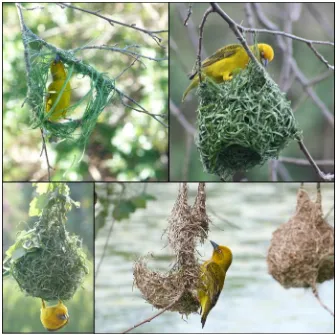
Figure 3. Clockwise start top left - cape weaver (Ploceus capensis) male that has just 394
completed the ring phase, more complete nest, tearing down an old nest with another nest in 395
the background, completed new nest. 396
Figure 4. Clockwise start top left – zebra finch (Taeniopygia guttata), male selecting short 397
nest material (~5cm), selecting long nest material (~10 cm) with female in background, late 398
stage of nest building working on roof with the entrance hole in the bottom right, early stage 399
of nest building. 400
Figure 5. The percentage of stiff string chosen by males that has no (n = 7), one (n = 10), or 401
two (n = 7) experiences building with flexible string (mean ± s.e.m). The dashed line 402
indicated 50%. This figure originally appeared in [35] and appears here with permission. 403
404
Figure 6. The associated costs of building measure by the number of pieces of sting in the 405
final nest (y-axis), for nests built with different material types (x-axis) for zebra finches in 406
[35]. 407
Figure 7. Cup-shaped nests build by zebra finches in [35] with different material types: 409
Figure 1. 411
412
413
Figure 2. 415
[image:18.595.81.468.91.338.2]Figure 3. 417
418
[image:19.595.129.465.106.441.2]Figure 4. 420
421
[image:20.595.62.527.92.445.2]Figure 5. 423
424
[image:21.595.59.517.78.539.2]Figure 6. 426
427
[image:22.595.122.482.89.458.2]Figure 7. 429