ISSN Online: 2153-1242 ISSN Print: 2153-1234
DOI: 10.4236/jis.2019.103008 Jul. 2, 2019 130 Journal of Information Security
Multi-Value Sequence Generated over Sub
Extension Field and Its Properties
Md. Arshad Ali
1*, Yuta Kodera
1, Takuya Kusaka
1, Satoshi Uehara
2, Yasuyuki Nogami
1,
Robert H. Morelos-Zaragoza
31Graduate School of Natural Science and Technology, Okayama University, Okayama, Japan
2Faculty of Environmental Engineering, University of Kitakyushu, Fukuoka, Japan
3Department of Electrical Engineering, San Jose State University, San Jose, CA, USA
Abstract
Pseudo-random sequences with long period, low correlation, high linear complexity, and uniform distribution of bit patterns are widely used in the field of information security and cryptography. This paper proposes an ap-proach for generating a pseudo-random multi-value sequence (including a binary sequence) by utilizing a primitive polynomial, trace function, and k-th power residue symbol over the sub extension field. All our previous se-quences are defined over the prime field, whereas, proposed sequence in this paper is defined over the sub extension field. Thus, it’s a new and innovative perception to consider the sub extension field during the sequence generation procedure. By considering the sub extension field, two notable outcomes are: proposed sequence holds higher linear complexity and more uniform distri-bution of bit patterns compared to our previous work which defined over the prime field. Additionally, other important properties of the proposed mul-ti-value sequence such as period, autocorrelation, and cross-correlation are theoretically shown along with some experimental results.
Keywords
Pseudo-Random Sequence, Trace Function, Power Residue Symbol, Sub Extension Field, Autocorrelation, Cross-Correlation, Linear Complexity, Distribution of Bit Patterns
1. Introduction
Sequences of numbers generated by using an algorithm are referred to as a pseudo-random sequence. Pseudo-random sequences are inseparable parts in information technology as well as in modern electronics. They are used in both How to cite this paper: Ali, Md.A.,
Kode-ra, Y., Kusaka, T., UehaKode-ra, S., Nogami, Y. and Morelos-Zaragoza, R.H. (2019) Mul-ti-Value Sequence Generated over Sub Ex-tension Field and Its Properties. Journal of Information Security, 10, 130-154.
https://doi.org/10.4236/jis.2019.103008
Received: March 28, 2019 Accepted: June 29, 2019 Published: July 2, 2019
Copyright © 2019 by author(s) and Scientific Research Publishing Inc. This work is licensed under the Creative Commons Attribution International License (CC BY 4.0).
http://creativecommons.org/licenses/by/4.0/
DOI: 10.4236/jis.2019.103008 131 Journal of Information Security
communication (such as cellular telephones and GPS signals) and cryptographic applications (such as key stream for stream cipher, sampling data for simulations, timing measurements in radar systems, error correcting codes in satellite commu-nications, and so on). In most cases, it is important to have the reproduce ability of the pseudo-random sequence [1]. As well as it should have many desirable characteristics such as a long period, low correlation, uniformly distributed bit patterns, high linear complexity, and statistical randomness [2] to become a prominent candidate for information security and cryptographic related applica-tions [3] [4]. The randomness regarding a sequence is considered as the key strength of the cryptographic systems [5]. Considering this crucial point, it’s better to use some non-linear mathematical calculation during sequence generation. Ad-ditionally, the sequence must have randomness property. The major substance for randomness is independency of values (or lack of correlation), unpredictability (or lack of predictability), and uniform distribution (or lack of bias) [6]. Along with these, there are some statistical tests available to judge the randomness of a se-quence such as NIST, Diehard, ENT test [7]. It is mandatory to evaluate the ran-domness of a sequence before utilizing them in any cryptosystems.
Other geometric sequences having prominent pseudo-random properties are the Mersenne Twister (MT) [8], Blum-Blum-Shub (BBS) [9], Legendre sequence
[10], maximum length sequence (M-sequence) [11], and Sidelnikov sequence
[12]. Among those, the former two pseudo-random number generators (MT and BBS) are well known considering their applications in cryptography rather than the theoretical aspect. On the other hand, the latter sequences (Legendre sequence, M-sequence, and Sidelnikov sequence) are prominent geometric sequences re-garding the theoretical aspect. Generally, the typical features of a pseu-do-random sequence such as its period, correlation, linear complexity, and dis-tribution of bit patterns cannot be theoretically proven. However, if a sequence is defined over the finite field, then those features are often proven. All these above-mentioned sequences generated based on some mathematics more specif-ically they are defined over the finite field. Therefore, most of their important properties are already theoretically proven. The authors are basically more inter-ested in the theoretical aspects of a pseudo-random sequence rather than their ap-plications in the cryptographic area. Therefore, the authors motivated in this re-search work by observing the theoretical features of the well-known Legendre se-quence, M-sese-quence, and Sidelnikov sequence. Moreover, many researchers are also attracted by these theoretic aspects of these sequences. Our proposed sequence generated by the idea of the Legendre sequence and M-sequences, thus the authors thought that its properties can be theoretically proven and fortunately it proven.
Our previous work on binary sequence [13] uses a primitive polynomial, trace function, and Legendre symbol to generate a new variety of pseudo-random bi-nary sequence. In brief, the previous sequence generation procedure is as follows: firstly, it utilizes a primitive polynomial over an odd characteristic field p to
generate a maximum length vector sequence as elements in pm, then applies
DOI: 10.4236/jis.2019.103008 132 Journal of Information Security
uses the Legendre symbol to binarize the scalars to binary sequence. Our previous binary sequence [13] generated by combining the features of M-sequence and L-sequence. Some important properties such as period, autocorrelation, and linear complexity have been theoretically proven in our previous work. Our previous works on multi-value sequence [14] [15] utilizes a primitive polynomial, trace function, and power residue symbol over odd characteristic field. Some important features of the sequence such as period, autocorrelation, and cross-correlation are theoretically proven in our previous work. The authors previous works on the binary sequence [13], signed binary sequence [16], and multi-value sequence
[15]are considered in the prime field p more specifically, the trace function
( )
Tr ⋅ maps an element of the extension field pm to an element of the prime
field p. Our previous work on multi-value sequence [17] considered on the sub extension field q characterized by four parameters however it has a shorter se-quence period of
(
1)
. 1
m
k p n
q
− =
−
The period and autocorrelation properties of the proposed sequence explained based on some experimental results only.
The authors in this paper proposed a multi-value sequence (including a binary sequence) by applying a primitive polynomial, trace function, and k-th power residue symbol over the sub extension field q. The k-th power residue symbol is an extended version of the Legendre symbol. In details, the proposed mul-ti-value sequence generation procedure is as follows: let p be an odd characteris-tic prime and m be the extension degree of a primitive polynomial f x
( )
over the extension field pm. It is well known that using the primitive polynomialmakes it possible to generate a maximum length vector sequence over pm. Let
ω
be a zero of the primitive polynomial f x( )
and it’s a primitive element inm
p
∗
. Then the sequence
( )
{
t ti| i Trp qm| ωi ,i 0,1,2, ,pm 2}
= = = −
becomes a maximum length sequence of having a period of pm−1, where,
( )
|
Trp qm ⋅ is the trace function over the sub extension field q. It maps an
ele-ment of the extension field pm to an element of the sub extension field q.
After the trace calculation, a non-zero constant element A is added to the trace values. This non-zero A can be any arbitrary element within the sub extension field q such as A∈
{
1,2, , q−1}
. Then, the k-th power residue symbol isutilized for mapping the trace sequence
to a k-value sequence more specif-ically a multi-value sequence.The authors recently started to consider the sub extension field q during
the sequence generation procedure, whereas, almost all our previous works on pseudo-random sequence [13][14] [15] are considered in the prime field p.
DOI: 10.4236/jis.2019.103008 133 Journal of Information Security
extension field pm elements to prime field elements and the possible range of
trace outputs are
{
0p−1}
. On the other hand, in case of sub extension field q, the trace maps extension field pm elements to sub extension field q elements and possible range of trace outputs are
{
0q−1}
. Therefore, the sub extension field allows more variations in the trace values and from the theoreti-cal perspective, this flexibility contributes to the betterment of a sequence prop-erties. Thus, from this point of view it’s a new dimension in this research area. Some of the notable contributions of the authors in this paper are: this work is an extension of our previous works [13][14][15]; if the parameter k satisfies the condition k p|(
−1)
, then it also includes our previous work [15]; this work overcomes the shorter period shortcoming of our previous work [17] by adding one more additional parameter A; the period, autocorrelation, and cross-correlation properties regarding the proposed sequence are explained both theoretically and experimentally; this work also makes a comparison in terms of autocorrelation, linear complexity, and distribution of bit patterns, according to the comparison results, it was found that the proposed sequence holds low correlation, high li-near complexity, and much better distribution of bit patterns compared to our previous work [14]. There are a lot of symbols used in this paper, thus a brief in-troduction about those symbols are introduced in Table 1.2. Preliminaries
This section explains some fundamental concepts of the finite field theory such as a primitive polynomial, trace function, k-th power residue symbol, and dual basis. Then, multi-value sequence is introduced along with its properties such as period, autocorrelation, cross-correlation, linear complexity, and distribution of bit patterns.
2.1. Primitive Polynomial
Consider a polynomial f x
( )
of degree m over prime field p. If it is not fac-torized into smaller degree polynomials over the prime field p, it is called an irreducible polynomial. Consider the smallest number e such that xe−1 isdi-visible by f x
( )
over p, it is known that e becomes a factor of pm−1. Then( )
f x is especially called a primitive polynomial, when e is equal to pm−1. Its zero
ω
belongs to the extension field pm and it becomes a primitive elementin pm that generates every non-zero element in pm as its power
ω
i (for2
0,1,2, , m
i= p − ). According to Fermat’s little theorem, the following property
between pm and its base field p holds [18].
Property 1. Let g be a generator of p∗m, ( 1) ( 1)
q p
g − −
becomes a non-zero element in prime field p and is also a generator of p∗. □
2.2. Trace Function
This work utilizes the trace function to map an element of the extension field
m
p
DOI: 10.4236/jis.2019.103008 134 Journal of Information Security
Table 1. List of symbols used in this paper.
List of symbols p odd prime number
m positive integer, mainly denotes the extension degree
m′ one of the factors of m q power of the odd prime q p= m′
k prime factor of q−1 such as k q|( −1)
p
odd characteristic prime field m
p
an extension field (base p and extension degree m)
q
sub extension field
q
∗
multiplicative group of q, excluding the 0 such as q q { }0
∗= −
( )
f x a primitive polynomial
ω root of an irreducible polynomial g generator of a group
A an arbitrary element in q
∗
( )
|
Trp qm ⋅ trace function maps pm element to q element
k
primitive k-th root of unity ( )
k
f ⋅ mapping function maps q element to k element
proposed sequence in this paper n period of a sequence
( )
R ⋅ autocorrelation of a sequence
( )
ˆ,
R ⋅ cross-correlation between the sequences and ˆ
( )
1|
0
Tr m im.
m m
p p q
i
x X X ′
− ′
=
= =
∑
(1)A crucial point, the above trace becomes an arbitrary element in q and the
trace function has a linearity property over the sub extension field q as
fol-lows,
(
)
( )
( )
| | |
Trp qm aX bY+ =aTrp qm X +bTrp qm Y , (2)
where a b, ∈q and X Y, ∈pm. In this paper, the following property is
im-portant [18].
Property 2. For each arbitrary element α∈q, the number of elements in m
p
whose trace with respect to q becomes
α
is given by p q pm = m m− ′ and the number of non-zero elements in pm whose trace is zero is given by(
p qm)
− =1 pm m− ′−1. □2.3.
k
-th Power Residue Symbol
DOI: 10.4236/jis.2019.103008 135 Journal of Information Security 1
q− as follows:
( )
( 1) 00, if 0,
1 , else if is a -th PR in , , otherwise is a -th PNR in , q k
k q
k
i
k q
a
a q a a k
a k
− ∗
∗
=
= = =
(3)
where PR and PNR stand for Power Residue and Power Non-Residue respec-tively. The k is a primitive k-th root of unity that exists in q and 0≤ <i k. It becomes a Legendre symbol when k=2 [19] and if k p|
(
−1)
, it becomes our previous work [15]. Note that, for a non-zero element a and a fixed k, theexponent i in Equation (3) is uniquely determined in the range of 0k−1. Moreover, since k 0 1
k = k =
and k is a prime number in this paper, the expo-nents can be dealt with as elements in k. This symbol is basically used for
checking whether or not a is a k-th PR over q as shown above. The output of the k-th power residue symbol can be represented as an exponent of k, where
k
is a k-th primitive root. This paper uses k-th power residue symbol to trans-late a trace sequence over q to a k values multi-value sequence such as
{ }
0,ki ,where i∈
{
0, , k−1}
.To represent the exponent i in Equation (3), this paper uses the following no-tations and it should be noted that the following notation excludes the case of
0
a= .
(
)
(
)
(
( 1))
logk logk q k . k
i= a q = a −
(4)
This paper utilizes the power residue symbol to map an element in q to an element in k. Regarding the power residue symbol
( )
a q k, the following property holds.Property 3. For each i from 0 to k−1, the number of non-zero elements in q
such that
( )
i k ka q = (5) is given by
(
q−1)
k. □2.4. Dual Bases
Dual basis that is used for some proofs shown in this paper is defined as fol-lows:
Definition 1.Let pm be a finite field and q be a finite extension of pm.
Then the two bases =
{
α α0, , ,1 αm−1}
and ={
β β0, , ,1 βm−1}
of qover pm are said to be the dual (or complementary) bases if
(
)
|
1, if , Tr
0, otherwise
m i j
p q
i j
α β = =
(6) where 1 ,≤i j m≤ −1. □
The dual basis of an arbitrary basis is uniquely determined in [18]. In this pa-per, the following property is important.
DOI: 10.4236/jis.2019.103008 136 Journal of Information Security
respectively. Based on the definition of dual basis and the linearity of the trace function, if
α
l be a basis of in pm is a non-zero sub extension fieldele-ment, then,
(
)
( )
| |
1, if ,
Tr Tr
0, otherwise,
m l j l m j
p q p q
j l
α β =α β = =
(7)
where 0 ,≤l j m≤ −1. Thus, when
α
l =1, Trp qm|( )
β
l =1. □2.5. Multi-Value Sequence and Its Properties
This paper introduces a k-value sequence, more specifically a multi-value se-quence as follows.
2.5.1. Notation and Period
Let multi-value sequence is denoted as
{ }
s ii , 0,1,2, ,n 1,= = −
(8)
where si∈
{
0,1, , k−1}
and n be the period of the sequence such as s si = n i+ .2.5.2. Autocorrelation and Cross-Correlation
The autocorrelation of a sequence is a scope for measuring how much the origi-nal sequence varies from its each shift value. After observing this property some special characteristic about the sequence can be found such as its period, some pattern of it, and so on [20]. The autocorrelation R
( )
x of sequence shiftedby x is generally defined as follows:
( )
10
R n si x si, k i
x − + −
=
=
∑
(9)
where k is a primitive k-th root of unity over the complex number . It
fol-lows that,
( )
1 00
R 0 n k .
i n
−
=
=
∑
= (10)
The cross-correlation is as important as the autocorrelation property. It is calculated between two different sequences of having the same period and it ex-plains the sharing of some partial information between two sequences. In addi-tion, if multiple sequences are used in any application (such as in security appli-cation), in that case, it is important to analyze the similarities between those se-quences. To do so, the cross-correlation property needs to be evaluated. Consi-dering the security aspects, the value of the cross-correlation preferred to be low because the higher value of cross-correlation, the more similar the sequences to each other [21]. Let ˆ=
{ }
sˆi be a different sequence of having a period of n. Then, the cross-correlation at x shifted is generally defined by the following eq-uation as,( )
1 ˆˆ,
0
R n si x si, k i
x +
− −
=
=
∑
(11)
DOI: 10.4236/jis.2019.103008 137 Journal of Information Security
2.5.3. Linear Complexity
The linear complexity (LC) of a sequence is closely related to how difficult it is to guess the next bit after observing the previous bits of a sequence. Since this pa-per considers k-value sequence with coefficients
{
0,1, , k−1}
, the linear com-plexity of sequence having a period of n is defined as follows.( )
(
(
( )
)
)
LC = −n deg gcd xn−1,h x ,
(12)
where h x
( )
of ={ }
si is defined over k as,( )
10 .
n i i i
h x − s x
=
=
∑
(13)
It should be noted that gcd
(
xn−1,h s( )
)
in Equation (12) needs to be cal-culated over k, where k is a prime number and k q|
(
−1)
. It is said that linearcomplexity of pseudo-random sequence for security applications is preferred to be high.
2.5.4. Distribution of Bit Patterns
From the viewpoint of security, the distribution of bit patterns is as important as the linear complexity. If a sequence holds uniform distribution of bit patterns, then it becomes difficult to guess the next bit after observing the previous bit patterns. For example, let’s assume a binary sequence having a period of 12 as
{
}
12= 1,0,1,0,1,0,1,0,1,0,1,0
. If we observe the 1-bit pattern in this sequence, then we can find that it has uniform distribution of 1 and 0. In other words, 1 and 0 appears same in number. However, when we check 2-bit patterns on 12, we find that it only has two type of patterns (10 and 01). In this case, we can eas-ily predict the next bit patterns after observing the previous patterns. Therefore, it is also essential to evaluate the distribution of bit patterns of a sequence to confirm its randomness.
3. Proposed Multi-Value Sequence
Let
ω
be a primitive element in the extension field pm, n be the period of theproposed multi-value sequence, m be a composite number which denotes the extension degree of the primitive polynomial, and m′ be one of the factors of
m. This paper proposes the following sequence by utilizing the trace func-tion and k-th power residue symbol as follows:
{ }
i , i k(
Trp qm|( )
i)
.k
s s f
ω
A p= = +
(14)
Here k is a prime number as well as a factor of q−1 such as k q|
(
−1)
. To make the above equation more simpler, from here on Trp qm|( )
⋅ will be representedas Tr
( )
⋅ . Therefore, the above equation becomes,{ }
,(
Tr( )
i)
.i i k k
s s f ω A p
= = +
(15)
DOI: 10.4236/jis.2019.103008 138 Journal of Information Security
generated by the k-th power residue symbol to a multi-value sequence. The map-ping function fk
( )
⋅ is defined as follows:( )
= 0,(
(
)
)
if 0,logk , otherwise. k
k
x f x
x p
=
(16)
As mentioned in Section 2.3, f xk
( )
with a fixed k maps an arbitrary elementq
x∈ to an element in k. For example, by utilizing the parameter p=5 and k=3, the sequence values will be in the range of
{
0,1,2}
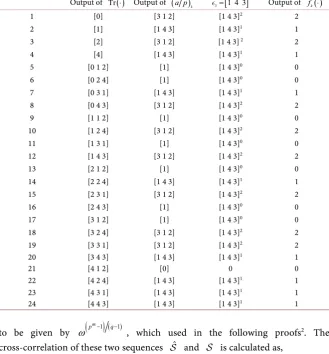
, all of these val-ues are the elements of 3. In addition, let us fixed [1 4 3] be as a 3-rd primitive root of unity in q. Then, all of the sequence values can be represented as aex-ponent of this primitive root 3. More details of this example are shown in Ta-ble 2. This mapping function fk
( )
⋅ holds the following property.Property 5. Consider x y, ∈q. If x≠0 and y≠0,
( )
( )
( )
1 .k k k
f x ± f y = f xy±
(17)
Based on Section 2.3 and Property 3, the mapping function also satisfies the following equation, it should be noted that, here C is a non-zero element in q.
1
0 0.
k v k v
−
=
=
∑
(18a)( )
( )
11 1 1
1 1 0
1 0.
k k
p p f u k
f u v
k k k
u u v
p k
−
− − −
= = =
−
= = =
∑
∑
∑
(18b)( )
( )
11 1
1 1 0.
k k
p p f Cu
f Cu
k k
u u
−
− −
= =
= =
∑
∑
(18c)This section, firstly mathematically prove the cross-correlation property of the proposed multi-value sequence, then it explains the autocorrelation property, and finally the period is introduced. Additionally, these properties are also ob-served based on some experimental results.
3.1. Cross-Correlation
The cross-correlation is calculated between two different sequences of having the same period. These two different sequences ˆ and can be defined as,
( )
(
)
{
}
ˆ ˆ ˆ| Tr i ,
i i k k
s s f ω B p
= = +
(19a)
( )
(
)
{
| Tr i}
.i i k k
s s f ω A p
= = +
(19b)
Here, A and B are non-zero elements in q. They can be represented with a generator g that exists in the sub extension field q and they hold the following relation.
, h
B g A= (20)
DOI: 10.4236/jis.2019.103008 139 Journal of Information Security
Table 2. Mapping procedure of fk
( )
⋅ for 24 different trace Tr( )
⋅ values1.Output of Tr( )⋅ Output of (a p)k 3=[1 4 3] Output of fk( )⋅
1 [0] [3 1 2] [1 4 3]2 2
2 [1] [1 4 3] [1 4 3]1 1
3 [2] [3 1 2] [1 4 3] 2 2
4 [4] [1 4 3] [1 4 3]1 1
5 [0 1 2] [1] [1 4 3]0 0
6 [0 2 4] [1] [1 4 3]0 0
7 [0 3 1] [1 4 3] [1 4 3]1 1
8 [0 4 3] [3 1 2] [1 4 3]2 2
9 [1 1 2] [1] [1 4 3]0 0
10 [1 2 4] [3 1 2] [1 4 3]2 2
11 [1 3 1] [1] [1 4 3]0 0
12 [1 4 3] [3 1 2] [1 4 3]2 2
13 [2 1 2] [1] [1 4 3]0 0
14 [2 2 4] [1 4 3] [1 4 3]1 1
15 [2 3 1] [3 1 2] [1 4 3]2 2
16 [2 4 3] [1] [1 4 3]0 0
17 [3 1 2] [1] [1 4 3]0 0
18 [3 2 4] [3 1 2] [1 4 3]2 2
19 [3 3 1] [3 1 2] [1 4 3]2 2
20 [3 4 3] [1 4 3] [1 4 3]1 1
21 [4 1 2] [0] 0 0
22 [4 2 4] [1 4 3] [1 4 3]1 1
23 [4 3 1] [1 4 3] [1 4 3]1 1
24 [4 4 3] [1 4 3] [1 4 3]1 1
to be given by
ω
( )
pm−1 ( )q−1 , which used in the following proofs2. Thecross-correlation of these two sequences ˆ and is calculated as,
( )
1(
Tr( )
)
(
Tr( )
)
ˆ,0
R n fk i x g A fh k i A, k
i
x − ω+ + − ω +
=
=
∑
(21)
where n is the period of these two sequences and according to the following sec-tion, it is given by pm−1. Furthermore, when h=0, then the value of A and B becomes exactly equal to each other, therefore, the cross-correlation becomes the autocorrelation of .
Theorem 1. The cross-correlation between the sequence ˆ and given by Equation (21) is as follows.
( )
(
)
( )
(
)
(
)
(
(
)
)
( )
( )
( )
1 ˆ, 21 , if ,
R , else if ,
, otherwise,
h k
h j h j j h
k k k k
h k
f g
m m m m m
k
f A g g f A g f g f g
m m
k k k k
f g m m
k
p p p x hn
x p x jn
p − ′ ′ − − − − − ′ − ′ − + − − = = + − − = − (22)
1In this example, we fixed [1 4 3] as a 3rd primitive root of unity that exists in
q
.
There-fore, every element can be represented as a power of this 3rd primitive root
3
. 2Since ω is a generator of
m p
∗
, therefore (pm1)(q1)
g ω − −
= becomes a generator of q
∗
DOI: 10.4236/jis.2019.103008 140 Journal of Information Security
where n n q=
(
− =1)
(
pm−1)
(
q−1)
and h satisfies the relation in Equation(20) as well as 0≤ ≠ ≤ −j h q 2. □
The proof for each case of Equation (22) is explained below. It should be noted that i holds the relation 0≤ < =i n
(
pm−1)
and it is mainly appeared atsummations. Furthermore, in the following section m m′ is denoted as r.
3.1.1. The Case of x hn=
In this case, the cross-correlation between the sequences ˆ and becomes as follows:
( )
1(
Tr(
)
)
(
Tr( )
)
1(
(
Tr( )
)
)
(
Tr( )
)
ˆ,0 0
R n fk i hn g A fh k i A n f gk h i A fk i A.
k k
i i
x − ω+ + − ω + − ω + − ω +
= =
=
∑
=∑
(23)
According to Property 5 and depending on the condition of whether or not
( )
Tr
ω
i + =A 0, the above equation can be rewritten as follows:( )
( )
( )
( )( )
( )
(
)
(
Tr)
(
Tr( )
)
0 0 ˆ,
Tr =0 Tr 0
R k h k h i k i .
i i
g A f A
f g f
k k
A A
x ω ω
ω ω
+ − +
⋅ −
+ + ≠
=
∑
+∑
(24)
Thus, the above equation becomes as,
( )
( )
( )
( )
0 ˆ,
Tr =0 Tr 0
R k h .
i i
f g
k k
A A
x
ω + ω + ≠
=
∑
+∑
(25)
It should be noted that gh≠0. Therefore, according to Property 2, the cross-correlation between the sequence ˆ and for the case of x hn=
holds the following relation.
( )
(
)
( )
ˆ,
R m m m 1 m m f gk h .
k
x = p − ′+ p − −p − ′
(26)
3.1.2. The Case of x= jn, j h≠
In this case, the cross-correlation between the sequences ˆ and becomes as follows:
( )
1(
Tr(
)
)
(
Tr( )
)
1(
Tr( )
)
(
Tr( )
)
ˆ,0 0
R n fk i jn g A fh k i A n f gk j i g A fh k i A.
k k
i i
x − ω+ + − ω + − ω + − ω +
= =
=
∑
=∑
(27)
According to Property 5, depending on the condition whether or not
( )
Tr
ω
i + =A 0 and gjTr( )
ω
i +g Ah =0 following relation is obtained.( )
( )
( )
(
)
(
)
( )
( )
(
)
(
)
( )
( )
( )
(
)
(
( )
)
11 ˆ,
Tr 0 Tr 0
Tr 0 Tr 0
Tr Tr
Tr 0 Tr 0
R
.
h j h j
k k
j i h j i h
i i
j i h i
k
j i h i
f A g g f A g
k k
g g A g g A
A A
f g g A A
k
g g A
A x ω ω ω ω ω ω ω ω − − − − − + ≠ + = + = + ≠ + + + ≠ + ≠ = + +
∑
∑
∑
(28)For example, if Tr
( )
ω
i + =A 0 and j h≠ , then,( )
(
)
Tr 0.
j i h h j
re-DOI: 10.4236/jis.2019.103008 141 Journal of Information Security
spectively becomes as follows:
( )
( )
(
)
(
)
(
(
)
)
Tr 0 Tr 0 ,h j h j
k k
j i h i
f A g g m m f A g g
k k
g g A
A p ω ω − − ′ − + ≠ + = =
∑
(30)( )
( )
(
)
(
1)
(
(
1)
)
Tr 0 Tr 0
,
h j h j
k k
j i h
i
f A g m m f A g
k k
g g A
A p ω ω − − − − − ′ − − + = + ≠ =
∑
(31)where the following facts and conditions should be noted for the above two summations:
In this paper, the parameter A is not 0 and A∈q.
The case of Tr
( )
ω
i + =A 0, gjTr( )
ω
i +g Ah ≠0. While gjTr( )
ω
i +g Ah =0, Tr( )
ω
i + ≠A 0.Assume, Tr
( )
i 0i
X =
ω
+ ≠A . Then the third summation in Equation (28)becomes as follows:
( )
( )
( )
(
)
(
( )
)
( )
( )
(
)
(
)
1 1 Tr TrTr 0 Tr 0
Tr 0 Tr 0
.
j i h i j h j
k k i
j i h j i h
i i
f g g A A f g A g g X
k k
g g A g g A
A A ω ω ω ω ω ω − − + + + − + ≠ + ≠ + ≠ + ≠ =
∑
∑
(32)Now all of the possible values of Xi∈q needs to be consider to resolve Eq-uation (32). According to Property 2 and considering the exceptions for the first and second summations in Equation (28), following relations are obtained,
{
}
# | 0 m m,
i
i X = = p − ′ (33a)
(
)
{
}
# | 1 j m m,
i
i X = A −g− =p − ′ (33b)
{
}
# | m m 1,
i
i X =A = p − ′− (33c)
{
}
# | m m,
i
i X =u = p − ′ (33d)
here 0≤ <i n and for each u q∈ −
{
0, , 1A A(
−gh j−)
}
. The cases of Equation(33a) and Equation (33b) respectively comply the first and second summations in Equation (28).
Furthermore, assume j
(
h j)
1i i
Y g= +A g −g X−
this is the input of mapping function fk
( )
⋅ as defined in Equation (32). Hence, considering the cases of(
1 h j)
i
X =A −g −
and Xi =0, the value of Yi in Equation (32) cannot be 0
and gj, respectively. These two cases already separated in Equation (28) as the first and second summations. As a consequence, Equation (32) can be rewritten as in Equation (34). In order to conform, the case of j
i
Y =g part (B) is added
in Equation (34). Furthermore, part (C) in Equation (34) is for adjusting the number of cases of Xi =A, which mentioned in Equation (33c). Therefore,
(18b) holds at part A in Equation (34).
DOI: 10.4236/jis.2019.103008 142 Journal of Information Security
( )
( )
(
)
(
)
( )
( )
( )
( )
( )
( )
(
)
(
)
( )
( )
(
)
(
)
( )
( )
1 1 1 Tr 0 Tr 0 Tr 0 Tr 0 (B) (C) Tr 0 Tr 0j h j
k i
j i h i
j h j
h h j j
k i
k k k k
j i h i
j h j j h
k i k k
j i h i
f g A g g X k
g g A A
f g A g g X f g f g m m f g m m f g
k k k k k
g g A A
f g A g g X m m f g f g
k k k
g g A A p p p ω ω ω ω ω ω − − − + − + ≠ + ≠ + − ′ ′ − − + ≠ + ≠ + − − ′ + ≠ + ≠ = − + − + = + +
∑
∑
∑
( )
( )
( )
( )
( )
( )
(A) (A) 0 . j h k kj h j h
k k k k
f g f g m m
k k
f g f g f g f g
m m m m
k k k k
p p p ′ − ′ ′ − − − − = − − = − − (34)
( )
(
(
)
)
(
(
)
)
( )
( )
(
)
(
)
(
(
)
)
( )
( )
1 ˆ, 1 R .h j h j j h
k k k k
h j h j j h
k k k k
f A g g f A g f g f g
m m m m m m
k k k k
f A g g f A g f g f g
m m
k k k k
x p p p
p − − − − − ′ ′ ′ − − − − − − ′ − = + − − = + − −
(35)
3.1.3. Otherwise
In this case, the cross-correlation between the sequences ˆ and becomes as follows:
( )
1(
Tr( )
)
(
Tr( )
)
ˆ,0
R n fk i x g A fh k i A. k
i
x − ω+ + − ω +
=
=
∑
(36)
Here, x is not divisible by n and
ω
x does not belongs toq
. We assume the following basis in pm, by using this
ω
x as,{
ω
x,1, , , ,γ γ
2 3γ
r−1}
.=
(37)
Again let be the dual basis of .
{
θ θ θ θ0, , , , ,1 2 3 θr−1}
.=
(38)
Assume that
ω
i can be represented with θ as follows: 1,
0 .
r i
i l l l v
ω − θ
=
=
∑
(39)Then,
ω
i x+is given by
1 ,
0 .
r
i x x
i l l l v
ω+ − θ ω
=
=
∑
(40)Based on Property 4, initial value of
ω
i is as,( )
,1Tr i .
i
v
ω
= (41) As previously mentioned that, and are the dual bases to each other, therefore Tr( )
ω
i x+DOI: 10.4236/jis.2019.103008 143 Journal of Information Security
( )
,0Tr i x .
i
v
ω
+ = (42)After substituting these trace values, Equation (36) becomes as follows.
( )
1(
,0)
( ,1 )ˆ,
0
R n f vk i g A f vh k i A. k
i
x − + − +
=
=
∑
(43)
Based on Equation (18), the above equation is rewritten as,
( )
( )(
)
(
)
( ),0 ,1
,0 ,0 ,0
,1 ,1 ,1
1 ,0 ,1 ,0 ,1 0 ˆ,
0 0 0
0 0 0
0 0 R . h k i k i
h h h
i i i
i i i
h
k i i
h i
i
f v g A
f v A
k k k
v g A v g A v g A
v A v A v A
f v g A v A
k
v g A
v A x − + − + + = + = + ≠ + = + ≠ + = + + + ≠ + ≠ = + + +
∑
∑
∑
∑
(44)According to Equation (18b) and
ω
i holds the relation 0≤ <i n, whichac-tually represents every non-zero element in pm, therefore, the second and third
summations holds the following relations.
( ,1 )
,0 ,1 0 0 0. k i h i i
f v A
k
v g A
v A
− +
+ =
+ ≠
=
∑
(45a)(
,0)
,0 ,1 0 0 0. h k i h i i
f v g A k v g A
v A
+
+ ≠
+ =
=
∑
(45b)In addition, by considering the sub extension field q and fixing the values of vi,0 and vi,1 the first summation holds the following relation as,
,0 ,1 0 2 0 0 . h i i m m k
v g A
v A
p − ′
+ =
+ = =
∑
(45c)Considering the same calculation procedure of Equation (34), the fourth summation in Equation (44) becomes as follows:
(
,0)
( ,1 )1( )
1(
)
( ),0 ,1
1 1 0 0
2 1 1 0 0 . h h
k i i k k k
h i
i
p p
f v g A v A m m f ab f g A f A
k k k
a b v g A
v A p − − + + − − − ′ + − + = = + ≠ + ≠ = −
∑
∑∑
(46)Since
ω
i cannot represent the zero vector, the number of vectors such that ,0 0i
v = and vi,1=0 is one less than that of the other combinations like
,0 0
i
v = and vi,1=1. That is why, the last subtraction
(
)
( )
0 h 0
k k
f g A f A k
+ − +
is
re-quired in Equation (46). According to the condition from Equation (18b), the first summation in Equation (46) becomes 0. Therefore, the following relation is obtained,
(
)
( )1( )
,0 ,1 ,0 ,1 0 0 . h h
k i i k
h i
i
f v g A v A f g
k k
v g A v A − + + + ≠ + ≠ = −
∑
(47)Therefore, the cross-correlation of the sequences ˆ and becomes as follows for this case,
( )
2( )
ˆ,
R m m f gk h .
k
x = p − ′−
DOI: 10.4236/jis.2019.103008 144 Journal of Information Security
Finally, the cross-correlation of the sequences ˆ and , that is in Equation (22), is proven.
3.2. Autocorrelation and Period
If the value of h=0, then ˆ and becomes the same sequence. In this case, the cross-correlation in Equation (22) becomes the autocorrelation after replac-ing the value h=0.
( )
(
( )
1)
(
(
1)
)
( )
2
1, if ,
R 1, else if ,
1, otherwise.
j j j
k k k
m
f A g f A g f g
m m
k k k
m m
p x hn
x p x jn
p
−
− − −
′ −
′ −
− =
= + − − =
−
(49)
Corresponding to the above autocorrelation equation, the period of the pro-posed multi-value sequence explicitly given by pm−1.
4. Examples and Discussions
This section experimentally observes the properties of the proposed sequence such as period, autocorrelation, and cross-correlation along with some examples. Throughout this section, x provides the absolute value of a complex number
x. In addition, the notation 3 denotes the proposed sequence with the para-meter A=3.
4.1.
p
=
5,
m
=
4,
m
′
=
2,
k
=
2
and
A=3,4Let f x
( )
=x4+2x3+2x2+2x+2 be a primitive polynomial over 5 . In this case, the period of this sequence becomes pm− =1 624. Then the sequence
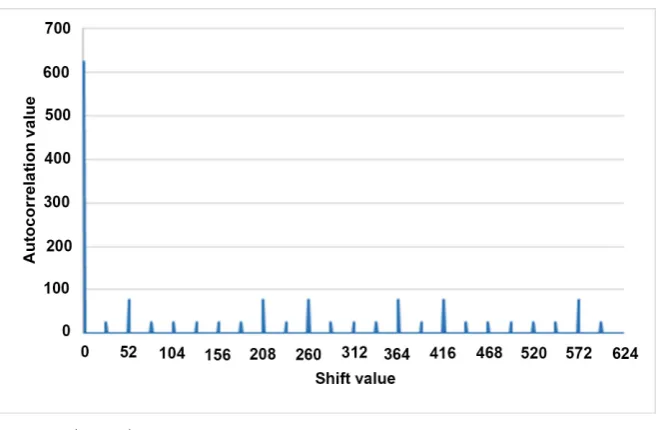
[image:15.595.210.539.493.708.2]3 is shown in Equation (50) and its autocorrelation becomes as follows and Figure 1 shows its autocorrelation graph.
DOI: 10.4236/jis.2019.103008 145 Journal of Information Security
{
3 001000111010000000100000000110101001100011001001101110101011
010100001001001010000101001001101000110000100001110101101010 010000100000110111011110100111101100000010110001000001111001 10010010000110000
=
1001011110111011110001110111001010001110101 111100100111000110011000000011110000111110110000111110110110 000001101100011101000011100101010100111110001000100001110011 011110010110111010101000101110010000111001001101010100011111 010100001011101011010110111101101010001110000010010111101000
}
100101101101111010100000100001011001001001100001110000110000 111111110101010101100110110110111110100011010011111101100110 001001101100101001100110
(50)
( )
3
624, if 0
24, else if 26,78,104,130,156,182,234,286,312,338,390,442,468,494,520,546,598, R
76, else if 52,208,260,364,416,572, 0, otherwise
x x x
x
=
=
= =
(51) On the other hand, it should be noted that 4 is different from 3 and its autocorrelation is given as follows and Figure 2 shows its autocorrelation graph.
( )
4
624, if 0
24, else if 26,78,104,130,56,182,234,286,312,338,390,442,468,494,520,546,598, R
76, else if 52,208,260,364,416,572, 0, otherwise
x x x
x
=
=
= =
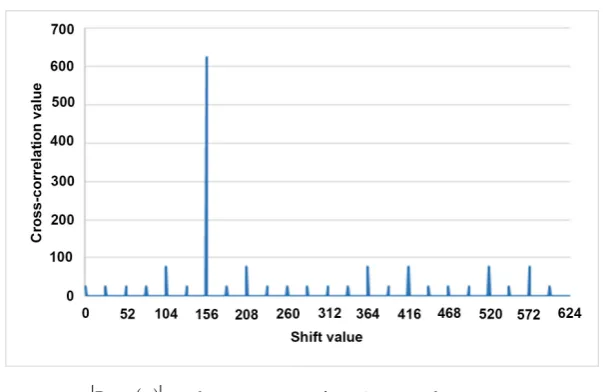
(52) The cross-correlation of 3 and 4 becomes as follows and Figure 6 shows its cross-correlation graph.
( )
3 4,
24, if 0,26,52,78,130,182,234,260,286,312,338,390,442,468,494,546,598, 76, else if 104,208,364,416,520,572,
R
624, else if 156, 0, otherwise
x x x
x
=
=
= =
(53)
4.2.
p
=
7,
m
=
4,
m
′
=
2,
k
=
3
and
A=3,4Let f x
( )
=x4+4x3+3x2+5x+3 be a primitive polynomial over 7 . In this case, the period of the sequence becomes pm− =1 2400. Figure 3, Figure 4,
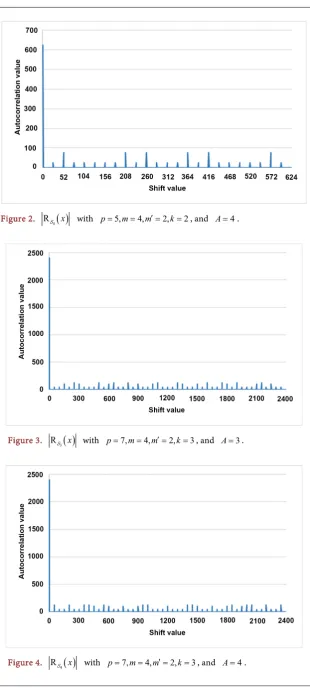
and Figure 5 show the autocorrelation graphs of 3 , 4 , and the
cross-correlation between the 3 and 4, respectively.
By observing the experimental results, it is found that in every case, the cross-correlation graph has exactly q−1 number of peaks. Among those, only one has a maximum value. For example, in Figure 6, the maximum cross-correlation value is 624, which corresponds to the first case of x hn= , the
DOI: 10.4236/jis.2019.103008 146 Journal of Information Security
Figure 2. R4
( )
x with p=5,m=4,m′=2,k=2, and A=4. [image:17.595.221.530.61.258.2]Figure 3. R3
( )
x with p=7,m=4,m′=2,k=3, and A=3. [image:17.595.223.524.289.484.2]DOI: 10.4236/jis.2019.103008 147 Journal of Information Security
Figure 5. R 3 4,
( )
x with p=7,m=4,m′=2,k=3, and A=3,4.Figure 6. R 3 4,
( )
x with p=5,m=4,m′=2,k=2, and A=3,4.these q−1 peaks the remaining part in the graph always holds a constant value of 0, which corresponds the case third case in Equation (22). It means that all this cross-correlation graph can be explained by Equation (22). It is also ob-served that by changing all the parameter values does not have any impact in the cross-correlation evaluation. On the other hand, as like the cross-correlation, the autocorrelation graph also has q−1 number of peaks. Among them, only one holds the maximum value, the others have small values, the remaining part al-ways holds a constant value of 1, and all these autocorrelation graphs can be ex-plained by Equation (49).
5. Comparison with Previous Work
[image:18.595.222.524.284.480.2]DOI: 10.4236/jis.2019.103008 148 Journal of Information Security
Even though the authors proposed sequence is a multi-value sequence. but it can be easily mapped into binary sequence by setting the parameter value k=2. In this section the authors will introduce a comparison of their proposed sequence (binary case) with their previous work [14] in terms of autocorrelation, linear complexity, and distribution of bit patterns properties. In this section, the authors previous sequence proposed in [14] will be called as NTU (Nogami-Tada-Uehara) sequence.
5.1. Autocorrelation
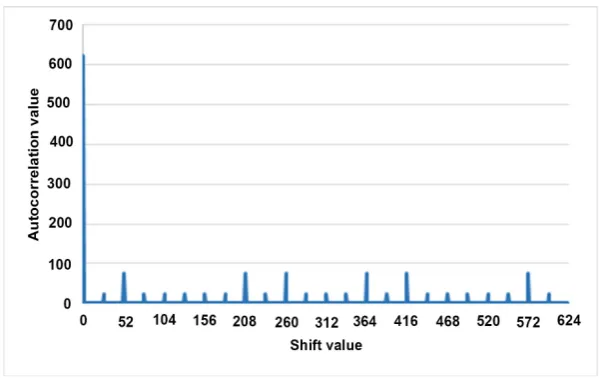
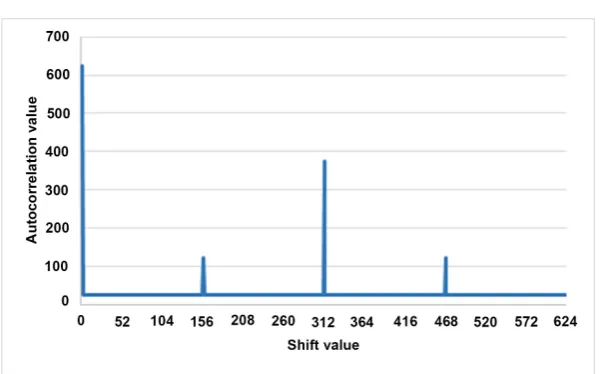
The autocorrelation of a sequence is a measure for how much the sequence dif-fers from its each shift value. In addition, by evaluating this property some spe-cial characteristics about the sequence such as its period, some pattern of the sequence, and so on can be also found and the value of the autocorrelation al-ways preferred to be as low as possible [22]. The autocorrelation of the proposed sequence (defined over sub extension field) and our previous sequence (NTU) (defined over prime field) is shown in Figure 7 and Figure 8, respectively. By observing their autocorrelation graph, it was found that on one hand, the num-ber of peak values is increases in the sub field sequence, on the other hand, the difference between the maximum peak value with the smaller peak values are much smaller in the proposed sequence compared to our previous sequence. Moreover, in the proposed sequence except the peaks remaining autocorrelation value always remains at 0. It should be noted that in case of correlation evalua-tion, the less difference between the peak values are more crucial rather than the number of peaks [22].
5.2. Linear Complexity
[image:19.595.223.528.520.709.2]The unpredictability of a sequence can be measured by the length of the shortest Linear Feedback Shift Register (LFSR) which can generate the given sequence. This approach is particularly appealing since there exists an efficient procedure
DOI: 10.4236/jis.2019.103008 149 Journal of Information Security
Figure 8. Autocorrelation of NTU sequence.
(it is so called the Berlekamp-Massy algorithm [23]) for finding the shortest LFSR. This length is referred as the linear complexity associated with the se-quence. The linear complexity property regarding a sequence is an important parameter which tells how difficult it is to predict the next bit pattern by ob-serving the previous bit pattern of a sequence. Thus, the linear complexity of a sequence is always preferred to be high. The linear complexity of the proposed sequence (defined over sub extension field) and our previous sequence (NTU) (defined over prime field) is shown in Figure 9 and Figure 10, respectively. By observing their linear complexity graph, it was found that the proposed sequence (which defined over the sub extension field) always hold high linear complexity compared to the NTU sequence. In other words, in terms of linear complexity the sequence defined over the sub extension field hold higher linear complexity than the sequence defined over the prime field.
5.3. Distribution of Bit Patterns
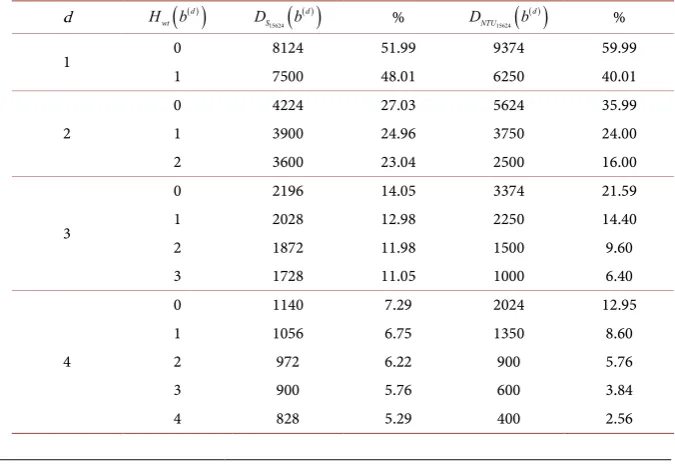
The distribution of bit patterns is another important measure to check the ran-domness of a sequence. From the viewpoint of security, the distribution of bit patterns is as important as the linear complexity. If a sequence holds the uniform distribution of bit patterns, then it becomes difficult to guess the next bit after observing the previous bit patterns. After the experimental observation, it was found that the NTU sequence is not uniformly distributed. In other words, in case of binary NTU sequence, there is much difference in appearance between the 0 and 1. To improve this drawback, instead of prime field (which used in the NTU sequence generation procedure), the authors focused on the sub extension field during the sequence generation procedure in this research work. As a result, after utilizing the sub extension field, the distribution of bit patterns becomes close to uniform. This comparison is shown in the following Table 3. In the fol-lowing table, b( )d ,
( )
( )dwt
H b , and D bn
( )
( )d denotes a bit pattern b of length d,
DOI: 10.4236/jis.2019.103008 150 Journal of Information Security
[image:21.595.223.525.274.449.2]Figure 9. LC of the proposed sequence.
Figure 10.LC of the NTU sequence.
Table 3. Comparison in bit distribution between the sub field binary sequence and NTU sequence.
d
( )
( )d wtH b
( )
( )15624
d S
D b %
( )
( )15624
d NTU
D b %
1 0 8124 51.99 9374 59.99
1 7500 48.01 6250 40.01
2
0 4224 27.03 5624 35.99 1 3900 24.96 3750 24.00 2 3600 23.04 2500 16.00
3
0 2196 14.05 3374 21.59 1 2028 12.98 2250 14.40
2 1872 11.98 1500 9.60
3 1728 11.05 1000 6.40
4
0 1140 7.29 2024 12.95
1 1056 6.75 1350 8.60
2 972 6.22 900 5.76
3 900 5.76 600 3.84
[image:21.595.201.539.508.741.2]DOI: 10.4236/jis.2019.103008 151 Journal of Information Security ( )n
b , respectively. In terms of the distribution of bit patterns, the sequence de-fined over the sub extension field hold much better distribution (close to uni-form) of 0 and 1 than the sequence defined over the prime field.
As mentioned previously, NTU sequence proposed in [14] is defined over the prime field and proposed sequence in this paper is defined over the sub exten-sion field. After the comparison results it is concluded that in terms of correla-tion the proposed sequence holds low correlacorrela-tion compared to NTU sequence; about linear complexity proposed sequence possesses high linear complexity than NTU sequence; regarding the distribution of bit patterns proposed se-quence hold much better distribution of bit patterns (close to uniform) than NTU sequence.
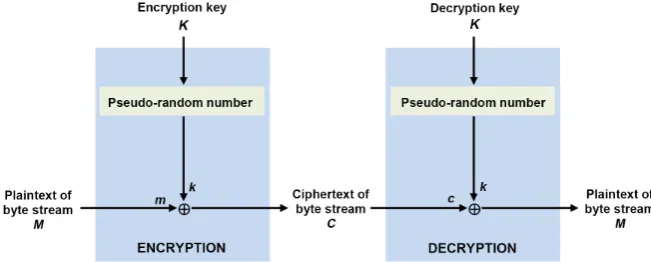
One of the most common applications of the pseudo-random binary sequence is in a stream cipher. Basically, stream cipher is divided into two classes: block cipher and stream cipher. Among these in case of block cipher, same key is used for both encryption and decryption of each block (≥64 bits) of data. On the oth-er hand, in case of stream ciphoth-er, encryption and decryption are poth-erformed by the bit wise ⊕ (XOR) operation with a key stream. Here, the authors restrict the discussion of their proposed pseudo-random binary sequence in a stream cipher. An image of the stream cipher is shown in Figure 11. Few important considerations during the design of a stream cipher are the key (which used for both encryption and decryption) should have large period, good randomness, and unpredictability properties due to the usage of same key in both encryption and decryption. Here, the encryption is carried out by applying a bit-wise ⊕
(XOR) operation between the plain-text of byte stream M and encryption key K. Then, the cipher-text C transmitted through a network. On the other hand, during the decryption, after the bit-wise ⊕ operation between the cipher-text
C and the same key K we will get the original plain-text M. In a stream cipher, a lot of sequences are assigned to several users, respectively. If these sequences have some correlation, then it will make some security vulnerabilities. Under this circumstance, it is important to observe the cross-correlation property be-tween several sequences. Additionally, its linear complexity and distribution of bit patterns needs to be high and uniform, respectively to confirm its random-ness. The authors proposed method can generate a long period pseudo-random sequence with typical auto and cross-correlation, high linear complexity, and almost uniformly distributed bit patterns features. After observing the experi-mental and comparison results, it can be concluded that the authors proposed sequence which defined over the sub extension field can be a prominent candi-date for a stream cipher like applications.
6. Conclusions and Future Works
DOI: 10.4236/jis.2019.103008 152 Journal of Information Security
Figure 11. Application of the proposed sequence in stream cipher.
research work are as follows:
This is an extension of our previous works [13][14][15].
This work overcomes the shorter period shortcoming of our previous work
[17].
The period, autocorrelation, and cross-correlation properties regarding the proposed sequence are theoretically explained.
The authors make a comparison in terms of autocorrelation, linear complex-ity and distribution of bit patterns properties with their previous work [14].
According to the comparison results, the proposed sequence holds low cor-relation, high linear complexity, and much better distribution of bit patterns compared to our previous work [14].
The proposed sequence can be a prominent candidate for stream cipher like cryptographic applications due to its exemplary properties.
As future works, the following points should be researched:
Mathematically prove the linear complexity and distribution of bit patterns properties.
To introduce more efficient calculation instead of the power residue
calcula-tion.
Acknowledgements
This work has been supported by JSPS KAKENHI Grant-in-Aid for Scientific Research (A) Number 16H01723.
Conflicts of Interest
The authors declare no conflicts of interest regarding the publication of this pa-per.
References
[1] Goresky, M. and Klapper, A. (2012) Algebraic Shift Register Sequences. Cambridge
University Press, Cambridge.
[2] Hamza, R. (2017) A Novel Pseudo Random Sequence Generator for Image-Cryptographic
Applications. Journal of Information Security and Applications, 35, 119-127.