Optimizing Non-Ferrous Metal Value from MSWI
Bottom Ashes
Simon P. M. Berkhout1, Bert P. M. Oudenhoven2, Peter C. Rem1
1Delft University of Technology, Delft, the Netherlands; 2Twence Afval en energie, Hengelo, the Netherlands. Email: [email protected]
Received March 22nd, 2011; revised April 28th, 2011; accepted June 1st, 2011.
ABSTRACT
The bottom ashes resulted annually from the incineration of municipal solid waste in Europe contain about 400,000 tonnes of metallic aluminium and 200,000 tonnes of heavy non-ferrous metals, such as copper and zinc. Efficient re-covery of this non-ferrous metal resource requires state-of-the-art separation technologies and a continuous feedback of laboratory analyses of the metal products and the depleted bottom ash to the operators of the bottom ash treatment plants. A methodology is presented for the optimization of the production of non-ferrous metal value from Municipal Solid Waste Incinerator bottom ash. Results for an incineration plant in the Netherlands show that efficient recycling can have a significant impact on value recovery as well as on non-ferrous metal recycling rates, producing up to 8% more revenue and 25% more metals from the ash.
Keywords: Urban Mining, Solid Waste, MSWI Bottom Ash, Non-Ferrous Metals
1. Introduction and Methods
The Municipal Solid Waste Incinerators (MSWI’s) of Europe produce a vast stream of some 20 million tonnes of bottom ashes, annually [1]. The ashes contain, next to ferrous metals, significant amounts of non-ferrous metals like aluminium, copper, zinc and lead, ranging in particle size from over 100 mm down to less than 1 mm [2,3]. If the entire particle size range of the metals is taken into account, MSWI bottom ash may contain up to 10% of the copper and aluminium consumption on a per capita basis. Recovering non-ferrous metals from the ashes is there-fore both a strategic asset [4] and an important step to-wards a sustainable use of resources. In view of the al-ready advanced recycling of non-ferrous metals in Euro-pean societies, it is perhaps even the largest single con-tribution yet to make.
An important economic drive for a more efficient re-cycling of bottom ash is the revenue of the metals. From 2002 to 2006, the LME price of copper increased from €1500 to €6000 per metric tonne. The worldwide eco-nomic crisis caused a steep price drop (to €2000/mt in Dec 2008) as a result of a decrease in demand. However, by May 2010 the price level had risen again to €6000/mt. Assuming average non-ferrous scrap prices over the past five years, a well-run bottom ash processing plant with an annual capacity of 100,000 tonnes creates a non-ferrous
scrap value of about 1.5 million Euro, which is sufficient to cover the cost (typically between 8 and 14 Euro/tonne) of the entire treatment that is necessary to convert the ash into a granular road filler. A positive externality of the production of secondary non-ferrous metals from bottom ash is a reduction of metal price fluctuations, as a result of the positive correlation between household waste vol- umes and the economy. From the viewpoint of ecology, comparative life cycle analyses for various bottom ash processing options show that the avoided environmental impact of the metallurgy of primary non-ferrous metal production and the reduced leaching potential of copper, zinc and lead from the ash more than outweighs the im- pacts of the treatment processes on the ash [5].
process to achieve a low organic content (often presented in terms of the LOI), and indirectly by a low moisture of the ash. An alternative is to compress the ash after taking it from the quench. Aging the ash for several weeks is very common, and has a beneficial effect on the process- ability, but tests at a large Dutch processor showed that aging of the ash for 10 weeks reduced the recoverable content of metallic aluminium by more than 6 kg/tonne of ash [6]. Other important parameters for the recovery are the type, number and the settings of the eddy current separators (ECS), which concentrate the non-ferrous metals from the ash.
Whichever process parameters are considered, a nece- ssary first step for optimizing non-ferrous metals recove- ry is to implement a monitoring scheme involving quick and consistent analyses of the two products, i.e., the non- ferrous concentrate and the metal-depleted ash, of the ECS. Reliable analysis results will allow the operator of the mechanical separation to optimize the process towards maximum non-ferrous value recovery. The aim of the present study is to develop a methodology that guaran-tees a consistent, reproducible value estimate that links directly to the post-processing of the metals by sink-floaters and smelters.
[image:2.595.312.538.86.249.2]2. Analysis Methodology
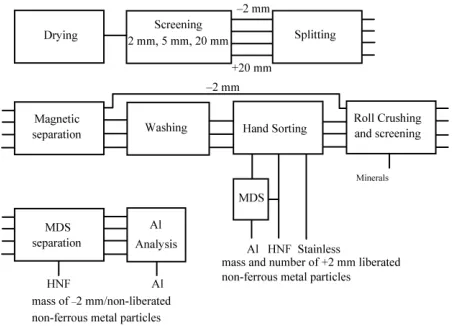
Figure 1 presents the analysis scheme that was employed for measuring non-ferrous metal concentrations in this study. The scheme aims for reproducibility and effici- ency. It is assumed that the two product streams of the ECS, the non-ferrous concentrate and the depleted ash, are sampled by combining a number of small samples taken at regular intervals from the downstream conveyors so as to produce samples that are representative for a certain period in time. Drying the product samples before the analysis is not essential. Wet screening will avoid the time-consuming drying step, but it will also complicate the subsequent handling of the –2 mm fraction, and the splitting and magnetic separation of the material. If the analysis is done on a regular basis, a tumble dryer may be used instead of the laboratory oven which was used in this study, to speed up the drying process. A tumble dryer may break some fragile aluminium particles into finer parts. However, the sink-floater is likely to pay for the aluminium on the basis of metal recovery after re-moving surface oxides, and this latter process is a much rougher treatment than tumbling.
The aluminium alloys (Al) and the heavy non-ferrous alloys (HNF) are the most relevant groups of non-ferrous metals [7-9] in terms of bottom ash scrap value. From the analysis point of view, it is relatively easy to determine also the non-magnetic stainless steel (SS) fraction next to the Al fraction and the HNF fraction. Since the alloy ra-
Figure 1. Full analysis scheme for the non-ferrous concen-trate and the metal-depleted ash product of the ECS section. HNF indicates the heavy non-ferrous alloys, mainly copper alloys.
tios within the Al fraction and in the HNF fraction are fairly constant for a particular size fraction and a given bottom ash stream, and since further analysis to deter-mine the element composition is both time-consuming and expensive, it was decided to limit the analysis to these three classes of alloys. The classification of the samples in terms of screen size was based on the fact that many sink-floaters have a problem with material smaller than 5 mm and that this size is also the lower limit to which conventional dry bottom ash processors are able to recover non-ferrous metals. Typically, dry treatment re-covery rates of non-ferrous metals drop from almost 100% for particles larger than 20 mm to virtually zero at some lower particle size between 5 mm and 12 mm, de-pending on the screening steps and the ECS technology of the process. Wet processes [10,11] and the Advanced Dry Recovery process [6] recover aluminium and heavy non-ferrous particles down to 2 mm. The samples were therefore screened at 2 mm, 5 mm and 20 mm.
concen-tration is about x/√N. It was found that a sample size of 25 kg for the non-ferrous concentrate and a sample size of 100 kg for the non-ferrous depleted ash correspond to relative errors in the aluminium and heavy non-ferrous mass balances of around 3% and 5% respectively. Accor- ding to Gy’s formula, four times bigger (smaller) ples will result in a factor of two smaller (larger) sam-pling errors. The -2 mm, 2 - 5 mm and 5 - 20 mm frac-tions of the samples were split a number of times prior to the metal analysis. If the analysis error of some split sample turned out to compromise the accuracy of the final mass balance, up to four times more material of that size fraction was analysed (see Table 1). The amount of 0 - 2 mm non-ferrous concentrate was too small to be significant for the bottom ash processing site that was reviewed in this study.
Magnetic steel particles can be separated either by a rotary drum magnet or by passing a magnet over a mono- layer of the material on a flat surface. If a hand-held magnet is used, the surface of the magnet should be cleaned regularly and the height of the magnet above the surface should be carefully defined to guarantee repro-ducibility of the results. As the magnet closes in on the sample, the increasing intensity of the magnetic field/ magnetic field gradient will first lift the elongated and flat steel parts before lifting more compact steel parts. Further increase of the magnetic intensity will also attract magnetic slag, magnetic HNF alloys and finally alumin-ium particles in which a small ferrous piece was intro-duced during the molten phase in the incineration process. Magnetic HNF alloys represent up to 10% of the HNF alloy fraction and up to 20% of the aluminium pieces may be contaminated with a ferrous inclusion. Ferrous- contaminated aluminium and magnetic HNF particles can be separated by the ECS, so they should not be removed into the ferrous fraction during analysis. The results in this paper were obtained with a rotary drum magnet, which was always run at the same high belt speed.
[image:3.595.57.287.630.722.2]After removal of the magnetic particles, size fractions larger than 2 mm were washed with water (L/S about 1) in a rotating vessel for 15 minutes and the fines were screened off. Then, the three alloy groups were separated
Table 1. Parts of the size fractions analysed for non-ferrous metals.
Size fraction mm Part of size fraction analysed Non-ferrous concentrate Depleted ash
0 - 2 - 1/256 - 1/64
2 - 5 1/2 - all 1/64 - 1/8 5 - 20 1/4 - all 1/8 - 1/2
+20 all all
from each other and from the glass, stone and slag, by hand sorting. Hand sorting of a sized and split sample is a relatively fast procedure, but experience shows that part of the HNF fraction tends to be recognised by the hand sorter as aluminium. In order to get consistent results, the hand-sorted aluminium fraction must be cleaned from HNF particles by sorting on density.
The most straightforward option for sorting the hand sorted aluminium on density is to sink-float the mixtures in a solution of Sodium Polytungstate of 2900 - 3000 kg/m3. The main disadvantage of this option is the large amount of work to recover the liquid from the products, which is necessary because of the high cost of this type of heavy liquid. Sodium Polytungstate also turns blue after extended contact with aluminium but this is reversi-ble by adding peroxide. A cheaper alternative is Mag-netic Density Separation (MDS, see Figure 2). The basic principle of MDS is to use a diluted magnetic liquid as the separation medium. In the absence of a magnetic field these liquids have a material density ρ which is comparable to that of water. But in a gradient magnetic field, the force on a volume of the liquid is the sum of the gravity and the magnetic force. The resulting apparent density varies exponentially with the vertical coordinate z:
π 0
π
e z p apparent
MB gp
(1)
Here, M is the magnetization of the magnetic liquid, B0 is
the magnetic induction at the surface of the magnet (z = 0) and p is the pole size. An MDS separator segregates the feed into stratified layers of different materials, so that each material floating at a specific distance above the magnet according to its density and the given formula. The present experiments were done with MDS using a five times diluted magnetic liquid from Ferrotec (see Figures 2 and 3). This liquid is so cheap that it is not necessary to recover it from the sorted products. A dis-advantage of MDS is that aluminium particles with a significant ferrous inclusion may end up in the heavy fraction.
Figure 2. Equipment for MDS separation of aluminium (floating) from heavy non-ferrous metals (sunk and col-lected at bottom of the gutter).
Figure 3. Apparent density ρapparent of the magnetic Ferrotec
liquid on the magnet used for the density separations. The data are for M = 2600 A/m, ρ = 1070 kg/m3, B
0 = 0.6 T and p
= 0.12 m. For these settings, copper is sinking and alumin-ium is floating at about 35 mm above the surface of the magnet.
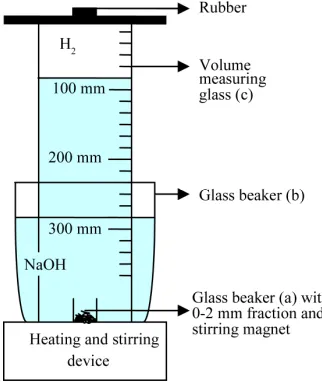
water. Finally, the resulting non-ferrous mixture is sepa-rated into an Al fraction and a HNF fraction by density sorting. The original –2 mm fraction cannot be hand sorted because of its small particle size. Therefore, this fraction is separated only for HNF by density separation and the metallic aluminium content is established chemi- cally by measuring the amount of hydrogen that is pro- duced when the material is immersed in a concentrated sodium hydroxide solution (Figure 4).
3. Online Analysis
The purpose of the standard analysis described above is to generate data for estimating the price of the non-ferrous concentrate and for the optimization of the value recove- ry. An additional online analysis procedure was deve- loped to be able to give a quick feedback on the separa-
tion performance within hours after sampling, allowing the operator to respond to fluctuations of the input. On- line analysis can replace most of the standard analyses, but now and then, a standard analysis has to be per- formed to be able to translate the results to absolute num- bers. The online analysis procedure is presented sche- matically in Figure 5. The difference with the standard analysis is that the samples are not washed or hand sorted before crushing. The result is the total non-ferrous con- tent, combining liberated and non-liberated pieces. Since crushing is a more intensive process than washing, more metal fines are produced by this procedure and the total non-ferrous content tends to be slightly less (10% - 13%, on average) than with the standard analysis. Instead of analysing all fractions, typically only the 2 - 5 mm and/or the 5 - 20 mm fractions will be analysed, because these are the primary focus of on-line optimization.
[image:4.595.339.500.305.496.2]Figure 4. Laboratory setup for measuring the metallic alu-minium content of 0 - 2 mm bottom ash fractions.
[image:4.595.318.523.530.695.2]4. Results and Discussion
Table 2 shows results of a standard analysis for a sample of the metal-depleted ash for a conventional dry treat-ment process in the Netherlands. Next to the concentra-tions of Al, HNF and SS, also the error estimates com-puted by Gy’s formula are shown, to highlight the bal-ance of contributions to the error in the overall non-ferrous metal concentrations by the individual size fractions.
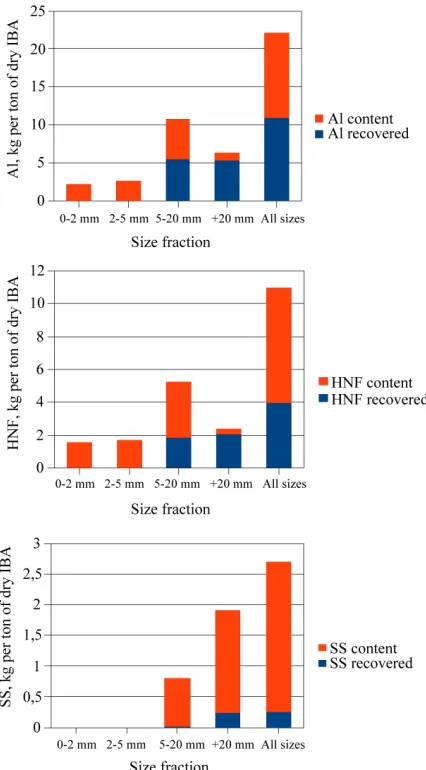
The data of Figure 6 represent averages of six analy-ses performed over a three-month period. It is clear that the recovery of aluminium and heavy non-ferrous alloys drops to zero halfway the 5 - 20 mm fraction, which is typical for conventional dry processes. Most ECS can recover flat stainless steel particles starting from about 20 mm, and this is confirmed by the data. The overall recoveries are about 50% for aluminium and 36% for the heavy non-ferrous alloys. Figure 7 shows the effect of the cut-point of the ECS in the grade-recovery curve for aluminium. By changing the splitter position or the belt speed of the ECS, the recovery of aluminium into the non-ferrous concentrate can be increased at the expense of recovering relatively more slag (mineral). The data points show that although these settings are not the only factor determining the aluminium recovery, they are nevertheless a major one. The line drawn through the data was made by connecting the point of zero recovery and 100% aluminium grade with the point of 100% re-covery of the ECS input and the input aluminium grade. These two extreme points can be realised by moving the splitter of the ECS so as to recover either all or none of the input material into the non-ferrous concentrate.
To optimize value recovery, an estimator is needed for the price of the non-ferrous concentrate. Sink-floaters will typically offer prices for MSWI non-ferrous scrap based on formulas that include the costs of sink-floating, smelting and the LME prices for the pure metals. A sim-ple formula for the revenue of scrap in Euro/tonne is given by Equation (2):
Al AlS Al Cu Cu
SF
S
Al
Al
Cu
Revenue (100% F )
R LME F Al% LME F Cu%
L Slag% F F Sales fee
R Recovery of aluminium from the smelt F Aluminum smelter fee
F Copper smelter fee L
SF
Al
Cu
Land fill fee F Sink-float fee
LME LME price of Aluminium LME LME price of Copper
[image:5.595.337.505.557.693.2](2)
Figure 6. Average ECS input metal contents and recoveries of aluminium (Al, top), heavy non-ferrous (HNF, middle) and stainless steel (SS, bottom) for a Dutch conventional dry process in terms of kg per tonne of dry ECS input. The results have been averaged over six analyses performed in a period of three months.
Table 2. Example result for the analysis of a sample from the metal-depleted product stream, including the number of parti-cles (#) found in each split fraction.
Size fraction Aluminium Heavy non-ferrous Stainless
mm kg Spl. kg # kg # kg #
Aluminium %
Heavy non-ferrous %
Stainless %
0 - 2 47.8 256 0.0012 0.00082 0 0.26 0.18 0.0
2 - 5 15.8 8 0.0446 1850 0.0307 344 0 0 0.31 ± 0.01 0.22 ± 0.01 0.0 5 - 20 37.8 2 0.2750 1041 0.188 171 0.014 11 0.48 ± 0.01 0.33 ± 0.03 0.02 ± 0.01
+20 12.8 1 0.0426 19 0.0123 13 0.0564 11 0.04 ± 0.01 0.01 ± 0,00 0.05 ± 0.01
[image:6.595.55.535.111.344.2]Total 114.2 1.09 ± 0.02 0.74 ± 0.03 0.07 ± 0.02
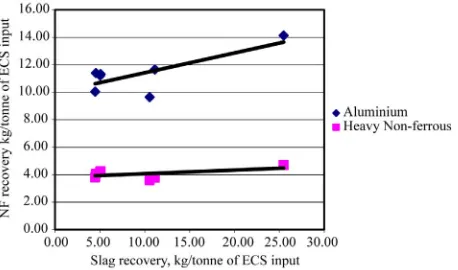
[image:6.595.61.290.393.528.2]Figure 8 shows a comparison of the prediction of this formula against historic scrap revenues for a Dutch MSWI over a five-year period, assuming a sales fee of 10%, a recovery of aluminium from the smelt of 70%, smelter fees of 300 Euro/tonne for aluminium and 900 Euro/tonne for copper and a sink-float fee of 90 Euro/ tonne. The land fill fee was set to 0 Euro/tonne, be-causein this case the slag separated by the sink-floater was returned to the MSWI. During the five-year refer-ence period, the primary data for the non-ferrous concen-trate showed a variation in slag content from 10% to 55%, and the LME prices for copper and aluminium varied by a factor of 2. Despite such variations, Equation (2) gives a reasonable account of the fluctuations of the actual non-ferrous scrap revenues obtained by the MSWI. There- fore it is realistic to use such equations in optimization studies, provided that the non-ferrous grade of concen-trates remains within the limits of the validation data. Figure 9 shows the results of the recovery-recovery graph for aluminium and copper versus slag in the non-ferrous concentrate computed from seven experi-mental data points. The trend line shows a positive cor-relation between both recoveries. This is expected be-cause changes of the cut-point of the ECS to recover more non-ferrous metals will also increase the amount of slag in the non-ferrous product. However, it is remark-able that 25% more non-ferrous metal can be recovered per tonne of input bottom ash by allowing the slag con-tent of the non-ferrous product to increase from 25% to 58%. Figure 10 shows a translation of the recovery trend lines into a curve for the revenue per tonne of dry ECS input. The LME prices used in Equation 2 are 1600 Euro/tonne for aluminium and 4,400 Euro/tonne for copper, in correspondence with 2010 trend line figures for these metal prices. The curve indicates that within the range of slag contents covered by the validation data, revenues per tonne of input bottom ash increase with the volume of non-ferrous product (and so with slag content). This means that in order to optimize value recovery, the ECS operator should go for high non-ferrous recovery Figure 8. Comparison of actual scrap prices with the
[image:6.595.59.275.569.688.2]pre-dictions of Equation (2).
Figure 9. Recovery of non-ferrous metals versus recovery of slag into the non-ferrous product of the ECS.
and not for high non-ferrous grade. Such a strategy is counterintuitive to most operators but it will increase revenues by up to 8% and is also beneficial for the recy-cling rate of non-ferrous metals from waste. In this as-pect, the result of this study is remarkably parallel to that of a study to optimize non-ferrous value recovery from car scrap, more than a decade ago [13]. That study also concluded that ECS operators may gain 25% extra non- ferrous metals by going for recovery instead of grade, increasing non-ferrous metal revenue by 15%.
REFERENCES
[1] EU Statistics, “Structural Indicators: Municipal Waste,” 2007. http://Europe.eu.int.
[2] L. Muchova and P. C. Rem, “Hydrogen from Bottom Ash,” In: A. Kungolos, K. Aravossis, A. Karagiannidis and P. Samaras, Eds., Proceedings of the International Conference on Environmental Management Engineering,
Planning, GRAFIMA, Thessaloniki, 2007, pp. 1895-
1900.
[3] Y. Hu and M. C. Bakker, “Recovery and Distribution of Incinerated Aluminium Packaging Waste,” Submitted to Waste Management, 2010.
[4] Public Consultation of the European Union, 2006. [5] L. Muchova, “Wet Physical Separation of MSWI Bottom
Ash,” TU Delft PhD Thesis, 2010.
[6] W. de Vries, P. Rem and P. Berkhout, “ADR:A New
Method for Dry Classification,” Proceedings of the ISWA
International Conference, Lisbon, 12-15 October 2009, p.
103.
[7] J. M. Chimenos, M. Segarra, M. A. Fernandez and F. Espiell, “Characterization of the Bottom Ash in Munici-pal Solid Waste Incinerator,” Journal of Hazardous
Ma-terials, Vol. 64, No. 3, 1999, pp. 211-222.
doi:10.1016/S0304-3894(98)00246-5
[8] G. Schmelzer, S. Wolf and H. Hoberg, “New Wet Treat-ment for Components of Incineration Slag,”
Aufbercei-tungs-Technik, Vol. 37, No. 4, 1996, pp. 149-157.
[9] L. Muchova, E. J. Bakker and P. C. Rem, “Precious Met-als in Municipal Solid Waste Incineration Bottom Ash,”
Water Air Soil Pollution, Vol. 9, No. 1-2, 2009, pp. 107-
116. doi:10.1007/s11267-008-9191-9
[10] P. C. Rem, C. de Vries, L. A. van Kooy and P. Bevilac-qua, M. A. Reuter, “The Amsterdam Pilot on Bottom Ash,” Minerals Engineering, Vol. 17, No. 2, 2004, pp. 363-365. doi:10.1016/j.mineng.2003.11.009
[11] BREF Waste Incineration, “Integrated Pollution Preven-tion and Control: Reference document on the Best Avail-able Techniques for Waste Incineration,” July 2005. [12] P. Gy, “Sampling for Analytical Purposes,” ISBN
0471979562, John Wiley, Hoboken, 1998.