doi:10.4236/am.2011.21011 Published Online January 2011 (http://www.SciRP.org/journal/am)
Average Life Prediction Based on Incomplete Data*
Tang Tang1, Lingzhi Wang2, Faen Wu1, Lichun Wang1 1
Department of Mathematics, Beijing Jiaotong University, Beijing, China 2
School of Mechanical, Beijing Jiaotong University, Beijing, China E-mail: [email protected]
Received May 4, 2010; revised November 18, 2010; accepted November 22, 2010
Abstract
The two-parameter exponential distribution can often be used to describe the lifetime of products for exam-ple, electronic components, engines and so on. This paper considers a prediction problem arising in the life test of key parts in high speed trains. Employing the Bayes method, a joint prior is used to describe the va-riability of the parameters but the form of the prior is not specified and only several moment conditions are assumed. Under the condition that the observed samples are randomly right censored, we define a statistic to predict a set of future samples which describes the average life of the second-round samples, firstly, under the condition that the censoring distribution is known and secondly, that it is unknown. For several different priors and life data sets, we demonstrate the coverage frequencies of the proposed prediction intervals as the sample size of the observed and the censoring proportion change. The numerical results show that the pre-diction intervals are efficient and applicable.
Keywords:Prediction Interval, Incomplete Data, Bayes Method, Two-Parameter Exponential Distribution
1. Introduction
Prediction problem has been very often and useful in many fields of applications. The general prediction pro- blem can be regarded as that of using the results of pre- vious data to infer the results of future data from the same population. The lifetime of the second round sam- ple is an important index in life testing experiments and in many situations people want to forecast the lifetimes of these samples as well as the system composed of these samples (See [1,2] and among others). For more details on the history of statistical prediction, analysis and appli- cation, see [3,4].
As we know, many quality characteristics are not nor- mally distributed, especially the lifetime of products for example, electronic components, engines and so on. Ass- ume that the lifetime of a component follows the two- parameter exponential distribution whose probability density function (pdf) given by
1
; , = exp x > ,
f x I x
(1.1)
where > 0 and 0 are called the scale parameter and the location parameter, respectively, and I A de- notes the indicator function of the set A. The readers are referred to [5,6] for some practical applications of the
two-parameter exponential distribution in real life. The recent relevant studies on the two-parameter exponential distribution can be found in [7-9], etc.
In this paper, we adopt the following testing scheme: for n groups of components, which come from n dif- ferent manufacture units possessing the same techno- logy and regulations, we sample m components from each group and put them to use at time t= 0 and to practice economy the experiment will be terminated if one of the m components is ineffective, where m is a predetermined integer. Denote the lifetime of the ineffe- ctive component by Xi1 i n. Obviously, Xi=
1 2
min Xi ,Xi ,,Xim ,where Xij
1 j m
is the life of the j-th component of thei
-th group. Hence, we obtainn
lifetime data X X1, 2,,Xn. If Xia , where a> 0 is a known constant, then we again sample one component from thei
-th group and denote its unknown lifetime byY
i. In this paper, our interest is topredict the average life of the second round sample, i.e.,
1
=1 =1
n n
i i i
i I X a i I X a Y
. For instance,
1
=1 =1
n n
i i i
i i
k I X a I X a Y
approximately des-cribes the average lifetime of a system of k com- ponents, based on the samples of the second round, is connected in active-parallel which fails only when all k components fail.
Normally, there are two different views on prediction problems, the frequentist approach and the Bayes appr- oach. The Bayesian viewpoint has received large atten- tion for analyzing data in past several decades and has been often proposed as a valid alternative to traditional statistical perspectives (see [10-12], etc.). A main diff- erent point between the Bayes approach and the frequen- tist approach is that in Bayesian analysis we use not only the sample information but also the prior information of the parameter.
To adopt the Bayes approach, we regard the para- meters and as the realization value of a random variable pair
,U
with a joint prior distribution
,
G .
Let
1, 1
, 2, 2
,,
n, n
be independent andidentically distributed (i.i.d.) with the prior distribution
,
G , and conditionally on
i, i
assume Xij has the pdf (1.1) which will be denoted by f x
,
in the following section. Set
=1
=1
= .
n
i i
i n
i i
I X a Y S
I X a
(1.2)Our problem is how to construct a function
1, 2, , n
g X X X to predict S.
As we know, many statistical experiments result in incomplete sample, even under well-controlled situations. This is because individuals will experience some other competing events which cause them to be removed. In life testing experiments, the experimenter may not al- ways be in a position to observe the lifetimes of all components put on test due to time limitation or other restrictions(such as money, material resources, etc.) on data collection (see [9,13] and others). Hence, censored samples may arise in practice. In this paper we assume furthermore that Xij
1 i n, 1 j m
are censored from the right by nonnegative independent random vari- ables Vi1 i n with a distribution function W . It is assumed that Xij
1 i n, 1 j m
are independent of Vi1 i n. In the random censorship model, the true lifetimes Xi = min
Xi1,Xi2,,Xim
1 i n arenot always observable. Instead, we observe only
= min ,
i i i
Z X V and i =I X
i Vi
.The paper is organized as follows. In Section 2, based on
Zi,i
1 i n, we define a predictive statistic for S and simulate its prediction results under the conditionthat the censoring distribution W is known. In Section 3, when the censoring distribution W is unknown, we obtain a similar result for a corresponding predictive sta- tistic of S as well as demonstrate the prediction perfor- mances. Some conclusions and remarks are presented in Section 4 and Section 5 deals with the proofs of the main theorems.
2. Predictive Statistic for
S
with KnownW
Note that Xij has the conditional pdf f x
,
, we know that, given
,
, Xi = min
Xi1,Xi2,,Xim
has the pdf
,
=mexp m x
>
.l x I x
(2.1)
Since Xi and Y ( if Xiai) come from the same group,
X Yi, i
1 i n would be i.i.d. with common marginal pdf
,
=
,
,
,
, Up x y
l x f y dG (2.2) where Udenotes the support of the prior distribu- tion G
,
.Rewrite
1
=1 =1 1
1 2
=1 =1
ˆ
= = = .
n n
i i i i
i i
n n
i i
i i
I X a Y n I X a Y S S
S
I X a n I X a
(2.3)By Fubini’s theorem, we know Equation (2.4) (Below) and
1 2
=1
( , )
= = ,
= exp ,
n
i i
i
ES E n I X a E E I X a
m a E
(2.5) where E , denotes the expectation with respect to
,
.Based on
Zi,i
1 i n, we define
1=1
=1
1 =
1 1 1
1
1 ,
1
n n
j j i i
i j i j i
n
i i
i
i i
Z I Z a
S
n n W Z W Z
I Z a
m Z a
n W Z
(2.6)
1 1 1 0 0 0 0
,
= = , = , , ,
= exp , = exp
U
U
ES E I X a Y I x a yp x y dxdy I x a l x dx yf y dy dG
m a m a
dG E
and
2 =1 1 = . 1 n i i i iI Z a
S
n W Z
(2.7)Note that conditionally on
i, i
all Zi1 i nare i.i.d. with the distribution function
= 1 1 1 ,
H W z L z ,
where
0
( , ) = z , ,
L z
l x dxwe have Equation (2.8) (Below) and
1 1 2 1 , 2 , = 1 = , 1= exp = .
x v
I Z a
ES E
W Z
I x a
E dW v l x dx
W x m a E ES
(2.9)Hence, the statistics S ii
= 1, 2
have the same exp- ectation as S ii
= 1, 2
.Set
1 2 = S . S
S (2.10) Remark 1. Note that it is almost impossible that all i
’s are equal to zero, so S1 and S2 are reasonable estimators for S1 and S2, respectively.
The main result in this section can be formulated in the following theorem.
Theorem 1. If the following conditions are satisfied: 1) E2 <, E2 <;
2) E
,
,
< ;3)
2
2 < ; 1
X I X a
E W X then 0, p
S S n
where
2 , = , 1 X E W X ,
,
=
,
1I X a
E
W X
and
p
denotes con- vergence in probability.
Clearly, S can be used as a predictive statistic for
S in this case.
Especially, when there is no censorship
Zi = Xi, i = 1
, S1 and S2 turn into, respectively
10 =1 =1 1 = 1 1 1 n n j ii j i n
i i
i
S X I X a
n n
m X a I X a
n
(2.11) and
20 =1 1 = . n i iS I X a
n
(2.12)Consequently, we use S0=S10 S20 as a prediction statistics of S.
Normally, we choose Gamma prior for the parameters
,
, however, it is easy to see that Theorem 1 does not depend on any specific prior distribution. This shows that for any a prior distribution satisfying the conditions of Theorem 1, the conclusion of Theorem 1 will hold.So in the simulation study, we let the prior distribution of parameters
500,1300 ,
Uniform
(2.13)
800,1400 ,
Uniform
(2.14) and the censoring distribution be
1 =11 1 1
1 1
= , ,
1 1 1
1 , 1 = , , 1 1 1 n n
j j i i
i j i j i
x v x v
x v
Z I Z a
ES E E E
n n W Z W Z
Z a I Z a
m E E
W Z
x I x a
E dW v l x dx dW v l x dx
W x W x
m E
1 , , 1 1= exp exp = ,
x a I x a
dW v l x dx
W x
m a m m a
= 1 exp , > 0,
W v cv v (2.15) where c= 0.0001, 0.0002 and 0.00025 can be used to describe the censorship proportion (CP) P X >V, which denotes the probability that X is larger than V . In the censorship model, if the probability P X >V
gets larger, then more V si' are likely to be observed other than X si' . Also, let m= 3.
Under the above assumptions, it is not difficult to check that the conditions (i), (ii) and (iii), defined in Theorem 1, are satisfied. Note that EX =EE m= 3800 3 , which shows the mean time to failure (MTTF) of mini- mum lifespan of the m components is 3800/3.
Firstly, we generate n random values from the priors (2.13) and (2.14), and denote them by
i, i
1 i n. Secondly, by Equations (2.1) and (2.15) we obtain1
i
X i n and Vi1 i n, accordingly, we get
= min , 1
i i i
Z X V i n and
= 1
i I Xi Vi i n
. Thirdly, let the predeter- mined constant a be equal to the MTTF, we compute the frequencies of the event
SS <
for = 200and = 100 with = 0.0001, 0.0002, 0.00025c . Repea-
ting the process for 5000 times, the results are reported in Table 1.
where PCP denotes the practical CP obtained from the simulation data. From Table 1, firstly, we find that when the PCP is fixed, the frequencies of
SS <
gene- rally increase as the sample size n and get larger, respectively. Secondly, as it can be expected, the fre- quencies tend to decrease as the PCP increases. As a con- trast, we report the frequencies of
S0S <
inTable 2 when there is no censorship, which are uni- formly better than those of Table 1.
In Tables 3 and 4, we change the value of the constant a and present the frequencies of
S S <
with a = 0.5MTTF and a = 1.5MTTF, respectively.Although it is difficult to describe how Sand the fre- quencies depend on the constant a, there is a trend that the frequencies of
SS <
are getting larger as the constant abecomes smaller. The reason is that S de- notes the average values of Yi's, as we know, if a gets smaller, obviously, both
ni=1I X
ia Y
i and
=1
n i i I X a
will become larger, then the S is more like the average life other than denoting several or a few samples, hence, the proposed method works better. That is why the frequencies in Table 3 perform the best among the above tables, especially for larger n.It is well-known that the prior distribution G
,
reflects the past experience about the parameter
,
in Bayesian analysis. During the process of our simula- tion, we find the fact that the performance of the freq- uencies of
SS <
depends on the prior distribu- tion. In what follows, we generate three kinds data ofTable 1. a = MTTF = 3800/3.
c n
Frequency SS < = 200
= 100
0.0001 (PCP = 11.80%)
20 0.7880 0.6020 30 0.8500 0.7040 50 0.9300 0.7900
0.0002 (PCP = 22.10%)
20 0.7100 0.5360 30 0.7780 0.5980 50 0.8680 0.7220
0.00025 (PCP = 26.80%)
20 0.5800 0.4660 30 0.6720 0.5340 50 0.8040 0.6320
Table 2. a = MTTF = 3800/3.
n
Frequency
S0S <
= 200
= 100
20 0.8280 0.6820 30 0.8610 0.7640 50 0.9440 0.8010
Table 3. a = 0.5 MTTF.
c n
Frequency SS< = 200
= 100
0.0001 (PCP = 11.80%)
20 0.8080 0.6620 30 0.8800 0.8140 50 0.9350 0.8410
0.0002 (PCP = 22.10%)
20 0.7300 0.6390 30 0.8470 0.6980 50 0.8980 0.8320
0.00025 (PCP = 26.80%)
20 0.6300 0.5670 30 0.7440 0.6340 50 0.8620 0.7920
Table 4. a = 1.5 MTTF.
c n
Frequency SS< = 200
= 100
0.0001 (PCP = 11.80%)
20 0.6860 0.5920 30 0.7600 0.6060 50 0.9050 0.6800
0.0002 (PCP = 22.10%)
20 0.6100 0.5160 30 0.6760 0.5770 50 0.7690 0.6240
0.00025 (PCP = 26.80%)
20 0.4880 0.4260 30 0.5710 0.5130 50 0.7050 0.4650
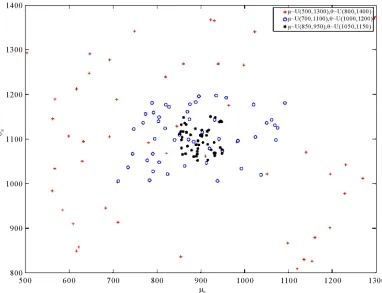
From the above, we see that for the three different priors of
,
, which have the same prior means for and , respectively, under the condition that their PCPs are almost the same, the more concentrative the prior values, the better the performances of the frequen- cies. This numerical evidence means that the proposed prediction intervals are in accordance with practice and applicable.
3. Predictive Statistic for
S
with Unknown
W
Note that the censoring distribution W(.) is unknown, hence the predictive statistic S is unavailable to use. This leads us to adopt the product limit estimator, which introduced to statistical problems by [14], to propose a corresponding predictive statistic for S in this case.
Define
1 2
ˆ
ˆ = ,
ˆ S S
S (3.1)
where
1
=1
=1 1 ˆ =
ˆ ˆ
1 1 1
1
1 ,
ˆ 1
n n
j j i i
i j i n j n i
n
i i
i
i n i
Z I Z a
S
n n W Z W Z
I Z a
m Z a
n W Z
(3.2)
2=1 1
ˆ = ,
ˆ 1 n
i i
i n i
I Z a S
n W Z
(3.3)and the product limit estimator W tˆn is given by
( , =0
=1 ˆ
1 = , < ,
1
I Z t
n i i
n n
i
n i
W t t Z
n i
(3.4)where Z 1 Z 2 Z n are the order statistics of
Z Z1, 2,,Zn
and i is the concomitant of Z i .Theorem 2. Under the same conditions as Theorem 1, we have
ˆ p 0.
S S
Obviously, Sˆ can be used as a predictive statistic for
S when the censoring distribution W is unknown. Remark 2. Note that in the case that the censoring distribution W is unknown, it is impossible to check whether the conditions of Theorem 2 are satisfied or not. Hence, we first need to propose a distribution function
W to fit the data V V1, 2,,Vn.
Consider the following several data sets, which come from [15]. We take them as the the censoring variables
1, 2, , n
V V V .
= 5
n , 381, 395, 408, 423, 431.
= 20
n , 350, 380, 400, 430, 450, 470, 480, 500, 520, 540, 550, 570, 600, 610, 630, 650, 670, 730, 770, 840.
= 31
n , 30 926, 34 554, 36 381, 38 423, 40 103, 40 501, 42 200, 44 392, 46 092, 46 125, 46 175, 48 025, 48 025, 48 055, 48 055, 48 055, 48 055, 48 056, 51 675, 52 344, 52 345, 52 345, 52 345, 52 379, 55 997, 56 202, 57 709, 57 709, 57 709, 57 709, 63 496.
= 71
n , 3 95642, 4 00418, 4 09161, 4 35505, 4 35540, 4 37601, 4 39179, 4 48768, 4 48768, 4 73667, 4 73667, 4 93985, 4 96362, 5 22019, 5 35341, 5 37272, 5 418045 44411, 5 60317, 5 69810, 5 74617, 5 84352, 6 17514, 6 19741, 6 24969, 6 27976, 6 27976, 6 57274, 6 74048, 6 88765, 7 18309, 7 20900, 7 20900, 7 20900, 7 20900, 7 36640, 7 58164, 7 58164, 7 58164, 7 64559, 8 24600, 8 5997, 8 71397, 8 93634, 9 04422, 9 197 45, 9 51173, 9 75447, 9 96745, 10 13631, 10 17288, 10 17288, 10 30804, 10 39500, 10 609 23, 10 60923, 10 78897, 10 87997, 10 97175, 11 59441, 11 99059, 12 23731, 12 40031, 12 40031, 12 55001, 13 19873, 13 94778, 15 55712, 17 646 12, 19 84823, 23 19907.
As we know the Weibull distribution is widely applied to life testing and reliability analysis. Some studies on it have been quickly developed in recent years (see [16] and [17], etc). The cumulative distribution function (CDF) of the three-parameter Weibull distribution is
= 1 exp t , F t
(3.5)
where is the shape parameter, is the location para- meter and is the scale parameter.
Figure 1. The values of
n, n
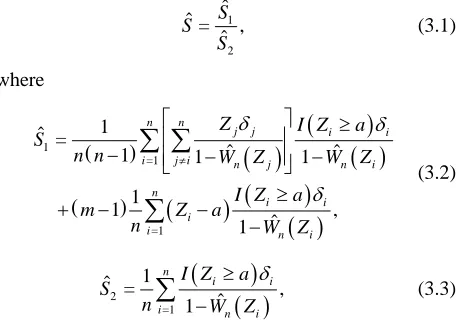
for three different priors. Table 5. a = 0.5 MTTF.PCP and the prior n
Frequency SS < Frequency
S0S <
= 200
= 100 = 200 = 100 PCP=11.76%
50 0.9240 0.6730 0.9420 0.7060
500,1300
U
800,1400
U
PCP=11.94%
50 0.9300 0.7280 0.9480 0.7520
700,1100
U
1000,1200
U
PCP=11.91%
50 0.9370 0.7540 0.9510 0.8500
850, 950
U
1050,1150
U
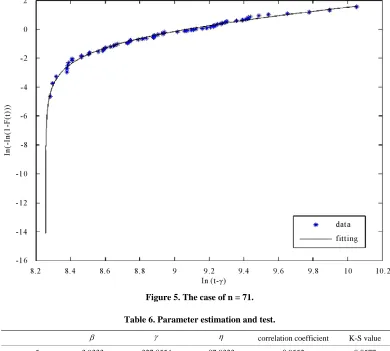
s (K-S) test method. Note that (3.5) can be transformed into the following linear equation
ln ln 1F t =ln t ln . (3.6) Firstly, to estimate the location parameter , we fol- low the principle of golden-section to find a value which
located in the interval
0,t 1
to maximize the absolute value of the correlation coefficient defined by
=1
2 2
=1 =1
= ,
n
i i
i
n n
i i
i i
x x y y
x x y y
[image:6.595.99.497.433.627.2]where = =1 , = =1 , = ln
,n n
i i i i
i i
x
x n y
y n x t
= ln ln 1
i i
y F t andt(1),t(2),,t( )n are the stati- stics of t t1, ,2 ,tn andF t
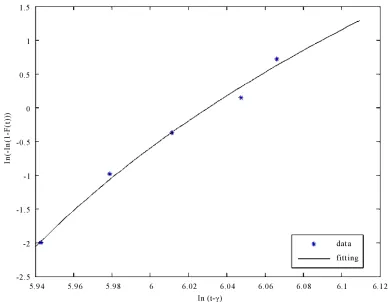
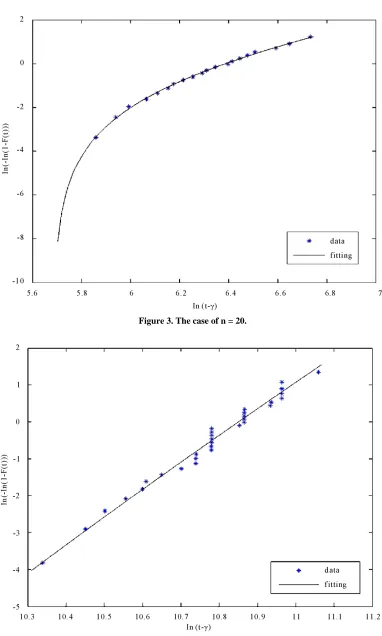
i =i0.32 n0.36.Secondly, adopting the least square method and regar- ding every group data as t t1, ,2 ,tn, we report the fit- ting results and the estimators of the parameters as well as the Kolmogorov-Smirnov test values in Figures 2-5 and Table 6. Where the K-S value denotes the Kolmogorov-Smirnov test value.
Assume that the parameters
,
have priors sim- ilar to (2.13) and (2.14), for example
1, 2
,
1, 2
Uniform Uniform , and m= 3.
Obviously, under the condition that the censoring distri- bution W is Weibull distribution with the above esti- mated parameters, it is easy to check that the conditions of Theorem 2 are satisfied.
We simulate the frequencies of
SˆS <
as the PCP changes and present the results in what follows. Also, we refer to the performances of the frequencies of
S0S <
as a contrast.From Tables 7-9, firstly, it is the same as before, we find that for the fixed PCP, the frequencies of
SˆS <
and
0 <
S S generally increase as the
Constant a gets small. Secondly, compared with Ta- bles 1, 3 and 4, for the same sample size
n
, the fre- quencies of
SS <
generally tend to be larger than those of
SˆS <
, which means in this case for given S is more concentrated in the vicinity of S. However, this may not be the case all the time. One reason is that Xi’s and Vi’s are different even for each the same sample size n and hence this makes the comparison more complicated. Thirdly, consistently, whether W is known or not the performances of the frequencies of
S0S <
are the best. Also, as it canbe expected, the frequencies of
SˆS <
generally tend to decrease as the PCP increases.4. Conclusions and Remarks
[image:7.595.99.487.403.705.2]In this paper, assume the observed lifetimes of com- ponents are rightly censored, we define a prediction sta- tistic to predict the average value of some untested com- ponents, firstly, under the condition that the censoring distribution is known and secondly, that it is unknown. In the case that the censoring distribution is unknown, we first fit the data V V1, 2,,Vn with a distribution function, say W t , and test the fitting by Kolmogorov-Smirnov
Figure 3. The case of n = 20.
Figure 5. The case of n = 71.
Table 6. Parameter estimation and test.
correlation coefficient K-S value
n = 5 3.9333 327.8554 87.9323 0.9552 0.0577
n = 20 1.9868 294.9828 298.2851 0.9992 0.0261
n = 31 6.5704 4623.1700 46952.0369 0.9914 0.1129
N = 71 1.1500 3854.0232 4856.6078 0.9960 0.0481
Table 7. a= 1.5
E+E m
.Frequency
SˆS <
Frequency
S0S <
PCP n = 200 = 100 = 200 = 100
10.91% 5 0.5630 0.5330 0.7100 0.7510
4.33% 20 0.6600 0.6520 0.8160 0.7190
6.63% 31 0.7100 0.6800 0.8500 0.7630
10.08% 71 0.8770 0.7420 0.9300 0.7730
Table 8. a=EE m.
Frequency
SˆS<
Frequency
S0S <
PCP n = 200 = 100 = 200 = 100
10.91% 5 0.5610 0.5500 0.7190 0.6710
4.33% 20 0.6740 0.6500 0.8260 0.6990
6.63% 31 0.7940 0.7120 0.8300 0.7530
[image:9.595.100.496.637.719.2]Table 9. a= 0.5
E+E m
.Frequency
SˆS<
Frequency
S0S <
PCP n = 200 = 100 = 200 = 100
10.91% 5 0.5930 0.5030 0.7390 0.6910
4.33% 20 0.6990 0.6170 0.8360 0.6890
6.63% 31 0.8030 0.7400 0.9230 0.7730
10.08% 71 0.9110 0.8100 0.9300 0.8380
test. Then, we regard the data V V1, 2,,Vn as being dis- tributed according to W t and check whether the con- ditions of Theorem 2 are satisfied or not. The numerical evidences show that the proposed prediction intervals are in accordance with practice and applicable. Also, it is easy to see that the proposed prediction method can be extended to many important survival models such as Erlang distribution, Gompertz distribution and so on. Furthermore, we may consider the same prediction pro- blem in any a pdf, say f x
,
I x > 0, which may be a finite mixture of any two life distributions, which occurs when two different causes of failure are present (see [19] and among others).5. Proofs
5.1. The Proof of Theorem 1
Proof. In order to obtain the conclusion of Theorem 1, we first prove
1 1 0, .
p
S S n (5.1) Note that
2 2 21 1 = 1 2 1 1 1.
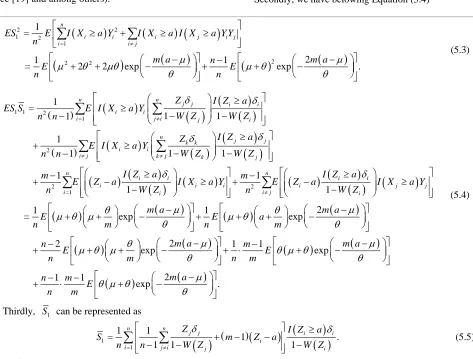
E S S ES ES S ES (5.2) Firstly, it is easy to see Equation (5.3) (Below) Secondly, we have belowing Equation (5.4)
2 2 1 2 =1 2 2 2 1 = 2 1 1= 2 2 exp exp .
n
i i i j i j
i i j
ES E I X a Y I X a I X a Y Y n
m a n m a
E E n n
(5.3)
1 1 2
=1 2 2 =1 1 = 1 1 1 1 1 1 1 1 1 n n
j j i i
i i
i j i j i
n
j j
k k
i i
i j k j k j
n
i i
i i i
i i
Z I Z a
ES S E I X a Y
W Z W Z
n n
I Z a Z
E I X a Y
W Z W Z
n n
I Z a m
E Z a I X a Y
W Z n
2 1 1 2 1 1= exp exp
2
2 1 1
exp
n
i i
i j j
i j i
I Z a m
E Z a I X a Y
W Z n
m a m a
E E a
n m n m
m a
n m
E E
n m n m
exp 2 1 1 exp . m a m a n m E n m (5.4)Thirdly, S1 can be represented as
1 =1
1 1
= 1 .
1 1 1
n n
j j i i
i
i j i j i
Z I Z a
S m Z a
n n W Z W Z
(5.5)2 1 2 =1 1 1 = , n i ij
i i j n
ES Q Q
n
(5.6)where
2 2 2 2 2 2 1 = 11 1 1
1 2
= , , ,
1 1 1 1 1
1 ,
1
n
j j i i
i i
j i j i
Z I Z a
Q E m Z a
n W Z W Z
X I X a n I X a
E E E E E
n W X W X n m W X
X a I X a
m E E
W X
2 1 , ,
1
X a I X a
m E E
m W X
(5.7) and
2 1 1 =1 1 1 1 1 1 1 1
1 1
1 1
n n n
j j j j j
i i i i
k k l l k k
ij
k i k i l j l j k i k i j
n
j l l
l j l
I Z a Z a I Z a
I Z a I Z a
Z Z m Z
Q E E
W Z W Z W Z W Z n W Z W Z W Z
n
I Z a Z
m E
n W Z
2 2 2 2 2 11 1 1 1
2 2
2 2 3
= , exp exp
1
1 1
2
j i i i i i i j j j
j i i j
Z a I Z a Z a I Z a Z a I Z a
m E
W Z W Z W Z W Z
m a m a
n X n n
E E E
W X m
n n n 2 2 2 2 1
, exp ,
1 1 1 1 2 1 , exp 1 1 2
2 2 1
exp
1
m a
XI X a XI X a
E E E E
W X m W X
n n
m a m X X a I X a
E E
n W X
m n m
E
n m m
2 2 2 2 1 exp .
a m m a
E m (5.8) Along with Equations (5.3)-(5.4) and (5.6)-(5.8), we have
2 2 2 1 1 2 2 2 1 3= 2 exp exp
1 2
2 1
exp , ,
1 1 1
2 1
m a n m a
E S S E E
n n n m
m a X I X a
E a E E E
n m n n W X W X
n I X
E E
n n m
2 2 2 1 , , 1 1 22 1 2
, , exp
1 1 1
2 2
,
1 1
a m X a I X a
E E
W X n W X
m a
m X a I X a n X
E E E E
n m W X n n W X
n XI X a
E E
n n W X m
2 exp2 1 1
, exp , .
1 1 1
m a
m a
m X X a I X a XI X a
E E E E
n W X n n W X
(5.9)
Combining Equation (5.9) and using the following facts:
1)
2 2
, >E X , > ; m
2)
2 2 2
2 ;
1 1 1
X a X I X a
E E
W X W a W X
3)
2 22 < 2 < ;
1 1
X I X a X a I X a
E E
W X W X
(5.10) and also by Cauchy-Schwarz inequality, we easily know
that under the conditions 1), 2) and 3),
21 1 = 0. lim
n
E S S
(5.11) Then by Markov's inequality, we conclude that (5.1) holds.
On the other hand, note that as n
2 2 =1 1 = 0, 1 with probability 1,n
i i
i
i i
I Z a
S S I X a
n W Z
(5.12)and
2 with probability 1.
S P Xa (5.13) From Equations (5.1), (5.12) and (5.13), Theorem 1 follows.
5.2. The Proof of Theorem 2
Proof. To prove Theorem 2, it is enough to show that ˆ p 0.
S S (5.14) Firstly, represent Sˆ1 as
1 =1 =1 2 =1 =1 1 1 ˆ = ˆ ˆ1 1 1
1 1
1 1 ˆ
1 1 . ˆ 1 n n j j i i
i n i j n j
n
i i i
i
n i n
i i
i
i n i
Z
I Z a
n S
n n W Z n W Z
Z I Z a
n n W Z
I Z a
m Z a
n W Z
(5.15) Note that
=1 =1 =1 ( ) 1 1 ˆ 1 11 1 1
sup ˆ 1 1 ˆ , sup ˆ 1 1
with probability 1,
n n
i i i i
i n i i i
n
i i
Zi Zn n i i i
n i i
Zi Z
n n i i
I Z a I Z a
n W Z n W Z
I Z a
W Z n
W Z
W Z W Z
P X a
W Z W Z
(5.16) since
1 1 =1 1 1 , n i i iI Z a E I X a W X P X a
n
(5.17) with probability 1.
By Equation (5.16) and the following result (see [20]),
( )
ˆ 0,
sup
p
n i i
Zi Zn
W Z W Z
(5.18) we know
=1 =1 1 1 0. ˆ 1 1n n p
i i i i
i n i i i
I Z a I Z a
n W Z n W Z
(5.19)Similarly, we have
=1 =1 1 1 0, ˆ 1 1n n p
j j j j
j n j j j
Z Z
n W Z n W Z
(5.20)
2 2 =1 =1 1 1 0, ˆ 1 1n n p
i i i i i i
i i
i n i
Z I Z a Z I Z a
n W Z n W Z
(5.21)
=1 =1 1 1 0. ˆ 1 1n n p
i i i i
i i
i n i i i
I Z a I Z a
Z a Z a
n W Z n W Z
(5.22) Combining Equations (5.15) with (5.19)-(5.22), we conclude that1 1 ˆ p 0,
S S (5.23) and
2 2
ˆ p 0.
S S (5.24) Hence, Equation (5.14) has been proved. Together with Theorem 1’s conclusion Theorem 2 holds.
6. Acknowledgements
The authors would like to thank an anonymous referee for his helpful comments.
7. References
[1] H. Robbins, “Some Thoughts on Empirical Bayes Esti-mation,” Annals of Statistics, Vol. 11, No. 3, 1983, pp. 713-723. doi:10.1214/aos/1176346239
[2] S. Zacks, “Introduction to Reliability Analysis,” Springer, New York, 1991.
[3] J. Aitchison and I. R. Dunsmore, “Statistical Prediction Analysis,” Cambridge University Press, Cambridge, 1975. doi:10.1017/CBO9780511569647
Chapman and Hall, London, 1993.
[5] L. J. Bain and M. Engelhardt, “Interval Estimation for the Two-Parameter Double Exponential Distribution,” Tech- nometrics, Vol. 15, No. 4, 1973, pp. 875-887. doi: 10.2307/1267397
[6] R. G. Easterling, “Exponential Responses with Double Exponetial Distribution Measurement Error-A Model for Steam Generator Inspection,” Proceedings of the DOE Statistical Symposium, U.S. Department of Energy, 1978, pp. 90-110.
[7] M. T. Madi and T. Leonard, “Bayesian Estimation for Shifted Exponential Distribution,” Journal of Statistical Planning and Inference, Vol. 55, No. 6, 1996, pp. 345-351. doi:10.1016/S0378-3758(95)00199-9
[8] W. T. Huang and H. H. Huang, “Empirical Bayes Esti-mation of the Guarantee Lifetime in a Two-Parameter Exponential Distribution,” Statistics and Probability Let-ters, Vol. 76, No. 16, 2006, pp. 1821-1829. doi:10.1016/ j.spl.2006.04.034
[9] J. W. Wu, H. M. Lee and C. L. Lei, “Computational Testing Algorithmic Procedure of Assessment for Life-time Performance Index of Products with Two-Parameter Exponential Distribution,” Applied Mathematics and Computation, Vol. 190, No. 5, 2007, pp. 116-125. doi: 10.1016/j.amc.2007.01.010
[10] J. O. Berger, “Statistical Decision Theory and Bayesian Analysis,” Springer, New York, 1985.
[11] R. S. Singh, “Bayes and Empirical Bayes Procedures for Selecting Good Populations from a Translated Exponen-tial Family,” Empirical Bayes and Likelihood Inference, Springer, New York, 2001.
[12] H. Lian, “Consistency of Bayesian Estimation of a Step Function,” Statistics and Probability Letters, Vol. 77, No. 1, 2007, pp. 19-24. doi:10.1016/j.spl.2006.05.007
[13] Q. H. Wang, “Empirical Likelihood for a Class of Func-tions of Survival Distribution with Censored Data,” An-nals of the Institute of Statistical Mathematics, Vol. 53, No. 3, 2001, pp. 517-527. doi:10.1023/A:1014617112870 [14] E. T. Kaplan and P. Meier, “Nonparametric Estimation
from Incomplete Observations,” Journal of the American Statistical Association, Vol. 53, No. 282, 1958, pp. 457- 481. doi:10.2307/2281868
[15] R. Y. Zheng, “Improvement on Grey Modelling Ap-proach and Its Applications to Fatigue Reliability Re-search,” Master Dissertation, National University of De-fense Technology, Chang Sha, 1989.
[16] K. O. Bowman and L. R. Shenton, “Weibull Distributions When the Shape Parameter is Defined,” Computational Statistics and Data Analysis, Vol. 36, No. 4, 2001, pp. 299-310. doi:10.1016/S0167-9473(00)00048-7
[17] U. Singh, P. K. Gupta and S. K. Upadhyay, “Estimation of Parameters for Exponentiated-Weibull Family Under Type-II Censoring Scheme,” Computational Statistics and Data Analysis, Vol. 48, No. 3, 2005, pp. 509-523. doi:10.1016/j.csda.2004.02.009
[18] L. F. Zhang, M. Xie and L. C. Tang, “A Study of Two Estimation Approaches for Parameters of Weibull Dis-tribution Based on WPP,” Reliability Engineering and System Safety, Vol. 92, No. 3, 2007, pp. 360-368. doi: 10.1016/j.ress.2006.04.008
[19] Z. F. Jaheen, “Bayesian Prediction Under a Mixture of Two-Component Gompertz Lifetime Model,” Test, Vol. 12, No. 1, 2003, pp. 413-426. doi:10.1007/BF02595722 [20] M. Zhou, “Asymptotic Normality of the Synthetic Data