Single MO-CCCCTA-Based Electronically Tunable
Current/Trans-Impedance-Mode Biquad Universal Filter
Sajai Vir Singh1, Sudhanshu Maheshwari2, Durg Singh Chauhan3
1Department of Electronics and Communications, Jaypee University of Information Technology, Waknaghat, India
2Department of Electronics Engineering, Zakir Hussain College of Engineering and Technology, Aligarh Muslim University, Aligarh, India
3Department of Electrical Engineering, Institute of Technology, Banaras Hindu University, Varanasi, India E-mail: [email protected], [email protected], [email protected]
Received June 12,2010; revised July 9,2010; accepted July 19,2010
Abstract
This paper presents an electronically tunable current/trans-impedance-mode biquad universal filter employing only single multi-output current controlled current conveyor trans-conductance amplifier (MO-CCCCTA) and two grounded capacitors. The proposed filter realizes all the standard filter functions i.e. low pass (LP), band pass (BP) and high pass (HP), notch and all pass (AP) filters in the current form at high impedance output through appropriate selection of the input signals, without any matching conditions. Simultaneously, it can also realize all the standard filter functions in trans-impedance form from the same circuit topology. The circuit does not require inverting-type input current signal(s) and double input current signal(s) to realize all the responses in the design. The validity of proposed filter is verified through PSPICE simulations.
Keywords: Universal, Current-Mode, Trans-Impedance-Mode, Biquad Filter
1. Introduction
Analog electronic filters are important blocks, widely employed in continuous time signal processing. They are present in just about every piece of electronic equip- ment that are obvious types of equipments, such as radios, televisions and stereo systems. Test equipments such as spectrum analyzers and signal generators also need fil- ters even where signals are connected into digital form, using digital to analog converters; analog filters are usually needed to prevent aliasing. Universal biquadratic filters belong to most popular analog filters, providing all standard filter functions (LP, BP, HP, Notch and AP), without modifying the circuit topology. Several filter realizations either in current-mode, where the input and the output variables are current, or in voltage-mode, where the input and output variables are voltage, have been reported using different active elements [1-22]. These filter circuits are classified as single input mul-tiple output (SIMO) [1-10], mulmul-tiple input single output (MISO) [11-19] and multiple input multiple output (MIMO) [20-22]. However, there are a number of
employs single CCCII, two grounded capacitors and one floating resistor and suffers from the following disadvantages: 1) requirement of passive component matching conditions, 2) requirement of inverting-type input current signal, 3) use of floating resistor which is not suitable for IC fabrications while other filter circuit of [19] uses single CCCCTA, two grounded capacitors and suffers from the following two disadvantages: re-quirement of double input current signal to obtain an all-pass response and use of one capacitor at port X which limits the use of filter in high frequency range since it effectively appears in series with X terminal re-sistance [28]. Lastly, a three inputs and two outputs current-mode single DO-CCCDTA based filter circuit [20] also realizes all the standard filter functions at high impedance outputs but it still require double input cur-rent signal to obtain an all-pass response. Up until now, no previous paper has reported a filter based on single active element which can realize all the standard res-ponses in current as well as trans-impedance form, to-gether, without any matching conditions, from the same topology. In this paper a single MO-CCCCTA- based electronically tunable current/trans-impedance- mode biquad universal filter is proposed. It also uses two grounded capacitors. The proposed filter realizes all the standard filter functions i.e. LP, BP, HP, notch and AP filters in the current form at high impedance output through appropriate selection of the input signals, with-out any matching conditions. Simultaneously, it can also realize all the standard filter functions in trans-impe- dance form from the same circuit topology. The pro-posed circuit does not require inverting-type input cur-rent signal(s) and double input curcur-rent signal(s) to real-ize all the responses in the design. The proposed circuit does not use capacitor at port X so this circuit is suitable in high frequency range. The circuit possesses low ac-tive and passive sensitivity. Moreover, the pole fre-quency (ωo) can be independently tuned without dis-turbing the parameter ωo/Q through adjusting the bias current of MO-CCCCTA. The performance of proposed circuit is illustrated by PSPICE simulation using 0.35 µ CMOS parameters.
2. Proposed Circuit
CCCCTA is relatively new proposed current mode active building block [19] which is the modified version of CCTA. This device can be operated in both current and voltage modes, providing flexibility. In addition, it can offer sever-al advantages such as high slew rate, high speed, wider bandwidth and simpler implementation. Moreover, in the CCCCTA one can control the parasitic resistance at X (RX) port by input bias current. The MO-CCCCTA properties
can be described in the following matrix equation
0 0 0 0 0 0
1 0 0 0 0
1 0 0 0 0 0
1 0 0 0 0 0
0 0 0 0 0
0 0 0 0 0
Y X
X x Y
Za, Zc Zb
Zb Zc
Ob mb Ob
Oc mc Oc
I I
V R V
I V
=
I V
I g V
I g V
(1)
where RX is the parasitic resistance at X terminal. gmb and
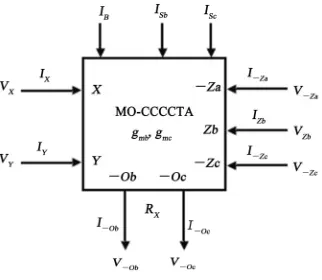
gmc are trans-conductance of CCCCTA. The schematic symbol of MO-CCCCTA is illustrated in Figure 1.
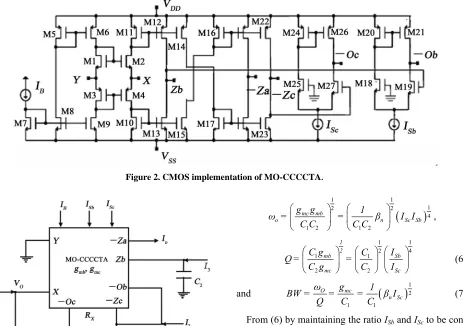
CMOS implementation of MO-CCCCTA is shown in
Figure 2. For a CMOS CCCCTA [29], the RX, gmb and gmc can be expressed to be
8 X
n B
1 R =
β I , g =mb βn SbI andg =mc βn ScI (2)
where
n n OX W C
L
(3)
where μn, COX and W/L are the electron mobility, gate oxide capacitance per unit area and transistor aspect ratio, respectively. IB, ISb and ISc are the biasing currents of MO-CCCCTA.
The proposed biquad filter circuit as shown in Figure 3 uses only single MO-CCCCTA and two grounded
ca-pacitors. By routine analysis of the circuit in Figure 3,
the output current IO and output voltage VO can be ob-tained as
2
1 1 2 2 2 3
2
1 2 2
mc mb mc O
mc mb mc I s C C I sC g I g g I
s C C sC g g g
(4)
2
1 1 2 2 2 3
2
1 2 2
x mc mb mc
O
mc mb mc
R I s C C I sC g I g g V
s C C sC g g g
(5)
[image:2.595.311.541.84.190.2]From Equations (4) and (5), various filter responses in current form as well as in trans-impedance form can be
[image:2.595.343.504.566.706.2]Figure 2. CMOS implementation of MO-CCCCTA.
Figure 3. proposed current/trans-impedance-mode universal filter.
obtained through appropriate selection of input currents. 1) High pass response in current form as well as in trans-impedance form, with I1= Iin, I2=I3= 0.
2) Low pass response in current form as well as in trans-impedance form, with I1=I2= 0, I3= Iin..
3) Inverted band pass response in current form as well as in trans-impedance form, with I1=I3= 0, I2= Iin..
4) Notch response in current form as well as in trans-impedance form, with I1=I3= Iin, I2= 0.
5) All pass response in current form as well as in trans-impedance form, with I1=I2=I3= Iin.
Thus, the circuit is capable of realizing all the standard filter responses in current as well as in trans-impedance- mode from the same configuration, without any matching constraints. Moreover, there is no requirement of invert-ing-type input current signal(s) and double input current signal(s) to realize all the responses in the design.
The filter parameters pole frequency (ωo), the quality factor (Q) and bandwidth (BW) ωo/Q can be expressed as
1 2 1 2 mc mb o g g ω = C C
1 1 2 4 1 2n Sc Sb 1
= β I I
C C , 1 2 1 2 mb mc C g Q = C g 1 1 4 2 1 2 Sb Sc I C = C I
(6)
and
1 O mc
ω g
BW = =
Q C
1 2 1
n Sc 1 = β I
C (7)
From (6) by maintaining the ratio ISb and ISc to be con-stant, it can be remarked that the pole frequency can be adjusted by ISb and ISc without affecting the quality factor. In addition, pole frequency can be controlled by ISb
without affecting bandwidth (BW) of the system. To see the effects of non idealities, the defining equations of the MO-CCCCTA can be rewritten as the following.
X Y X X
V =βV + I R , I-Za=αa XI , I =Zb αb XI (8)
Zc c X
I =α I , IOb=γb mb Zbg V , IOc=γcg Vmc -Zc (9)
where β, αa, αb, αc ,γb and γc are transferred error values deviated from one. In the case of non-ideal and re-analy- zing the proposed filter in Figure 3, it yields the current
output and voltage output as
2
1 2 2 3
2
1 2 2
( )
a 1 2 c mc b c mb mc
O
c c mc b c b mb mc α I s C C I sγC g + I γ γ g g I =
s C C + sγ αC g +γ γ α g g
(10)
2
1 1 2 2 2 3
2
1 2 2
a X c mc b c mb mc
O
c c mc b c b mb mc
α R I s C C I sγC g + I γ γg g V =
s C C + sγ αC g +γ γ α g g
(11)
In this case, the ωo and Q are changed to
1 2
1 2 b c b mb mc o
γ γ α g g
ω = C C , 1 2 1 2 b b mb
c c mc
γ αC g 1
Q =
α γC g
(12)
[image:3.595.314.539.585.704.2]1 2
1 2 o
ω
C ,C
S = , 1
2 o
b c b mb mc
ω
γ,γ,α,g ,g
S = , o 0
a c X
ω α ,α,β,R
S = (13)
2
1 2 mc c
Q C ,g ,γ
S = , 1 1
2 b b mb
Q C ,α,γ,g
S = , 1Qc
α
S = Qa X 0
α ,β,R
S =
(14) From the above results, it can be observed that all the active and passive sensitivities are equal or less than 1 in magnitude.
3. Simulation Results
The PSPICE simulations are carried out to demonstrate the feasibility of the proposed circuit using CMOS im-plementation as shown in Figure 2. The simulations use
a 0.35 µm MOSFET [30] from TSMC. The dimensions of PMOS are determined as W = 3 µm and L = 2 µm. In NMOS transistors, the dimensions are W = 3 µm and L
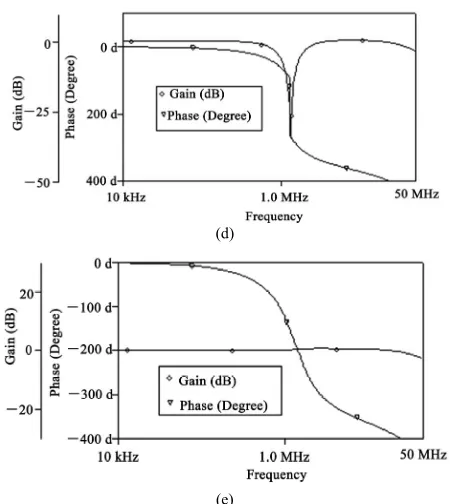
= 4 µm. The circuit is designed for Q = 1 and fo = ωo / 2π = 1.57 MHz. The active and passive components are chosen as IB = 7.5 µA, ISb = ISc = 30.65 µA and C1 = C2 = 7.5 pF. Figure 4 Shows the simulated gain and phase
responses of the HP, LP, BP, Notch and AP in the current
(a)
(b)
(c)
(d)
[image:4.595.54.289.61.150.2](e)
Figure 4. Current gain and Phase responses of the proposed filter (a) HP, (b) LP, (c) BP, (d) Notch and (e) AP.
form, of the proposed circuit in Figure 3. The supply
voltages are VDD = –VSS = 2.5 V. The simulated pole fre-quency is obtained as 1.35 MHz. It is noted that simula-tion results agree quite well with theoretical ones as ex-pected, whereas the difference between them arises from non-idealities such as non ideal gain and parasitic elements. The power dissipations of the proposed circuit for the design values is found as 0.629 mW that is a low value.
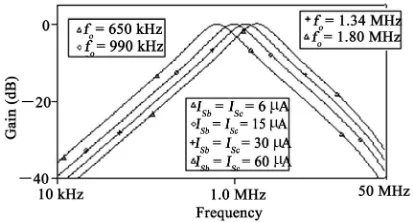
Next, the frequency tuning aspect of the circuit is veri-fied for a constant Q (= 1) value for the BP response in current-mode. The bias currents ISb and ISc are varied si-multaneously, by keeping its ratio to be constant. The pole frequency variation, for Q = 1, is shown in Figure 5.
The frequency is found to vary as 650 kHz, 990 kHz, 1.34 MHz and 1.8 MHz for four values of ISb = ISc = 6 µA, 15 µA, 30 µA and 60 µA, respectively. Further simula-tions are carried out to verify the total harmonic distor-tion (THD). The circuit is simulated for THD analysis at BP output in current-mode, by applying sinusoidal input current of varying amplitude and constant frequency. The THD values for the input current signal having am-plitude less than 40 µA, at frequency 1.35 MHz remain in acceptable limits i.e. 4%. The time domain response of band-pass output in current form is shown in Figure 6. It
[image:4.595.311.536.76.328.2] [image:4.595.64.283.370.718.2]Figure 5. Band pass responses in current-mode for different values of ISb = ISc of the proposed filter.
Figure 6. The sinusoidal input having frequency of 1.35 MHz and corresponding band pass output waveforms in cur-rent-mode of the proposed filter.
4.
Conclusions
This paper presents an electronically tunable current/ trans-impedance-mode biquad universal filter using single MO-CCCCTA. The proposed filter offers the following advantages: 1) realization of LP, HP, BP, Notch and AP responses in current form as well as in trans-impedance form without changing the circuit topology; 2) both the capacitors being permanently grounded; 3) low sensitivity figures, low THD and low power consumptions; 4) inde-pendent current control of ωo without disturbing ωo/Q; 5) no requirement of components matching conditions to get all filter responses; 6) no requirements of invert-ing-type input current signal(s) and double input current signal(s) to realize the response(s) in the design; 7) single active element.
5. References
[1] S. Minaei and S. Türköz, “New Current-Mode Cur-rent-Controlled Universal Filter with Single Input and Three Outputs,” International Journal of Electronics, Vol. 88, No. 3, 2001, pp. 333-337.doi:10.1080/00207210010 013201
[2] T. Katoh, T. Tsukutani, Y. Sumi and Y. Fukui, “Elec-tronically Tunable Current-Mode Universal Filter Em-ploying CCCIIs and Grounded Capacitors,” International
Symposium on Intelligent Signal Processing and Com-munications, 2006, pp. 107-110.
[3] S. Minaei and S. Türköz, “Current-Mode Electronically Tunable Universal Filter Using Only Plus-Type Current Controlled Conveyors and Grounded Capacitors,” Elec-tronics and Telecommunication Research Institute Jour-nal, Vol. 26, No. 4, 2004, pp. 292-296.doi:10.4218/etri j.04.0103.0146
[4] I. A. Khan and M. H. Zaidi, “Multifunction Translinear-C Current Mode Filter,” International Journal of Electron-ics, Vol. 87, No. 6, 2000, pp. 1047-1051. doi:10.1080/002 072100412984
[5] M. Soliman, “Current Mode Universal Filters Using Cur-rent Conveyors,” Circuits Systems and Signal Processing, Vol. 27, No. 3, 2008, pp. 405-427. doi:10.1007/s0003 4-008-9034-y
[6] T. Tsukutani, Y. Sumi, S. Iwanari and Y. Fukui, “Novel Current-Mode Biquad Using MO-CCCIIs and Grounded Capacitors,” Proceedings of 2005 International Sympo-sium on Intelligent Signal Processing and Communica-tion Systems, 13-16 December 2005, pp. 433-436. [7] D. R. Bhaskar, A. K. Singh, A. K. Sharma and R. Senani,
“New OTA-C Universal Current-Mode/Trans-Admi- ttance Biquads,” Institute of Electronics, Information and Communication Engineering Electronics Express, Vol. 2, No. 1, 2005, pp. 8-13. doi:10.1587/elex.2.8
[8] J. Wu and E. I. El-Masry, “Universal Voltage and Cur-rent-Mode OTAs Based Biquads,” International Journal of Electronics, Vol. 85, No. 5, 1998, pp. 553-560.doi: 10.1080/002072198134355
[9] C. M. Chang and M. J. Lee, “Voltage-Mode Multifunc-tion Filter with Single Input and Three Outputs Using Two Compound Current Conveyors,” IEEE Transactions on Circuits and Systems- I: Fundamental Theory and Ap-plications, Vol. 46, No. 11, 1999, pp. 1364-1365. doi:10. 1109/81.802827
[10] S. Maheshwari, “Analogue Signal Processing Applica-tions Using a New Circuit Topology,” IET Circuits, De-vices and Systems, Vol. 3, No. 3, 2009, pp. 106-115.doi: 10.1049/iet-cds.2008.0294
[11] T. Praveen, M. T. Ahmed and I. A. Khan, “A Canonical Voltage-Mode Universal CCCII-C Filter,” Journal of Ac-tive and Passive Devices, Vol. 4, No. 1-2, 2009, pp. 7-12. [12] S. Maheshwari, “High Performance Voltage-Mode Mul-tifunction Filter with Minimum Component Count,”
WSEAS Transactions on Electronics, Vol. 5, No. 6, 2008, pp. 244-249.
[13] M. T. Abuelma’atti and N. A. Tassaduq, “A Novel Three Inputs and One Output Universal Current-Mode Filter Using Plus-Type CCIIs,” Microelectronics Journal, Vol. 30, No. 3, 1999, pp. 287-292. doi:10.1016/S0026-2692 (98)00169-4
[14] R. Senani, “New Universal Current Mode Biquad Em-ploying All Grounded Passive Components but Only Two DOCCs,” Journal of Active and Passive Devices, Vol. 1, No. 3-4, 2006, pp. 281-288.
Current-Contolled Current-Mode Filter with Three Inputs and One Output Using Current Controlled Conveyor,”
Active Passive Electronics Components, Vol. 21, No. 1, 1998, pp. 33-41.doi:10.1155/1998/83413
[16] W. Tangsriart and W. Surakampontorm, “Electronically Tunable Current-Mode Universal Filter Employing Only Plus-Type Current-Controlled Conveyors and Grounded Capacitors,” Circuits Systems and Signal Processing, Vol. 25, No. 6, 2006, pp. 701-713.doi:10.1007/s00034-005-0 908-y
[17] W. Tangsrirat and W. Surakampontorm, “Low-Component Current-Mode Universal Filter Using Current-Controlled Conveyors and Grounded Capacitors,” Journal of Active and Passive Devices, Vol. 4, No. 3, 2009, pp. 259-264. [18] C. M. Chang, “Universal Active Current Filter Using
Single Second-Generation Current Controlled Conveyor,”
International Journal of Circuits, Systems and Signal Processing, Vol. 1, No. 1, 2007, pp. 194-198.
[19] M. Siripruchyanun and W. Jaikla, “Current Controlled Current Conveyor Transconductance Amplifier (CCCCTA): A Building Block for Analog Signal Processing,” Elec-trical Engineering, Vol. 90, No. 6, 2008, pp. 443-453. doi:10.1007/s00202-007-0095-x
[20] M. Siripruchyanun and W. Jaikla, “Electronically Con-trollable Current-Mode Universal Biquad Filter Using Single DO-CCCDTA,” Circuits System Signal Processing, Vol. 27, No. 1, 2008, pp. 113-122. doi:10.1007/s00034-0 08-9014-2
[21] W. Tangsriart, “Current-Tunable Current-Mode Multi-function Filter Based on Dual-Output Current-Controlled Conveyors,” International Journal of Electronics and Communications, Vol. 61, No. 8, 2007, pp. 528-533. doi:10.1016/j.aeue.2006.09.005
[22] T. Tsukutani, Y. Sumi and N. Yabuki, “Versatile Current Mode Biquadratic Circuit Using Only Plus Type CCCIIs and Grounded Capacitors,” International Journal of Electronics, Vol. 94, No. 12, 2007, pp.1147-1156.doi:10. 1080/00207210701789998
[23] Y. Wang and R. Raut, “A Design of Transresistance Am-plifier for High Gain-Bandwidth Applications,” Pro-ceedings of the 2003 10th IEEE International Conference on Electronics, Circuits and Systems, 14-17 December 2003, pp. 185-188.
[24] A. Carlosena and E. Cabral, “Novel Transimpedance Filter Topology for Instrumentation,” IEEE Transactions on Instrumentation and Measurement, Vol. 46, No. 4, 1997, pp. 862-867. doi:10.1109/19.650789
[25] M. Soliman, “Mixed-Mode Biquad Circuits,” Microelec-tronics Journal, Vol. 27, No. 6, 1996, pp. 591-594.doi:10. 1016/0026-2692(95)00121-2
[26] J. Ramirez-Angulo, M. Robinson and E. Sanchez-Sinencio, “Current-Mode Continuous-Time Filters: Two Design Approaches,” IEEE Transactions on Circuits and Sys-tems-II: Analog and Digital Signal Processing, Vol. 39, No. 6, 1992, pp. 337-341.doi:10.1109/82.145290 [27] S. Minaei, G. Topcu and O. Cicekoglu, “Low Input
Im-pedance Trans-ImIm-pedance Type Multifunction Filter Us-ing Only Active Elements,” International Journal of Electronics, Vol. 92, No. 7, 2005, pp. 385-392.doi:10. 1080/00207210412331334789
[28] A. Fabre, O. Saiid and H. Barthelemy, “On the Frequency Limitations of the Circuits Based on Second Generation Current Conveyors,” Analog Integrated Circuits and Signal Processing, Vol. 7, No. 2, 1995, pp. 113-129.doi:1 0.1007/BF01239166
[29] M. Siripruchyanun, P. Silapan and W. Jaikla, “Realiza-tion of CMOS Current Controlled Current Conveyor Transconductance Amplifier and Its Application,” Jour-nal of Active and Passive Devices, Vol. 4, No. 1-2, 2009, pp. 35-53.